Download the Complete Report Here
 Rain Enhancement Technologies Holdco, Inc. (RAIN)
WETA Validation and Early Commercialization Shape RAIN’s Emerging Precipitation-Enhancement Opportunity
- RAIN’s WETA platform positions the early-stage atmospheric water technology company as a potentially disruptive provider of scalable, incremental water solutions. WETA uses atmospheric enhancement by ionization (AEI) within a fixed-site, remotely operated system designed to enhance naturally occurring rainfall and snow when suitable atmospheric conditions are present. Its solar-powered architecture eliminates aircraft and does not use conventional seeding agents, supports operations across rain and snow conditions and can cover a broad target area. Rising water stress, less dependable snowpack and growing agricultural and infrastructure demand are increasing the need for supplementary water solutions. WETA’s flexible commercial structures and ability to serve multiple customers from one installation could reduce adoption friction and support attractive site economics.
- Integrated evidence platform and expanding field record provide the foundation for WETA’s emerging defensibility. RAIN combines ionization hardware with meteorology, site selection, remote monitoring, plume modeling and statistical analysis. The multiyear Oman trial provides third-party precedent, while La Sal delivered company-reported snow-water-equivalent enhancement of >20% during the 2025-26 winter and was externally reviewed. Continued deployments can deepen RAIN’s operating knowledge, proprietary dataset and customer credibility, strengthening an execution-led moat that extends beyond the physical equipment.
- Upcoming milestones could move RAIN from field validation toward paid deployments and broader commercial adoption. The proposed Upper Yampa paid pilot remains subject to approval and funding, while the Turkey arrangement requires an initial order. Additional La Sal and Weld County results, publication of technical studies and FREA (Fog Removal by Electrical Activity) testing with CHP (California Highway Patrol) and Caltrans could broaden the evidence base, expand customer engagement and establish new commercial reference projects.
- Leadership and shareholder support underpin WETA commercialization, while the proposed Tensor combination could add a second technology growth platform. CEO Randy Seidl brings enterprise-technology commercialization experience, while Chairman Harry You contributes strategic and capital-markets expertise and financial support. The proposed combination would add Tensor as a separately managed subsidiary alongside RET. Existing RAIN shareholders would own ~10% before dilution from the PIPE financing and any debt conversion, with Eric Frazier becoming CEO and Randy Seidl becoming President, both reporting to the board. Closing is targeted for 1Q27, subject to definitive terms, approvals, debt restructuring and $25 million of financing.
- Commercial conversion provides the central pathway to a higher valuation. Revenue from RAIN’s core precipitation-enhancement operations had not commenced through 1H26, leaving its valuation primarily driven by technical and commercial milestones. Paid deployments, disclosed project economics, customer payments and repeat orders would begin establishing revenue visibility and the scalability of the one-to-many model. While we do not issue price targets or recommendations, we believe successful execution could narrow RAIN’s substantial valuation gap to established water-technology companies, while improving revenue visibility, cash generation and funding flexibility could provide additional support for re-rating.
Company Overview
RAIN – Advancing WETA from U.S. Field Validation Toward Commercialization
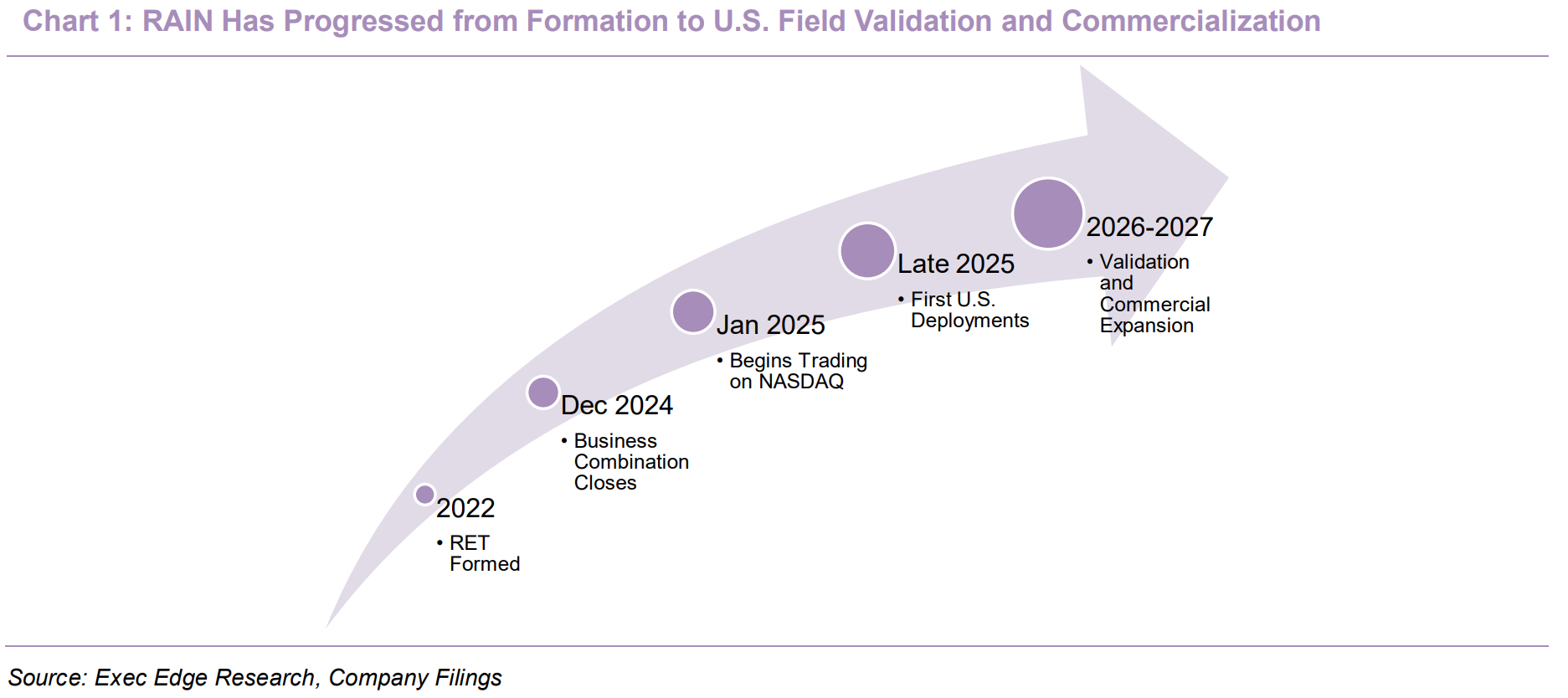
- Rain Enhancement Technologies Holdco, Inc. (NASDAQ: RAIN) is an early-stage atmospheric water technology company developing systems intended to enhance naturally occurring rain and snowfall. Its operating subsidiary, Rain Enhancement Technologies, Inc. (RET), was incorporated in 2022 and became a Massachusetts corporation in 2024. The current public parent was formed through the business combination with Coliseum Acquisition Corp., which closed on December 31, 2024; RAIN common stock and warrants began trading on Nasdaq on January 2, 2025. The company’s core objective is to develop, manufacture, commercialize and operate atmospheric enhancement by ionization (AEI) technology through its proprietary Weather Enhancement Technology Array (WETA) platform. WETA combines ionization hardware with meteorology, software, remote controls, weather instrumentation and field operations, with the aim of improving both precipitation outcomes and the ability to measure them. RAIN moved from corporate formation and system development into U.S. field operations during 2025, establishing its initial U.S. installations in Utah and Colorado during late 2025. It subsequently completed a full winter operating season in Utah, operated a permitted installation in Colorado, expanded its finished-system inventory and began pursuing paid public-sector and international deployments. These milestones position RAIN for the next phase of its development, centered on converting field validation into paid deployments and establishing a repeatable commercial model. As of 2Q26, revenue from the company’s core AEI activities had yet to commence, making commercial conversion its central near-term priority.
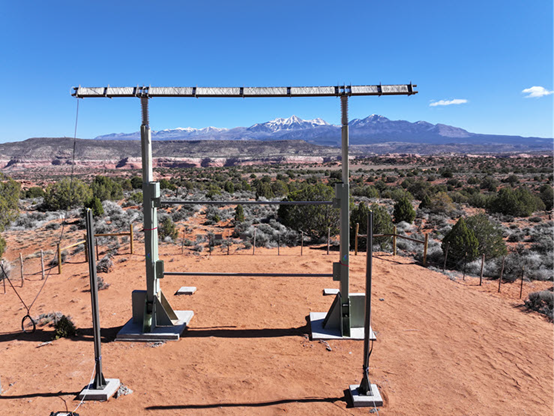
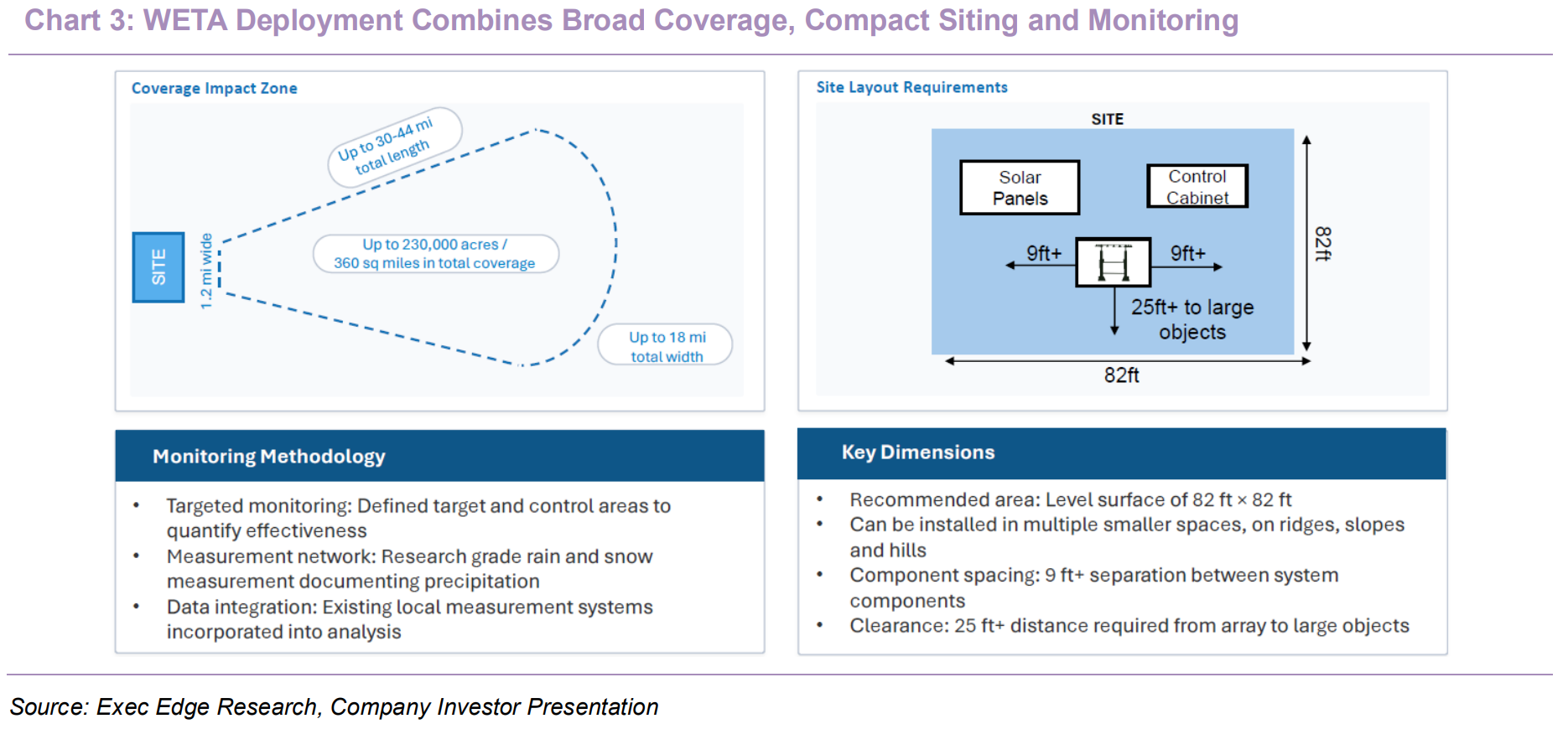
- WETA is RAIN’s ground-based ionization system designed to enhance naturally occurring precipitation when suitable moisture, clouds and atmospheric transport are present. The unit releases a controlled stream of negatively charged ions, which attach to airborne aerosols and are carried upward by naturally occurring updrafts. Within a cloud layer, the charged particles are intended to support the condensation and coalescence processes through which water droplets or ice crystals grow large enough to fall as rain or snow. WETA therefore works with existing atmospheric moisture to increase the amount of precipitation reaching the ground. A standard array is approximately 39 feet wide and 26 feet high when operating, uses a high-voltage direct-current ionization source and typically consumes less than 500 watts. It is powered by an off-grid solar and battery system, can be switched on or off remotely and does not require aircraft, silver iodide or other chemical seeding agents. Depending on topography and atmospheric conditions, designed coverage can reach approximately 230,400 acres, or 360 square miles. Each deployment is paired with research-grade rain or snow gauges to provide target and control analysis and, where available, radar. This measurement architecture is central to RAIN’s commercial proposition because performance is established by comparing real on-the-ground measurements in the targeted enhancement area and the control area using proven statistic evaluation techniques and external peer review evaluation of results and methodologies to achieve them.
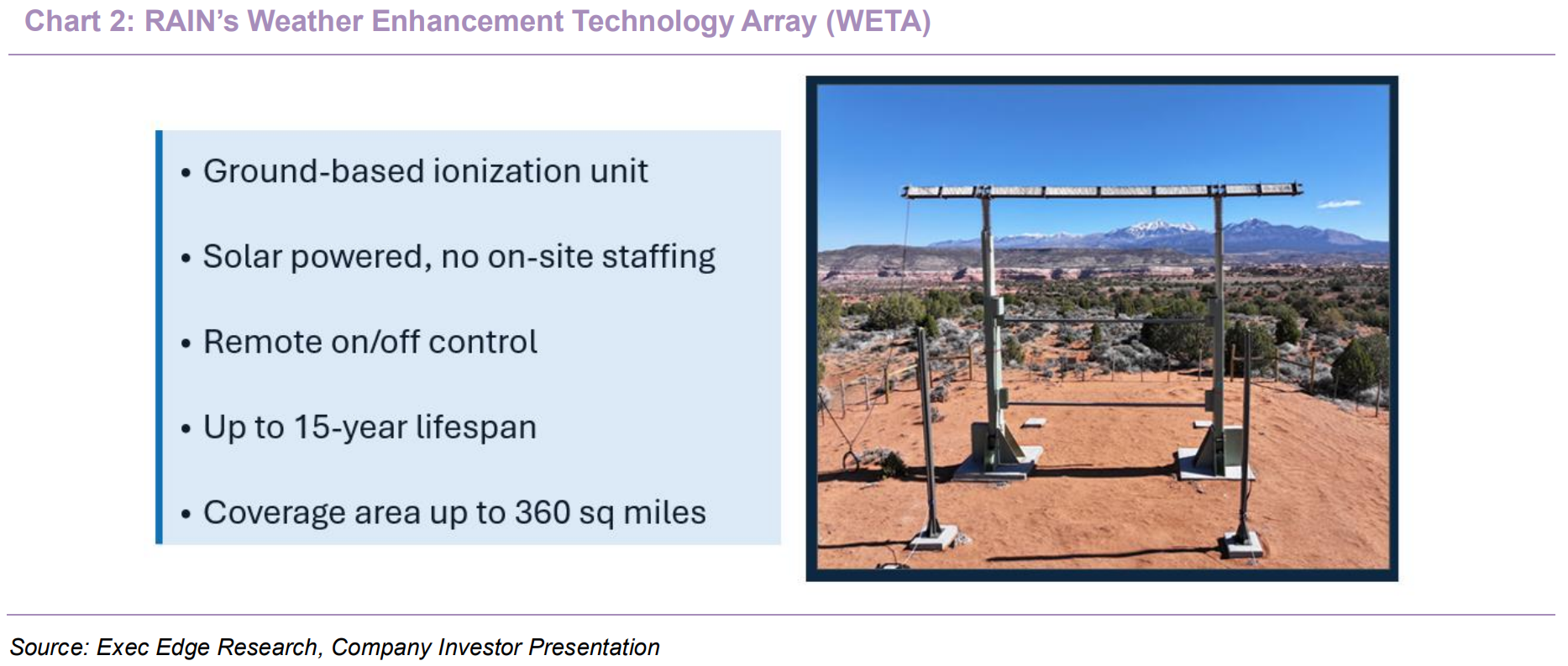
- WETA’s modular design enables rapid, capital-efficient deployment across remote and geographically diverse locations. Each unit is preassembled for fit and quality checks, then packaged in crates weighing less than 5,600 pounds in total. Installation can be completed manually, although skid-steer loaders and small excavators can accelerate the process. Once equipment is on site, installation can take less than a week. A (minimum) 3,600-watt solar array charges the operating batteries, allowing the system to function off grid, and remote telemetry supports autonomous operation with limited on-site staffing. The hardware is designed for a service life of up to 15 years, subject to maintenance and component servicing, and is depreciated over 10 years for accounting purposes. Each deployment is supported by detailed meteorological and site-selection work covering prevailing winds, updrafts, terrain, target coverage, access, instrumentation, land availability and local permitting. By November 2025, the company was operating at La Sal in Utah and in Weld County, Colorado, with the Colorado unit permitted and live since October 2025. Since the beginning of 2026, RAIN has also had ten completed units available for placement. This inventory can shorten the interval between customer commitment and deployment across research, pilot and commercial opportunities, subject to required approvals and site suitability.
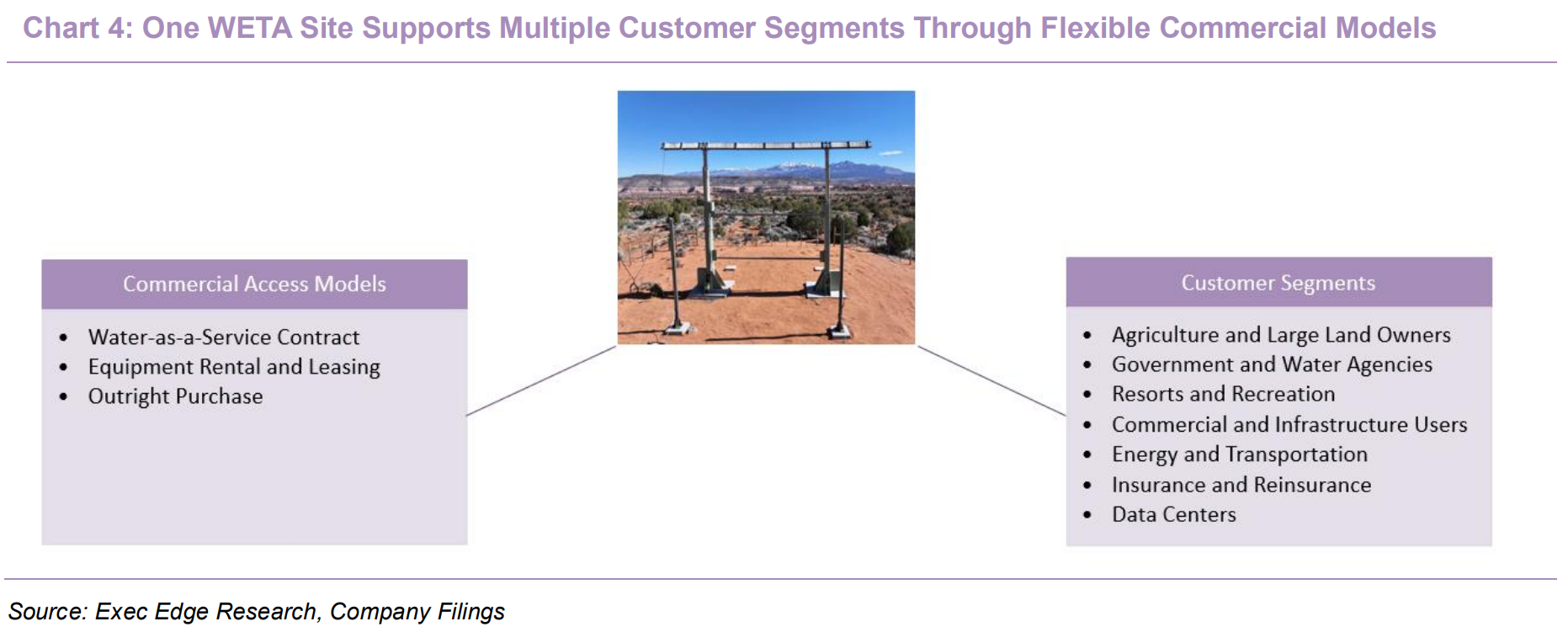
- RAIN’s proposed one-to-many commercial model is designed to generate recurring revenue from multiple users within a single WETA coverage area. Rather than treating each WETA as a conventional equipment sale serving one buyer, the company intends to install and operate systems in locations where the resulting precipitation could benefit several users within the same target geography. Under the proposed service model, RAIN would fund the initial manufacturing and installation, retain ownership and operational control, and contract with multiple customers benefiting from the same installation. This structure is intended to spread the fixed cost of a long-lived asset across a broader revenue base and increase site-level margins as additional users are added. The preferred contract structure comprises multi-year recurring service arrangements supported by a land-and-expand sales process. More recent commercial materials also offer purchase and lease-to-own alternatives, while the Turkey agreement contemplates a 60-month equipment lease with renewal and purchase options. For qualifying sites with adequate historical and forward measurement data, RAIN also offers a minimum 10% precipitation-enhancement guarantee, integrating site instrumentation and statistical evaluation into the commercial package. Target customers include water agencies and other government bodies, agricultural operators, ranches, wineries, resorts and golf courses, as well as energy, transportation, insurance, industrial and infrastructure users whose operations depend on water availability or visibility. Together, water-as-a-service contract, equipment rental and leasing, and purchase options allow RAIN to address different customer budgets and procurement preferences while retaining the potential for recurring revenue and expanding site-level economics.
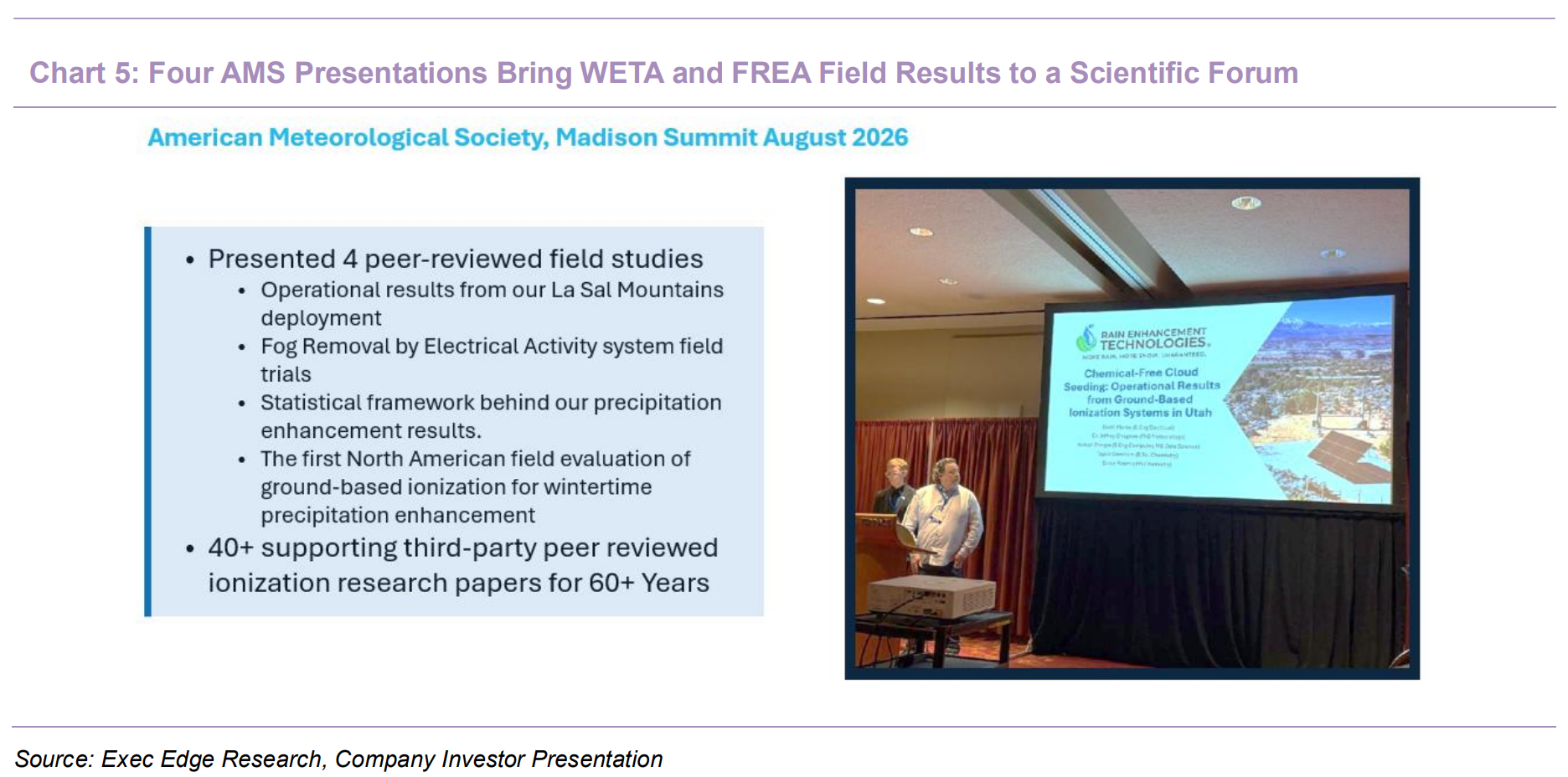
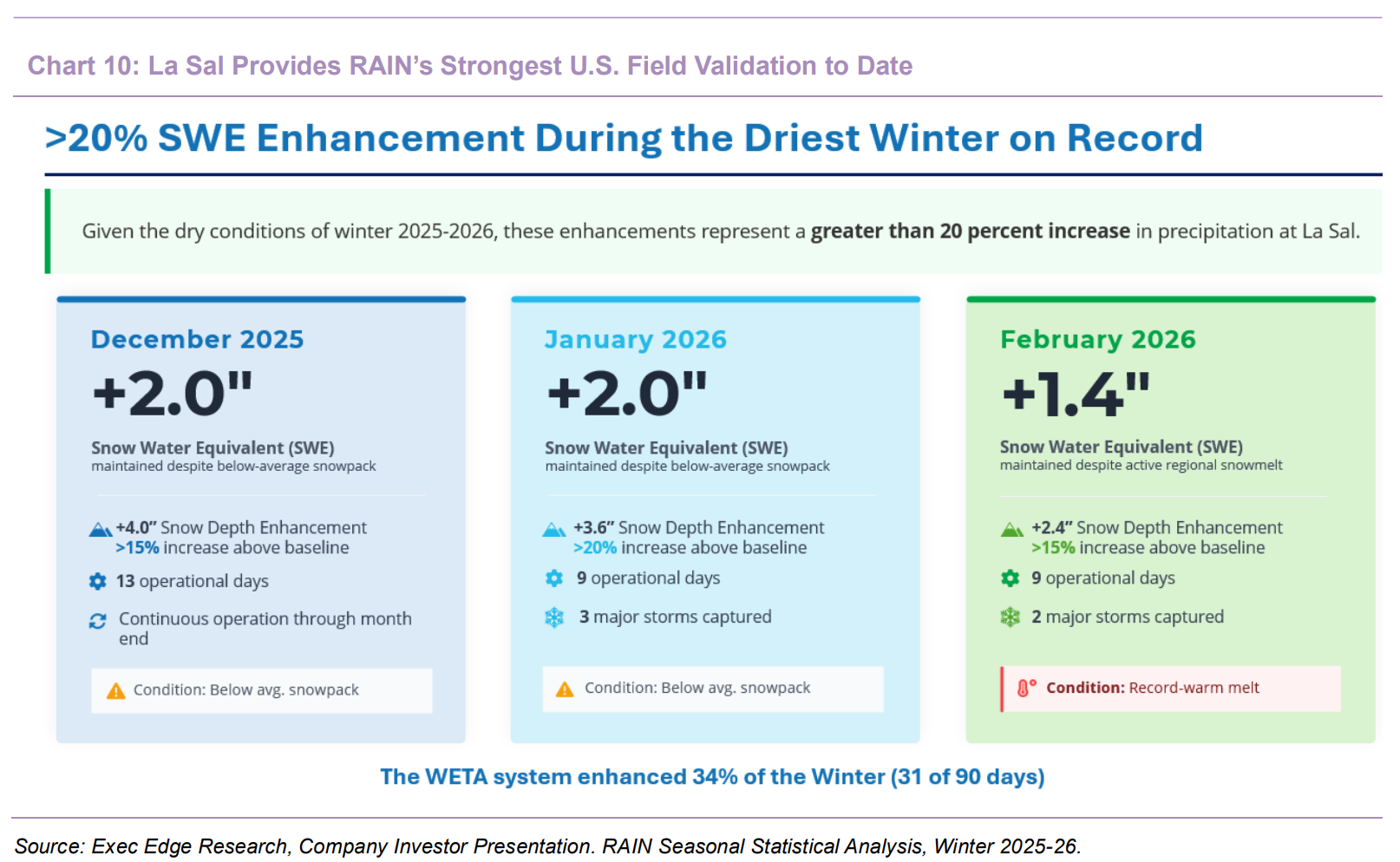
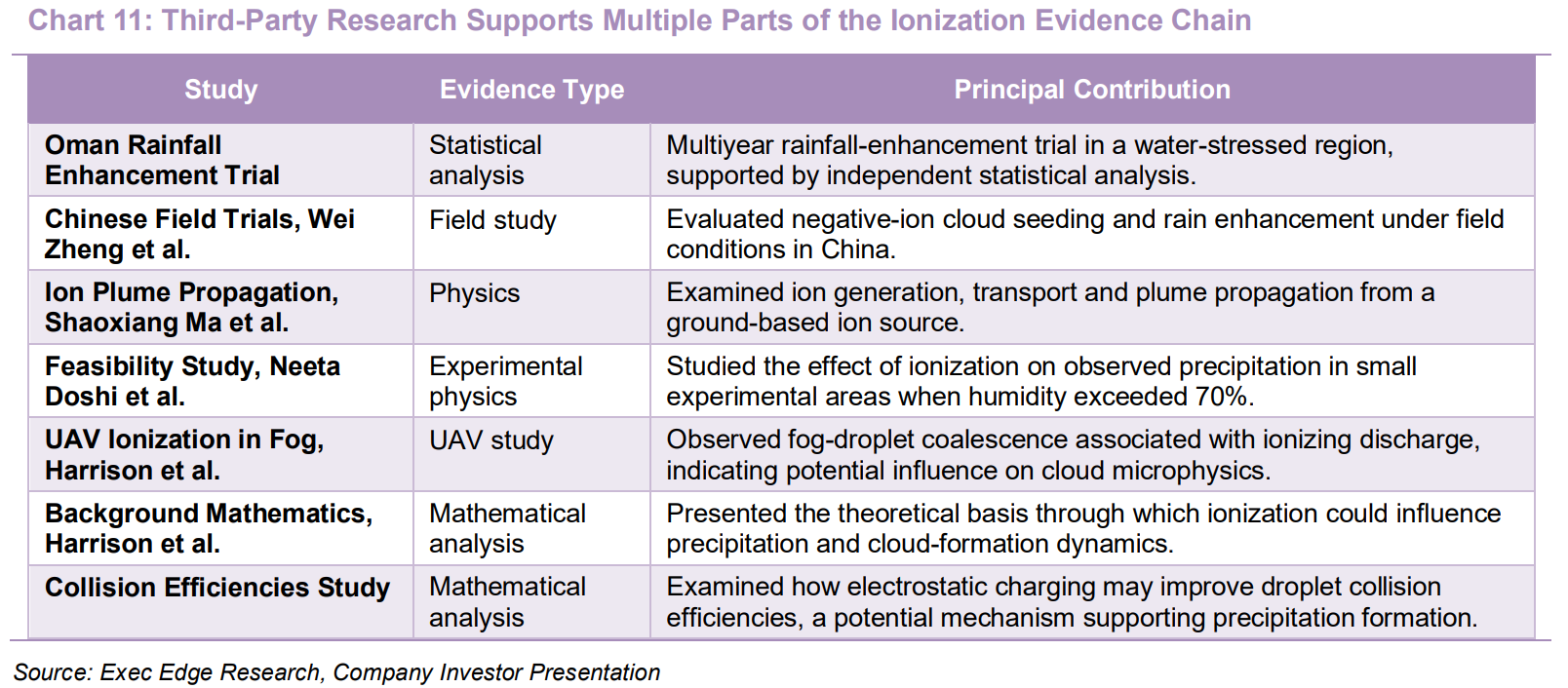
- The company’s evidence base combines multiyear international ionization research with the first full-season operating data from company-built WETA systems in the U.S. A randomized Oman trial conducted from 2013 to 2018 reported average rainfall enhancement of approximately15%. A 2022 International Statistical Review paper on the program found statistically significant rainfall enhancement and identified the results as an incentive for further research, while noting that the open-atmosphere ionization mechanism remained conjectural (International Statistical Review). RAIN’s most important current reference site is the La Sal Mountains installation in Utah, which operated from mid-November 2025 and remains operating. Its seasonal analysis for Winter indicated more than 20% enhancement in snow-water equivalent relative to paired control locations, equivalent to an estimated 8,750 acre-feet, or approximately 2.85 billion gallons, of incremental water. The seasonal analysis used three statistical methods and was externally reviewed by Dr. Binod Pokharel of Utah State University. La Sal represents RAIN’s first complete U.S. winter operating dataset and its strongest domestic field validation to date. Broader replication across sites, seasons and weather conditions would further establish the consistency of these results. RAIN continues data collection at La Sal and Weld County; preliminary 2026 Colorado indications were too early for final measurement. The technical team also presented four technical studies at the August 2026 AMS Madison Summit, covering La Sal operations, statistical evaluation and fog dispersal. Together, the Oman research, La Sal results and expanding U.S. validation program strengthen the evidence required to support WETA performance commitments and customer adoption.
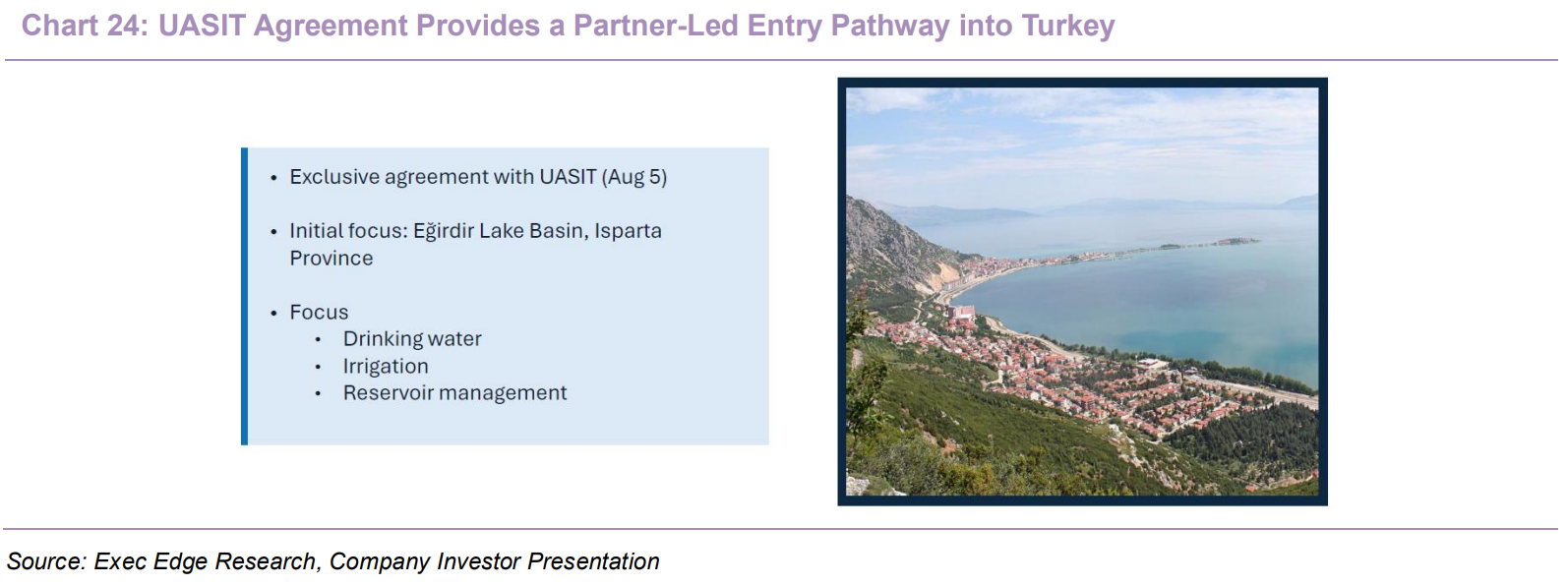
- RAIN is advancing paid U.S. water-agency deployments and partner-led international expansion as its first pathways toward commercial scale. In Colorado, the Colorado Water Conservation Board, Colorado River District and Upper Yampa Water Conservancy District publicly supported a pending state-funded pilot in the Flat Tops range, with installation targeted for October 2026. The proposed project would serve watersheds feeding the Yamcolo Reservoir; RAIN estimates that a roughly 120-square-mile coverage area could generate more than 10,000 additional acre-feet in an average year. Approval, funding and installation represent the next milestones toward establishing Upper Yampa as RAIN’s first paid water-district deployment. Internationally, RAIN signed an exclusive representation and equipment lease agreement with UASIT (Ulusal Atmosferik İyonizasyon Teknolojileri San ve Tic Anonim Şirketi) in August 2026. The arrangement targets WETA units, beginning with the Eğirdir Lake Basin in Turkey, subject to RAIN receiving an order by December 31, 2026 and obtaining relevant institutional approvals.
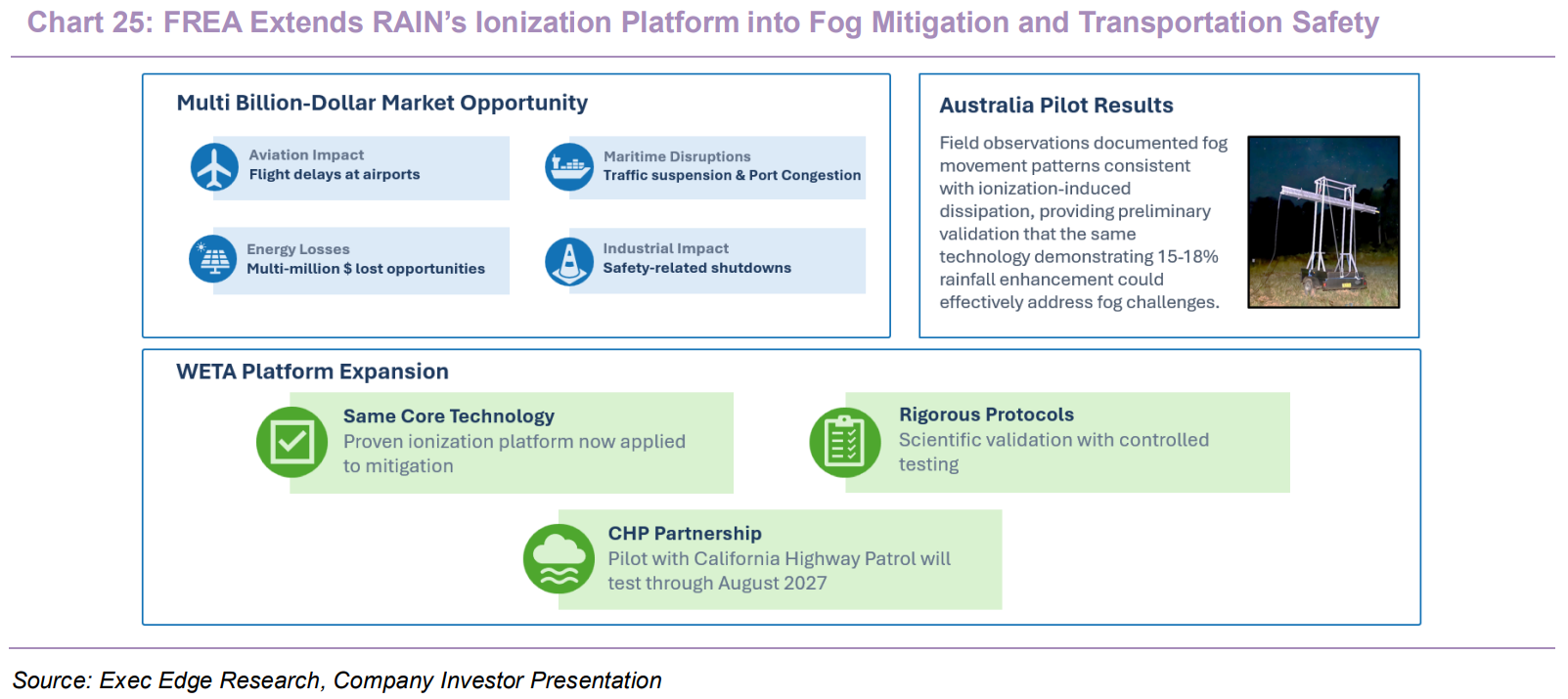
- FREA extends RAIN’s ionization platform into fog mitigation and transportation safety applications. Following an initial Australian field pilot in 2025, RAIN entered into a one-year agreement with the California Highway Patrol and Caltrans in September 2026 to test FREA at the Caltrans Dynamic Test Facility in West Sacramento through August 2027. The program provides access to a controlled, high-speed roadway testing environment to generate field data on fog-density reduction and visibility improvement, creating a potential pathway toward commercial adoption across transportation infrastructure. Studies are ongoing in Australia with initial results from those trials expected in December 2026, pending suitable weather to complete testing.
- The proposed Tensor combination would reposition RAIN as a multi-technology holding company with two distinct operating businesses: RET’s precipitation enhancement business and Tensor’s AI infrastructure-security business. In September 2026, RAIN entered into a binding all-stock letter of intent with Tensor Networks, a developer of patent-pending predictive AI infrastructure-security technology that has performed work under three U.S. Air Force contracts. Following the combination, RET and Tensor would operate as separately managed, wholly owned subsidiaries of RAIN, sharing corporate and administrative functions at the holding-company level. Tensor shareholders would own approximately 90% of the fully diluted combined company and existing RAIN shareholders approximately 10%, before financing dilution. Closing is targeted for 1Q27, subject to due diligence, a definitive agreement, shareholder and Nasdaq approvals, debt restructuring and at least $25 million of gross equity or equity-linked financing. Upon closing, Eric Frazier would become CEO of RAIN, and Randy Seidl would become President of RAIN.
- Tensor’s “Safe AI” approach includes its patent-pending Predictive Tensor Control Plane and Tensor Network Quantum Gravity frameworks, which are designed to isolate AI workloads behind independent hardware boundaries and limit data exfiltration or lateral movement. Management views RET and Tensor as addressing different parts of AI infrastructure, with RET focused on water availability and Tensor on infrastructure security and reliability.
Right-to-Win
Defensibility Centered on Integrated Technology, Evidence and Commercial Execution
- We believe RAIN’s emerging competitive advantage is built around WETA as an integrated operating and evidence platform combining ionization technology, scientific measurement, deployment experience and commercialization capabilities. The potential advantage extends beyond the physical hardware to site selection, meteorological assessment, remote operation, performance measurement, analytics, and accumulated operating knowledge. WETA’s operating attributes and conditional performance guarantee can reduce adoption friction, while permitted reference projects provide prospective customers with observable evidence under real operating and regulatory conditions. Each additional deployment can expand RAIN’s field dataset, deepen operating knowledge and strengthen customer relationships, creating an increasingly repeatable platform for site selection, performance validation and commercial expansion. At this stage, RAIN’s defensibility is primarily execution-led rather than patent-led, with the moat positioned to deepen as repeatable outcomes, proprietary know-how and recurring customer relationships accumulate.
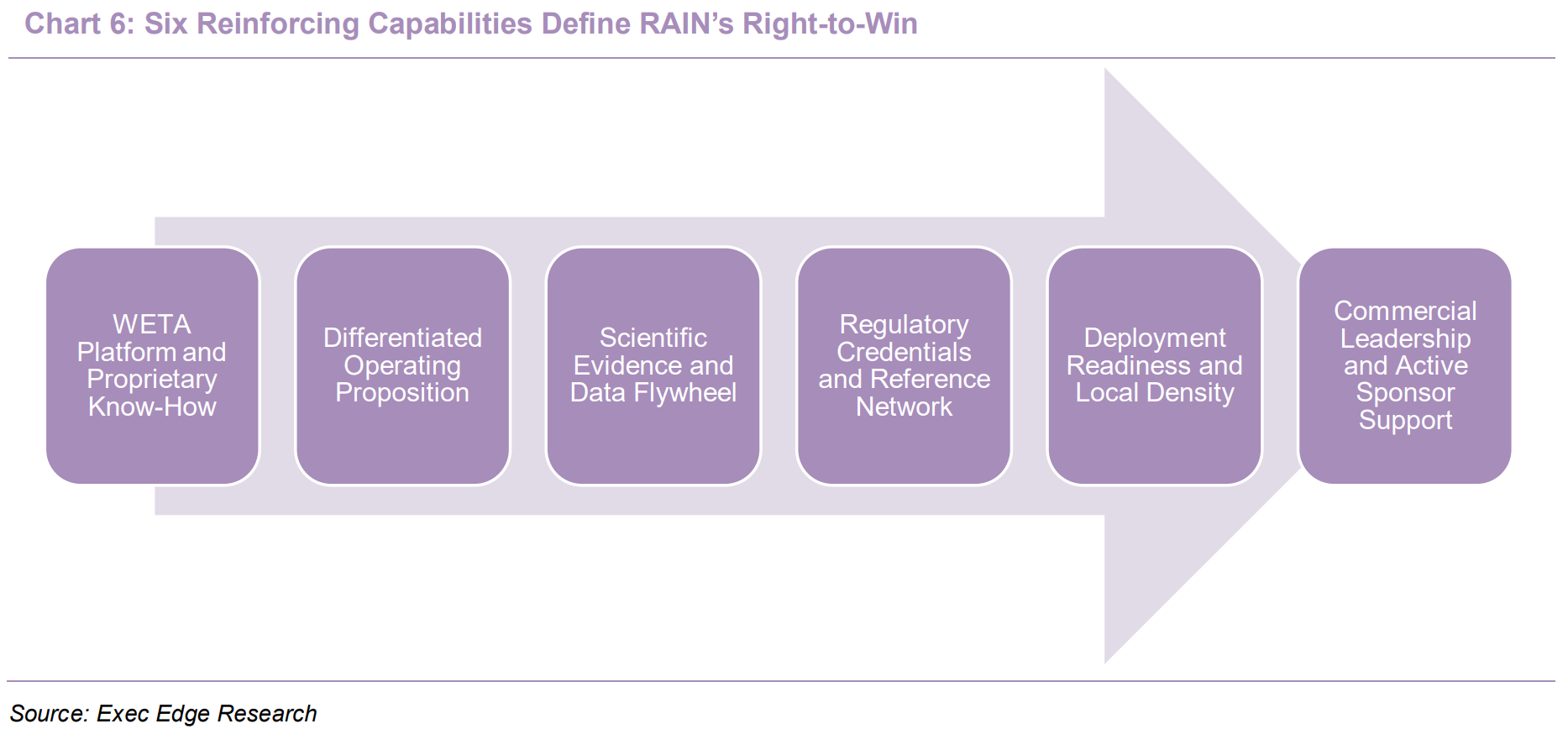
- WETA’s integrated architecture creates a broader technology advantage than ionization hardware alone. WETA brings together ionization hardware, meteorological assessment, site selection, weather instrumentation, remote controls and statistical analysis within one operating workflow. This matters because customers are not purchasing ion output alone; they are purchasing a measurable precipitation outcome under location-specific atmospheric conditions. The integrated workflow allows RAIN to connect system operation with measured outcomes, refine where and when WETA is deployed, and build a consistent framework for evaluating performance. We believe this advantage can strengthen as RAIN accumulates field data, proprietary operating know-how and capabilities in forecasting, radar integration and machine-learning controls.
- Accumulated field experience can deepen WETA’s proprietary know-how across site selection, operating parameters, system configuration, manufacturing and performance analysis. Much of this knowledge is developed through deployment and captured in operating processes rather than embodied in the visible hardware. RAIN has developed and assembled technologies for atmospheric enhancement by ionization (AEI) that underlie its offerings and are protected by exclusive licenses, copyright, trade secrets, know-how and contracts. It plans to continue to develop these and other technologies. We believe RAIN’s present moat rests primarily on system integration, engineered designs, and accumulated operating know-how. The company intends to expand this protection through patents, copyright and trade-secret protections together with contractual safeguards, including nondisclosure and invention-assignment agreements.
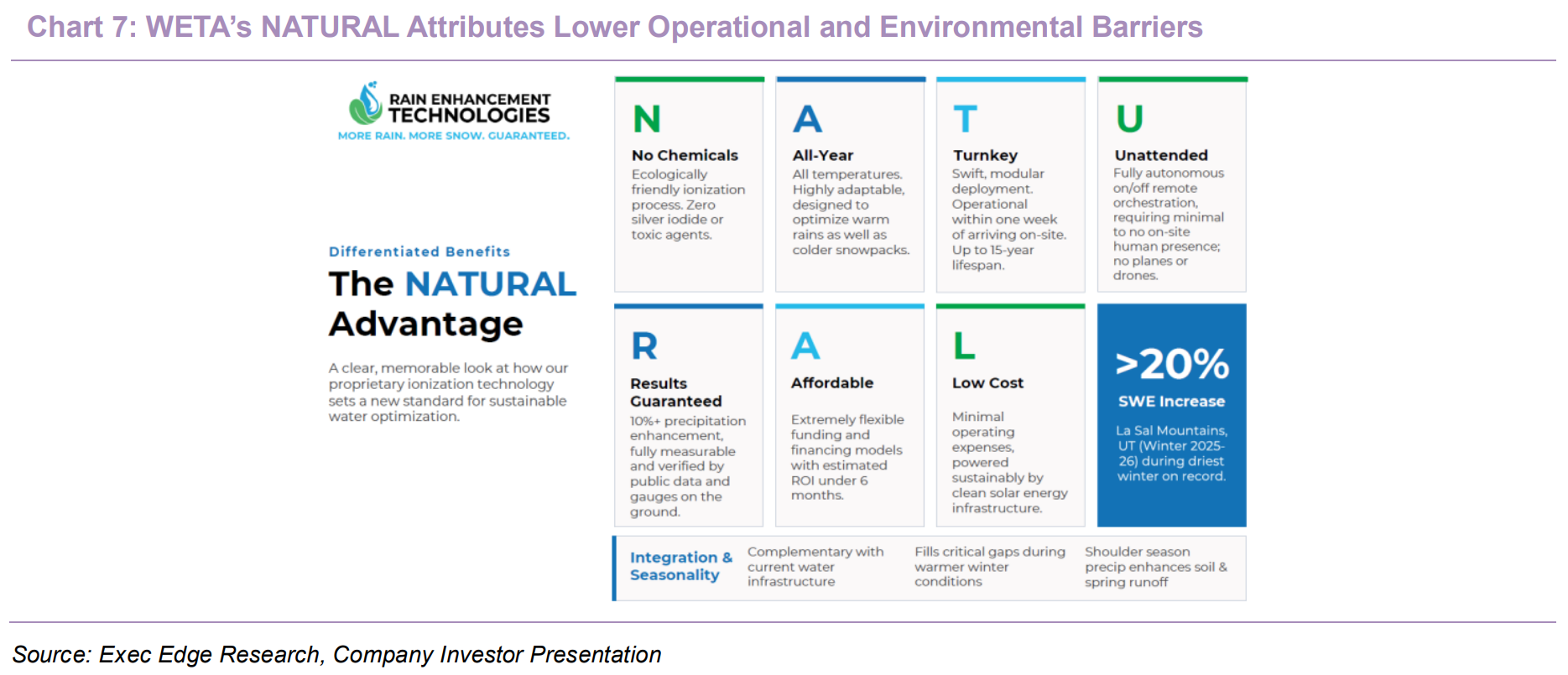
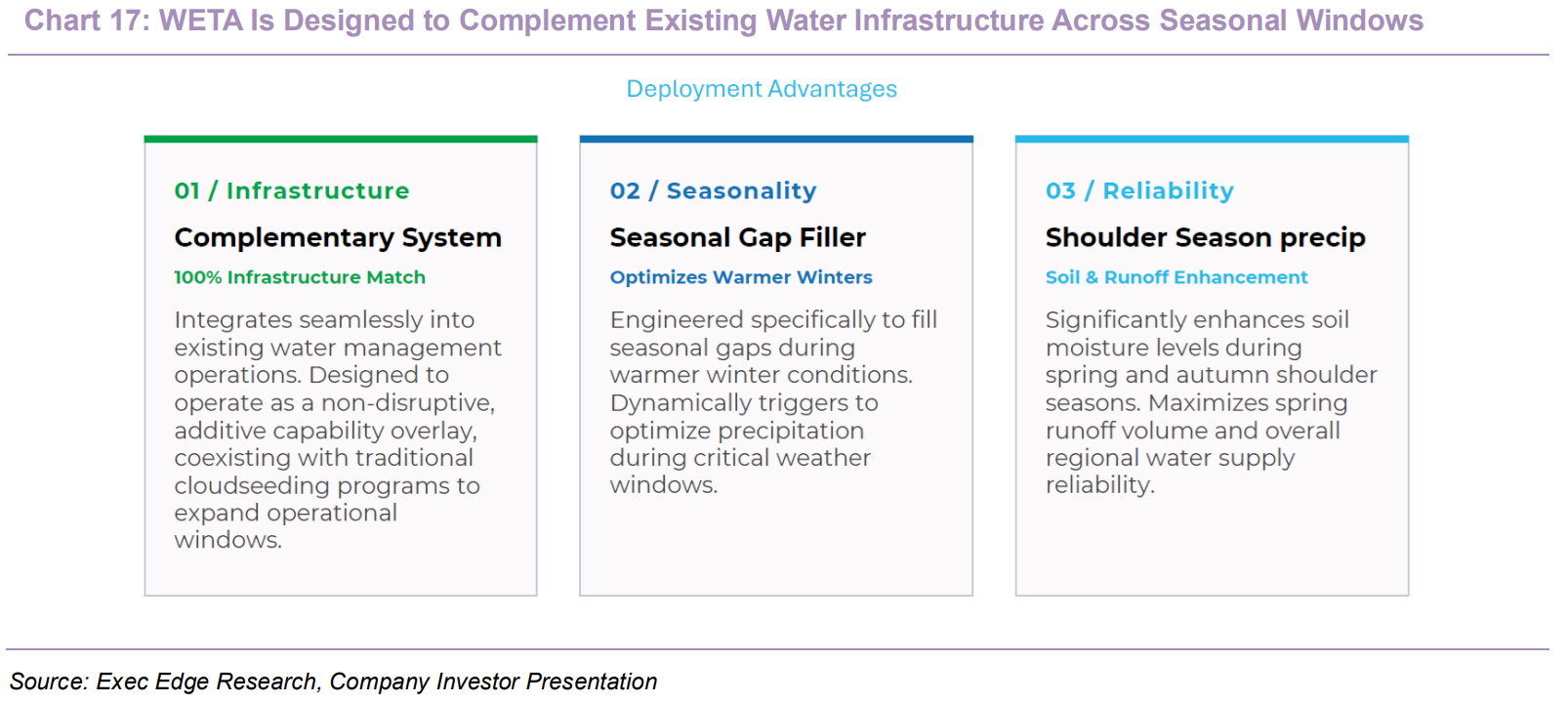
- WETA’s chemical-free, autonomous design is intended to support extended operating periods and may lower the practical barriers to adopting precipitation-enhancement technology. The system uses atmospheric ionization rather than silver iodide, is powered by off-grid solar infrastructure and can be controlled remotely without aircraft or routine onsite staffing. Its modular configuration supports deployment in remote locations, while operation across both warm-rain and cold-snow conditions may extend utilization beyond the narrower seasonal windows associated with some conventional programs. These characteristics can simplify procurement and deployment for public agencies and commercial customers by addressing environmental acceptability, operating logistics, staffing, site footprint and the ability to respond when suitable weather develops. Compared with airborne seeding, WETA also eliminates aircraft operations and recurring chemical-seeding inputs, supporting lower operating complexity and broader deployment flexibility.
-
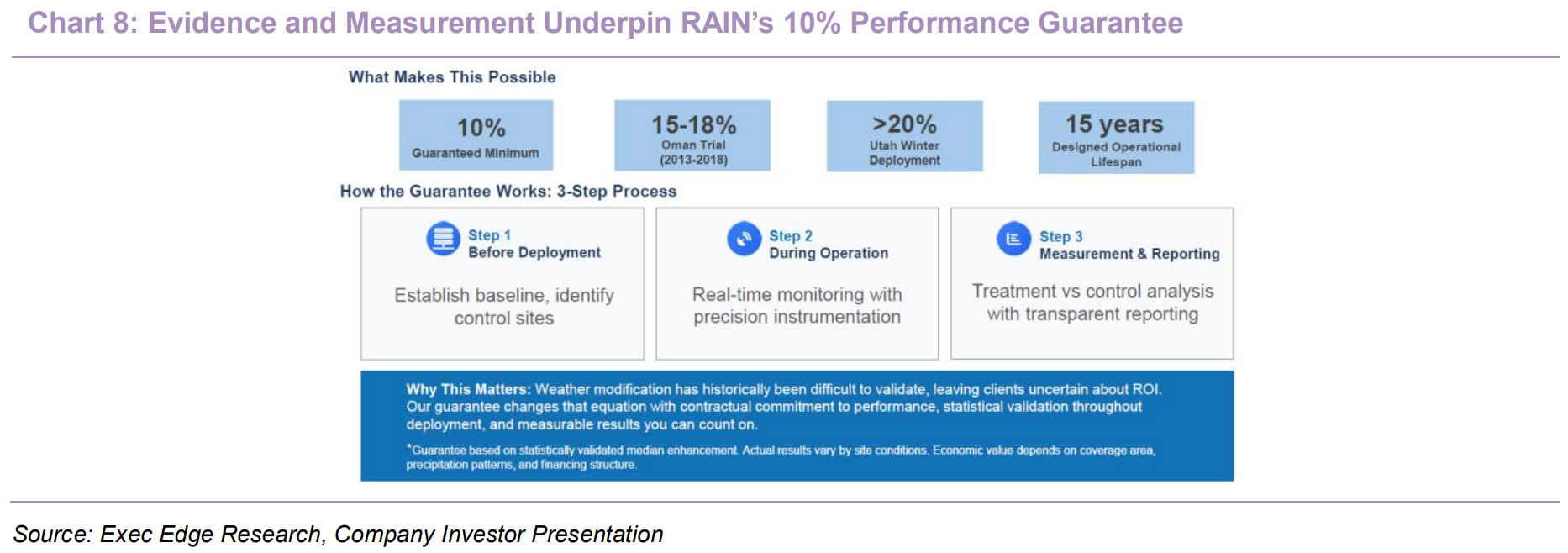
- RAIN’s industry-first and only minimum 10% precipitation-enhancement guarantee converts measurable performance into a contractual differentiator. Introduced in April 2026, the guarantee adds accountability to a weather-modification market in which natural variability has historically made performance difficult to attribute. Each qualifying deployment establishes historical baselines and control sites before installation, uses precision monitoring during operation, and compares treatment and control outcomes through statistical analysis and transparent reporting using real on the ground measurements. RAIN’s service, rental and leasing, and purchase structures complement the guarantee by allowing customers to align adoption with their budgets and procurement requirements. We believe the combination of contractual accountability, instrumented measurement and flexible contracting strengthens WETA’s commercial proposition and can reduce customer uncertainty around performance and return on investment.
-
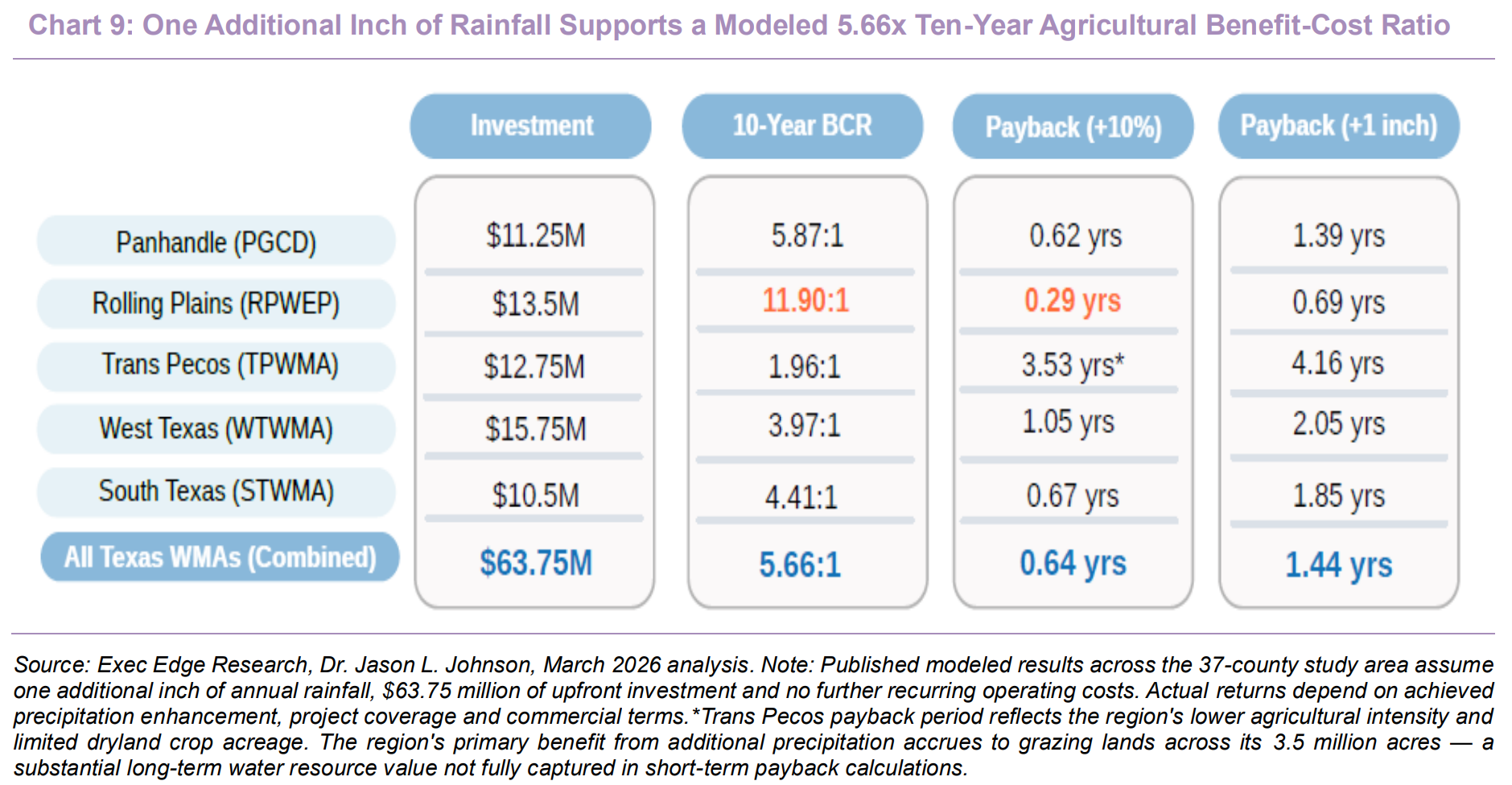
- Quantified agricultural returns strengthen WETA’s customer value proposition and provide an economic framework for procurement. A RAIN-commissioned analysis by Dr. Jason L. Johnson of Texas A&M AgriLife Extension estimates that one additional inch of annual rainfall across 37 Texas counties could generate $44.2 million in annual direct agricultural benefits. Against an assumed $63.75 million investment in 85 WETA units, equivalent to $750,000 per unit, the published analysis reports a 5.66x ten-year benefit-cost ratio and 1.44-year aggregate simple payback. Nine counties produce modeled ten-year benefit-cost ratios above 10x under the one-inch scenario. Under a 10% precipitation-enhancement scenario, the analysis estimates $98.9 million of annual agricultural benefits, with 22 of the 37 counties recovering the assumed investment within one year. These findings provide prospective water managers and agricultural customers with a framework for comparing WETA investment against crop, irrigation and grazing benefits. Actual customer returns and RAIN’s commercial economics will depend on achieved precipitation enhancement, project coverage and contract terms.
- A layered evidence base strengthens RAIN’s credibility in a market where natural weather variability makes causal attribution inherently difficult. The evidence includes published third-party ionization research, the randomized multiyear Oman program and company-operated U.S. deployments. At La Sal, RAIN reported greater than 20% enhancement in snow-water equivalent during the 2025-2026 winter, with the conclusion tested through analog-year comparison, ridge-regression counterfactual modeling and Bayesian Structural Time Series analysis and externally reviewed by Dr. Binod Pokharel of Utah State University. RAIN subsequently presented four technical studies at the August 2026 AMS Madison Summit. We believe the combination of randomized third-party research, multi-method U.S. field analysis and engagement with the scientific community differentiates RAIN from weather-modification propositions supported primarily by observational claims. Broader replication across sites, seasons and weather regimes can further strengthen that credibility and support customer adoption.
- We believe WETA’s measurement infrastructure can turn each deployment into a source of proprietary operating insight. Each instrumented deployment adds observations across terrain, storm type, season and operating configuration. RAIN intends to combine weather stations, treatment and control gauges, radar, third-party weather data and automated controls to improve site selection, operating timing and performance forecasting. If deployments expand, that dataset could produce a reinforcing cycle: stronger measurement supports customer confidence, additional contracts generate more observations and accumulated learning improves subsequent deployment design. Over time, linking site-specific operating conditions to measured outcomes could strengthen WETA’s deployment methodology and performance predictability. The data flywheel remains at an early stage, with its strategic value dependent on expanding the installed base, retaining rights to relevant data and demonstrating that accumulated learning improves future deployments.
- Permitted operations and relationships with public water organizations are building RAIN’s institutional credibility. The Weld County system has operated under a Colorado permit since October 2025, while Utah authorities and the Grand Water & Sewer Service Agency supported the La Sal program. In Colorado, the Colorado Water Conservation Board, Colorado River District and Upper Yampa Water Conservancy District have publicly supported a proposed state-funded pilot near Steamboat Springs. Together, these engagements demonstrate RAIN’s ability to navigate stakeholder coordination, permitting, measurement design and public-sector review. Such experience is particularly relevant in weather modification, where customers must evaluate environmental considerations, cross-boundary effects and the credibility of reported outcomes alongside cost. A documented approval and operating record can therefore reduce perceived implementation risk for subsequent buyers.
- Reference projects can convert regulatory experience and measured field performance into a commercially valuable customer network. La Sal supplies a completed winter dataset, Weld County demonstrates operation under a Colorado permit and Upper Yampa could establish a paid water-district reference if approvals and funding lead to deployment. Successful renewals, contract expansions or introductions from participating agencies could shorten future sales cycles in markets where buyers prefer evidence from comparable geographies and counterparties. We believe this reference effect could become an important enabler as RAIN expands from supported field projects into paid deployments, measured outcomes and repeat orders. The network remains at an early stage, however, and has not yet produced a broad base of recurring commercial relationships.
- A deployment-ready inventory and standardized field process give RAIN the capacity to respond more quickly to near-term opportunities. By 2Q26, RAIN reported ten completed, deployment-ready systems, providing capacity to pursue additional pilots and commercial projects without waiting for a new manufacturing cycle. Standardized components, quality assurance and repeatable installation procedures can lower execution risk, shorten the interval between contract and operation and support more consistent measurement across sites. While RAIN has not yet demonstrated manufacturing at commercial scale, this operating base provides an early execution advantage as deployment activity expands.
- Deployment readiness becomes more strategically valuable when paired with RAIN’s proposed one-to-many commercial model. A WETA site is intended to influence a broad target area, potentially allowing several water users, agricultural operators or public entities within the same geography to purchase access to one installed asset. Adding customers to an operating site could increase revenue without proportionate system capital, creating local density economics and improving returns on field service, monitoring and data infrastructure. Long-lived equipment, customer-specific baselines and multiyear service arrangements may also increase switching friction once a site is established. We believe this combination could create attractive site-level economics as customer density increases. However, customer stacking, recurring core revenue and site-level margins have yet to be demonstrated, making local density an emerging commercial advantage rather than an established network effect.
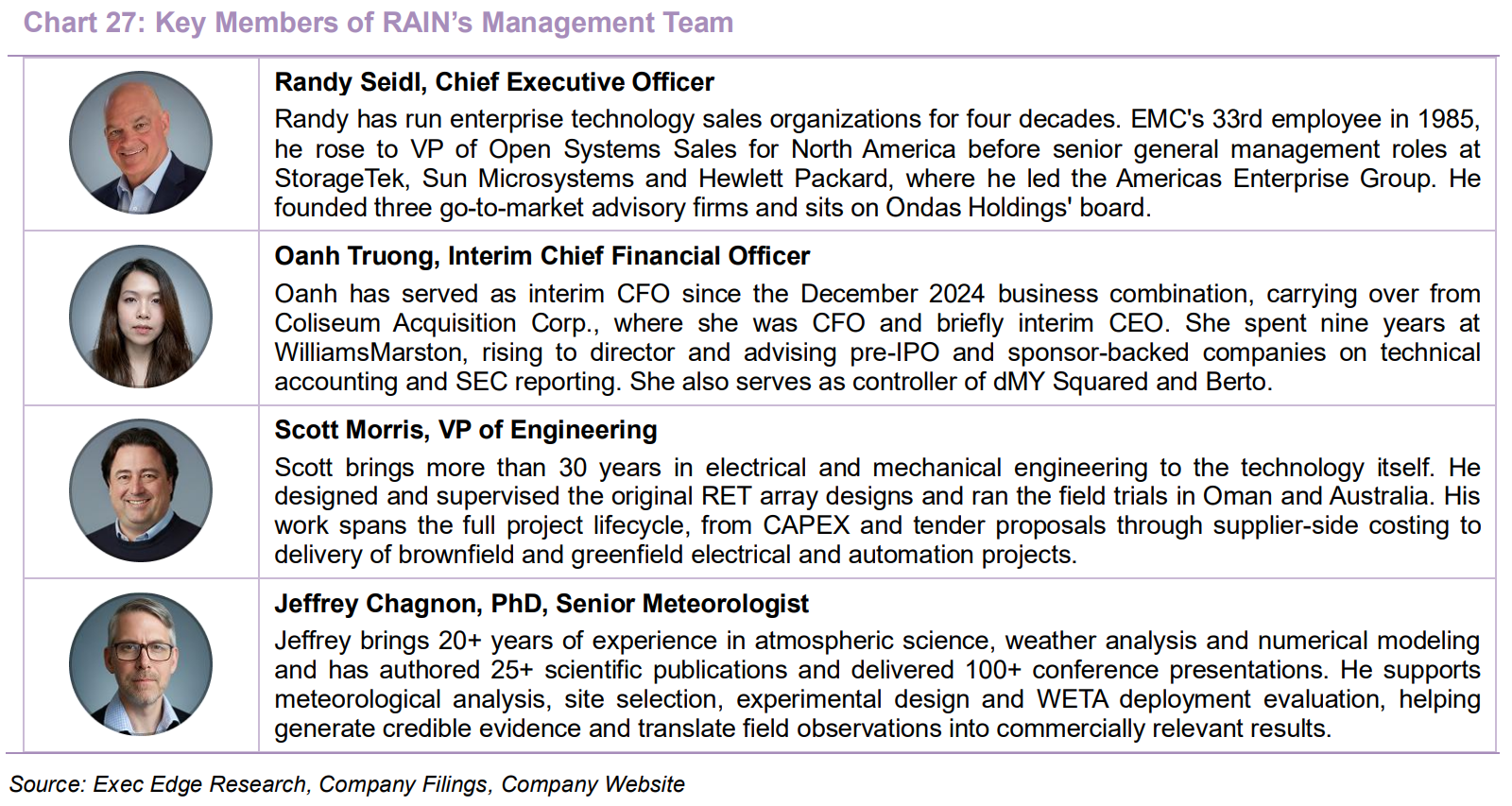
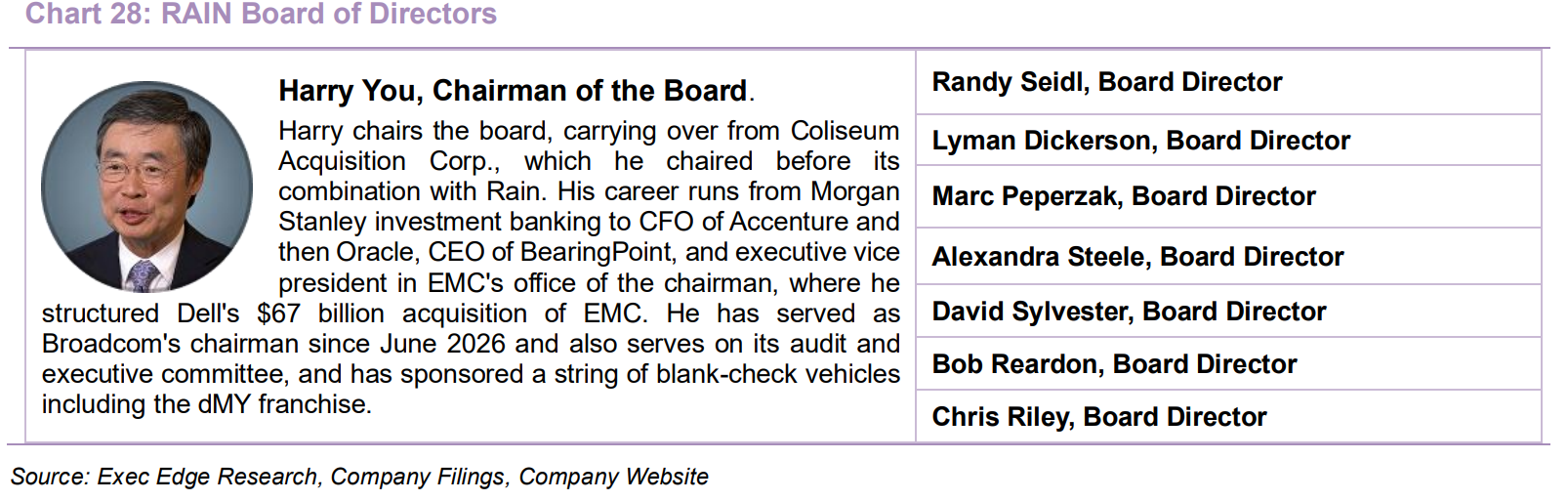
- RAIN’s team combines atmospheric expertise with enterprise technology commercialization, corporate transformation and capital-markets experience. Chief Executive Officer Randy Seidl has held senior commercial roles at Hewlett Packard, Sun Microsystems and EMC and has subsequently built sales, recruiting and revenue-acceleration businesses. VP of Engineering Scott Morris brings more than 30 years of engineering experience, including designing earlier array systems and operating ionization trials in Oman and Australia. Senior Meteorologist Jeffrey Chagnon, PhD, adds expertise in atmospheric dynamics, numerical weather prediction and field-data analysis, while interim Chief Financial Officer Oanh Truong contributes SEC reporting, financial management and capital-markets experience. Chairman Harry You brings experience spanning Oracle, Accenture, EMC, Morgan Stanley, Broadcom and several public-company transactions. His background in strategy, finance and technology acquisitions, together with his industry network, can support customer introductions, talent recruitment, partnerships and inorganic expansion. The broader board and adviser group adds water-industry, public-sector sales and governance expertise, while management reported a team of more than 50 employees, contractors, directors and advisors. This combination is relevant because commercializing WETA requires scientific and field expertise alongside enterprise-grade selling, public-sector engagement and access to capital.
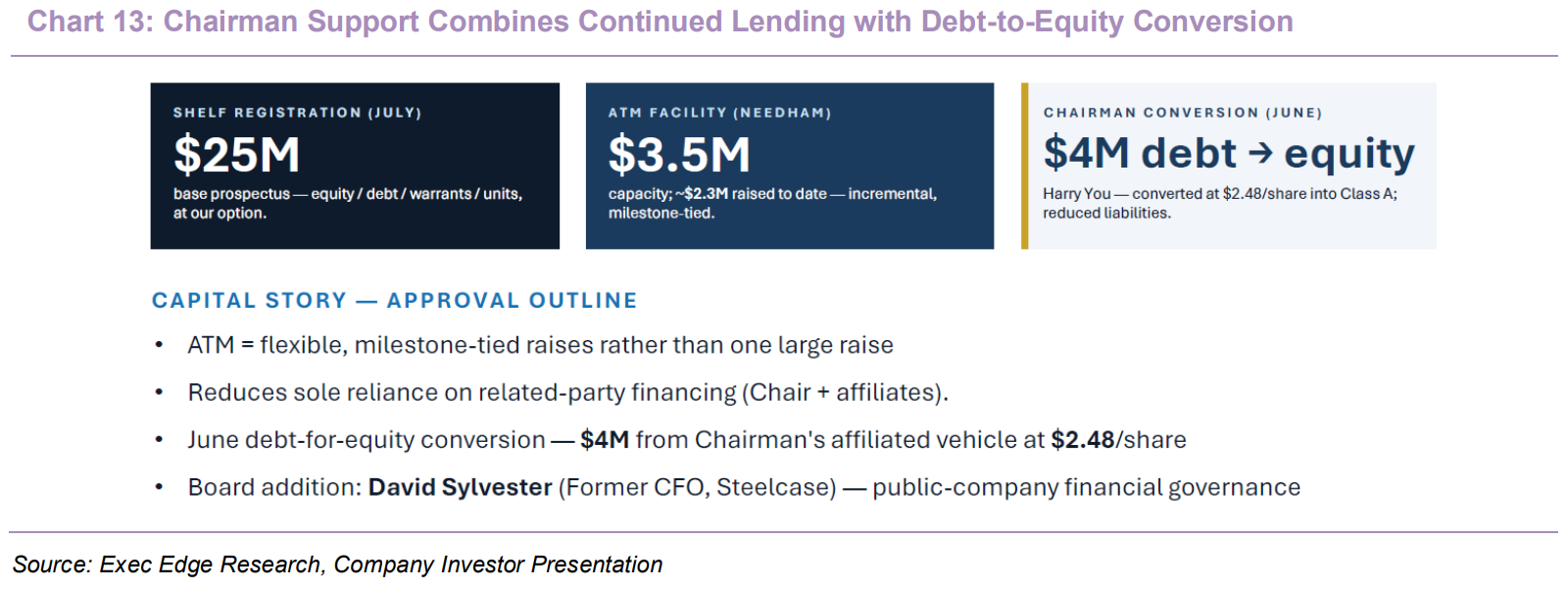
- Harry You’s backing has extended beyond the SPAC transaction through continued lending and the conversion of debt into equity. In March 2026, his affiliate RHY Management increased its new-lending commitment from $7 million to $10 million. In June, RHY and its affiliates converted $4 million of debt into equity, reducing RAIN’s liabilities and increasing the chairman’s equity alignment. These actions give tangible substance to Harry You’s stated commitment and have supported RAIN through its commercialization phase. We regard this active shareholder support as a financing and execution advantage, with longer-term value dependent on converting that support into paid deployments and recurring revenue.
Industry Trends and Company Positioning
Structural Water Scarcity Is Raising the Value of Incremental Water Supply

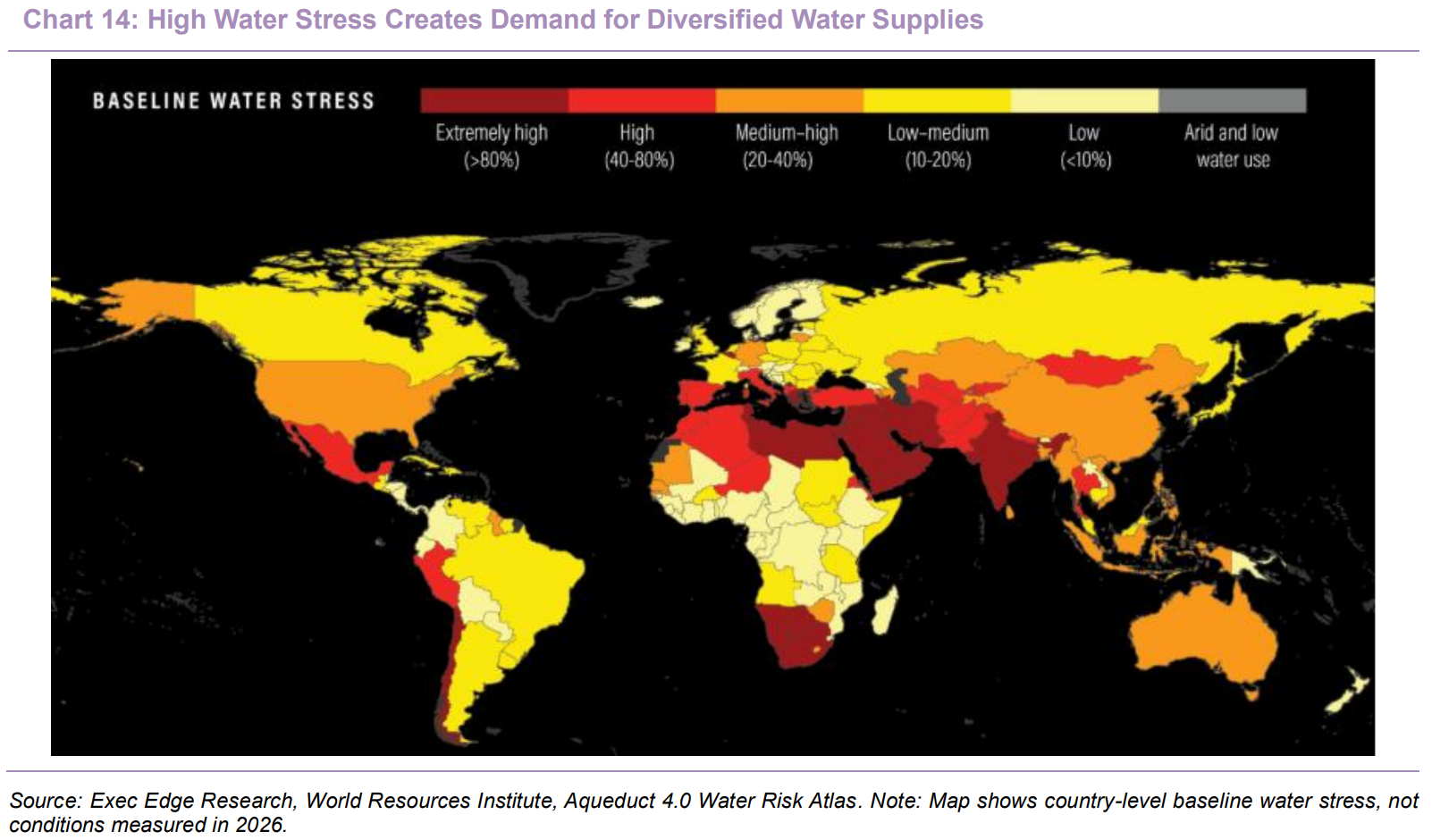
- Structural water scarcity is increasing the economic value of dependable, incremental water supply. Population growth, urbanization and rising consumption are increasing demand while climate variability makes supplies less dependable. The problem is therefore not simply that certain regions receive too little precipitation; water may be unavailable in the required location, season or quality, while households, agriculture and industry compete for the same constrained resource. The economic consequences extend through weaker agricultural output, disrupted industrial activity, health costs and lower household productivity. The OECD’s 2026 Financing Water Security report, citing 2024 modeling by the Global Commission on the Economics of Water, estimates that underinvestment could reduce global GDP by approximately 8% by 2050, with losses of 10% to 15% in low-income countries. Although scenario-based, these estimates illustrate the potential macroeconomic scale of water insecurity. Governments and businesses are consequently treating water security as a long-duration infrastructure and resilience priority. The response increasingly extends beyond emergency restrictions to conservation, reuse, storage, desalination, improved allocation and carefully evaluated supply augmentation. Within this broader portfolio, precipitation enhancement offers a potential supplementary source of water alongside conservation and conventional infrastructure investment.
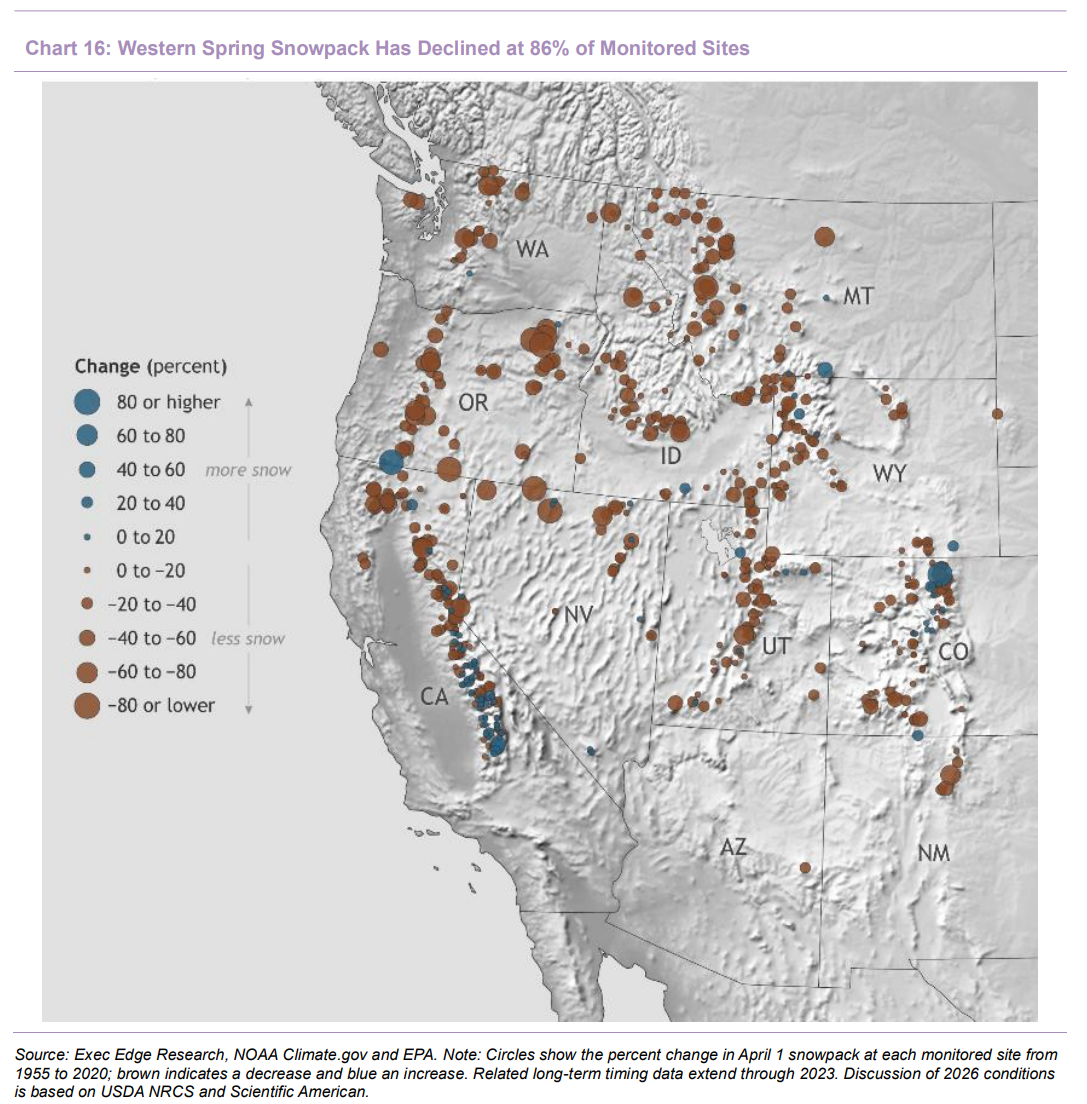
- Declining Western U.S. snowpack is increasing the need for more resilient and diversified water supplies. Mountain snowpack functions as a natural reservoir, storing winter precipitation and releasing it during warmer months when agricultural and municipal demand rises. NOAA and EPA data show that April snowpack declined at 86% of monitored western sites between 1955 and 2020, with particularly widespread reductions across the Northwest, northern California and the northern Rocky Mountains. Higher temperatures can cause more precipitation to fall as rain, bring forward peak accumulation and accelerate melting. EPA’s latest published long-term analysis, which extends through 2023, indicates that the western snowpack season shortened by approximately 15 days on average after 1982, while peak snowpack shifted almost seven days earlier.
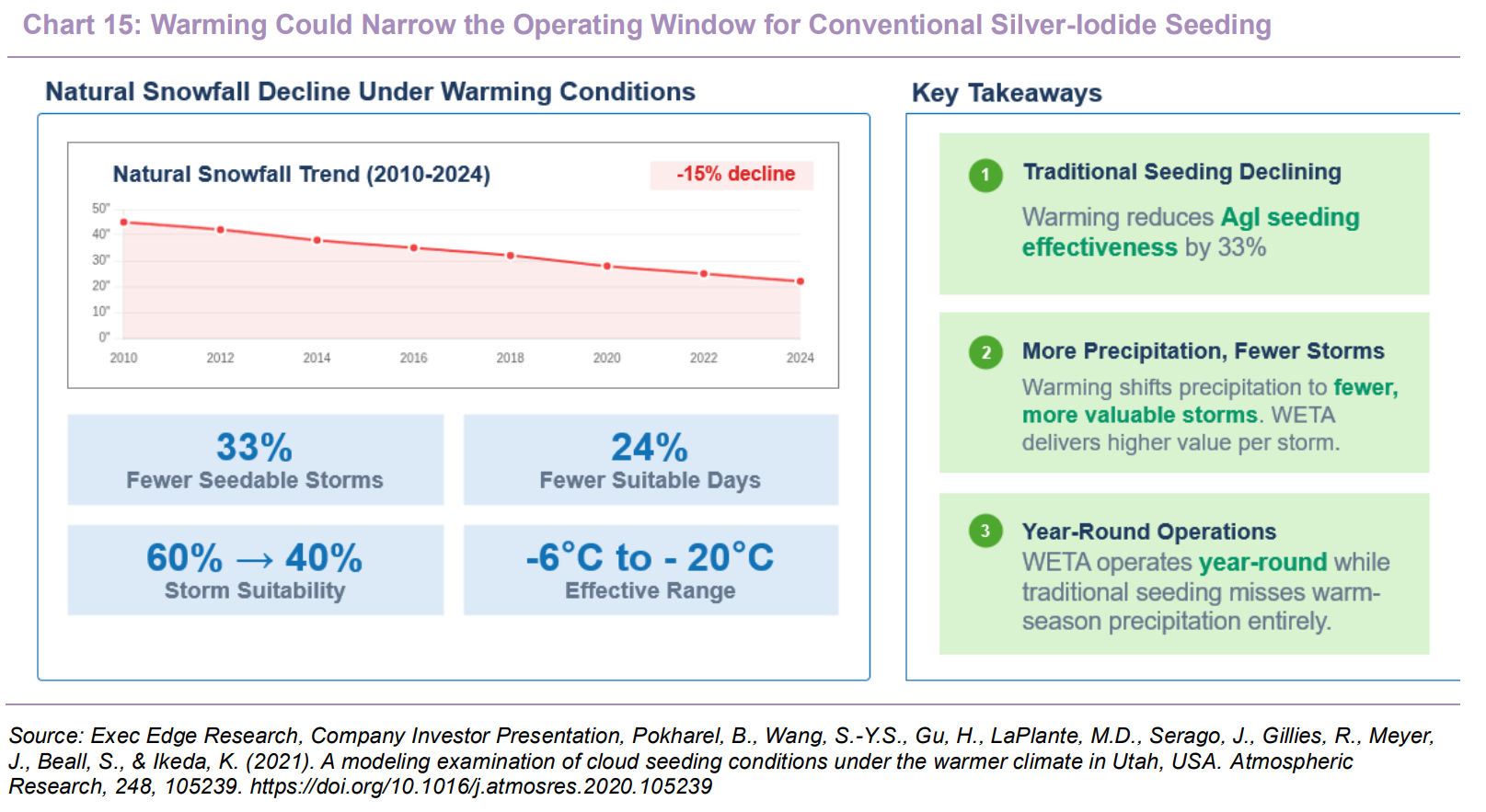
- Warming may also narrow the winter operating window for conventional silver-iodide cloud seeding. A modeling study of Utah’s mountains found that the proportion of precipitating winter clouds meeting temperature and supercooled-liquid-water requirements could decline from approximately 60% under current conditions to 40% under a high-emissions warming scenario. This could reduce the applicability of conventional silver iodide (glaciogenic) seeding as winters warm. WETA is designed to operate across broader seasons and precipitation types; however, the cited study did not evaluate ionization, so it supports WETA’s market rationale rather than its comparative effectiveness.
-
- Severe 2026 conditions across the Upper Colorado Region illustrate how quickly weaker snowpack can affect water availability. Following a warm winter, a record-setting March heat wave rapidly depleted an already weak snowpack near the point when it would ordinarily approach its seasonal peak. Snow-water equivalent in the region had fallen to 4.3 inches by March 28. USDA’s subsequent April 1 assessment confirmed record-low or near-record-low snowpack across much of the West, identifying Colorado, Utah and several neighboring states among the most exposed areas. Weak or prematurely melting snowpack can reduce reservoir inflows, constrain irrigation allocations, affect hydropower generation and increase uncertainty for water-dependent communities and businesses. Conditions remain variable across years and individual basins, but the structural challenge is increasingly defined by less dependable seasonal storage and a widening mismatch between runoff timing and customer demand. This strengthens the incentive to diversify water supplies, improve forecasting and evaluate incremental precipitation enhancement when atmospheric conditions are suitable. This geographic exposure overlaps directly with RAIN’s initial U.S. operating footprint in Utah and Colorado, providing a clear strategic rationale for its early deployment focus.
- Agriculture represents one of RAIN’s clearest potential markets because incremental precipitation can translate into measurable economic value. Water shortages can reduce planted acreage, crop yields and livestock productivity while increasing pumping, irrigation and feed costs. The economic effect depends not only on annual water volume but also on when precipitation arrives, which crops receive it and whether the additional water can be retained in soil, reservoirs or aquifers. USDA’s latest irrigation survey identified approximately 53.1 million irrigated acres using 81 million acre-feet of water in 2023, demonstrating the scale of agricultural dependence on managed supplies. Exposure is also geographically concentrated: Arkansas, California, Idaho, Nebraska and Texas account for roughly half of U.S. irrigated acreage. This concentration can create addressable regional opportunities, but it also complicates commercialization. Rainfall benefits may extend across numerous farms, watersheds and jurisdictions, making it difficult for an individual grower to capture the full economic value of an intervention. Water districts, counties, irrigation authorities and producer associations may therefore be more suitable contracting entities because they can aggregate beneficiaries and evaluate results across a broader area. This structure aligns with RAIN’s proposed one-to-many commercial model, under which a single WETA installation could serve multiple users within a target geography. We believe RAIN’s agricultural opportunity depends less on total irrigated acreage than on its ability to aggregate beneficiaries and demonstrate compelling customer economics across each coverage area.
- Rising infrastructure costs increase the relevance of supplementary water solutions that can improve the productivity of existing systems. Water systems must expand access, replace aging networks and adapt to changing supply conditions while keeping customer bills affordable. Research cited by the World Economic Forum estimates that approximately €11.4 trillion (~$12.83 trillion as of 10/2/26 exchange rate of €1 = $1.126) of cumulative water-infrastructure investment will be required through 2040, compared with current spending trajectories that leave a €6.5 trillion gap (~$7.31 trillion as of 10/2/26 exchange rate of €1 = $1.126). This requirement encompasses drinking-water and sanitation access, network resilience, leakage reduction, reuse and technological modernization, rather than representing an addressable market for precipitation enhancement. These constraints favor a portfolio approach in which conservation, recycling, storage, network upgrades and incremental supply solutions are evaluated against local conditions and lifecycle economics. Technologies requiring limited supporting infrastructure could become increasingly relevant where conventional capacity additions are expensive or slow, provided incremental benefits justify the expenditure.
- We believe the WETA (Weather Enhancement Technology Array) is positioned as a flexible supplementary water solution that combines fixed-site deployment with a broad potential coverage area. The WETA’s ground-based configuration is designed to operate without aircraft or conventional seeding agents, potentially simplifying deployment and enabling one installation to serve multiple beneficiaries within an appropriate geographic area. Because the system is solar-powered and requires no seeding materials to replenish, it is designed to run for a season or longer with minimal on-site maintenance once installed. These attributes are relevant to water districts, agricultural regions, resorts and infrastructure operators seeking incremental precipitation without constructing another large water asset. Service and lease structures can align customer expenditure with deployment periods and measured outcomes, while increasing local customer density could strengthen site economics. The WETA is designed to complement conservation, storage and conventional infrastructure by enhancing existing precipitation potential when suitable atmospheric moisture is present; it cannot create storms or eliminate drought. Commercial adoption will depend on converting monitored deployments into externally reviewed evidence, repeatable results and demonstrated economic value across seasons and locations. RAIN was also named the 2026 AgTech Climate Innovation of the Year by AgTech Breakthrough in August, adding industry recognition as the company expands its positioning with agricultural customers.
WETA Aligns with the Shift Toward Persistent and Measurable Weather Enhancement

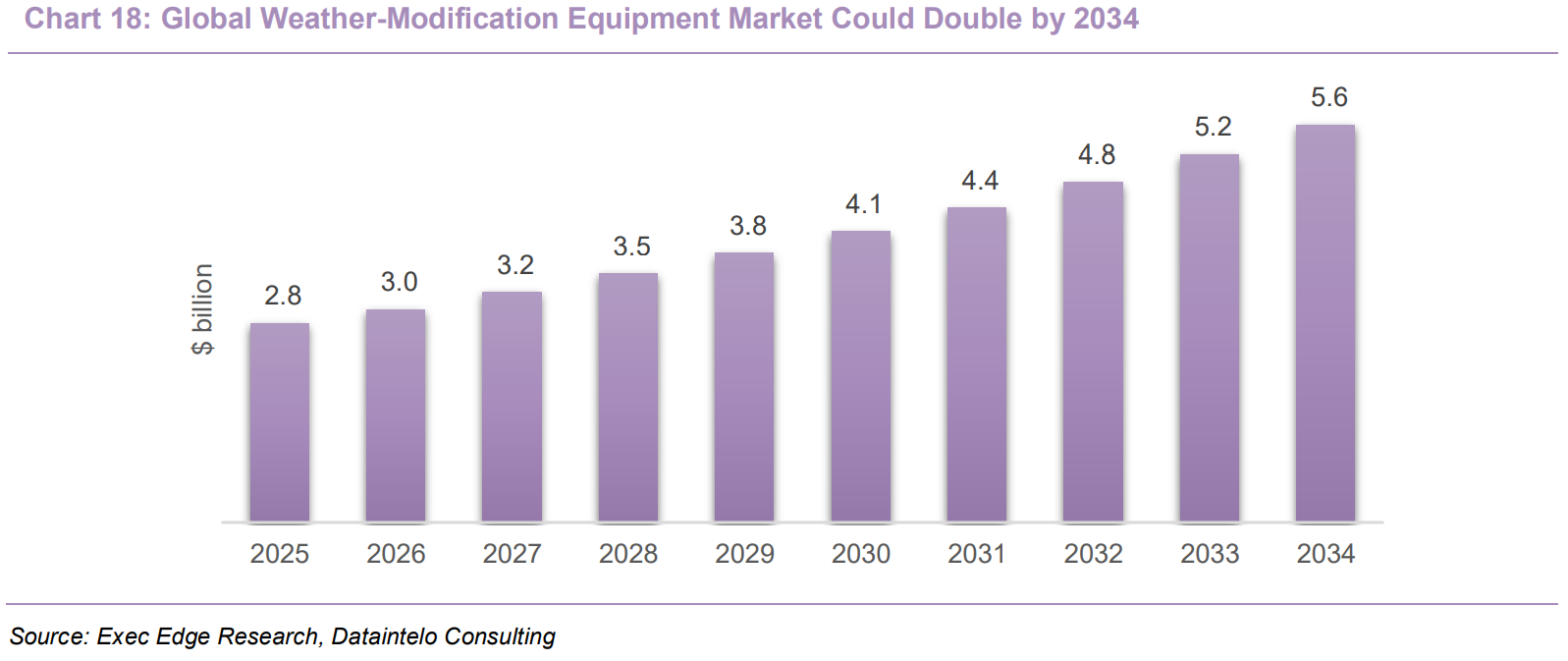
- Growing water-security needs are increasing the strategic relevance of weather enhancement as a source of incremental supply. The World Meteorological Organization defines weather modification as deliberate intervention in the atmosphere to influence local or regional conditions, principally through precipitation enhancement, hail suppression and fog dispersal. These activities are distinct from large-scale climate intervention and are already conducted operationally in more than 50 countries. Dataintelo Consulting estimates that the global weather-modification equipment market will expand from approximately $2.8 billion in 2025 to $5.6 billion by 2034, with a reported CAGR of 8.1% from 2026 to 2034. The estimate covers a broad ecosystem spanning cloud-seeding equipment, weather radar, weather balloons, satellites and other supporting technologies across ground-based, airborne and satellite-based architectures, making it an indicator of institutional spending rather than RAIN’s directly addressable market. We believe RAIN’s relevant opportunity lies in the narrower intersection of ground-based technology, precipitation enhancement and water management. Within this segment, commercial adoption of ionization-based systems will depend on demonstrating measurable and repeatable outcomes under credible operating, measurement and governance frameworks.
- Conventional cloud seeding demonstrates established institutional demand while highlighting operating constraints that create room for alternative weather-enhancement architectures. Traditional programs introduce silver iodide, hygroscopic particles, dry ice or other agents into suitable clouds using aircraft, flares or ground generators. Aircraft can place agents closer to selected cloud formations but require flight availability, specialist crews, fuel and coordination during relatively narrow weather windows. Ground generators reduce aircraft dependence, although prevailing winds must transport the seeding material into clouds containing suitable temperatures and supercooled liquid water. Conventional seeding remains conditional on suitable clouds and atmospheric moisture, while natural precipitation variability makes incremental effects difficult to isolate. Climate change could further tighten these operating constraints for winter silver-iodide seeding. A Utah-specific modeling study by Pokharel et al. projected that, under a high-emissions warming scenario, the proportion of precipitating clouds suitable for seeding could decline from approximately 60% to 40%, reflecting higher temperatures and fewer precipitation events. Although specific to Utah and winter silver-iodide seeding, the study highlights a potential mismatch: water scarcity can increase demand for precipitation enhancement even as warming reduces the conditions suitable for conventional cold-cloud methods. This strengthens the rationale for developing technologies capable of operating across a broader range of temperatures, cloud types and precipitation processes.
- Unlike programs that infer results from cloud-targeting models or radar alone, RAIN evaluates each deployment with research-grade precipitation and snow gauges in defined target and control areas, so reported enhancement reflects water that actually reached the ground in the watershed being served. This approach supports the company’s minimum 10% guarantee and aligns with WMO and GAO recommendations for predefined baselines and independent review.
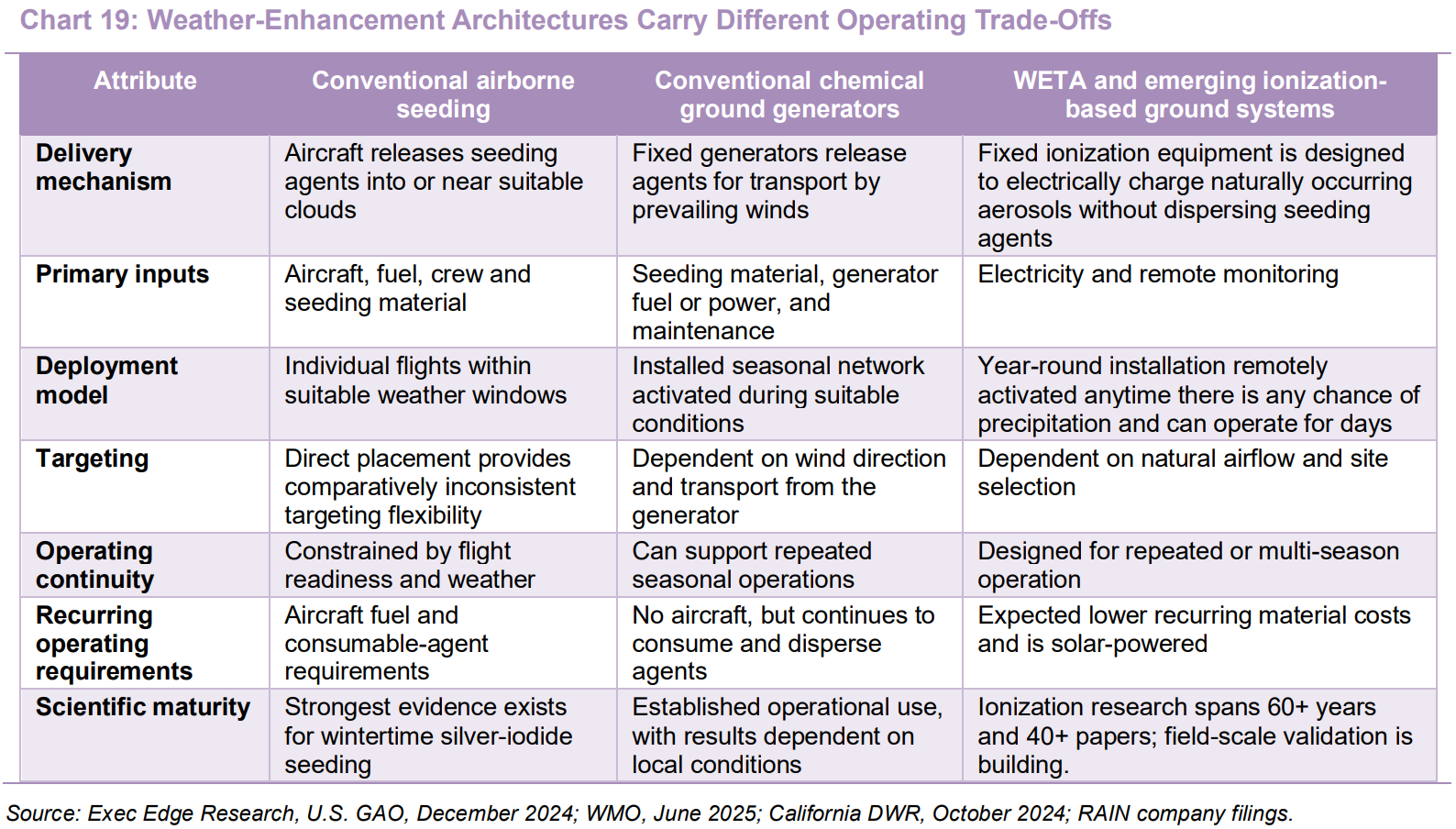
- Measurement and decision support are becoming as important as deployment hardware in weather enhancement. Radar, remote sensing, high-resolution modeling, nowcasting and automated controls can help operators identify favorable atmospheric windows and evaluate outcomes more systematically. The 11th WMO Scientific Conference on Weather Modification included AI-driven forecasting and decision-support systems among its principal themes. Fixed ground equipment fits this evolution because it can remain installed near a watershed or agricultural region and be activated when defined atmospheric criteria are satisfied. However, remote operation alone is not differentiating, as conventional silver-iodide generators are increasingly remotely controlled, including within Utah’s established program. Differentiation increasingly depends on combining remote operation with lower recurring inputs, improved monitoring and the ability to operate across conditions unsuitable for conventional silver-iodide seeding. Ionization-based systems may reduce aircraft, fuel and seeding-agent requirements, but their broader atmospheric applicability continues to evolve. Accordingly, emerging systems must demonstrate repeatable efficacy across the temperatures, cloud structures and precipitation types they claim to address, in addition to offering greater operating convenience.
- WETA aligns RAIN with the industry shift toward persistent, remotely operated and measurement-led weather enhancement. Its fixed, solar-powered architecture is designed to reduce recurring aircraft, fuel, seeding-agent and onsite-labor requirements while supporting multi-season monitoring and service relationships. A single installation may also serve several beneficiaries within its operating area, supporting RAIN’s proposed one-to-many model and potentially improving site economics as customer density increases. Commercial adoption will depend on externally reviewed results that demonstrate repeatable performance across sites, seasons and atmospheric conditions.
Evidence, Transparency and Regulation Are Gatekeepers to WETA Adoption

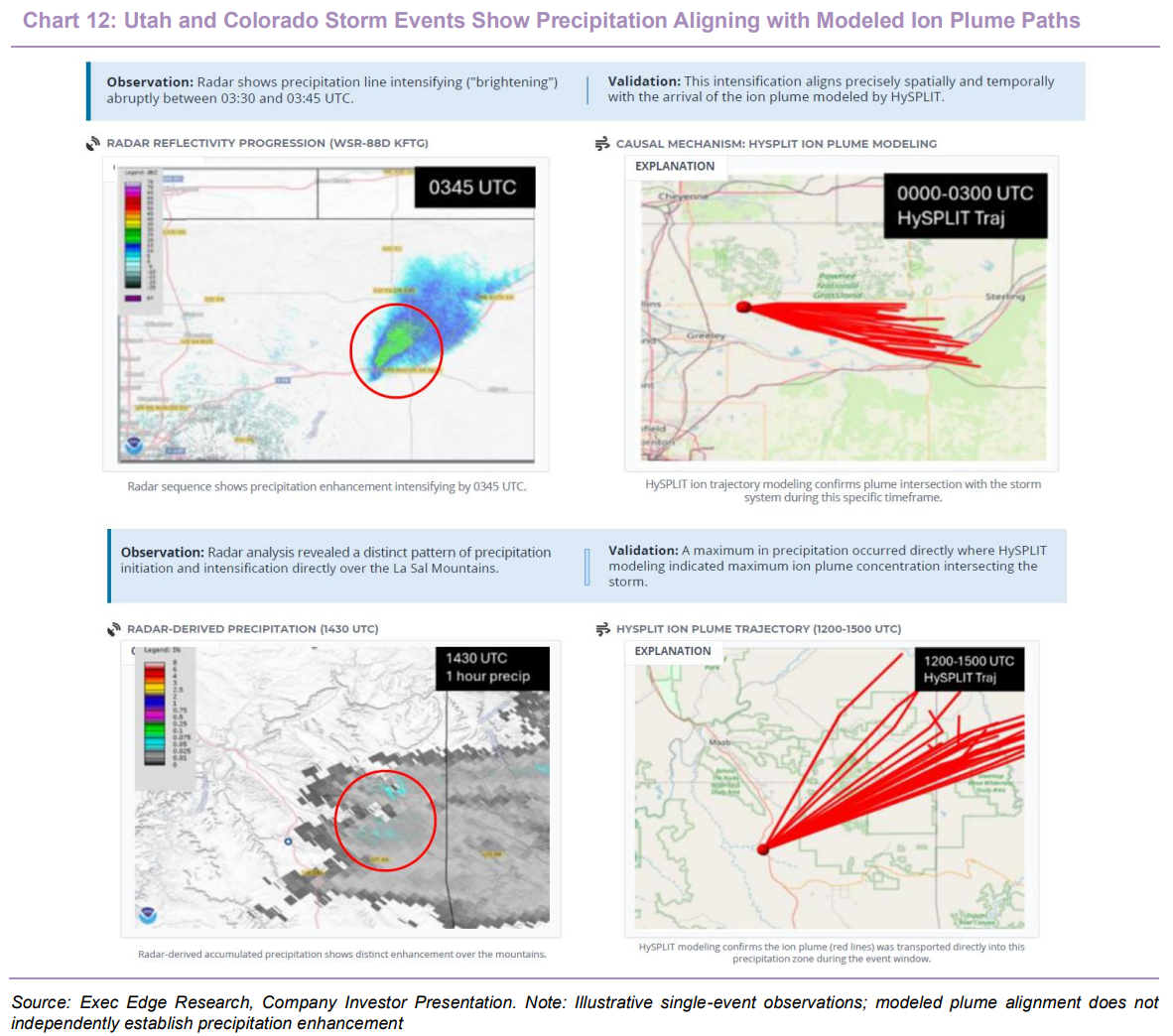
- Reliable attribution is becoming a central commercial gatekeeper for weather-enhancement technologies seeking institutional adoption. Precipitation varies substantially between storms, seasons and nearby watersheds, making a simple comparison of rainfall before and after deployment insufficient to establish causality. The U.S. Government Accountability Office found precipitation-uplift estimates ranging from zero to 20% across the cloud-seeding studies it reviewed, but warned that inconsistent baselines, limited datasets and differing evaluation methods make performance and investment returns difficult to compare. The WMO recommends defining treatment criteria in advance, randomizing suitable events where practicable and combining statistical analysis with physically based evidence. Improved radar, sensors, plume modeling and high-resolution atmospheric simulations can strengthen this process by assessing whether an intervention aligned spatially and temporally with observed precipitation. Greater measurement precision does not itself prove causality, particularly when the expected intervention signal is small relative to natural weather variability.
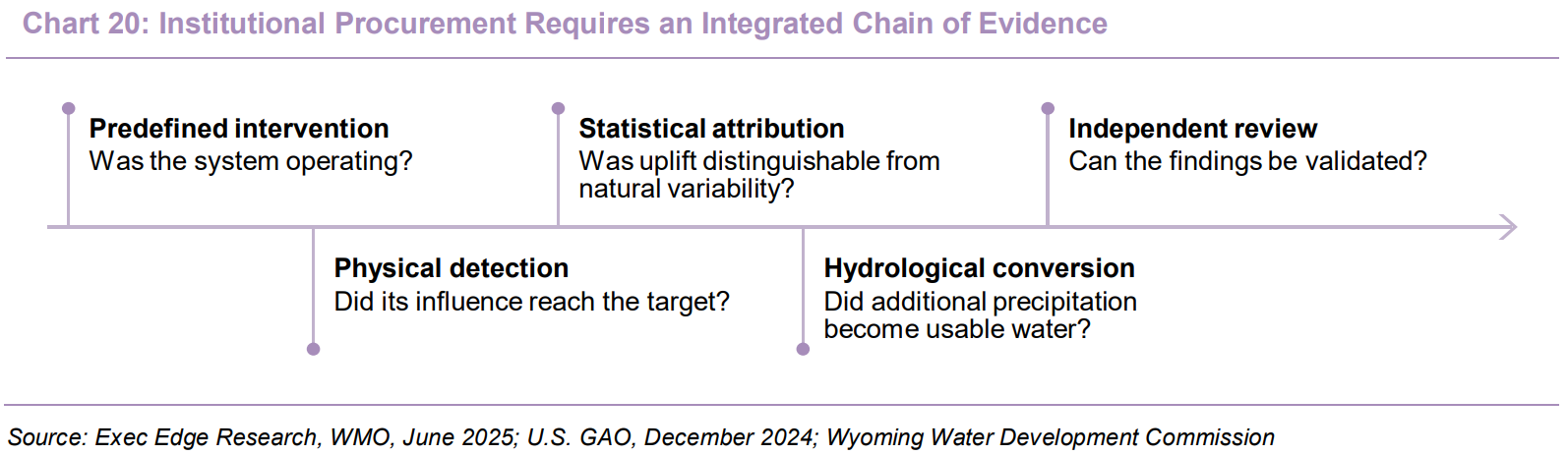
- Commercial adoption depends on translating attributable precipitation into usable water and customer economics. Additional rainfall or snowfall has different economic consequences depending on its location, timing, intensity and interaction with soil, crops, reservoirs and existing water infrastructure. Water agencies may prioritize incremental runoff or reservoir inflows, while agricultural customers may measure avoided irrigation expense, crop revenue or grazing-land productivity. The Wyoming Weather Modification Pilot Program provides a useful evaluation precedent: it paired target-and-control analysis with high-resolution gauges, physical measurements and atmospheric modeling, while recommending that cloud models be validated against observations and connected to hydrological models. RAIN’s March 2026 Texas study illustrates how attributed precipitation can subsequently be translated into customer economics. Prepared by a Texas A&M AgriLife Extension economist, the study applies a ten-year discounted NPV framework to assumed annual rainfall increases, including a one-inch case and percentage-uplift scenarios, and estimates agricultural benefits from crop revenues, irrigation savings and grazing-land improvements. These calculations can show what verified incremental rainfall might be worth, but they do not establish that WETA will produce the assumed uplift. The commercial value of such modeling therefore depends on instrumented deployments establishing attributable precipitation and translating it into measurable hydrological outcomes.
- Regulatory readiness and public transparency are becoming commercial differentiators in weather enhancement. Weather modification is governed through overlapping federal reporting requirements and state-level approval regimes that vary materially by jurisdiction. GAO reported that, as of July 2025, ten states had reported weather-modification activity, and each required an approval process such as permitting or licensing. At that time, three states had enacted bans and a number of others had proposed some form of restriction, although the proposals varied in scope and covered activities, and introduction of a proposal does not imply enactment or continued consideration. The federal Weather Modification Reporting Act also requires operators to report activities to NOAA before, during and after deployment. GAO’s February 2026 review concluded that NOAA’s database remained incomplete and inconsistent, estimating that more than half of submitted reports likely contained errors or missing information. These weaknesses can hinder scientific evaluation while reinforcing public concerns that activities are not being adequately monitored. RAIN’s ionization-based system does not disperse silver iodide or other chemical seeding agents, which reduces one source of regulatory and public concern. Commercial credibility increasingly depends on demonstrating where, when and why systems operate, disclosing monitoring methods and communicating potential limitations and downwind considerations. A repeatable compliance framework supported by accessible data and independent review could become a meaningful competitive advantage as customers increasingly evaluate scientific credibility, regulatory preparedness and public acceptance together.
- RAIN’s integration of operations and measurement can make each WETA deployment both a precipitation-enhancement system and an evidence-generating platform. Instrumented treatment and control areas, predefined activation criteria, atmospheric modeling, hydrological measurement and independent review can help distinguish WETA’s contribution from natural variability. The Texas analysis can then translate verified uplift into customer economics rather than serving as a substitute for evidence of uplift. Consistent NOAA reporting, state permitting and transparent disclosure of positive results could strengthen RAIN’s credibility in procurement. In our view, this evidence-led approach can improve customer confidence, support repeat orders and turn RAIN’s measurement and regulatory capabilities into a commercial advantage.
AI Data-Center Growth Broadens RAIN’s Potential Stakeholder Base
- AI-led data-center expansion is turning electricity and water availability into increasingly linked constraints on new capacity. Berkeley Lab estimates that U.S. data centers consumed 192 TWh in 2024, equivalent to 4.7% of national electricity use, and projects consumption of 649 TWh, or 11.8%, by 2030. Hyperscale campuses create large, continuous loads, and cooling is among their most significant sources of water demand. Open-loop and evaporative systems consume the most water, losing it to evaporation as they reject heat, while closed-loop systems recirculate water and use less, though they can still require substantial supplies, particularly where they rely on cooling towers. Cooling needs also link computing growth to water indirectly through electricity generation. Requirements vary by climate, cooling architecture, workload and power mix, meaning resource constraints can emerge within a utility territory or watershed before becoming apparent nationally. Ceres estimates that electricity serving data centers across seven states was associated with approximately 3.4 trillion gallons of freshwater withdrawals in 2024. Withdrawals measure water accessed rather than permanently consumed and include hydropower, so the figure indicates system dependence rather than depletion. More importantly, 66% of electricity generated by water-using plants in those states came from areas facing medium-high to extremely high baseline water stress. Data-center planning must therefore consider onsite cooling, generation mix, seasonal availability, permitting and community acceptance together. Water-efficient cooling and reclaimed supplies can reduce direct demand, while less water-intensive generation can reduce upstream exposure, making water resilience a broader infrastructure requirement rather than a facility-level efficiency measure.
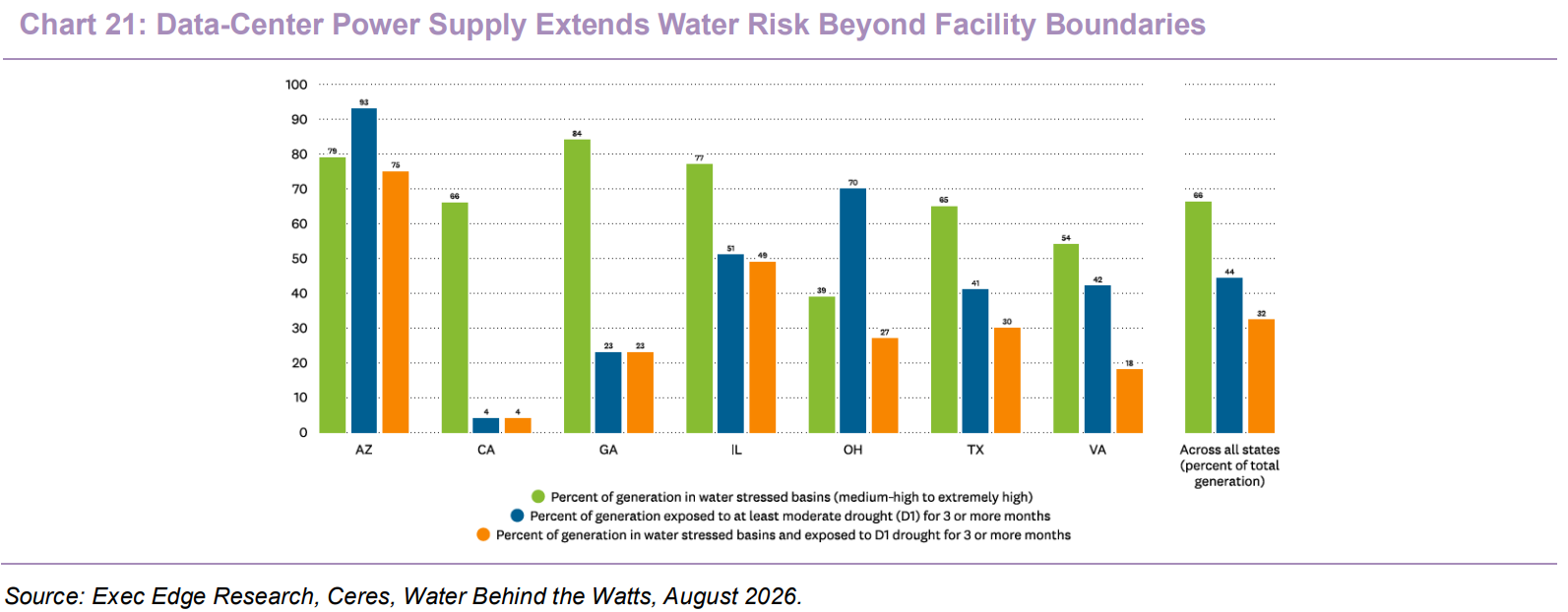
- Corporate water strategies are expanding beyond facility efficiency toward power-supply exposure and watershed-level resource planning. Leading cloud operators already combine lower onsite demand, recycled-water use and replenishment projects. Google reports replenishing approximately 7.7 billion gallons during 2025, equivalent to 78% of its freshwater consumption, while AWS reports reaching 75% of its 2030 water-positive objective; reporting methodologies and boundaries differ. Ceres nevertheless finds that most strategies remain focused on facility cooling and equipment, while few companies disclose the water used to generate purchased electricity. This gap matters because an enterprise-wide replenishment ratio may not address exposure in the watersheds supporting a company’s power supply. More comprehensive strategies would integrate cooling efficiency, alternative water sources, generation mix, power-plant exposure and basin-level drought conditions. Procurement may consequently favor interventions offering measurable benefits within the relevant watershed, creating opportunities for water solutions that can demonstrate credible location, additionality and independent verification.
- Data-center water exposure creates a potential role for RAIN beyond facility operators. Management has included AI data centers in RAIN’s sales pipeline. The opportunity appears most relevant where a WETA deployment can support the watershed serving a data-center campus or its power supply, potentially benefiting multiple users rather than a single facility. However, RAIN has not disclosed a data-center customer, pilot, order or revenue. The segment therefore represents an emerging commercial adjacency, with its potential tied to site-level hydrology, measurable precipitation benefits and customer support for watershed-scale interventions.
Growth Strategy
Focused on Paid Deployments, Repeatable Commercial Execution and Selective Expansion
- RAIN’s growth strategy centers on converting WETA validation into paid deployments, building a repeatable commercial model and extending the platform across selected geographies and applications. Management is focused on government, commercial and water-district opportunities, flexible customer contracts and expansion through selected verticals and local partners. Deployment-ready inventory provides the capacity to respond to funded opportunities, while additional seasonal data and external scientific review are intended to strengthen customer confidence and support conversion. Commercial execution is focused on securing approvals, defining measurable outcomes, deploying against funded commitments and generating follow-on orders where customer economics support broader adoption. Fog mitigation and other atmospheric applications offer additional pathways for applying RAIN’s ionization capabilities but remain secondary to the commercialization of precipitation enhancement. We believe progress should increasingly be reflected in the transition from supported field projects to contracted deployments, renewals and geographic expansion.
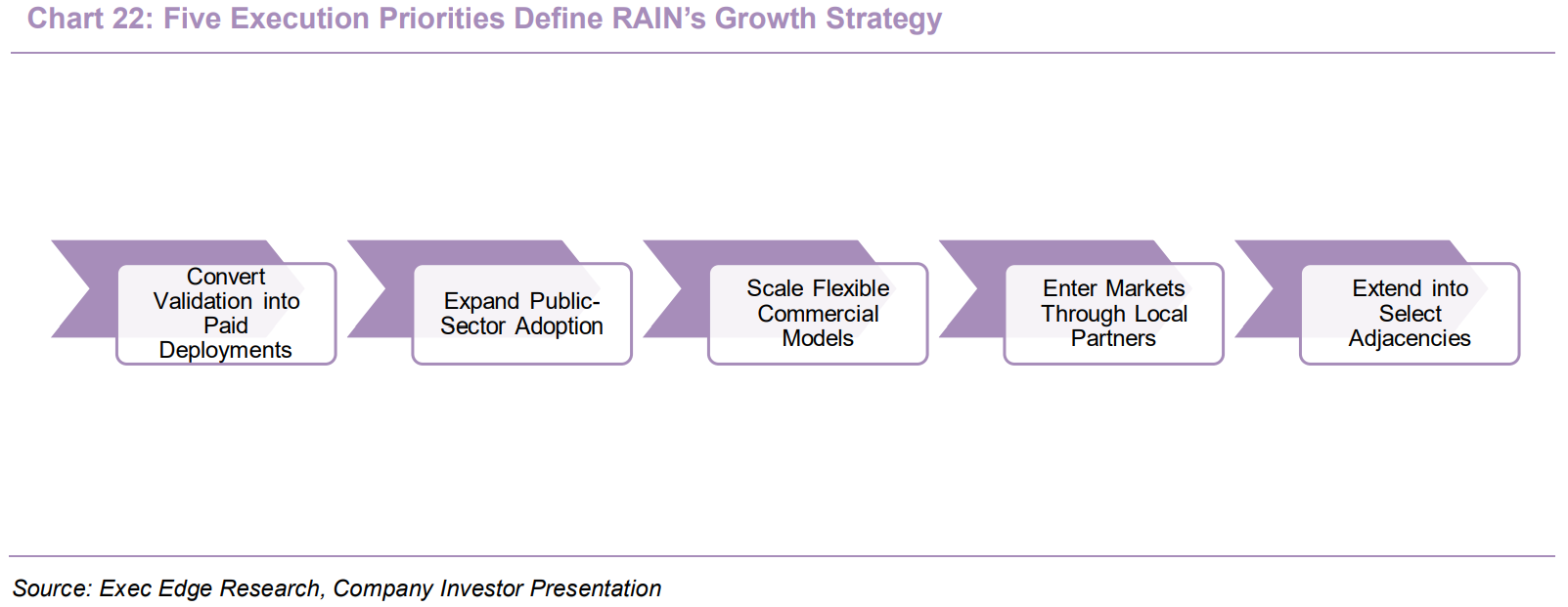
- RAIN is seeking to convert field validation into commercial orders through a repeatable, inventory-supported deployment model. The existing validation record and conditional performance guarantee provide a basis for sales discussions, with commercial efforts focused on converting the company’s validation and near-term milestones into orders. Commercial conversion must be matched by operational readiness. RAIN’s deployment-ready inventory provides capacity to execute funded pilots and initial orders without another full manufacturing cycle. The company continues to evaluate new sites based on weather patterns, terrain, permitting, accessibility and other operating considerations, while documenting its sourcing, manufacturing and assembly processes and developing additional monitoring and measurement tools. To support future scale, RAIN has identified manufacturing optimization, bill-of-materials value engineering, enhanced software controls, machine-learning automation and potential additional manufacturing partners as areas for further development.
- Beyond public water agencies, RAIN is marketing WETA to ski areas seeking snowpack enhancement and pursuing international expansion. Public water agencies can support large project areas and provide valuable reference customers, although projects require permits, stakeholder support and demonstrable public benefit. RAIN is pursuing this channel through the Upper Yampa pilot in Colorado, which has received support from the Colorado Water Conservation Board, Colorado River District and Upper Yampa Water Conservancy District. The pending state-funded project is progressing through the Colorado approval process and targets an October 2026 installation across watersheds serving the Yamcolo Reservoir, subject to approval and funding. The company has experience navigating Colorado and Utah permitting processes and participating in public hearings, which could support subsequent agency deployments. We believe successful execution and measurement at Upper Yampa could provide an important paid reference for broader multi-year service, lease or purchase opportunities across public water organizations, ski areas and international markets.
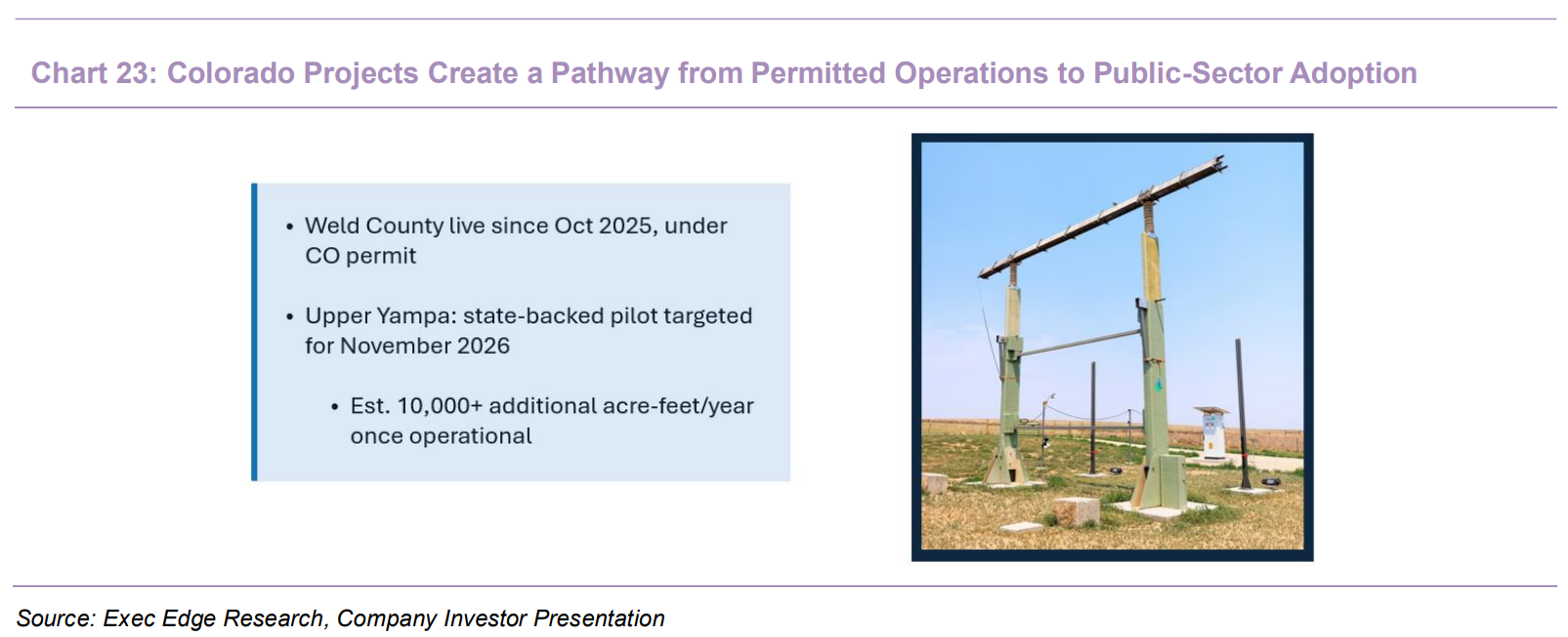
- Flexible service, rental and lease, and ownership structures broaden RAIN’s potential customer base and routes to monetization. RAIN emphasizes flexible one-year agreements, multi-year agreements, annual rentals, lease-to-own structures and outright purchases, while retaining the ability to serve multiple customers from a single installation where operationally practical. The Turkey agreement demonstrates the lease route through a conditional structure with renewal and purchase options, while Upper Yampa materials offer lease-to-own and purchase alternatives following the proposed pilot. This flexibility allows RAIN to align contract structures with customer budgets, procurement requirements and ownership preferences while retaining recurring-revenue opportunities through service and lease arrangements.
- RAIN is using U.S. reference projects and customer-specific economic analysis to expand across priority water-dependent markets. The U.S. West is the initial focus because drought exposure, established regulation and active water districts create identifiable buyers. La Sal and Weld County provide operating references, while Upper Yampa could add a publicly funded water-agency case. Management is targeting municipalities, agriculture, ranching, Tribal governments, AI data centers, and ski and golf resorts. The Texas benefit-cost framework translates incremental rainfall into crop, irrigation and grazing benefits, providing a template for developing customer-specific economic cases across agricultural markets.
- Partner-led market entry provides RAIN with local relationships and implementation capabilities for international expansion. Its exclusive UASIT agreement targets an initial lease in Turkey, beginning with the Eğirdir Lake Basin and potentially extending to other water-stressed regions, subject to an order and institutional approvals. We believe this model provides a measured route into new geographies by combining RAIN’s technology and operating framework with a local partner’s customer access and knowledge of institutional requirements.
- FREA provides RAIN’s most advanced opportunity to extend its ionization platform beyond precipitation enhancement. The technology is being developed for fog mitigation across highways, airports, ports and other transport infrastructure. RAIN completed an initial Australian field pilot in 2025, presented its deployment and optimization framework at the AMS Madison Summit and entered a one-year agreement with the California Highway Patrol and Caltrans to test FREA at the Caltrans Dynamic Test Facility through August 2027, with installation planned for November 2026. The program provides a controlled environment for measuring fog density, visibility and operational performance, with the resulting data intended to support subsequent commercial evaluation. Management has also referenced possible air-quality applications, although those remain at an earlier research stage. Longer term, RAIN has identified licensing or acting as a channel partner for complementary water-generation technologies as another potential avenue for extending the platform, although precipitation enhancement and instrumented FREA testing remain the current development priorities.
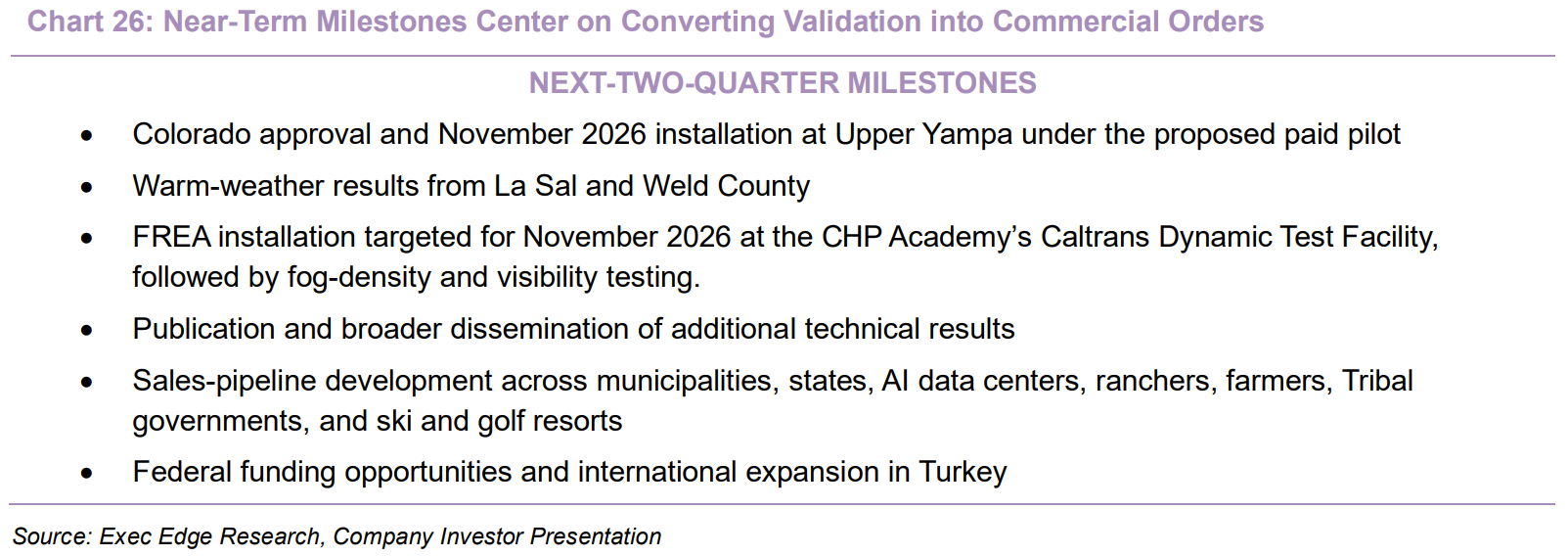
- Management’s stated priorities for the next two quarters are to move RAIN from evidence building toward broader commercial execution. Management’s milestones combine regulatory approval and the targeted Upper Yampa installation with additional warm-weather results from La Sal and Weld County, continued FREA development, publication of technical results and expansion across federal and international opportunities. We believe the central theme is conversion: using stronger validation, operating evidence and institutional relationships to secure orders and establish repeatable commercial reference projects.
Management Team
Commercialization Experience, Technical Expertise and Board Depth Support Execution
- RAIN combines experienced commercial leadership with technical continuity, scientific depth and active shareholder backing, a relevant mix for converting field validation into repeatable customer deployments. Chief Executive Officer Randy Seidl brings enterprise-sales and operating experience from EMC, StorageTek, Sun Microsystems and Hewlett Packard, while Scott Morris contributes WETA engineering and field-development expertise. Senior Meteorologist Jeffrey Chagnon, PhD, adds more than 20 years of atmospheric-modeling and weather-analysis experience, supported by a developing data-science and field-analysis team. Interim CFO Oanh Truong adds public-company accounting and capital-markets reporting experience. Chairman Harry You contributes a complementary combination of technology-sector strategy, transaction execution and continuing financial support. His experience includes serving as CFO of Oracle and Accenture, overseeing corporate strategy and business development at EMC and Chairman of Broadcom. We view this combination as relevant to financing decisions, executive recruitment, partner evaluation and disciplined commercialization.
Fundamentals & Valuation
Customer Economics and Funding Flexibility Frame the Path to Commercial Revenue
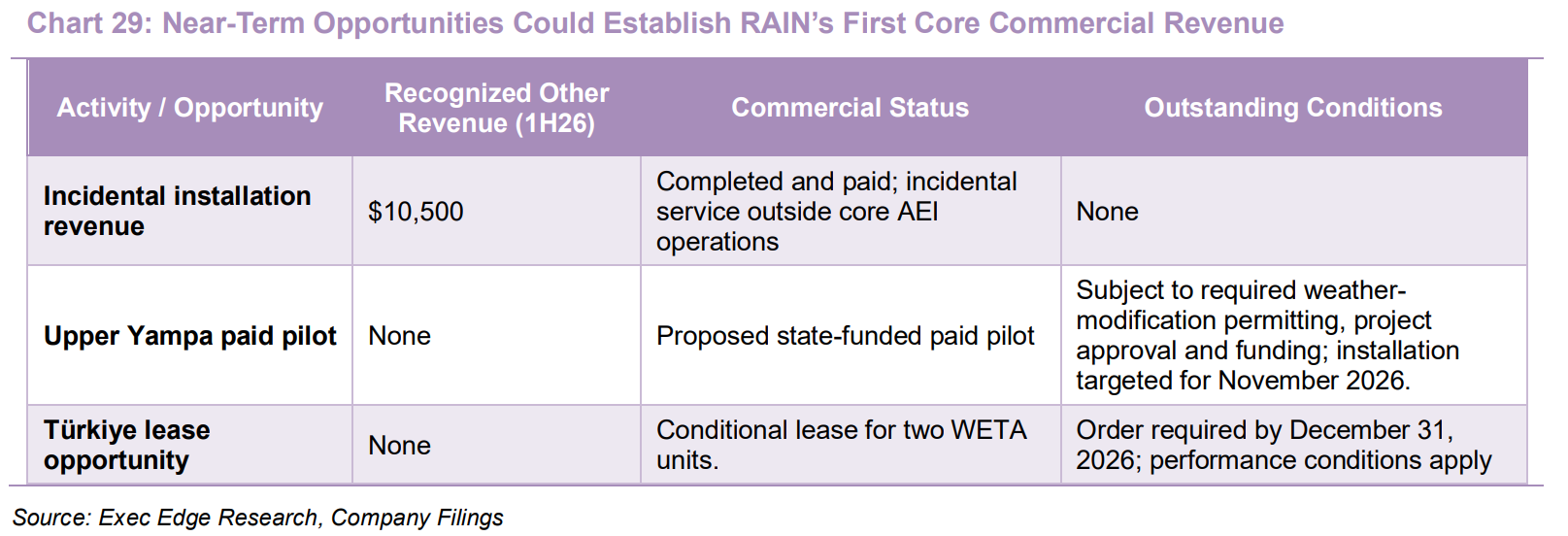
- RAIN’s financial opportunity rests on converting a potentially compelling customer value proposition into paid contracts and repeatable project economics. Revenue of $10,500 in 1H26 came from an incidental installation, with core atmospheric enhancement operations still pre-revenue. The proposed Upper Yampa paid pilot and conditional Turkey lease represent the most visible near-term routes to initial core commercial revenue. If approved, funded and ordered, these opportunities could begin establishing observable pricing, payment structures and cash-collection patterns across RAIN’s service, lease and purchase models.
- Management’s La Sal analysis and the RAIN-commissioned Texas agricultural-benefit study illustrate potential customer value. At La Sal, management estimated that WETA generated approximately 8,750 acre-feet of incremental water during the 2025-26 winter at an equivalent cost of roughly $10 per acre-foot. The Texas study estimates $44.2 million of annual direct agricultural benefits from one additional inch of rainfall across 37 counties and $360.5 million of discounted benefits over ten years, using a 4.1% discount rate. We believe the first commercial contracts will therefore be important in establishing how customer value translates into pricing, installation-cost recovery, recurring service revenue and project-level margins.
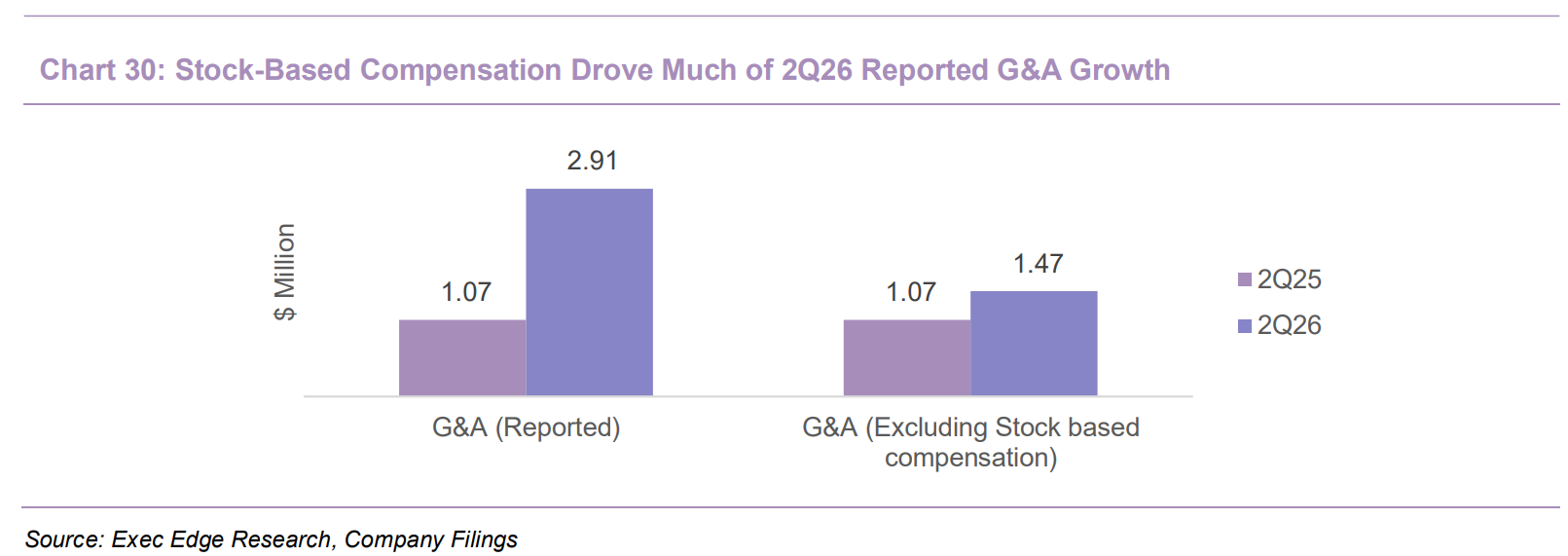
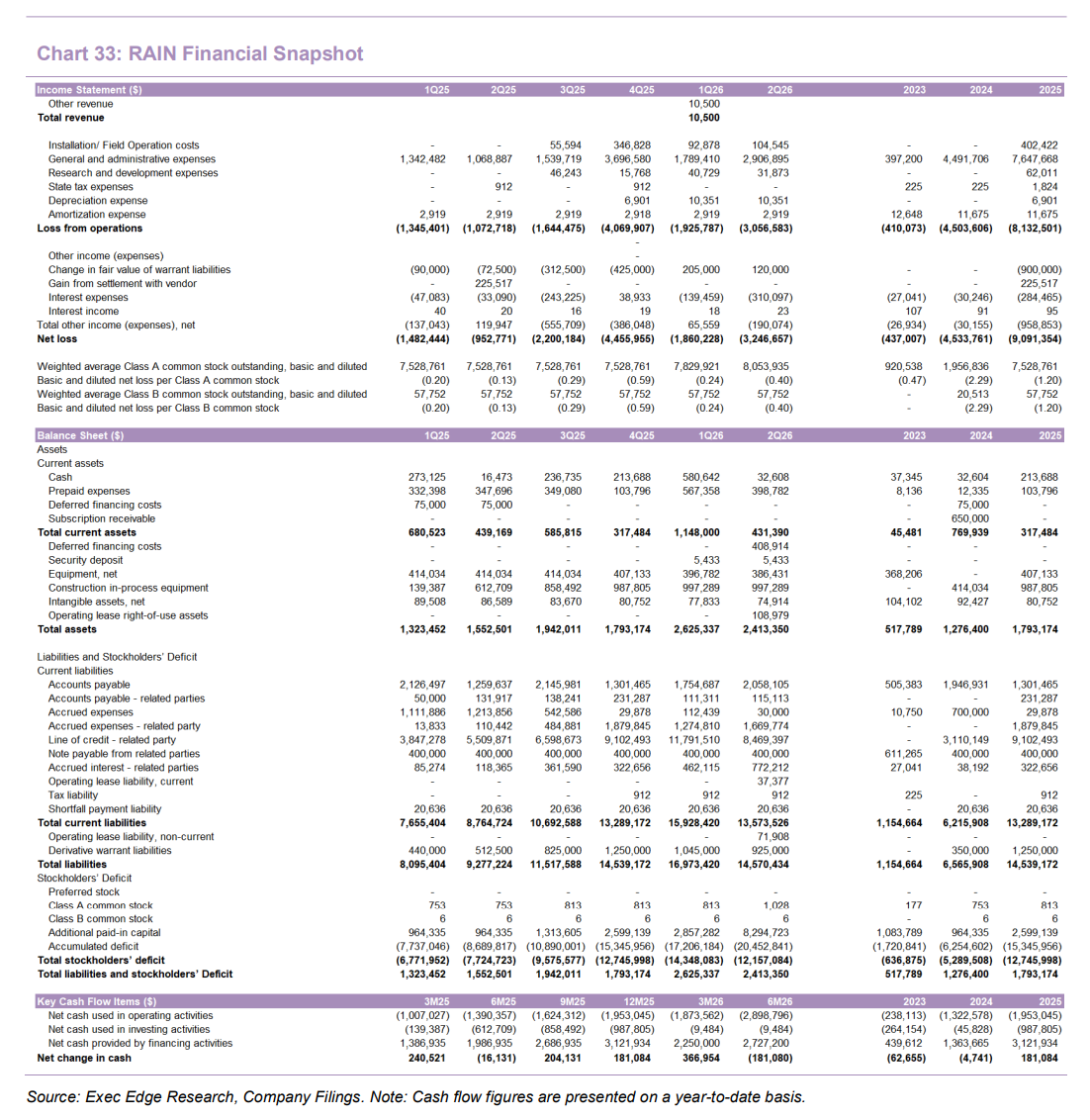
- Stock-based compensation accounted for much of 2Q26 reported G&A growth, while G&A excluding that expense increased more moderately. The 2Q26 net loss was $3.25 million, compared with $0.95 million in 2Q25, while G&A increased to $2.91 million from $1.07 million. The latest quarter included $1.44 million of stock-based compensation, compared with none a year earlier. Excluding this expense, G&A was approximately $1.47 million, representing 37% y/y growth versus the 172% increase in reported G&A. Immediately vested June awards contributed $1.19 million of non-cash expense, meaning the quarter should not be mechanically annualized to estimate recurring overhead. Across 1H26, G&A of approximately $4.70 million remained substantially larger than field-operations costs of $197,000 and R&D expense of $73,000, reflecting a cost base still centered on corporate and commercialization infrastructure rather than scaled deployments. Stock-based compensation remains a dilutive economic cost, but separating it provides a clearer view of the operating cost base supporting commercialization. We believe RAIN can generate meaningful operating leverage if commercial revenue scales across its established personnel, professional-service and corporate infrastructure, with the pace of contract conversion and incremental hiring determining how quickly that leverage emerges.
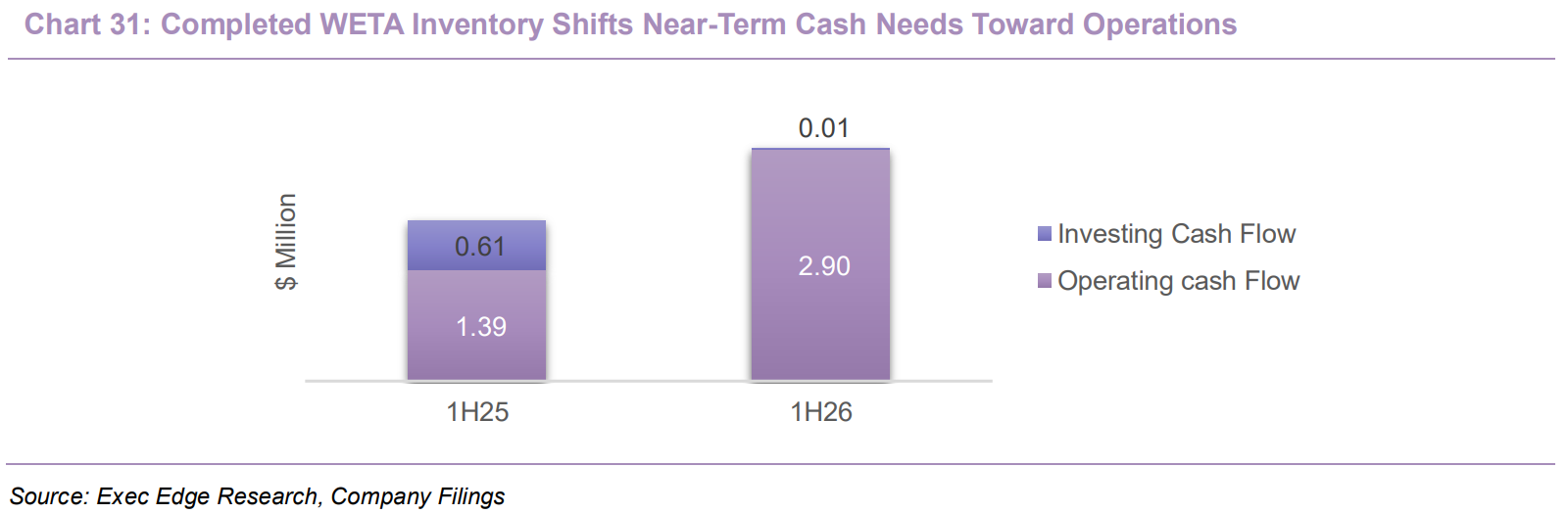
- With its initial WETA inventory largely built, RAIN’s near-term cash requirements have shifted toward field operations and commercialization. Equipment expenditure declined to approximately $9,500 in 1H26 from $613,000 in 1H25. Operating cash outflow increased to $2.90 million from $1.39 million, taking combined operating and investing cash outflow to $2.91 million, approximately 45% above the prior-year period. Related parties also funded approximately $617,000 of G&A expenses directly during 1H26, supplementing cash resources while creating obligations outside reported operating cash outflow. We believe the completed equipment base gives RAIN flexibility to align future manufacturing expenditure with funded deployment demand. The more important cash-flow indicator will be the relationship between customer receipts and installation; monitoring and corporate expenditure as commercial projects begin.
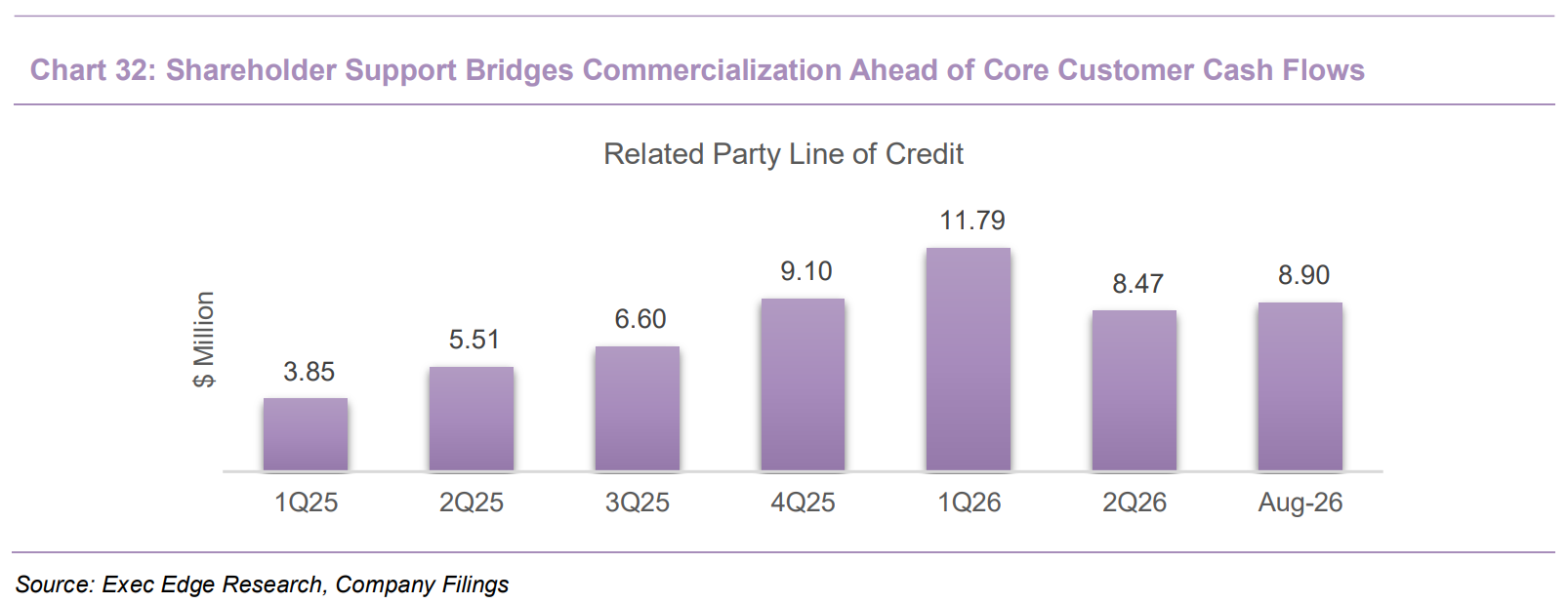
- Related-party support and public-market access have provided RAIN with a funding bridge toward initial commercial deployments. At June 30, 2026, cash totaled approximately $33,000, with current assets of $0.43 million and current liabilities of $13.57 million, resulting in a $13.14 million working capital deficit. Of the company’s current liabilities, $8.47 million represented the outstanding related-party loan balance under the line of credit arrangement with RHY Management, an affiliate of Chairman Harry You. The line of credit, initially established with a $7 million limit, was increased to $10 million in March 2026, and in June 2026, $4 million of the outstanding balance was converted into equity. The increased credit commitment and subsequent debt-to-equity conversion demonstrate RHY’s continued financial support of the Company beyond the original business combination. Approximately $1.5 million of borrowing capacity remained available under the line of credit at June 30, 2026.
- Existing financing obligations mean that new capital must support both commercialization and debt-related commitments. RAIN paid approximately $555,000 of accrued facility interest on August 10, while interest expense increased to approximately $450,000 in 1H26 from $80,000 in 1H25. The 2Q26 filing continued to include a going-concern disclosure. The proposed Tensor transaction also requires RAIN’s outstanding indebtedness, including the RHY line of credit, to be converted, restructured or forgiven on mutually agreed terms as a condition of closing. Continued shareholder backing and broader financing access provide near-term funding avenues, while conversion of the commercial pipeline into customer receipts would begin reducing RAIN’s reliance on external capital.
- RAIN’s expanded financing toolkit provides greater flexibility to fund commercial milestones and diversify its sources of capital. The approximately $3.5 million at-the-market program with Needham permits incremental equity issuance, allowing fundraising to be staged rather than concentrated in a single transaction. By August 26, 2026, approximately 1.45 million shares had been issued through the program for approximately $2.4 million of gross proceeds, leaving approximately $1.1 million of gross program capacity. The broader $25 million shelf registration provides a framework for potential future securities issuance, although it does not represent committed funding or available cash. Continued access to public-equity financing also depends on listing compliance; RAIN requested a Nasdaq hearing on August 21 following a minimum market value deficiency, staying any suspension or delisting pending the hearing process. Nasdaq compliance also directly affects the proposed Tensor transaction: either party may terminate the binding letter of intent if RAIN’s securities are delisted, while closing requires Nasdaq approval to list the combined company’s common stock. ATM issuance, the June debt conversion and compensation-related share issuance increased outstanding Class A shares from 8.13 million at December 31, 2025 to 11.73 million by August 26, a calculated increase of approximately 44%. The resulting trade-off is greater financial flexibility against a larger share base. We believe incremental financing can support shareholder value where it funds paid deployments, repeat business and progressively stronger cash coverage, although near-term issuance increases dilution before core commercial revenue has been demonstrated.
- We believe RAIN’s financial inflection will be defined by whether initial commercial deployments validate pricing, cash recovery and repeatable site economics. The existing equipment base can support initial projects without substantial near-term manufacturing expenditure, while shareholder support, the ATM program and the broader shelf provide potential financing pathways during commercialization. Successful conversion of Upper Yampa, Turkey or other pipeline opportunities could begin demonstrating how RAIN’s customer value proposition translates into revenue, gross profit and operating cash flow. As that evidence develops, external capital could increasingly fund deployment-led growth rather than primarily supporting pre-revenue corporate expenditure.
Commercialization and Strategic Execution Provide Paths to a Higher Valuation
- Disclaimer: Exec Edge does not publish proprietary estimates, ratings, price targets, or investment recommendations. The valuation discussion below is illustrative only and is based on company filings, management commentary, and third-party data and estimates. It does not constitute a recommendation, price target, rating, or prediction of future pricing.
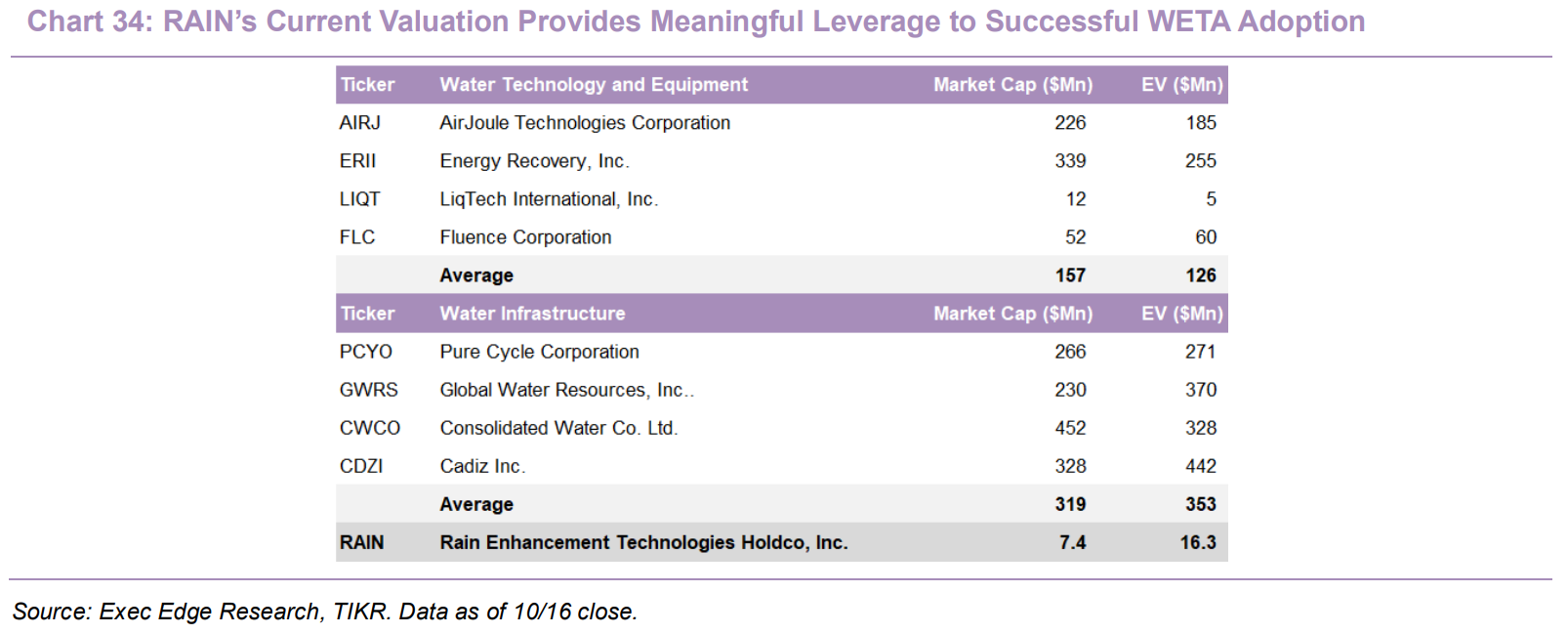
- RAIN’s current valuation reflects its pre-revenue commercialization stage while providing meaningful potential leverage to successful WETA adoption. At a market capitalization of $7.4 million and enterprise value of $16.3 million, RAIN trades at a substantial absolute valuation gap to public water-technology and water-infrastructure companies. The selected Water Technology and Equipment companies have an average market capitalization of approximately $157 million and enterprise value of approximately $126 million, compared with approximately $319 million and $353 million, respectively, for the selected Water Infrastructure companies. AirJoule provides the closest thematic comparison through its early-stage atmospheric water technology, while Energy Recovery illustrates the value associated with proprietary water technology supported by scaled commercial adoption. Cadiz provides a development-stage reference for monetizing differentiated water infrastructure, while Consolidated Water and Global Water Resources represent more mature operating models with established customers and recurring relationships. We believe the valuation gap illustrates the potential value available as RAIN establishes commercial validation, revenue visibility and a broader customer base.
- WETA’s asset profile and customer-value benchmarks provide an initial framework for assessing commercial economics. WETA is depreciated over an estimated useful life up to 15 years, while its proposed one-to-many model could support attractive site economics as customers are added. Management estimates that La Sal produced incremental water at approximately $10 per acre-foot, while the Texas analysis modeled a 5.66x ten-year customer benefit-cost ratio. Commercial contract terms will ultimately determine how much of this potential value RAIN captures through revenue and margins.
- WETA commercialization and the proposed Tensor combination provide the principal potential catalysts for re-rating. WETA milestones include approval and funding of the Upper Yampa paid pilot, receipt of the initial two-unit Turkey lease order, additional results from La Sal and Weld County, continued FREA development and publication of further technical results. Successful execution could move RET toward paid deployments, strengthen revenue visibility and demonstrate the scalability of its one-to-many model. The Tensor transaction introduces a second potential growth platform, with closing targeted for 1Q27, subject to a definitive agreement, debt restructuring, Nasdaq approvals and at least $25 million of gross financing. Under the proposed terms, existing RAIN shareholders would own approximately 10% of the combined company before dilution from the contemplated financing. Additional disclosure regarding Tensor’s commercial traction, financial profile and final transaction terms would allow investors to assess the combined company more directly. RAIN’s valuation therefore remains milestone-driven, with progress across WETA commercialization and the proposed transaction providing the principal pathways to re-rating.
Risks
- Scientific validation. RAIN’s commercial proposition depends on demonstrating that atmospheric ionization produces measurable, repeatable precipitation enhancement. Although La Sal and other deployments have expanded the evidence base, outcomes can vary by location, season and weather pattern, while separating system effects from natural variability remains technically demanding. Limited-duration or geographically concentrated datasets may therefore slow customer decisions, regulatory acceptance and contract expansion. Continued instrumented deployments, standardized measurement and independent review remain important to strengthening the technology’s credibility.
- Commercial conversion. RAIN remains at an early commercialization stage, with limited recognized revenue and several opportunities still structured as evaluations, pilots or conditional engagements. Management has identified converting validation and pipeline activity into orders as a near-term priority, including the proposed Upper Yampa paid pilot and Turkey lease opportunity. Procurement cycles may be prolonged by budgeting, technical diligence and the shared-area benefits of rainfall enhancement, which can complicate customer attribution, payment responsibility and progression toward recurring contracts.
- Funding requirements. RAIN’s continued product development, field validation, commercialization activity and public-company costs are expected to require additional capital before operations become self-funding. At June 30, 2026, the company had approximately $33,000 of cash and a $13.14 million working-capital deficit, and its 2Q26 filing continued to include a going-concern disclosure. Related-party lending, at-the-market equity issuance and the conversion of related-party debt have provided financing flexibility, while also illustrating RAIN’s reliance on external capital and shareholder support. Future funding availability, pricing and timing remain market-dependent. Additional equity could dilute existing holders, while constrained access to capital could moderate the pace of deployments, hiring and commercial expansion.
- Proposed Tensor combination. RAIN’s binding letter of intent with Tensor remains subject to due diligence, a definitive agreement, shareholder and Nasdaq approvals, debt restructuring and at least $25 million of gross financing. The transaction could be delayed, renegotiated or not completed. If completed on the proposed terms, existing RAIN shareholders would own approximately 10% of the combined company before financing dilution. Limited financial information is currently available regarding Tensor, making its potential contribution difficult to assess.
- Weather dependence. System performance remains linked to atmospheric conditions, including cloud formation, humidity, wind direction and natural updrafts, and RAIN cannot generate precipitation under clear-sky conditions. Weather variability can affect operating windows, measured outcomes and customer satisfaction across sites and seasons. The stated contractual precipitation guarantee may support adoption, but it also makes agreed baselines, measurement methods and remedy terms economically important. Climate shifts or unfavorable seasonal patterns could reduce suitable operating periods or delay evidence collection.
- Deployment scaling. RAIN’s strategy requires moving from a small installed base toward reliable, repeatable deployment across multiple regions. That transition involves manufacturing capacity, supplier qualification, quality control, site access, installation logistics, remote monitoring and field maintenance. The company has not yet established all supplier relationships or demonstrated high-volume production, and specialist personnel may be harder to source in remote areas. Scaling faster than operating systems mature could raise costs or affect service quality; slower scaling could defer revenue conversion and local-density economics.
- Regulatory acceptance. Weather-modification activity is governed through a combination of state, local, land-use and, in some markets, national requirements. Approval processes can include applications, public hearings, operating notices and site permissions, with timing and standards varying by jurisdiction. Recent project discussions indicate that public-sector support can facilitate adoption, but approvals may still add lead time. Public concerns about efficacy, environmental effects or unintended weather outcomes could also influence legislation, permitting, community acceptance and the pace of geographic expansion.
- Competitive defensibility. RAIN competes with established water-supply alternatives, conventional cloud seeding and emerging weather-enhancement technologies. Traditional approaches benefit from longer operating histories, institutional relationships and larger research datasets. At the same time, portions of atmospheric ionization technology may be based on publicly available knowledge, and the current patent portfolio offers limited protection for the core platform. Competitive advantage therefore depends substantially on engineering execution, operating know-how, site-selection expertise, proprietary datasets and the ability to produce superior validated economics.
- Reporting controls. RAIN identified a material weakness in internal control over financial reporting and restated previously issued interim financial statements for an insurance-financing liability. Management has outlined remediation measures, but their effectiveness will require continued testing as reporting obligations and transaction complexity increase. The company must also maintain Nasdaq’s financial and market-value requirements following prior deficiency notices. A recurrence of reporting deficiencies or listing non-compliance could increase compliance costs, reduce investor confidence and constrain access to capital.
Subscribe to our Weekly Newsletter to Receive All Research
Contact: