Download the Complete Report Here
 Local Bounti Corporation (LOCL)
Retail Momentum, Food-Safety Relevance, and Yield Gains Strengthen the Growth Story; EBITDA Progress Continues
- Key Takeaways:
- Revenue increased 14% y/y and 4% q/q to $13.9 million, while adjusted EBITDA loss improved 17% y/y to $5.8 million.
- Progress toward positive adjusted EBITDA continues, supported by higher revenue, lower adjusted G&A, and ongoing yield and cost-efficiency initiatives.
- Commercial momentum broadened across new accounts and SKUs, including a planned ~400-store single-serve salad-kit pilot this fall.
- Network yields remain at record levels, with California production improving ~10%; recent $12.5 million investment strengthens near-term liquidity.
- Shares trade at ~0.51x LTM sales, leaving rerating potential if margin recovery, EBITDA improvement, and balance-sheet execution continue.
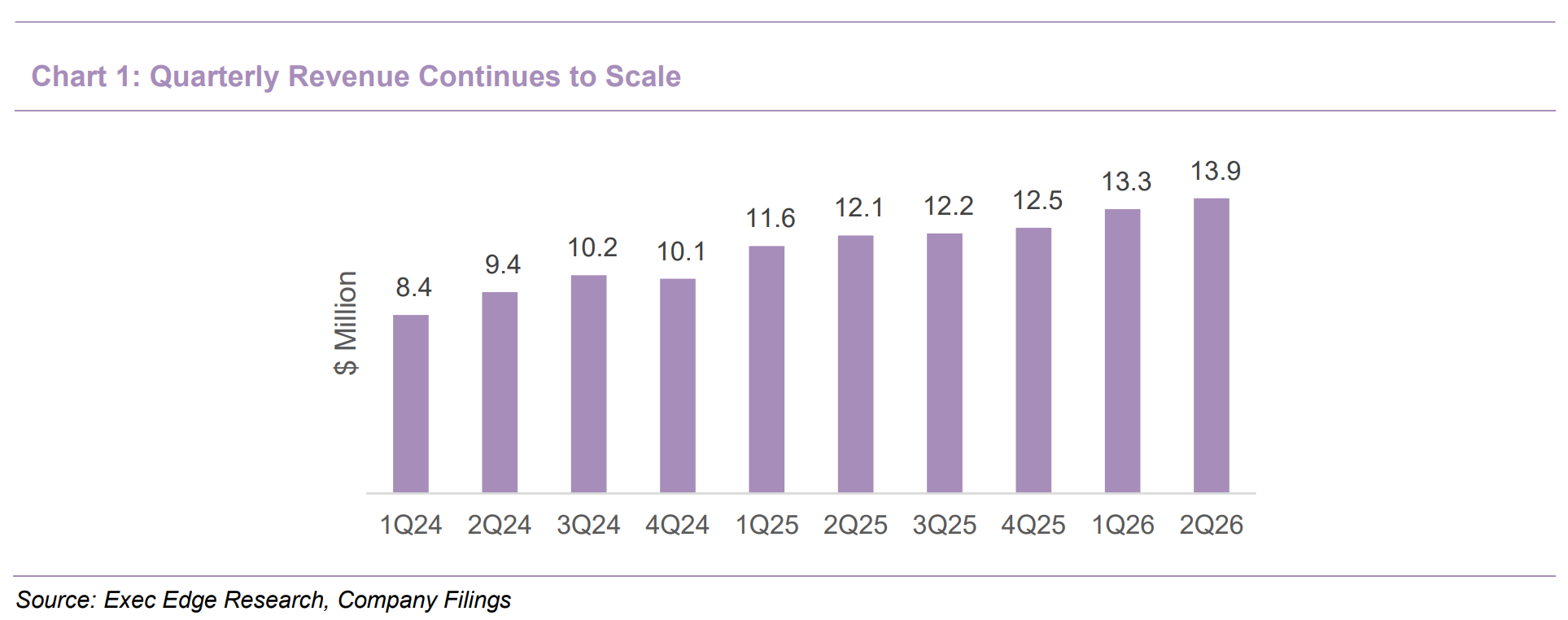
- LOCL’s 2Q results reinforce the transition from facility build-out toward yield, customer mix, SKU expansion, and operating leverage. Revenue increased 14% y/y to $13.9 million from $12.1 million and rose ~4% sequentially from $13.3 million, driven by higher production and sales from Georgia, Texas, and Washington. 1H26 revenue reached $27.2 million, up ~15% from $23.7 million in 1H25, extending the growth trend as LOCL converts higher output from its installed asset base into retail sales. Adjusted EBITDA loss narrowed 17% y/y to $5.8 million from $7.1 million and was broadly stable versus $5.7 million in 1Q26. The y/y improvement indicates that higher revenue and tighter cost discipline are beginning to translate into operating leverage despite temporary gross-margin pressure during the quarter. With the three Stack & Flow-enabled facilities already at full harvestable capacity, incremental growth is increasingly coming from better asset productivity, although further gross-margin improvement is needed to accelerate progress toward positive adjusted EBITDA.
- Food safety and traceability emerged as an important strategic theme this quarter, increasing retailer focus on the attributes that differentiate LOCL’s controlled-environment model. Retail sourcing conversations that historically centered on cost and availability are increasingly incorporating water sourcing, environmental control, traceability, and food-safety monitoring. This shift is visible more broadly, with FMI’s 2026 research indicating that 31% of responding retailers plan to add food-traceability technology capabilities this year, while recent produce-safety events have highlighted the commercial impact of supply-chain exposure, with U.S. fresh-lettuce unit sales falling 9% w/w during July’s Cyclospora outbreak, per NielsenIQ data. Against this backdrop, LOCL’s seed-to-package controlled environment and closed-loop water management reduce exposure to several variables associated with open-field agriculture, including runoff, wildlife, and changing outdoor conditions. With approximately 13,000 retail doors already serviced, this strengthens LOCL’s positioning with retailers seeking more traceable, controlled, and resilient fresh-produce supply and could support deeper commercial relationships over time.
- Commercial momentum continued to build as previously announced wins converted into active placements and new accounts broadened distribution entering 2H26. The six-SKU Harris Teeter rollout across more than 250 stores and a separate large regional retailer covering approximately 160 stores are now fully launched and tracking in line with expectations. The account base expanded further after quarter-end, with a new Mid-South retailer launching five SKUs across approximately 66 stores in July and a Rocky Mountain partner beginning shipments of four SKUs across approximately 110 stores in early August. LOCL also received bid awards during 1H26 extending supply arrangements with multiple national retail accounts across baby leaf lettuce and organic butter lettuce through 1Q27. The progression from account wins to multi-SKU launches and longer supply commitments provides greater demand visibility and should support more efficient crop planning and facility utilization as retail programs scale.
- The single-serve salad-kit relaunch adds a potentially meaningful value-added growth vector, while Romano Caesar and arugula continue to broaden LOCL’s opportunity within existing retail relationships. Following discussions with a major retailer, LOCL agreed to relaunch its single-serve salad-kit line through a Mid-Atlantic pilot covering approximately 400 stores this fall. The initiative builds on encouraging performance from the family-sized Romano Caesar Salad Kit, which recorded a 75% increase in baseline velocity in 4Q25; an additional distribution center launched in May 2026 and has since reached velocities comparable with the existing network. Arugula also remains an active growth opportunity following successful 2025 launches from Washington and Texas, particularly where conventional supply has struggled to consistently meet retailer demand. Together with baby leaf and organic butter lettuce program extensions through 1Q27, these initiatives give LOCL additional ways to deepen shelf presence and expand revenue per retail relationship without requiring a proportionate increase in physical capacity.
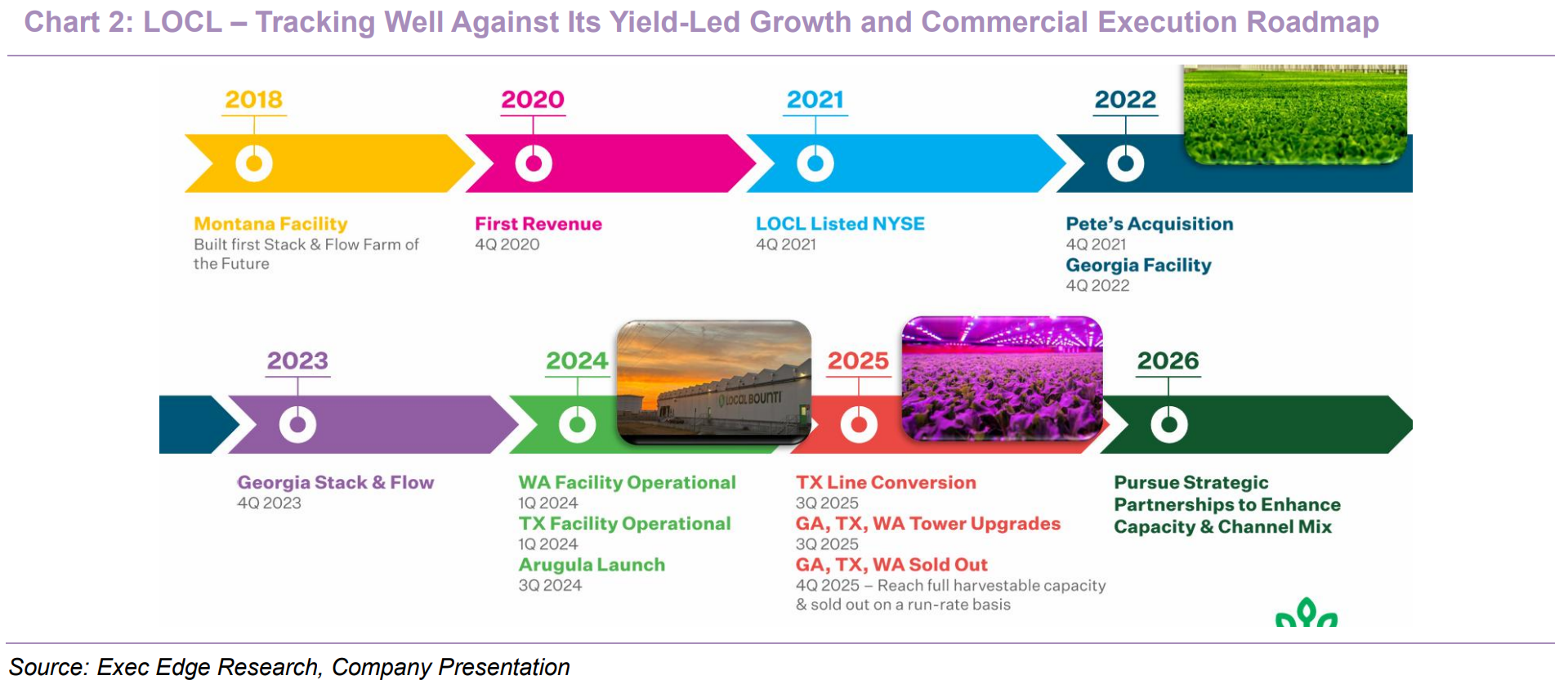
- Yield remains the primary operating growth lever, with Georgia, Texas, and Washington sustaining the approximately 10% higher run-rate capacity benefit from tower upgrades completed in 4Q25. The three Stack & Flow-enabled facilities continue to operate at the highest yield levels in company history, with tower upgrades completed in 4Q25 supporting approximately 10% higher run-rate yield capacity. Revenue increased 14% y/y in 2Q26, driven by increased production and sales from Georgia, Texas, and Washington, providing evidence that higher facility productivity is translating into incremental volume. These gains allow LOCL to increase production from the existing facility base and support continued revenue growth without adding comparable new capacity.
- California is beginning to provide a second proof point for the yield-led strategy, while network-wide cost initiatives broaden the path to improved unit economics. Selective investments at the California facilities remain targeted to generate as much as a 20% improvement in yields, with initial work at one location already driving an approximately 10% increase in total production versus the prior-year period. At the same time, more efficient seeding practices reduced seed costs approximately 20% y/y, while additional savings are being pursued across procurement, maintenance, labor efficiency, and freight management. These initiatives complement the ~10% yield-capacity improvement across Georgia, Texas, and Washington and reinforce the broader strategy of extracting more output at lower unit costs from the existing network. The benefits were partly obscured in 2Q26 by temporary Georgia packing inefficiencies, making gross-margin recovery an important 2H26 indicator of whether these operating gains are translating into reported profitability.
- Strategic partnership discussions are gaining relevance as retailer interest in controlled supply increases, while LOCL continues to keep future capacity tied to committed demand. Food-safety concerns are increasing the urgency of strategic retailer discussions, while LOCL reaffirmed its existing demand-backed approach to future capacity. Additional Stack & Flow-enabled capacity, including potential Midwest expansion, remains under review, with timing and configuration being evaluated alongside retailer discussions and product-specific requirements. This approach allows LOCL to prioritize growth from higher yields and deeper retail penetration before committing capital to additional capacity. A demand-backed expansion model could help LOCL scale distribution while limiting the capital intensity associated with its earlier build-out phase. This becomes increasingly relevant as retailers place greater emphasis on traceability, food safety, and regional supply reliability.
- Adjusted gross margin temporarily moderated to 27% as Georgia’s channel diversification introduced packing inefficiencies, while underlying yield and cost trends remained constructive. Adjusted gross profit was $3.7 million, essentially unchanged from 2Q25, while adjusted gross margin declined approximately 300 bps y/y from 30% and approximately 200 bps sequentially from 29%. The moderation reflected packing inefficiencies created as LOCL diversified Georgia’s channel mix; those processes have since been refined and implemented. In our view, the decline did not reflect deterioration in facility yields, which remained at record levels, but it highlights the near-term complexity that can accompany broader retail mix and package formats. A return toward the 29%-30% adjusted gross-margin range alongside continued revenue growth would provide a stronger indication that LOCL’s retail mix and cost initiatives are converting into better unit economics.
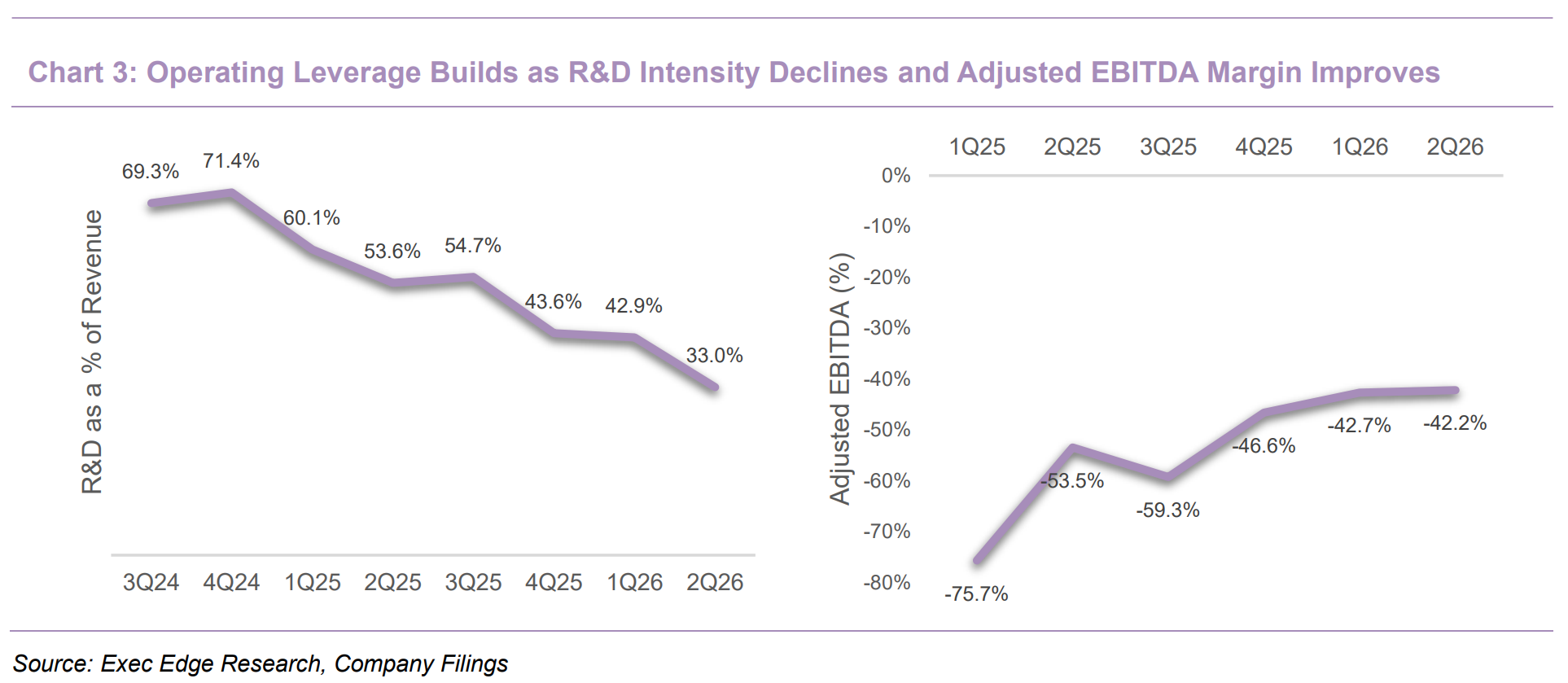
- Operating leverage continued to improve as LOCL shifted spending toward commercial expansion while reducing development and corporate overhead. Sales and marketing expense increased approximately 20% y/y to $2.9 million in 2Q26 and 14% to $5.1 million in 1H26, broadly in line with revenue growth of approximately 15%, suggesting the recent rollout cadence has not required disproportionate commercial spending. Retailer wins, SKU breadth, program duration, and product velocity remain the more relevant commercial indicators, with recent launches across 250+ Harris Teeter stores, a 160-store regional account, new Mid-South and Rocky Mountain programs across 66 and 110 stores, respectively, and the planned 400-store salad-kit pilot indicating that higher selling investment is translating into distribution growth. At the same time, operating expenses declined approximately 11% y/y to $15.0 million, with R&D down 29% to $4.6 million and adjusted G&A down 17% to $4.1 million. The shift is consistent with LOCL moving from heavier technology and facility-ramp spending toward scaled commercial execution, while keeping overhead growth below revenue growth.
- Adjusted EBITDA loss improved 17% y/y, advancing LOCL toward management’s goal of positive adjusted EBITDA. Net loss narrowed to $19.8 million from $21.6 million in 2Q25, supported by lower operating expenses and a modest reduction in net interest expense. Sequentially, the increase in GAAP net loss from 1Q26 was largely attributable to a roughly $6.6 million swing in warrant fair value accounting. More importantly, adjusted EBITDA loss improved to $5.8 million from $7.1 million y/y, while the 1H26 loss narrowed approximately 24% to $11.5 million from $15.3 million. The continued improvement, alongside higher revenue and tighter cost discipline, supports management’s view that the business is steadily narrowing the gap to positive adjusted EBITDA.
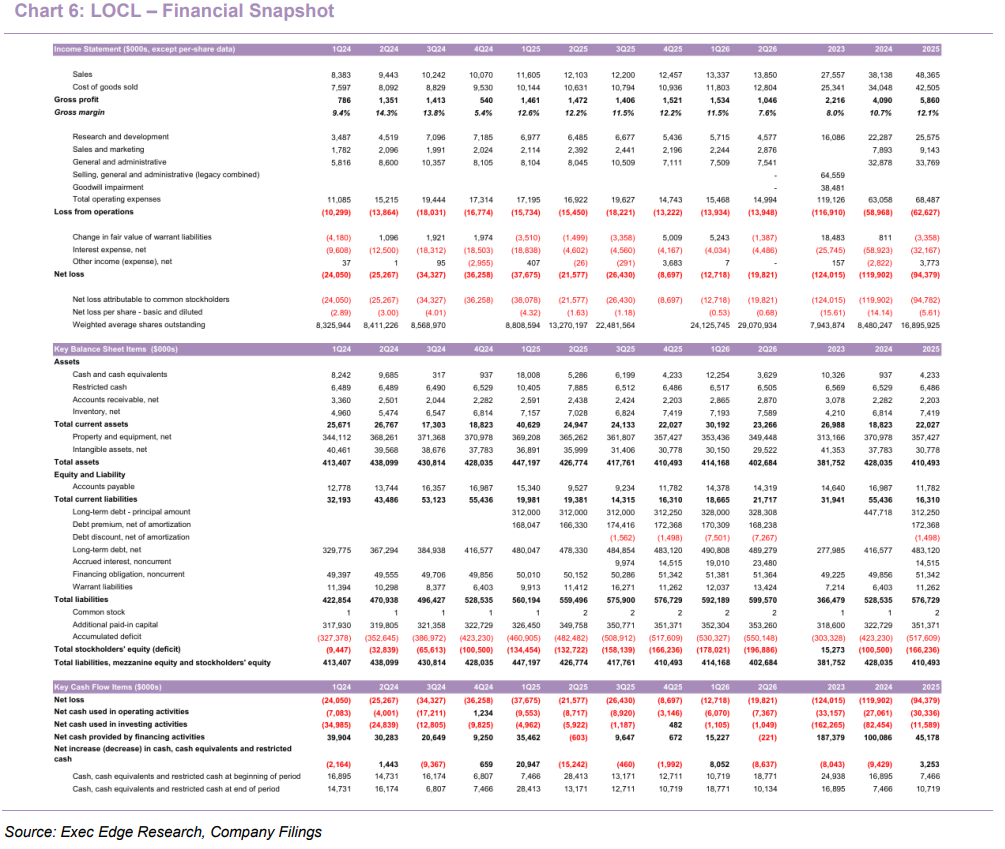
- Cash consumption improved as the business moved beyond the heavier facility build-out phase, although liquidity remained modest at quarter-end ahead of the subsequent financing. Net cash used in operating activities improved approximately 26% to $13.4 million in 1H26 from $18.3 million in 1H25, while investing cash use declined approximately 80% to $2.2 million from $10.9 million as construction spending normalized. Cash, cash equivalents, and restricted cash declined to $10.1 million at June 30 from $18.8 million at the end of 1Q26, with working capital narrowing to approximately $1.5 million. Inventory remained relatively stable at $7.6 million versus $7.4 million at year-end despite new retail programs ramping, indicating that the liquidity draw was driven primarily by continued operating cash consumption rather than inventory build. The lower capital-spending burden is constructive, but further revenue growth, margin recovery, and EBITDA improvement remain necessary to support stronger internal cash generation and reduce reliance on external capital.
- Leverage remains elevated, keeping balance-sheet discipline central to the broader profitability and cash-generation story. LOCL had approximately $302.8 million of principal outstanding under the Cargill Senior Facility and $328.3 million of total long-term debt principal at June 30. Reported long-term debt was approximately $489.3 million, primarily reflecting the debt premium recorded in connection with the 2025 restructuring. While the restructuring reduced prior obligations and the business is now operating with a lower capital-spending burden, the absolute debt load remains significant relative to LOCL’s current revenue base and cash generation, making sustained EBITDA improvement and lower cash consumption critical to improving financial flexibility.
- The subsequent $12.5 million strategic investment and related Cargill amendments materially improve near-term liquidity and financial flexibility. U.S. Bounti’s additional investment brings total strategic capital committed in 2026 to $27.5 million and was structured through a 7.0% convertible note maturing in August 2031, initially convertible at $1.37 per share, together with a 1.0 million-share warrant at $0.125. PIK interest reduces near-term cash requirements, while conversion of the initial principal alone could add approximately 9.1 million shares. In connection with the financing, Cargill waived a minimum-liquidity covenant default, reset required liquidity to $3.5 million through March 2027 and $2.0 million thereafter, and permitted certain 2027 interest to be paid in kind, subject to conditions. These measures extend LOCL’s liquidity runway, but continued improvement in adjusted EBITDA and operating cash flow remains necessary to address the company’s leverage and reduce reliance on external capital.
- 2H26 setup remains constructive, with new retail programs, sustained yield gains, and continued cost actions providing multiple levers for sequential improvement. Management expects revenue and the adjusted EBITDA loss rate to continue improving through 2026, with revenue growth and cost discipline remaining the primary drivers toward breakeven. Entering 3Q, LOCL is carrying forward $13.9 million of quarterly revenue, new launches across approximately 66 Mid-South and 110 Rocky Mountain stores, sustained ~10% higher run-rate yield capacity across Georgia, Texas, and Washington, and early production benefits from the California optimization program. The ~400-store single-serve salad-kit pilot expected this fall adds another potential growth driver. The key 2H26 proof points are continued sequential revenue growth, recovery in adjusted gross margin from 27%, and further narrowing of the $5.8 million adjusted EBITDA loss as LOCL progresses toward positive adjusted EBITDA.
Operating Progress Supports an Execution-Led Valuation Recovery Case
- Disclaimer: Exec Edge does not publish proprietary estimates, ratings, price targets, or investment recommendations. The valuation discussion below is illustrative only and is based on company filings, management commentary, and third-party data and estimates. It does not constitute a recommendation, price target, rating, or prediction of future pricing.
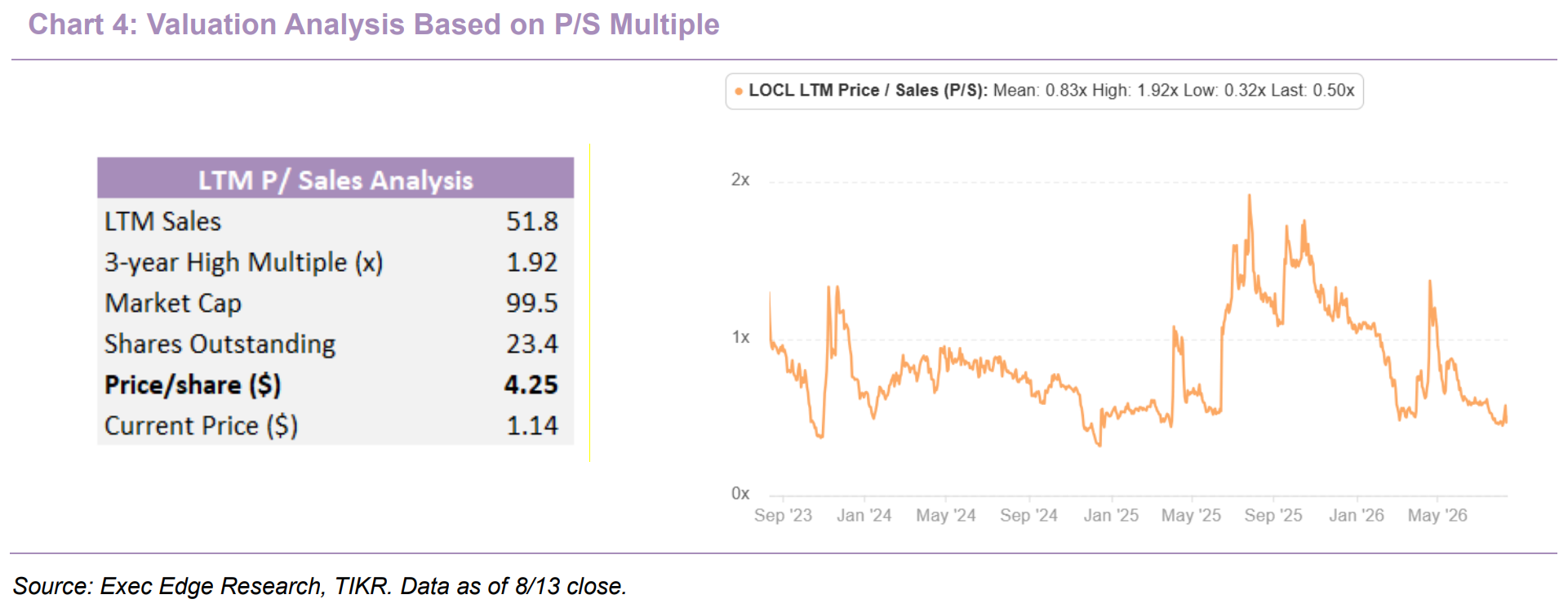
- LOCL trades near the lower end of its historical valuation range despite recent operating improvement. LOCL currently trades at 0.51x LTM sales versus a three-year high multiple of 1.92x and a three-year mean of 0.83x. Applying the historical high multiple to LTM sales of $51.8 million implies an illustrative market capitalization of $99.5 million, or $4.25 per share. Importantly, this framework does not require aggressive forward revenue assumptions; rather, it reflects potential multiple recovery if investors gain confidence that LOCL’s recent execution improvements, including higher revenue, record facility yields, lower adjusted G&A, normalization of temporary gross-margin pressure, and narrowing adjusted EBITDA losses, are sustainable.
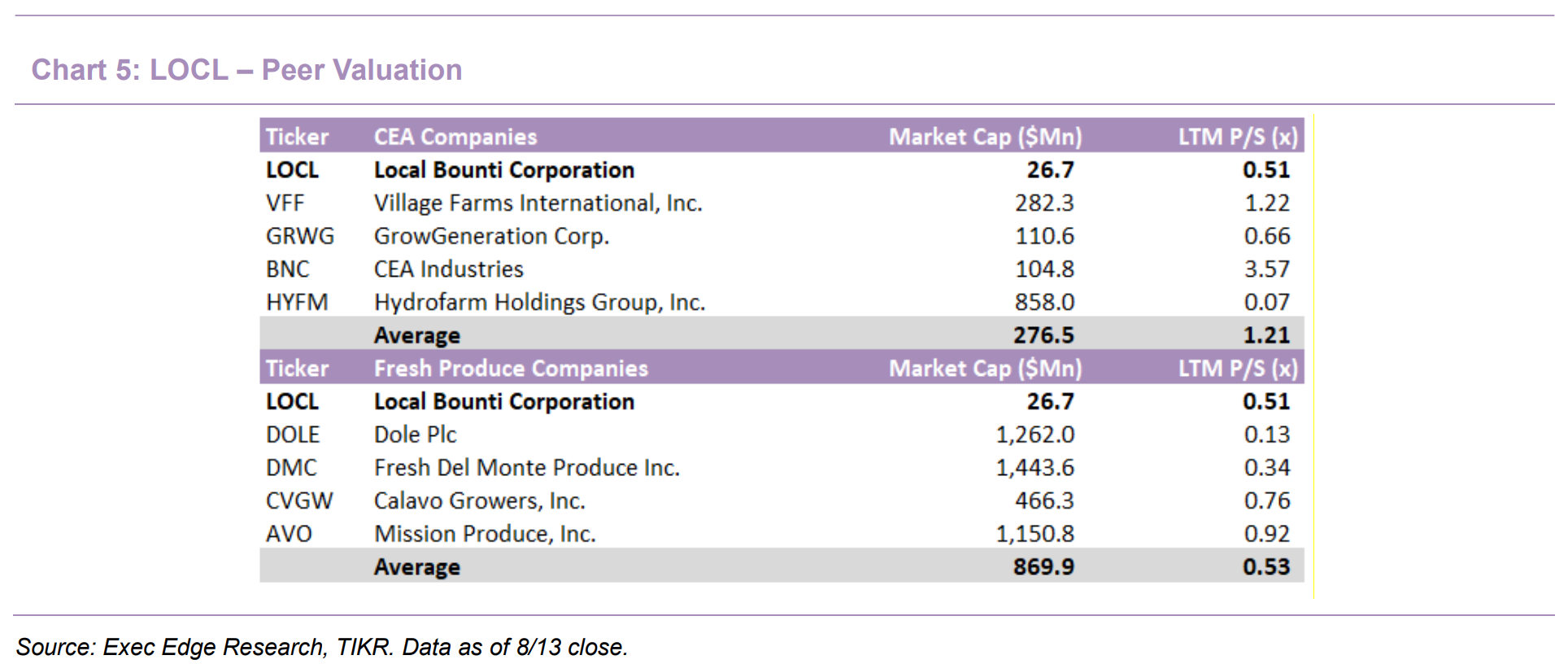
- Relative valuation remains nuanced across the CEA-linked peer set, while traditional fresh-produce peers provide a useful valuation anchor. LOCL trades at 0.51x LTM sales, below Village Farms at 1.22x and GrowGeneration at 0.66x, while remaining above Hydrofarm at 0.07x and below the headline CEA-linked peer average of 1.21x, which is elevated by CEA Industries at 3.57x. Against traditional fresh-produce companies, which average 0.53x LTM sales, LOCL now trades at a modest discount despite its patented Stack & Flow platform, approximately 13,000-door retail footprint, recent double-digit revenue growth, and improving adjusted EBITDA trajectory. In our view, sustained execution could support a valuation premium to conventional produce peers if investors increasingly recognize LOCL as a technology-enabled CEA platform rather than a traditional produce supplier.
- The key re-rating triggers remain execution-led rather than purely multiple-led. Continued sequential revenue growth, recovery in adjusted gross margin toward prior levels, further narrowing of the adjusted EBITDA loss, and conversion of recent retail wins into repeatable volume would provide the clearest support for valuation recovery. Strategic investor backing also strengthens the setup, with U.S. Bounti committing an additional $12.5 million following its $15.0 million March investment, bringing total strategic capital committed in 2026 to $27.5 million and strengthening near-term financial flexibility. At the same time, leverage and prospective dilution remain important constraints, meaning a sustained re-rating will ultimately depend on LOCL converting higher facility productivity and broader distribution into stronger margins, lower cash consumption, and improved per-share economics.
Read Exec Edge’s Initiation on Local Bounti Corporation Here
Subscribe to our Weekly Newsletter to Receive All Research
Contact: