Download the Complete Report Here
 Caesarstone Ltd. (CSTE)
Multi-Material Expansion and Margin Recovery Support the Growth Outlook; Valuation Remains Attractive.
- A premium multi-material surfaces platform becoming structurally lighter and more flexible. CSTE designs, develops, sources and markets premium quartz, ICON, porcelain, natural stone and complementary surface products, generating $397.2 million of revenue in 2025, with direct sales contributing 89% of revenue across its largest markets. The company has transitioned quartz production to external partners while retaining product development, quality, brand and customer control, with Lioli providing owned porcelain capacity. This broadens CSTE beyond legacy quartz while reducing fixed manufacturing exposure and increasing sourcing flexibility.
- A differentiated model built on reinforcing sourcing, design, brand and direct-market capabilities supports commercial relevance across materials. CSTE combines partner-led quartz production with proprietary formulations, quality assurance, design know-how, premium brand recognition and local sales infrastructure. ICON provides the clearest proof point, with Australia delivering four consecutive quarters of y/y growth following the full rollout of CSTE’s crystalline-silica-free collection. Porcelain extends the same commercial platform into additional applications, broadening the competitive advantage beyond any single product or manufacturing asset.
- Growth strategy pairs a structural cost reset with targeted commercial and category expansion. CSTE is completing the partner-led production transition, rebuilding North American customer and channel engagement, sustaining Australia’s ICON-led momentum, expanding porcelain and extending brand-led geographic reach. The restructuring targets more than $100 million of annualized savings by 2027 versus 2023, including approximately $22 million from the Bar-Lev closure. Execution is now focused on stabilizing core volumes, improving Lioli’s commercial alignment, expanding channel productivity and mitigating the new U.S. quartz tariffs.
- Material substitution and selective regional recovery broaden CSTE’s addressable opportunity beyond legacy quartz. CSTE’s existing and adjacent categories span approximately 53% of global countertop volume, while engineered quartz is forecast to recover and porcelain offers materially faster growth from a smaller base. Natural stone adds further U.S. optionality, while Australia demonstrates how regulatory change can redirect rather than eliminate premium-surface demand. North America remains the largest earnings opportunity, with renovation, ageing housing stock and material substitution providing recovery potential even before a full housing upcycle.
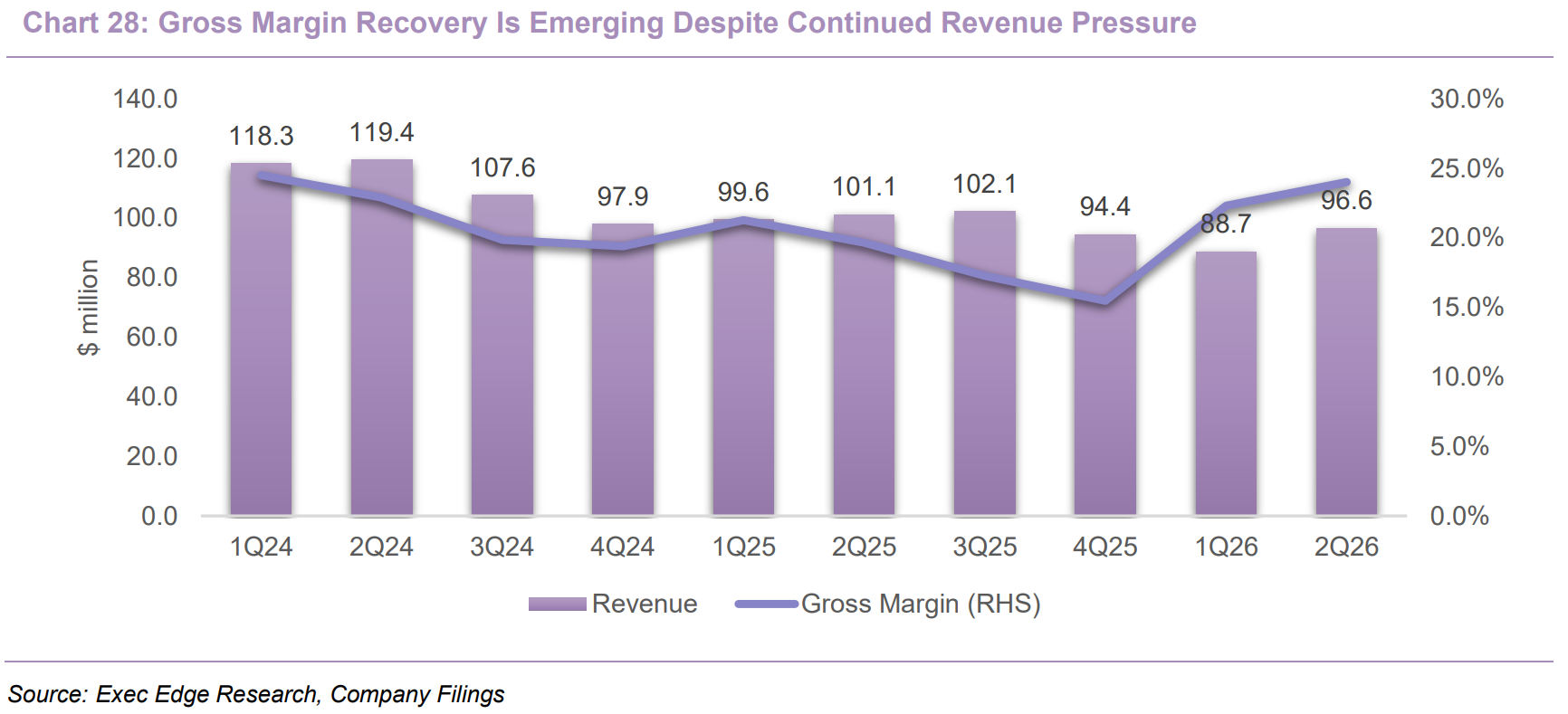
- Margin recovery despite continued topline pressure creates operating leverage and re-rating potential. In 2Q26, revenue declined 4.5% y/y to $96.6 million, but gross margin improved to 24.0% from 19.6% and adjusted EBITDA loss narrowed as the lower-cost operating model began to translate into better underlying economics. We do not issue ratings, recommendations or price targets; however, at approximately 0.41x LTM EV/Sales versus a 1.09x peer median, CSTE retains meaningful re-rating potential if margins prove durable, North American volumes stabilize, tariffs are mitigated and silica-related liabilities remain manageable.
Company Overview
CSTE – Premium Global Surfaces Franchise with a Growing Multi-Material Platform
- Caesarstone Ltd. (CSTE) has evolved from a quartz countertop pioneer into a premium, multi-material surfaces company serving residential and commercial spaces worldwide. Founded in 1987, CSTE built its franchise through engineered quartz countertops and has since broadened its portfolio into porcelain, crystalline-silica-free surfaces, natural stone, sinks, and selected fabrication-related products. The portfolio is primarily installed in kitchens, while additional applications include bathroom vanities, backsplashes, outdoor kitchens, flooring, cladding, façades, furniture, and other interior and exterior surfaces. CSTE markets most products under the Caesarstone brand, with Lioli used for porcelain and separate LOCKEBO and KASKER brands used for certain IKEA products. The company reported 2025 revenue of $397.2 million and offers more than 150 quartz, ICON, and porcelain models. Its products are sold across approximately 60 countries through a combination of direct operations and third-party distributors. CSTE’s positioning centers on premium design, product durability, and a broad palette of colors, finishes, textures, thicknesses, and physical characteristics. Quartz surfaces combine mineral content, polyester, and pigments, while porcelain surfaces use clay minerals, natural minerals, and additives to produce slabs designed for heat, stain, scratch, and UV resistance. This product breadth has expanded CSTE beyond its countertop-focused quartz heritage into a broader surfaces platform spanning multiple materials and applications.
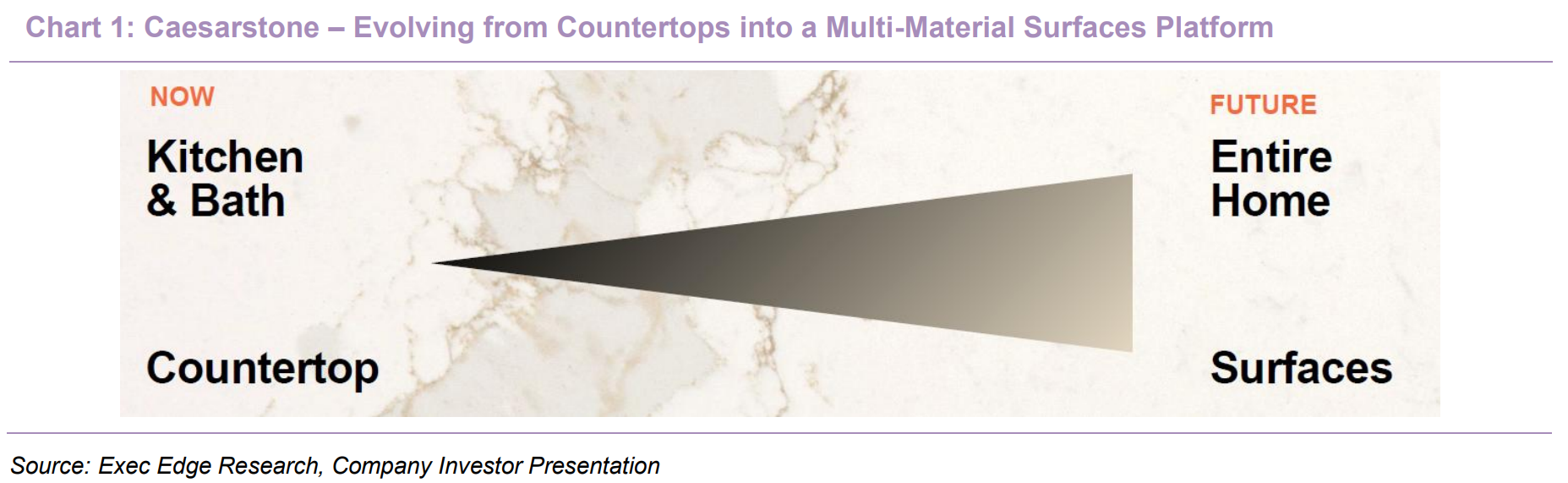
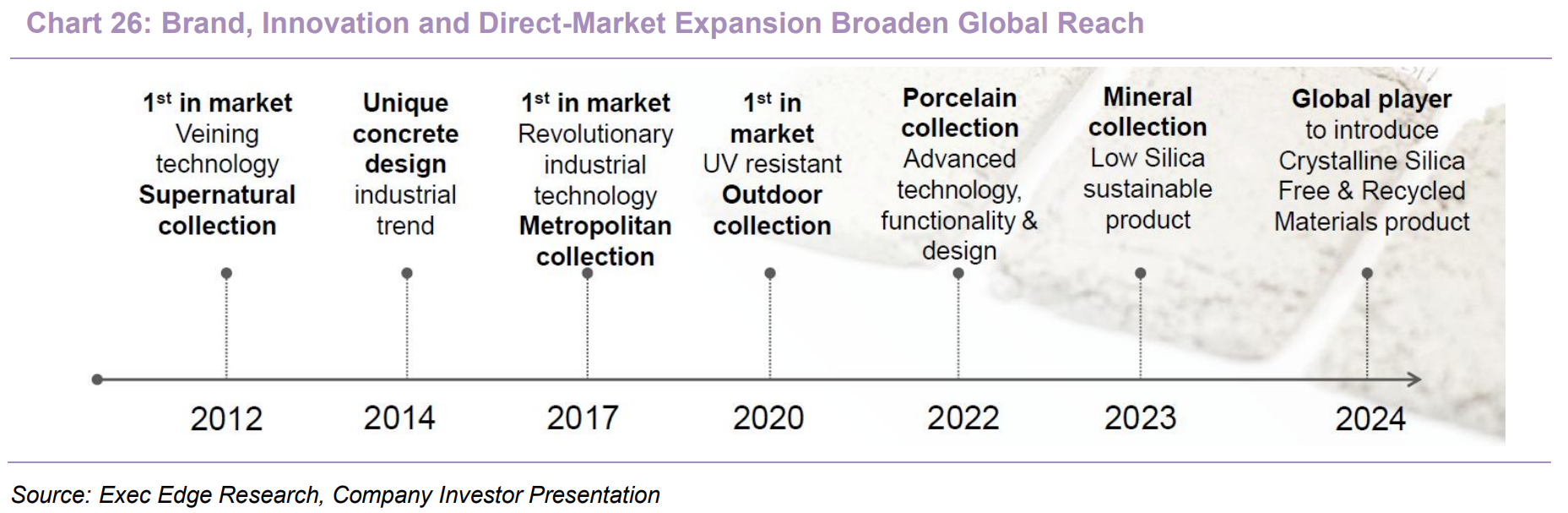
- CSTE’s multi-material portfolio builds on its established quartz franchise to broaden the company’s relevance across materials and applications. Engineered stone remains centered on quartz surfaces, composed on average of approximately 85% minerals blended with polyester and pigments. CSTE markets Classico, Supernatural, Metropolitan, Outdoor, and porcelain collections through a multi-tiered pricing architecture. Supernatural offers natural-stone-inspired designs, Metropolitan reflects industrial textures, and Outdoor is designed for long-term UV exposure. Following the Lioli acquisition, CSTE added porcelain slabs for countertops, flooring, and cladding. Since 2024, CSTE has transitioned its portfolio toward Caesarstone ICON crystalline-silica-free surfaces, which may contain traces of crystalline silica of up to 1% and are made from approximately 80% recycled materials blended with polyester and pigments. The Omicron acquisition added resold natural stone, sinks, fabrication tools, and installation accessories to CSTE’s U.S. assortment. Its distribution locations across Florida, Ohio, Michigan, and Louisiana add established customer and fabricator relationships while broadening CSTE’s exposure to natural stone alongside engineered surfaces.
- The company’s predominantly direct distribution network provides greater control across its largest surface markets. CSTE sells principally to fabricators, wholesalers, resellers, and distributors, which then serve contractors, developers, builders, kitchen-and-bath retailers, architects, designers, and end-consumers. Direct sales represented 89% of 2025 revenue. The company operates direct sales channels in the U.S., Australia, Canada, Israel, the United Kingdom, Sweden, India, Singapore, and Germany, supported by local warehouses, sales teams, and distribution locations in key urban areas. In these markets, CSTE can combine slab sales with third-party-sourced fabrication and installation services for selected channels. The U.S. is the largest market, representing 47.0% of 2025 revenue, followed by Australia at 17.0%, Canada at 13.1%, EMEA at 13.1%, and Israel at 4.9%. CSTE serves other territories through third-party distributors, with indirect-market distributor sales accounting for approximately 11.0% of 2025 revenue. The company’s regional structure includes the U.S., Canada, APAC, EMEA, and Israel teams, while a Rest of World organization manages most third-party distribution partners. This model pairs direct control in major markets with distributor-led access in smaller and less-developed territories, allowing CSTE to distribute products globally while tailoring sales, inventory, service, and marketing activity to local market structures.
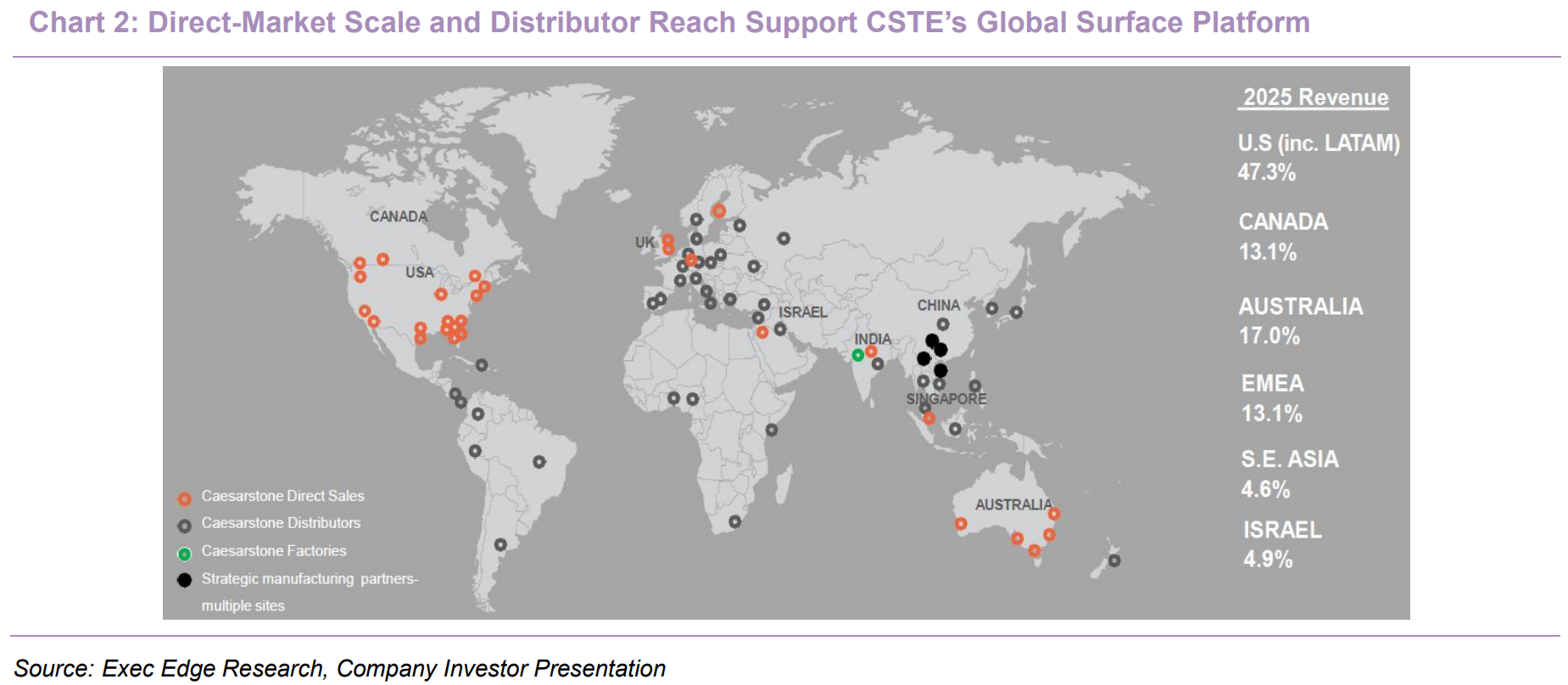
- The supply chain now combines partner-led engineered-stone production with retained in-house and outsourced porcelain capacity. The company sources engineered-stone products through production business partners, or PBPs, located in the Far East, India, the Middle East, and Europe. Approximately 73% of its engineered-stone sourcing was manufactured by PBPs during 2025. One production partner accounted for approximately 36% and another approximately 23% of total engineered-stone products manufactured, creating meaningful concentration within the partner network. Only approximately 24% of CSTE’s products could be manufactured at more than one PBP facility based on the latest disclosed data, limiting near-term interchangeability across the network. CSTE retains in-house porcelain manufacturing at its Lioli facility in Morbi, Gujarat, India, while also sourcing porcelain from external partners. The company provides selected proprietary technology and equipment to PBPs, maintains confidentiality and intellectual-property protections, and conducts quality-control and quality-assurance processes across owned and partner facilities. Finished slabs are shipped from the India facility or partner locations to CSTE distribution centers, third-party distributors, or customers worldwide. International sourcing also exposes CSTE to tariffs and other trade restrictions, particularly on products imported into the U.S.
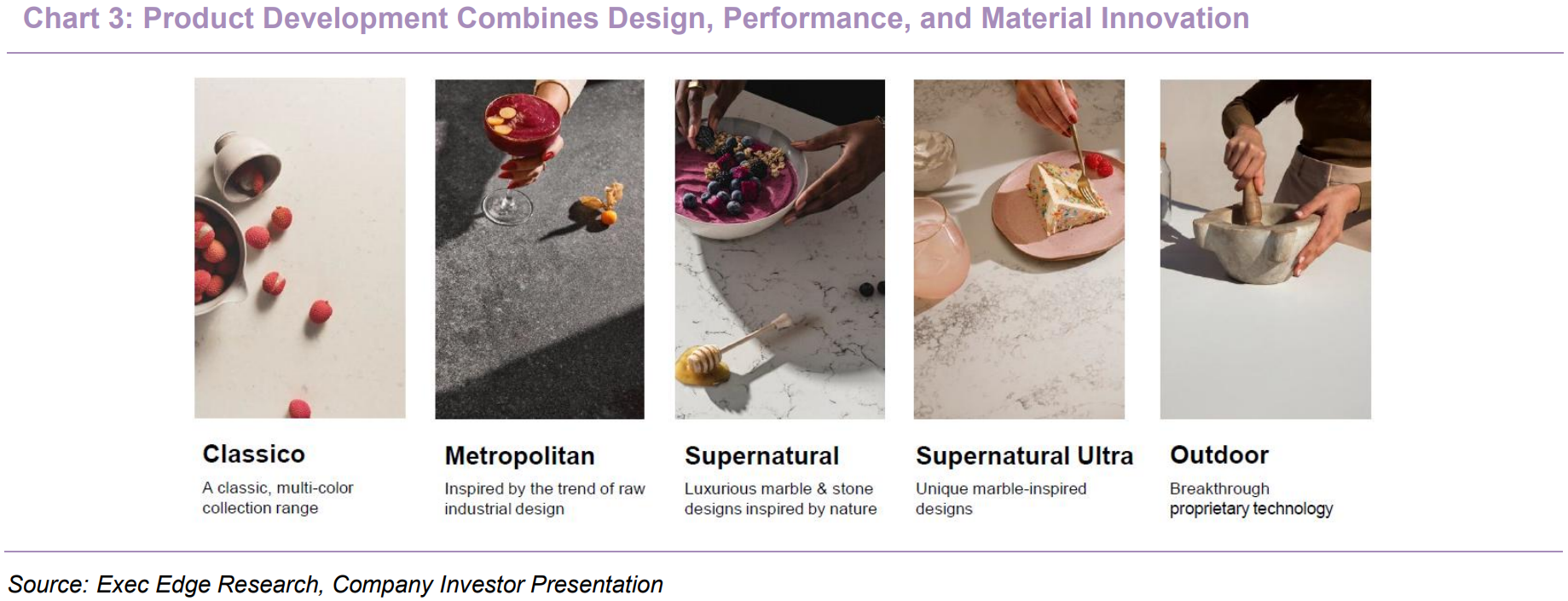
- Product development combines design, formulation, laboratory testing, protected know-how and enterprise systems supporting global execution. CSTE develops material formulations, manufacturing processes, colors, finishes, dimensions and product collections through its research-and-development organization. Its internal laboratory operations group and accredited external laboratories test durability, flexural strength and, where applicable, crystalline-silica content, while selected products carry certifications including NSF International and GREENGUARD Indoor Air Quality. Intellectual-property protection includes trademarks covering the Caesarstone name, logo, collections and selected product models; patents and pending applications in several jurisdictions; employee confidentiality arrangements; and trade-secret controls applied internally and across production partners. The company’s operational technology includes an Oracle-based enterprise-resource-planning platform, manufacturing-execution systems used to manage production workflows, and Salesforce infrastructure supporting customer-relationship management. These systems assist forecasting, inventory planning, quality control and working-capital management across the global network. CSTE also provides standard warranties for varying periods depending on the product and market and records estimated repair or replacement costs when products are sold.
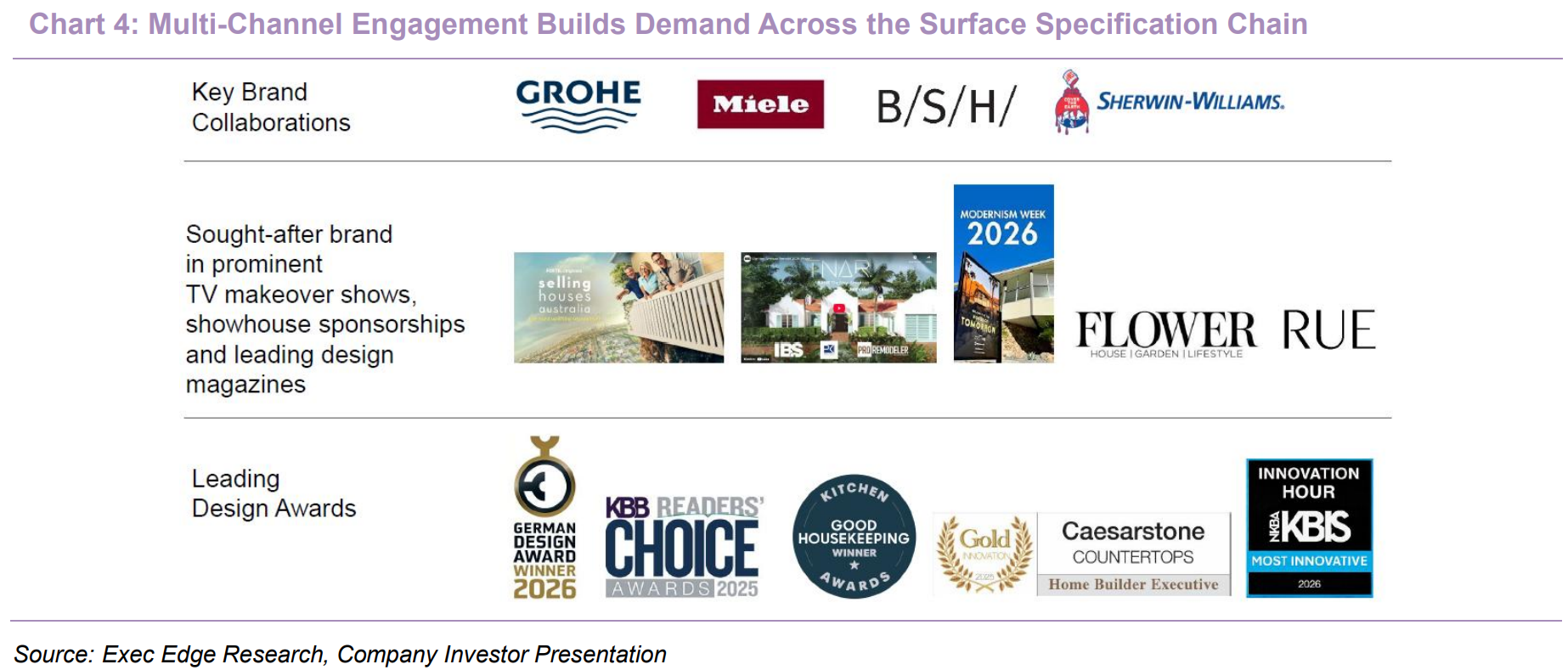
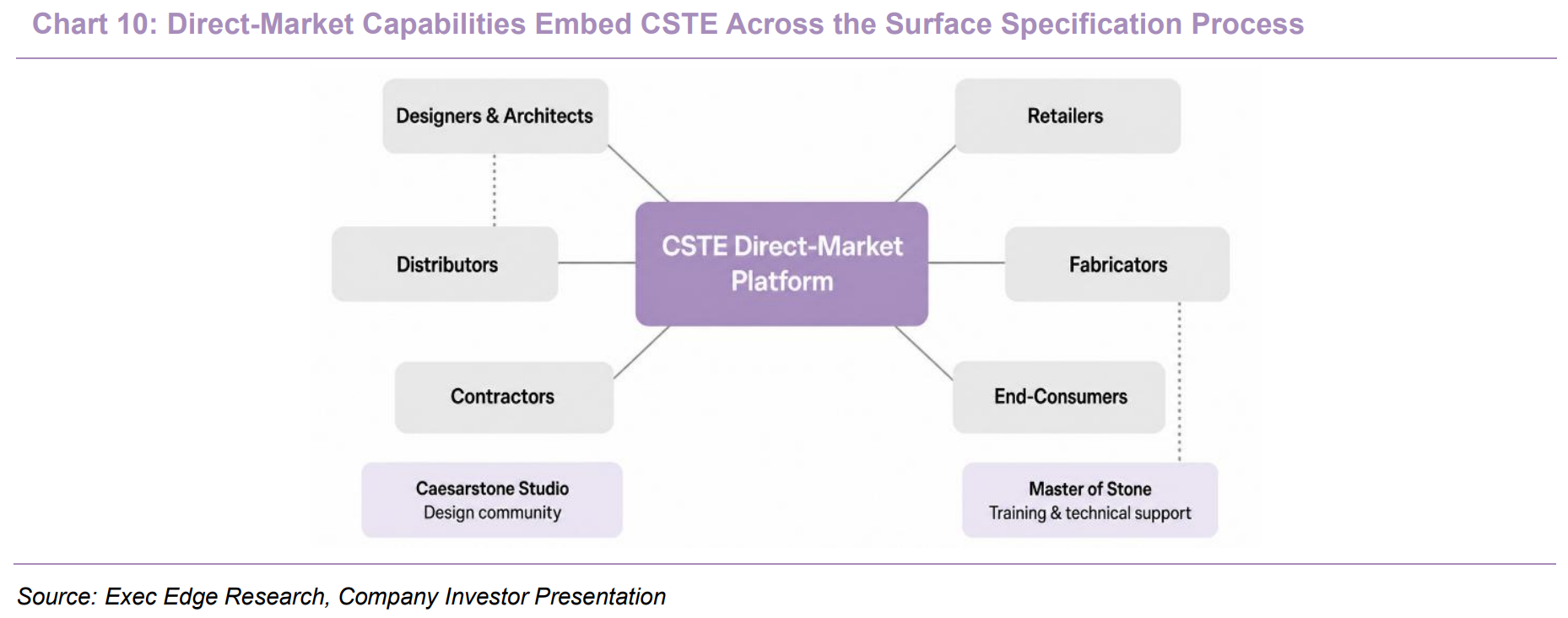
- The company’s demand-generation model reaches across the full specification chain, reinforcing brand pull with fabricator, retail, and trade-partner support. CSTE markets its branded surfaces across the full purchase and specification chain, including end-consumers, kitchen-and-bath retailers, fabricators, contractors, builders, architects, designers, developers, distributors, and stone suppliers. The company uses a multi-channel approach that includes home-interior publications and websites, display stands, sample books, trade shows, home-design events, design competitions, media campaigns, influencer activity, social media, and digital platforms. CSTE operates dedicated regional websites for end-consumers, the design community, and fabricators, with product information, installation images, design tools, product-use guidance, and other digital content intended to support the renovation journey and specification process. Its Caesarstone Studio platform addresses designers and other professional users, while the Master of Stone platform provides fabricators with training content on health and safety, installation methods, professional know-how, and plant-management practices. CSTE also works with distributors on localized marketing strategies and business plans, although distributors control their local prices, inventory policies, and customer-level commercial terms.
- Silica-related claims and the new U.S. quartz safeguard remain important considerations within CSTE’s operating profile. As of June 30, 2026, the company faced claims involving approximately 800 individuals globally and had recorded a $51.2 million provision for probable and reasonably estimable losses, while insurance coverage remains disputed. Separately, the new four-year U.S. tariff-rate quota introduces additional tariffs on covered quartz imports, increasing landed-cost exposure for a U.S. business supplied primarily through CSTE’s global production network. The company is evaluating sourcing, supply-chain, and pricing actions to mitigate the impact.
Right-to-Win
Integrated Product, Sourcing and Channel Capabilities Define Competitive Advantage
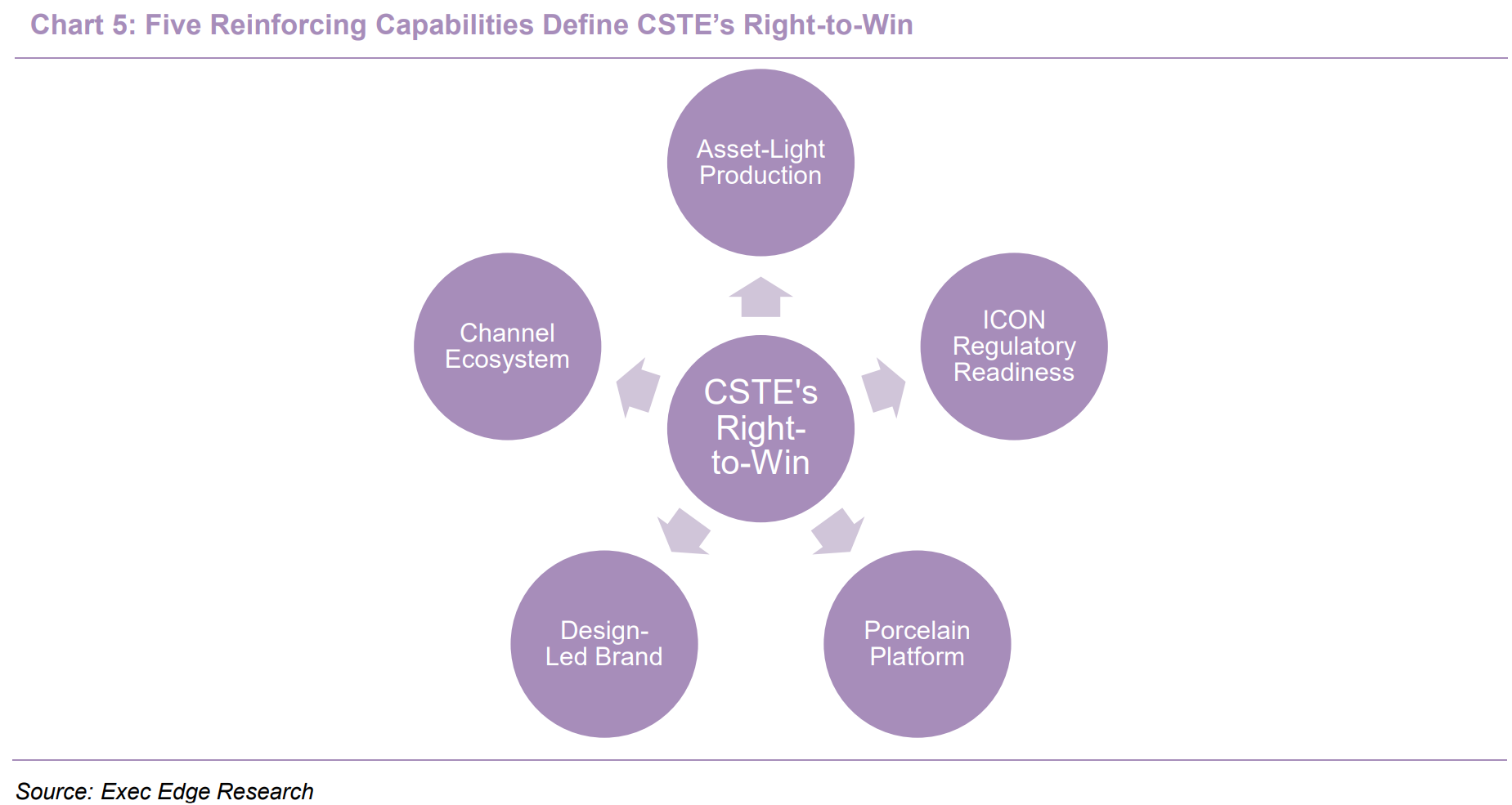
- We believe CSTE’s right-to-win rests on five reinforcing capabilities across sourcing, product innovation, brand, design, and market access. Its partner-led quartz network lowers fixed manufacturing exposure while preserving control over product design, specifications, quality assurance, and customer relationships. ICON demonstrates an ability to respond to material regulation, while porcelain extends the company’s established brand and distribution infrastructure into additional surface applications. These products are supported by a design system developed across multiple collections and direct-market operations that connect CSTE with designers, fabricators, retailers, and consumers. The strength of the model lies in how these capabilities work together, combining flexible production with product development, brand recognition, and established routes to market. This can shorten commercialization cycles, support more consistent execution, and reduce friction when introducing new materials and applications. Australia’s recovery and recent margin improvement provide early operating evidence that these capabilities can translate into commercial and financial outcomes. We discuss each of these elements in detail below.
- Partner-led quartz production forms a key tenet of CSTE’s right-to-win by lowering fixed-capacity exposure while preserving control over product quality and customer experience. CSTE now relies on a geographically diversified network of production partners for quartz while retaining product design, formulations, specifications, technology, quality assurance, brand management, and customer relationships. This separates capital-intensive manufacturing from the capabilities that determine product consistency and commercial relevance. The structure also allows management to allocate production across external facilities instead of maintaining sufficient owned capacity for peak demand. Early financial evidence supports the model, with gross margin reaching 24.0% in 2Q26 from 19.6% in 2Q25 despite lower revenue.
- The competitive value lies in combining flexible external capacity with retained product, quality, brand, and customer control. CSTE’s formulations, quality processes, design history, brand recognition, and customer access allow the company to use production partners as an extension of its operating model rather than simply outsource manufacturing. A multi-region network can also provide flexibility when demand, freight conditions, or trade policies change. The model’s value therefore depends on maintaining consistent product standards and service across the partner network.
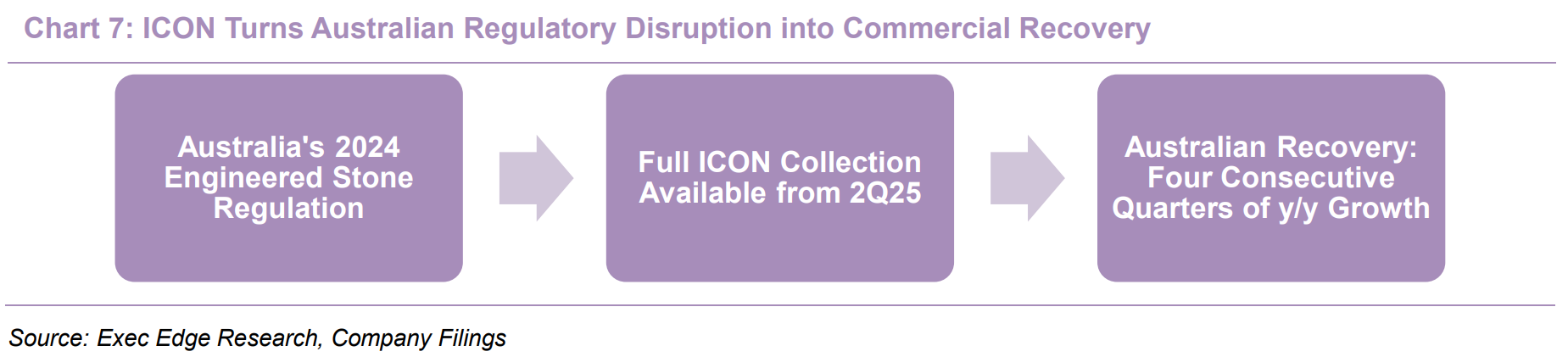
- ICON demonstrates a repeatable capability to translate regulation into a market-ready premium alternative. CSTE’s response in Australia required more than changing the mineral formulation. The company combined a compliant product platform with recycled inputs, collection continuity, design development, product testing, inventory conversion, and engagement with fabricators and retail channels. This allowed CSTE to address Australia’s engineered-stone prohibition while maintaining the appearance, performance, and premium positioning associated with Caesarstone. The subsequent availability of the full ICON collection and four consecutive quarters of Australian growth provide evidence that customers and trade partners accepted the reformulated offering.
- The advantage lies in coordinating formulation, compliance, design continuity, and channel conversion under one brand. CSTE’s established Australian network allowed the company to align testing, dependable local inventory, samples, fabricator familiarity, technical guidance, and consumer confidence around the reformulated offering. That integrated approach is harder to replicate than the material substitution itself and demonstrates an organizational capability to connect product development with trade execution when regulation changes the acceptable material set.
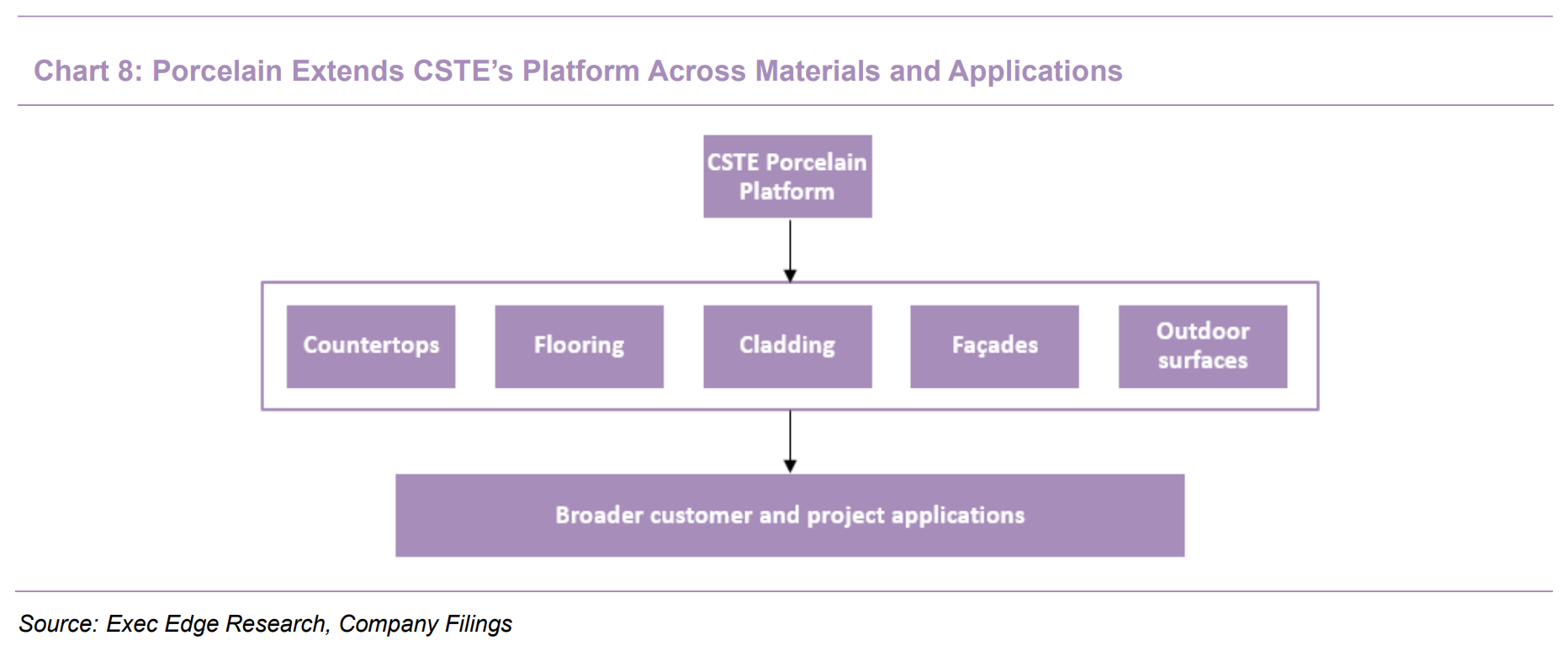
- Porcelain strengthens CSTE’s right-to-win by combining dedicated manufacturing with external sourcing flexibility. Full ownership of Lioli provides a manufacturing base that can be integrated with CSTE’s design, product-development, testing, and collection-planning capabilities. External sourcing relationships provide additional product and supply options without requiring every design or format to be manufactured internally. This gives CSTE greater control over product standards and design consistency in porcelain while retaining sourcing flexibility across formats and collections. The significance lies in the combination of manufacturing access and broader product-development capabilities rather than Lioli ownership alone.
- Commercial advantage comes from introducing porcelain through an established premium-surface ecosystem rather than as a stand-alone material. CSTE can bring porcelain to market through existing samples, showrooms, designers, fabricators, retailers, distributors, and local sales infrastructure. Familiarity with the Caesarstone brand and service model may reduce friction in specification and adoption, while coordinated design language across materials can make porcelain more relevant within broader project requirements. The advantage therefore comes from integrating manufacturing access, design, brand, and channel reach within one commercial platform.
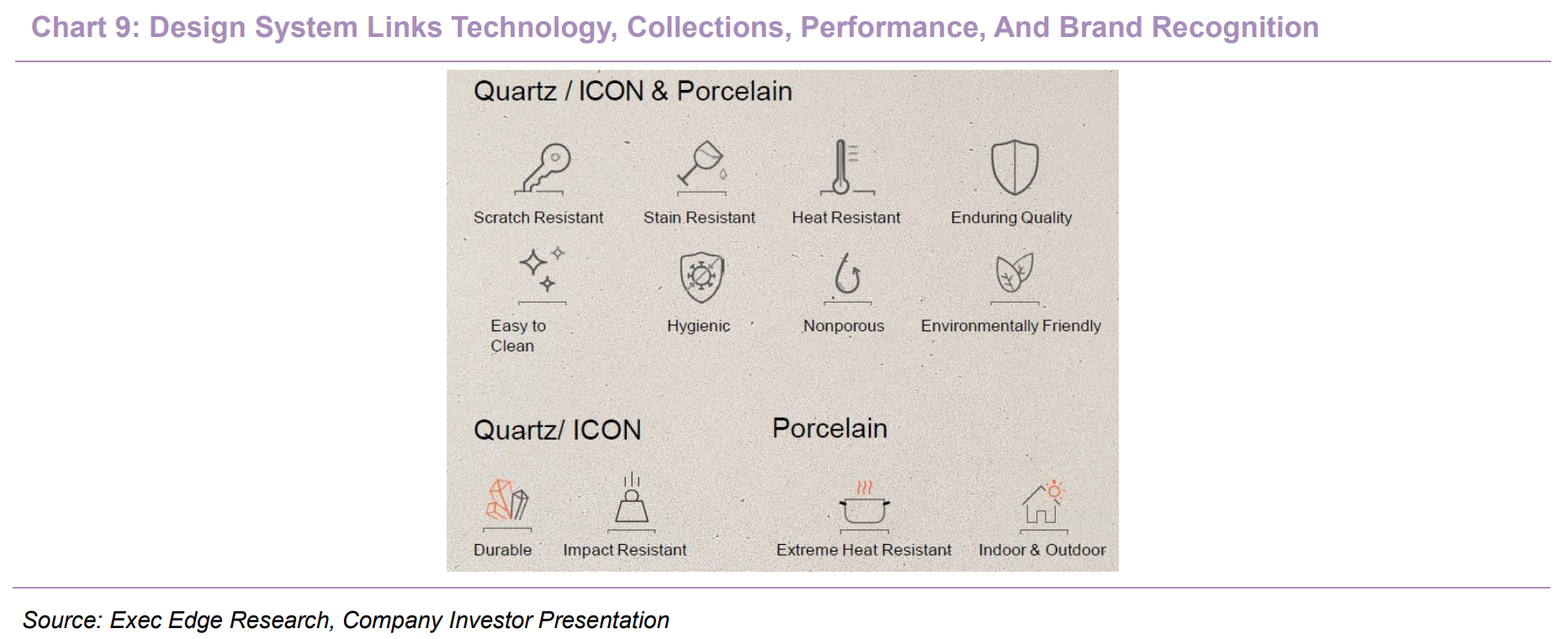
- CSTE’s premium brand forms a key element of its right-to-win, reinforced by accumulated design, formulation, testing, and commercialization capabilities across multiple surface categories. These capabilities combine product development, proprietary know-how, quality validation, and collection planning under a recognizable premium brand. Formal protections include trademarks covering the Caesarstone name, logo, collections, and selected product models, together with patents, pending applications, confidentiality arrangements, and trade-secret controls. Brand collaborations, design awards, showhouse participation, television exposure, and design-media coverage further reinforce recognition among consumers and specification professionals. Together, these assets provide a common platform for introducing new designs and materials while maintaining a consistent premium identity.
- Accumulated design equity can reduce product comparability and strengthen the company’s position in specification-led purchasing. Countertop and surface decisions incorporate visual preference, performance requirements, sample availability, fabricator familiarity, and consumer trust, rather than commodity material price alone. CSTE’s ability to pair recognizable collections with consistent design language across quartz, ICON, and porcelain can make the brand more relevant when customers need multiple material choices for a project. The differentiation is cumulative: formulation supports performance, design creates visual distinction, testing validates quality, and the brand provides a recognized reference point for customers and trade professionals. CSTE’s defensibility therefore rests less on any individual patent or product design and more on the interaction of design history, proprietary know-how, product-development processes, and commercial recognition.
- Direct-market infrastructure strengthens CSTE’s position by linking the brand with the professionals and customers influencing surface selection and installation. Local sales coverage, inventory availability, samples, technical information, training, and marketing support allow the company to engage with designers, fabricators, retailers, distributors, contractors, and consumers throughout the purchase process. These relationships provide visibility into specification preferences and customer feedback while creating an established route for introducing new collections and materials.
- The channel ecosystem can accelerate adoption by combining local product availability with technical support, fabrication expertise, and established trade relationships. A designer or fabricator considering a new collection requires confidence in local inventory, product performance, installation methods, and customer support. CSTE’s direct operations and technical platforms can provide that support while helping the company introduce new materials, including ICON and porcelain, to established trade relationships. The breadth of this coverage creates a practical advantage in coordinating design-led demand, product education, fabrication expertise, and local supply, while 2Q26 big-box growth led by IKEA provides a current proof point of channel relevance.
Industry Trends and Company Positioning
Broader Material Coverage Expands CSTE’s Addressable Surface Opportunity

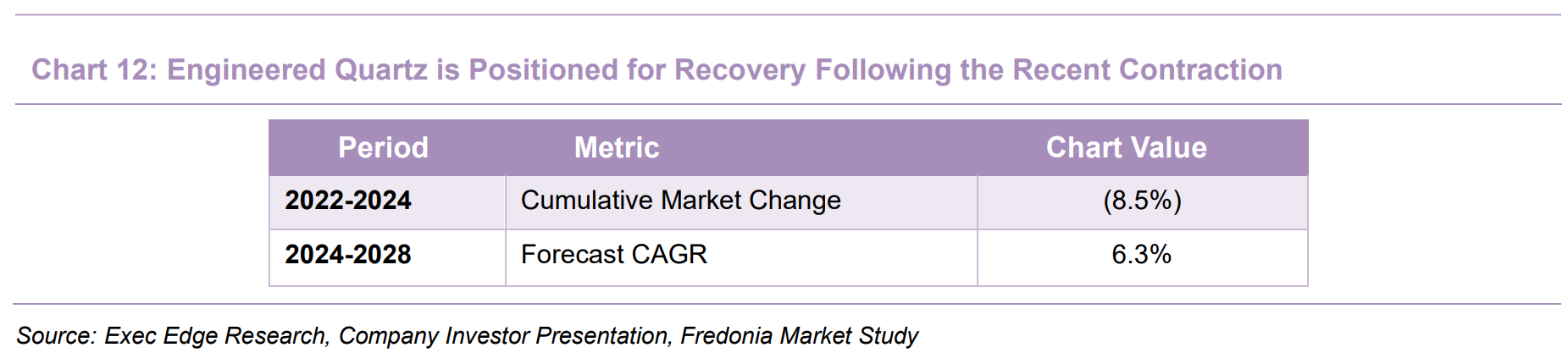
- CSTE’s broader material portfolio materially expands its addressable opportunity across a global countertop market increasingly shaped by material substitution and category diversification. Fredonia’s March 2025 study estimates that the global countertop market generated approximately $151.6 billion of installed end-consumer value in 2024, including fabrication, installation, and related services. By volume, engineered quartz represented 17% of the market, porcelain 3%, granite 26%, and marble 7%, meaning CSTE’s existing and adjacent categories span approximately 53% of global countertop demand. The $151.6 billion market figure should therefore be viewed as an indicator of overall industry scale rather than a directly serviceable revenue pool for surface suppliers, as installed pricing varies materially by material and includes downstream services beyond CSTE’s core slab economics. The same study recorded a 5.6% contraction in global countertop value during 2022 to 2024, including an 8.5% decline in engineered quartz, but forecasts a 6.3% engineered-quartz CAGR through 2028. A separate, newer Fredonia materials-level study forecasts total global countertop volume increasing 2.9% annually to 653 million square meters by 2030. We believe CSTE’s broader material exposure increases its ability to capture demand as category volumes recover and customer preferences shift across surface types.
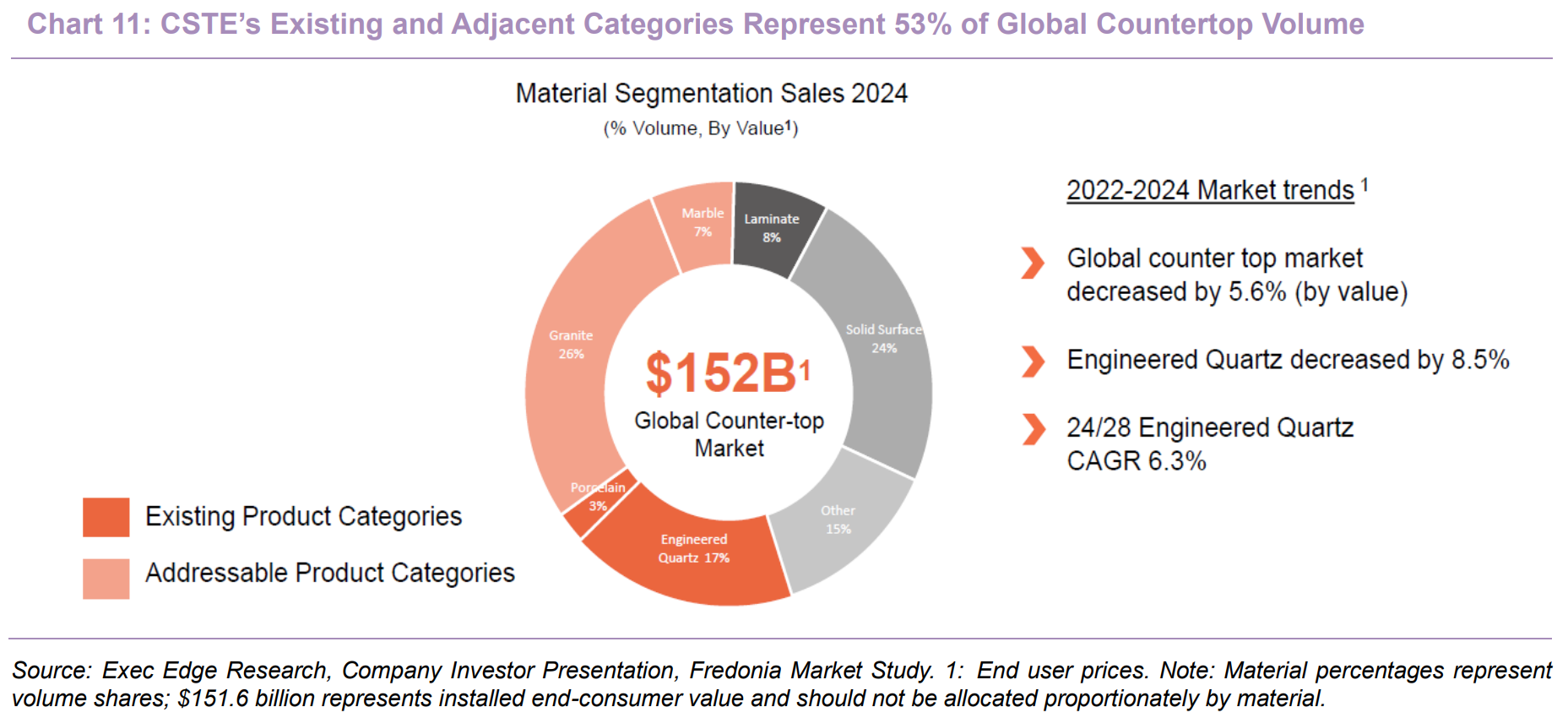
- Engineered quartz remains an established growth category, while porcelain is emerging as the faster-growing adjacency from a much smaller base. Fredonia estimates that engineered-quartz sales to end consumers grew at a 14.3% CAGR between 1999 and 2024, versus 5.2% for the overall countertop market, reflecting quartz’s combination of design consistency, durability, lower maintenance, and broad availability. Following the 2022 to 2024 downturn, the outlook calls for 6.3% annual engineered-quartz growth through 2028, while a separate Fredonia materials study forecasts global engineered-stone demand increasing 5.4% annually by volume to 97 million square meters and 5.8% by value to $9.1 billion. The recovery should be supported by remodeling, housing construction, and increasing countertop penetration in developing markets, although future share gains are likely to be more contested as silica regulation and alternative materials reshape customer choice. For CSTE, this creates a more balanced opportunity: quartz remains the scale category, while porcelain provides a faster-growing avenue for portfolio expansion.
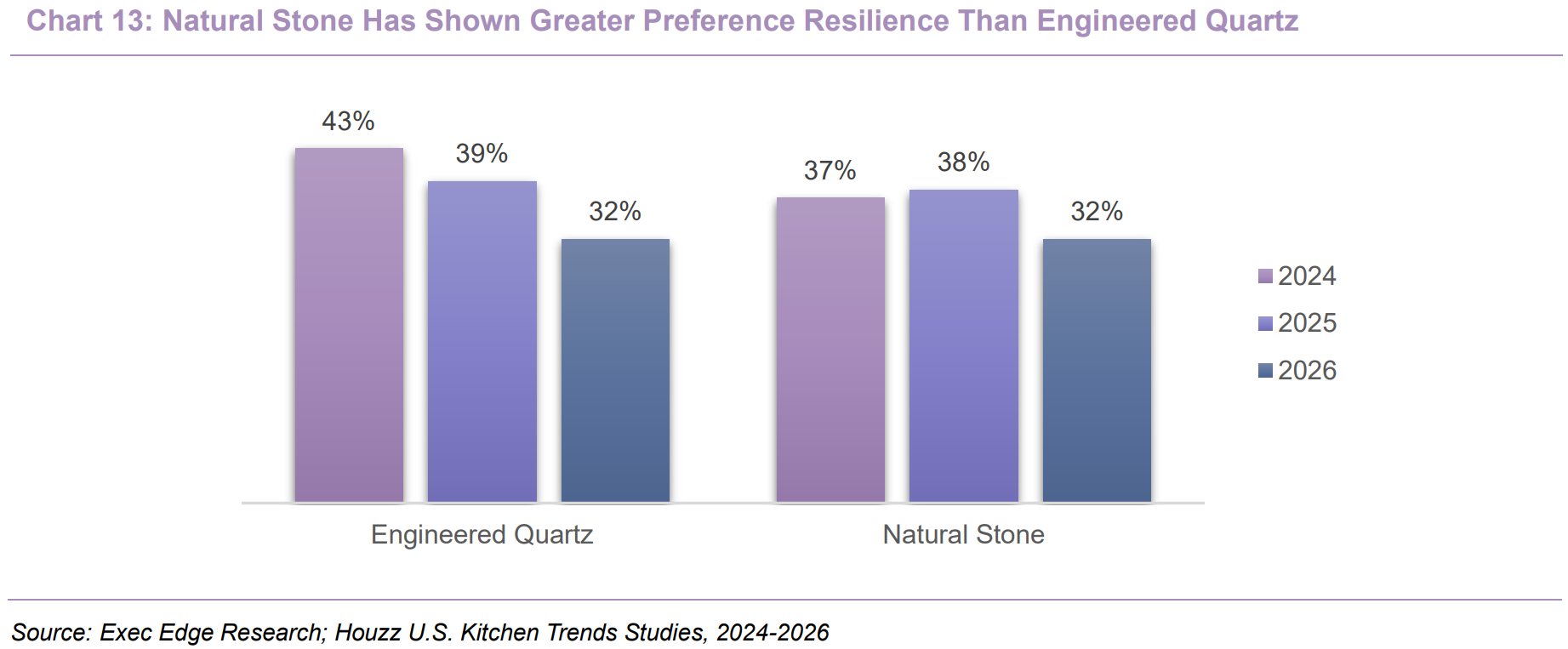
- Natural stone has shown greater resilience than engineered quartz in recent U.S. renovation decisions, reflecting a broader shift toward differentiated surface aesthetics. Houzz’s U.S. kitchen-renovation survey shows engineered quartz declining from 43% of upgraded countertops in 2024 to 32% in 2026, while the combined share of granite, quartzite, soapstone, and marble declined more modestly from 37% to 32%. Within natural stone, resilience was concentrated in more differentiated materials: quartzite held its 10% share and soapstone increased from 3% to 4%, while granite and marble declined. The pattern suggests that homeowners are not simply rotating from engineered quartz into natural stone, but are broadening material choices toward surfaces offering greater visual variation, veining, and premium character. NKBA’s 2026 survey reinforces this trend, placing natural quartzite immediately behind quartz among professionals’ expected countertop preferences and identifying organic and natural aesthetics as a leading design direction. Natural stone still carries trade-offs around slab variability, maintenance, fabrication complexity, and crystalline-silica controls. For CSTE, a broader natural-stone assortment provides useful portfolio balance as customer preferences become more fragmented across surface types.
- CSTE’s broader category participation creates multiple avenues for growth beyond a recovery in legacy quartz alone. The company represented approximately 3.3% of global engineered-stone volume in 2024, leaving room to participate in a category recovery while also broadening exposure through porcelain and natural stone. Porcelain offers the strongest structural growth vector, extending CSTE into countertops, flooring, cladding, façades, and outdoor surfaces, while natural stone adds an adjacent cross-selling opportunity through the Omicron platform in the U.S. We believe the key opportunity is therefore not simply a larger headline TAM, but the ability to capture a greater share of customer surface requirements across multiple materials and applications. Realizing that opportunity will depend on translating portfolio breadth into sustained adoption, broader geographic reach, stronger channel productivity, and measurable revenue and gross-profit contribution from newer categories.
Porcelain’s Small Base Supports Rapid Share Expansion
- Porcelain is emerging as the clearest structural share-gain category within the countertop market, supported by a small base and expanding material substitution. Fredonia estimates that porcelain represented only about 3% of global countertop volume in 2024, well behind granite, engineered quartz, and solid surface. Yet global porcelain countertop sales to end consumers grew at a 30.5% CAGR between 2016 and 2024, while forecasts call for volume growth of 19.9% annually in the U.S., 18.7% in Canada, and 12.4% in Australia during 2024 to 2028. Adoption is being supported by natural-stone-inspired designs, non-porous performance, resistance to heat, stains, and weather, and growing relevance where silica regulation or quartz import costs affect conventional engineered stone. The high growth rates partly reflect a small starting base, but continued share gains appear increasingly supported by product substitution rather than broad construction growth alone.
- Large-format porcelain is expanding the category beyond countertops into broader interior, exterior, and architectural applications. Modern slabs can reproduce marble, stone, concrete, and wood across kitchen worktops, islands, backsplashes, floors, wall cladding, façades, and outdoor surfaces. Larger formats reduce visible joints and allow designers to carry one finish across multiple surfaces, supporting a coordinated “total look.” This broadens the opportunity beyond residential countertop replacement and opens participation in hospitality, retail, office, multifamily, and other specification-led projects. The addressable opportunity nevertheless remains distinct from the broader porcelain-tile market, where flooring dominates and much of global volume is commodity product. Large-format slabs also require specialized lifting, cutting, and installation equipment, trained crews, suitable substrates, and dedicated logistics. Category growth therefore depends not only on design and product performance, but also on the development of fabrication capacity, installer expertise, technical support, and reliable local availability.
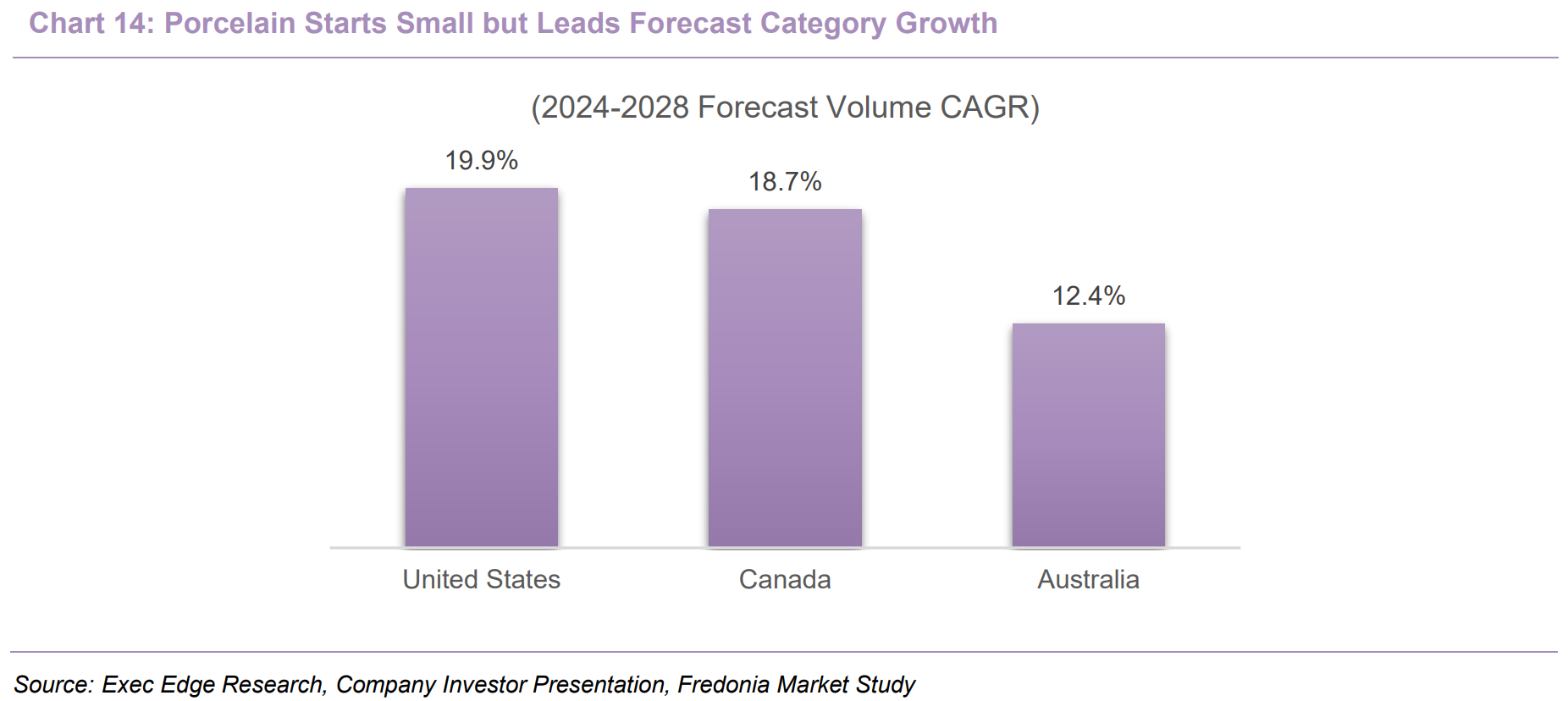
- CSTE is positioned to participate in porcelain growth through a combination of dedicated manufacturing capacity and an established premium-surface commercial platform. Wholly owned Lioli provides production access, while CSTE contributes product development, design, branding, and direct-market distribution. This allows the company to introduce large-format porcelain through existing customer relationships, samples, showrooms, fabricator networks, and local sales infrastructure rather than building a new commercial platform from scratch. We believe this should improve CSTE’s ability to translate category growth into adoption, provided product quality, local availability, fabricator capability, and channel sell-through continue to develop alongside the market.
North American Scale Supports Recovery Potential Despite Near-Term Demand Pressure

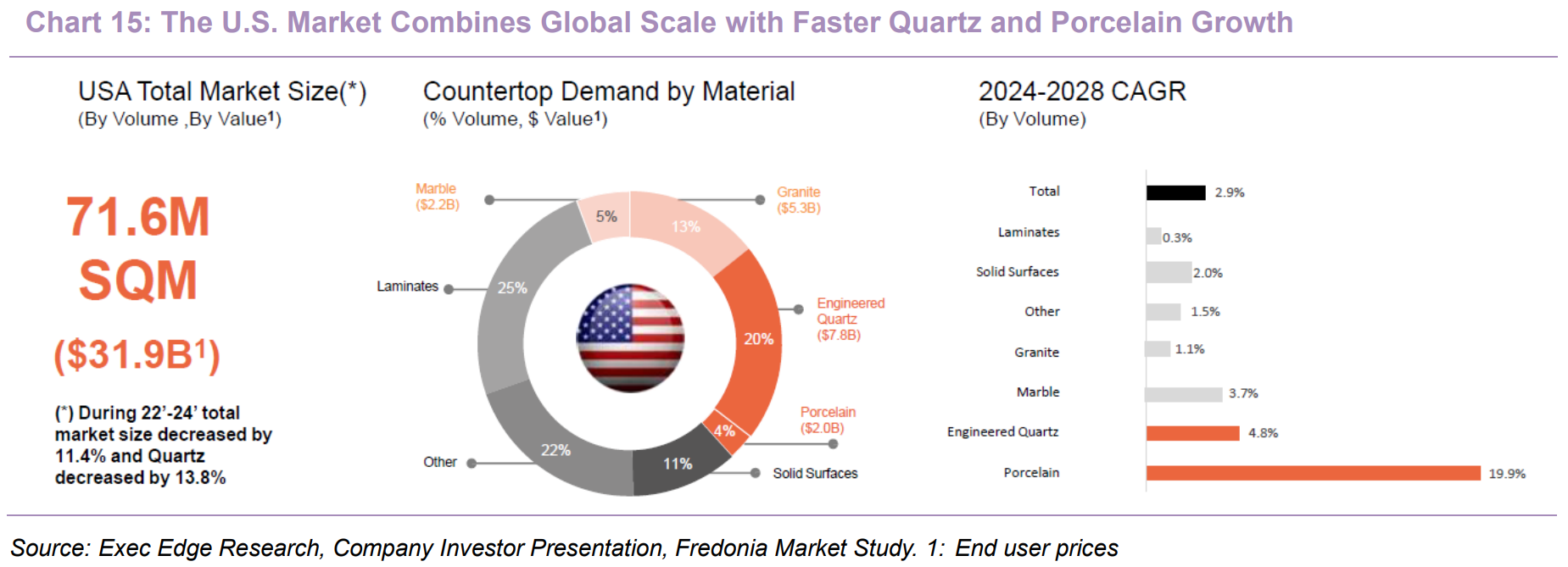
- The U.S. remains the industry’s most important value pool, combining global scale with a cyclical recovery and continued material substitution. Fredonia estimates that the country consumed 71.6 million square meters of countertops worth $31.9 billion at end-user prices in 2024, equivalent to roughly one-fifth of the global market presented in the same research. This scale supports a deep network of designers, retailers, distributors, fabricators, and installers, making shifts in U.S. material preferences influential across the broader surfaces industry. The market is recovering from a difficult base, with total countertop volume down 11.4% during 2022 to 2024 and engineered quartz down 13.8%. Forecasts call for total volume to grow at a 2.9% CAGR through 2028, while engineered quartz is projected to increase 4.8% and porcelain 19.9% from a much smaller base. We believe the more important industry signal is the combination of measured demand recovery and continued share migration across materials, rather than headline market growth alone. Given the U.S. market’s scale and installed value, even modest volume improvement can generate meaningful incremental surface demand, with the pace dependent on household confidence, financing conditions, and project affordability.
- Structural remodeling demand can support U.S. surface consumption even before housing transactions recover meaningfully. The median owner-occupied home reached 42 years in 2023, compared with 31 years in 2003, increasing the need for replacement and improvement spending as building systems and interiors age. Harvard’s remodeling indicator projects approximately $519 billion of annual home-improvement and repair expenditure through mid-2027, although growth is expected to slow. Mortgage lock-in may also support renovation activity by encouraging some homeowners to improve existing properties rather than move. FHFA research estimates that higher-rate lock-in prevented 1.33 million fixed-rate home sales between 2Q22 and 4Q23. Kitchens also remain surface-intensive projects. Houzz reports that 91% of surveyed kitchen renovators upgrade countertops, 52% of upgraded islands exceed seven feet, and 28% of upgraded backsplashes use slabs, increasing surface area per project. Outdoor kitchens and wet bars provide an additional application for weather-resistant materials. Together, these factors support a renovation-driven demand base that can improve before housing turnover fully normalizes, helping countertop volumes recover even in a still-constrained transaction environment.
- August 2026 quartz tariffs and broader North American trade measures have added a new layer of cost and sourcing uncertainty across the surfaces industry. A four-year U.S. tariff-rate quota on covered quartz-surface imports took effect on August 15, 2026. During the first year, imports within an annual quota of approximately 13 million square meters are subject to an additional 25% tariff, while above-quota imports face an additional 50%; quota volumes rise and tariff rates decline in later years. Canada, Mexico, Australia, and several other trading partners are initially excluded, making the effect dependent on sourcing origin, quota availability, and individual supplier arrangements. The broader trade environment also tightened later in August, when the U.S. imposed 50% tariffs on C$27.6 billion of selected Canadian goods following the suspension of bilateral negotiations, with Canada announcing retaliatory tariffs of 15%, 25%, and 50% on an equivalent value of selected U.S. imports. Countertop products are not uniformly covered, but tariffs on metals, equipment, and other construction-linked inputs can raise project costs and affect builder or homeowner budgets. Importers may respond through pricing, supplier changes, inventory management, or greater emphasis on alternative materials such as porcelain and natural stone. The combined effect could accelerate supplier diversification, sourcing shifts, and material substitution as industry participants adapt to a more restrictive trade environment.
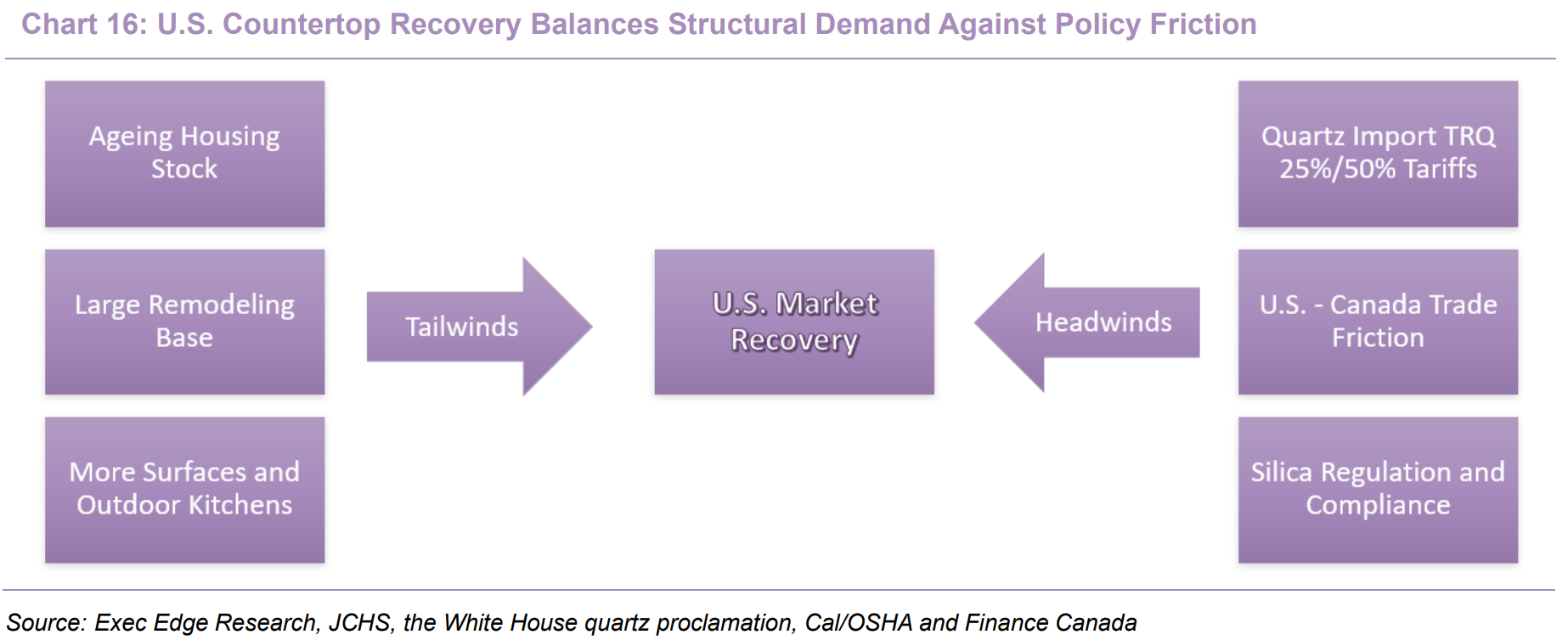
- Silica regulation and housing affordability are reshaping U.S. countertop demand in different ways, influencing both material selection and project timing. California strengthened its respirable-crystalline-silica standard in 2025, requiring enhanced wet methods, respiratory protection, medical surveillance, and reporting for high-exposure fabrication tasks. In 2026, the state began emergency rulemaking that could prohibit fabrication and installation of artificial-stone products containing more than 1% crystalline silica. While the proposal is not a nationwide U.S. product ban, California’s scale and regulatory influence could accelerate adoption of lower-silica formulations, porcelain, and other alternative materials. Compliance requirements may also raise fabrication costs or reduce capacity among smaller workshops unable to fund equipment and training. These industry-specific pressures coincide with a still-constrained housing cycle, where elevated financing costs, affordability pressure, and weak transaction volumes can delay discretionary renovation projects. Harvard expects remodeling-spending growth to decelerate through mid-2027, although lower housing turnover can also encourage some homeowners to renovate rather than move. We believe the key distinction is that regulation may change which material is selected, while affordability and consumer confidence determine whether the project proceeds at all.
- Canada’s surface market is recovering from a deep cyclical trough, with renovation, housing density, and material substitution supporting the medium-term opportunity. The countertop market represented 4.7 million square meters and $1.9 billion of end-user value in 2024, after total volume declined 23.2% during 2022 to 2024 and engineered quartz fell 24.8%. Fredonia forecasts a 5.2% total-market CAGR through 2028, including 6.3% growth for engineered quartz and 18.7% for porcelain. The recovery is supported by more than new housing alone. CMHC estimates that restoring 2019 affordability would require 430,000 to 480,000 annual housing starts through 2035, compared with approximately 245,000 to 250,000 under its business-as-usual projection, highlighting substantial underlying housing need. Residential renovation output has remained near C$80 billion annually since 2023, while apartment investment increased 8.3% in 2025, supporting recurring kitchen and bathroom demand within multi-unit development. Laminates also still represent 31% of countertop volume, leaving room for quartz, porcelain, and other premium materials to gain share through replacement. We believe the combination of renovation activity, greater housing density, and premium material substitution provides a more relevant medium-term demand framework than single-family housing starts alone.
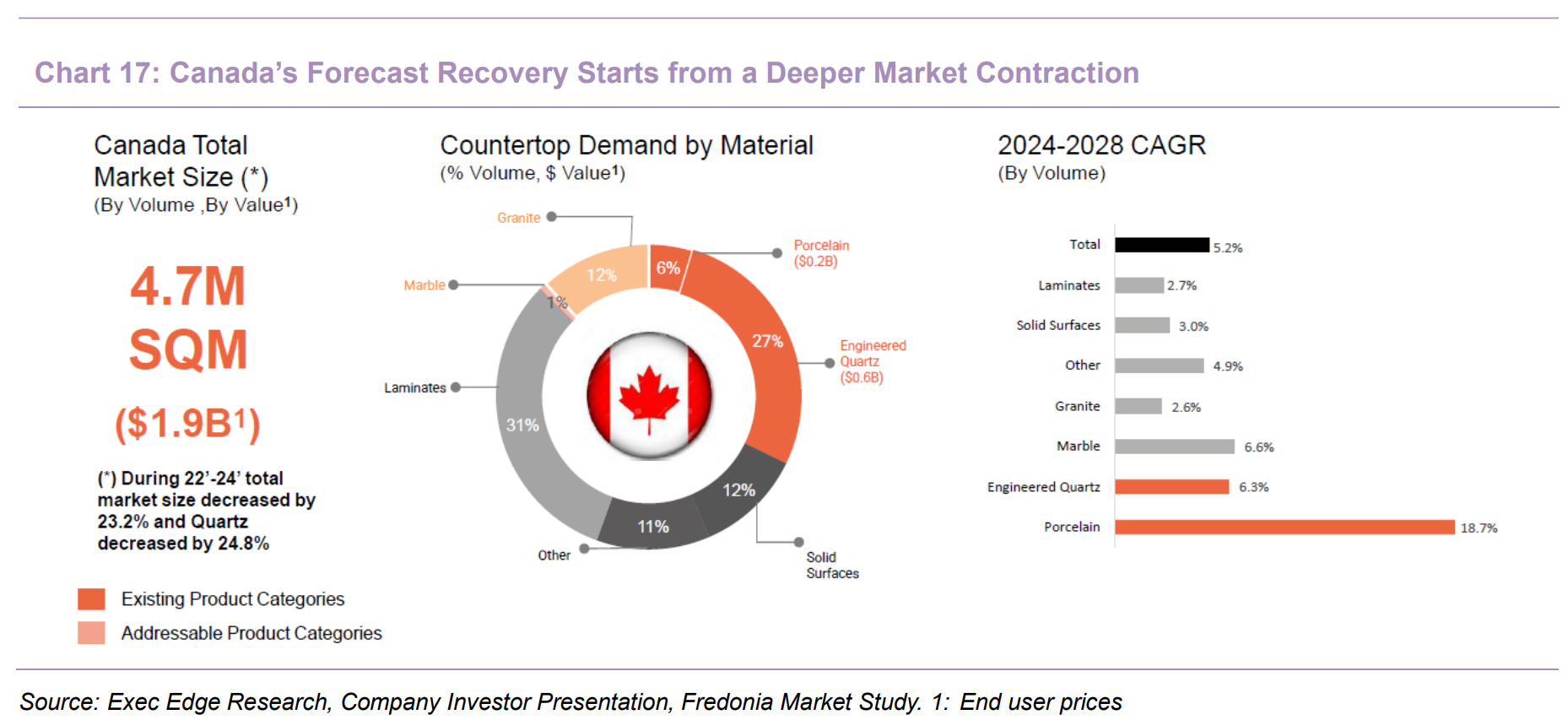
- Canada’s structural housing deficit supports the medium-term surface opportunity, but near-term recovery is likely to remain uneven. CMHC expects housing activity to stay subdued through 2026 as high borrowing and construction costs, modest income growth, slower population growth, and trade uncertainty constrain demand. Homeownership construction remains particularly pressured by weak condominium presales, elevated inventories, and tighter financing, while activity varies meaningfully by province. The shift toward rental and multifamily development also matters for surfaces, as smaller units can carry less countertop area or lower-priced materials than detached homes and premium condominiums. Renovation provides a more stable demand base, although shorter contractor backlogs and customer reluctance to proceed with full project scope point to continued caution. We believe the positive medium-term category outlook can therefore coexist with a softer near-term housing cycle, with remodeling, replacement, and material share gains supporting recovery before ownership construction fully normalizes.
- Overall, North America remains CSTE’s largest demand exposure and the most important region for restoring consolidated growth. Renovation, replacement, and material substitution can support surface demand before a broad housing recovery, but affordability pressure, trade costs, and weaker project activity may keep the recovery uneven. CSTE is positioned to participate through its direct sales and distribution infrastructure and is taking targeted steps to improve conversion, including rebuilding relationships with key customers and fabricators, addressing weaker commercial and stone-supplier channels, expanding big-box participation led by IKEA, improving product availability with production partners, and implementing pricing actions in response to higher import costs. These initiatives give CSTE several avenues to capture an improving demand environment without requiring a full housing-cycle recovery. The more important proof point is whether stronger channel execution begins to stabilize core North American volumes while preserving pricing and margins as the tariff environment evolves.
Australia Provides the Clearest Growth Evidence While Europe and Asia Expand Optionality

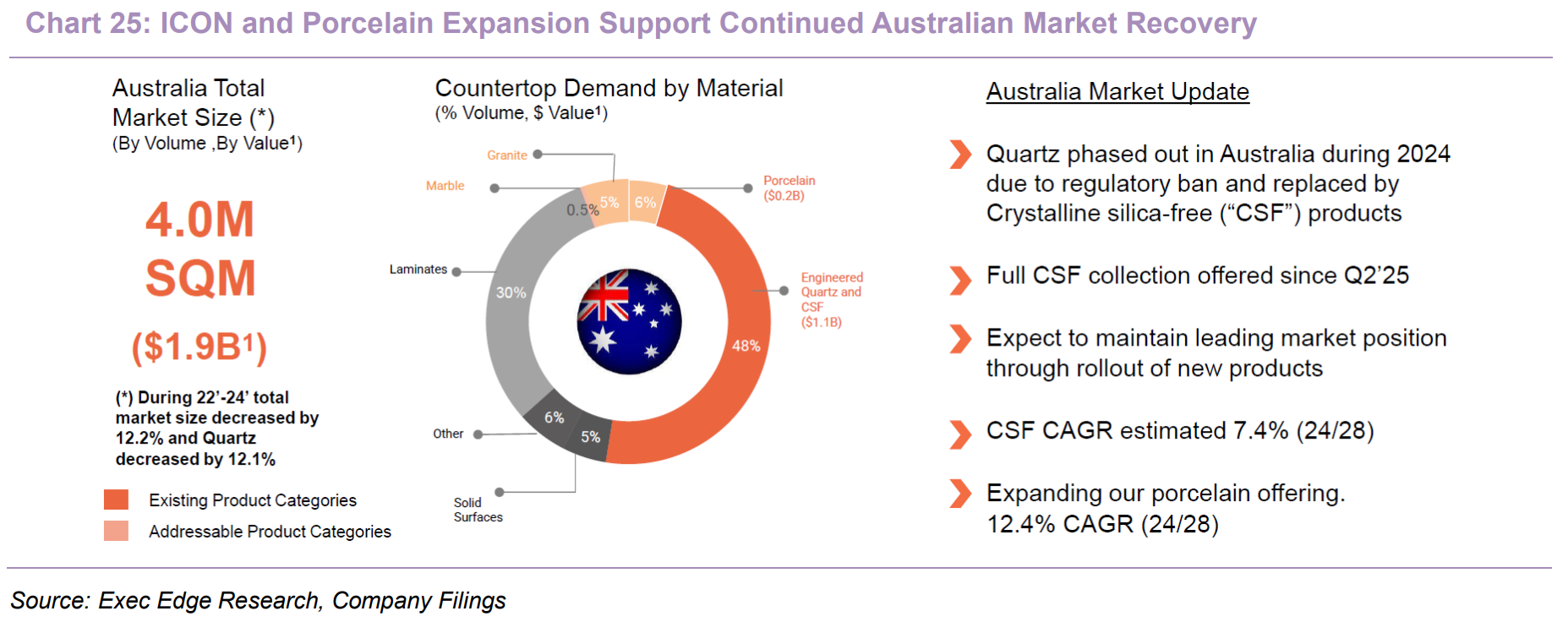
- Australia has become a regulatory-substitution market where countertop demand is shifting across materials rather than disappearing. The market represented approximately four million square meters and $1.9 billion of end-user value in 2024, following a 12.2% decline in total volume during 2022 to 2024. From July 2024, Australia prohibited the manufacture, supply, processing, and installation of engineered-stone benchtops, panels, and slabs meeting the regulatory definition, followed by an import prohibition from January 2025. Porcelain and resin-free sintered stone are excluded from that definition, while products containing less than 1% crystalline silica fall outside the prohibition. The regulatory change has redirected established demand toward crystalline-silica-free surfaces, porcelain, natural stone, and other compliant alternatives rather than eliminating the underlying need for premium surface products. Fredonia forecasts crystalline-silica-free surfaces growing at a 7.4% CAGR during 2024 to 2028 and porcelain at 12.4%. We believe this creates a structurally attractive substitution opportunity, but one in which design credibility, product availability, testing, fabricator acceptance, and channel support remain critical to winning share. For CSTE, the shift is particularly relevant given the full ICON rollout and its expanding porcelain offering.
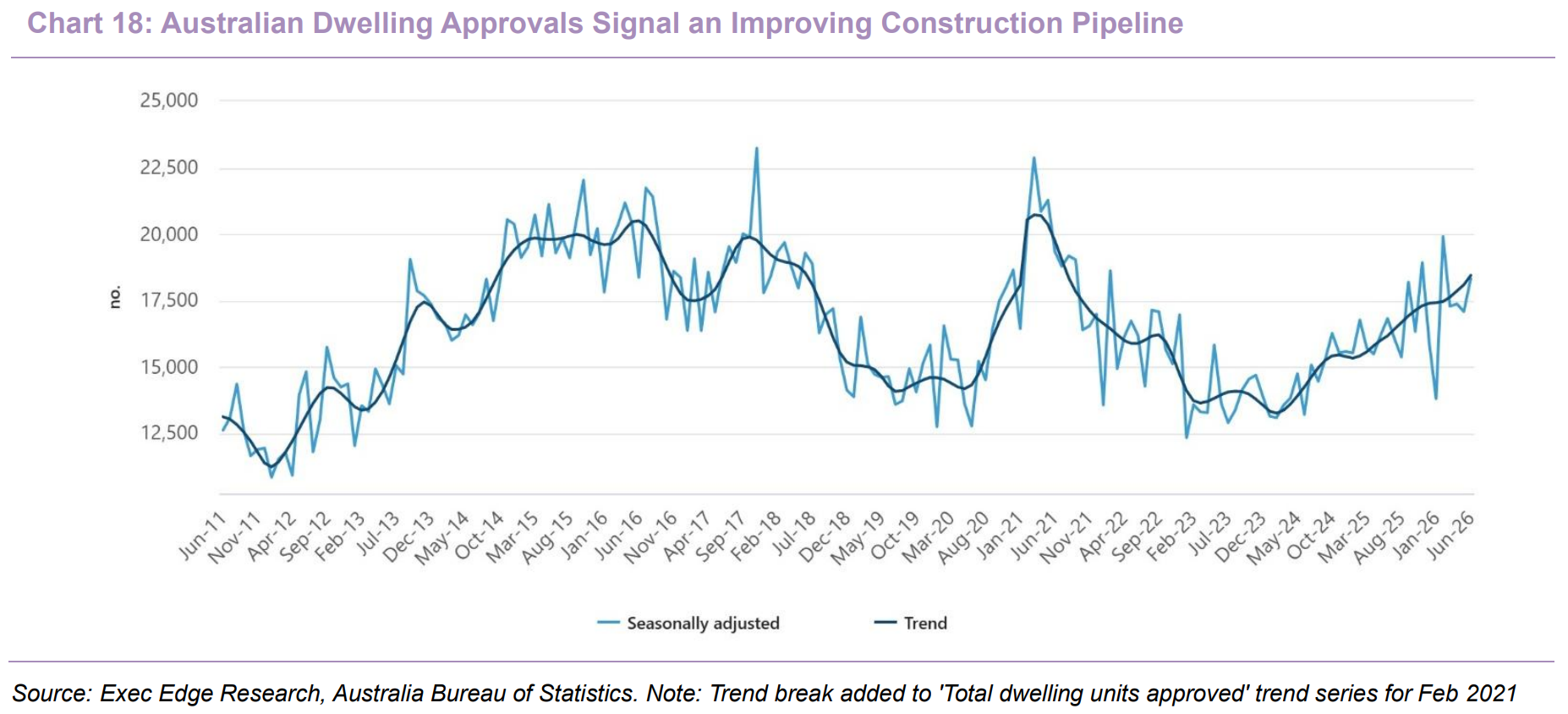
- Improving construction activity and a resilient renovation base support Australian surface demand, even as affordability and delivery constraints temper the pace of recovery. Seasonally adjusted dwelling approvals reached 18,328 in June 2026, up 8.9% y/y, while the trend series increased 14.1%. Private detached-house approvals also rose, providing a relatively surface-intensive source of future demand. Population growth and household formation support longer-term housing requirements, while renovation activity provides an additional source of replacement demand independent of new completions. Outdoor living is also relevant in Australia, extending weather-resistant surfaces into barbecue, entertainment, and pool areas. The recovery remains constrained by financing, planning, labor availability, builder capacity, and elevated home prices, while adoption of newer materials requires appropriate fabrication tools, training, and reliable distribution. Regulatory compliance also remains important across permitted materials because cutting natural and manufactured surfaces can generate respirable dust. We believe the improving project pipeline is supportive, but the pace of installed surface growth will ultimately depend on how effectively housing activity, material substitution, and fabrication capacity convert into completed projects.
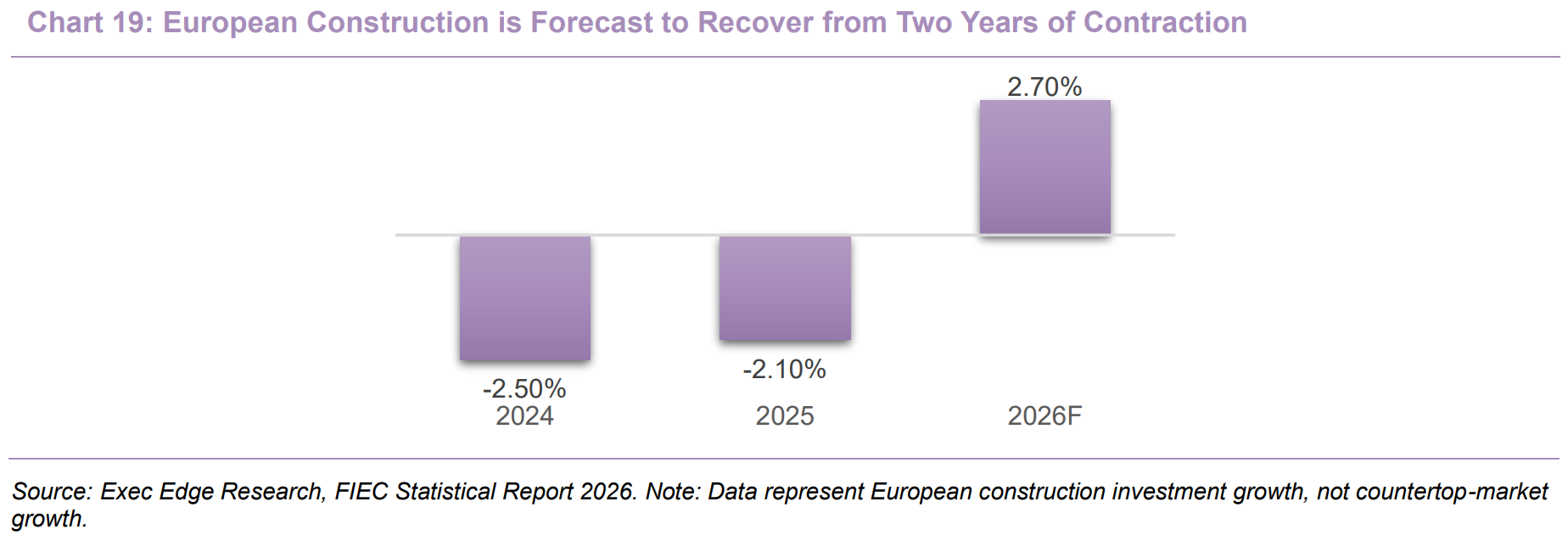
- Europe’s surface opportunity is likely to be driven more by refurbishment, specification-led demand, and selective construction recovery than by a synchronized housing upcycle. Construction investment declined 2.5% in 2024 and 2.1% in 2025, but FIEC forecasts a 2.7% increase in 2026 as building investment returns to growth and renovation and non-residential activity improve. The region’s ageing building stock provides a long-duration refurbishment backdrop, with approximately 85% of EU buildings constructed before 2000 and around 75% showing poor energy performance. While energy renovation does not translate directly into countertop demand, broader property upgrades can create associated kitchen, bathroom, flooring, wall, and façade opportunities. Large-format porcelain is particularly relevant because it extends beyond worktops into floors, walls, bathroom surfaces, façades, and commercial interiors, supporting coordinated applications across hospitality, retail, offices, and multifamily projects. Lower financing costs would improve project economics, but public renovation programs, building-energy requirements, and the need to modernize ageing properties may provide more durable support than new home construction alone. We believe this favors suppliers able to combine specification support, technical documentation, and multi-application product breadth across fragmented local markets.
- Europe’s fragmented recovery makes local market positioning and route-to-market capabilities more important than the headline regional growth rate. EU construction production increased only 0.2% y/y in June 2026, while euro-area output declined 0.7%, despite FIEC’s forecast recovery in annual investment. Conditions remain uneven, with improving activity in markets such as Germany and Sweden contrasting with weaker trends in France and Spain, while U.K. repair and maintenance have remained more resilient than new work. Financing costs, planning delays, energy and material prices, skilled-labor shortages, and cautious private investment continue to constrain projects. At the same time, regulation can support refurbishment while increasing supplier requirements, including documentation, traceability, and sustainability compliance. Currency movements and energy-intensive porcelain production add further cost sensitivity. We believe near-term opportunities are therefore more likely to emerge through individual countries, renovation segments, and specification-led projects than through a broad residential upcycle. Successful participation will depend on local inventory, architectural engagement, installation support, and the ability to navigate country-specific standards and channels.
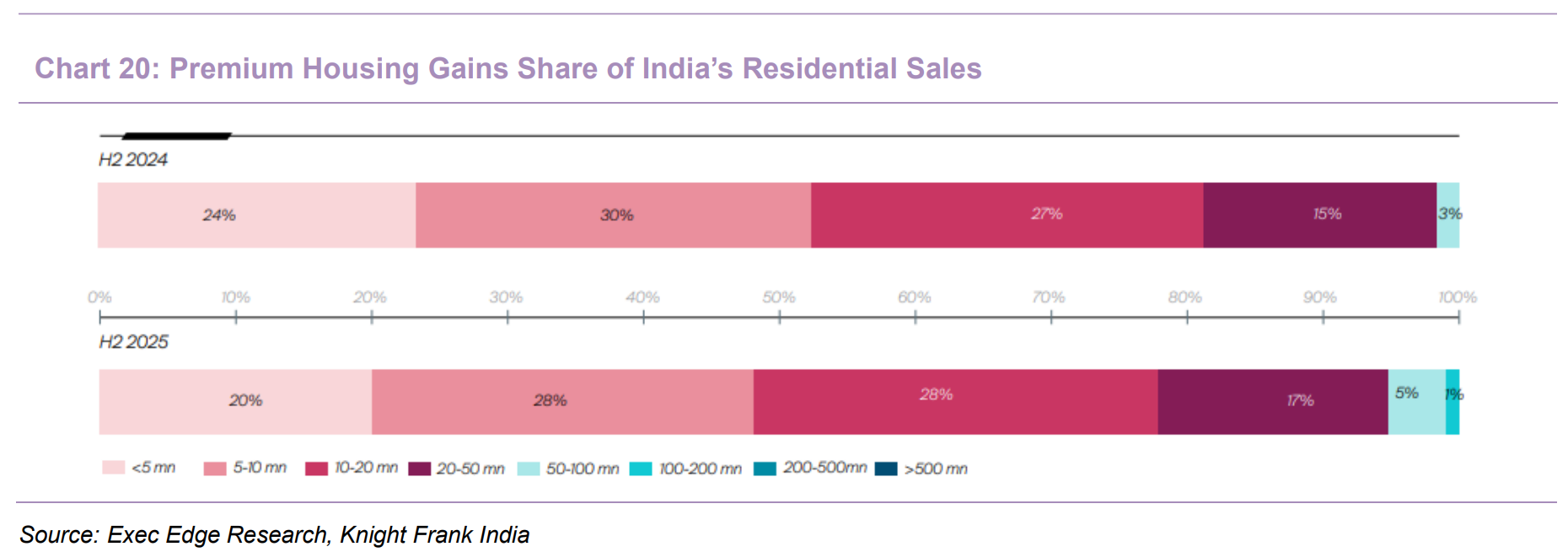
- India’s premiumization trend supports branded surface demand while strengthening the case for porcelain-led growth. Knight Frank recorded approximately 348,000 residential sales across the eight largest markets in 2025, broadly stable y/y after several years of growth. The more important trend for premium surfaces is the rising value mix, with homes priced above ₹10 million representing approximately half of sales and demand increasingly concentrated in larger units, better amenities, and higher-quality finishes. Bengaluru, Mumbai, Hyderabad, Chennai, and the National Capital Region provide concentrated pools of consumers, developers, and design professionals, while continued urbanization and infrastructure investment support longer-term housing formation. India also offers raw-material availability, manufacturing expertise, and export infrastructure that support porcelain slab production. The opportunity remains competitive, with quartz, natural stone, ceramic tile, and porcelain available across wide price points and distribution and installer capabilities varying materially by city. Large-format porcelain also requires specialized transport, cutting, and installation, which can constrain adoption outside developed metropolitan channels. We believe India is therefore better viewed as a premium urban demand and manufacturing opportunity than as a broad-based national countertop growth market.
- Singapore combines a visible construction pipeline with a high-value, specification-led market that favors premium surface applications. The Building and Construction Authority expects construction demand of S$47 to S$53 billion in 2026, broadly consistent with S$50.5 billion in 2025, while construction output is forecast to increase to S$43 to S$46 billion. Government land supply and a confirmed pipeline of 9,320 private residential units in 2026, more than 50% above the annual average of the previous decade, provide additional visibility. Beyond housing, hotels, offices, retail, healthcare, and public buildings create demand for countertops, vanity surfaces, flooring, and wall cladding, while high design standards can favor premium, durable, and coordinated materials. The market remains modest in absolute size and dependent on imported products, skilled installation, and the timing of large projects, but its specification intensity makes it relevant beyond domestic volume alone. We believe Singapore can also serve as a useful reference market for architects, developers, and distributors across Southeast Asia, although broader regional adoption will depend on local channel development and project conversion.

- CSTE’s geographic diversification creates multiple paths to growth without requiring a synchronized recovery across all markets. Australia provides the clearest company-level evidence, with regulatory substitution and the ICON rollout already supporting renewed revenue momentum. Europe offers a different opportunity centered on refurbishment, specification-led projects, and broader porcelain applications, while India combines premiumization with CSTE’s porcelain manufacturing footprint and Singapore provides exposure to a high-value, specification-oriented Southeast Asian market. The opportunity is therefore diversified not only by geography, but also by demand driver, reducing reliance on any single housing cycle or material category. We believe successful expansion will increasingly depend on CSTE translating its local sales infrastructure, broader material portfolio, and direct-market relationships into sustained regional growth, higher new-material penetration, and stronger project conversion.
Growth Strategy
Structural Reset Supports Commercial and Category Expansion
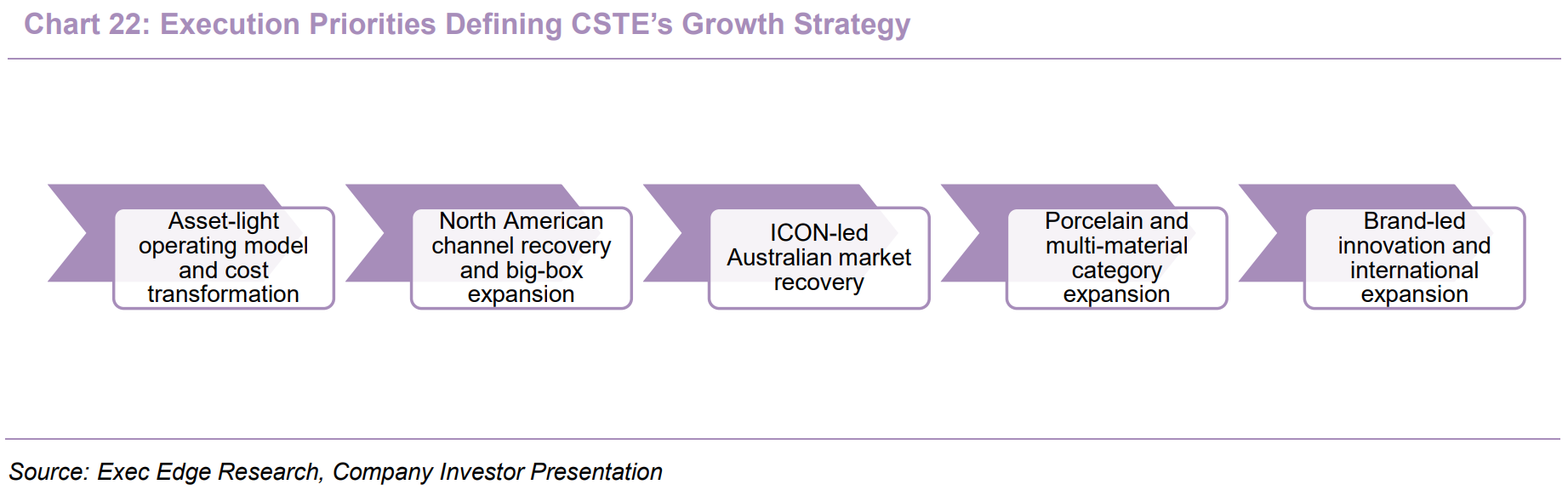
- CSTE’s growth strategy combines a lighter operating model with targeted commercial, product, and geographic initiatives. The strategy is centered on five priorities: completing the cost reset, rebuilding North American demand, sustaining Australia’s ICON-led recovery, expanding porcelain, and broadening brand and geographic reach. Successful delivery would lower the company’s breakeven point, restore operating leverage, broaden the revenue mix, and strengthen CSTE’s ability to convert an eventual end-market recovery into more durable earnings growth. The following five elements outline the strategy and key initiatives undertaken through 2Q26.
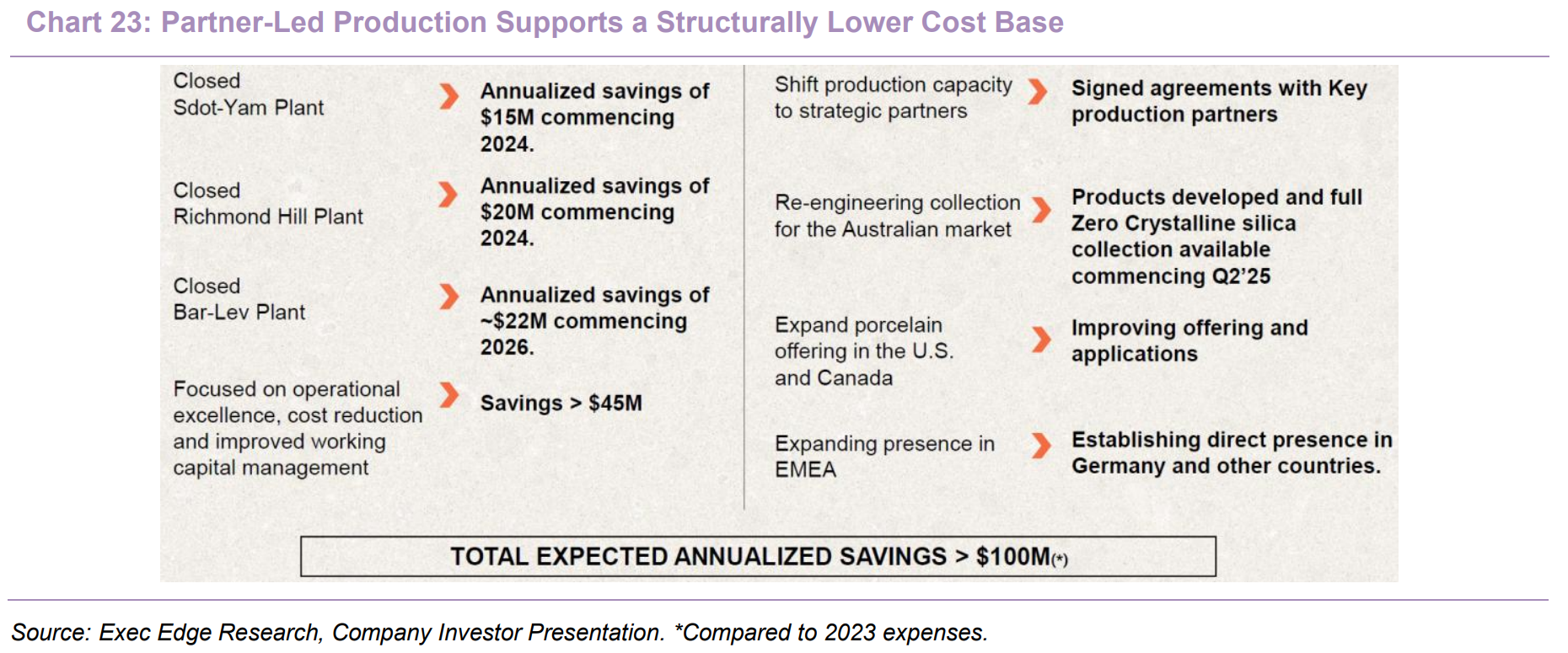
- The partner-led production reset is expected to deliver more than $100 million of annualized savings by 2027 while structurally lowering CSTE’s fixed-cost base. The company has completed the transition of quartz production from owned facilities to a global network of production business partners, while retaining in-house porcelain manufacturing at the Lioli facility in India. This follows the closures of Sdot Yam and Richmond Hill in 2023 and Bar-Lev in December 2025. The Bar-Lev closure alone is expected to generate approximately $22 million of annualized cash savings once fully implemented, contributing to total anticipated annualized savings of more than $100 million by 2027 relative to 2023. During 2Q26, restructuring cash costs were $1.2 million, with an additional $3 million to $4 million expected for the balance of 2026. Management is also evaluating distribution-center consolidation and other fixed-cost initiatives. The strategy is intended to lower the company’s breakeven point while improving sourcing flexibility and product availability through lower-volume periods.
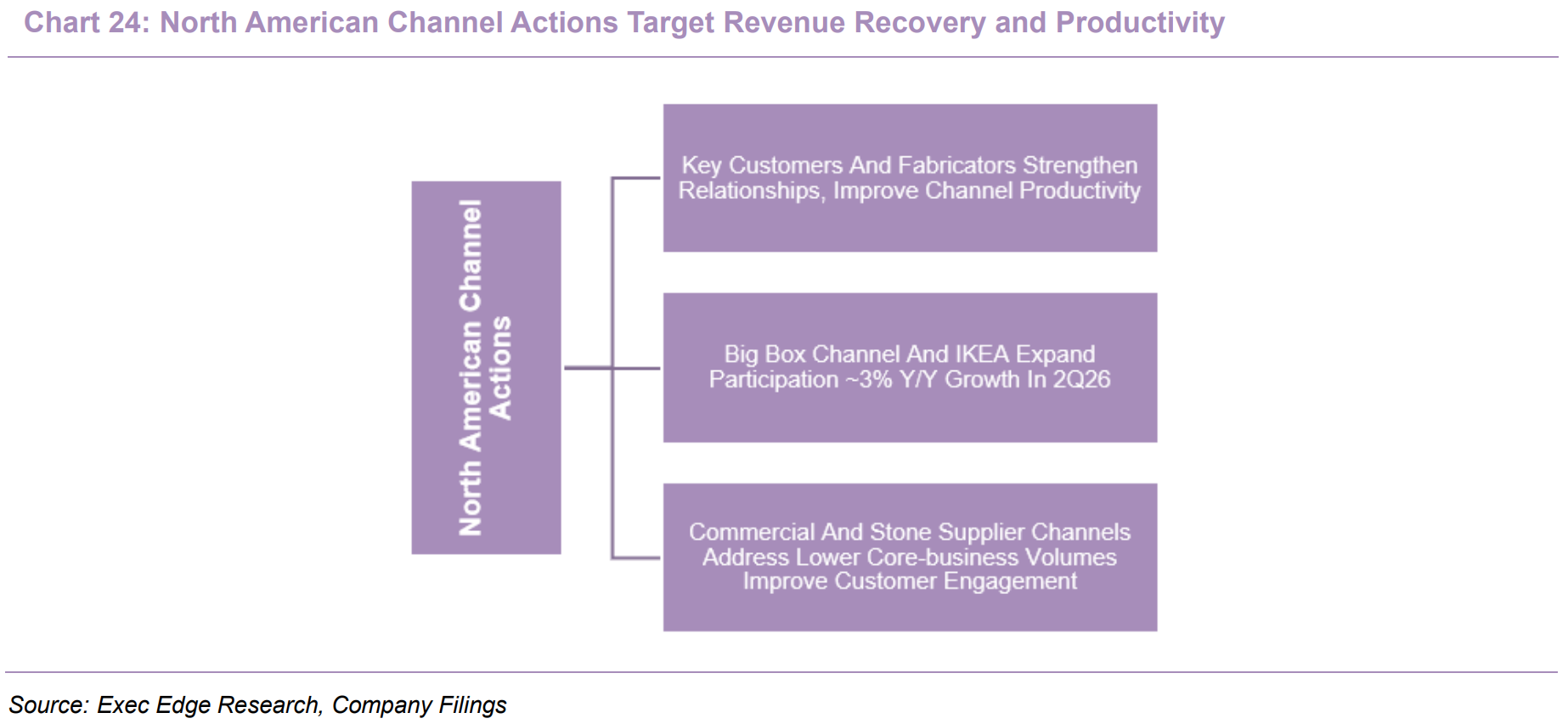
- North American recovery is centered on rebuilding customer engagement, improving channel productivity, and expanding selected retail relationships. Recent actions include strengthening relationships with key customers and fabricators, addressing commercial and stone-supplier channels, and increasing participation in the big-box channel, including IKEA. Big-box revenue grew approximately 3% y/y in 2Q26, led by IKEA, providing an early proof point of traction within one targeted channel. CSTE’s local sales, warehouse, and distribution infrastructure supports these efforts by connecting customer demand with inventory and technical support. The company is also coordinating with production partners to improve product availability and has introduced U.S. pricing actions intended to offset part of the increase in imported-product costs. The focus is on restoring growth across weaker channels while extracting more from the existing North American commercial footprint.
- Australia’s growth strategy is focused on extending the ICON-led recovery while broadening the material offering through porcelain. Following Australia’s engineered-stone prohibition, CSTE introduced its full ICON crystalline-silica-free collection and redirected commercial activity toward replacement products that could be supplied under the revised market requirements. Execution now centers on sustaining ICON adoption through sales, product education, channel engagement, and collection availability, while expanding porcelain as an additional material choice. Together, these initiatives are intended to rebuild CSTE’s market position and broaden customer participation beyond the legacy quartz category.
- Porcelain growth is focused on improving Lioli’s commercial alignment and expanding distribution across priority direct markets. CSTE is integrating its Indian production base and external sourcing relationships with the company’s broader product-development, collection-planning, and commercial infrastructure. Recent actions include expanding the porcelain assortment, coordinating selected designs across materials, and incorporating porcelain into the broader Caesarstone premium-surfaces proposition. Expansion in the U.S. and Canada remains a key priority, while porcelain is also being developed alongside ICON in Australia. The strategic objective is to use CSTE’s existing customer relationships and local-market infrastructure to increase porcelain availability, specification, and sell-through through the existing commercial platform.
- Brand and geographic expansion is focused on deepening engagement and extending direct-market reach in priority regions. Recent initiatives combine new product launches, design-led marketing, digital content, showrooms, trade events, and professional education with expansion in Germany and other EMEA markets. CSTE is using local sales teams and production or distribution partners to build awareness, support product specification, and introduce its multi-material portfolio in priority markets. The expansion follows earlier direct-market investments in the United Kingdom and Sweden and is intended to deepen CSTE’s presence across EMEA. Success should be reflected in sustained new-product adoption, deeper local customer relationships, and durable share gains across priority markets.
Management Team
Experienced Leadership Team Anchors Operating and Commercial Transformation
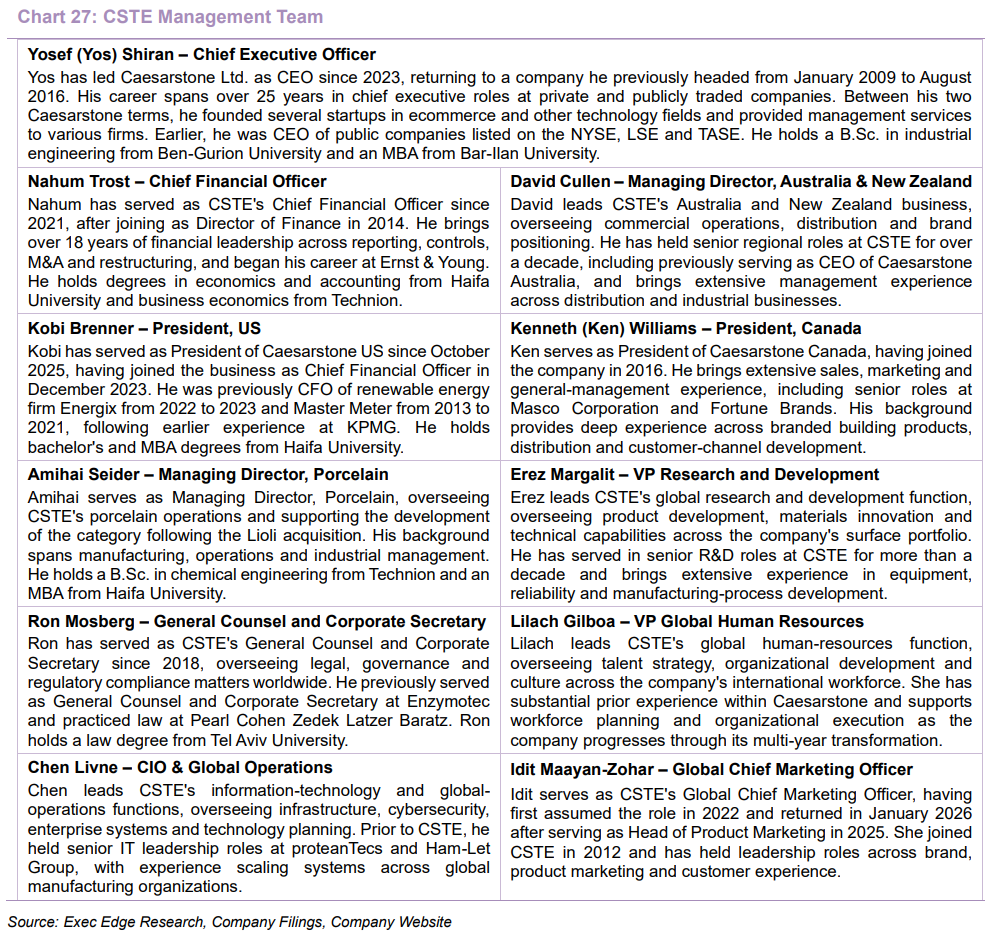
- Experienced leadership is driving CSTE’s cost reset, commercial recovery, and multi-material expansion. CEO Yos Shiran, returning in 2023 after a prior tenure leading the company, brings over 25 years of CEO-level experience guiding the ongoing transformation. CFO Nahum Trost, promoted internally after nearly a decade in finance roles, anchors the balance sheet and cost-reduction execution that underpin the path to profitability. Around them, a comprehensive leadership bench spans legal, marketing, technology and human resources, ensuring coordinated execution across CSTE’s global footprint. The Board of Directors, chaired by Dr. Ariel Halperin and comprising directors with backgrounds in private equity, capital markets and industrial operations, adds independent oversight and strategic counsel as CSTE navigates its multi-year restructuring plan.
Fundamentals & Valuation
Structural Cost Reset Drives Margin Recovery Despite Revenue Pressure
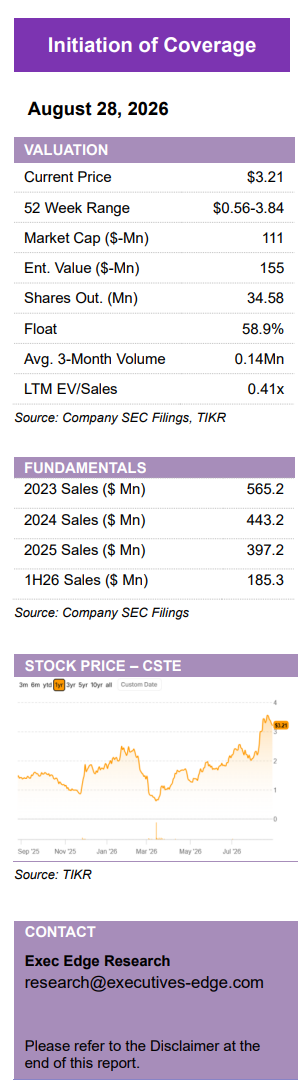
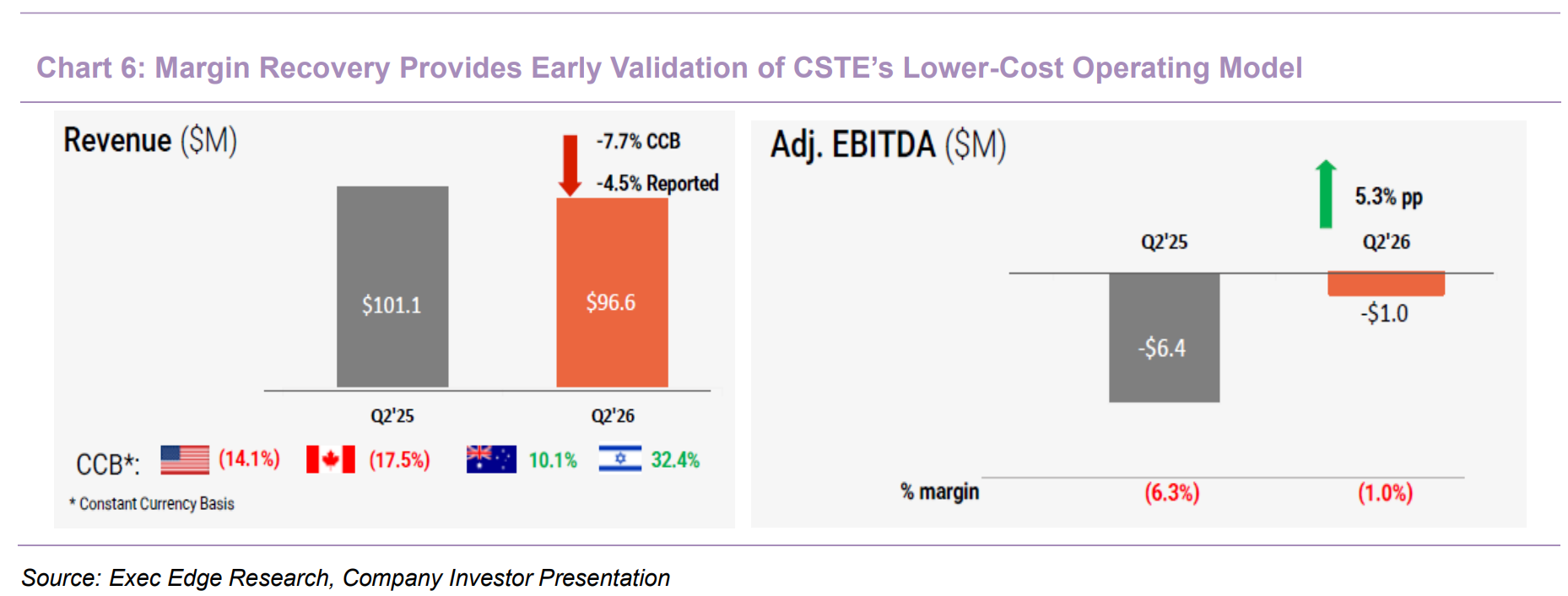
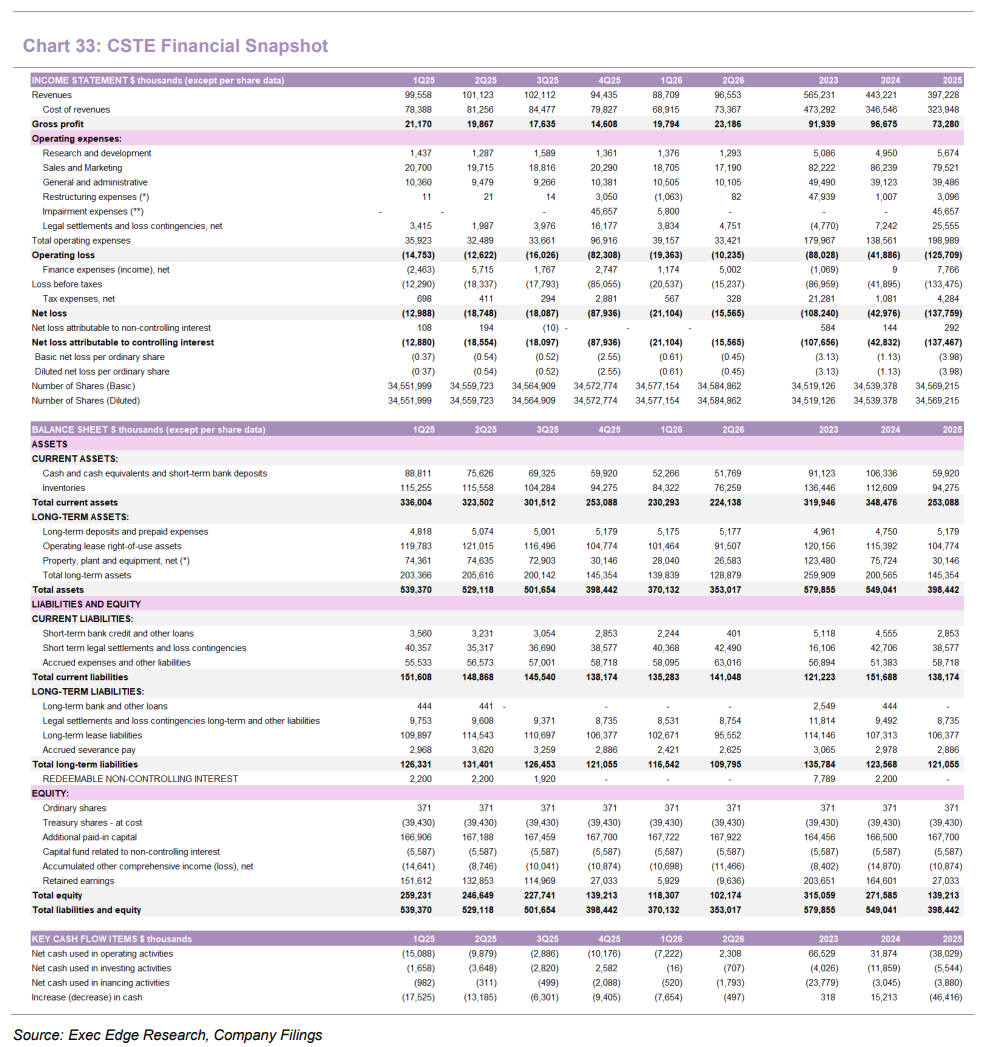
- CSTE’s restructuring is beginning to restore profitability despite revenue pressure. Revenue declined to $397.2 million in 2025 from $565.2 million in 2023, while 1H26 revenue fell another 7.7% y/y as reported and 11.3% on a constant-currency basis to $185.3 million. The decline has reflected soft end-market demand and competitive pressure, particularly in North America, alongside lower volumes and pricing pressure. The pressure persisted in 2Q26, when revenue declined 4.5% y/y as reported and 7.7% in constant currency to $96.6 million. However, gross margin expanded to 24.0% from 19.6%, and the adjusted EBITDA loss narrowed to $1.0 million from $6.4 million. The key takeaway is that the lower-cost operating model is improving profitability before demand has recovered. Near-term progress is therefore better measured through recurring gross margin, adjusted EBITDA, and cash consumption than immediate top-line growth. A stable revenue base would create meaningful earnings leverage, but continued volume erosion could absorb part of the benefit from the lower cost structure. Margin recovery is now visible, making revenue stabilization the next key proof point.
- The restructuring program provides the clearest quantified path toward a materially lower breakeven point. CSTE expects annualized savings of more than $100 million by 2027 relative to its 2023 expense base. This target incorporates approximately $15 million from the Sdot-Yam closure, $20 million from Richmond Hill, and $22 million from Bar-Lev, alongside additional sourcing, organizational, and working-capital actions. With quartz production fully transferred to external partners, the company has removed a substantial portion of its owned manufacturing capacity and related fixed overhead. The result is a more flexible cost structure that requires less revenue to support profitability and less capital to maintain production. However, the $100 million figure should not be interpreted as an incremental EBITDA bridge from current results. A portion of the savings has already been reflected, while revenue declines, inflation, logistics, foreign exchange, partner economics, and tariffs can offset the gross benefit. The more relevant proof points are therefore recurring gross-margin expansion and adjusted EBITDA improvement rather than the headline savings target alone.
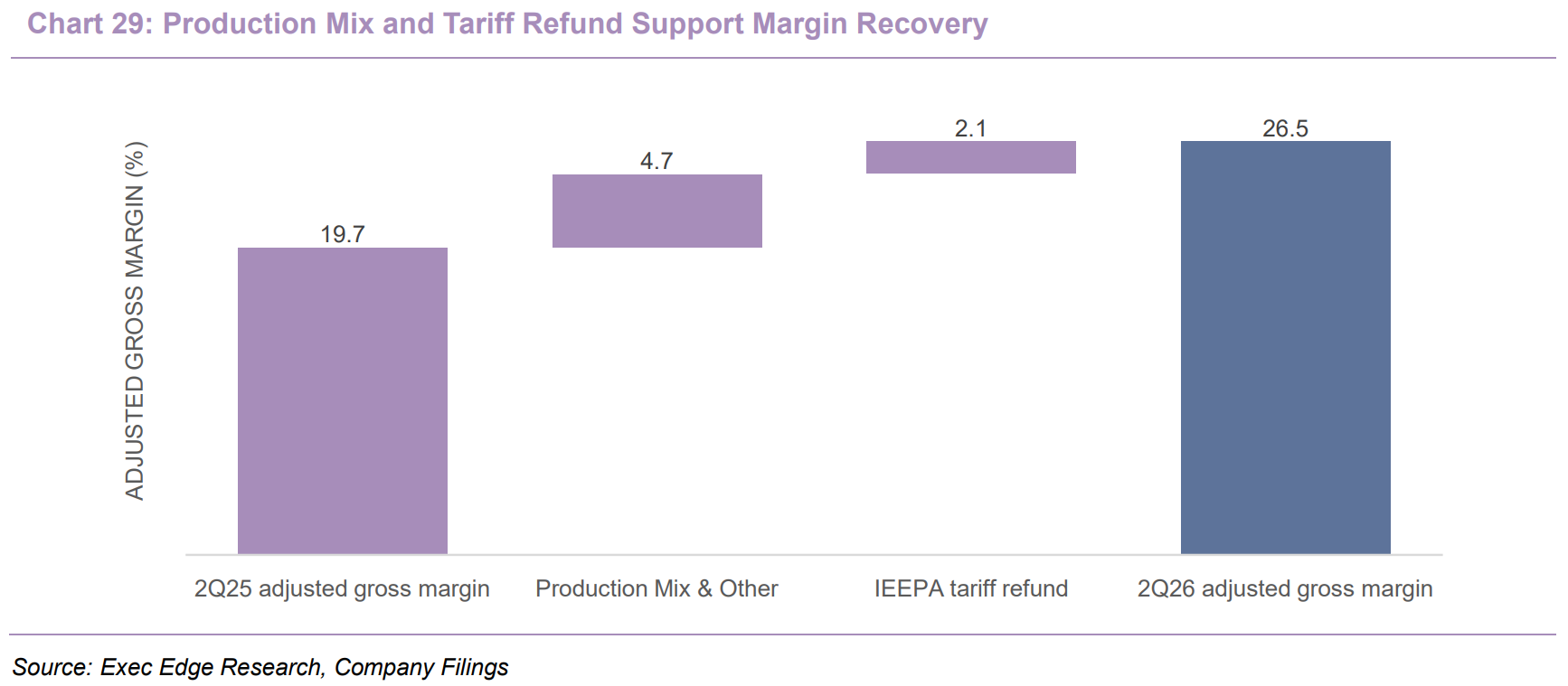
- Second-quarter margin expansion provides the clearest evidence yet that the cost reset is translating into better underlying economics. Gross margin improved 440 bps y/y and 170 bps sequentially to 24.0%, while adjusted gross margin increased 680 bps y/y and approximately 260 bps sequentially to 26.5%. The principal recurring driver was the transition from Bar-Lev production to CSTE’s global manufacturing-partner network, supported by a more favorable production-source mix. However, 2Q26 also included a $2.0 million refund of previously paid U.S. IEEPA tariffs and favorable foreign exchange, partly offset by lower volume and higher logistics costs. The refund contributed approximately 210 bps to quarterly margin based on reported revenue. On a simple pro forma basis, removing only that benefit would reduce adjusted gross margin to approximately 24.4%, still materially above 19.7% in 2Q25. This indicates that most of the y/y improvement was operational rather than one-off. The sustainability of the margin improvement will depend on how adjusted gross margin holds as the refund lapses and the new quartz tariffs enter the cost base.
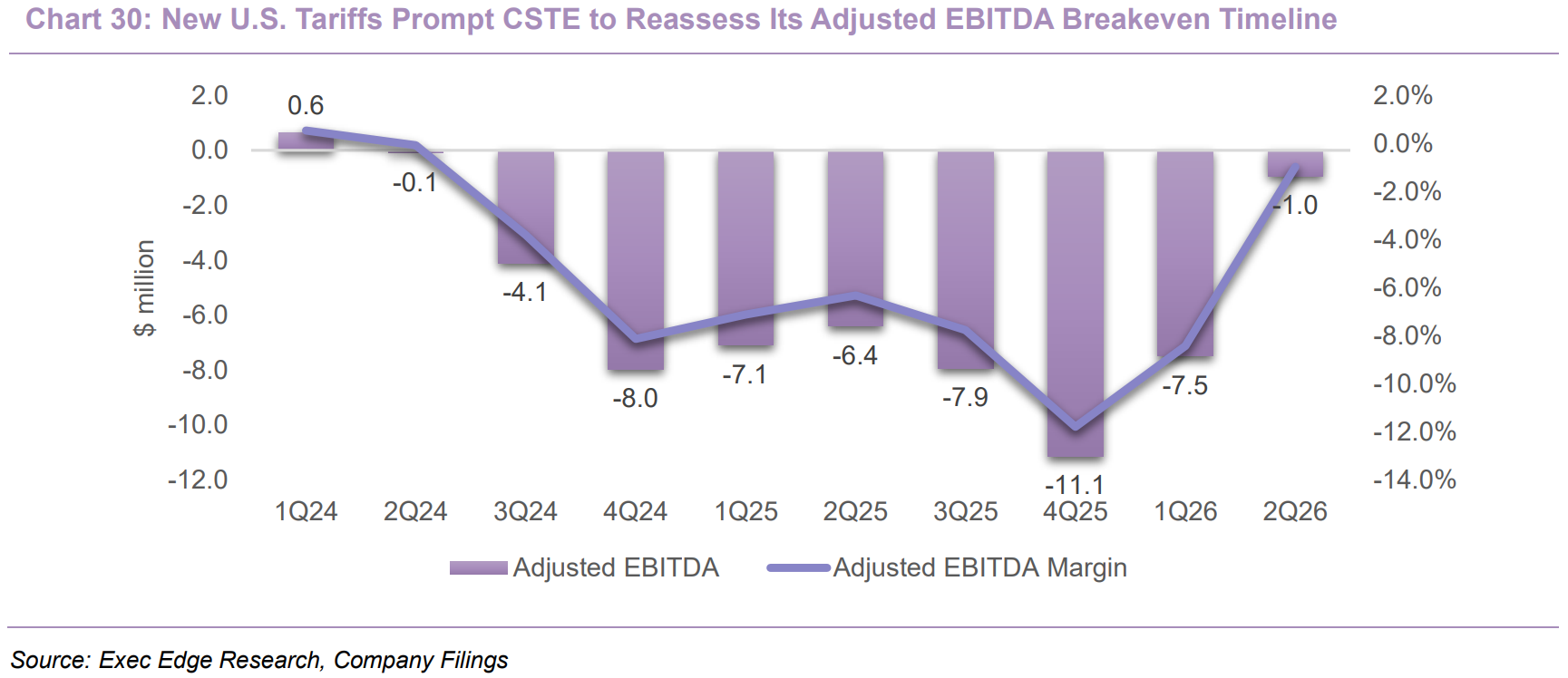
- Adjusted EBITDA neared breakeven as margin recovery began to translate into operating leverage. The adjusted EBITDA loss narrowed to $1.0 million in 2Q26 from $6.4 million in 2Q25 and $7.5 million in 1Q26. Excluding legal settlements, impairment, and restructuring expenses, operating expenses declined to $28.6 million from $30.5 million y/y and improved to 29.6% of revenue from 30.1%. The larger earnings contribution therefore came from gross-margin expansion rather than further material reductions in commercial and administrative spending. Reported adjusted gross profit of $25.6 million and adjusted EBITDA of negative $1.0 million imply an EBITDA-relevant adjusted expense base of approximately $26.6 million. Holding the 26.5% adjusted gross margin constant, an illustrative quarterly revenue level of roughly $100 million would have supported adjusted EBITDA breakeven. This is a sensitivity rather than a forecast, and the threshold would rise if tariffs reduce margin. The analysis nevertheless indicates that CSTE had moved close to operational breakeven before the new tariff measure, increasing the earnings sensitivity to margin retention and even modest revenue recovery. Management had previously targeted positive adjusted EBITDA in 3Q26, but is now reassessing the timing following the new U.S. quartz tariffs.
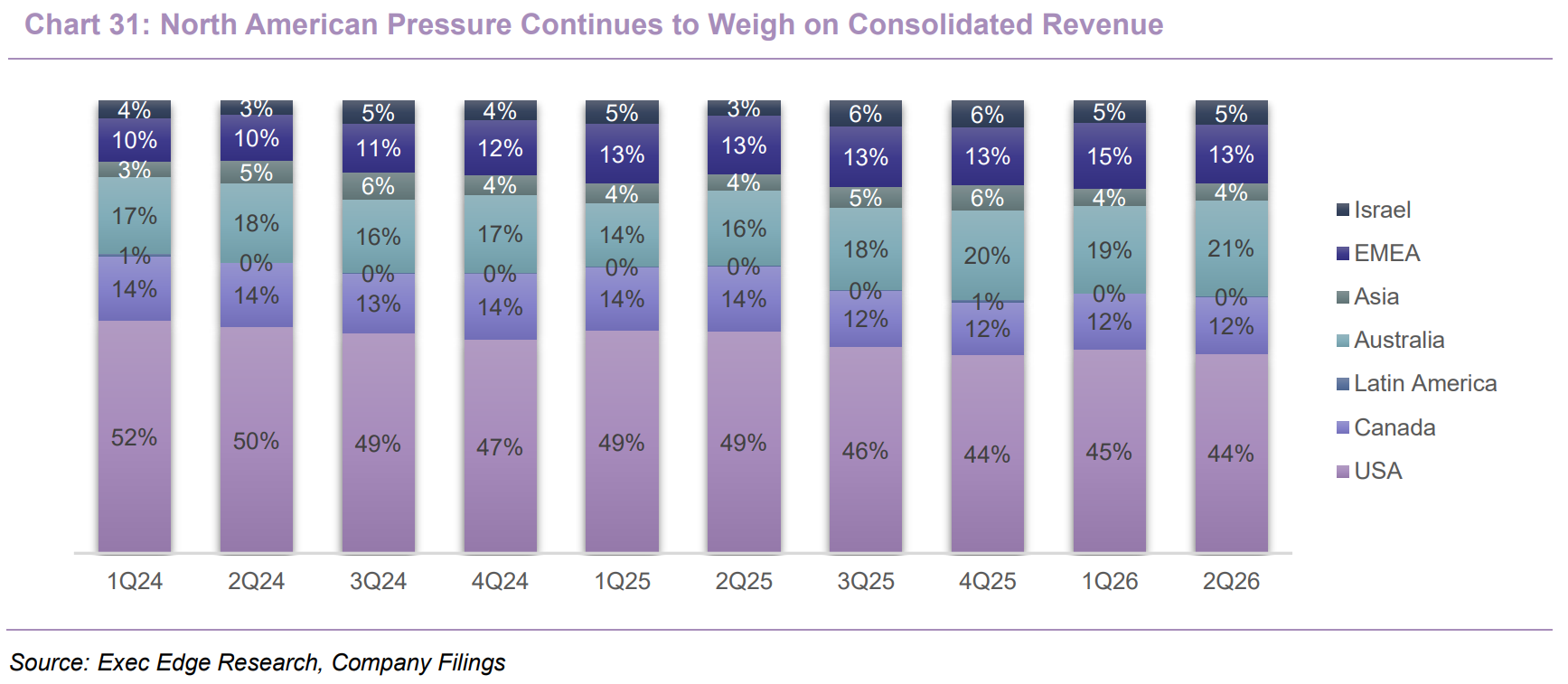
- North America remains the key demand-side proof point for CSTE’s turnaround, with core volumes still under pressure despite early channel traction. U.S. revenue declined 14.1% y/y to $42.7 million in 2Q26, following an 18.6% decline in 1Q26, leaving 1H26 revenue down 16.3%. Management attributed the latest decline to lower core-business volumes, particularly in commercial projects, new development, and stone-supplier channels. Canada revenue also declined 17.5% in constant currency during 2Q26 amid fewer housing completions and weak market conditions. These trends matter because the U.S. generated approximately 44% of quarterly revenue and remains the company’s largest market. Big-box revenue grew approximately 3% y/y, led by IKEA, but this was insufficient to offset weakness in the broader channel base. Total revenue’s 4.5% reported decline also understated the operating contraction because favorable currency reduced the constant-currency decline of 7.7%. A broader North American recovery should become more credible once core volumes stabilize and improving channel performance begins to offset weakness in commercial and stone-supplier demand. The relevant indicators are commercial activity, stone-supplier orders, pricing retention, and whether big-box growth becomes material enough to change the regional trajectory.
- The new U.S. quartz tariff represents the most significant near-term test of CSTE’s emerging margin structure. CSTE’s partner-based production network supplies the U.S. primarily through imports, and the average tariff applicable to products imported into the market was already approximately 15% during 2Q26. Effective August 15, 2026, the new four-year quartz tariff-rate quota imposes an additional 25% tariff on industry imports within the first-year quota of approximately 13 million square meters and 50% above the quota. The measure directly tests the sourcing model that drove the recent gross-margin improvement, making landed cost, supplier allocation, and pricing key determinants of margin retention. Management intends to respond through supply-chain optimization, sourcing changes, and pricing, but had not quantified the expected net impact. The company is consequently reassessing the timing of positive adjusted EBITDA while evaluating mitigation measures. Together with North American volume, tariffs are a key swing factor for the pace of the turnaround. The most relevant indicators are realized tariff rates, quota utilization, supplier allocation, pricing retention, and normalized gross margin after 3Q26.
- Australia and new materials provide the clearest current evidence of where renewed growth could emerge. Australian revenue increased to $20.3 million from $16.6 million in 2Q26, representing 22.1% reported growth and 10.1% growth in constant currency. The result marked a fourth consecutive quarter of y/y growth, while 1H26 constant-currency growth reached 10.6%. The recovery followed the launch of the full crystalline-silica-free ICON collection in 2Q25 and provides the clearest evidence that product redevelopment can restore market position after regulatory disruption. The distinction between reported and constant-currency growth remains important, as currency accounted for a meaningful portion of the translated increase. Porcelain adds a second growth vector by extending CSTE into additional materials and applications, although current disclosure does not yet allow investors to isolate its revenue or margin contribution.
- We believe Australia and ICON provide tangible evidence that new-material innovation can support growth, while porcelain offers a broader medium-term opportunity as distribution expands across priority markets. The key proof points are sustained Australian momentum, broader porcelain distribution, and a rising contribution from new materials to consolidated growth and mix.
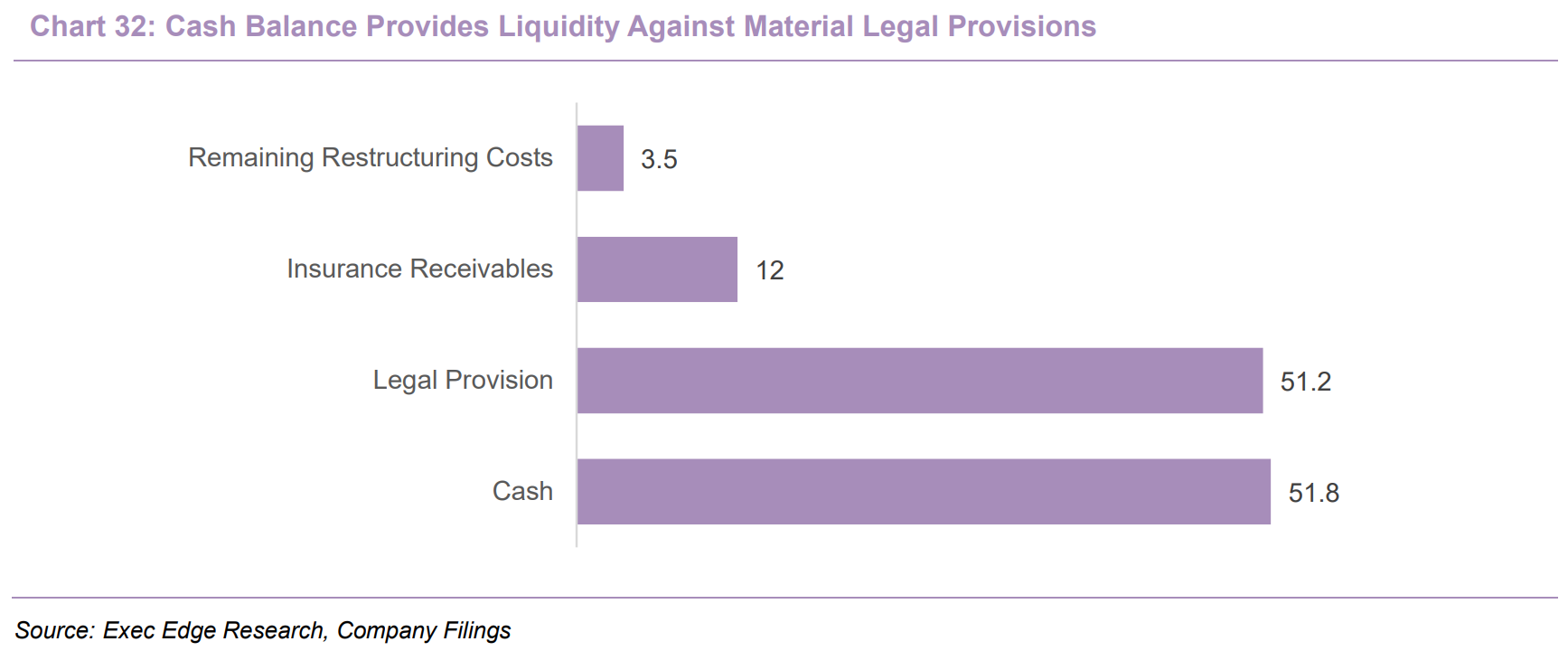
- The balance sheet provides sufficient liquidity to support the restructuring, while cash conversion and silica-related liabilities remain important valuation considerations. CSTE ended 2Q26 with $51.8 million of cash and short-term deposits and no debt to financial institutions. Operating cash outflow improved to $4.9 million in 1H26 from $25.0 million in 1H25, while 2Q26 generated approximately $2.3 million of operating cash after a $7.2 million outflow in 1Q26. The improvement was supported by inventory reduction and the $2.0 million tariff refund, making the quarterly inflow only partly representative of underlying earnings. Inventory declined $18.0 million during 1H26 to $76.3 million, while cash fell $8.2 million from year-end. A further $3 million to $4 million of restructuring cash costs is expected during 2026. Separately, the $51.2 million silica-related provision approximately equals the cash balance, against $12.0 million of recorded insurance receivables. These claims are excluded from adjusted EBITDA but remain relevant to cash and equity value. From here, the balance-sheet story will depend on sustained operating cash generation, completion of the remaining restructuring payments, and how silica-related liabilities and insurance recoveries ultimately develop.
Recent Re-Rating Narrows the Discount; Further Upside Tied to Operating Delivery
- Disclaimer: Exec Edge does not publish proprietary estimates, ratings, price targets, or investment recommendations. The valuation discussion below is illustrative only and is based on company filings, management commentary, and third-party data and estimates. It does not constitute a recommendation, price target, rating, or prediction of future pricing.
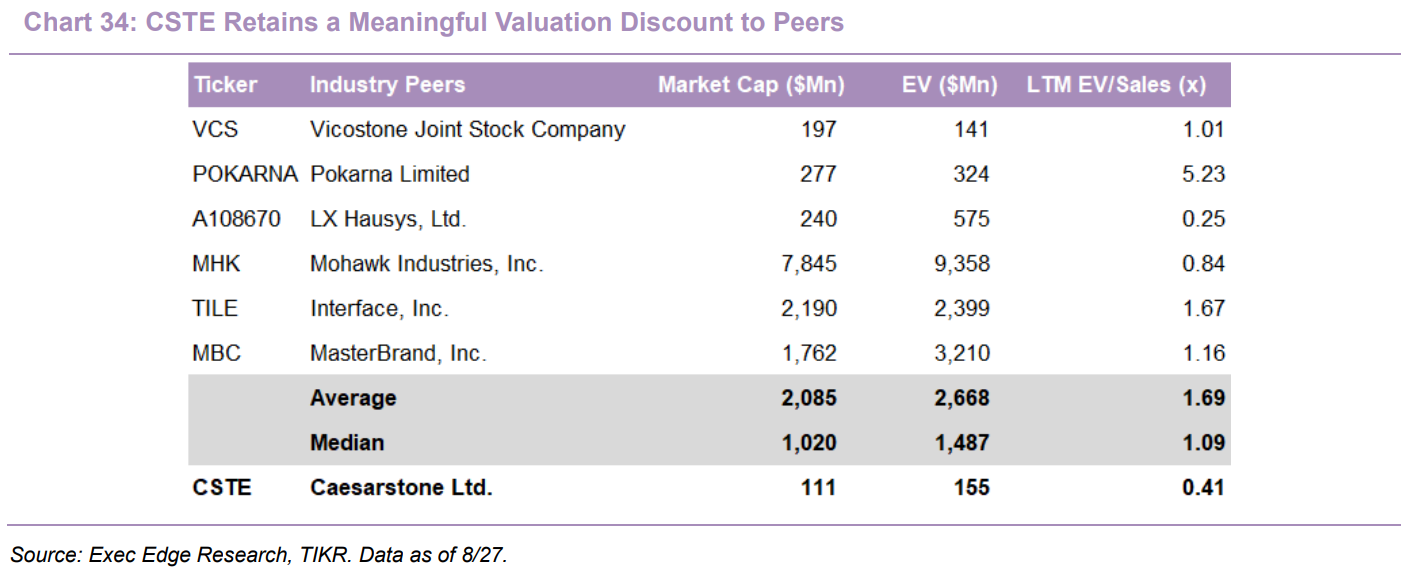
- CSTE’s recent re-rating reflects growing recognition of the cost reset, but the current valuation still leaves substantial upside if operating improvement proves durable. The stock increased from $2.09 on July 31 to $3.21 on August 27 as 2Q26 provided clearer evidence that the lower-cost operating model is translating into margin recovery and operating leverage. Yet CSTE still trades at only approximately 0.41x LTM EV/Sales versus the peer median of 1.09x, an approximately 62% discount. We believe that gap appropriately reflects negative adjusted EBITDA, weak North American demand, tariff uncertainty, and silica-related legal exposure, but also creates meaningful valuation asymmetry if the restructuring translates into recurring profitability and cash generation.
- Even a partial normalization of the valuation implies substantial upside without requiring a return to peer multiples. Applying a conservative 0.70x LTM EV/Sales multiple to CSTE’s $381.8 million of LTM revenue implies an enterprise value of approximately $267.3 million and an illustrative equity value of approximately $223.1 million, or $6.45 per share. The 0.70x multiple remains approximately 35% below the 1.09x selected-peer median, providing meaningful upside while retaining a sizeable discount for the remaining turnaround risks. This valuation is illustrative only and should not be interpreted as a price target.
- The peer set is most useful as a directional valuation reference. Vicostone and Pokarna provide the closest quartz-surface comparisons, while LX Hausys, Mohawk, Interface, and MasterBrand offer exposure to adjacent surface, renovation, specification, and distribution markets. Differences in scale, product mix, growth, geography, and profitability argue against assuming full like-for-like convergence.
- The next leg of value creation increasingly depends on earnings delivery rather than further recognition of the restructuring alone. Sustaining adjusted gross margin in the mid-20% range, reaching positive adjusted EBITDA, stabilizing North American volumes, mitigating the new U.S. tariffs, and maintaining Australian momentum would provide the operating evidence needed to support further multiple expansion. Conversely, renewed margin pressure, continued U.S. contraction, weaker pricing, or larger cash requirements from silica-related claims could constrain the re-rating. After the recent share-price recovery, the opportunity now rests on CSTE demonstrating that its structurally lower breakeven point can translate into durable earnings and cash flow.
Technical Analysis
Bullish Trend Holds as Momentum Cools Near Long-Term Resistance
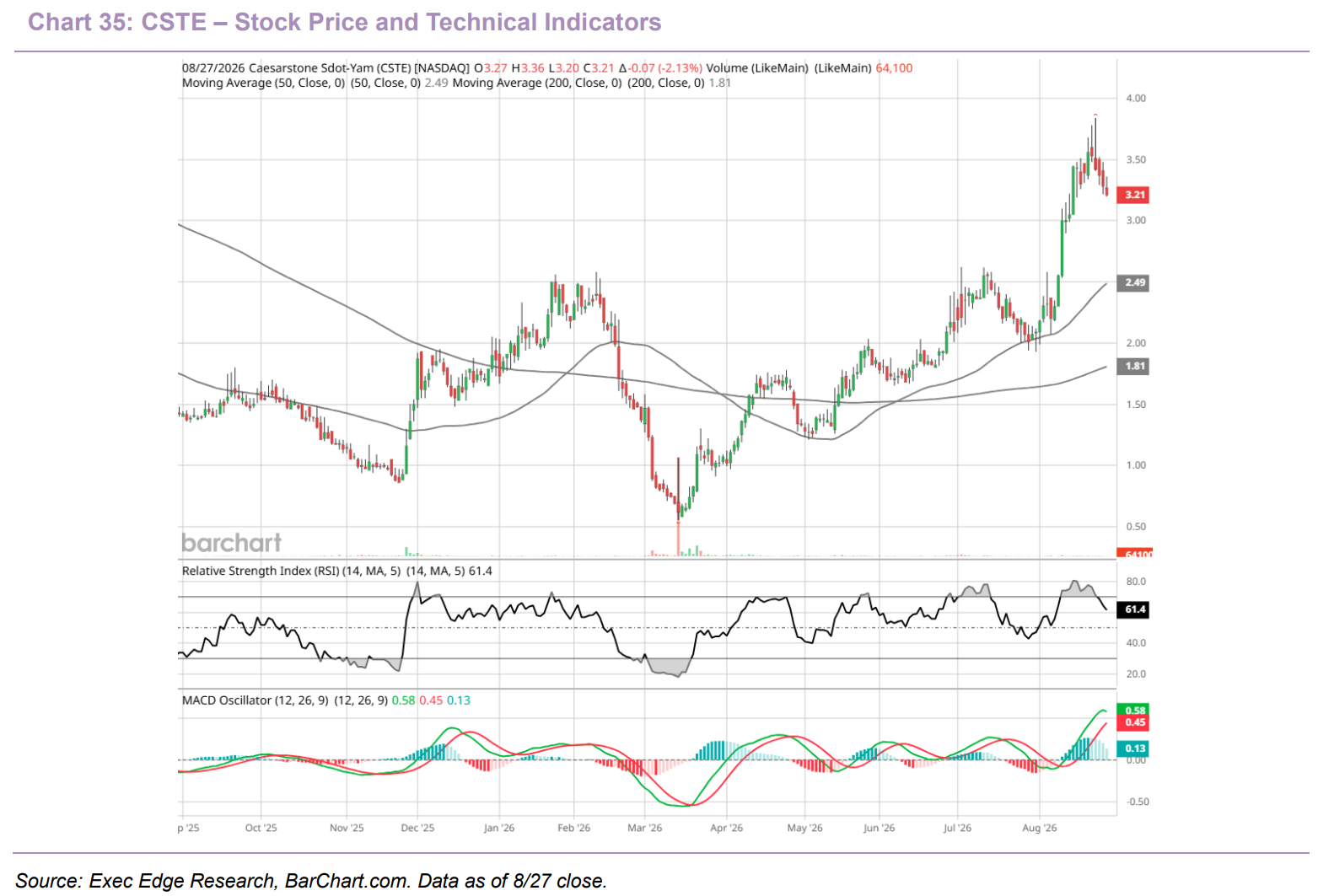
- CSTE’s charts indicate a strong medium-term recovery and bullish momentum, although the recent pullback suggests that the sharp August advance is entering a consolidation phase. The shares closed at $3.21 on August 27 and traded 28.9% above the 50-day moving average of $2.49 and 77.3% above the 200-day moving average of $1.81, with both moving averages rising. Momentum remains positive but has begun to cool following the recent surge. The 50-day moving average (DMA) has crossed above the 200-DMA and remained above it since early June. Daily RSI reached overbought territory above 70 during the August advance but has subsequently declined to 61.4 as the shares pulled back from their recent high, indicating moderation in momentum without yet undermining the bullish trend. The daily MACD remains positive, with the MACD line of 0.58 above its 0.45 signal line and a positive 0.13 histogram. However, the narrowing histogram indicates that upside momentum is decelerating. The weekly chart has established a clear higher-high and higher-low price pattern since April, with the advance accelerating sharply in August as the stock broke above the $2.50-$2.60 resistance area and surged toward $3.80. On the weekly chart, RSI stands at 66.7 after recently moving above 70, while the MACD line of 0.57 remains above its 0.32 signal line with a positive 0.25 histogram, supporting the broader bullish trend. The recent pullback from approximately $3.80-$3.85, close to the declining 200-week moving average, establishes this area as significant resistance. Initial support is around $3.00, corresponding with the recent breakout area, followed by approximately $2.50-$2.60 and the rising 50-day moving average near $2.49. Overall, CSTE’s short- and medium-term technical trends remain bullish, supported by rising moving averages and a higher-high/higher-low price structure, but weakening daily momentum and the pullback from long-term resistance increase the likelihood of near-term consolidation or further retracement before another sustained advance.
Risks
- Silicosis litigation and insurance coverage. CSTE is subject to bodily-injury claims alleging exposure to respirable crystalline silica during product fabrication. As of June 30, 2026, the company was subject to claims involving approximately 800 individuals globally, including approximately 600 in the U.S., and had recorded a $51.2 million provision for probable and reasonably estimable losses. The vast majority of U.S. claims remain at an early stage or are considered only reasonably possible losses, for which no provision has been recorded. Outcomes may include settlements, judgments, defense costs, and additional claims. Existing insurance coverage is disputed and may not fully offset related liabilities or cash payments. The company had recorded $12.0 million of insurance receivables as of June 30, 2026.
- Evolving silica regulation. Worker-safety regulation governing engineered stone and crystalline silica continues to evolve across CSTE’s markets. Australia’s ban on engineered-stone slabs containing crystalline silica took effect in most states and territories in July 2024, and other jurisdictions may adopt restrictions, enhanced fabrication standards, or enforcement programs. Compliance may require product reformulation, testing, safety measures, or changes to distribution and fabrication practices. New requirements could increase costs, disrupt product availability, encourage litigation, or limit sales of affected materials.
- Tariffs and trade restrictions. CSTE’s international sourcing model is exposed to tariffs, antidumping and countervailing duties, quotas, and other trade restrictions. Effective August 15, 2026, the U.S. imposed a four-year tariff-rate quota on quartz surface imports, with first-year covered imports within an approximately 13 million square meter annual quota subject to an additional 25% tariff and imports above the quota subject to an additional 50% tariff. Such measures may increase landed costs, disrupt sourcing, or require pricing and supply-chain changes. The company may respond through sourcing optimization and pricing, but cannot ensure that these actions will fully offset the financial impact.
- Housing-market sensitivity. Demand for CSTE’s products depends substantially on residential renovation, remodeling, and new construction, particularly in the U.S., Australia, and Canada. Higher interest rates, inflation, tighter credit, weaker consumer confidence, or recessionary conditions may delay home purchases and renovation projects. These conditions can reduce volumes and constrain the company’s ability to pass through higher costs. Prolonged housing weakness could pressure revenue, margins, inventory levels, and the pace at which the restructured cost base reaches profitability.
- Competitive and pricing pressure. CSTE competes across engineered stone, porcelain, natural stone, and other surface materials on price, brand, design, quality, innovation, availability, distribution, and service. Its premium positioning can leave products priced above alternatives, while lower-cost manufacturers may offer similar surfaces, respond more quickly to trends, or compete for production capacity. Increased imports and material substitution may reduce market share and pricing flexibility. Failure to maintain product differentiation or availability could adversely affect sales, margins, and financial performance.
- Production-partner dependence. Following the closure of its engineered-stone facilities, CSTE now relies on PBPs for substantially all engineered-stone production. Certain models remain dependent on a limited number of partners, with only approximately 24% of products capable of being manufactured by more than one PBP based on the latest disclosed data. Partner disruption, inconsistent quality, intellectual-property leakage, logistics problems, or delayed qualification of capacity could interrupt supply, raise costs, delay launches, and damage customer relationships or the Caesarstone brand.
- Market and customer concentration. CSTE has exposure to a limited number of markets and retail relationships. Its four largest direct markets generated 82% of 2025 revenue, with the U.S. representing 47%. Housing conditions, regulation, competition, currency movements, or changing material preferences can affect results disproportionately. In North America, termination or deterioration of large-retailer relationships, or inadequate performance by third-party fabricators and installers, could reduce sales, create service or warranty issues, and weaken the company’s reputation with customers.
- Israel-related disruption. CSTE is incorporated and headquartered in Israel, where senior management, research and development, and other personnel are located. Armed conflict, terrorism, political instability, reserve-duty call-ups, labor disruption, or damage to infrastructure could affect workforce availability, logistics, costs, and business continuity. Regional tensions may also disrupt supplier relationships, increase cybersecurity threats, or lead to sanctions and boycotts. Commercial insurance does not cover losses from war or terrorism, and government compensation may not be available or sufficient.
Subscribe to our Weekly Newsletter to Receive All Research
Contact: