By Exec Edge Editorial Staff
Wison New Energies used Gastech 2026 in Bangkok to unveil something unanticipated: a data center. Not on land, but floating. The concept is the timely, logical extension of the company’s offshore engineering and construction capabilities and positions Wison as a solution-provider to one of today’s knottiest problems.
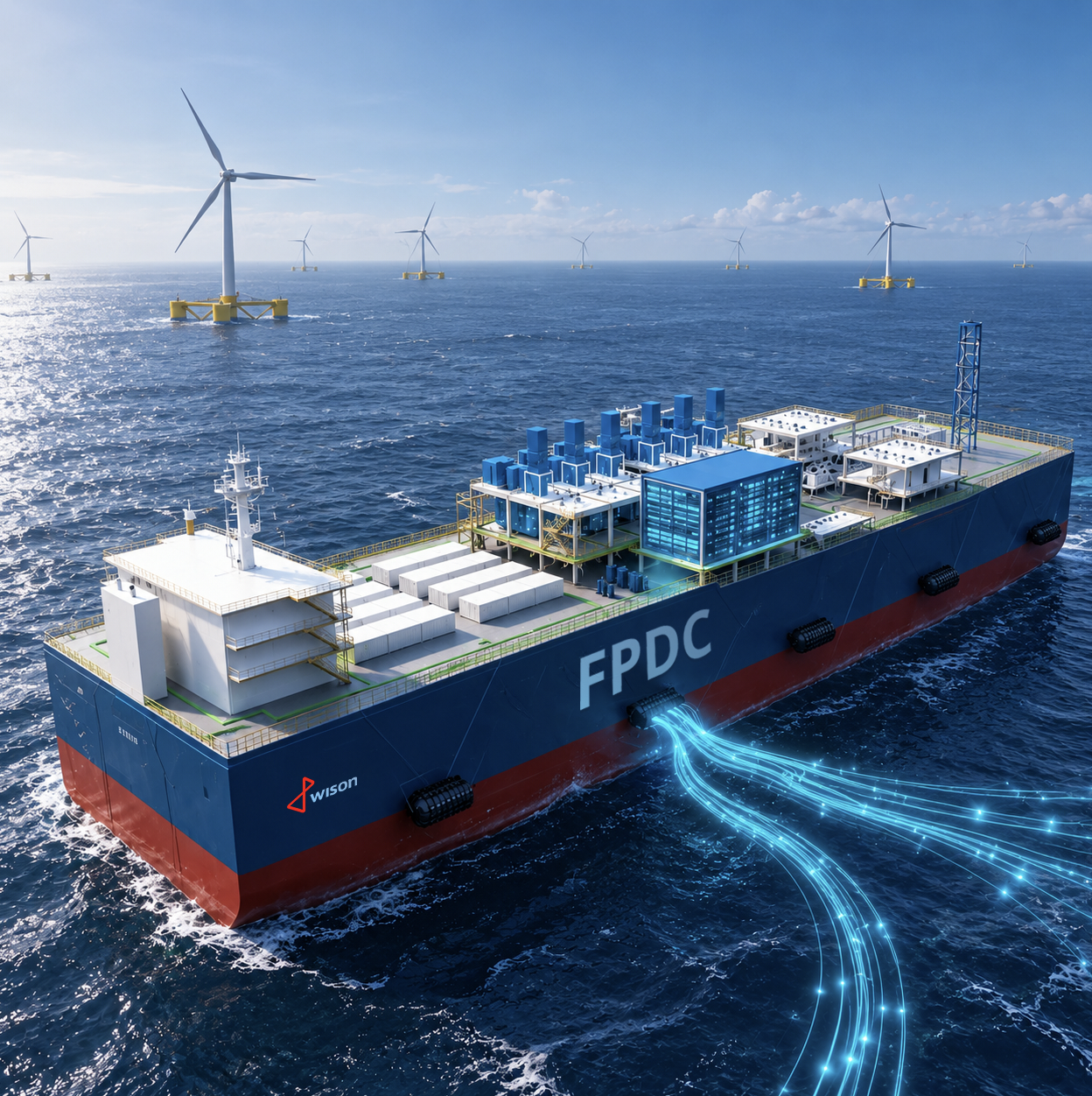
Wison New Energies unveiled its concept for a floating data center at the Gastech 2026 conference in Bangkok earlier this month.
The Floating Power Data Center concept, or FPDC, pairs Wison’s Floating Storage Regasification to Power technology with modular data-center infrastructure on a single offshore platform. LNG is stored and regasified onboard, then converted directly to electricity for onsite computing racks. It’s a natural-gas power plant and a server farm on the same hull.
The idea sounds like a stretch until you consider what’s driving it. Artificial intelligence has turned data centers into some of the most power-hungry structures ever built, and resistance to them is growing in the U.S. Grid interconnection queues are backed up for years in many regions. Water-intensive cooling systems are drawing objections from residents worried about strained local supplies. Land near major metro areas and fiber hubs, the kind data centers need most, is scarce and getting pricier.
And the political backlash has turned real: in August, Texas Governor Greg Abbott directed regulators to pause the data center permitting process until the state can review the sector’s water and energy usage. The audit covers every data center project moving through the state grid operator’s interconnection process, with officials required to collect information on tax incentives, water and power consumption, and effects on surrounding communities before any new project gets approved. Until recently, Texas was courting data centers. Now it’s a case study in how fast the politics can turn.
Wison’s pitch is that floating platforms sidestep a lot of that friction. Push the data center offshore, and it no longer competes with residential neighborhoods for grid capacity or municipal water. Site it near a port instead of a suburb, and the nature of the permitting process and conversations about noise change. The company is also examining whether the cold energy released during LNG regasification could help cool the servers, an efficiency angle that engineers are still validating but one that speaks to how tightly Wison is trying to integrate the two systems rather than just stacking them on the same deck.
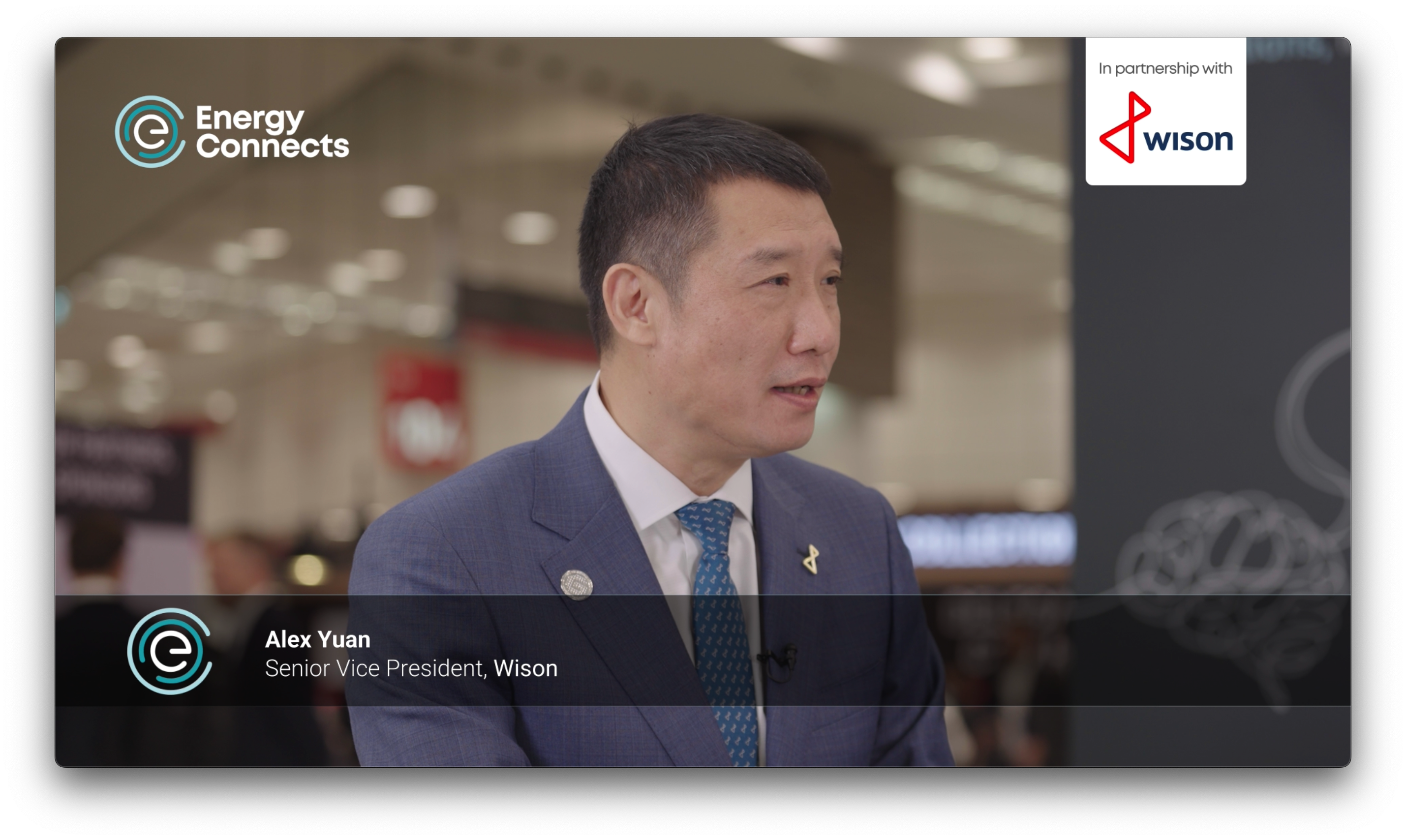
Wison New Energies Senior Vice President Alex Yuan speaks to Energy Connects at Gastech 2026.
It’s a concept. But it’s also a logical extension of what Wison already does well.
The company built its reputation on floating LNG and floating production, storage and offloading vessels, known as FPSOs, engineering complex energy infrastructure at sea and delivering it through in-house fabrication yards.
Its most recent proof point came this summer, when Wison signed the EPCIC contract for the Baleine Phase 3 FPSO serving Eni’s offshore field in Côte d’Ivoire, a nearly 308-meter facility designed to process 90,000 barrels of oil a day. Wison carried that project from front-end design through full execution, the kind of end-to-end delivery model, spanning engineering, procurement, construction, installation and commissioning, that reduces the handoff risk operators worry about most and provides a foundation for Wison’s broader expansion into operations and maintenance (O&M).
Speaking with trade outlet Energy Connects at Gastech, Wison Senior Vice President Alex Yuan framed that shift as deliberate. “For Wison, extending from EPCIC into O&M is a natural and important step in our long-term strategy,” he said, pointing out that involvement in commissioning gives the company’s teams “first-hand knowledge of system processes, equipment performance, control logic and maintenance requirements, reducing handover risk after start-up.”
Wison has since layered AI-enabled monitoring, digital twins and structural hull sensors developed with classification society Bureau Veritas onto that foundation, aimed at catching mechanical problems before they become failures. Applying that same modular, fabrication-heavy approach to a floating data center isn’t a leap for Wison. It’s the next application of a playbook the company has already proven at sea.
That playbook was on full display at Gastech, where Wison rolled out a string of announcements that, taken together, chart the company’s expanding footprint with U.S. and U.S.-linked industry. Two of the partners involved, KBR and ABS, are headquartered in the Houston area. A third, Shell, is one of the most recognizable energy names in the world. Each deal also threads back to the same theme Wison keeps returning to: lower emissions, more efficient designs, and floating solutions built for a market under pressure to decarbonize.
Here’s a look at the major news Wison made at Gastech 2026:
- Shell: Wison signed a collaboration agreement to integrate Shell’s Dual Mixed Refrigerant liquefaction technology into its floating LNG portfolio, marking the first time the process, previously limited to Shell-equity projects, will be available across the wider FLNG market. Shell will support Wison through the pre-FEED, FEED and EPC phases and provide performance guarantees on the technology. “This collaboration with Shell significantly strengthens our FLNG offering,” said Damien Xuan Chi Nguyen, Wison’s chief technology officer, who joined Shell for a technical presentation at Gastech.
- KBR: Wison and the Houston-based engineering firm signed a strategic memorandum of understandingcovering engineering, advisory services and integrated project solutions, with Wison potentially serving as engineering design or EPC contractor and KBR as advisor or engineering partner. It’s the kind of deal that reflects where Wison’s Yuan says the broader FLNG market is heading. As clients push for larger-capacity projects, he told Energy Connects, the draw isn’t size for its own sake but the ability to “monetize offshore gas resources faster” and “reduce reliance on large-scale onshore infrastructure,” goals that depend on exactly the kind of engineering and execution partnerships Wison and KBR are now exploring.
- DNV: The Norwegian classification society granted the world’s first FLNG ABATE Notation FEED Approval for Wison’s Low Emission FLNG, designed for large-scale deepwater gas developments and aimed at improving project economics while cutting capital costs and carbon footprint.
- ABS: The Houston-headquartered American Bureau of Shipping granted Approval in Principle for Wison’s Floating Storage and Regasification Unit design for ammonia, validating the technical safety of a platform meant to link offshore ammonia imports to onshore terminals as the green ammonia trade grows.
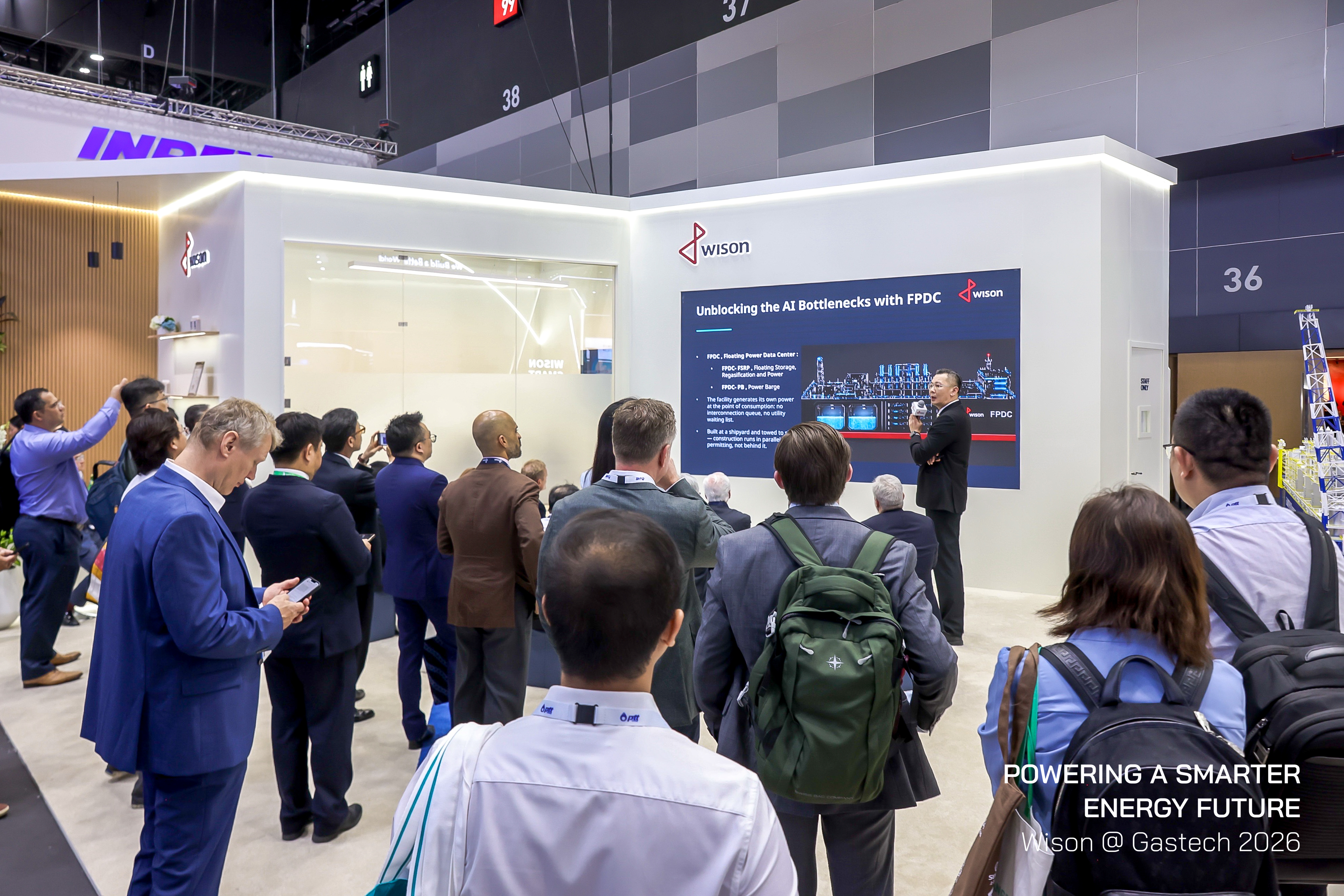
Wison’s floating data center captures media and industry attention at Gastech 2026.
None of these announcements is transformational on its own. But the cumulative picture shows a company positioning itself as more than an FLNG specialist. Wison is building relationships across the U.S. energy and engineering establishment, from a supermajor to two Houston institutions, while simultaneously testing whether its floating expertise can solve a problem that is top of mind all across the U.S.
If the data-center pushback in Texas and elsewhere continues, Wison’s bet on water may end up looking less like a novelty and more like foresight.
Never Miss our Weekly Highlights HERE
Contact:
Click HERE to follow us on LinkedIn