Download the Complete Report Here
 Horizon Quantum Holdings Ltd. (HQ)
Scalable Characterization and OQC Integration Deepen Triple Alpha; Entropica Could Accelerate Fault-Tolerant Roadmap
- Key Takeaways:
- Triple Alpha integration with OQC’s 32-qubit Toshiko processor extends hardware-control and calibration capabilities beyond HQ’s own Ember-1 testbed.
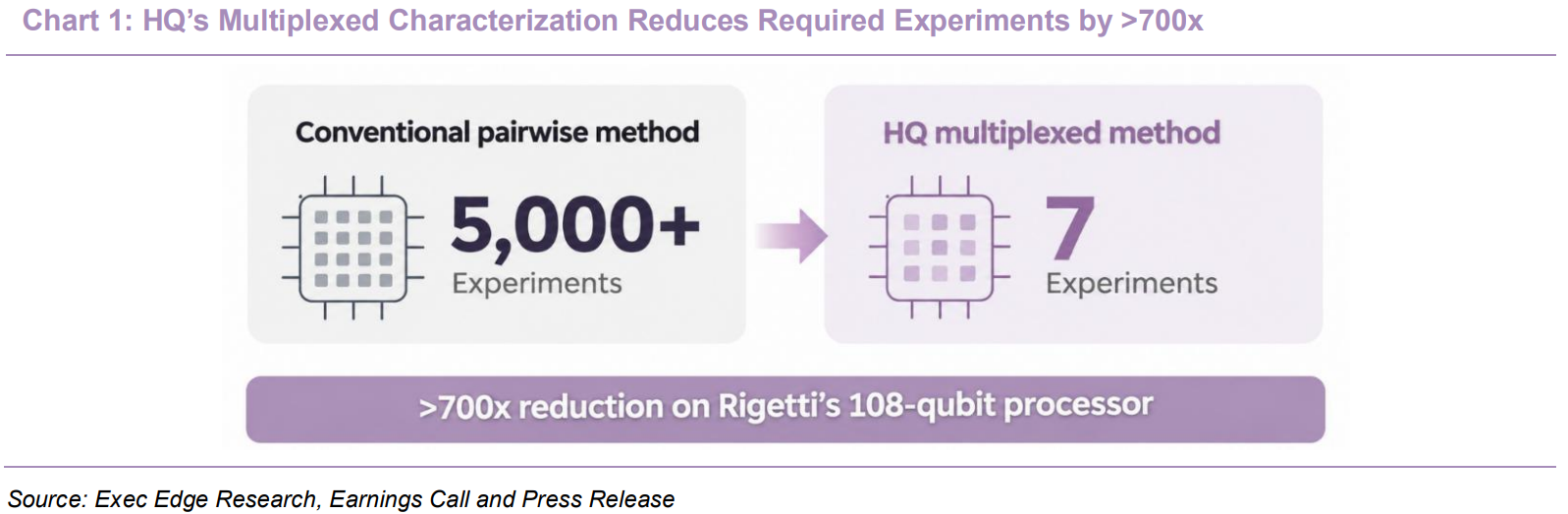
- Multiplexed characterization on Rigetti’s 108-qubit processor reduced required experiments from over 5,000 to seven, demonstrating significant scalability improvements.
- Proposed $27 million all-share acquisition of Entropica Labs could fill a critical gap in Triple Alpha’s fault-tolerant compilation capabilities.
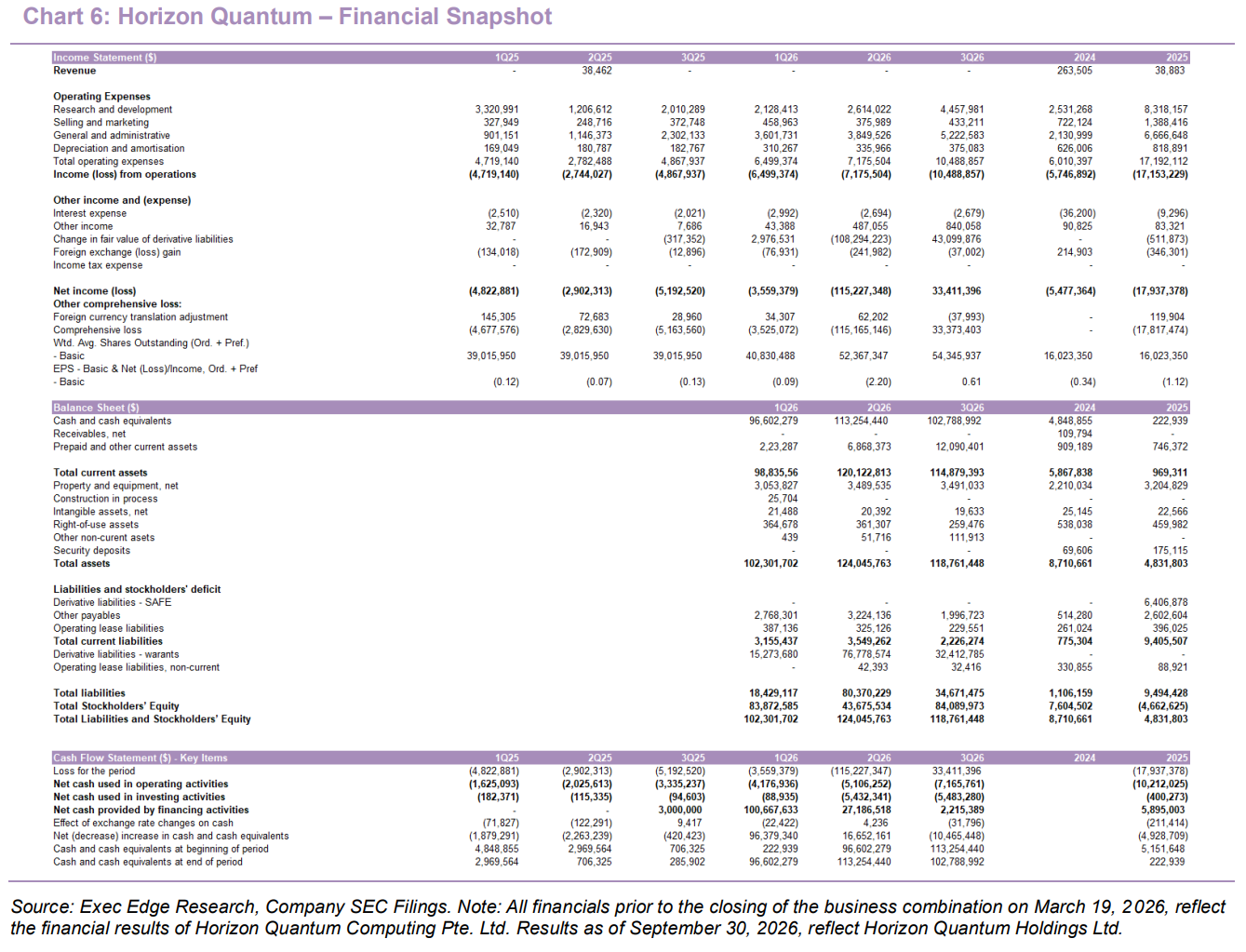
- Operating expenses rose 116% y/y to $10.5 million, widening adjusted EBITDA loss to $6.3 million; quarter-end cash stood at $102.8 million.
- HQ’s differentiated software infrastructure model and continued technical execution support longer-term rerating potential.
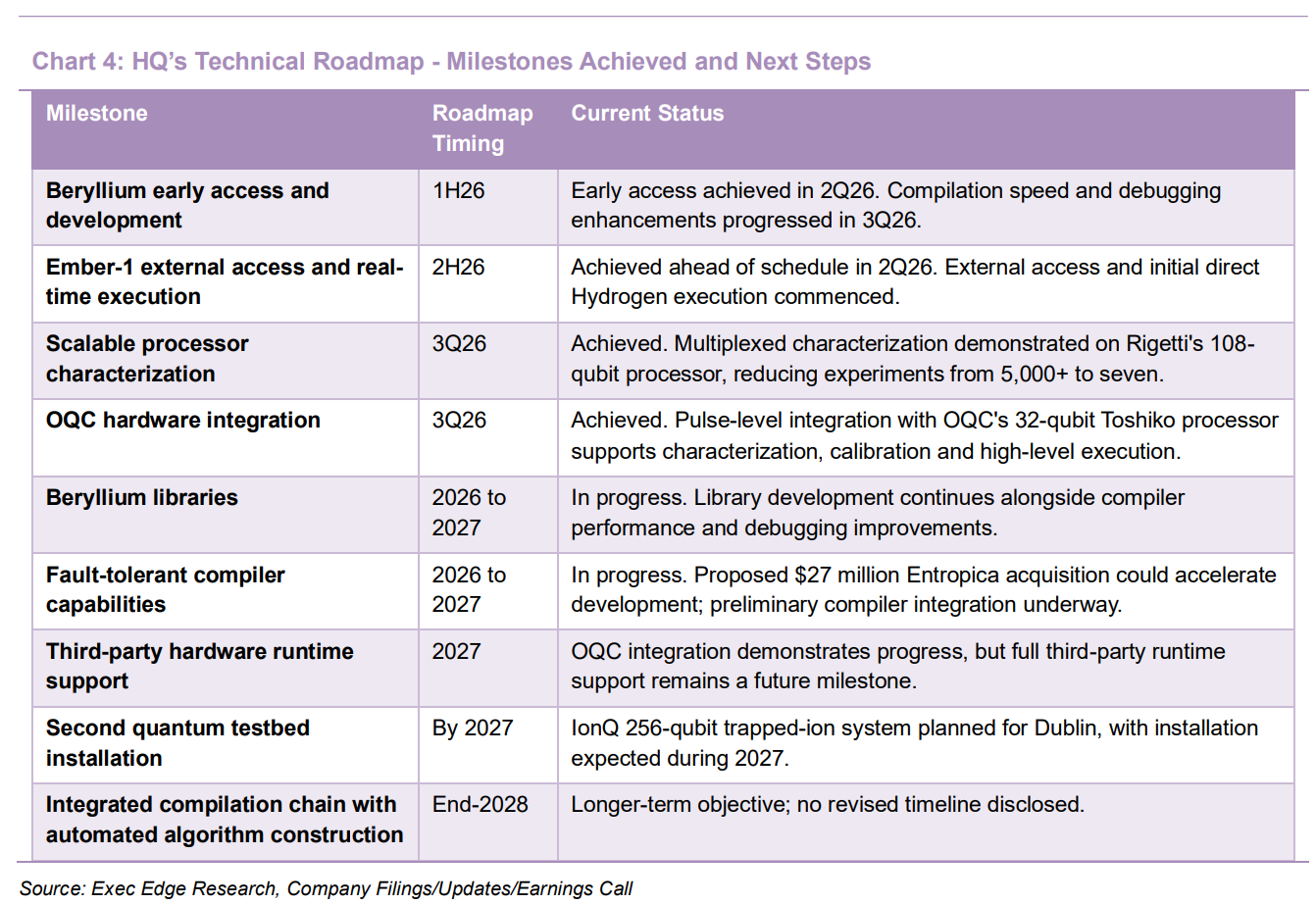
- 3Q26 technical execution deepens HQ’s quantum software infrastructure capabilities across hardware integration, processor characterization, and fault-tolerant computing. Triple Alpha achieved pulse-level integration with Oxford Quantum Circuits’ (OQC) 32-qubit Toshiko processor, extending its hardware-control capabilities beyond HQ’s own Ember-1 testbed. In parallel, proprietary multiplexed characterization techniques were successfully implemented on Rigetti’s 108-qubit Cepheus processor, reducing the experiments required to characterize unwanted qubit interactions from more than 5,000 to just seven. The proposed $27 million acquisition of Entropica Labs could add complementary expertise in quantum error correction and fault tolerance. Together, these developments expand Triple Alpha’s role from programming and execution toward hardware optimization and more sophisticated quantum computation, reinforcing HQ’s positioning as a hardware-agnostic software infrastructure platform.
- OQC integration extends Triple Alpha’s hardware-control capabilities beyond HQ’s internally operated Ember-1 testbed. Announced November 9, the successful integration with OQC’s 32-qubit Toshiko superconducting processor enables direct pulse-level control, allowing developers to conduct experiments measuring qubit relaxation (T1), phase coherence (T2), and perform gate calibration through Triple Alpha. Importantly, the platform can package these characterization routines into web-based APIs, making them accessible through conventional software workflows rather than requiring developers to interact with hardware-specific control interfaces. Building on Ember-1’s external deployment in 2Q26, the integration demonstrates that Triple Alpha’s low-level control functionality can extend to independently developed quantum processors, reinforcing its hardware-agnostic architecture.
- Proprietary multiplexed characterization marks a significant technical advance, enabling more efficient and scalable characterization of quantum processors. HQ successfully implemented its techniques on Rigetti’s 108-qubit Cepheus processor to characterize ZZ crosstalk, where unwanted interactions between qubits can reduce computational fidelity. Conventional pairwise characterization would require more than 5,000 distinct experiments on a processor of this size, while HQ’s multiplexing technique reduced the requirement to just 7, representing an improvement of more than 700 times. The results were validated against conventional characterization methods, providing technical evidence of the protocol’s accuracy. Importantly, the technique scales logarithmically with processor size, requiring theoretically only 20 distinct experiments for a million-qubit system, demonstrating its potential applicability to much larger quantum processors. Beyond improving characterization efficiency, these capabilities strengthen Triple Alpha’s value proposition to hardware partners, supporting deeper software integration and potentially accelerating adoption across the quantum hardware ecosystem.
- We believe the proposed $27 million acquisition of Entropica Labs could materially strengthen HQ’s fault-tolerant computing capabilities and accelerate development of a more complete quantum software infrastructure stack. Announced November 5, HQ signed a non-binding letter of intent to acquire the Singapore-based quantum software company through the issuance of Class A ordinary shares. Entropica specializes in quantum error correction and fault tolerance, particularly the translation of quantum operations into encoded representations required for reliable computation. This complements Triple Alpha’s existing ability to compile higher-level programs into fault-tolerant gate sets and execute sophisticated hybrid classical and quantum workloads. Combining the two platforms could help integrate error correction encoding, syndrome measurement, classical decoding, and corrective feedback within a more unified software stack, expanding HQ’s relevance as quantum processors become more sophisticated.
- Entropica could fill a critical gap in Triple Alpha’s fault-tolerant compilation pipeline, with preliminary integration work already underway. Triple Alpha supports compilation into discrete fault-tolerant gate sets such as Hadamard, T, and CNOT, and its runtime is designed to handle the classical processing and quantum interactions required during error correction. Entropica brings expertise in encoding these operations into quantum error correction codes, bridging the two capabilities. The companies have already begun connecting their respective compilation systems, while Entropica has been an early user of both Triple Alpha and Ember-1, providing an established foundation for technical integration. The proposed all-share transaction preserves cash and could accelerate capability development relative to building an equivalent research organization internally.
- Beryllium development advances beyond its 2Q26 early-access release, with compiler performance and debugging capabilities emerging as key priorities. As Triple Alpha’s highest-level object-oriented programming language, Beryllium is intended to reduce the complexity of developing quantum applications through familiar programming constructs and reusable software libraries. During 3Q26, development focused on improving compilation speed and building debugging tools to identify and trace errors that emerge during program execution. These capabilities are particularly important for sophisticated quantum programs involving dynamic control flow, mid-circuit measurements, and interaction between classical and quantum processing. Improved compilation speed and runtime debugging could reduce development complexity and support broader adoption beyond Beryllium’s initial early-access group, which primarily comprises hardware partners. While updated developer counts or usage metrics were not disclosed, progress in these capabilities remains an important step toward a more accessible and scalable development environment.
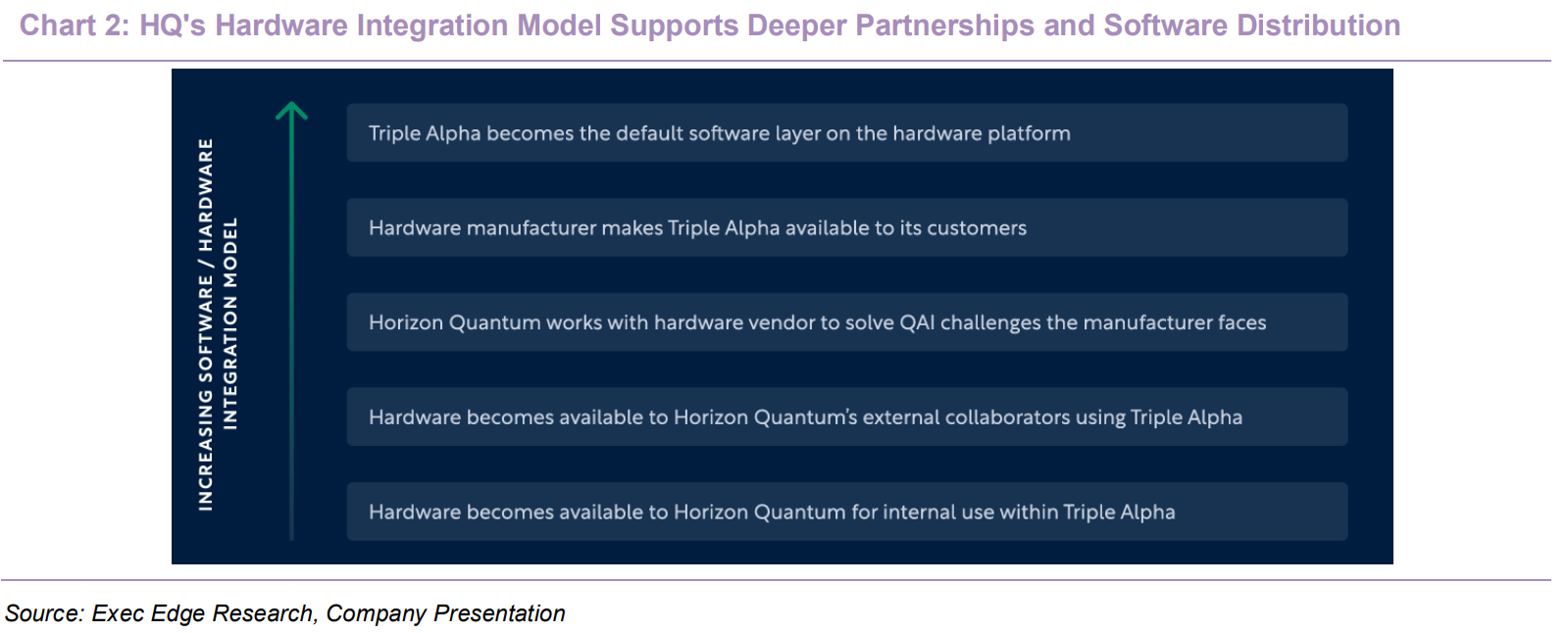
- HQ’s expanding hardware partnerships strengthen Triple Alpha’s distribution potential and provide a path toward broader commercial adoption. The company continues to progress collaborations with OQC, Rigetti, Quantum Machines, Alice & Bob, AQT, and other hardware ecosystem participants, spanning processor integration, compiler development, control systems, and calibration. HQ’s hardware engagement strategy progresses through five stages, from initial hardware integration and external access to joint technical development, manufacturer-led distribution, and ultimately adoption as a default software layer. Current collaborations generally extend into the third and fourth stages, with certain agreements incorporating provisions for hardware manufacturers to make Triple Alpha available to their users. Although default-software adoption has not yet been achieved, manufacturer-led distribution could provide HQ access to established hardware customer bases, potentially accelerating software adoption without requiring a proportionate expansion in direct sales infrastructure.
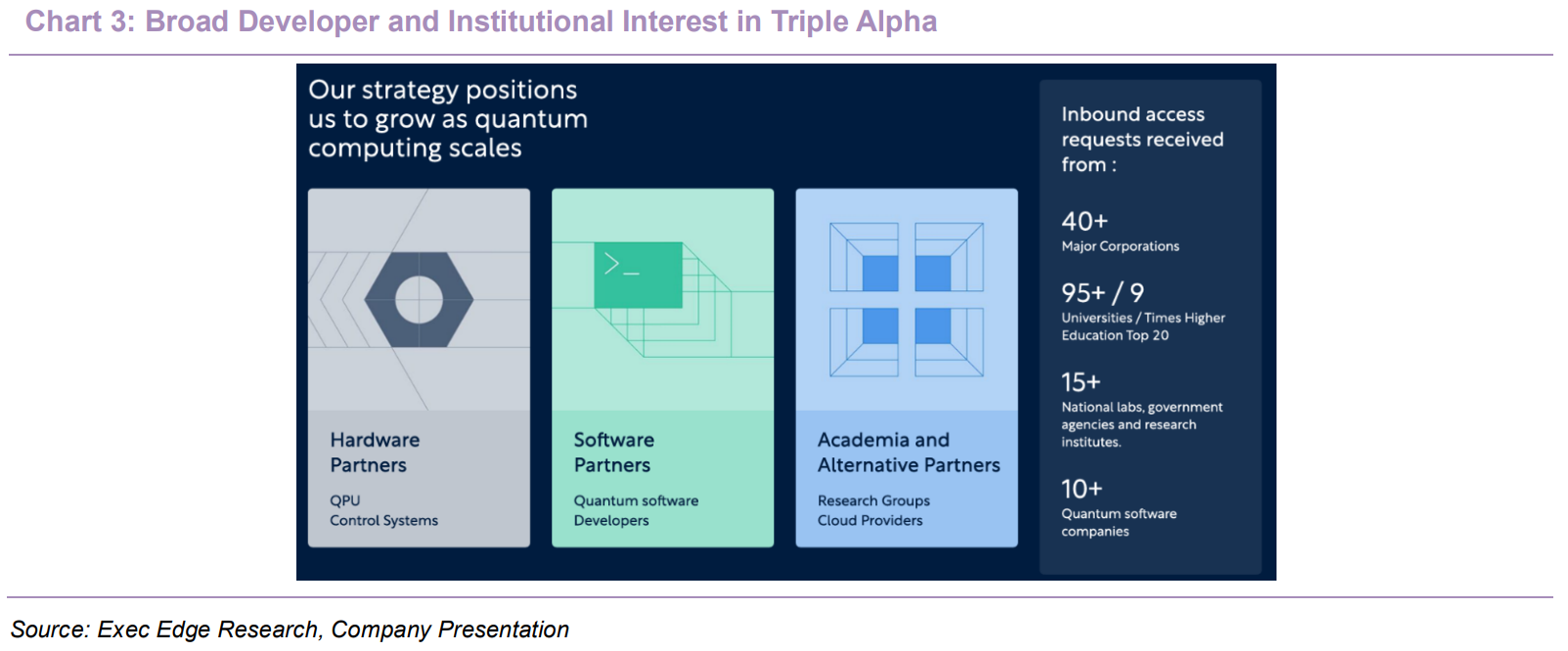
- Broad developer and institutional interest reinforces HQ’s longer-term commercialization potential across enterprise, research, and government markets. HQ has received inbound access requests from more than 40 major corporations, over 95 universities, including nine among the Times Higher Education top 20, more than 15 national laboratories, government agencies and research institutes, and over 10 quantum software companies. This breadth of interest indicates a potentially diverse developer base for Triple Alpha, although access requests have yet to translate into disclosed active usage or commercial adoption metrics.
- HQ continues to prioritize technical development over near-term monetization, maintaining its focus on scalable software infrastructure rather than proof-of-concept services revenue. HQ generated no revenue during 3Q26, unchanged from 3Q25 and 2Q26. The intended business model involves transitioning early-access users to paying customers through cloud-based cost-per-use or on-premise deployment arrangements as commercially relevant quantum workloads emerge. This approach preserves the focus on scalable software infrastructure and usage-based monetization, although the timing of meaningful revenue generation remains dependent on broader industry progress toward quantum advantage. Accordingly, platform functionality, external adoption, and hardware integration remain more relevant measures of execution than near-term revenue.
- Operating expenses increased as HQ scaled its technical workforce and R&D investment to support its expanding software and hardware roadmap. Total operating expenses increased 116% y/y to $10.5 million in 3Q26 from $4.9 million, rising 46% sequentially from $7.2 million in 2Q26. R&D expenses increased 122% y/y to $4.5 million from $2.0 million and 70% sequentially from $2.6 million, driven primarily by additional science and engineering personnel, compensation adjustments, and technology-related expenses. Excluding share-based compensation, R&D expenses increased 65% y/y. G&A expenses increased 127% y/y to $5.2 million from $2.3 million, reflecting higher personnel and public-company operating costs, while sales and marketing expenses remained modest at approximately $0.4 million. Full-time employees increased to 60 from 42 a year earlier and 57 in 2Q26, with technical personnel representing approximately 60% to 80% of the workforce.
- Adjusted EBITDA loss widened as operating costs increased, while reported GAAP net income was driven by a non-cash warrant remeasurement gain. HQ reported an adjusted EBITDA loss of $6.3 million compared with $3 million in 3Q25 and $5.5 million in 2Q26, reflecting the expanded operating expense base. For the first nine months of 2026, adjusted EBITDA loss reached $15.9 million compared with $6.8 million in the prior-year period. Reported GAAP net income totaled $33.4 million, or $0.61 per basic share, compared with a net loss of $5.2 million, or $0.13 per share, a year earlier. However, the result included a $43.1 million non-cash gain from remeasurement of warrant-related derivative liabilities following a decline in HQ’s share price. The gain had no cash flow impact and does not reflect underlying operating profitability. Given the potential for continued warrant-related accounting volatility, adjusted EBITDA and operating cash consumption remain more useful indicators of financial performance during the pre-revenue phase.
- Operating cash consumption increased alongside HQ’s expanding technical organization and hardware investment, contributing to lower quarter-end liquidity. Net cash used in operating activities increased to $7.2 million in 3Q26 from $5.1 million in 2Q26 and $3.3 million in 3Q25. For the first nine months of 2026, operating cash use reached $16.4 million compared with $7.0 million a year earlier. Investment in property, equipment, and construction in progress totaled $11.0 million during the nine-month period compared with $0.4 million in the prior year, reflecting increased expenditure on quantum hardware and supporting infrastructure. Prepaid and other current assets increased to $12.1 million from $0.7 million at year-end 2025, highlighting the need to monitor the composition of these assets and the timing of future capital commitments.
- HQ’s strong cash position provides substantial flexibility to fund its technical roadmap, despite rising operating cash consumption and hardware investment. Cash and equivalents stood at $102.8 million at September 30, down $10.5 million sequentially from $113.3 million at the end of 2Q26 but above the $96.6 million balance at the end of 1Q26. Liquidity was bolstered by $98.2 million in net business combination proceeds and $28.7 million in cumulative warrant exercise proceeds during the first nine months of 2026. The proposed all-share Entropica acquisition would preserve cash, while the planned $35 million IonQ system remains a material capital commitment. Overall, the balance sheet provides financial flexibility to support continued R&D, strategic investments, and hardware integration, with disciplined cash deployment remaining critical ahead of commercialization.
- Near-term outlook remains centered on advancing Triple Alpha’s technical roadmap, expanding hardware integration, and broadening external adoption ahead of commercialization. Key priorities include expanding Beryllium’s functionality and developer access, advancing fault-tolerant compilation, extending characterization and embedded calibration capabilities, and progressing hardware partnerships toward manufacturer-led distribution. The proposed Entropica acquisition could accelerate fault-tolerant development, while the planned installation of IonQ’s 256-qubit trapped-ion system in Dublin during 2027 would further strengthen HQ’s multimodal infrastructure. With commercialization dependent on broader industry progress toward quantum advantage, successful technical execution and external platform adoption remain the key milestones for assessing HQ’s progress.
Small Cap Software Infrastructure Pure Play in Quantum Computing
- Disclaimer: Exec Edge does not publish proprietary estimates, ratings, price targets, or investment recommendations. The valuation discussion below is illustrative only and is based on company filings, management commentary, and third-party data and estimates. It does not constitute a recommendation, price target, rating, or prediction of future pricing.
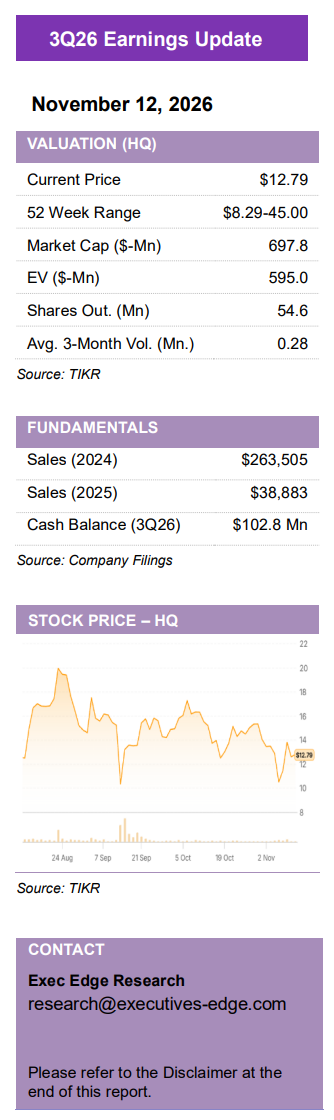
- HQ remains a differentiated small-cap quantum software infrastructure play, with continued technical progress strengthening its long-term investment positioning. As of 11/11 close, HQ has a market capitalization of $698 million and enterprise value of $595 million, with cash of $102.8 million representing ~15% of market capitalization. The stock has declined approximately 15% from the $15.03 reference price in early August, while its current EV stands just 10% above the original $541 million SPAC transaction valuation. This modest premium comes despite continued progress in hardware integration, scalable characterization, Beryllium development, and fault-tolerant computing capabilities, although meaningful commercial adoption remains a future milestone.
- The company trades at a substantial valuation discount to publicly listed quantum peers, reflecting its earlier commercialization stage but offering potential for rerating as its software infrastructure capabilities mature. HQ’s $698 million market capitalization and $595 million EV compare with peer-group averages of $4.4 billion and $3.8 billion, respectively, representing discounts of approximately 84% on both measures. While the absence of meaningful revenue, paying customers, and visibility into quantum advantage partly explains this gap, HQ’s hardware-agnostic software model offers differentiated exposure to advances across multiple quantum architectures. The company’s capital-efficient software strategy and $102.8 million cash position provide flexibility to pursue its roadmap, although rising operating cash consumption and the planned $35 million IonQ investment remain important considerations.
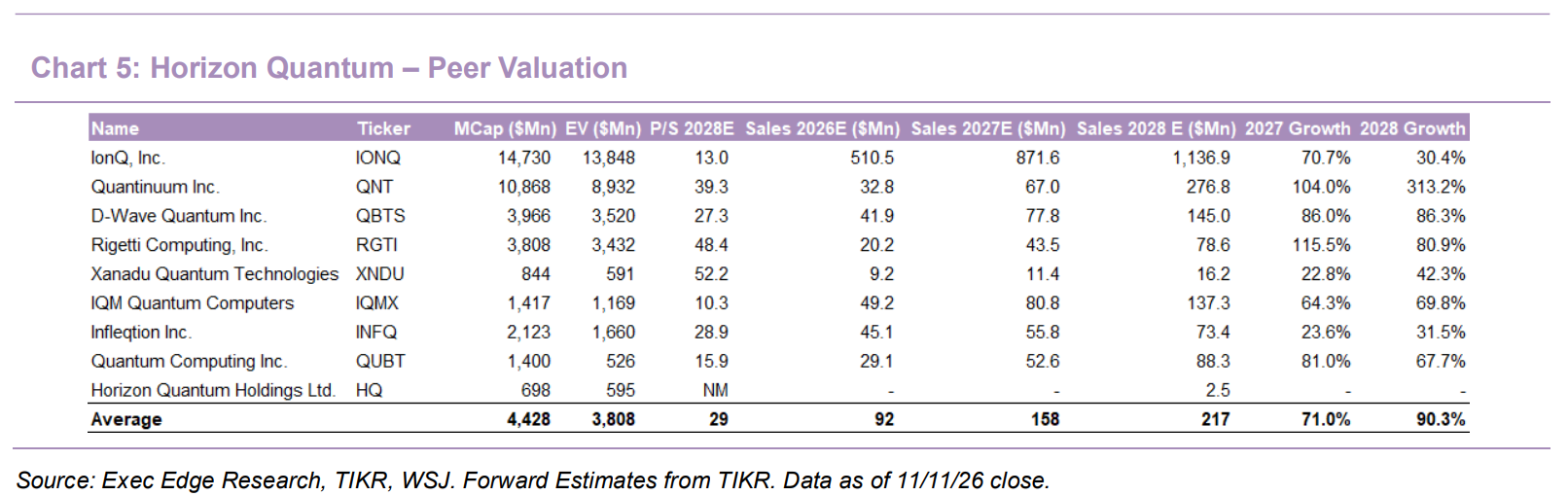
- We believe continued technical execution and broader software adoption could support HQ’s longer-term valuation rerating. Third-party hardware integration, scalable characterization, and the proposed Entropica acquisition are expanding Triple Alpha’s capabilities, while manufacturer-led distribution and wider developer adoption represent the next steps toward commercialization. Evidence of recurring software monetization could narrow HQ’s valuation gap with larger quantum peers, although the timing of quantum advantage, rising development costs, and execution risks remain key uncertainties. HQ’s software-first model and strong liquidity position it to benefit as quantum computing moves closer to commercial viability.
Read Exec Edge’s Initiation on HQ Here
Subscribe to our Weekly Newsletter to Receive All Research
Contact: