
Download the Complete Report Here
 Xanadu Quantum Technologies (XNDU)
Optical-Loss Breakthroughs and Manufacturing Partnerships Advance Fault-Tolerance Roadmap. Valuation Remains Attractive.
- Key Takeaways:
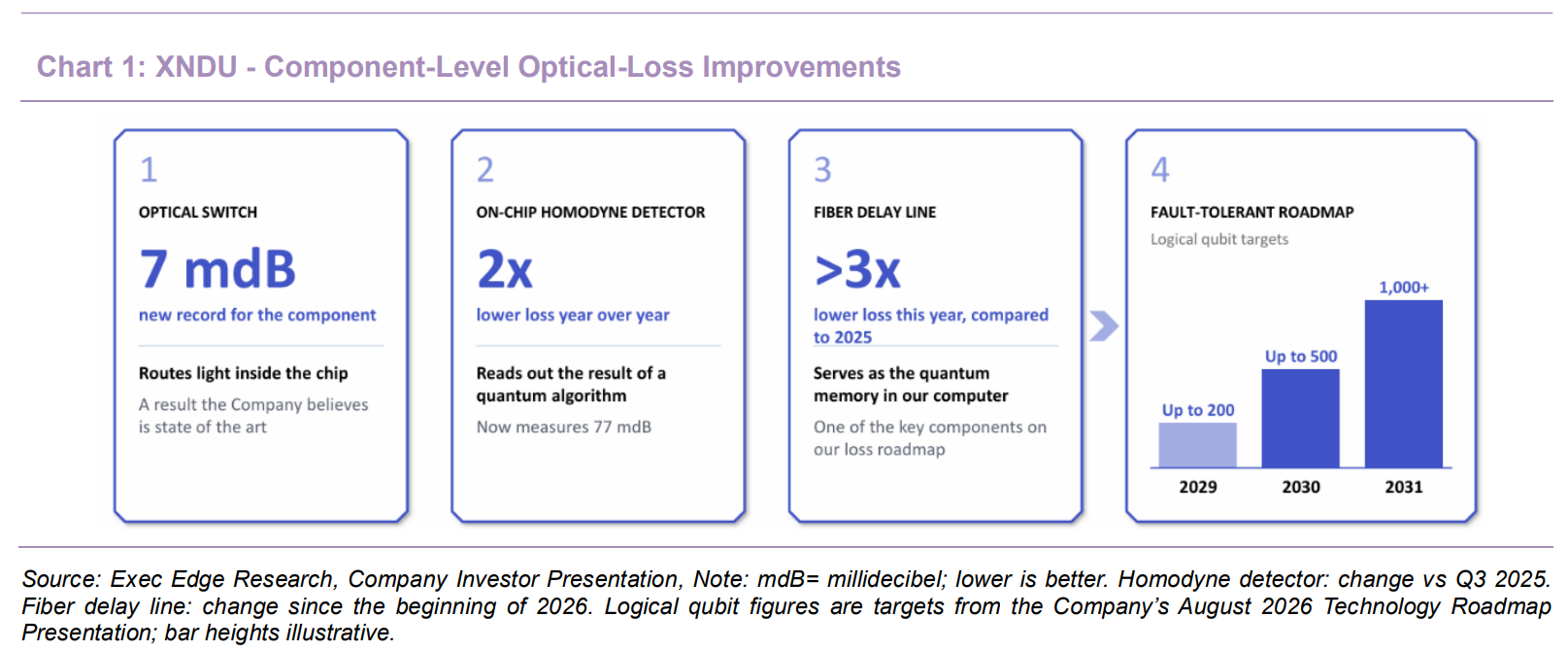
- XNDU reduced optical-switch loss to 7 milli-dB from approximately 20 milli-dB, alongside 2x lower homodyne detector loss and greater than 3x fiber delay-line improvement.
- Silicon-nitride wafer runs doubled year to date, while GlobalFoundries, ASML, Bluefors and Inception strengthen the manufacturing foundation for fault-tolerant quantum computing.
- Backline launched with AMD, PennyLane reached 1.1 million monthly installs, and initial commercial software revenue demonstrates progress toward enterprise monetization.
- C$195 million in conditionally repayable federal funding and provisional DARPA support strengthen funding visibility, while $286.5 million cash supports accelerating R&D investment.
- At $548 million EV, approximately 84% below the peer average, XNDU offers rerating potential tied to hardware execution, manufacturing scale and funding visibility.
- XNDU’s latest optical-loss breakthroughs demonstrate continued hardware progress, with higher R&D investment and manufacturing activity translating into measurable component-level improvements. XNDU achieved optical-switch insertion loss of just 7 milli-dB, down from approximately 20 milli-dB last year, representing a 65% reduction and what the company believes is the lowest reported loss for an electro-optic switch of its class. The result was achieved in collaboration with HyperLight using its thin-film lithium niobate (TFLN) platform and high-volume manufacturing infrastructure, reinforcing the benefits of XNDU’s partner-led development model. The switch also operates at microsecond or faster reconfiguration speeds, compared with millisecond-scale operation for several competing switching technologies, potentially improving system performance and scalability.
- Loss reduction across other critical optical components reinforces broader progress toward fault-tolerant operation. On-chip homodyne detector loss declined approximately 2x y/y to 77 milli-dB, while fiber delay-line loss fell more than 3x since the beginning of 2026. These improvements build on the 0.085 dB edge-coupling achievement reported in 2Q26 and demonstrate progress across switching, measurement, optical memory, and packaging. While these results strengthen confidence in XNDU’s engineering execution, the ultimate measure of progress remains the reduction in aggregate system-level loss required for fault-tolerant operation.
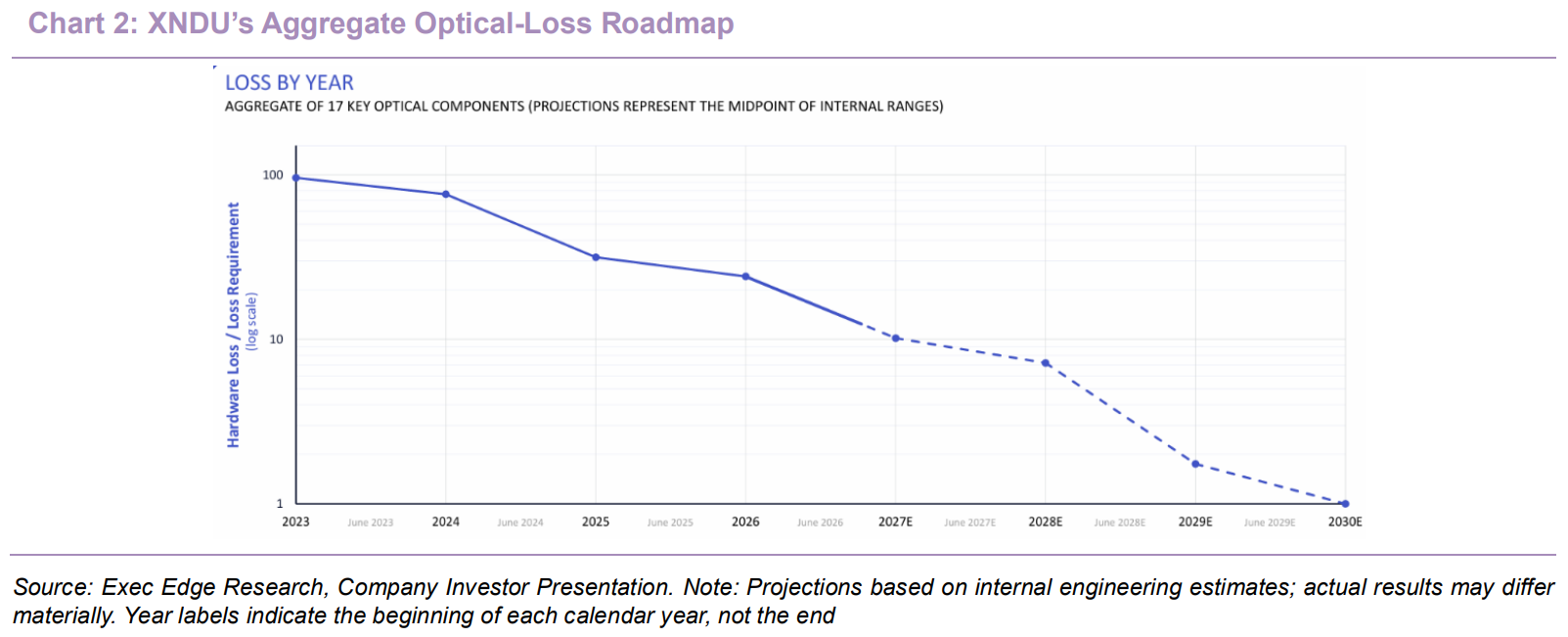
- XNDU’s published optical-loss roadmap establishes a measurable path toward fault tolerance, with the next aggregate update in 1Q27 emerging as an important technical catalyst. Unveiled in August, the roadmap tracks cumulative optical loss across 17 critical components relative to the threshold required for fault-tolerant operation, with 1.0x representing the target threshold. XNDU has reduced its aggregate loss gap by as much as 200x over roughly four years and expects the ratio to reach 10.2x by the beginning of 2027. The latest earnings call clarified that the roadmap’s annual markers represent the beginning rather than the end of each year, without changing the underlying loss trajectory or long-term milestones. Further reduction from 10.2x to the fault-tolerance threshold remains a significant engineering challenge. XNDU plans to update the aggregate metric in 1Q27 and annually thereafter, reflecting the nonlinear nature of loss reduction.
- Fault-tolerant quantum computing remains the primary objective, with XNDU targeting increasingly capable logical-qubit systems through 2031. XNDU continues to target up to 200 logical qubits in 2029 with logical error rates as low as 10⁻⁸, increasing to up to 500 logical qubits in 2030 with error rates as low as 10⁻¹⁶, and 1,000 or more logical qubits from 2031 onward. These targets build on Aurora’s modular, networked photonic architecture, which connected four server racks using optical fiber. The roadmap also targets qubit-factory development during 2026 to 2027, fault-tolerant demonstrations during 2028 to 2029, and an operational quantum data center during 2029 to 2030. While its room-temperature photonic architecture offers potential scalability advantages, the transition from component-level progress to reliable qubit generation, error correction, and system-level integration remains a substantial execution challenge.
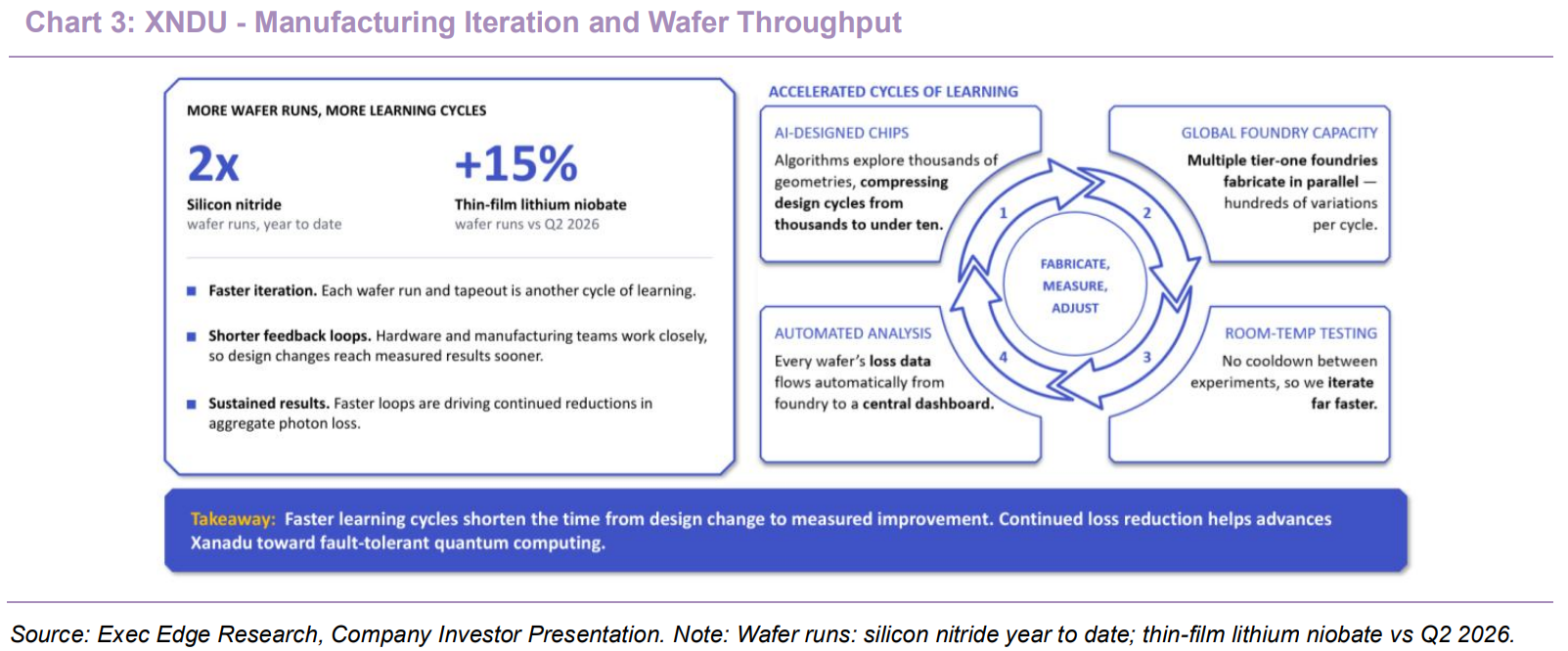
- Higher wafer throughput is accelerating XNDU’s engineering iteration cycle, supporting faster development and improved manufacturing scalability. Silicon-nitride wafer runs have doubled year to date, while TFLN wafer runs increased another 15% sequentially, building on the significant fabrication capacity expansion reported in 2Q26. The higher cadence allows more chip designs to be fabricated, measured, and refined in parallel, accelerating identification of process limitations and improving R&D productivity. Increased wafer availability should also support faster qualification of components required for the GKP qubit factory, bringing XNDU closer to repeatable manufacturing of critical hardware components.
- Partnerships with GlobalFoundries, ASML, and Bluefors address critical manufacturing, performance, and infrastructure bottlenecks, strengthening XNDU’s path to scalable photonic hardware. GlobalFoundries’ multiyear collaboration leverages its 300 mm Malta, New York fab to develop ultra-low-loss silicon-nitride photonic chips and superconducting nanowire single-photon detectors (SNSPDs). The shift from transition-edge sensors to SNSPDs is significant as they operate orders of magnitude faster, potentially boosting clock rates while reducing the fiber length and footprint of the qubit factory. ASML is targeting waveguide propagation loss through advanced lithography, addressing a major source of photon loss in integrated photonic circuits. Bluefors is developing modular cryogenic systems that could replace large centralized cooling installations with infrastructure better suited to a data-center environment. Together, these partnerships should improve manufacturing scalability, reduce optical losses, and lower the infrastructure requirements and cost of deploying larger quantum systems.
- Inception represents a major step toward internalizing critical manufacturing capabilities and accelerating hardware development. The planned 158,000-square-foot advanced photonics research and manufacturing facility in Toronto is expected to begin operating in early 2027. It will include approximately 65,000 square feet of cleanroom and high-technology space, 10,000 square feet for heterogeneous integration, and 20,000 square feet for photonic packaging. The facility is designed to support testing and measurement of millions of integrated devices per month, alongside assembly of rack-level modules required for XNDU’s networked quantum architecture.
- Greater in-house manufacturing control should improve iteration speed, process consistency, and scalability. XNDU’s existing packaging operation has already reduced turnaround times from as long as three months to approximately eight hours, demonstrating the benefits of internalizing critical processes. Inception should extend these efficiencies across testing, qualification, and integration of silicon nitride, TFLN, and detector technologies as wafer throughput increases. This should support more repeatable manufacturing of integrated photonic systems while reducing dependence on external processing schedules, although it increases capital intensity ahead of commercial-scale deployment.
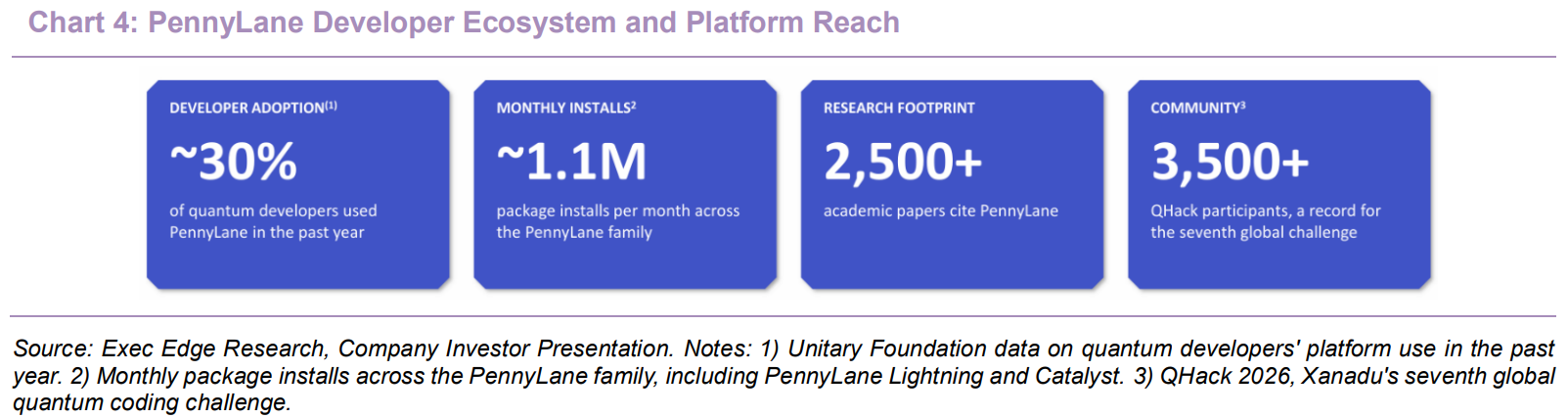
- PennyLane continues to strengthen XNDU’s developer ecosystem, providing an established distribution channel for future software monetization. Approximately 30% of quantum developers surveyed by the Unitary Foundation used PennyLane during the past year, while its broader package family, including Lightning and Catalyst, recorded approximately 1.1 million monthly installs. PennyLane has also been cited in over 2,500 academic publications, while the seventh QHack competition attracted more than 3,500 participants. Together with relationships across 150-plus universities in over 35 countries, these metrics reinforce XNDU’s position within the quantum developer ecosystem. This reach provides a potential customer acquisition advantage as XNDU begins monetizing enterprise training, simulation tools, and application development services. Enterprise adoption is also expanding, with RBC and Booz Allen using XNDU’s software for quantum workforce training, alongside existing engagements with Lockheed Martin, providing an early pathway from developer adoption toward commercial relationships.
- Backline’s launch with AMD extends XNDU’s software stack into the classical control infrastructure required for fault-tolerant quantum computing. The open platform integrates CPUs, GPUs, and FPGAs to support real-time error correction and quantum hardware control. Backline demonstrated median round-trip latency of approximately 2.3 microseconds between an FPGA and AMD CPU and 4.5 microseconds between an FPGA and GPU, demonstrating low-latency quantum-classical integration using commercially available hardware. Its hardware-agnostic architecture creates potential opportunities beyond XNDU’s photonic systems, with early interest from national laboratories, computing manufacturers, and other quantum companies. Separately, XNDU’s QROM optimization reduced Toffoli-gate requirements by approximately half, while digital-twin capabilities support more efficient algorithm development and hardware-resource estimation.
- Enterprise application development is expanding across semiconductors and pharmaceuticals, strengthening XNDU’s pipeline of potential commercial opportunities. The Mitsubishi Chemical collaboration has demonstrated quantum algorithms for modeling materials used in advanced semiconductor manufacturing, with development progressing toward a fault-tolerant-ready software pipeline. Separately, JSR signed a statement of work to evaluate XNDU’s simulation and resource-estimation capabilities, helping assess algorithm feasibility, hardware requirements, and potential commercial applications. XNDU also partnered with the University of Alberta to develop quantum algorithms for photosensitizers used in cancer treatment, extending its application reach into pharmaceutical research. Together, these engagements strengthen enterprise relationships, help identify commercially relevant applications, and inform future hardware requirements, although meaningful revenue contributions remain further out.
- Project OPTIMISM has advanced through a definitive federal funding agreement, strengthening support for XNDU’s manufacturing roadmap. The company secured up to C$195 million (~US$140 million) from the Government of Canada under the Strategic Response Fund to support Inception and related photonic manufacturing and R&D activities. The funding is structured as a conditionally repayable loan, with disbursements tied to eligible expenditures rather than provided upfront. No borrowings had been made as of September 30, 2026, while negotiations with the Government of Ontario remain ongoing. The agreement improves funding visibility for planned manufacturing investments and could reduce reliance on equity financing, although disbursement timing and associated spending commitments remain important considerations.
- DARPA’s additional provisional funding provides continued external validation of XNDU’s technical roadmap. XNDU received provisional approval for up to $10 million through a one-year extension of its participation in DARPA’s Quantum Benchmarking Initiative (QBI), building on its Stage B work. The program evaluates whether emerging quantum architectures can achieve utility-scale performance within realistic budgets and timelines. Beyond supporting R&D, continued participation provides independent assessment of XNDU’s photonic approach against commercially relevant technical benchmarks. The extension does not constitute advancement to Stage C, and funding remains subject to final approval.
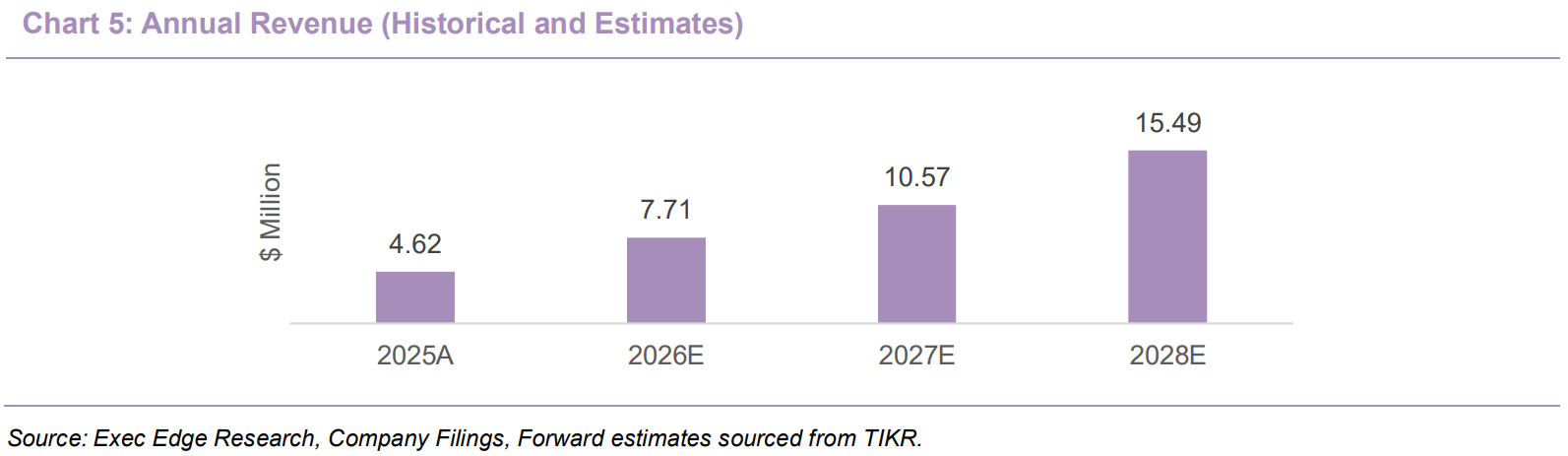
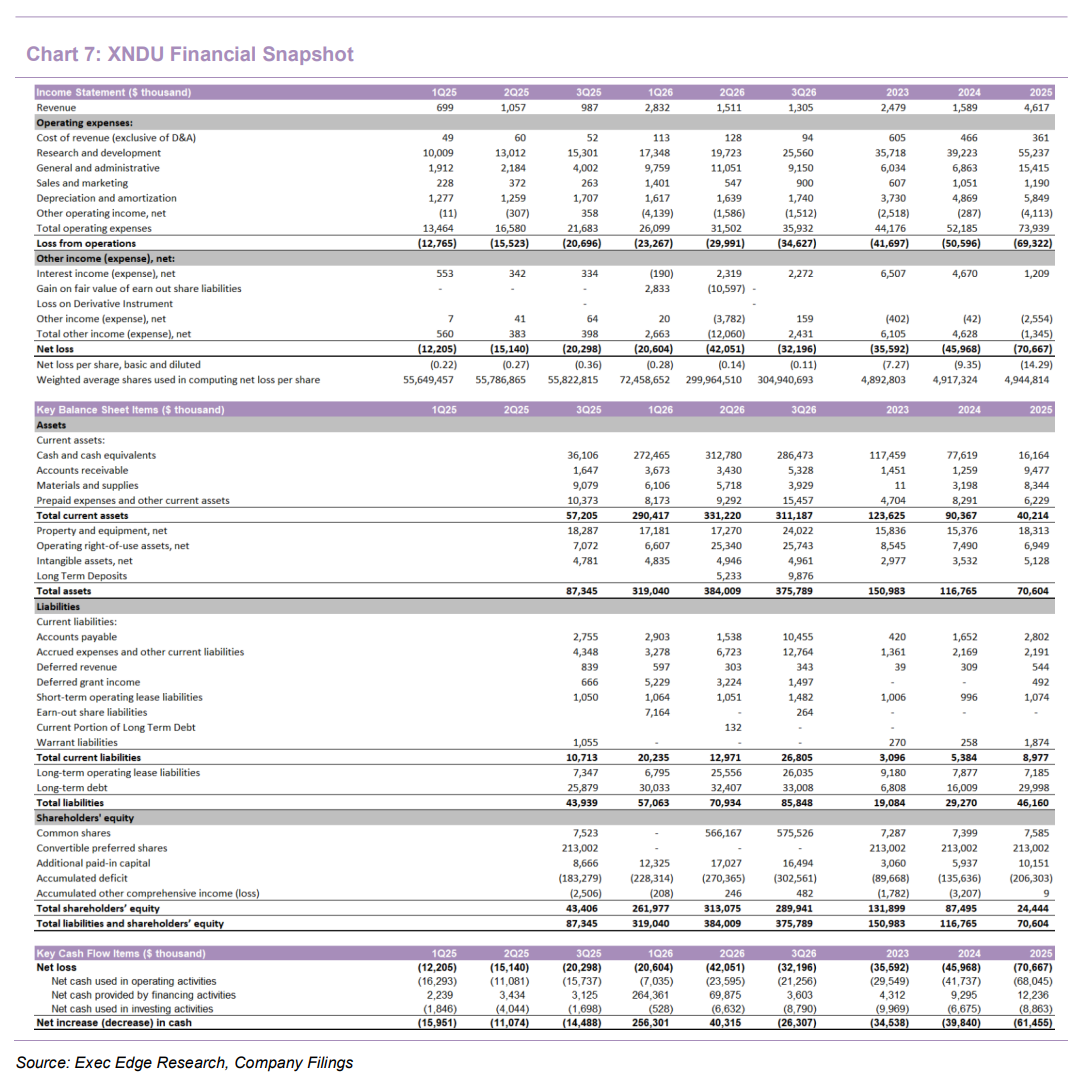
- Revenue growth remains milestone-driven, with XNDU prioritizing hardware roadmap execution over near-term commercialization. 3Q26 revenue increased 32% y/y to $1.3 million but declined 14% sequentially from $1.5 million, reflecting the timing of government-funded programs and customer contracts. Nine-month revenue more than doubled to $5.65 million from $2.74 million, primarily supported by DARPA-related milestones and new engagements. Customer concentration remains high, with one customer accounting for 81% of 3Q26 revenue, while XNDU also began generating commercial software revenue, although contributions remain small and unquantified. Street estimates sourced from TIKR project revenue of $7.71 million in 2026 (+67% y/y), $10.57 million in 2027 (+37%), and $15.49 million in 2028 (+47%). The 2026 estimate implies approximately $2.06 million in 4Q revenue, nearly 1.6x the 3Q level, underscoring the importance of contract timing and milestone recognition to near-term revenue visibility.
- R&D investment accelerated as higher wafer activity, foundry spending, and engineering expansion supported the hardware roadmap, widening underlying operating losses. R&D expense increased 30% sequentially and 67% y/y to $25.6 million, while headcount reached 361 versus 306 in 2Q26. Capex increased to $8.4 million from $6.1 million sequentially, reflecting higher investment in testing and manufacturing infrastructure. G&A moderated to $9.2 million from $11.1 million sequentially, although it remained above $4.0 million a year ago. Adjusted EBITDA loss widened to $26.3 million from $21.3 million in 2Q26 and $15.4 million in 3Q25, reflecting higher development spending. GAAP net loss, however, narrowed to $32.2 million from $42.1 million sequentially, primarily due to the absence of approximately $12.5 million in prior-quarter fair-value losses.
- XNDU’s strong liquidity position supports continued roadmap investment, although cash consumption is increasing alongside manufacturing activity. Cash stood at $286.5 million, down from $312.8 million sequentially, while debt totaled $33.3 million, implying net cash of approximately $253 million. Nine-month operating cash outflows increased to $51.9 million from $43.1 million y/y, while investing outflows rose to $16.0 million from $7.6 million. Working capital reflected changes in procurement and payment timing, with materials and supplies declining to $3.9 million from $8.3 million at year-end, while accounts payable increased to $10.5 million from $2.8 million. Contractual obligations totaled $104.1 million, including $53.3 million due within 12 months. Existing cash is expected to fund operations and planned investment for at least the next 12 months.
- Capital allocation remains focused on hardware roadmap execution, with the synthetic ATM providing additional financing flexibility. XNDU did not draw on its synthetic ATM during 3Q26, following $67.2 million raised through the issuance of 5.5 million shares in 2Q26, leaving $232.8 million of available facility capacity. Combined with $286.5 million of cash and approximately $150 million of potential government-related funding, XNDU has access to approximately $669 million in existing liquidity and potential funding sources, although government support remains conditional and further ATM utilization would result in shareholder dilution.
- Outlook remains focused on accelerating hardware development, with higher near-term investment expected to support key technical milestones. R&D spending and capex are expected to increase further in 4Q26, driven by additional GlobalFoundries activity, equipment purchases, and continued hiring. Inception is expected to begin operations in early 2027, while the next aggregate optical-loss update in 1Q27 will provide a broader assessment of progress toward the 10.2x loss ratio targeted for the beginning of 2027. The key measure of execution will be whether higher investment translates into lower system-level loss, improved manufacturing scalability, and tangible progress toward fault-tolerant quantum computing.
Differentiated Architecture and Milestone Progress Support Potential Valuation Rerating
- Disclaimer: Exec Edge does not publish proprietary estimates, ratings, price targets, or investment recommendations. The valuation discussion below is illustrative only and is based on company filings, management commentary, and third-party data and estimates. It does not constitute a recommendation, price target, rating, or prediction of future pricing.
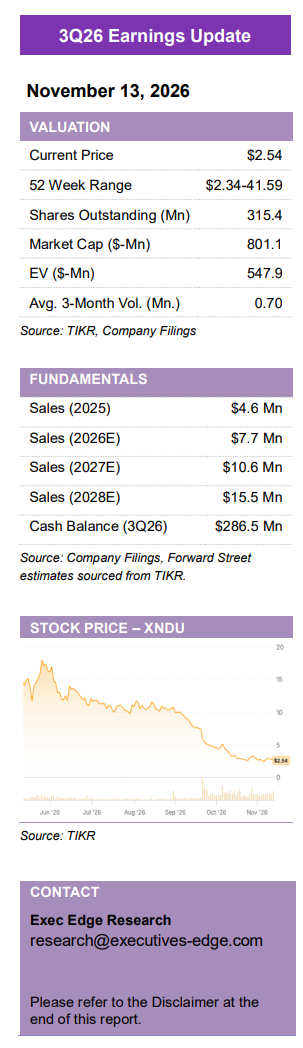
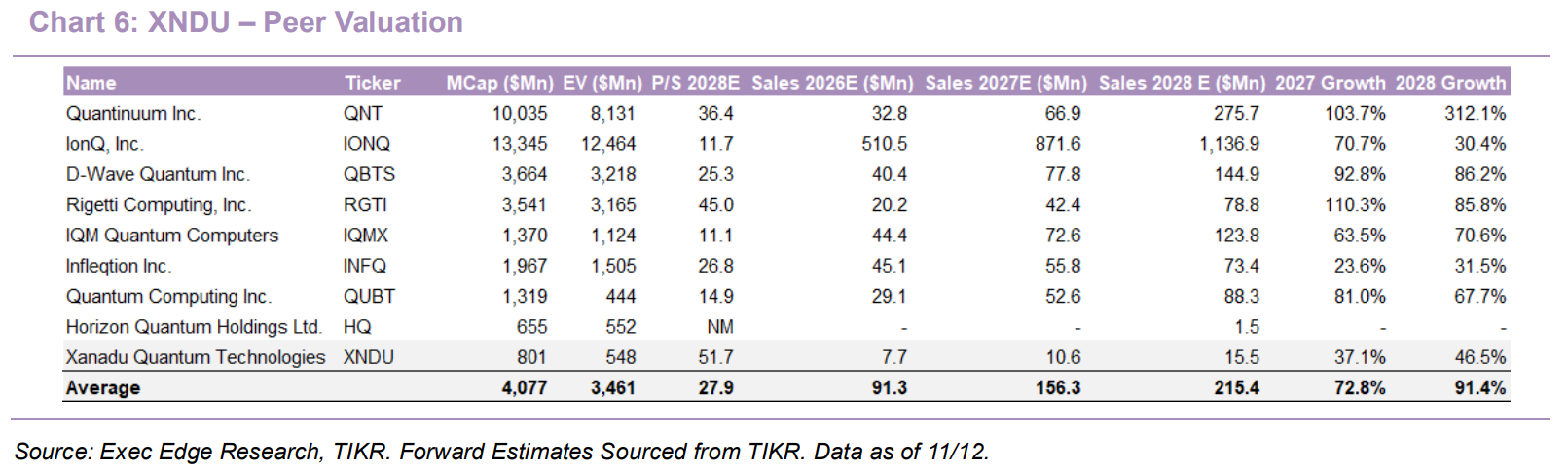
- XNDU’s valuation has reset significantly despite continued technical progress and growing strategic partnerships. As of the November 12 close of $2.54, XNDU has a market capitalization of $801 million and EV of $548 million, representing declines of approximately 75% and 81%, respectively, from the August earnings update. The current EV is also approximately 82% below the original SPAC transaction valuation of $3.1 billion. The sharp decline contrasts with continued optical-loss improvements, manufacturing expansion, and government funding progress, suggesting a growing disconnect between XNDU’s technical execution and market valuation, although commercialization timelines and capital requirements remain key risks.
- XNDU trades at a substantial valuation discount to quantum computing peers despite its differentiated photonic architecture, expanding manufacturing capabilities, and established software ecosystem. Its $548 million EV is approximately 84% below the peer group average of $3.46 billion, and compares with $3.22 billion for D-Wave, $3.17 billion for Rigetti, and $1.51 billion for Infleqtion. XNDU also trades at a lower EV than seven of the eight other companies in the peer group, underscoring its relatively modest absolute valuation despite its full-stack positioning, measurable progress in optical-loss reduction, and strategic partnerships with leading semiconductor and technology companies. As the industry advances toward fault-tolerant quantum computing, XNDU’s integrated hardware and software platform provides meaningful long-term strategic optionality that could support a narrowing of the valuation gap as technical milestones are achieved.
- Rerating potential remains tied to hardware roadmap execution, manufacturing scalability, and funding visibility. The next aggregate optical-loss update in 1Q27, progress toward the 10.2x loss ratio, GlobalFoundries manufacturing collaboration, and Inception commissioning will be important catalysts. Further government funding conversion and early software monetization could provide additional support. Sustained technical progress and disciplined capital deployment will be essential to rebuilding investor confidence and supporting a valuation recovery.
Download the Complete Report Here
Read Exec Edge’s Initiation on Xanadu Quantum Here
Watch IPO Edge Fireside Chat with Xanadu Founder & CEO Christian Weedbrook
Subscribe to our Weekly Newsletter to Receive All Research
Contact:



