Download the Complete Report Here
GrabAGun Digital Holdings Inc. (PEW)
Gross Margin Expansion Reinforces Improving Retail Economics; Camfour Establishes Three Complementary Routes to Market. Attractively Valued.
- Key Takeaways
- Gross profit growth of 44% and 480 bps of margin expansion reinforce improving retail economics, despite a 4.7% revenue decline.
- Camfour completes PEW’s three complementary routes to market, combining digital retail, manufacturer services and wholesale distribution through a $34 million all-cash acquisition.
- PEW Logistics is evolving into a broader manufacturer e-commerce platform, supported by $271K in quarterly revenue, four manufacturer partners and expanded KelTec operations.
- Higher pricing and sourcing efficiencies support margin resilience, despite firearm and non-firearm volumes declining 14% and 27%.
- Valuation remains compelling at 0.43x LTM sales, a 76% peer discount, with market cap below estimated post-acquisition cash.
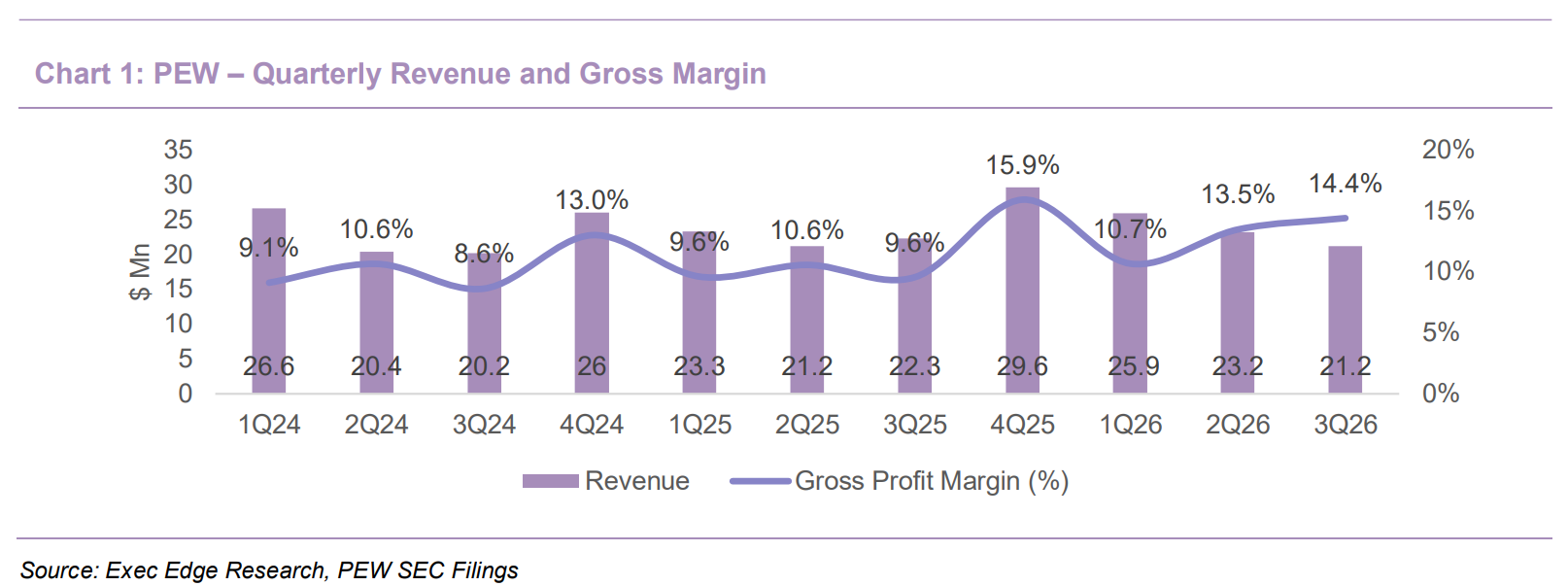
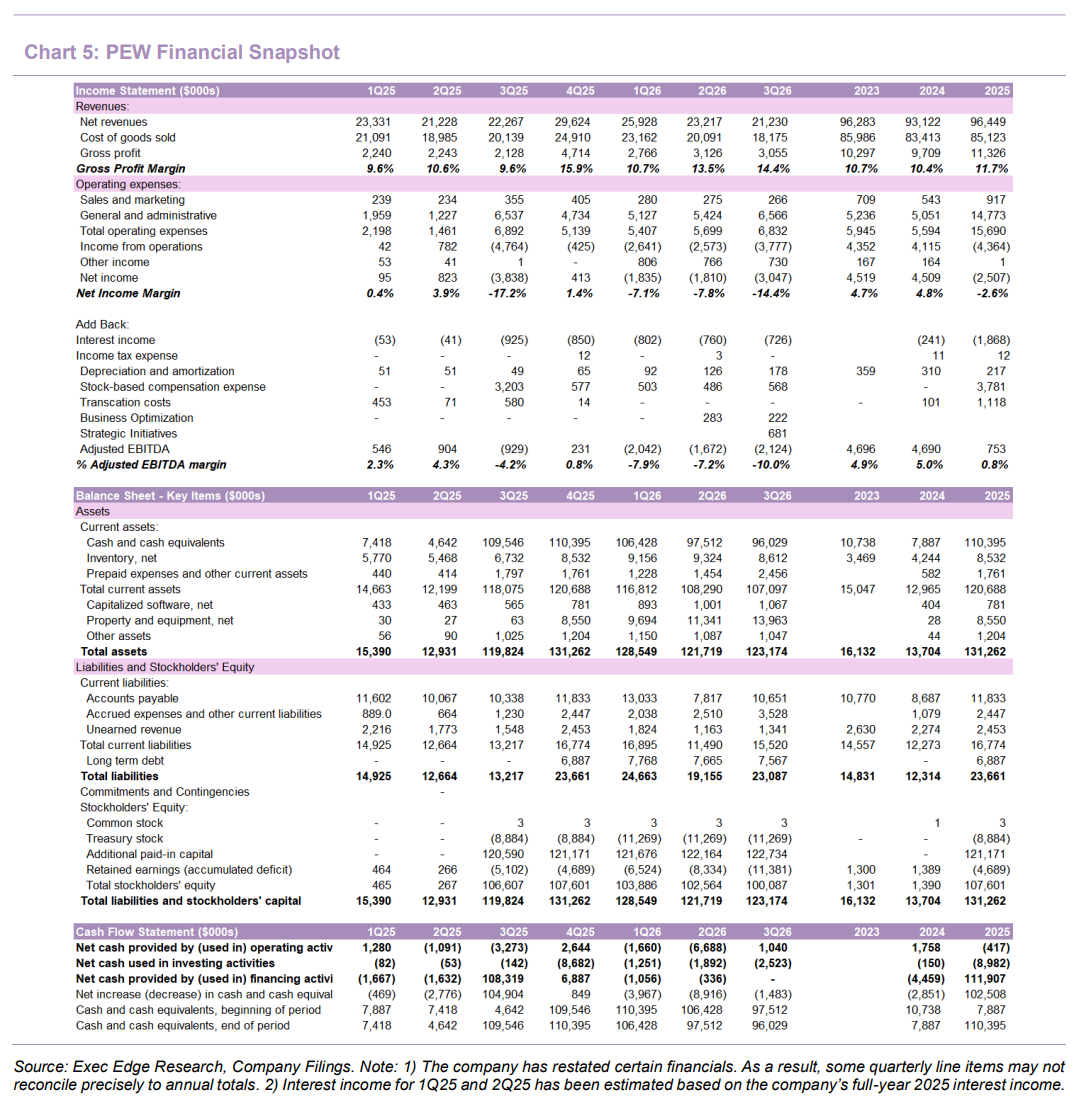
- Gross profit grew 44% despite lower revenue, as stronger pricing and sourcing drove 480 bps of gross margin expansion. PEW reported revenue of $21.2 million, down 4.7% y/y and 8.6% sequentially, as weaker product volumes outweighed higher realized pricing. COGS declined 9.8% y/y to $18.2 million, driving a 43.6% increase in gross profit to $3.1 million, while gross margin expanded 480 bps y/y and 90 bps sequentially to 14.4%. The improvement reflected favorable product mix, AI-driven pricing, increased direct manufacturer sourcing and a modest contribution from higher-margin PEW Logistics. This marked the third consecutive quarter of y/y gross margin expansion, with 9M26 gross profit increasing 35.3% to $8.9 million on revenue growth of 5.3% to $70.4 million. Gross margin for 9M26 expanded 280 bps to 12.7%, demonstrating that improved pricing and procurement economics are driving stronger gross profitability even as underlying product demand softens.
- Higher selling prices and favorable product mix continue to support revenue, although accelerating volume declines highlight underlying demand pressure. Firearms revenue declined 4.5% y/y to $17.3 million, with a 10% increase in average selling prices partially offsetting a 14% decline in volumes, compared with 12% pricing growth and a 4% volume decline in 2Q26. Non-firearms revenue declined 11.8% to $3.7 million, as volumes fell 27% against a 20% increase in selling prices, versus an 18% volume decline and 30% pricing growth in the prior quarter. The slowdown reflected summer seasonality, normalization following elevated suppressor demand in 2Q26 and a challenging post-listing comparison. PEW’s firearm volumes declined 14% compared with a 2.5% increase in industry NSSF-adjusted NICS background checks, indicating that recent revenue resilience has been driven primarily by pricing and product mix rather than underlying unit growth. A recovery in underlying unit demand, alongside sustained pricing gains, will be critical to restoring topline growth without sacrificing improved gross margins.
- Digital engagement and organic customer acquisition remain resilient, although lower conversion highlights continued pressure on monetization. PEW ended 3Q26 with approximately 1.4 million registered accounts, 17.8K monthly transactions (versus 17.1K in 2Q26) and approximately 73,000 active SKUs as of October. Average monthly page views increased to 11.9 million from 10.3 million in 2Q26, while session duration improved to 5.0 minutes from 4.9 minutes and bounce rate declined to 36% from 37%. Conversion moderated to 0.6% from 0.7%, indicating that stronger engagement has not translated into a corresponding improvement in conversion. Total traffic increased 4% y/y, while new-user growth reached 26%, supported by management’s shift in marketing investment toward SEO and organic customer acquisition, including direct and organic social channels. Sales and marketing expense declined 25% y/y to $0.27 million, or approximately 1.3% of revenue, while customer lifetime value increased 4% to $825. Mobile accounted for approximately 70% of sessions and transactions and 68% of revenue. The combination of 26% new-user growth, higher customer lifetime value and lower marketing expenditure supports the efficiency of PEW’s digital acquisition strategy, although improving conversion remains important for translating engagement into sustained revenue growth.
- PEW Logistics continues to scale, with sequential revenue growth reinforcing the potential of its higher-margin, capital-light platform model. Service revenue increased 22% sequentially to $271K in 3Q26 from $223K in 2Q26 and $153K in 1Q26, bringing 9M26 revenue to $647K. Cumulative gross merchandise value exceeded $3.1 million since its January launch, demonstrating early commercial traction. The platform generates revenue through fulfillment, e-commerce hosting and storage services, combining transaction-based fees with recurring revenue streams. By leveraging PEW’s existing technology, compliance systems and fulfillment network, additional manufacturer activity can be supported without proportionate infrastructure investment. While service revenue currently represents ~1.3% of consolidated sales, its higher-margin profile supports improving revenue mix. Growth can be driven by both additional manufacturer onboarding and deeper monetization of existing relationships, providing two avenues for scaling higher-margin service revenue and potentially improving consolidated profitability over time.
- PEW Logistics’ expansion into full-service manufacturer e-commerce creates additional monetization opportunities beyond fulfillment. SAR USA joined the platform in October as its fourth manufacturer, following KelTec, Derya Arms and Backwoods Suppressors, broadening adoption across domestic, international and regulated product categories. More importantly, PEW Logistics expanded its KelTec relationship in November by launching and fully operating the manufacturer’s new website, extending its offering beyond fulfillment into direct-to-consumer sales, merchandising and a broader assortment of firearms, parts, accessories and apparel. The expanded offering creates opportunities for higher transaction values and incremental service revenue while establishing capabilities that can be replicated across other manufacturers.
- Regulatory developments could further support suppressor-related demand, with NFA background checks increasing 129% y/y in September and October 9 ATF guidance indicating that the agency would no longer enforce certain NFA registration requirements for suppressors, although federal background checks and applicable state laws remain in effect. PEW’s established compliance infrastructure and FFL network, covering 97% of the U.S. population within 15 miles of a licensed dealer, position it to capture incremental manufacturer activity as compliant direct-to-consumer channels expand.
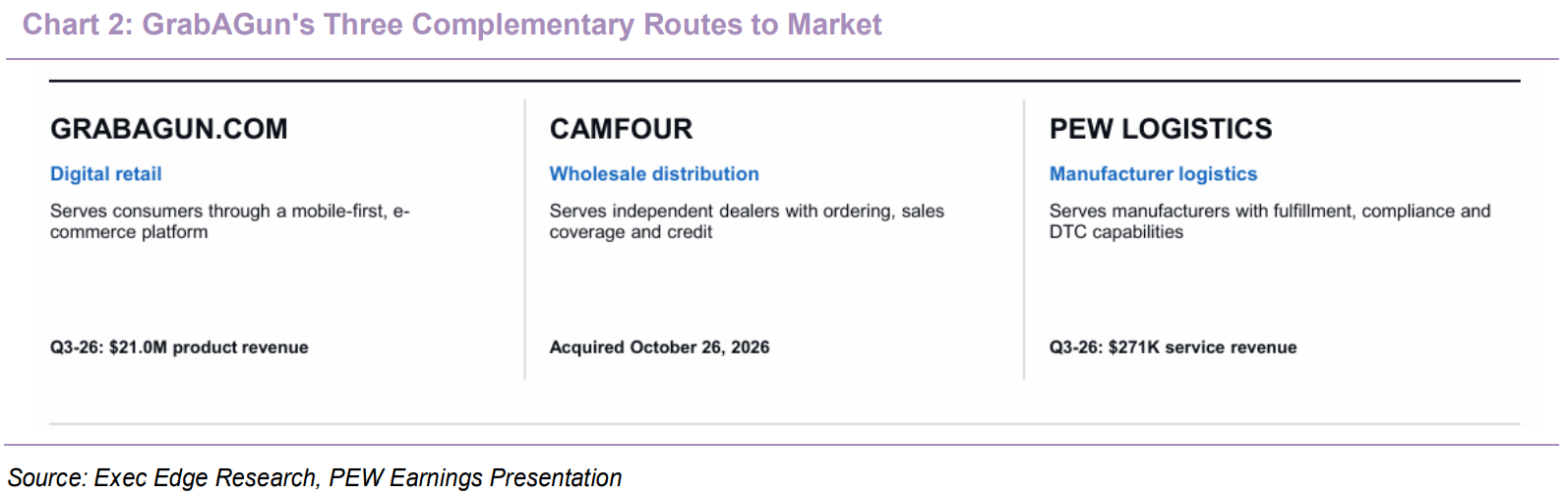
- The $34 million Camfour acquisition establishes wholesale distribution as PEW’s third route to market, significantly expanding its operating scale and industry reach. Completed on October 26, the all-cash transaction adds an established national firearms distributor founded in 1952, with extensive manufacturer relationships and independent dealer coverage. Camfour generated approximately $77.4 million of audited revenue in 2025, compared with PEW’s $96.5 million, providing a substantial incremental revenue opportunity beyond digital retail and manufacturer services. The acquisition was funded entirely through existing cash without external financing or share dilution. Camfour will continue operating independently under its existing name, retaining its sales team, dealer relationships and commercial terms, while benefiting from PEW’s technology and procurement capabilities. As Camfour was already a supplier to GrabAGun, a portion of its historical revenue will be eliminated upon consolidation. The transaction positions PEW across three complementary channels serving consumers, manufacturers and independent dealers, creating opportunities for cross-channel efficiencies and revenue diversification.
- Camfour provides opportunities to improve purchasing economics and inventory efficiency by extending PEW’s proprietary technology across wholesale distribution. PEW plans to leverage its 16-year technology infrastructure, including AI-driven demand forecasting, automated pricing, procurement and its eGunbook compliance platform, which has supported over 1 million direct-ship transactions. Applying these capabilities to Camfour could improve inventory turnover, sourcing efficiency and purchasing scale. The $34 million acquisition was valued primarily against inventory and receivables, net of assumed liabilities, and remains subject to closing adjustments. Wholesale distribution also introduces lower-margin revenue, inventory requirements and dealer credit exposure, making working capital management critical to integration success. Camfour’s earnings contribution remains unquantified pending additional financial disclosures expected in January 2027. Successful integration and improved operating efficiencies will be critical to generating attractive returns on PEW’s $34 million investment.
- Gross margin expansion is improving profitability, although higher underlying operating costs continue to constrain operating leverage. Total operating expenses remained broadly flat at $6.8 million, with G&A at $6.6 million. Higher employee compensation of $1.3 million and professional fees of $0.9 million, including $0.7 million related to Camfour, were largely offset by a $2.6 million reduction in stock-based compensation. GAAP net loss narrowed to $3.0 million, or $0.10 per share, from $3.8 million, or $0.14 per share, supported by higher gross profit. For 9M26, net loss widened to $6.7 million from $2.9 million y/y. Adjusted EBITDA deteriorated to a loss of $2.1 million from $0.9 million y/y and $1.7 million in 2Q26, as a $2.1 million increase in normalized operating costs more than offset the $0.9 million improvement in gross profit. For 9M26, adjusted EBITDA was negative $5.8 million versus positive $0.5 million y/y. Sustained gross margin gains must now translate into stronger revenue throughput and improved operating leverage.
- Expanded fulfillment infrastructure supports PEW’s growth ambitions, although higher construction costs and an unconfirmed completion timeline warrant monitoring. Capital expenditures totaled $5.7 million in 9M26, while construction in progress reached $8.2 million. The construction agreement increased approximately 42% to $7.4 million from $5.2 million, primarily due to building code and fire safety requirements. The new facility is expected to expand PEW’s operating footprint by approximately 2.5x, supporting higher fulfillment capacity across GrabAGun.com and PEW Logistics. However, the building had not entered service as of September 30, and the previously anticipated 4Q26 operational milestone remains unconfirmed. Timely completion and efficient utilization will be important to realizing returns on the higher investment.
- Supplier diversification and disciplined inventory management support working capital efficiency, while Camfour shifts capital allocation toward strategic growth. Inventory stood at $8.6 million at September-end versus $9.3 million in 2Q26. Purchases from major wholesale distributors declined to 26% of product costs from 41% y/y, reflecting increased direct manufacturer sourcing. Accounts payable increased to $10.7 million from $7.8 million in 2Q26, partially reversing the prior quarter’s working capital outflow.
- Operating cash flow turned positive in 3Q26, although nine-month cash outflows remained elevated. Cash totaled $96.0 million, down from $110.4 million at year-end, against approximately $7.9 million of debt. The subsequent $34 million Camfour acquisition reduces available liquidity and adds wholesale working capital requirements, though management expects sufficient resources to fund operations for at least 12 months. PEW repurchased approximately $2.4 million of shares during 9M26, while its $20 million authorization expired in August with $8.7 million unused. Management is prioritizing liquidity, Camfour integration, core operations and PEW Logistics, while evaluating future acquisitions and repurchases based on shareholder returns.
- Strengthened leadership and governance support PEW’s expanding platform and acquisition strategy. Jonathan Terry’s appointment as CFO in August and John Swanagon’s appointment as CTO in September reinforce financial oversight and technology execution as PEW integrates Camfour and scales PEW Logistics. The November appointment of W. Bryan Hill, former CFO of Alkami Technology and RealPage, to the Board’s Audit and M&A Committees adds public-company financial and transaction expertise. Together, these appointments strengthen PEW’s leadership capabilities as it transitions toward a broader commerce, distribution and logistics platform.
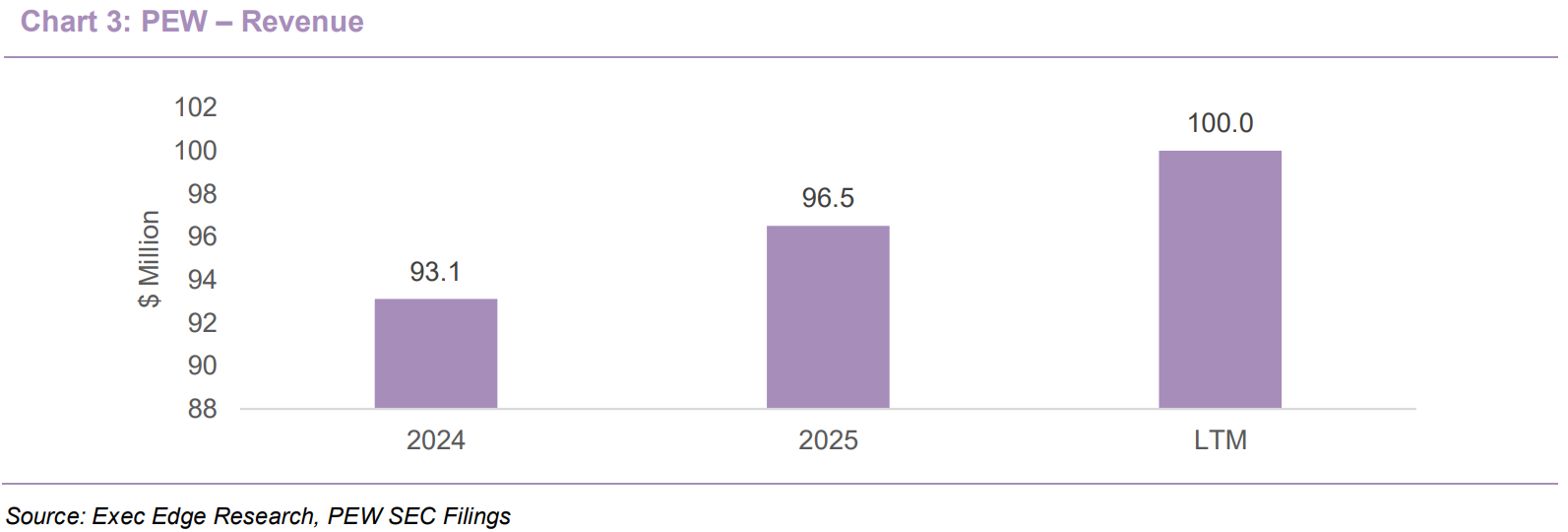
- PEW’s expanding platform creates multiple avenues for growth beyond its core digital retail business. PEW generated approximately $100.0 million of LTM revenue, compared with $96.5 million in 2025 and $93.1 million in 2024, reflecting continued growth despite softer industry demand. The combination of digital retail, manufacturer services through PEW Logistics and wholesale distribution through Camfour broadens PEW’s customer reach, revenue opportunities and ability to capture value across the firearms supply chain. Current Street estimates sourced from TIKR indicate revenue of $102.6 million in 2026E and $109.3 million in 2027E, but appear not to fully incorporate Camfour and are therefore not being used. Looking ahead, growth will depend on recovering retail volumes, scaling higher-margin manufacturer services and leveraging Camfour’s distribution network to improve purchasing economics and expand market reach.
Attractive Valuation Supported by Expanding Platform Capabilities
- Disclaimer: Exec Edge does not publish proprietary estimates, ratings, price targets, or investment recommendations. The valuation discussion below is illustrative only and is based on company filings, management commentary, and third-party data and estimates. It does not constitute a recommendation, price target, rating, or prediction of future pricing.
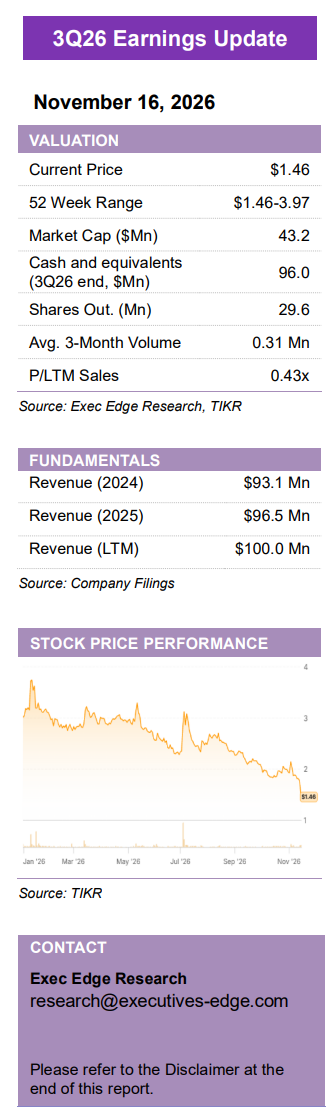
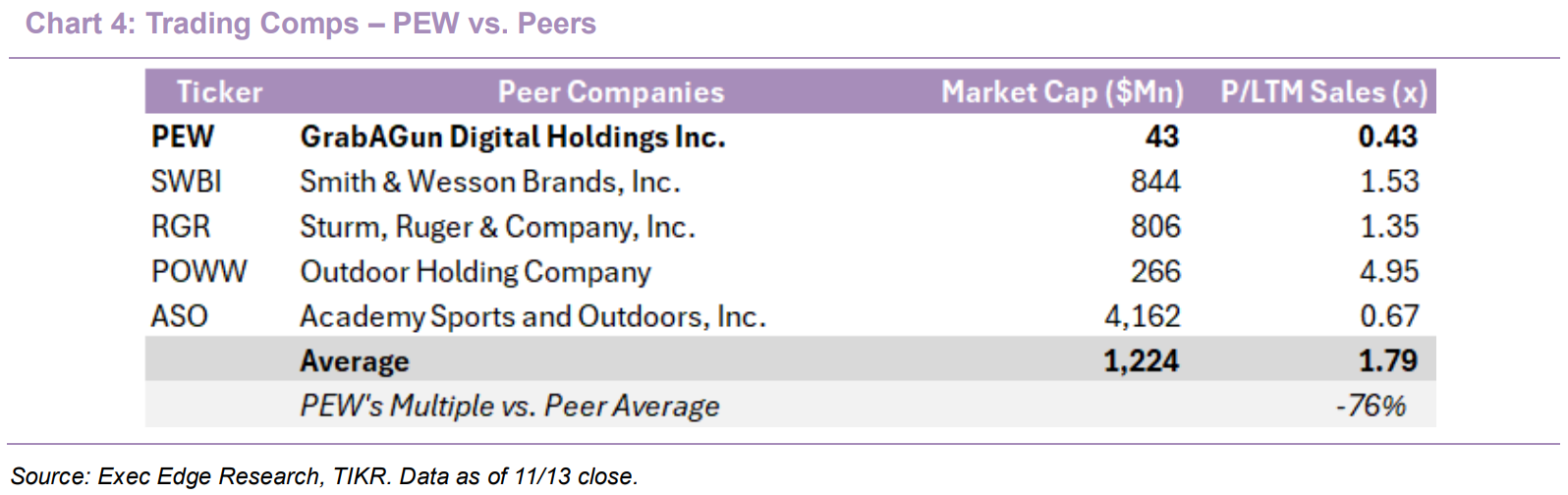
- PEW remains attractively valued, trading below its cash balance and at a significant discount to peers and prior trading levels. As of 11/13 close, PEW had a market capitalization of $43.2 million, compared with September-end cash of $96.0 million and total debt of $7.9 million. Adjusting for the subsequent $34 million all-cash Camfour acquisition, illustrative cash stands at $62 million, implying a negative enterprise value of ~$11 million, before subsequent cash movements and acquisition-related adjustments. The stock trades at 0.43x LTM sales, excluding Camfour’s revenue contribution, at its one-year low and approximately 49% below its one-year average of 0.84x. The valuation remains compelling given improving gross margins, expanding platform capabilities and the addition of Camfour’s wholesale distribution business.
- PEW trades at a substantial discount to firearms and sporting goods peers. At 0.43x LTM sales, PEW trades at a 76% discount to the peer average of 1.79x, including Smith & Wesson (1.53x), Sturm Ruger (1.35x), Outdoor Holding Company (4.95x) and Academy Sports (0.67x). Even excluding higher-multiple Outdoor Holding Company, the remaining peers average 1.18x LTM sales, approximately 2.8 times PEW’s valuation. The discount is notable given PEW’s digital infrastructure, improving gross margins and expanding reach across retail, manufacturer services and wholesale distribution.
- Margin expansion, PEW Logistics scaling and Camfour integration provide multiple catalysts for valuation rerating. Gross margin expanded 480 bps y/y to 14.4% in 3Q26, while PEW Logistics reached $271K in quarterly service revenue and expanded to four manufacturers. Camfour adds purchasing scale, independent dealer access and opportunities for procurement and inventory efficiencies. A recovery in product volumes, improving operating leverage and successful integration of Camfour could drive stronger earnings and cash generation, supporting a narrowing of PEW’s substantial valuation discount.
Read Exec Edge’s Initiation on PEW Here
Subscribe to our Weekly Newsletter to Receive All Research
Contact: