

Download the Complete Report Here
Cibus, Inc. (CBUS)
Rice Commercialization Advances; BioFragrance Direct-Sales Opportunity Expands to $100 Million. Attractively Valued.
- Key Takeaways:
- Rice HT1/HT3 delivered positive LATAM field results, with Interoc’s customer-variety testing underway and initial commercialization targeted for 2028.
- BioFragrance’s shift to direct sales expands the peak annual revenue opportunity to $100 million, with potential gross margins of 50%-70%.
- Partner-funded programs broaden through Indian mustard, while Direct Breeding’s 12-15 month editing turnaround supports deeper customer relationships and scalability.
- Revenue increased 30% y/y to $0.8 million, while operating cash usage declined 19% YTD, although near-term financing remains necessary to advance commercialization.
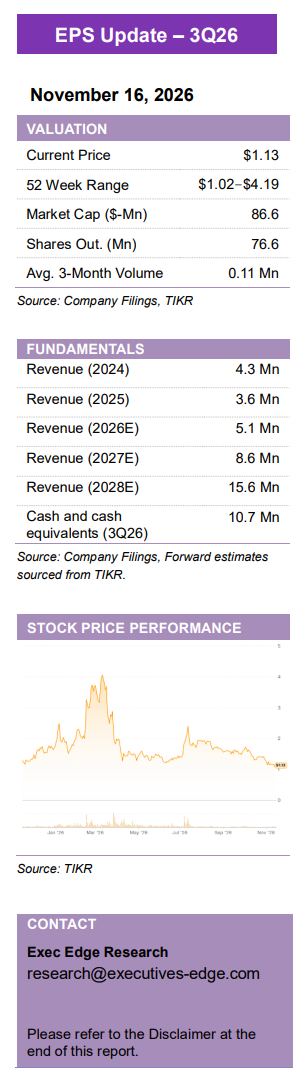
- At an ~$86.6 million market cap, CBUS trades below its $200 million peak annual Americas rice royalty opportunity, highlighting significant potential value as commercialization progresses.
- Rice HT1 and HT3 moved closer to commercialization as successful LATAM field trials paved the way for validation in Interoc’s own elite varieties. Both herbicide-tolerance traits performed well in regional test varieties planted in April 2026, with results received in August. Interoc subsequently planted its own elite rice varieties carrying CBUS’ traits in Ecuador in late September, with results expected in 1Q27. This represents a more consequential test, evaluating trait performance in genetics intended for commercialization while generating data to support expansion of herbicide labels to trait-bearing rice. Positive results would strengthen commercial readiness and support progression toward demonstration plots, seed multiplication and the targeted 2028 LATAM launch. The 1Q27 readout is therefore a pivotal commercialization milestone, with successful validation in Interoc’s own germplasm providing a stronger foundation for the transition from technical development toward royalty-generating seed sales.
- LATAM remains CBUS’ first major royalty opportunity, with the focus shifting toward definitive commercial agreements and launch readiness. CBUS continues negotiating an agreement with Interoc that would provide per-acre royalties on trait-bearing seed. Its seven rice seed-company customers across LATAM and the U.S. represent an estimated 5-7 million peak addressable acres and approximately $200 million in potential annual Americas royalties, with LATAM accounting for the majority. The 2028 launch depends on customer validation, commercial agreements, herbicide-label expansion and seed availability. CBUS is also preparing a regulatory dossier for Brazil and pursuing partnerships in India. U.S. commercialization remains linked to Albaugh’s herbicide registration, now targeted for 2029 or 2030 versus 2029 previously. Converting validation into commercial agreements and royalty-bearing acreage will be central to unlocking the value of CBUS’ rice opportunity.
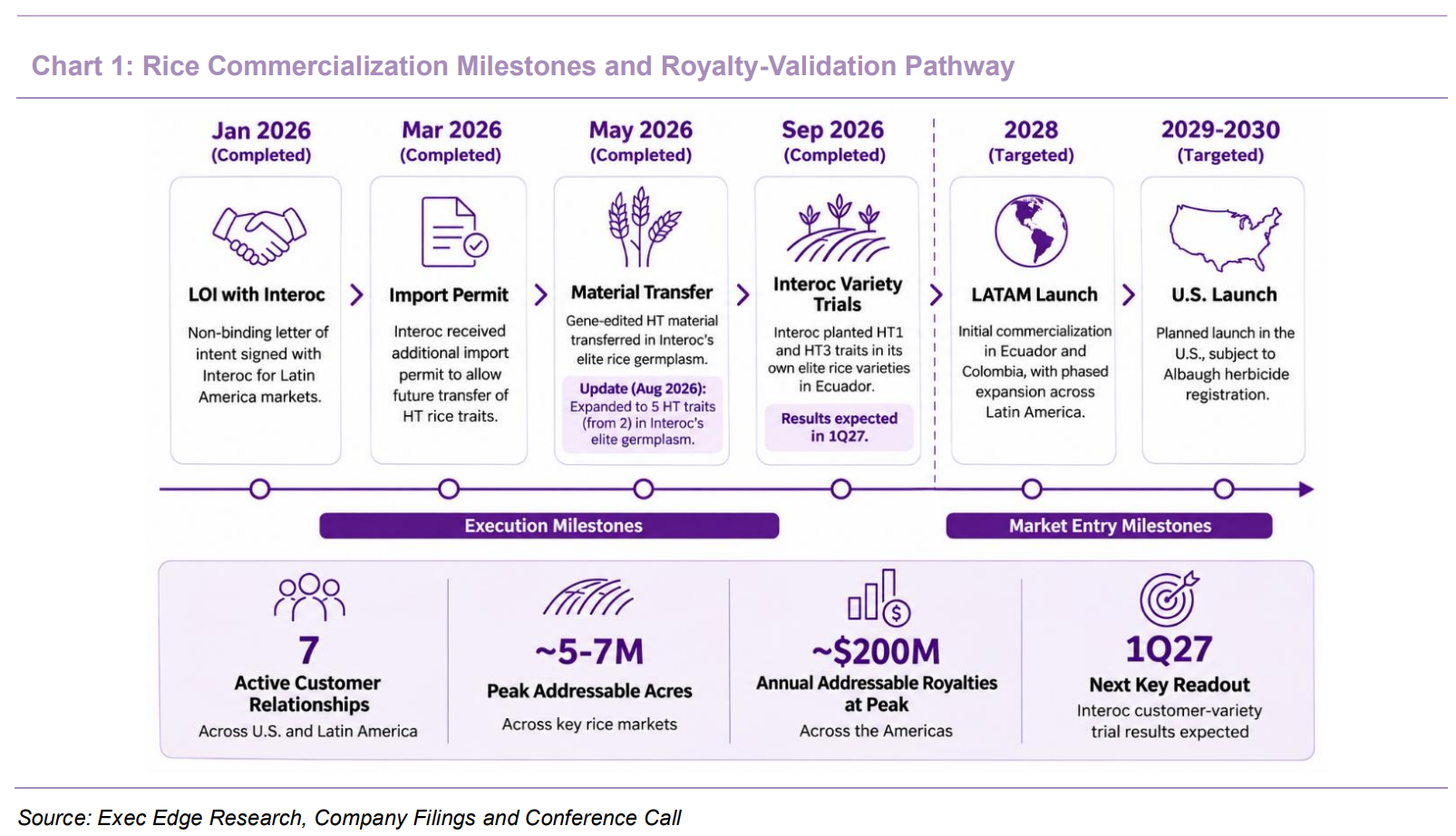
- Interoc’s expansion from two to five traits strengthens CBUS’ potential to become an embedded precision-breeding partner rather than a standalone trait licensor. The expanded relationship creates scope for multiple development programs using existing editing infrastructure, potentially improving customer economics without proportionate increases in development costs. Interoc’s focus on hybrid rice creates opportunities for stacking productivity traits in proprietary varieties, while partners such as Fedearroz provide exposure to conventional seed markets. CBUS’ demonstrated 12-15 month editing turnaround in canola supports the scalability of this model, positioning multi-trait customer relationships as a potential source of recurring development revenue and stronger long-term platform economics.
- BioFragrance’s shift to direct sales expands its peak annual revenue opportunity to $100 million while preserving an asset-light operating model. CBUS now targets an eight-ingredient portfolio, compared with the previously estimated $20-$40 million annual opportunity under a royalty model. Direct sales enable greater participation in product economics and closer customer relationships, while outsourced contract manufacturing limits capital expenditure requirements. Potential gross margins of approximately 50%, increasing toward 70% at scale, support attractive profitability and operating leverage. The shift fundamentally expands CBUS’ participation in ingredient economics, positioning BioFragrance as a potentially significant commercial revenue engine ahead of rice royalties.
- Commercial progress is supporting the transition toward direct sales, with initial product approvals and manufacturing preparations underway. The consumer-products partner has approved the first two BioFragrance ingredients for use in its products, while CBUS has initiated manufacturing preparations. The company also presented more than 20 fragrance possibilities, prompting requests for larger quantities of two additional ingredients for formulation development. Direct engagement with customer perfumers supports faster product refinement and portfolio expansion. Additional scale-up orders targeted for 2H26 remain outstanding, making formulation wins and purchase-order conversion the next important commercial milestones. Successful conversion would establish a direct-sales revenue stream and provide a foundation for scaling the broader eight-ingredient portfolio.
- Crystal Crop partnership opens a new partner-funded commercialization pathway in India’s large mustard market, reinforcing cross-crop scalability. The September agreement to develop gene-edited mustard traits began generating development revenue in 3Q26. India cultivates approximately 21 million mustard acres, with yields of 1,200-1,400 kg/hectare versus 1,800-2,000 kg/hectare in leading producing countries, while importing more than half its edible oil requirements. Crystal Crop will evaluate the traits for potential commercialization under an exclusive Indian licensing arrangement, leveraging over 14,800 distribution partners across 23 states and four union territories. CBUS has initiated regeneration work in Crystal Crop’s varieties ahead of trait editing. The partnership demonstrates CBUS’ ability to expand into new crops through partner-funded development, creating near-term revenue and future royalty potential without building its own seed distribution infrastructure.
- Partner-funded programs continue advancing the broader productivity-trait pipeline while limiting CBUS’ internal capital requirements. The U.K. Light Leaf Spot resistance program remains on schedule, addressing a disease that caused an estimated £300 million in crop losses during the severe 2022 season. Pod Shatter Reduction received DEFRA approval for trial planting following three years of field testing in customer germplasm. In nutrient-use efficiency, edited canola lines are ready for John Innes Centre evaluation, with material transfer shifting from 3Q26 to 4Q26; parallel editing has begun in rice. Second-generation canola herbicide tolerance was confirmed across three trial locations, although drought limited yield data to one, while soybean editing reagents were validated. Collectively, these advances expand CBUS’ longer-term commercialization pipeline while allowing management to concentrate internal resources on near-term revenue opportunities in rice and Sustainable Ingredients.
- Direct Breeding’s speed, multi-trait capabilities and neutral positioning underpin CBUS’ ability to scale across crops and customer relationships. CBUS has demonstrated single-cell plant regeneration across nine crops and is actively developing traits in five, with a proven 12-15 month editing turnaround in canola. Unlike conventional breeding, Direct Breeding modifies elite customer germplasm without introducing editing machinery requiring subsequent removal, enabling multiple traits to be incorporated more efficiently. CBUS also avoids competing with customers in seed or chemical sales, strengthening its positioning as an independent technology partner. These advantages position CBUS to scale repeat development programs across crops and customers, with faster turnaround and multi-trait capabilities supporting stronger platform economics over time.
- Vylor’s separation from Corteva reinforces the strategic value of agricultural genetics and the scalability of trait licensing. The October 2026 separation created an independent seed and genetics company valued at approximately $48 billion, while Vylor is targeting more than $500 million in gross licensing income in 2027. The separation brings greater public-market visibility to the value of proprietary genetics and trait licensing, reinforcing the strategic relevance of CBUS’ independent precision-breeding platform.
- Improving regulatory alignment across major agricultural markets continues to expand CBUS’ commercialization pathways. The EU’s precision-breeding framework entered implementation in July 2026, with regulations expected through 2028, supporting conventional-like treatment for qualifying disease-resistance and Pod Shatter Reduction traits while excluding herbicide tolerance from the more favorable category. England’s established framework provides a separate pathway for precision-bred crop trials. In LATAM, Ecuador has confirmed conventional-breeding equivalence for CBUS’ HT1 and HT3 rice traits, while Peru introduced case-by-case evaluation potentially exempting qualifying gene-edited crops from its GMO moratorium. In the U.S., USDA-APHIS determinations support commercialization of relevant traits, while the FDA completed its altered-lignin alfalfa review without further questions. Together, these developments strengthen the regulatory foundation for CBUS’ rice commercialization roadmap and support broader adoption of its precision-breeding platform across crops and geographies.
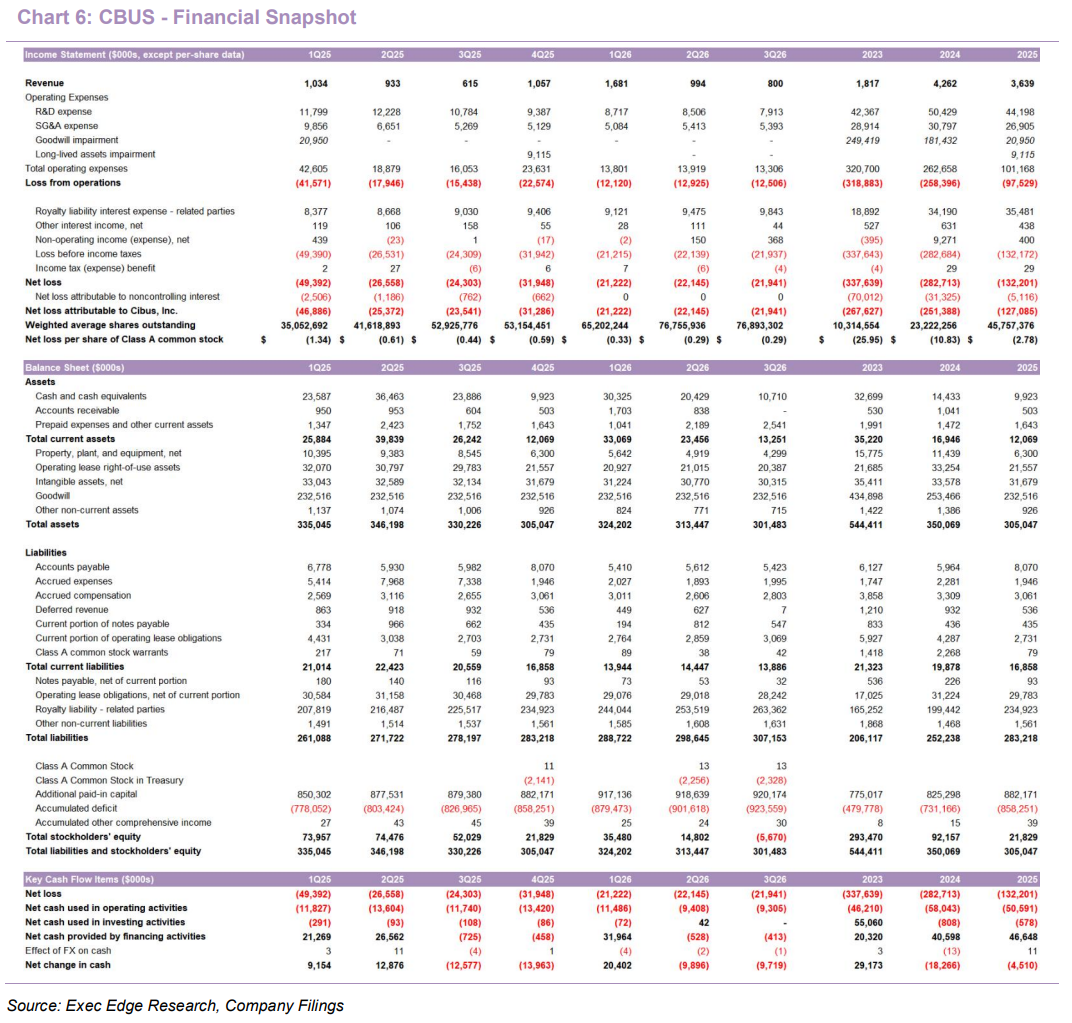
- Partner-funded collaborations continue driving revenue growth, providing early validation of platform monetization strategy. CBUS reported 3Q26 revenue of $0.8 million, up 30% y/y but down from $1.0 million in 2Q26, while 9M26 revenue increased 35% to $3.5 million. The Procter & Gamble collaboration contributed $0.65 million in 3Q26 versus $0.39 million y/y, representing approximately 81% of quarterly revenue, and $2.93 million in 9M26, or 84% of total revenue. Initial revenue from the Indian mustard program added another partner-funded stream. The growing contribution from collaboration programs demonstrates early platform monetization, with BioFragrance commercial sales and future trait royalties providing the next avenues for diversification and scale.
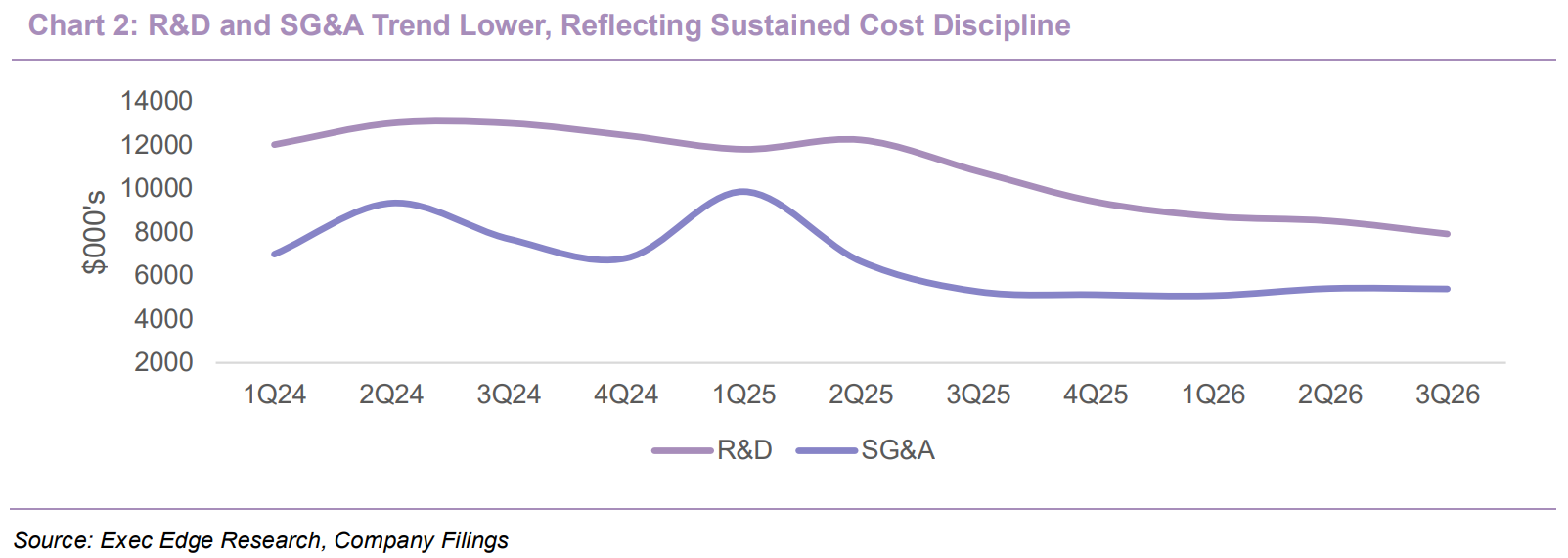
- Structural cost reductions continue to improve CBUS’ operating profile, narrowing losses while preserving investment in commercial priorities. R&D declined 27% y/y to $7.9 million from $10.8 million, driven by lower headcount, facilities consolidation and streamlined development spending, while SG&A remained broadly stable at $5.4 million. Combined operating expenses fell 17% to $13.3 million, narrowing operating loss to $12.5 million from $15.4 million. For 9M26, R&D and SG&A declined approximately $15.6 million y/y to $41.0 million, demonstrating sustained cost discipline. Net loss narrowed to $21.9 million from $24.3 million, with loss per share improving to $(0.29) from $(0.44), partly aided by a higher share count. Results included $9.8 million of noncash royalty-liability interest expense versus $9.0 million y/y, which does not affect operating cash usage. The leaner cost structure positions CBUS to support its commercialization priorities while maintaining tighter control over operating expenses as revenue scales.
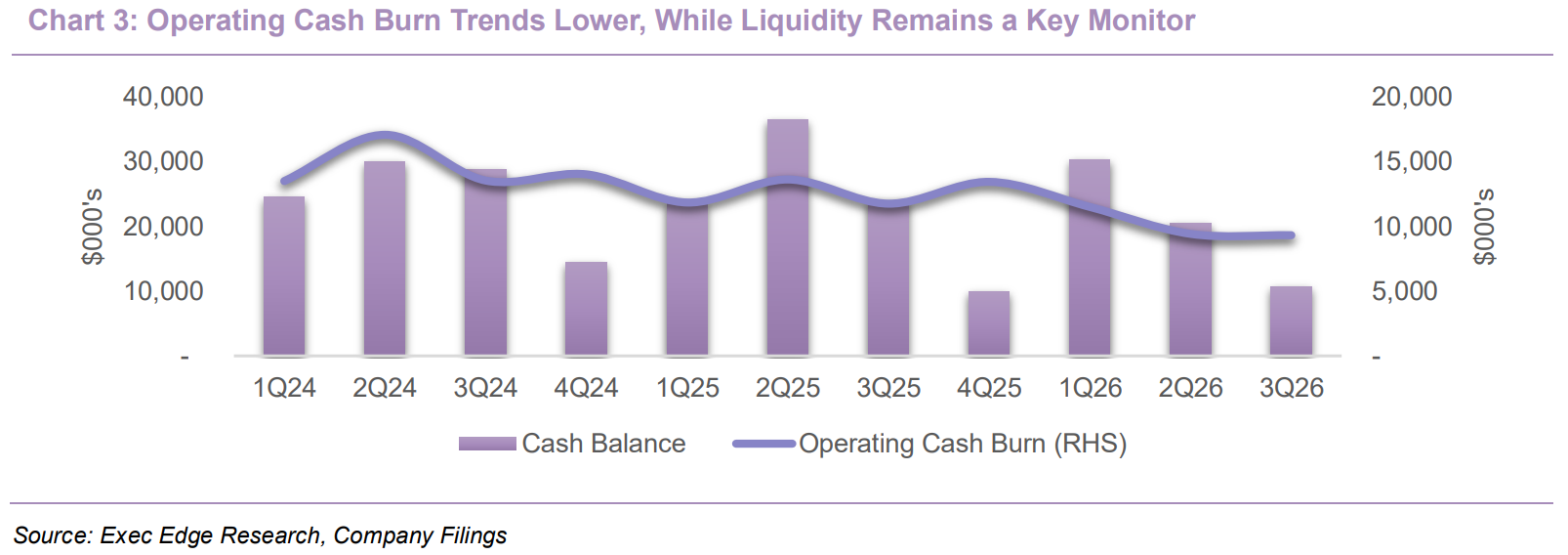
- Structural cost reductions are lowering cash burn, although near-term financing remains critical to advancing commercialization. Cash declined to $10.7 million at September-end from $20.4 million in 2Q26, while quarterly operating cash usage totaled $9.3 million. For 9M26, operating cash usage improved 19% y/y to $30.2 million from $37.2 million, despite a $1.3 million working-capital outflow versus a $5.4 million inflow y/y, reinforcing the impact of structural cost reductions. CBUS maintains its target of exiting 2026 at an approximately $35 million annualized net cash usage run rate, but existing liquidity is expected to fund operations only into early 1Q27. The $50 million ATM offers financing flexibility, although it generated no net proceeds through September after associated expenses, while shares outstanding increased 41% YTD to 76.6 million. The latest 10-Q also identifies 16.9 million potential common-share equivalents and ongoing evaluation of strategic alternatives. Securing additional capital on favorable terms will be critical to sustaining commercial execution while preserving the value of CBUS’ emerging royalty and BioFragrance opportunities for existing shareholders.
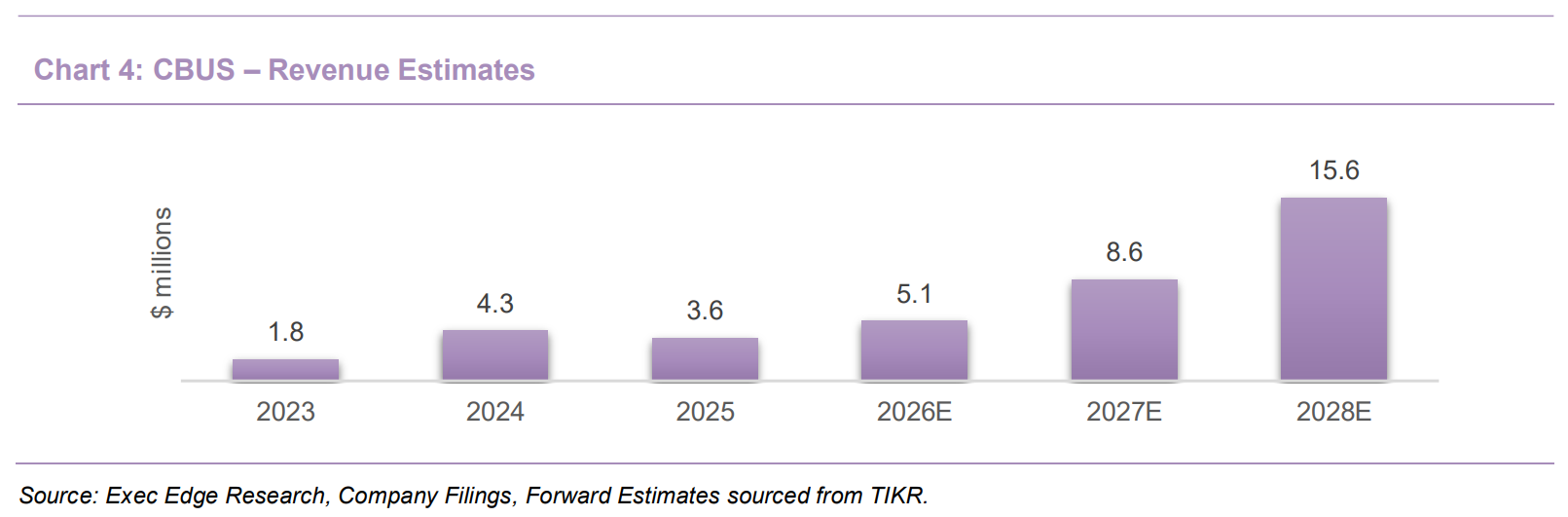
- Street estimates reflect a more measured commercialization ramp, leaving meaningful upside potential as BioFragrance and rice milestones translate into revenue. Street’s revenue estimates (source: TIKR) of $5.1 million in 2026E, $8.6 million in 2027E and $15.6 million in 2028E are lower than the $12.4 million and $47.6 million previously expected for 2027 and 2028, respectively. The revised forecasts reflect a gradual revenue build despite CBUS’ expanded $100 million peak BioFragrance opportunity and continued progress toward rice commercialization. With initial BioFragrance ingredients approved, manufacturing preparations underway and Interoc customer-variety results expected in 1Q27, earlier purchase-order conversion, stronger ingredient sales or faster royalty adoption could drive revenue above current Street expectations. Successful conversion of these milestones into commercial revenue would provide a foundation for upward estimate revisions and strengthen the case for a valuation rerating.
Rice HT Anchors Valuation Framework; Platform Optionality Adds Upside
- Disclaimer: Exec Edge does not publish proprietary estimates, ratings, price targets, or investment recommendations. The valuation discussion below is illustrative only and is based on company filings, management commentary, and third-party data and estimates. It does not constitute a recommendation, price target, rating, or prediction of future pricing.
- CBUS remains attractively valued relative to its substantial commercial and royalty opportunities. As of 11/13 close of $1.13, CBUS has a market capitalization of $86.6 million and enterprise value of ~$76.5 million, excluding royalty liabilities and leases. The stock trades at approximately 4.9x 2028E EV/Sales, with substantial value creation dependent on the conversion of rice royalties and BioFragrance opportunities into recurring commercial revenue. Importantly, CBUS’ current market capitalization represents only ~0.43x its disclosed $200 million peak annual Americas rice HT royalty opportunity, highlighting the significant scale of the potential royalty stream relative to its current equity valuation, even before considering BioFragrance and the broader trait portfolio.
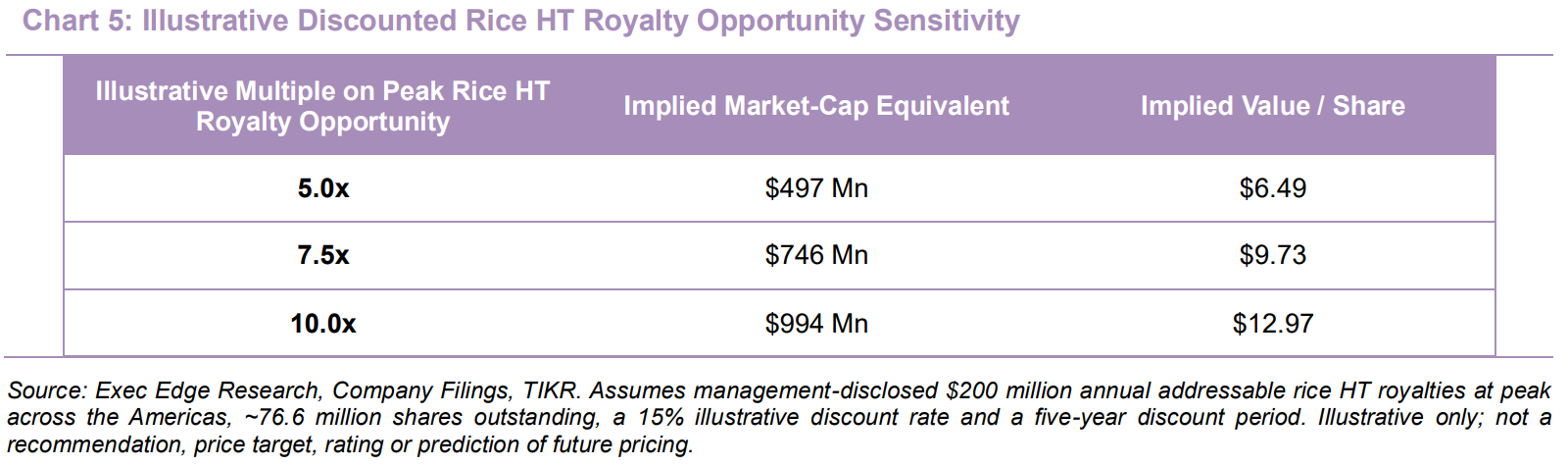
- Rice HT remains the clearest valuation anchor, with the established discounted royalty framework indicating substantial potential upside upon successful commercialization. Applying illustrative multiples of 5.0x-10.0x to the approximately $200 million peak annual Americas rice royalty opportunity and discounting five years at 15% implies a value of $497-$994 million, or approximately $6.49-$12.97 per share, with a 7.5x midpoint of $9.73. These sensitivities reflect the potential economics of a mature, high-margin royalty stream rather than current earnings or contracted revenue. Positive LATAM field results and progression into Interoc’s customer varieties strengthen the commercialization pathway, with definitive agreements, the targeted 2028 launch and subsequent farmer adoption representing key drivers of royalty realization. The framework excludes future dilution and contractual royalty-holder claims.
- BioFragrance and the broader crop portfolio add meaningful optionality beyond the rice royalty opportunity. The transition to direct sales expands BioFragrance’s disclosed peak annual revenue potential to approximately $100 million across eight ingredients, with targeted gross margins of 50%-70% at scale. At full commercialization, this implies approximately $50-$70 million in potential annual gross profit, with outsourced manufacturing supporting capital-efficient growth. Initial product approvals and manufacturing preparations strengthen its commercial prospects. CBUS’ broader productivity-trait portfolio also represents more than $1.9 billion in management-estimated potential annual royalties across approximately 367-369 million addressable acres. These opportunities remain at varying development stages and are not incorporated into the base rice valuation sensitivity.
- Street price targets highlight the potential valuation opportunity, with commercial milestones providing clear catalysts for a rerating. The mean Street price target of $14.33, sourced from TIKR, compares with CBUS’ current share price of $1.13 and reflects expectations for significant value creation as commercialization progresses. Key catalysts include Interoc’s 1Q27 trial results, definitive rice commercialization agreements and BioFragrance purchase orders. Faster commercialization could also drive upward revisions to Street revenue estimates, providing an incremental catalyst for rerating. Successful execution across these opportunities, supported by disciplined capital allocation, could drive greater market recognition of CBUS’ underlying platform and royalty potential.
Read Exec Edge’s Initiation on Cibus, Inc. Here
Subscribe to our Weekly Newsletter to Receive All Research
Contact:



