Download the Complete Report Here
 Otovo ASA (OTOVO)
AI-Native Services Roll-Up and Endurance Platform Shape OTOVO’s Path to Profitable Scale and Re-Rating
- OTOVO is scaling an AI-native energy services business across Europe and the U.S., bringing acquired field teams and customer relationships onto one platform. Endurance is designed to link equipment monitoring, diagnosis, dispatch and repair to support faster, lower-cost service. Field Services and Recurring Services are gaining revenue share, while memberships, upgrades and grid services over time could lift revenue per customer. The model is designed to turn a growing service network and broad customer base into broader lifecycle monetization.
- Endurance, customer access and field execution form the core of OTOVO’s emerging operating advantage. The proprietary platform connects intake, monitoring, diagnosis, quoting, procurement, scheduling, dispatch and billing while consolidating fragmented external software. OTOVO’s 60,000+ customers, 22,000 memberships and 1.9 million legacy records create a broad relationship pool for services, retention and upgrades, while early automation and cost-reduction metrics suggest Endurance is beginning to support both software savings and technician productivity.
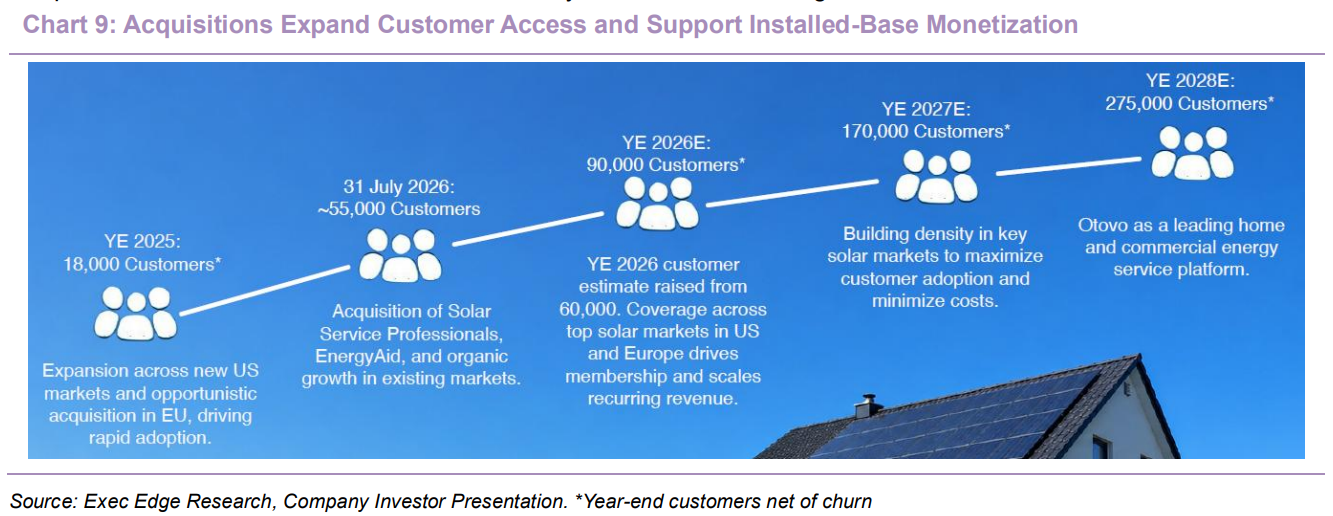
- Acquisition-led scale is expanding customer density, service capacity and geographic reach. Completed transactions have added customer books, technicians, vehicles and local operating capability, while Green Panel remains signed but unclosed and PV Hawaii and Mr. Elektro remain non-binding LOIs. Management brings relevant energy-services, transaction and restructuring experience, while Endurance and OTOVO’s repeatable integration process are intended to provide a common operating backbone across acquired businesses. Management targets ~90,000 year-end customers, up from 60,000+ in Sept. 2026 and 18,000 at 2025 year-end.
- Industry shifts increasingly favor lifecycle service, distributed-energy complexity and scaled field-service platforms. The installed solar fleet continues to expand and age across Europe and the U.S., broadening demand for monitoring, diagnosis, repairs and upgrades even as new-installation markets fluctuate, while installer exits are creating additional demand from orphaned systems. Battery adoption, connected assets and grid participation expand the serviceable equipment base, technician scarcity raises the value of AI-enabled productivity, and fragmented local service markets create opportunities for platforms that combine local execution with centralized technology and procurement.
- Improving service mix and gross economics create re-rating potential as OTOVO targets a larger profitable operating base. Field and Recurring Services reached 38.8% of 2Q26 revenue as quarterly gross margin rose to 46.1%, while management’s 4Q26 annualized run-rate guidance calls for $105-115 million of revenue and $15-20 million of adjusted EBITDA. Liquidity remains a key monitorable, though the July raise strengthened near-term funding. We do not issue ratings, recommendations or price targets; however, at 0.73x EV/Sales and 4.61x EV/EBITDA, OTOVO trades at a substantial discount to service peers, leaving meaningful re-rating potential if acquisition integration, service-volume growth and cash conversion support delivery of the targeted earnings profile.
Company Overview
OTOVO – Scaling an AI-Native Energy Services Network
- Otovo ASA (OTOVO) is an AI-native home and business energy services company across Europe and the U.S. It aims to bring equipment monitoring, diagnostics, repairs, electricity services where available and grid participation into one customer relationship. Endurance, its proprietary AI platform, is designed to detect issues in connected equipment and coordinate service from diagnosis through resolution, including repairs around the clock. OTOVO is pursuing an acquisition-led energy-services roll-up, combining local service teams and customer relationships under a shared operating model intended to improve coverage, technician productivity and service efficiency as it scales. Field Services, Recurring Services and equipment upgrades now define OTOVO’s growth strategy, supported by the overall large customer base associated with an aging installed fleet, including systems installed by other providers. OTOVO ASA is a Norwegian public limited liability company headquartered in Oslo and listed on Euronext Oslo Børs under ticker OTOVO. In early 2026, the company indicated that it is working toward a potential U.S. dual listing.
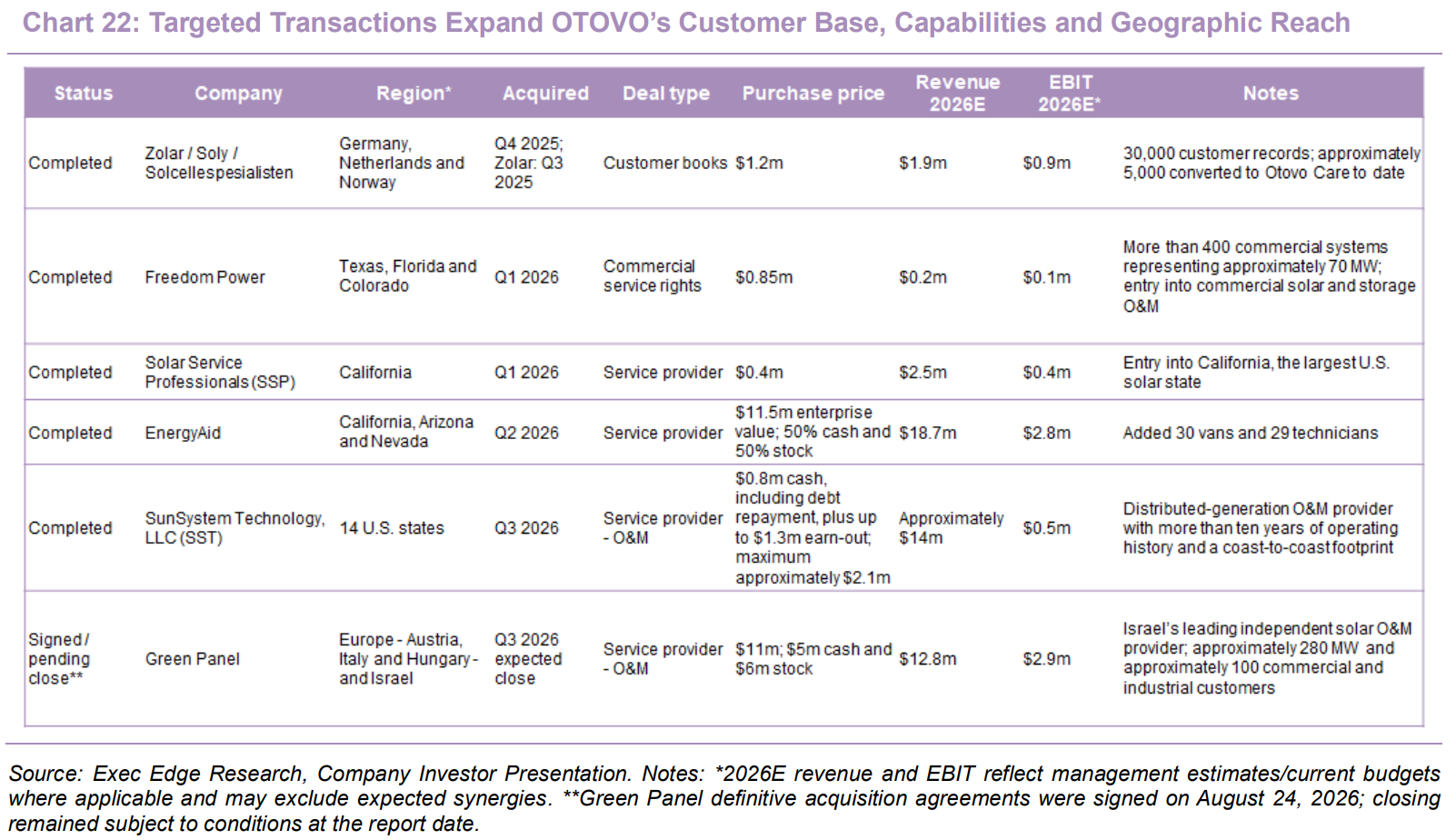
- OTOVO’s December 2025 acquisition of Onvis established its U.S. service base. Subsequent acquisitions of Solar Service Professionals, EnergyAid and SunSystem Technology have added local teams and customers. Green Panel is under definitive agreement but remained unclosed at the report date, while PV Hawaii and Mr. Elektro remain subject to non-binding LOIs. The company has a global footprint with a presence in 15 European countries, Israel and the U.S.
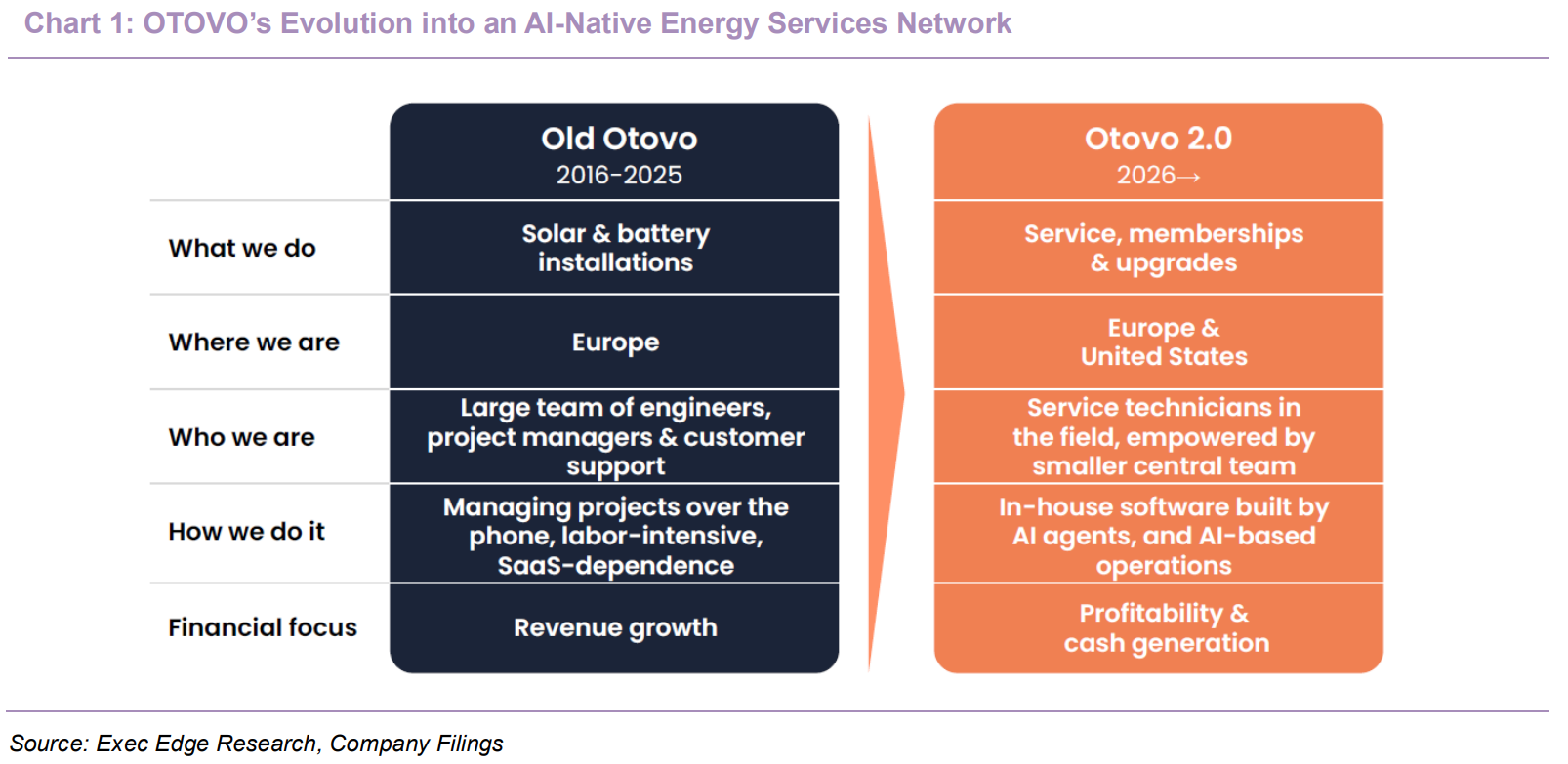
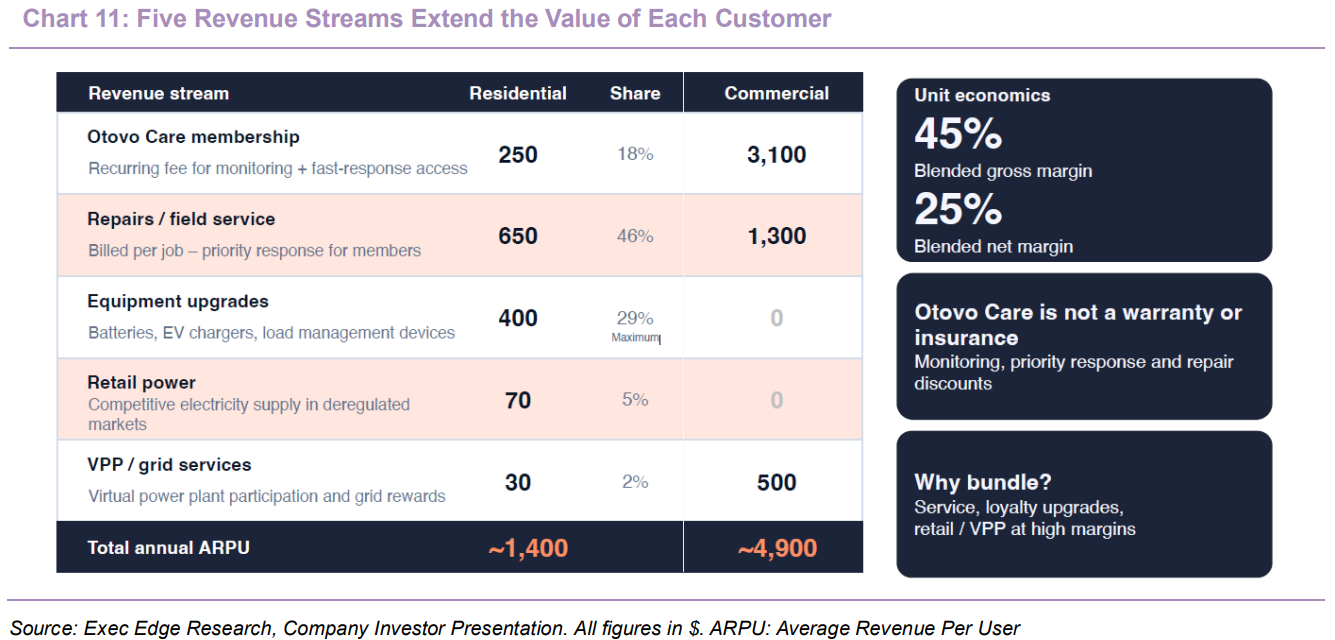
- OTOVO’s service-led model is designed to monetize each customer across three reporting segments and five potential revenue streams. Recurring Services includes OTOVO Care memberships, grid and electricity services, rental of home-energy products and fees from the divested EDEA subscription entities. Field Services comprises inspection, diagnostics, repair, maintenance, replacement and logistics work for residential and business customers. OTOVO Care provides equipment monitoring, remote troubleshooting, defined response access, priority scheduling on selected plans and discounts, but does not function as a warranty or insurance contract; repairs remain separately billable. The broader customer proposition adds one-off repair events, batteries and other equipment upgrades, retail electricity where available, and virtual power plant and other grid services where applicable. Newbuild remains a reported segment and includes new solar and battery systems as well as equipment added to existing systems. In 2Q26, the segment presentation recorded NOK 57.7 million of Newbuild revenue, NOK 5.6 million of Recurring Services revenue and NOK 31.1 million of Field Services revenue, highlighting the growing contribution from services as the business model shifts. Service is intended to anchor the ongoing customer relationship, with repairs, memberships, upgrades, retail electricity and grid services expanding revenue per customer over time.
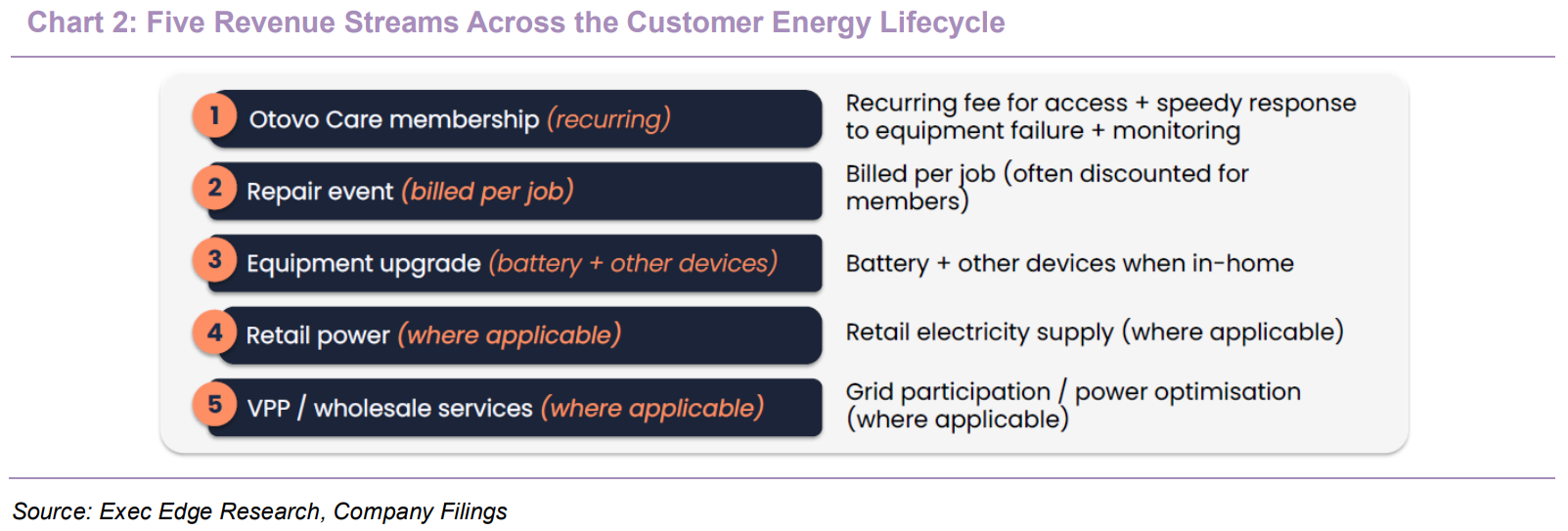
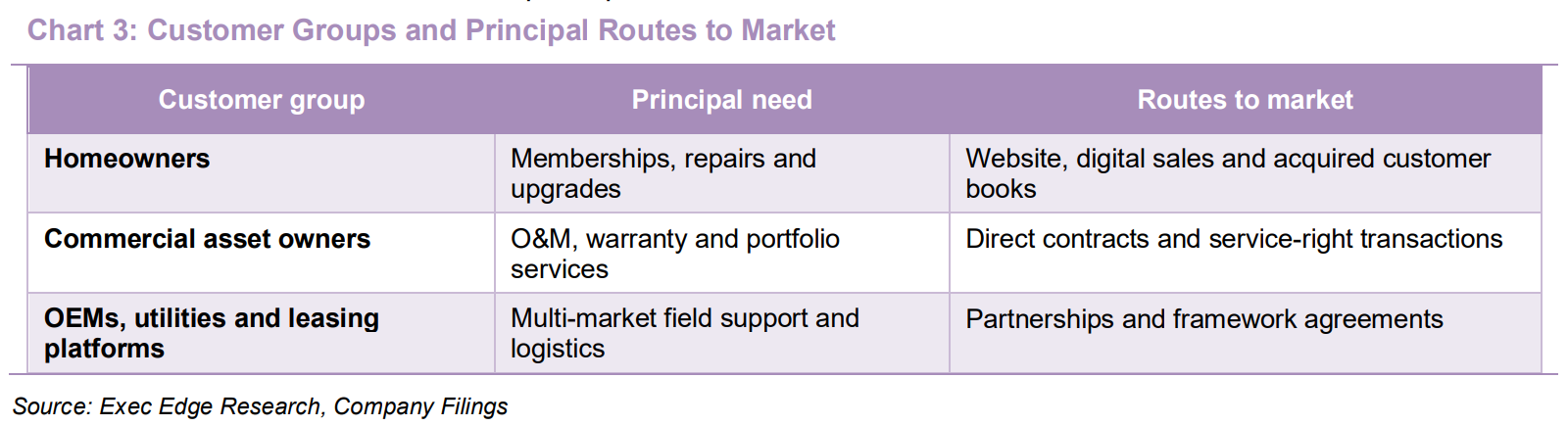
- The company serves homeowners, commercial asset owners and energy-industry partners through multiple service and distribution channels. Residential users purchase solar and battery systems, request one-off servicing, join OTOVO Care, or add batteries, EV chargers, generators, monitoring and load-management equipment to existing installations. Commercial customers use operations, maintenance and warranty services for larger portfolios, while original equipment manufacturers and asset owners can contract for multi-market field support and logistics. OTOVO also serves FORTE PV and the EDEA entities under continuous-sale, platform-access and management arrangements associated with the divested subscription portfolio. Routes to market combine direct digital sales, local installer relationships, acquired service businesses, customer books obtained from former installers, OEM and asset-owner partnerships, and access arrangements such as the March 2026 Freedom Solar transaction. The agreement gave Onvis responsibility for performing the remaining warranties on 417 commercial installations and exclusive access to market membership-based services for Freedom’s commercial and residential customers. Management reported more than 60,000 customers in September 2026, including customers added through acquisitions and organic activity; the figure represents the broader customer base and should not be read as a count of paying OTOVO Care members. The U.S. website sells OTOVO Care directly in tiered monthly plans and separately markets inspections, repairs, cleaning, generator service and battery additions. European channels continue to include the digital marketplace, regional commercial teams, installer relationships and the installed customer bases of OTOVO and acquired predecessor brands.
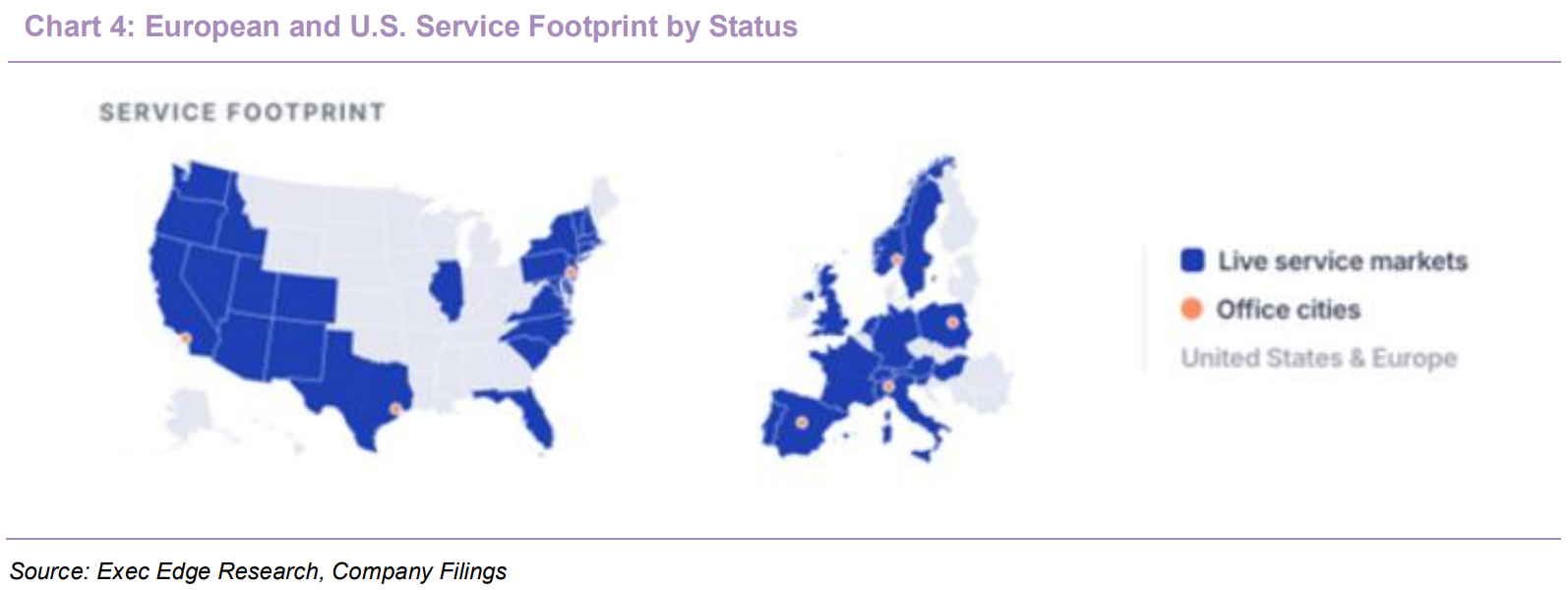
- A growing transatlantic service footprint combines regional operations, acquired businesses and partner networks. OTOVO’s registered head office is in Oslo, while its 2025 workforce disclosures identified a Madrid shared-service hub, a Houston operation and regional offices or personnel in Berlin, Lisbon, London, Milan, Paris, Vienna and Warsaw, among other locations. The U.S. platform began with Houston-based Onvis and expanded through Solar Service Professionals in California, EnergyAid in California, Arizona and Nevada, and SunSystem Technology, whose July 2026 acquisition added an operations-and-maintenance footprint across 14 states. European activity combines continuing solar and battery sales, OTOVO Care, equipment upgrades and developing field-service capacity across established country organizations. The current footprint should be distinguished from announced expansion: the August Green Panel agreements contemplated additional operations in Israel, Hungary and wider Europe, while the non-binding PV Hawaii and Mr. Elektro letters of intent would add Hawaii and licensed installation and service capacity in Norway and Sweden. OTOVO described the enlarged, transaction-inclusive footprint as 15 European markets, Israel and 17 U.S. states, but those figures include businesses that had not closed when announced. Service delivery is coordinated through local technicians, vehicles, installation partners and central software, with customer support, scheduling and dispatch connected across the operating network. The August update stated that service-work intake exceeded completions, leading the group to hire technicians and add capacity. The model relies on service locations, technicians, partners and software rather than owned manufacturing infrastructure.
- An asset-light delivery model pairs outsourced equipment and installation with a growing field-service network. OTOVO delivers field services through employed technicians, acquired local teams and subcontractors, coordinated through shared customer, inventory and dispatch systems. The group does not manufacture equipment; its Newbuild projects continue to use third-party hardware suppliers and installation partners. Solar modules, inverters, mounting equipment, batteries, smart meters and EV chargers are sourced from third parties, many based in Asia. OTOVO limits projects to approved hardware assessed for technical quality, manufacturer financial standing and responsible production, while country-level distribution agreements can improve pricing, credit terms and supply availability. Field execution is supported by vehicles, inventory, routing and dispatch systems, with training, certification, quality checks, monitoring, contractual recourse and liability insurance governing service delivery.
- Endurance is becoming the AI-enabled operating layer for OTOVO’s service model, connecting customer, asset and field-service workflows across the platform. OTOVO Cloud was developed in-house for the original marketplace and links digital sales, geospatial and solar-resource data, installer cost models, algorithmic bidding, project allocation, documentation, invoicing and post-installation production monitoring. The platform also supplies technical services to the associated EDEA portfolio companies. During 1Q26, management approved a transition under which Endurance would progressively replace OTOVO Cloud.
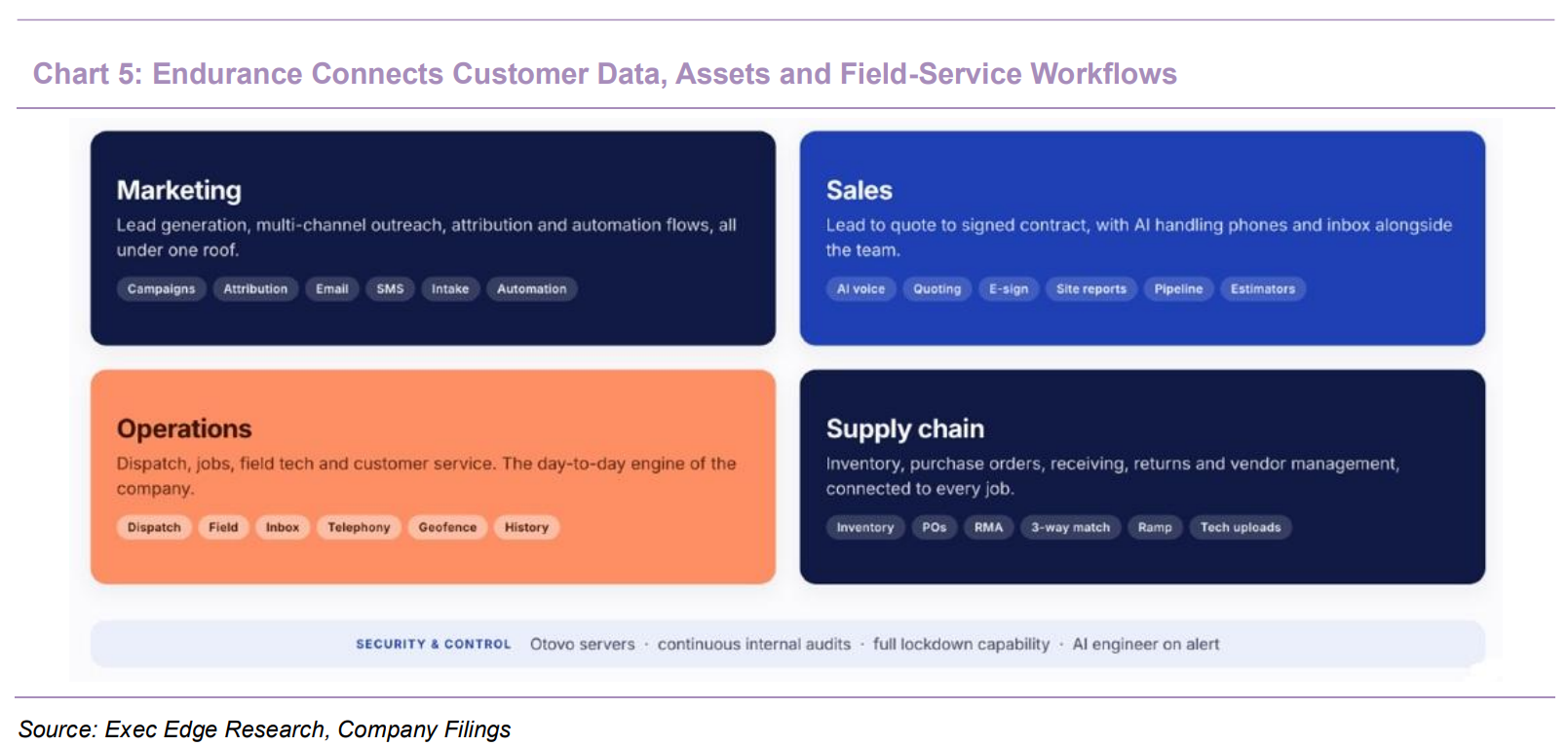
- Endurance is a proprietary operating stack spanning customer relationship management, intake, equipment monitoring, diagnostics, customer records, call handling, scheduling, dispatch, procurement, inventory, billing and customer support. The platform is also intended to replace a fragmented third-party SaaS stack, reducing external software costs and centralizing operating data and workflows. AI agents automate defined workflow tasks alongside employees, while hardware integrations bring operating data from solar, battery and generator systems into the platform. Management had targeted company-wide rollout and legacy SaaS retirement during 3Q26, while the August update identified additional Endurance-enabled measures planned for September and October, indicating that deployment and optimization remained ongoing. The strategic objective is to reduce software and support costs, improve technician productivity and service response, and provide a common operating system for integrating acquired businesses.
- A leaner workforce is being rebuilt around field-service capacity as OTOVO scales the services model. The group reported 186 full-time equivalents in 2025 and 189 people across all contract types at year-end, distributed across 14 locations after an approximately 40% headcount reduction. Acquisitions in 2026 added technicians, field managers and customer-service personnel, while the August update reported further hiring to address the work-order backlog. Operating infrastructure includes the Oslo headquarters, Madrid shared-service hub, Houston and acquired U.S. service organizations, regional European teams, installer account management, customer support and dispatch. Rooftop and electrical work carries safety, property and workmanship risks, addressed through HSEQ policies, training, certification, quality controls and insurance. The group also operates across multiple privacy, contractor-licensing, consumer-protection, telemarketing, renewable-energy, tax and leasing regimes.
Right-to-Win
Technology, Customer Access and Field Scale Strengthen Right-to-Win
- We believe OTOVO’s right-to-win is built on combining customer access, field-service scale and an AI-native operating system within an acquisition-led roll-up model. Endurance connects intake, diagnosis, procurement and dispatch, while a repeatable integration process allows acquired customer books and service organizations to migrate onto common workflows. Broad customer base creates opportunities for memberships, repairs and equipment upgrades, supported by a growing technician network across Europe and the U.S. Together, these capabilities are intended to lower customer-acquisition friction, improve service economics and support faster integration as OTOVO scales through acquisitions. These capabilities are reinforced by leadership experience in energy services, transactions and financial restructuring. We discuss these elements in detail below.
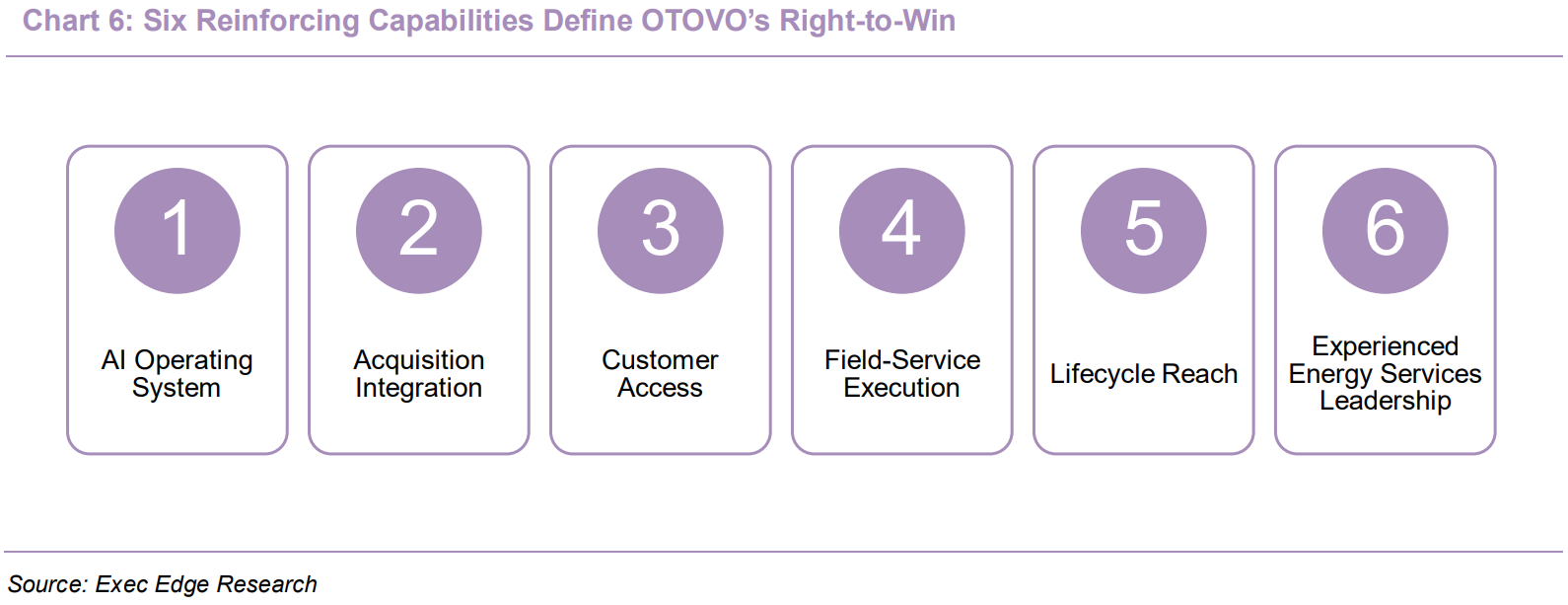
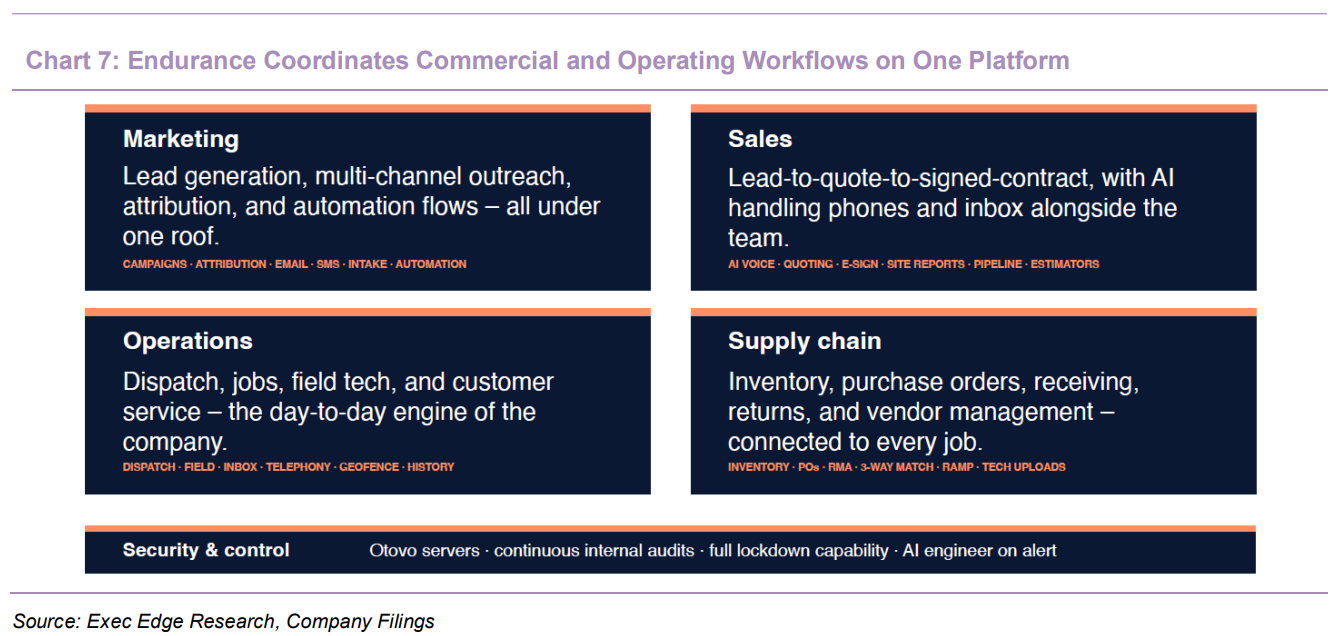
- Endurance is a core element of OTOVO’s right-to-win, with its advantage rooted in embedded workflows, operating data and implementation at scale. In the 2Q26 earnings call, management described Endurance as more than software: the challenge is restructuring the operating organization around AI and applying the system consistently across customer service, field operations and acquired businesses. Endurance is replacing 56 external software applications with one proprietary stack and shared data layer spanning marketing, intake, communications, quoting, contracting, procurement, inventory, scheduling, dispatch, billing and customer support. AI agents execute defined tasks across marketing, sales, operations and supply chain, with human escalation incorporated where required, while the platform maintains centralized security controls, continuous internal audits and full-lockdown capability. A six-person core AI team supports rollout and integration. OTOVO’s advantage therefore lies in the workflow design, operating data, organizational adoption and execution speed embedded in Endurance, rather than in the underlying code alone.
- Early operating evidence suggests Endurance can improve service economics as well as reduce software and support costs. Endurance’s autonomous engineering agent had resolved 1,113 of 1,362 actionable engineering tickets and merged 696 code changes during the 30 days preceding the 2Q26 presentation. OTOVO has also identified more than $5 million of annualized cost impact, comprising approximately $2.3 million of avoided software expenditure, $1.7 million of software-support reductions and $1.0 million of staffing and administrative savings. Management expects remote diagnosis, parts preparation and optimized dispatch to improve first-time-fix performance and technician productivity, while the August update identified further Endurance-enabled cost reductions planned for September and October. These figures are management estimates rather than audited financial outcomes, and their realization depends on successful company-wide adoption, retirement of legacy systems and continued operating reliability. The key validation will be whether these efficiencies translate into higher technician productivity, better service outcomes and sustained cost savings as volumes and acquired operations scale.
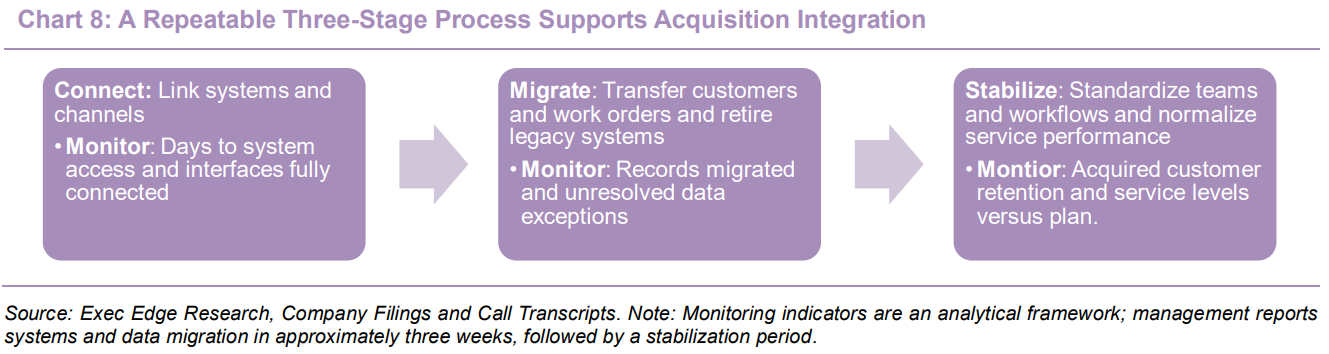
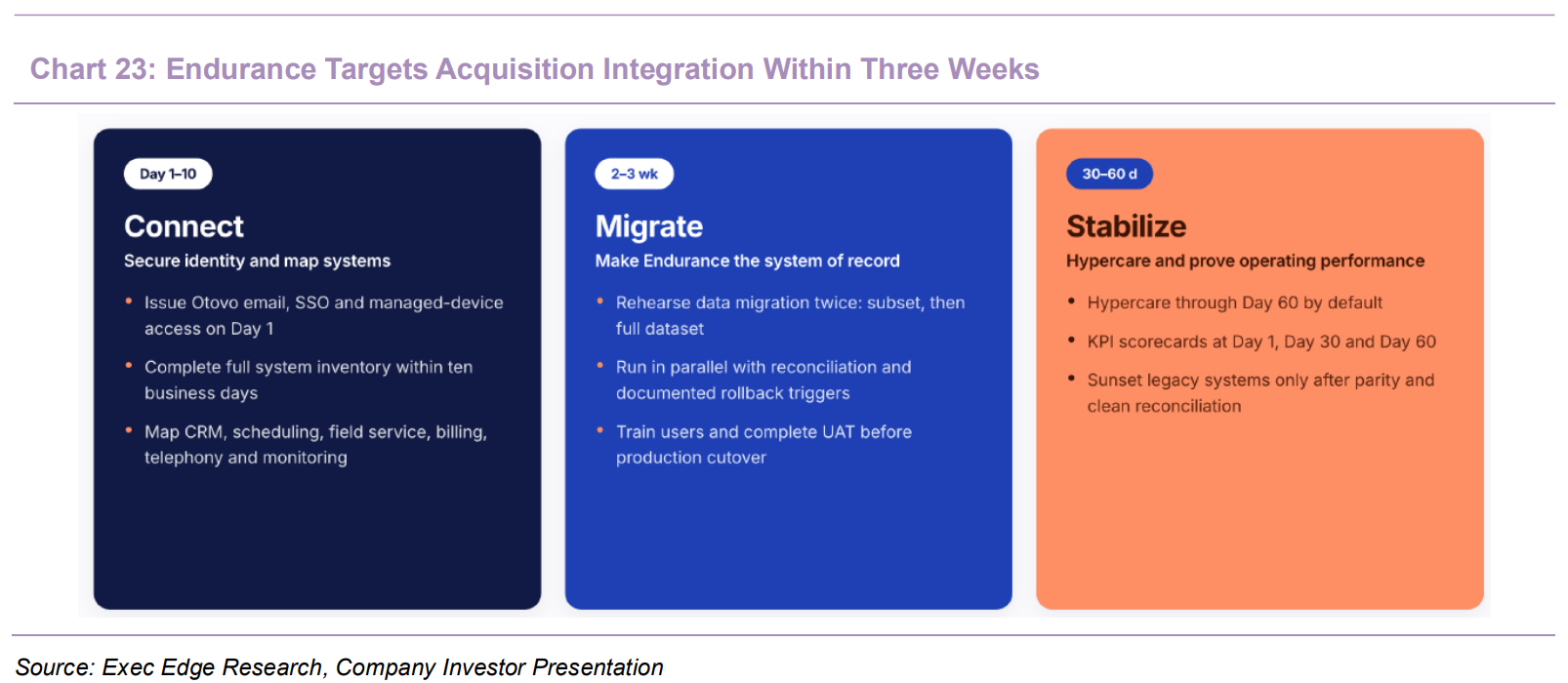
- We believe repeatable integration is another key element of OTOVO’s emerging moat in a fragmented acquisition market. OTOVO describes a three-stage integration process: connect identity, communications and operating systems during the first ten days; migrate customer and operating data so Endurance becomes the system of record within approximately two to three weeks; and stabilize operations over 30-60 days before legacy systems are fully retired. This distinction matters because the three-week figure refers principally to systems and data migration rather than complete operating stabilization. The process could allow OTOVO to add customer books, technicians and local operating capabilities while reusing a common administrative and operating backbone across acquisitions. This remains an emerging rather than established advantage, as most transactions were completed or announced during 2026 and there is still limited evidence of sustained customer retention, realized synergies or normalized post-acquisition profitability. The clearest evidence of repeatability will be integration timing, data exceptions, customer retention, service levels, realized savings and post-acquisition profitability.
- OTOVO’s installed customer relationships create a lower-friction distribution advantage across memberships, repairs and equipment upgrades. As of September 2026, the company reported more than 60,000 customers and 22,000 memberships, alongside 1.9 million legacy customer records accumulated through predecessor brands, monitoring relationships and acquired customer books. The 1.9 million records are not active paying service customers, but they expand the addressable relationship pool from which OTOVO can market services, memberships and upgrades. Access to system history, contact details and installed equipment can reduce dependence on broad paid-media acquisition and make service outreach more relevant than a cold sales approach. Customer-book acquisitions also add records at the same time as local service capacity, allowing OTOVO to offer monitoring, repairs and upgrades after migration to its platform. The value of this customer-access advantage should increase as more records convert into active, retained and economically attractive relationships. Reported customer growth and approximately 22,000 memberships provide initial evidence, while the 90,000 year-end customer figure remains a target. Conversion, membership attachment, churn, repeat service usage and upgrade activity should provide the clearest evidence of how effectively OTOVO is monetizing this installed-base access.
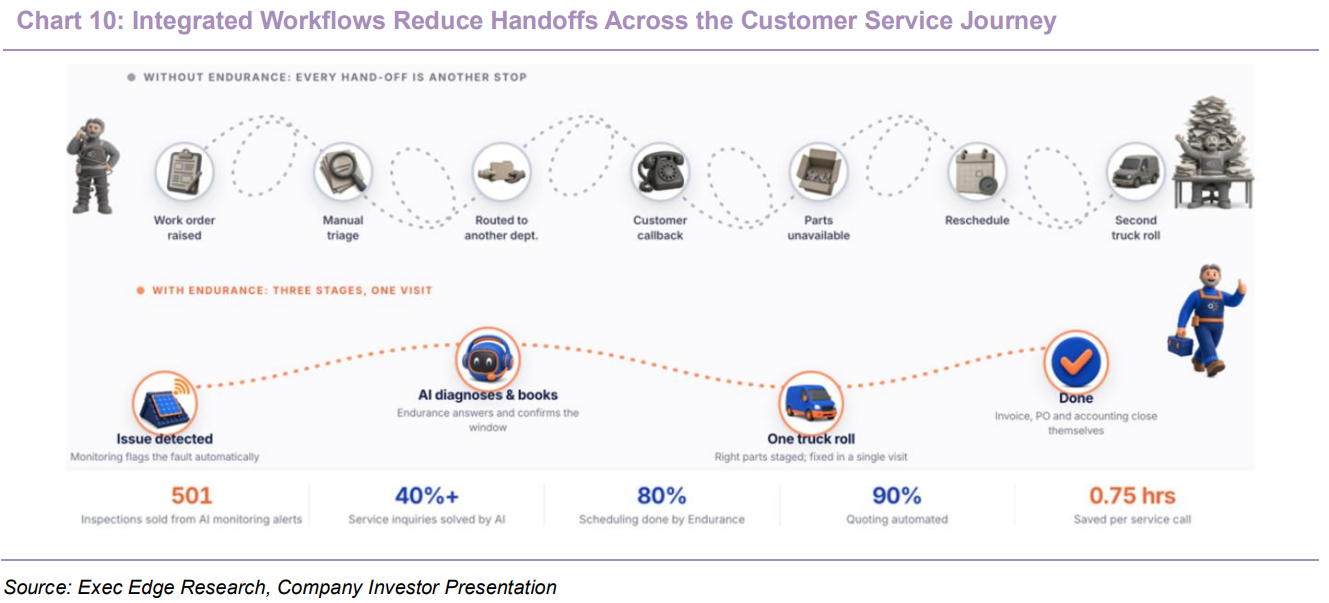
- Integrated AI-driven workflows strengthen OTOVO’s defensibility by improving service speed, consistency and technician productivity without proportionate overhead growth. Endurance connects fault detection, AI-assisted diagnosis and booking, route and parts preparation, field repair, invoicing and purchase orders through one customer record. The company reported 501 inspections sold following AI monitoring alerts, more than 40% of service inquiries resolved by AI, 80% of scheduling completed by Endurance and 90% of quoting automated. These are company-reported operating measures rather than audited KPIs, but they provide early evidence that live workflow deployment is supporting commercial and operating activity. OTOVO’s objective is for the technician to become the only human customer touchpoint, although this has not yet been demonstrated across the broader organization. The clearest evidence of progress will be faster response times, higher first-time-fix rates, more jobs completed per technician, sustained customer satisfaction and service growth without proportionate increases in support headcount.
- The company’s broad service offering and multi-market footprint strengthen its right-to-win by extending the customer relationship across the energy lifecycle. OTOVO combines monitoring and membership access with repairs, equipment upgrades, electricity services and grid participation, allowing the relationship to continue after the initial installation rather than ending with a single transaction. The company has identified five potential residential revenue streams and indicates target annual revenue per customer of approximately $1,400, although this remains a management target rather than a reported portfolio average. The same operating infrastructure can also serve commercial asset owners and equipment manufacturers that require maintenance, replacement, logistics and warranty support across several regions. Freedom Solar provided access to more than 400 commercial systems representing approximately 70 MW, while SST added a 14-state U.S. service footprint. OTOVO’s European presence and installer marketplace extend the potential coverage model beyond wholly owned field teams. In our view, combining a common customer and work-order platform with local execution across equipment brands, geographies and customer types can deepen both customer value and partner relevance. This cross-market proposition remains partly emerging because several OEM and asset-owner opportunities are prospective or conditional. Signed multi-market contracts, renewal rates, service-level performance and revenue generated per customer should provide the clearest evidence that this broader lifecycle model is gaining traction.
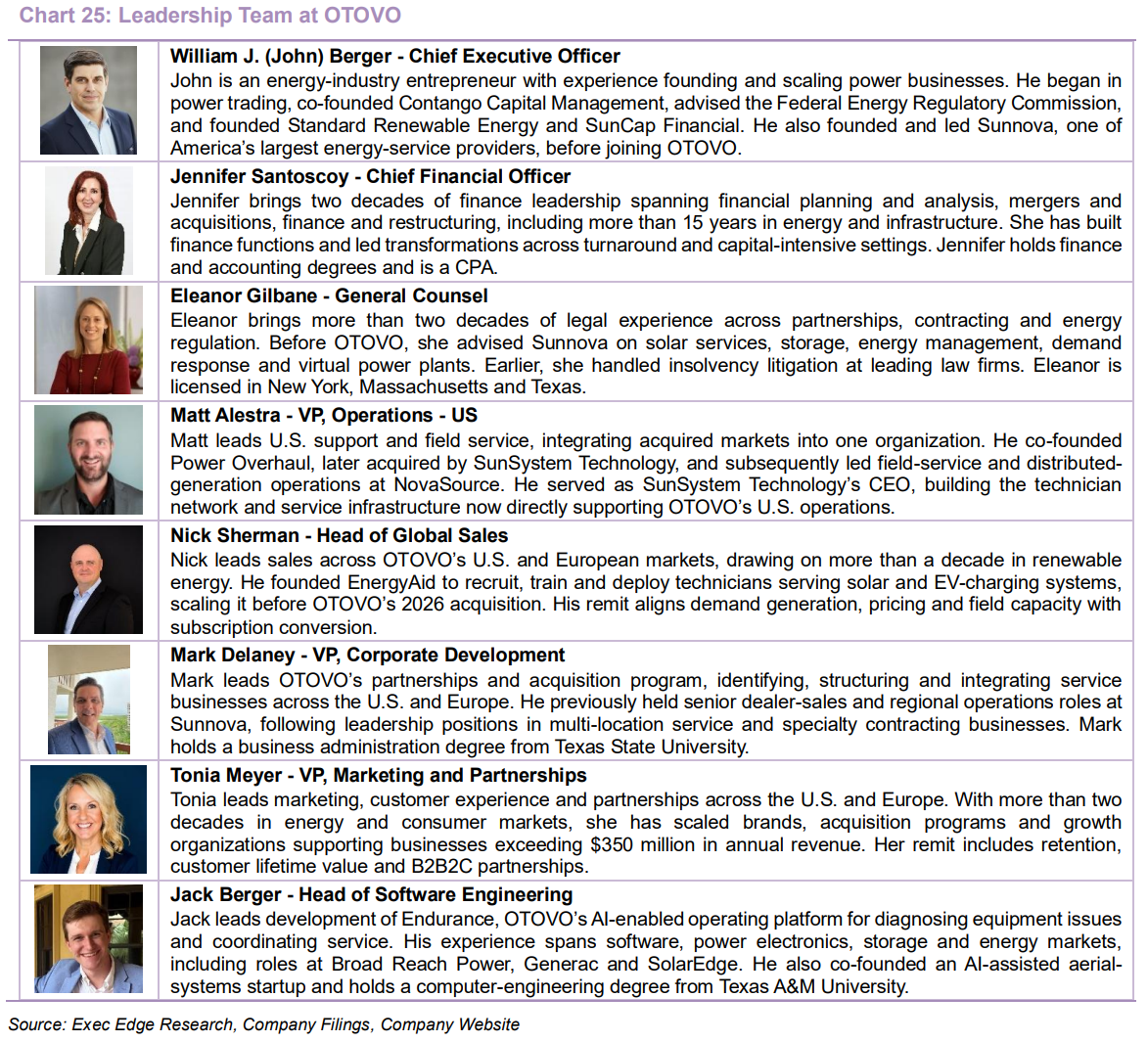
- OTOVO’s leadership team combines energy-services scaling, transaction execution and financial restructuring experience at a pivotal stage. CEO John Berger brings direct experience founding and scaling Sunnova, alongside a background in power trading, investment management and renewable energy. CFO Jennifer Santoscoy contributes more than 15 years in energy and infrastructure finance, spanning FP&A, M&A, commercial finance and restructuring, while General Counsel Eleanor Gilbane adds two decades of partnership, contracting and solar-services legal experience. The broader leadership team adds field-operations, sales, corporate-development, marketing and software expertise relevant to acquisition integration, service execution and technology deployment. The team’s execution will ultimately be measured by its ability to integrate acquisitions, improve operating leverage, maintain cash discipline and move the business toward profitability.
Industry Trends and Company Positioning
The Installed Solar Fleet Creates a Large Lifecycle-Service Opportunity

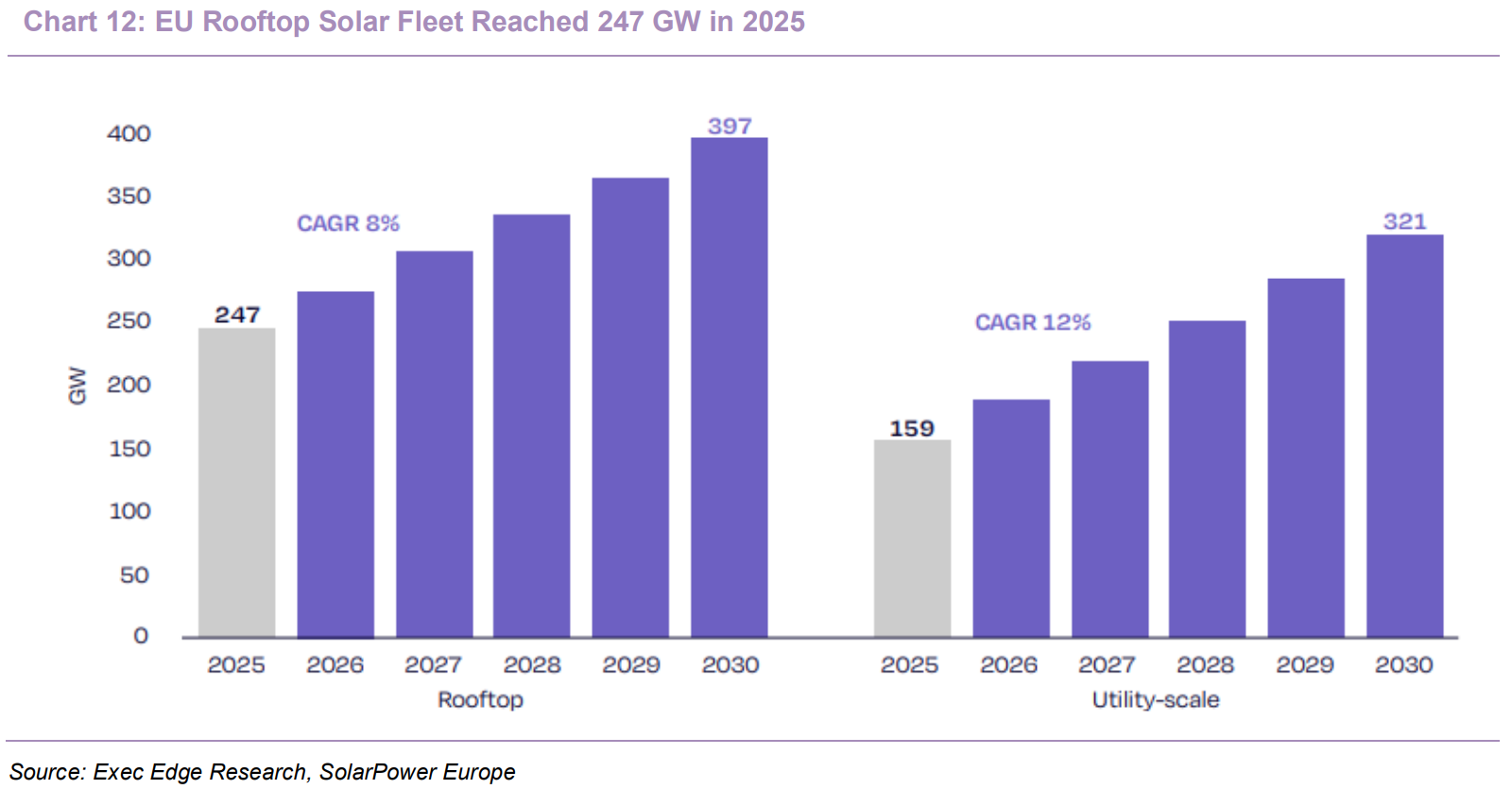
- A rapidly expanding installed solar fleet is creating a durable base of equipment that needs support throughout its operating life. IEA PVPS estimates that global photovoltaic capacity reached 2.96 TW at the end of 2025, while SolarPower Europe places the EU fleet at 406 GW, including 247 GW on residential, commercial and industrial rooftops. In the U.S., SEIA and Wood Mackenzie report more than 6.2 million cumulative solar installations and an installed solar base approaching 290 GW, enough to power more than 50 million American homes. These figures point to a large and geographically dispersed stock of operating equipment that continues to require monitoring, diagnosis, maintenance and component replacement regardless of annual installation trends. Each new system expands that installed base, while existing assets remain in service for years and generate lifecycle needs as they age. The service opportunity therefore scales with the size, age and complexity of the operating fleet rather than with new-system sales alone, although system type, ownership and local service availability will influence how much of that opportunity can be monetized.
- An aging solar fleet is expanding demand for performance management, component replacement and life-extension services. IEA PVPS estimates that more than 300 GW of global photovoltaic capacity was installed over ten years ago and identifies inverter replacement, revamping and performance management as needs becoming more visible in these older cohorts. Aging does not imply broad system failure, but it does increase the need to distinguish normal performance variation from monitoring faults, component degradation and issues requiring physical inspection or replacement. SolarPower Europe’s latest operations and maintenance guidelines address preventive maintenance, data management, electrical safety, testing, inspections, repowering and end-of-life handling. These activities illustrate how lifecycle service broadens as assets age, combining planned maintenance with diagnosis, corrective work and decisions around repair, replacement and continued operation. The industry opportunity therefore expands with the age and complexity of the installed base, although actual service intensity will vary by system condition, component quality and operating environment.
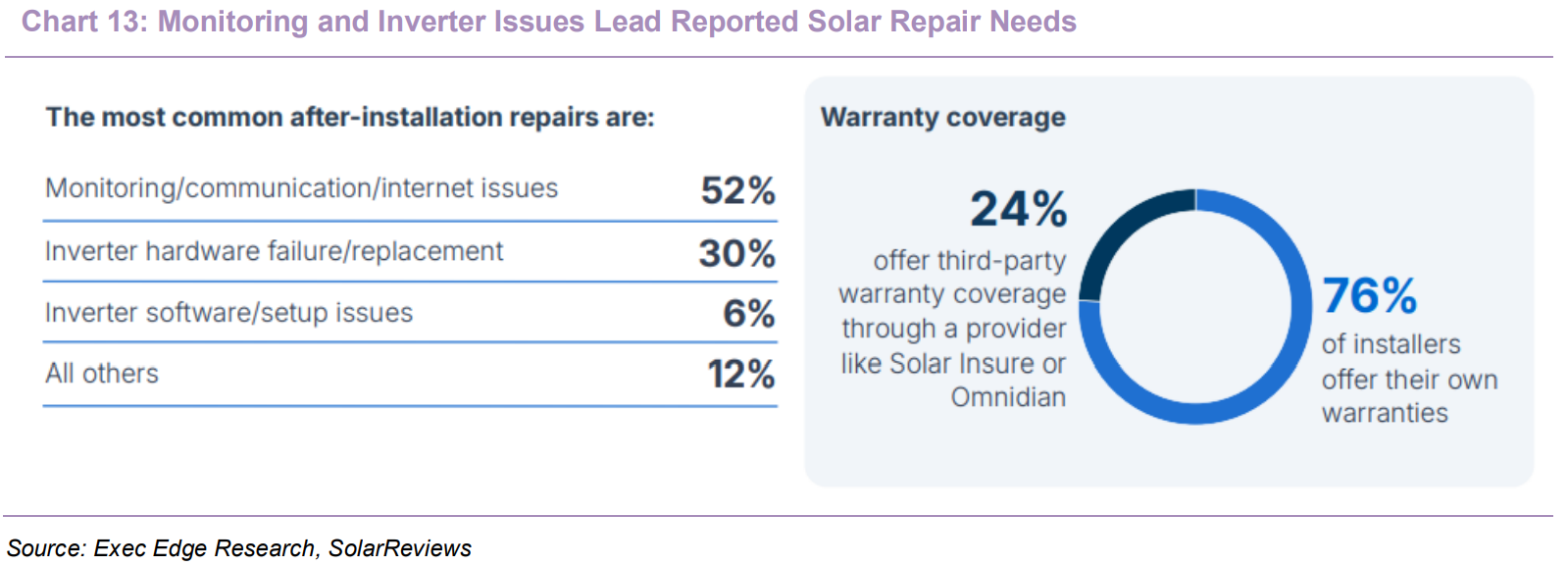
- Monitoring and connectivity issues are making diagnosis an increasingly important part of solar service. In SolarReviews’ 2025 U.S. installer survey, fielded from December 2024 to January 2025, 52% of respondents identified monitoring, communications or internet problems as their most common after-installation repair category; 30% selected inverter hardware and 6% inverter software or setup. While these figures reflect surveyed installers rather than national repair-job shares, they show that restoring system performance often begins with connectivity, data access and technical diagnosis before equipment is replaced. IEA PVPS’s February 2026 study of PV digitalization describes monitoring and reliable asset data as tools for detecting underperformance and guiding maintenance decisions, while its July 2026 assessment of operating solar-plus-battery systems highlights the role of inverter behavior, controls, temperature, firmware and battery-state estimates in observed performance. As connected equipment becomes more common, effective service increasingly depends on distinguishing remote, software or communications issues from faults that require physical inspection or component replacement. This expands the value of continuous monitoring, remote triage and targeted field dispatch across the installed fleet.
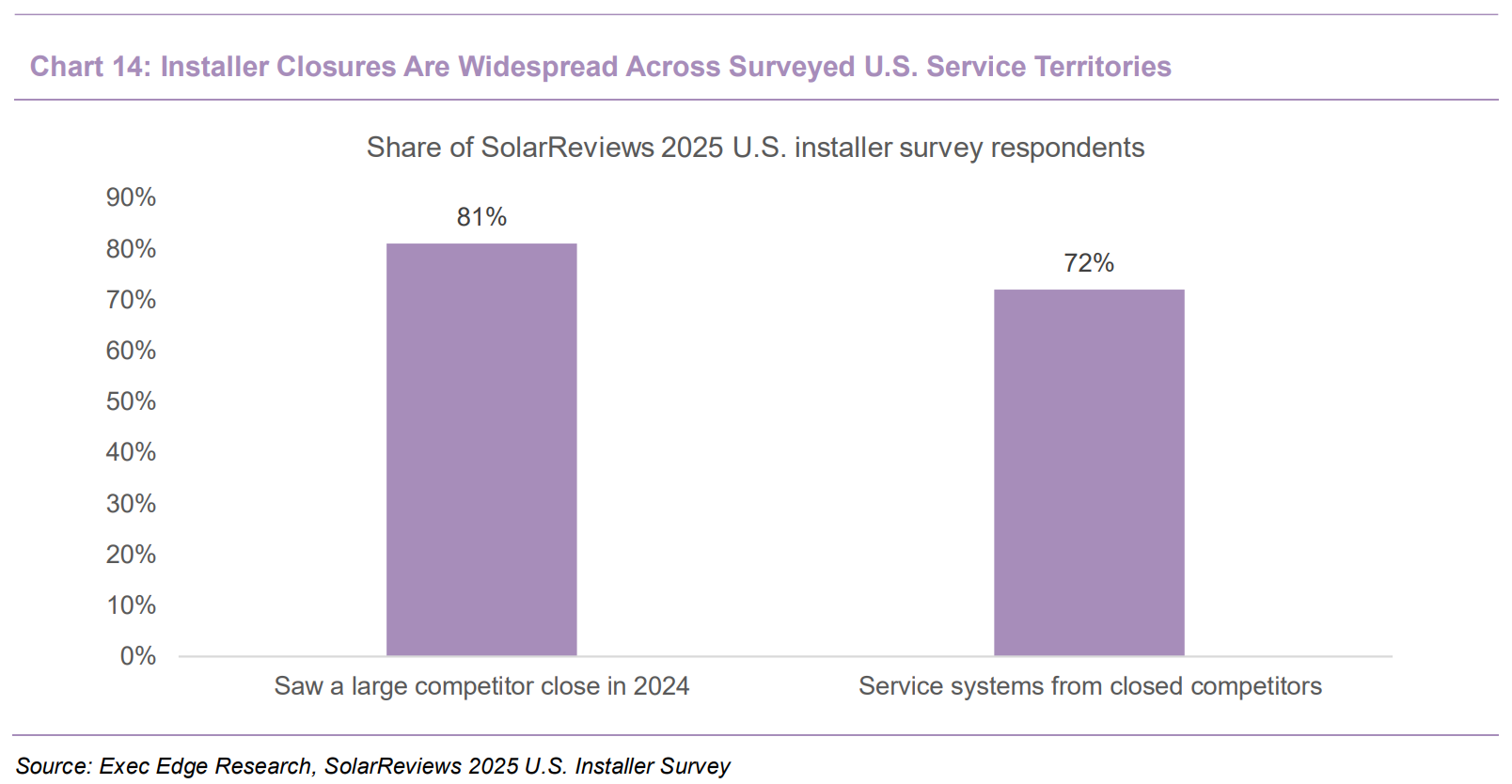
- Installer failures are creating a growing aftermarket for independent diagnosis, repair and warranty coordination as systems become operationally orphaned. Sunnova and Solar Mosaic filed for Chapter 11 bankruptcy in June 2025 following SunPower’s 2024 collapse, underscoring the pressure facing parts of the residential solar ecosystem. SolarReviews’ 2025 U.S. installer survey found that 81% of respondents had seen at least one large competitor close in their service territory during 2024, while 72% serviced installations completed by competitors that had closed. These figures describe participating contractors rather than the proportion of U.S. systems left without support, but they indicate that third-party service is already common among surveyed installers. Solar Power World reported in July 2026 that U.S. contractors were taking on customers whose original installers had exited, with interviewed providers describing phone troubleshooting, site inspections, completion of unfinished commissioning, replacement of faulty components and warranty support. A July 2026 pv magazine article described a comparable support gap emerging among European rooftop customers, although it did not quantify the number of affected systems. Installer closure does not necessarily terminate equipment-manufacturer warranties, while maintenance of leased or PPA systems generally remains the responsibility of the entity that owns the equipment and may transfer to an acquirer. Even where coverage survives, customers can still need a qualified local provider to diagnose faults, determine coverage, perform the work and coordinate claims. Together, these sources point to an established role for independent service providers across orphaned and transferred customer relationships.
- OTOVO’s service business is positioned around the expanding stock of operating energy equipment rather than relying solely on demand for new installations. Acquired service teams and customer relationships extend its local reach, while Endurance is intended to connect monitoring, diagnosis, dispatch and repair across that network. Management reported 91 technician FTEs at July 31, 2026; the August update recorded 2,766 completed service work orders and said intake exceeded completions. This makes technician hiring, retention, utilization and productive field capacity central to service growth. OTOVO’s service activity should become less sensitive to new-installation cycles as it scales, although Newbuild remains a material contributor to group revenue. The evidence to watch is whether added technicians and customer access translate into more completed work, recurring-care conversion and gross profit without sustained growth in backlog or overtime.
Storage and Grid Services Broaden the Distributed Energy Revenue Pool

- Distributed energy is evolving from stand-alone rooftop solar into integrated home and business energy systems that broaden the serviceable asset base. The International Energy Agency’s Electricity 2026 report describes solar PV, batteries, electric vehicles, heat pumps and digitally controlled loads as increasingly interconnected parts of the power system, with flexibility needed to integrate their combined generation and demand securely. This convergence is already visible in purchasing patterns. Wood Mackenzie and the Solar Energy Industries Association report that a record 45% of U.S. residential solar installations included battery storage in 1Q26. Separately, the Clean Investment Monitor, produced by Rhodium Group and MIT CEEPR, reports that U.S. consumer investment in distributed electricity generation and storage reached nearly $12 billion in 2Q26, more than double 1Q26 and the highest quarter on record. Residential battery-storage installations exceeded residential solar installations for a second consecutive quarter, while spending on residential battery storage accounted for 75% of investment in the distributed electricity generation and storage category. The market is therefore shifting from a single generation product toward a broader energy system that can generate, store, control and optimize when electricity is generated, stored and consumed, expanding the potential for recurring monitoring, service and equipment upgrades over the customer lifecycle.
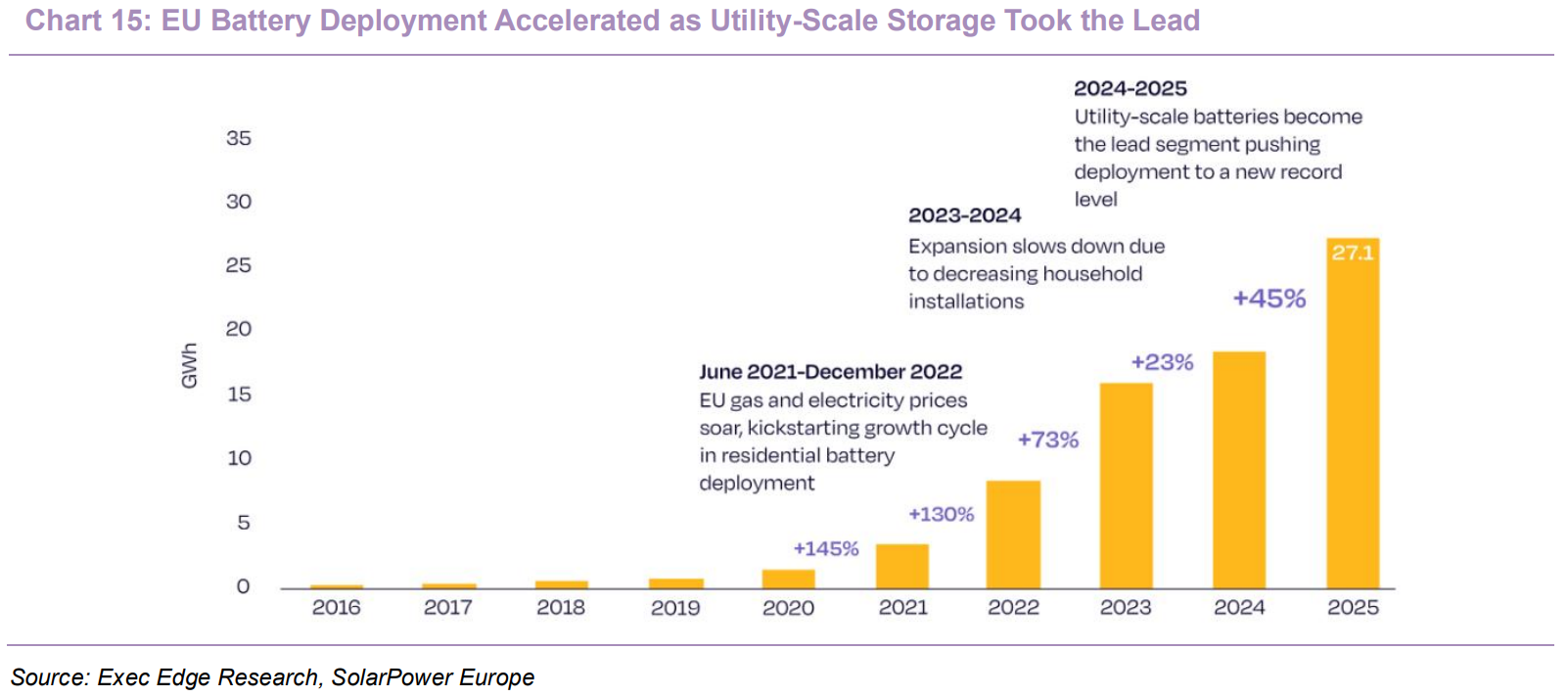
- Battery storage is scaling across residential, commercial and grid applications, expanding distributed energy beyond solar generation alone. SolarPower Europe reports that the EU installed a record 27.1 GWh of battery capacity in 2025, 45% more than in 2024, lifting operating capacity to 77.3 GWh. The market mix also changed: utility-scale systems supplied 55% of annual additions for the first time, while residential installations fell 6% as electricity prices and support schemes became less favorable. The U.S. shows a similarly broad market across customer classes. The American Public Power Association, citing SEIA and Benchmark Mineral Intelligence, reports a record 20.2 GWh of U.S. storage additions in 2Q26, comprising 17.9 GWh of utility-scale, 1.8 GWh of commercial and industrial, and 657 MWh of residential capacity. Storage is therefore becoming infrastructure deployed across multiple customer classes rather than only a residential solar add-on, with applications spanning energy shifting, capacity provision, system balancing, grid support and integration of loads such as EVs and heat pumps.
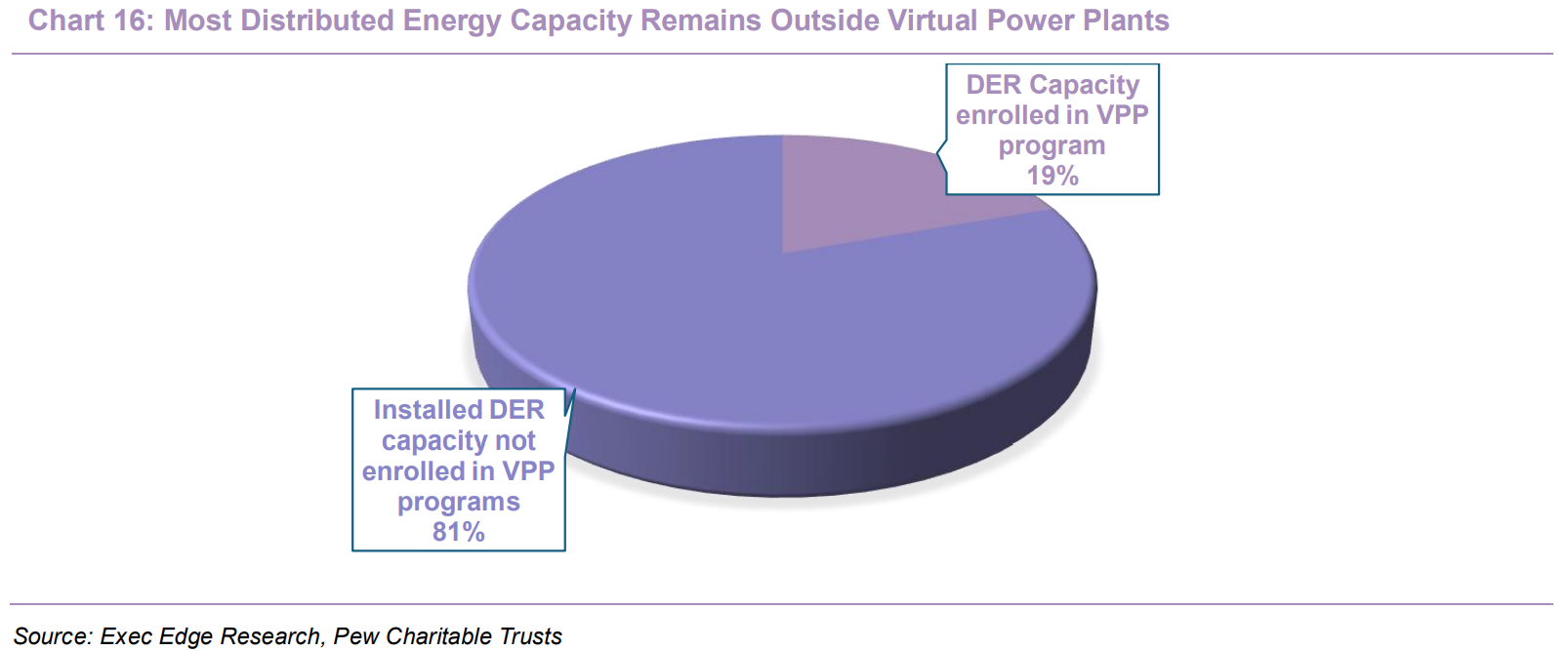
- Digital aggregation is expanding distributed-energy economics by turning customer assets into dispatchable portfolios for grid services. Pew Charitable Trusts defines a virtual power plant as a software-coordinated collection of distributed resources, such as batteries, thermostats and EV chargers that can act as one controllable resource for utilities. Pew estimates that North American VPP capacity reached 37.5 GW in 2025, although less than 20% of distributed-energy capacity was enrolled in 2024, illustrating both commercial progress and substantial unused potential. The IEA explains that flexible loads and batteries can shift or reduce consumption, provide balancing and grid support, contribute capacity during peaks and help defer some network investment. Lawrence Berkeley National Laboratory’s 2025 inventory identified 180 VPP programs and more than 790 demand-response or net-metered solar-plus-storage programs, confirming that aggregation is moving beyond isolated pilots. However, Pew and the IEA identify regulatory market access, compensation, interoperability, smart-meter and control penetration, customer enrollment and acceptance of automated control as continuing constraints. Grid services are therefore broadening the revenue potential of distributed assets, but commercialization remains market-specific and dependent on regulation, customer participation and interoperable technology.
- Distributed-energy expansion broadens the equipment OTOVO can service and upgrade, while grid participation adds longer-term revenue optionality. OTOVO is already expanding batteries and other upgrades across its existing customer base, while its broader service offering includes EV chargers, load-management devices and monitoring. Retail power and VPP/grid rewards remain prospective rather than material reported revenue. The nearer-term opportunity is therefore to deepen revenue per existing customer through equipment upgrades and connected services, with grid participation representing a later-stage adjacency as portfolio scale and market access develop. Commercialization will depend on compatible devices, customer enrollment, market access and sufficient portfolio scale. The clearest evidence of progress will be growth in upgrade revenue, battery attachment and connected assets, followed over time by VPP enrollment and separately reported grid-services revenue.
Technician Scarcity Strengthens the Case for Endurance-Enabled Field Service

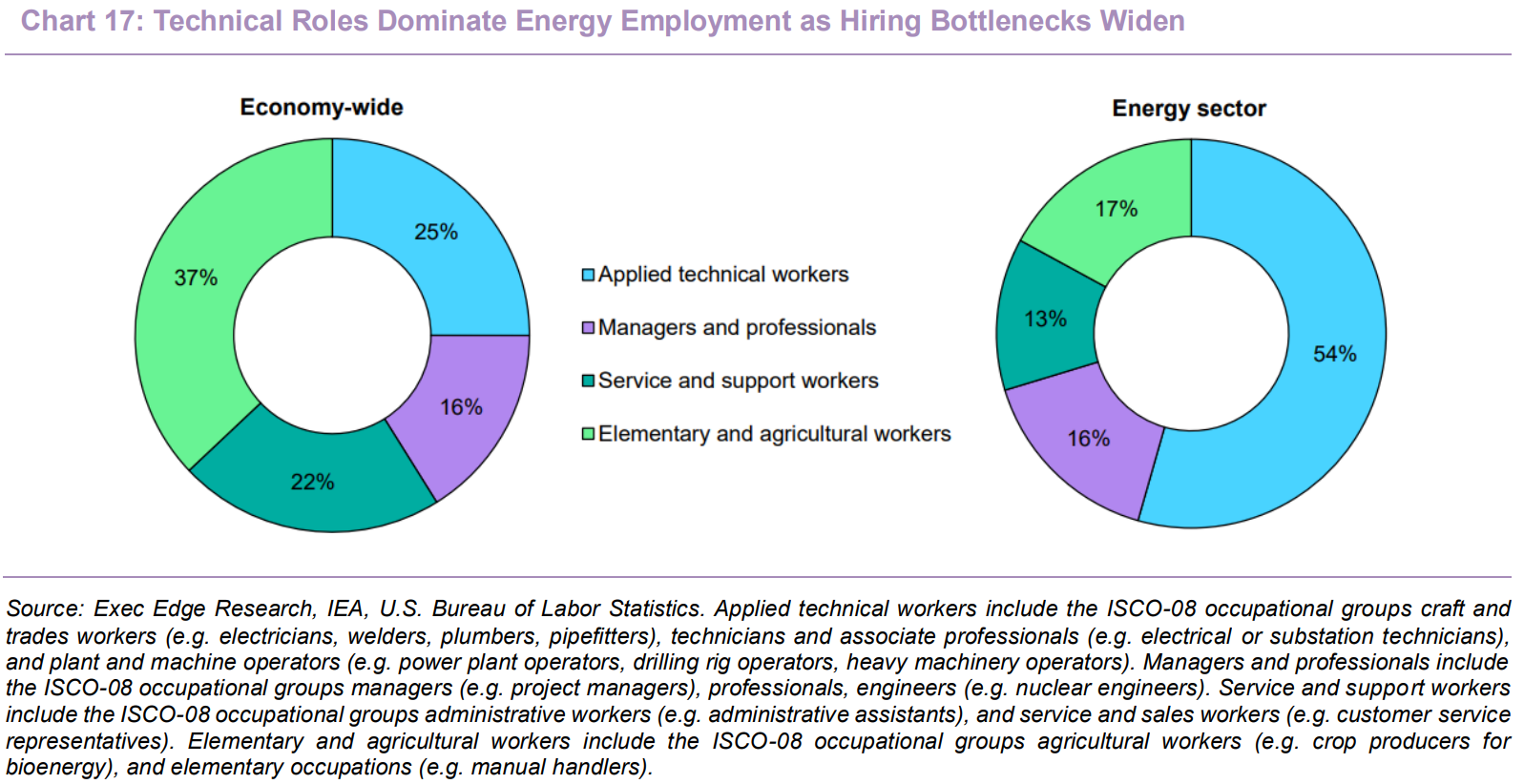
- Technician scarcity is making field-service productivity increasingly important as energy-service demand outpaces skilled-labor supply. The International Energy Agency’s World Energy Employment 2025 survey, covering more than 700 companies, trade unions and educators, found that more than half faced critical hiring bottlenecks and approximately 60% reported labor shortages affecting project timelines, system reliability or cost control. Applied technical occupations, including technicians, electricians, line workers and skilled trades, represent more than half of energy employment. Across mining, manufacturing, utilities and construction, the IEA estimates that annual demand for new applied technical workers increased 16% between 2015 and 2022, compared with a 9% increase in graduations from relevant vocational programs. The U.S. Bureau of Labor Statistics projects 37% employment growth for solar photovoltaic installers between 2025 and 2035, with approximately 4,200 openings annually; this occupation includes both installation and maintenance work. Expanding the workforce remains difficult because technical field roles require certification, equipment familiarity and on-site execution that cannot be fully automated. Technician scarcity can therefore constrain response times and completed work orders even when demand is available, increasing the value of tools that preserve technical knowledge, reduce nonproductive work and raise output from each available technician.
- AI is emerging as a way to expand technician capacity and field-service productivity rather than replace physical labor. The IEA concludes that current AI applications do not materially reduce demand for construction, operations and maintenance workers because their core activities remain manual and site-specific. Instead, AI can remove nonproductive work surrounding the technician by improving remote diagnosis, job preparation, scheduling, routing, knowledge retrieval, parts selection and service documentation. McKinsey’s March 2025 article describes a water-treatment company that increased technician capacity by 40% and cut overtime by 6% after adopting digital scheduling. Its May 2026 assessment cites a separate engine-OEM case in which AI-supported diagnosis and parts prediction reduced labor hours per job by 15% and parts used per job by 18%. BCG reports that a transport-maintenance operator using guided workflows and extended-reality devices reduced rework by 40% and completed maintenance 25% faster. These are results from individual implementations in adjacent service industries; they illustrate potential productivity mechanisms rather than expected outcomes for solar service providers. AI can therefore increase jobs completed per technician and improve service economics, while recruitment, training and retention remain necessary to expand physical field capacity.
- As AI use cases connect, the competitive value is shifting from individual tools toward an integrated field-service operating layer. McKinsey’s May 2026 assessment describes artificial intelligence moving beyond technician support into demand forecasting, pricing, customer intake, diagnosis, dispatch, parts planning, billing and retention. Generative AI can organize manuals, asset histories and service records, while agentic systems can coordinate decisions across customer databases, work orders, technician availability, inventory and finance systems. Boston Consulting Group identifies three developments enabling this shift: more capable AI agents, growing data from connected equipment and improved technician hardware such as augmented-reality devices. Together, these capabilities can create a reinforcing workflow in which diagnosis informs parts planning, dispatch matches skills and availability, and completed jobs feed new operating data back into the system. This integrated model can support more consistent service across locations and acquired operations than separate point solutions and manually maintained records. However, McKinsey’s May 2026 assessment identifies weak data management, unclear ownership of outcomes, poor integration with core workflows and limited frontline adoption as barriers to sustained value. Its March 2025 field-service article separately highlights legacy-system integration and cybersecurity as requirements for the underlying data platform. BCG similarly emphasizes workflow redesign, technician participation, training and change management. The industry shift is therefore not simply toward greater AI adoption, but toward common operating systems that connect assets, customers, technicians, inventory and back-office processes, with value ultimately demonstrated through service outcomes and operating efficiency rather than software deployment alone.
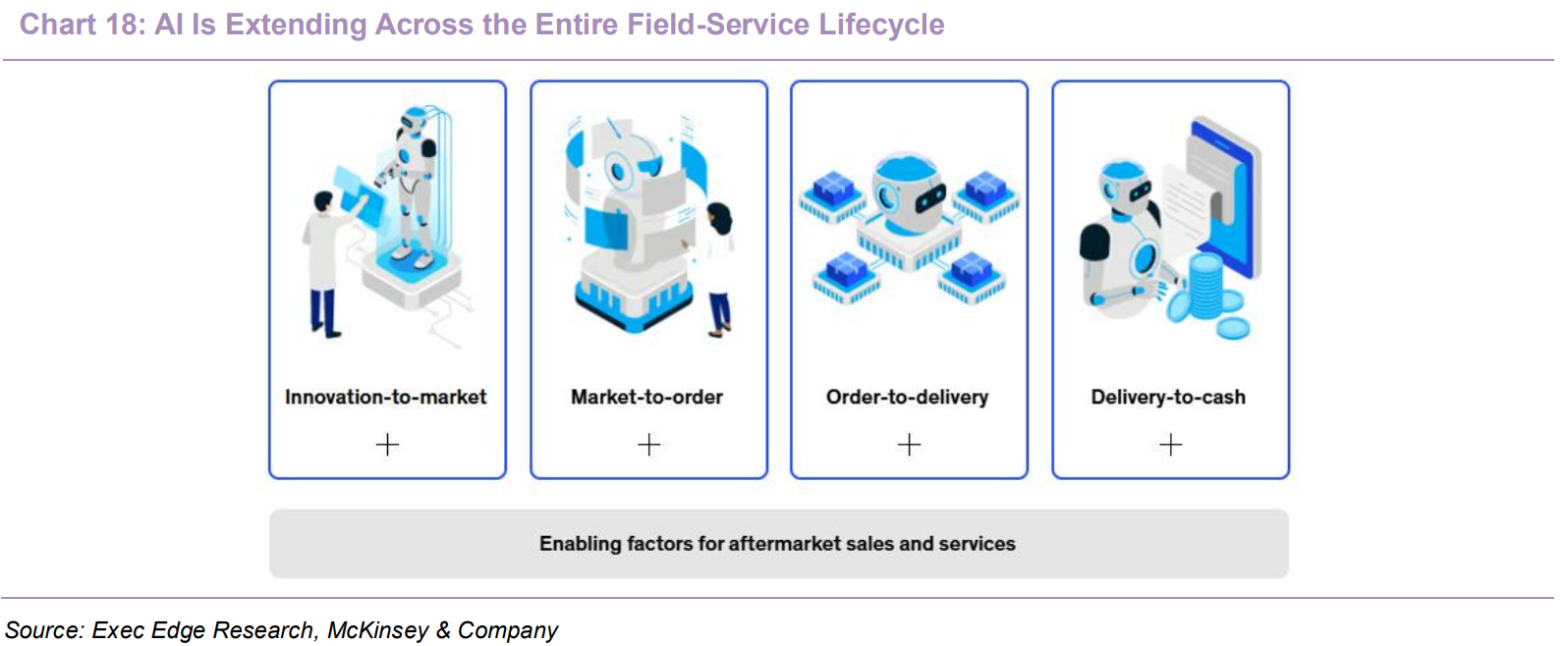
- OTOVO’s recent operating update shows why Endurance and technician capacity must scale together to support Field Services growth. The August 2026 update reported 2,766 completed service work orders, but intake exceeded completions, increasing backlog and technician overtime. OTOVO expected additional hiring to raise throughput, while Endurance was intended to improve dispatch, information flow and job preparation around each technician. The combination supports a complementary model in which added field capacity expands physical service capability while Endurance is intended to increase output from each technician. The clearest evidence of improving technician leverage will be higher work orders per technician, lower overtime and repeat visits, faster response times, reduced backlog and stronger Field Services margins.
Fragmented Service Markets Favor Scaled Platforms as Consolidation Accelerates
- Fragmented distributed-energy and home-service markets create an opening for scaled platforms that combine local execution with centralized infrastructure. McKinsey’s February 2026 assessment of U.S. home services describes numerous subsectors as comprising many small and local providers, with independents and local operators exceeding 80% share in some service categories. Kroll’s November 2025 review of residential HVAC services similarly describes an essential, recurring and locally fragmented market populated by many founder- or family-owned businesses. These operators can build strong customer relationships and route density, but they often lack the capital and administrative scale to spread technology, procurement and centralized services across a broader network. Fragmentation therefore reflects the local nature of execution: customers require nearby technicians familiar with regional codes and equipment, while larger platforms can centralize supporting functions across multiple branches. This structure favors platforms that preserve local customer relationships and field execution while centralizing technology, procurement and commercial infrastructure across a broader network.
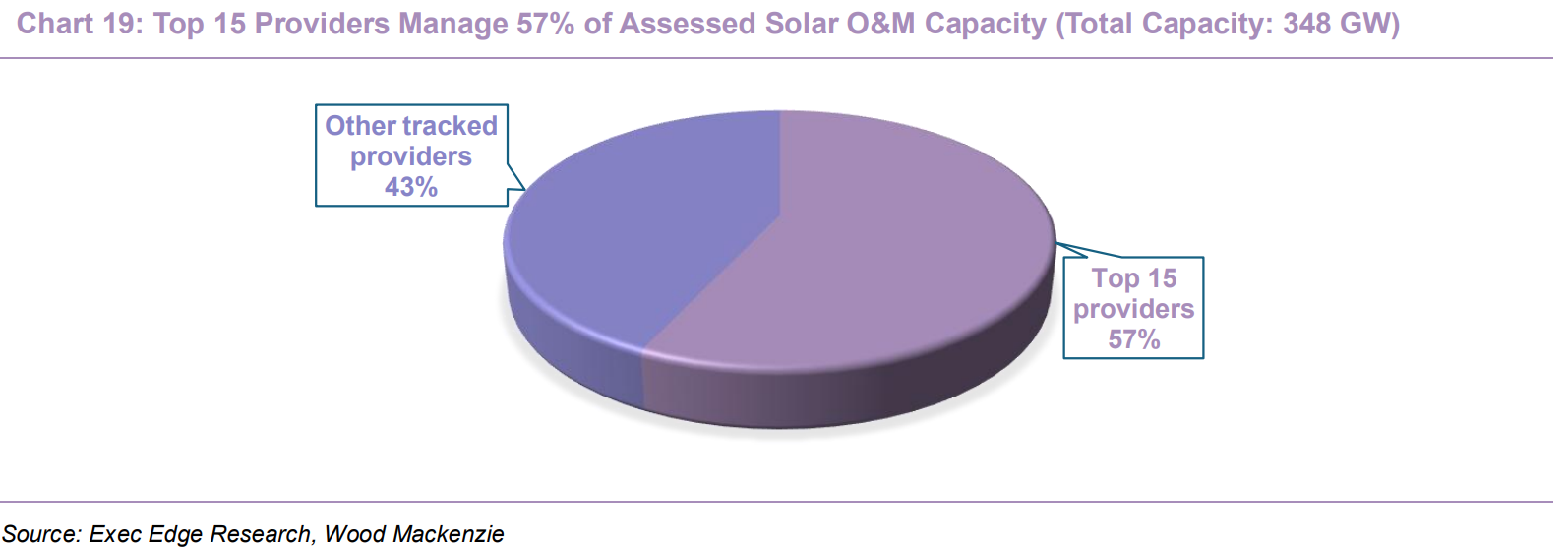
- Consolidation is advancing as larger service platforms use geographic density and shared infrastructure to improve scale economics. Wood Mackenzie’s assessed global solar PV O&M market reached 348 GW at year-end 2025, with the 15 largest providers managing 200 GW, or 57% of assessed capacity. Those providers added 41 GW during the year, demonstrating that scale is increasing within the tracked global O&M provider market. While this dataset does not directly measure residential service concentration, adjacent home-service markets show a comparable direction. Kroll reports that private-equity and strategic buyers are using regional platforms and add-on acquisitions to build density, combine trades and expand maintenance-plan revenue. Buyers are also prioritizing modern dispatch, mobile invoicing and diagnostic systems that can spread technology and administrative costs across larger technician networks. McKinsey identifies consolidation, digitalization and multibrand platforms as important sources of economies of scale in the wider home-services market. Scale alone does not assure value creation, however, with technician retention, customer engagement and operating-system integration remaining important execution risks. Successful consolidators therefore need to combine local service density with centralized technology, procurement, commercial relationships and operating controls.
- OTOVO’s acquisition-led model is designed to capture consolidation benefits by combining local service density with Endurance-enabled operating infrastructure. M&A is the company’s primary growth channel, using transactions to add technicians, vehicles, customer contracts and local market access before migrating operations onto Endurance. The fragmented target base can accelerate geographic coverage and service capacity, while the common operating platform is intended to standardize workflows and spread technology and administrative infrastructure across acquired businesses. Transaction volume alone, however, does not establish value creation. The key test is whether OTOVO can repeatedly retain customers and technicians, integrate acquired operations without service disruption and convert added revenue and density into sustainable gross profit and cash flow. Evidence of successful consolidation should emerge through faster integration, rising work-order density, realized cost savings, acquired-business profitability and improving cash contribution.
Growth Strategy
Scaling Energy Services Through Acquisitions, Automation and Installed-Base Monetization
- OTOVO’s growth strategy is designed to scale its AI-native energy-services model through acquisitions, installed-base monetization and automation. Growth is expected to come principally from acquiring service businesses and customer books, monetizing the installed base through field services, memberships and upgrades, and expanding contracted OEM and asset-owner relationships. Endurance provides the common operating layer for integrating acquisitions, automating workflows and supporting service delivery across a larger geographic footprint. Together, these initiatives are intended to increase customer density, broaden revenue sources and build operating leverage across Europe and the U.S. We discuss key tenets of the company’s growth strategy below.
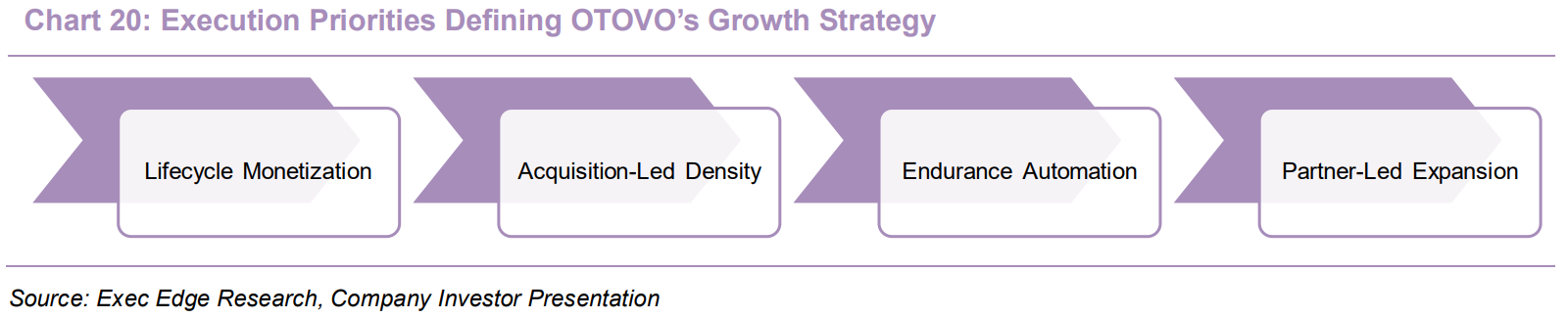
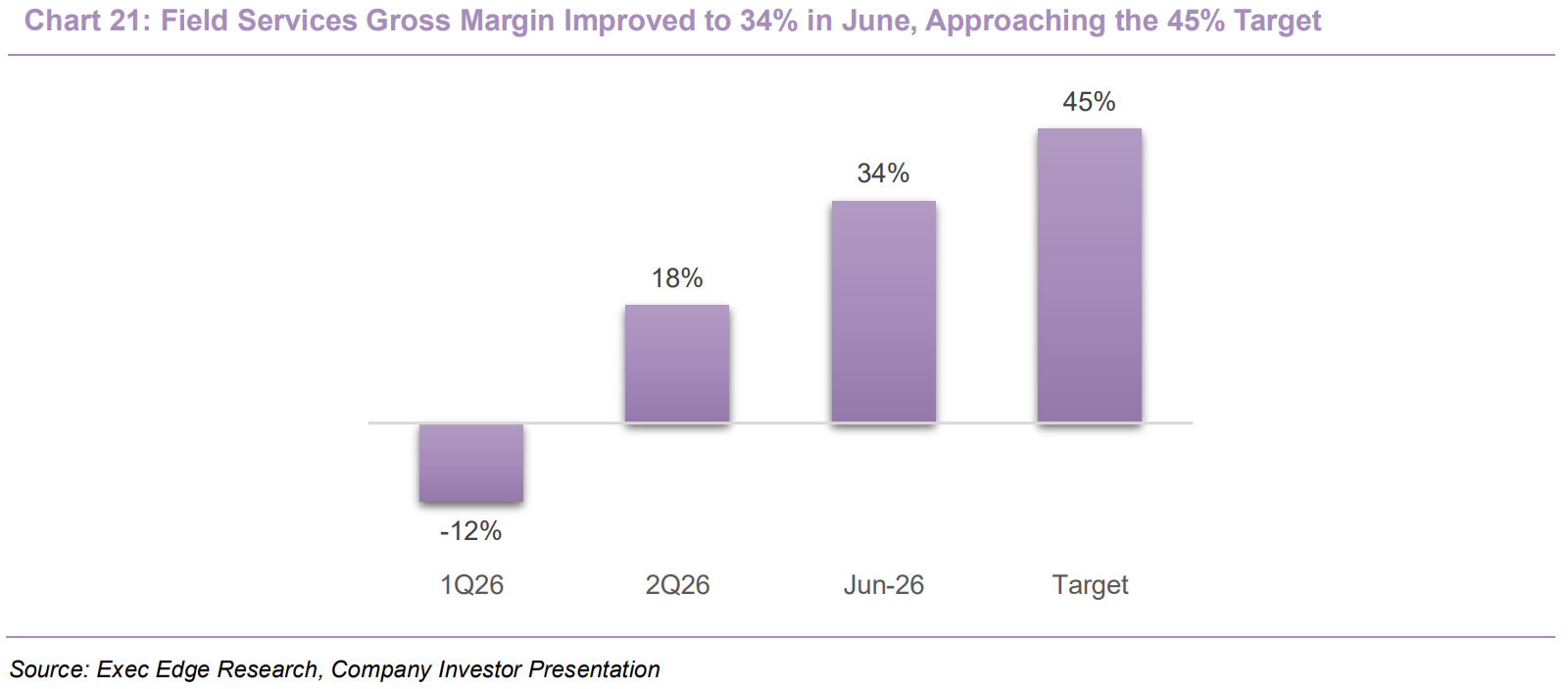
- Lifecycle monetization is designed to shift OTOVO from one-time Newbuild revenue toward a broader mix of recurring services, repairs and equipment upgrades. The established capability is OTOVO’s digital marketplace and installation base; the newer initiative is a services-led model organized around Field Services, Recurring Services and upgrade-oriented Newbuild. Recent actions include scaling OTOVO Care memberships, directing resources toward repairs and operations and maintenance, reducing marketing for new installations, and offering batteries, EV chargers, generators, load-management equipment, retail power and grid services. These products reach homeowners and commercial customers through direct digital channels, service visits and existing customer relationships. In 2Q26, Field Services generated NOK 31.1 million of revenue and Recurring Services NOK 5.6 million, compared with NOK 57.7 million from Newbuild. The August update reported an estimated 2,766 completed service work orders, average service revenue of approximately $656 per completed work order and gross margin of approximately 46% per completed work order. The targets include a 45% Field Services gross margin and greater revenue per customer across five streams. Further progress will depend on scaling technician capacity while improving membership conversion, repeat service activity and upgrade attachment across the installed base.
- OTOVO’s energy-services roll-up is intended to add technicians, customer relationships and local operating capacity faster than organic expansion alone. M&A is designated as OTOVO’s primary growth channel, building on the established customer-book transactions involving Zolar, Soly and Solcellespesialisten and completed transactions involving Onvis, Solar Service Professionals, EnergyAid and SunSystem Technology. The newer pipeline comprises the signed but unclosed Green Panel acquisition and non-binding letters of intent for PV Hawaii and Mr. Elektro. Beyond adding revenue, these transactions expand local technician density, service rights, licenses, customer records and geographic coverage, while acquired customer books create additional opportunities for OTOVO Care, repairs and upgrades. Reported progress includes more than 60,000 customers as of September 2026, compared with 18,000 at year-end 2025, and SST’s completed addition of a 14-state U.S. footprint. The year-end objective of approximately 90,000 customers remains a target, while Green Panel is included in 4Q26 annualized run-rate guidance despite remaining subject to closing. The model becomes more compelling if acquired density translates into faster service, higher technician utilization, customer-book conversion and incremental cash contribution after integration.
- Endurance automation is intended to convert acquisition-led scale into operating leverage by standardizing workflows and reducing software and support costs. OTOVO Cloud supports the legacy marketplace, while Endurance is the newer AI-enabled platform being deployed across marketing, sales, customer service, scheduling, dispatch, procurement, inventory and billing. Recent work has migrated acquired operations, built AI agents for customer and operational tasks, consolidated customer records and begun terminating third-party software. The 2Q26 materials identified more than $5 million of annualized cost impact, including over $1 million added during the quarter; these amounts are management estimates rather than reported savings in the income statement. Management had targeted company-wide rollout and legacy SaaS retirement during 3Q26, with P&L effects from SaaS terminations expected in 4Q26, while the August update identified further Endurance-enabled measures planned for September and October. Successful deployment should allow OTOVO to absorb additional customers and acquisitions with less incremental support infrastructure, making realized cost savings and technician productivity the key evidence of operating leverage.
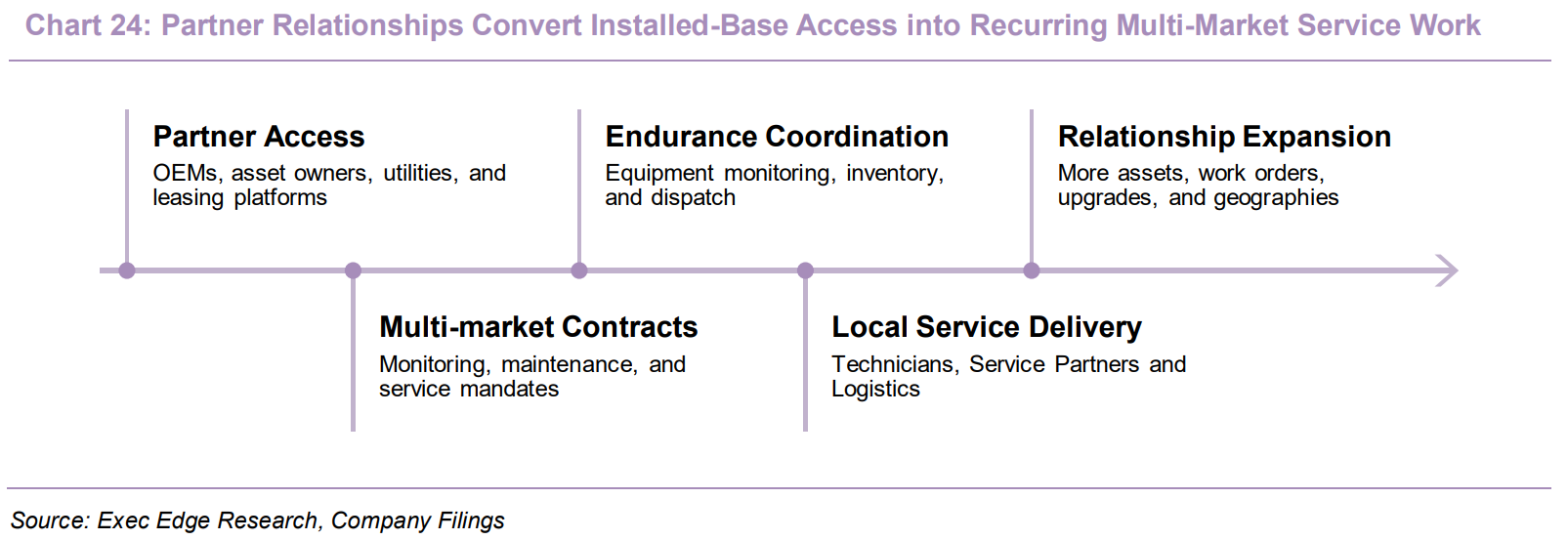
- Partner-led expansion is intended to extend OTOVO’s service platform into larger OEM, asset-owner, utility and commercial relationships. Established activity includes service and platform arrangements with the EDEA portfolio and the Freedom Solar transaction, which transferred responsibility for warranties on 417 commercial systems representing approximately 70 MW and provided exclusive access to market membership to Freedom’s commercial and residential customers. The September 2026 partnership with InCharge Energy extends this model into commercial solar, battery-storage and EV-charging service across the U.S. The companies’ combined offerings cover more than 100,000 energy assets, with an initial launch across California, Arizona, Texas and Florida and additional states planned by year-end. Each company will offer the other’s preventive-maintenance plans while retaining its own technicians and customer relationships, with Endurance supporting intake, scheduling and dispatch for OTOVO-originated work. InCharge contributes more than 40,000 EV-charging assets and a field-service network of more than 100 staff, broadening OTOVO’s ability to support multi-asset commercial sites without building all service capacity organically.
- The broader objective is to scale these multi-market relationships across monitoring, maintenance, repairs, replacements, logistics and equipment upgrades. The signed but unclosed Green Panel transaction is intended to support an OEM relationship covering more than 250,000 installations across several European markets, although both the transaction closing and resulting commercial contribution remain conditional. The revised 4Q26 annualized run-rate guidance of $105-115 million of revenue and $15-20 million of adjusted EBITDA, up from $80-90 million and $2.5-7.5 million previously, partly reflects greater B2B business potential alongside acquisitions and additional Endurance savings. Successful execution could broaden OTOVO’s customer mix and improve utilization of the same field-service infrastructure across larger contracted portfolios.
Management Team
Leadership Depth Supports Acquisition-Led and AI-Native Services Expansion
- OTOVO’s leadership combines energy-market entrepreneurship, financial discipline and operational execution suited to the company’s transition into an AI-native services platform. CEO John Berger brings a founder-operator profile, having built multiple power-sector businesses and founded and led Sunnova through its expansion as a U.S. residential energy-services provider. CFO Jennifer Santoscoy adds more than 15 years of energy and infrastructure finance experience, spanning planning, transactions, restructuring and liquidity management. The wider team contributes legal, field-service, sales, corporate-development, marketing and software capabilities. The board and its committees complement management through capital-allocation discipline, acquisition oversight and governance as OTOVO scales its service platform across markets.
Fundamentals & Valuation
Services Transition Reshapes Margins, Earnings and Cash Economics
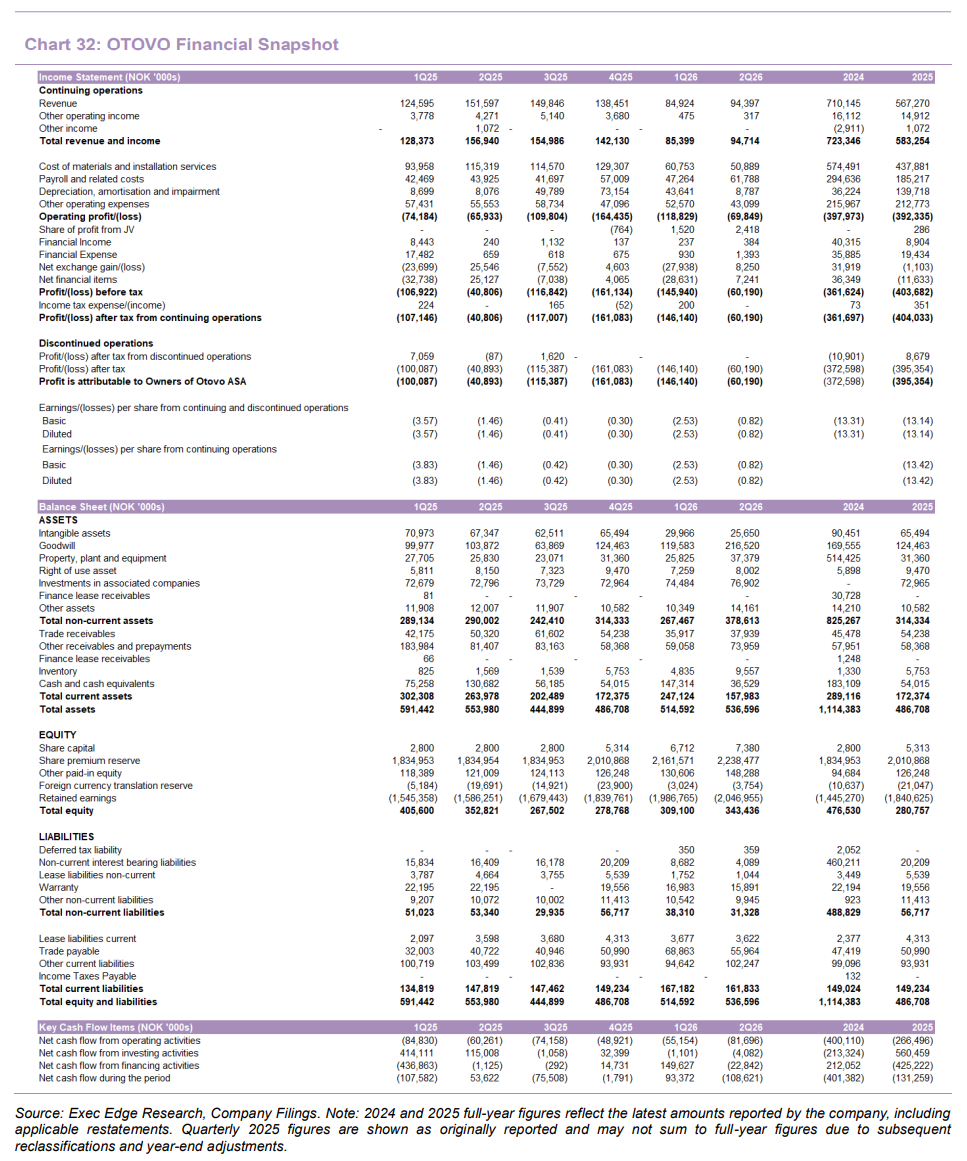
- OTOVO’s financial profile is increasingly being shaped by the scale-up of higher-value services, acquired field capacity and recurring income. Field Services, Recurring Services and equipment upgrades are becoming more important to the revenue mix as OTOVO adds technicians, customer relationships and local operating capacity through acquisitions and deploys Endurance across a common operating platform. A large pool of aging and orphaned systems also acts as a growth driver, as OTOVO can generate service revenue from equipment it did not originally install. The historical decline in group revenue partly reflects the deliberate reduction of lower-margin Newbuild activity following the 2021-22 European solar boom, when higher interest rates, lower electricity prices and weaker residential demand reduced installation volumes and left OTOVO with a cost base built for a larger installation business. Revenue declined 20.1% to NOK567.3 million in 2025 and a further 35.1% to NOK179.3 million in 1H26. Restructuring, lower customer-acquisition spending and the growing services mix are reducing hardware intensity and supporting potentially stronger margins and operating leverage. The next stage of the financial transition depends less on a recovery in new-installation demand and more on scaling productive technician capacity, integrating acquired businesses and converting the expanding customer base into service revenue and cash generation.
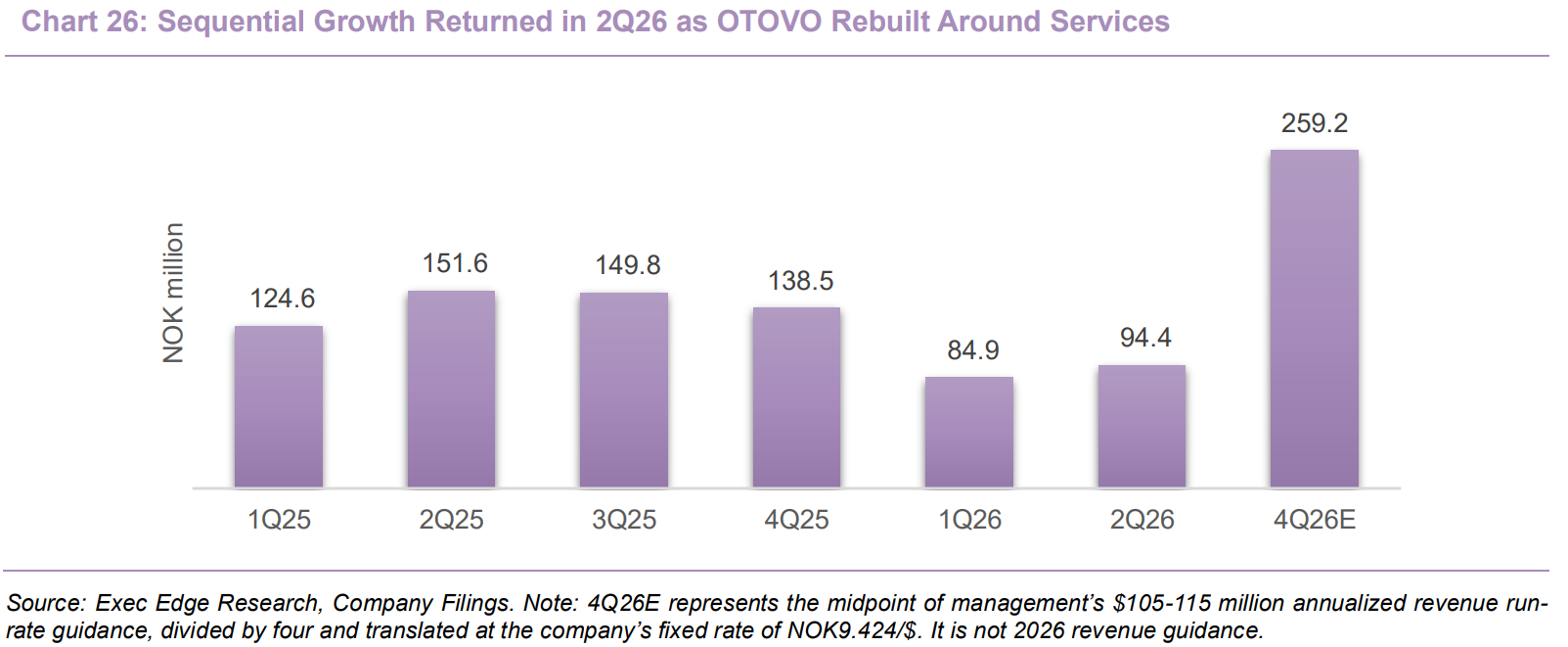
- Sequential growth in 2Q26 marks early progress, while year-end run-rate guidance implies a materially larger revenue and earnings base. Quarterly revenue increased 11.2% from NOK 84.9 million in 1Q26 to NOK 94.4 million in 2Q26, although the latest quarter remained 37.7% below 2Q25. Management’s 4Q26 annualized run-rate guidance calls for revenue of $105-115 million and adjusted EBITDA of $15-20 million. This equates to quarterly revenue of $26.25-28.75 million, or approximately NOK247-271 million using the company’s fixed NOK9.424/$ conversion rate. The accompanying year-end target of approximately 90,000 customers implies growth of nearly 50% from the 60,000+ reported as of September 2026. Delivery therefore depends on successful integration of acquired businesses, continued service-volume growth and conversion of the expanding customer base into revenue.
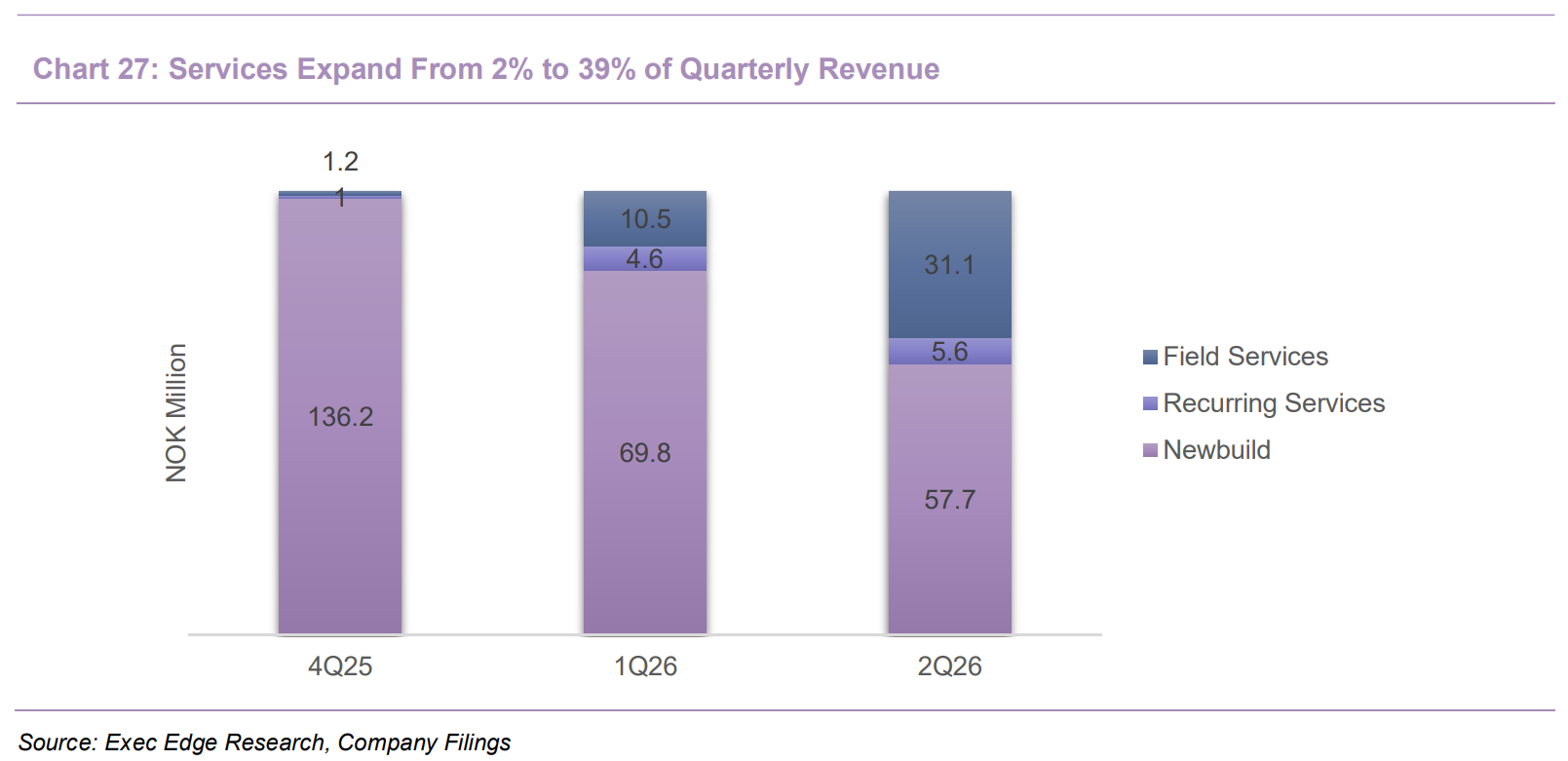
- Services are becoming a meaningful part of the revenue mix, reaching nearly 40% of group revenue in 2Q26. Field Services revenue increased from NOK 1.2 million in 4Q25 to NOK 10.5 million in 1Q26 and NOK 31.1 million in 2Q26, reflecting the consolidation of Onvis, SSP and EnergyAid. Recurring Services revenue rose from NOK 1.0 million to NOK 4.6 million and NOK 5.6 million over the same periods. Together, these segments increased from 1.6% of group revenue in 4Q25 to 17.8% in 1Q26 and 38.8% in 2Q26. Newbuild revenue moved in the opposite direction, falling from NOK 136.2 million to NOK 69.8 million and NOK 57.7 million as OTOVO reduced marketing-led installations. The service ramp is therefore beginning to rebuild the revenue base, with further growth dependent on technician capacity, acquired operations and customer conversion rather than a recovery in Newbuild volumes.
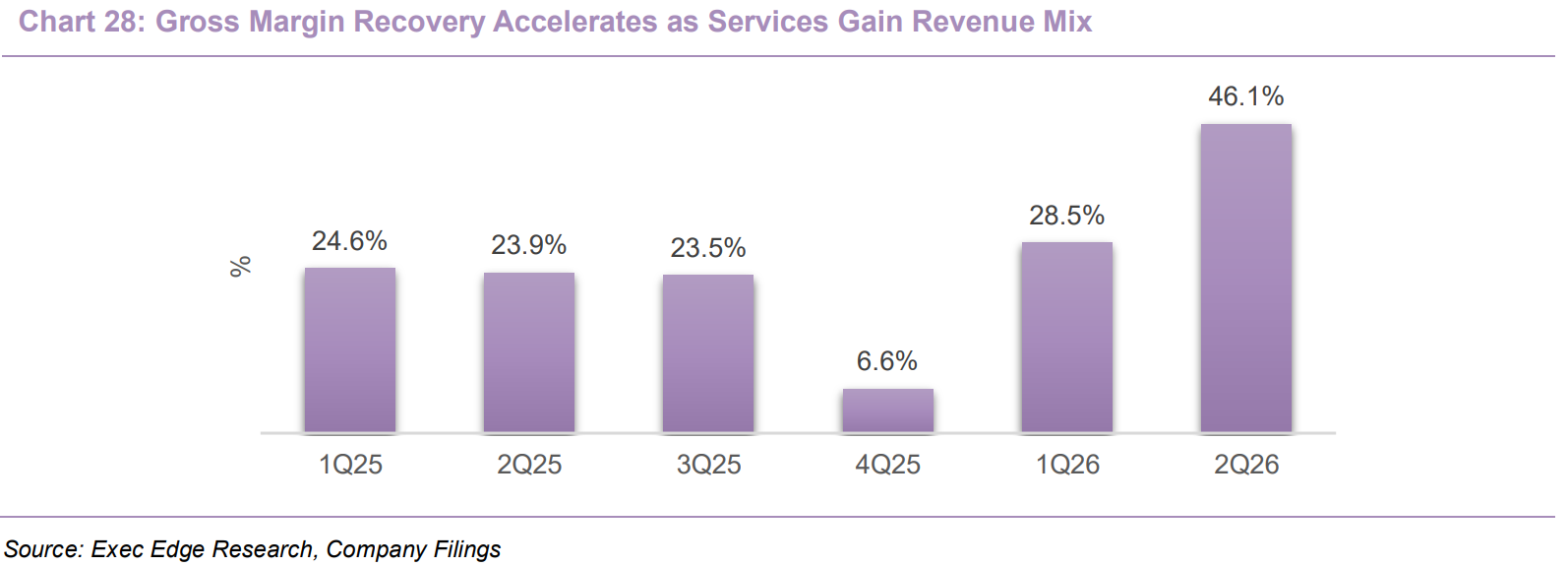
- A richer service mix is translating into materially stronger gross margins despite lower consolidated revenue. On the revenue-based measure used here, gross profit declined only 4.6% to NOK 129.4 million in 2025 despite a 20.1% revenue contraction, lifting gross margin to 22.8% from 19.1%. In 1H26, gross profit increased 1.1% to NOK 67.7 million even as revenue declined, expanding gross margin to 37.7%. 2Q26 contributed NOK 43.5 million of gross profit and a 46.1% margin, compared with NOK 24.2 million and 28.5% in 1Q26. The August update also estimated a 46% gross margin per completed service work order, although that operating measure is not directly comparable with consolidated gross margin. Quarterly margin has remained sensitive to business mix and project timing, ranging from 6.6% in 4Q25 to 46.1% in 2Q26. Sustaining this improvement as service volumes scale will be more important than any single-quarter margin outcome.
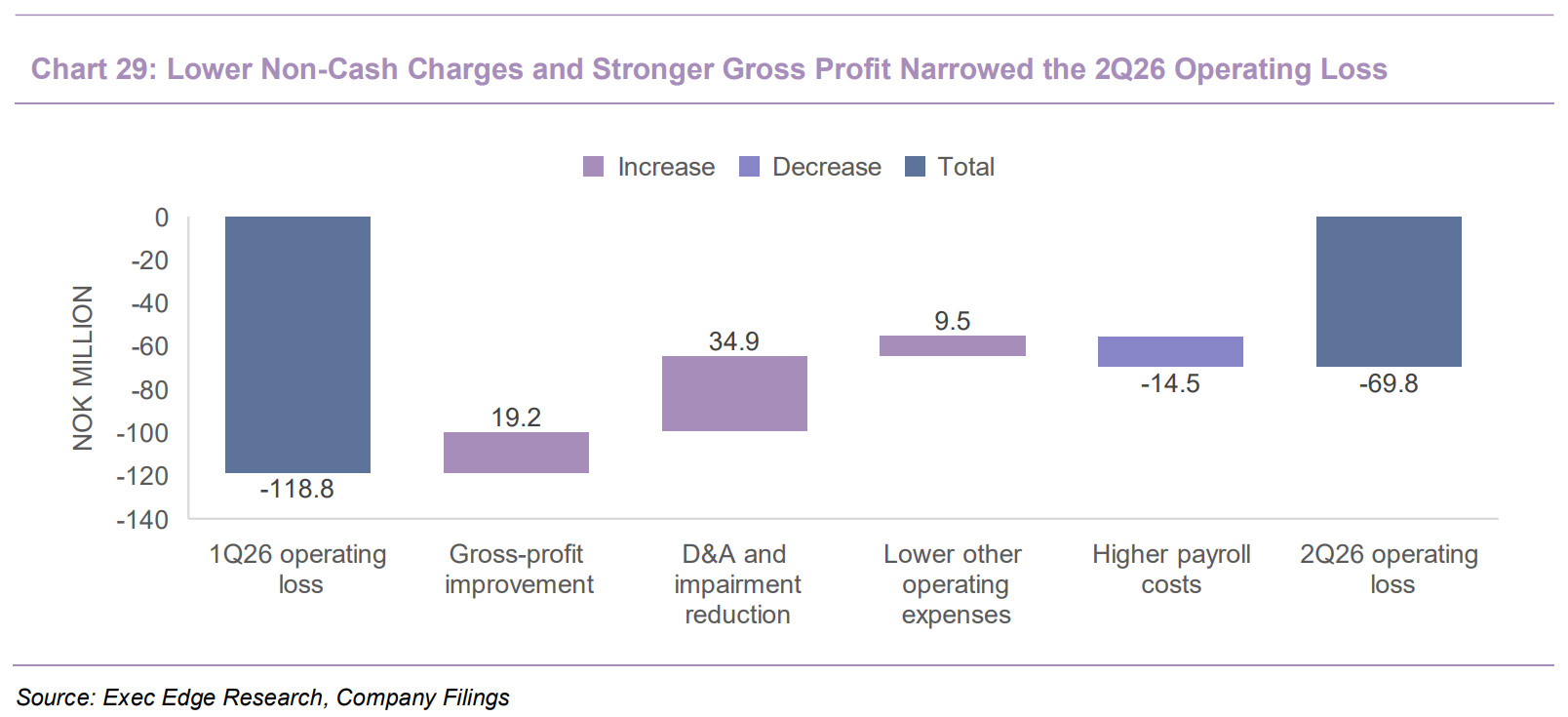
- Sequential losses narrowed in 2Q26 as gross profit improved and operating costs began to normalize, although the cost base remains elevated. OTOVO’s operating loss improved modestly to NOK 392.3 million in 2025 from NOK 398.0 million in 2024, although the operating margin weakened as revenue contracted. Excluding depreciation, amortization and impairment, the operating loss was approximately NOK 252.6 million, compared with NOK 361.7 million in 2024. In 1H26, the operating loss widened to NOK 188.7 million from NOK 140.1 million, with payroll and other operating expenses reaching 114.2% of revenue. Sequentially, the 2Q26 loss narrowed to NOK 69.8 million from NOK 118.8 million in 1Q26. Higher gross profit, lower depreciation and impairment, and reduced other operating expenses drove the improvement, partly offset by NOK 14.5 million of additional payroll as field capacity expanded.
- The 4Q26 adjusted EBITDA target implies a major earnings inflection as OTOVO shifts from restructuring toward service-led operating leverage. 2Q26 adjusted EBITDA was negative $4.5 million, whereas the 4Q26 annualized run-rate guidance implies positive quarterly adjusted EBITDA of $3.75-5.00 million. This represents an approximately $8.25-9.50 million swing in quarterly adjusted EBITDA from 2Q26 to the implied 4Q26 run-rate. The company expects higher service revenue, acquired-company contributions, improving Field Services margins and Endurance-related cost reductions to support that change. The bridge therefore depends on both revenue scale and cost absorption, with acquisitions and service growth lifting gross profit while Endurance and restructuring reduce the supporting cost base. 2Q26 net loss also narrowed to NOK 60.2 million from NOK 146.1 million in 1Q26, although a favorable swing in foreign-exchange-related financial items contributed materially. The key financial proof point will be whether the expected gross-profit growth and cost reductions translate into sustained adjusted EBITDA improvement and stronger operating cash flow through 2H26.
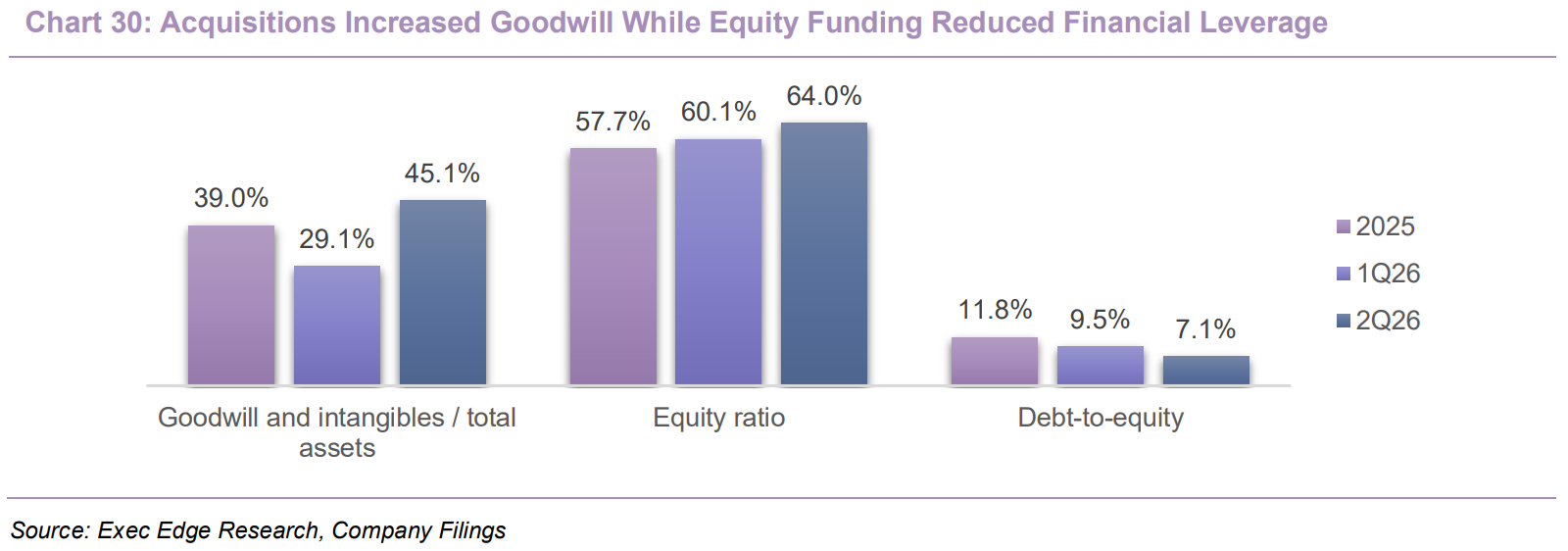
- Equity funding has strengthened capitalization as acquisition activity shifts more of the asset base toward goodwill. Total assets increased from NOK 486.7 million at year-end 2025 to NOK 536.6 million at June 30, 2026. Goodwill rose 74.0% to NOK 216.5 million, while intangible assets declined from NOK 65.5 million to NOK 25.7 million. Together, these assets represented 45.1% of total assets, compared with 39.0% at year-end. Equity increased 22.3% to NOK 343.4 million, lifting the equity ratio from 57.7% to 64.0%. Including interest-bearing liabilities, the drawn revolving credit facility and leases, financial debt totaled approximately NOK 24.3 million at 2Q26, leaving debt-to-equity at approximately 7.1%. The stronger equity base provides additional balance-sheet support for the acquisition strategy, although rising goodwill increases the importance of acquired businesses delivering the expected earnings and cash-flow contribution.
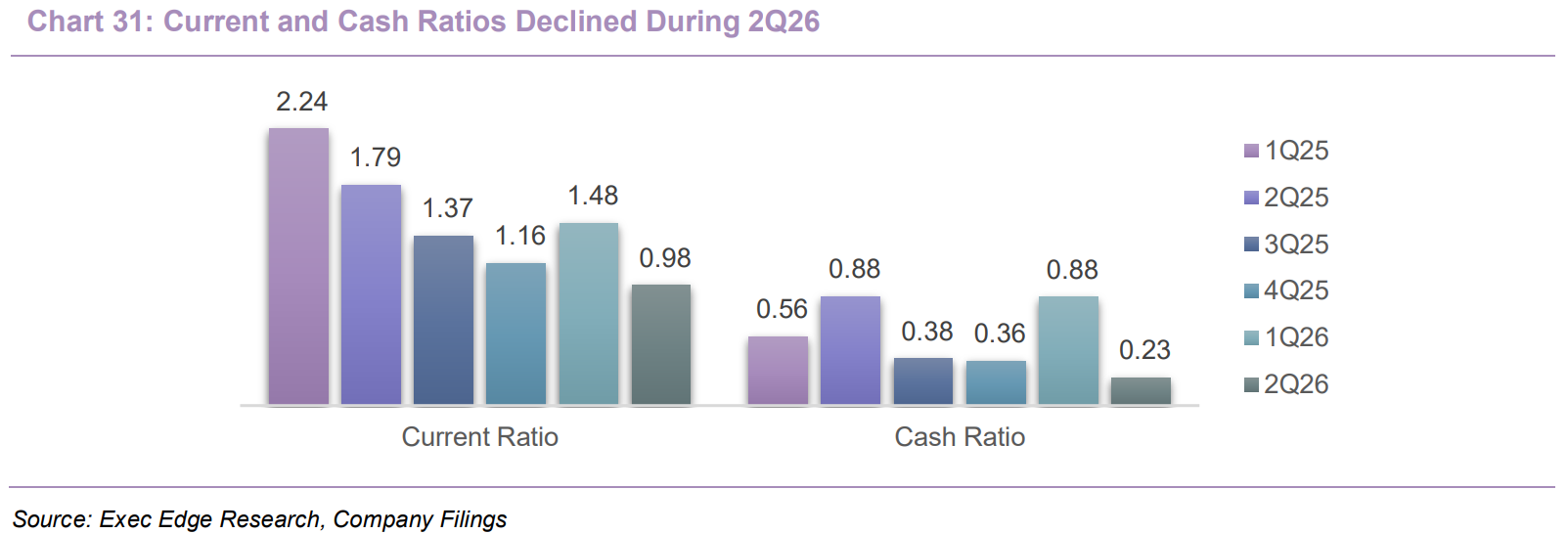
- Liquidity tightened in 2Q26, but the July equity raise subsequently strengthened the near-term cash position. Cash fell from NOK 147.3 million at 1Q26 to NOK 36.5 million at 2Q26, while current assets of NOK 158.0 million were slightly below current liabilities of NOK 161.8 million. The current ratio declined from 1.48 times to 0.98 times, and the cash ratio fell from 0.88 times to 0.23 times. Net working capital moved from positive NOK 79.9 million at 1Q26 to negative NOK 3.9 million at 2Q26; it had been positive NOK 23.1 million at 2025 year-end. Funded debt remained modest, but the NOK 15.5 million revolving credit facility was classified as current after its maturity passed without an extension in place. Liquidity subsequently improved following the July equity raise, which management said added approximately $7 million of cash after quarter-end. The balance-sheet focus therefore remains on liquidity and cash conversion, including receivable collection and the working capital required to support acquisitions and higher service volumes.
- Operating cash burn has moderated from 2024 levels, while service scale remains the key bridge toward cash-flow breakeven. Operating cash outflow narrowed from NOK 400.1 million in 2024 to NOK 266.5 million in 2025, improving operating cash-flow margin from negative 56.3% to negative 47.0%. In 1H26, operating cash outflow narrowed further to NOK 136.9 million from NOK 145.1 million, although 2Q26 consumption increased to NOK 81.7 million from NOK 55.2 million in 1Q26. 1H26 financing inflows of NOK 126.8 million largely offset operating cash use, while investing activities consumed only NOK 5.2 million. The August update estimated core-company cash-flow breakeven at approximately 160 completed service work orders per business day and stated that daily completions and average service-work-order revenue had reached that estimated level late in the month. This preliminary, management-defined, non-IFRS milestone excludes acquisition, restructuring, dual-listing and certain other costs, but provides a useful operating marker for assessing whether rising service volumes are beginning to translate into lower underlying cash burn.
- Overall, OTOVO’s financial profile is increasingly reflecting the scale-up of services, acquired field capacity and Endurance-enabled operating leverage. The revenue mix is shifting toward Field Services and Recurring Services, gross margins have expanded materially, and sequential operating losses narrowed in 2Q26. At the same time, acquisitions and equity funding have strengthened the strategic platform and capitalization, while liquidity and operating cash burn remain the principal financial constraints. We believe the key inflection will be whether higher service volumes, improving technician utilization, acquired-company contributions and Endurance-related savings can translate the stronger gross-profit profile into positive adjusted EBITDA and progressively lower cash consumption through 2H26.
Service Transition Discount Leaves Re-Rating Potential Tied to Execution
- Disclaimer: Exec Edge does not publish proprietary estimates, ratings, price targets, or investment recommendations. The valuation discussion below is illustrative only and is based on company filings, management commentary, and third-party data and estimates. It does not constitute a recommendation, price target, rating, or prediction of future pricing.
- We believe OTOVO’s valuation does not yet reflect the earnings profile that could emerge if the services-led model delivers on management’s current run-rate objectives. OTOVO’s services-led model combines Field Services, recurring memberships and equipment upgrades, while its acquisition-led roll-up and Endurance platform are intended to add local service capacity and improve operating leverage as acquired businesses scale across a common platform. Gross margins have already improved materially and management is targeting a substantially larger, profitable operating base by 4Q26. At the same time, the current valuation appropriately reflects meaningful execution risk around acquisition integration, achievement of run-rate guidance and conversion of improving service economics into sustained cash generation. In our view, this combination creates re-rating potential without requiring OTOVO to approach the full valuation of more established service peers.
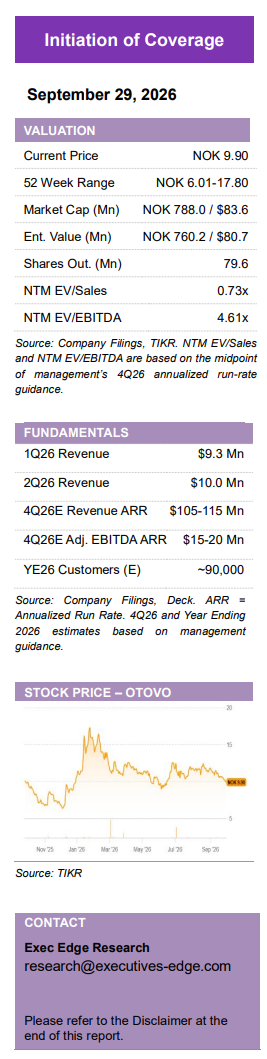
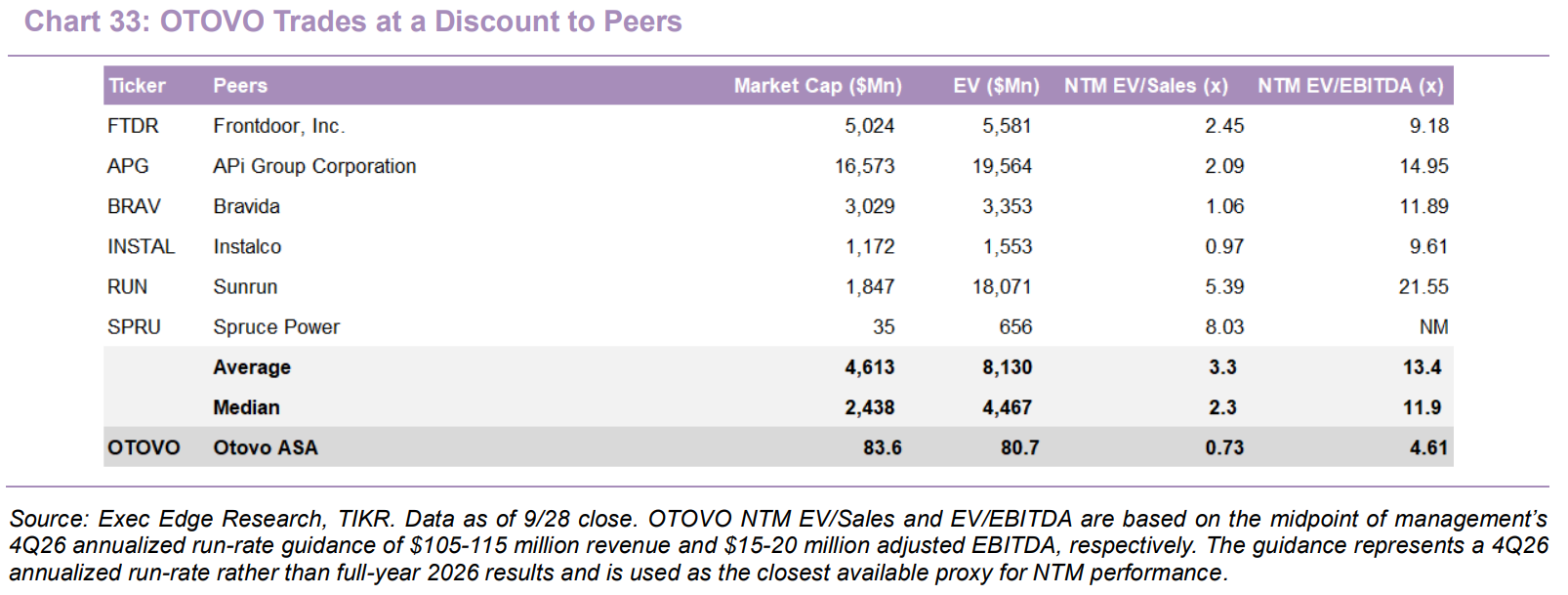
- The shares trade at a discount to the peer group. As of 9/28 close, OTOVO had a market capitalization of ~NOK788.0 million ($83.6 million) and enterprise value of ~NOK760.2 million ($80.7 million). Using the midpoint of management’s 4Q26 annualized run-rate guidance as the closest available NTM proxy, OTOVO trades at 0.73x EV/Sales and 4.61x EV/EBITDA. The selected peer group averages 3.3x and 13.4x, respectively, while peer medians are approximately 2.3x and 11.9x. OTOVO therefore trades at discounts of approximately 78% to average EV/Sales and 66% to average EV/EBITDA, with similarly substantial discounts to the respective medians.
- Even a partial narrowing of the valuation gap implies meaningful illustrative value without assuming convergence to peer multiples. Applying a 1.10x NTM EV/Sales multiple to the ~NOK 1.04 billion ($110 million) revenue base represented by the midpoint of management’s 4Q26 annualized run-rate guidance produces an illustrative enterprise value of ~NOK 1.14 billion ($121.0 million) and an illustrative equity value of ~NOK1.17 billion, or NOK 14.67 per share. This represents an illustrative valuation framework rather than a price target. The selected 1.10x multiple remains approximately 52% below the full peer median of 2.3x and approximately 30% below the roughly 1.58x median of Frontdoor, APi Group, Bravida and Instalco, leaving room for further re-rating as fundamentals strengthen and the services-led business model scales.
- We believe the case for a higher valuation ultimately depends on operating delivery rather than acquisition activity alone. Management’s 4Q26 annualized run-rate guidance of $105-115 million of revenue and $15-20 million of adjusted EBITDA implies a significant improvement from the current reported earnings base. Continued service-volume growth, improving Field Services margins, successful integration of acquired businesses and realization of Endurance-related savings would provide evidence that the emerging earnings profile is sustainable. Conversely, slower integration, weaker customer monetization, persistent cash consumption or additional external funding requirements could sustain the current discount. We believe positive adjusted EBITDA accompanied by progressively stronger operating cash flow would provide the clearest support for a more durable re-rating.
Risks
- Funding and liquidity: OTOVO remains reliant on external funding while the service model approaches operating scale. At June 30, 2026, cash stood at NOK 36.5 million after a NOK 81.7 million quarterly operating outflow, although the July equity raise strengthened subsequent liquidity. Funding needs could increase if operating improvement, acquisition contributions or working-capital conversion take longer than planned. Continued access to equity or other financing therefore remains important, while additional share issuance could dilute existing shareholders and may depend on capital-market conditions.
- Service transition: OTOVO’s service-led transition requires Field Services, memberships and upgrades to scale as lower-margin Newbuild activity contracts. Execution depends on customer conversion, technician capacity, route density and cost absorption across Europe and the U.S. If service volumes, membership attachment or utilization develop more slowly than expected, revenue replacement and profitability could take longer. The 2Q26 results showed improving service mix and gross margin, but consolidated revenue remained below the prior year and the group continued to report operating losses.
- Acquisition integration: Acquisitions are central to adding customers, technicians, service rights and geographic coverage, while current guidance partly assumes completion of announced transactions. Delays, unsuccessful closings or weaker acquired performance could affect planned scale and earnings. Completed transactions also require customer, workforce, data, financial-control and technology integration across different jurisdictions. If retention, operating improvements or Endurance-related savings fall short, cash generation may lag expectations and the carrying value of acquired goodwill or customer-related intangible assets may require reassessment.
- Technology dependence: Endurance is increasingly central to customer intake, monitoring, diagnosis, scheduling, dispatch, procurement and billing. Software defects, data-quality problems, inaccurate automation, cyber incidents or service interruptions could affect customers and field operations. The transition from OTOVO Cloud and migration of acquired businesses also introduce integration, scalability and key-person dependencies. System monitoring, testing and internal controls reduce these exposures, but wider deployment increases the operational consequences of platform disruption or failures to meet evolving privacy and AI-governance requirements.
- Service liability: Installation, electrical and field-service work can expose employees, subcontractors, customers and property to injury, damage and workmanship issues. OTOVO combines employed technicians with third-party installers, creating variability in execution and supervision. The group can remain responsible when manufacturers or installation partners do not remedy defective hardware or work, while direct solar and battery sales may carry warranties of up to ten years. Training, certification, quality controls, contractual recourse and insurance moderate these exposures but cannot eliminate service costs or liability.
- Regulatory complexity: Operations across Europe and the U.S. are subject to electrical and contractor licensing, consumer-protection and telemarketing rules, data-privacy requirements, tax and VAT treatment, renewable-energy incentives and potential financial-services classifications. Requirements differ by market and may change as service, membership and AI-enabled offerings develop. Adverse interpretations or delayed approvals could increase compliance costs, restrict particular products or slow expansion. The shift toward services reduces dependence on new-installation subsidies, although policy changes can still influence customer demand and equipment economics.
- Demand sensitivity: Demand for solar, batteries and upgrades remains sensitive to interest rates, inflation, electricity prices and household purchasing power. Prolonged financing costs or weaker energy-price savings can delay discretionary investment and reduce Newbuild and upgrade volumes. Service and membership revenue linked to the installed base provides some diversification, but it does not remove exposure to broader consumer conditions. Geopolitical developments may also affect energy costs and confidence across OTOVO’s markets, producing uneven demand and making local capacity planning more difficult.
- Supply-chain and currency: OTOVO depends on third-party manufacturers and distributors for modules, inverters, batteries and replacement components, with several categories concentrated among Asian suppliers or a limited number of global vendors. Trade restrictions, geopolitical disruption, shipping constraints or supplier weakness could raise costs, extend lead times and affect repair response. International operations also create EUR, USD and other currency exposure through component purchases, subsidiary translation and intragroup balances. Local-currency revenues and financing provide partial natural hedging, but the group does not currently use derivatives to hedge currency movements.
Subscribe to our Weekly Newsletter to Receive All Research
Contact: