Download the Complete Report Here
 Cibus, Inc. (CBUS)
Rice Royalty Conversion, Precision-Breeding Platform, and BioFragrance Scale-Up Support Commercial Inflection
- CBUS is an asset-light precision-breeding platform that develops productivity traits for seed-company partners, rather than owning seed production, distribution or farmer relationships. RTDS and the Trait Machine process are designed to edit elite customer germplasm and return partner-ready material for commercialization. Disclosed productivity-trait portfolio across rice, canola and soybean represents ~367-369 million peak addressable acres and >$1.9 billion of management-estimated potential annual addressable royalties.
- RTDS differentiation, elite-germplasm execution and IP depth support CBUS’ precision-breeding right-to-win. CBUS combines repair-template-guided editing, crop-specific cell biology and regeneration capabilities to edit elite customer germplasm. More than 500 patents and patent applications span RTDS methods, crop-trait applications and selected outputs, while the company’s non-transgenic profile aligns with markets separating precision-bred crops from legacy GMO frameworks.
- Industry trends are moving in CBUS’ favor, though commercialization remains crop- and country-specific. Precision-bred productivity traits are gaining relevance as weed pressure, crop disease, fertilizer volatility and food-security needs increase demand for higher-yielding, input-efficient crops. Farmers have adopted trait-enabled seed at scale where value is clear, while seed companies need faster precision-breeding tools; regulatory momentum is improving in LATAM, the U.S. and the U.K., although EU treatment remains nuanced given herbicide-tolerance exclusions under Category 1 NGT rules.
- Near-term milestones center on rice royalty validation and BioFragrance scale-up. Rice HT1 / HT3 remains the first royalty-validation pathway, with LATAM the initial launch corridor after Interoc material transfer in May 2026 and the U.S. targeted for 2029. Sustainable Ingredients adds a second lane, with first customer payment received in 4Q25 and additional BioFragrance scale-up orders targeted in 2H26.
- New CEO Craig Wichner adds commercial execution, regenerative-agriculture and capital-discipline experience as CBUS works to convert milestones into revenue. Wichner brings financial acumen and regenerative / organic farming leadership from Farmland LP, which manages >$350 million in assets and over 19,000 acres. His focus on getting improved traits into customers’ hands, converting near-term targets into revenue and maintaining capital discipline aligns with Street estimates for revenue to rise from $3.6 million in 2025 to $42.1 million in 2028E, while management targets annual net cash usage of ~$30 million or less in 2026.
- Current valuation appears attractive relative to disclosed royalty opportunities. While we do not assign a rating or price target, CBUS’ market capitalization remains below its disclosed >$200 million annual Americas rice HT royalty opportunity at peak, making rice HT the cleanest illustrative valuation anchor if LATAM partner conversion and commercial economics materialize. BioFragrance’s $20-$40 million annual royalty opportunity, the broader crop-trait royalty pool and the RTDS / Trait Machine platform provide additional upside if milestones convert into recurring revenue.
Company Overview
Cibus – Asset-Light Precision-Breeding Royalty Platform Approaching Commercialization
- Cibus, Inc. (CBUS) is an asset-light precision-breeding and trait-royalty platform moving from technology validation toward initial commercial proof points. CBUS develops and licenses productivity traits to seed companies, using RTDS and the Trait Machine process to make targeted improvements in elite germplasm rather than owning seed production, distribution or farmer relationships. The company’s core focus is productivity traits that address yield, profitability and sustainability challenges in major row crops, including weed management, disease resistance, nutrient-use efficiency and other agronomic characteristics. This makes CBUS closer to an agricultural intellectual property (IP) and trait-royalty platform than a conventional seed producer, as it does not own the farmer distribution relationship or seed bulk-up function. New CEO Craig Wichner adds commercial and capital-discipline focus as CBUS enters this next phase, with stated priorities around getting improved traits into customers’ hands, converting near-term commercialization targets into revenue and maintaining capital discipline. The business remains pre-commercial in its core productivity-trait royalty model, but its operating posture has moved closer to launch readiness, with rice herbicide tolerance and Sustainable Ingredients representing the clearest near-term commercial programs. In rice, the transfer of gene-edited herbicide-tolerance material to Interoc in May 2026 marked an important step into testing and production ahead of contemplated Latin American commercialization, while Sustainable Ingredients provides a nearer-term partner-funded revenue bridge.
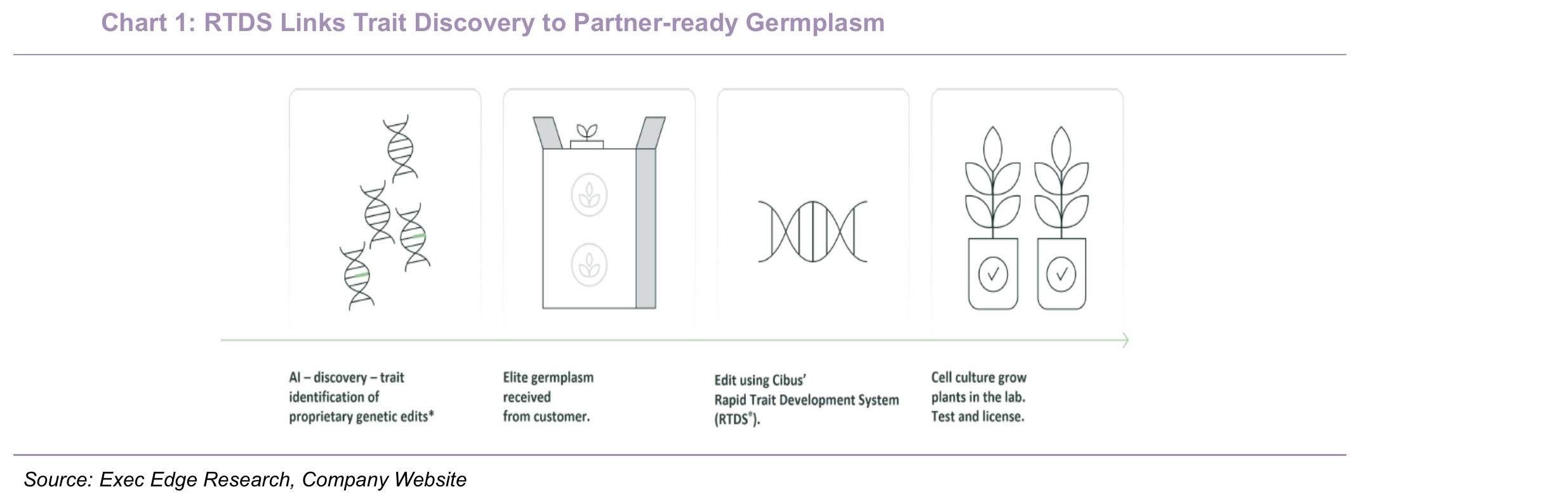
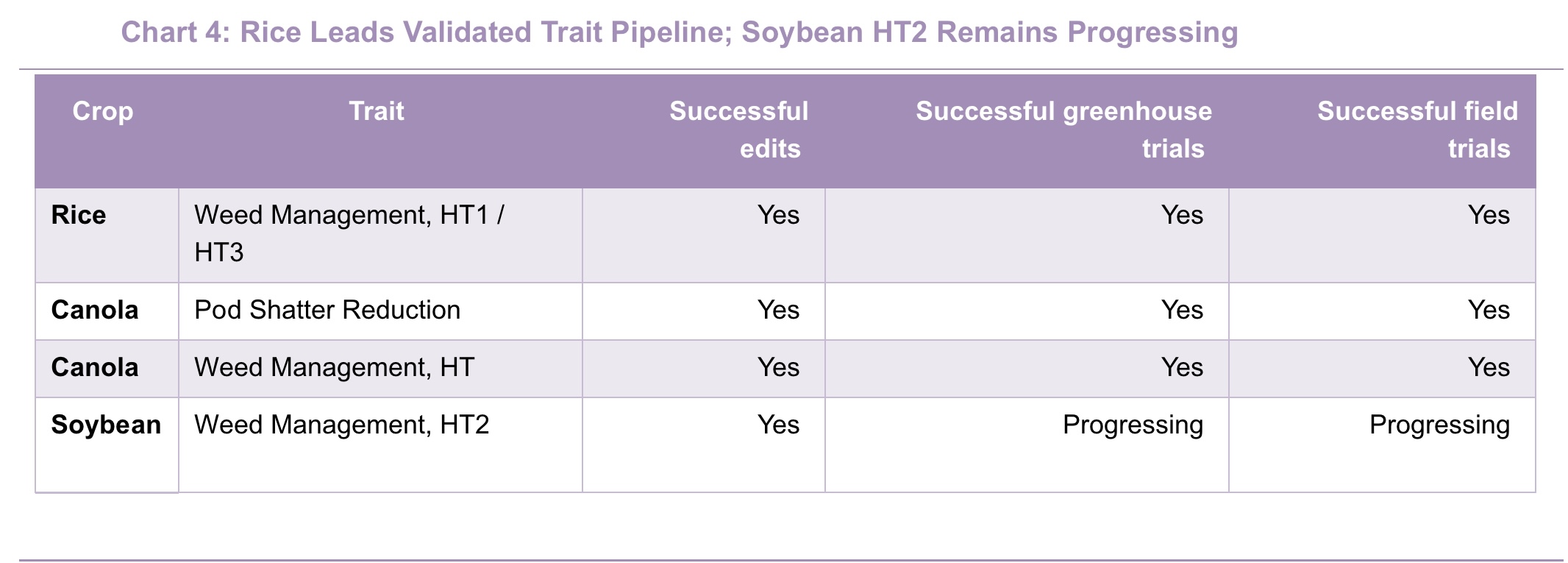
- Rapid Trait Development System (RTDS) and the Trait Machine process enable CBUS to make precise genetic edits directly in elite germplasm, rather than developing traits solely in laboratory model lines. RTDS combines crop-specific cell biology platforms with gene-editing technologies to create a semi-automated, high-throughput process for editing seed-company elite germplasm. This positions RTDS as CBUS’ precision-breeding engine, with the Trait Machine process designed to make deliberate edits inside commercially relevant germplasm rather than relying on slower selection cycles in conventional breeding. The process begins with customer germplasm, enables edits at the single-cell level, and regenerates the edited cell into a plant carrying the desired trait. The platform is designed to work within seed-company breeding programs instead of replacing them, allowing customers to retain genetic backgrounds already optimized for agronomic performance, geography and end-market needs. CBUS has operational crop platforms across cassava, canola, flax, peanut, potato, rice, sugar beet and wheat, and has used its rice and canola platforms to edit elite customer germplasm. Soybean remains a developing platform, supported by successful editing of a soybean cell with edits associated with an herbicide tolerance (HT) trait. The technology portfolio is also meaningful, with more than 500 patents and patent applications spanning RTDS methods, crop / trait applications and selected gene-edited trait outputs.
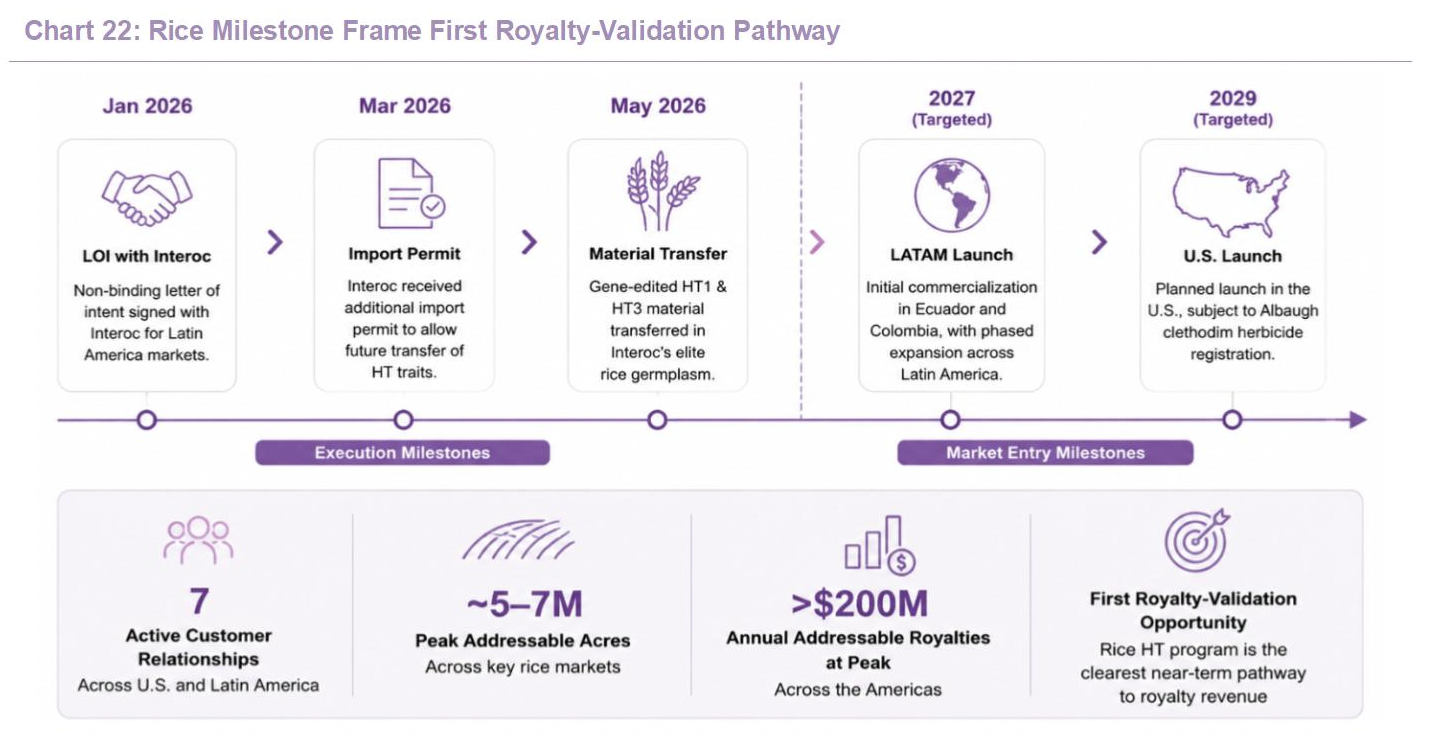
- Rice herbicide tolerance is CBUS’ first royalty-validation pathway, while broader crop programs preserve partner-funded platform optionality. The company’s lead productivity traits are rice herbicide tolerance (HT) traits HT1 and HT3, which target weed-management needs in Latin America and the U.S. and serve as CBUS’ lead near-term commercialization program. The rice program includes seven active customer relationships across the U.S. and LATAM, representing 5 million to 7 million peak addressable acres and over $200 million of management-estimated annual addressable royalties at peak. Latin America is the first intended commercialization corridor, with Interoc serving as an important initial partner after a January 2026 commercialization framework, March 2026 import permit and May 2026 transfer of gene-edited HT material for testing and production ahead of a contemplated launch. The U.S. launch target has been reset to 2029 as Albaugh works through the clethodim herbicide registration process. Beyond rice, CBUS retains a broader productivity-trait portfolio across canola, soybean, wheat, nutrient-use efficiency and alfalfa, while Sustainable Ingredients provides an adjacent near-term partner-supported revenue lane. In canola and oilseed rape, the platform includes Pod Shatter Reduction (PSR), HT2 herbicide tolerance, Sclerotinia resistance and Light Leaf Spot disease-resistance work; soybean has progressed through successful editing of a soybean cell for HT2; and wheat has progressed through regeneration of plants from single cells in a wheat cultivar. The broader portfolio adds platform breadth and long-duration optionality, while near-term execution remains concentrated around rice commercialization and Sustainable Ingredients scale-up.
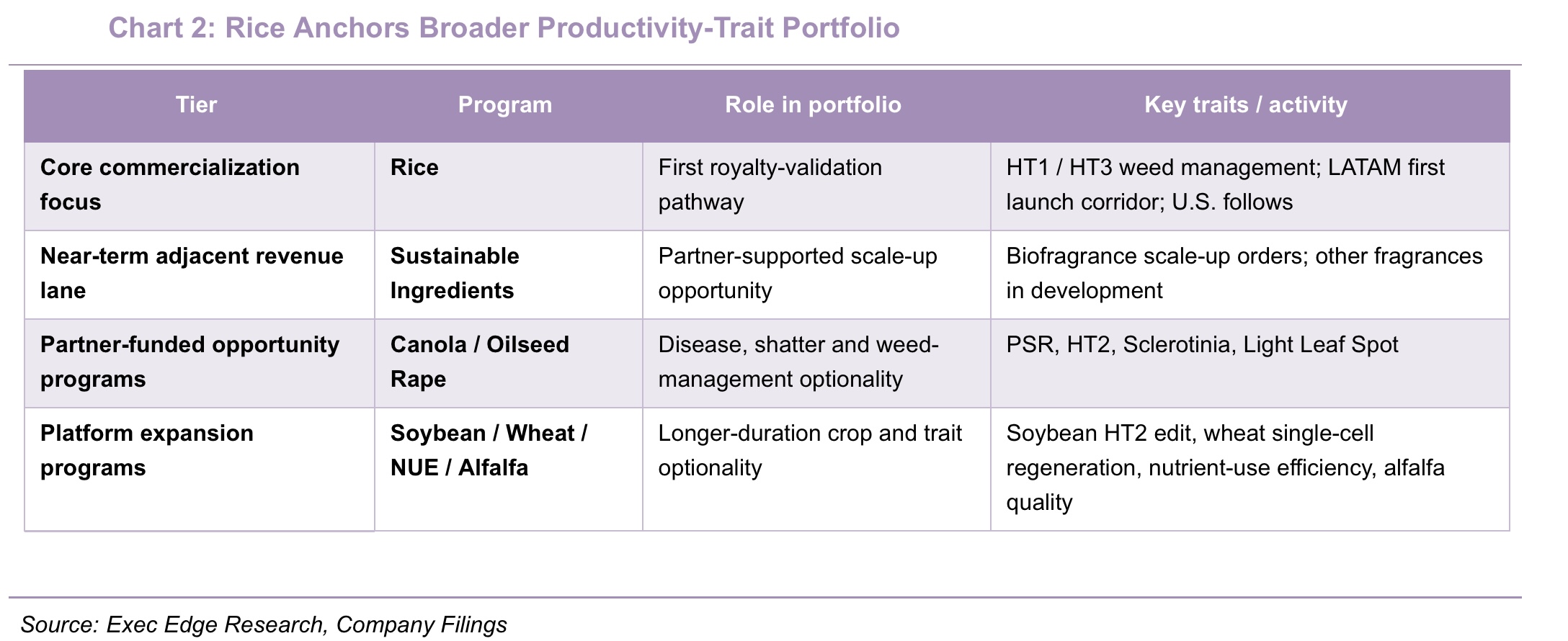
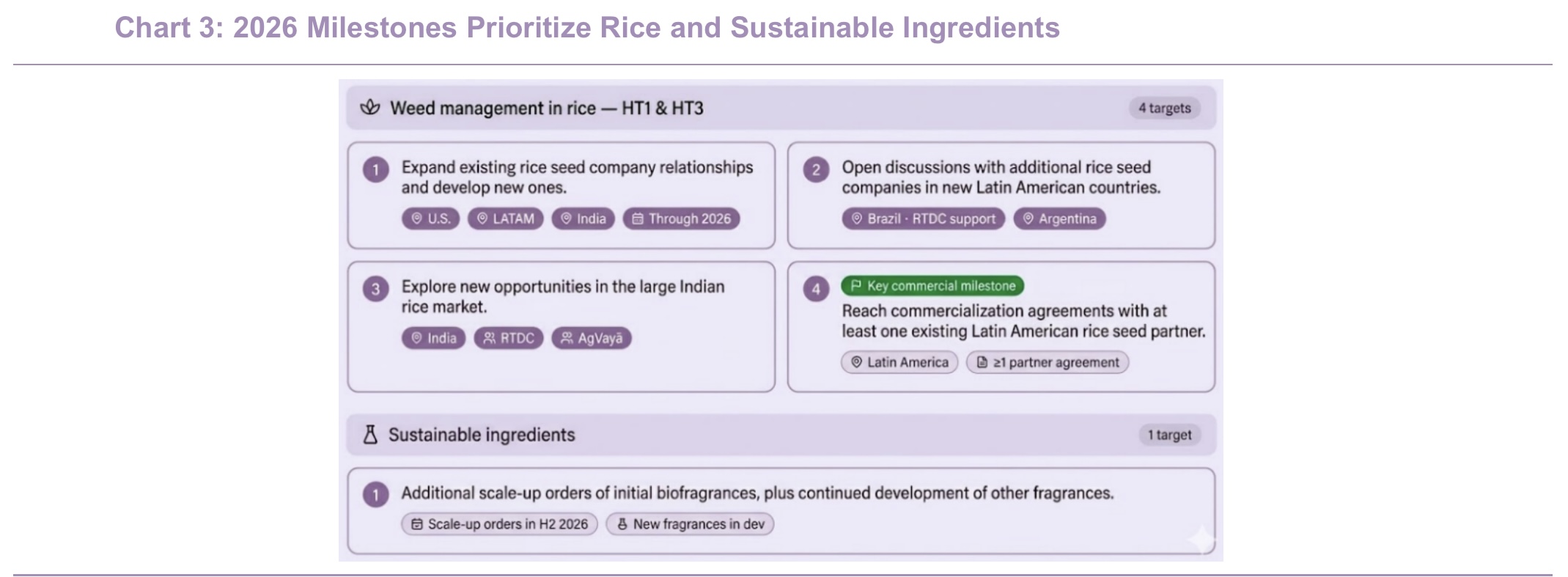
- 2026 execution agenda is concentrated on partner conversion in rice and scale-up activity in Sustainable Ingredients. In rice, the company is focused on expanding existing seed-company relationships across the U.S. and LATAM, advancing discussions with additional LATAM partners in Brazil and Argentina, exploring market-entry opportunities in India with RTDC and AgVayā, and reaching commercialization agreements with at least one existing LATAM rice seed partner. In Sustainable Ingredients, the near-term focus is on additional scale-up orders for initial BioFragrance products in 2H26 and continued development of other fragrances, following the first customer payment in 4Q25 and expanded partner-funded R&D activity in 1Q26. This focus is important because CBUS retains broader optionality across canola, soybean, wheat and nutrient-use efficiency, but the disclosed 2026 commercial milestones are narrower and more execution-oriented.
- CBUS’ asset-light model depends on converting edited traits into royalty-bearing seed products through partners. Seed companies provide elite germplasm, CBUS edits the germplasm using RTDS and the Trait Machine process, and seed-company partners are expected to handle seed multiplication, channel relationships and farmer commercialization after transfer. The intended revenue model is built around royalty or license fees tied to seed containing CBUS-developed traits, with economics potentially structured on a per-bag, per-unit or per-acre basis. The value of a trait depends on the crop, geography, addressable acreage, farmer economic benefit, competitive alternatives, intellectual property protection and, for herbicide tolerance traits, the role of the chemistry provider. This structure is attractive from an asset-intensity perspective because CBUS can focus on editing, trait development, IP and partner relationships rather than building a seed distribution business.
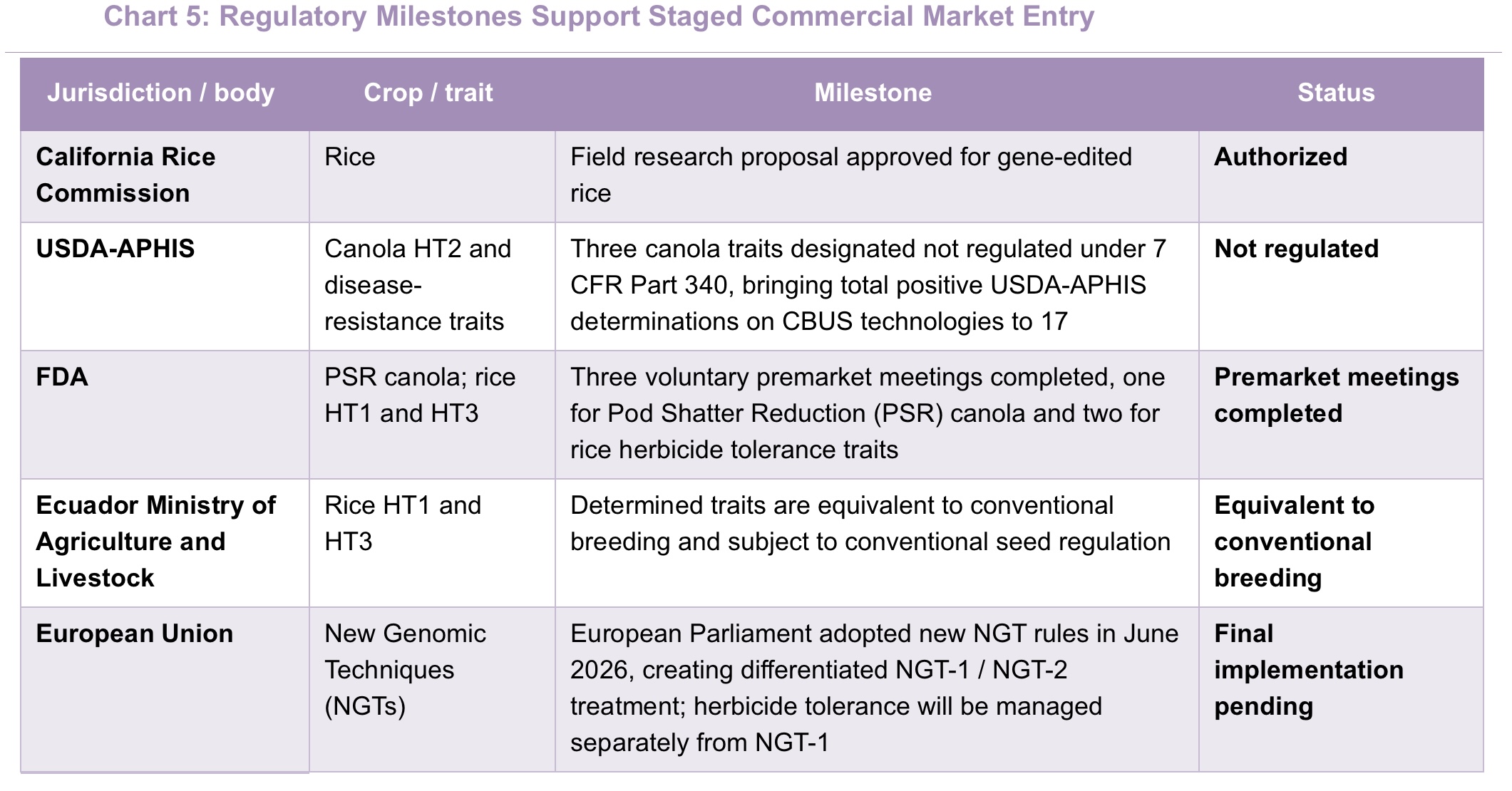
- Regulatory momentum is a central commercialization catalyst, as non-transgenic gene-edited traits may receive differentiated treatment versus legacy GMO frameworks. CBUS’ regulatory opportunity is tied to the distinction between precision gene-edited traits and transgenic genetically modified organisms, as RTDS is designed to make targeted edits without inserting or integrating foreign genetic material. This matters commercially because several jurisdictions are building separate frameworks for gene-edited crops, increasingly evaluating products based on the nature of the genetic change rather than only the process used to create it. CBUS’ initial commercialization efforts are focused on markets with clearer gene-editing pathways or product-specific determinations, including Ecuador’s determination that CBUS’ HT1 and HT3 rice traits are equivalent to conventional breeding. The backdrop remains nuanced, however, as Europe has now finalized a differentiated NGT framework that treats qualifying Category 1 (NGT-1) plants similarly to conventional varieties, while gene edited herbicide-tolerance traits for example will qualify as Category 2 (NGT-2) and will have additional oversight.
Right-to-Win
Differentiated Precision-Breeding Workflow, IP and Regulatory Positioning Support Platform Defensibility
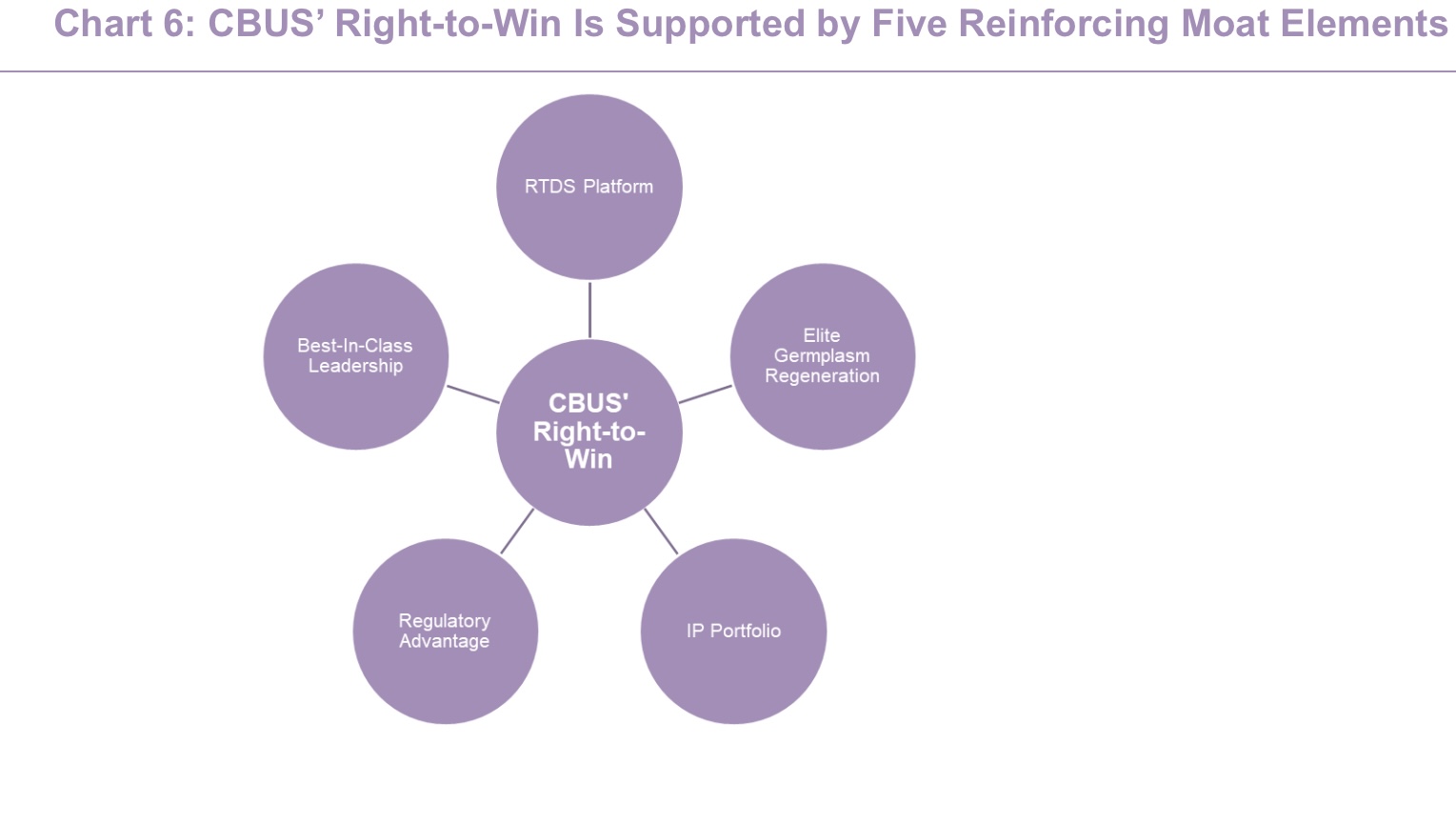
- We believe CBUS’ right-to-win rests on converting precision-breeding capability into partner-ready traits through a workflow that extends beyond access to standard editing tools. The company’s defensible business model is supported by five reinforcing layers: repair-template-driven editing, precision-breeding execution in elite germplasm, platform-level intellectual property (IP), non-transgenic regulatory positioning, and commercialization-oriented leadership. CBUS remains pre-commercial in its core trait royalty model, so the next stage of validation depends on moving from edited cells and field data into seed-company material transfer, market-entry planning and eventual royalty economics. The moat is therefore less about a single trait and more about an integrated workflow that can repeatedly turn crop improvements into commercial opportunities.
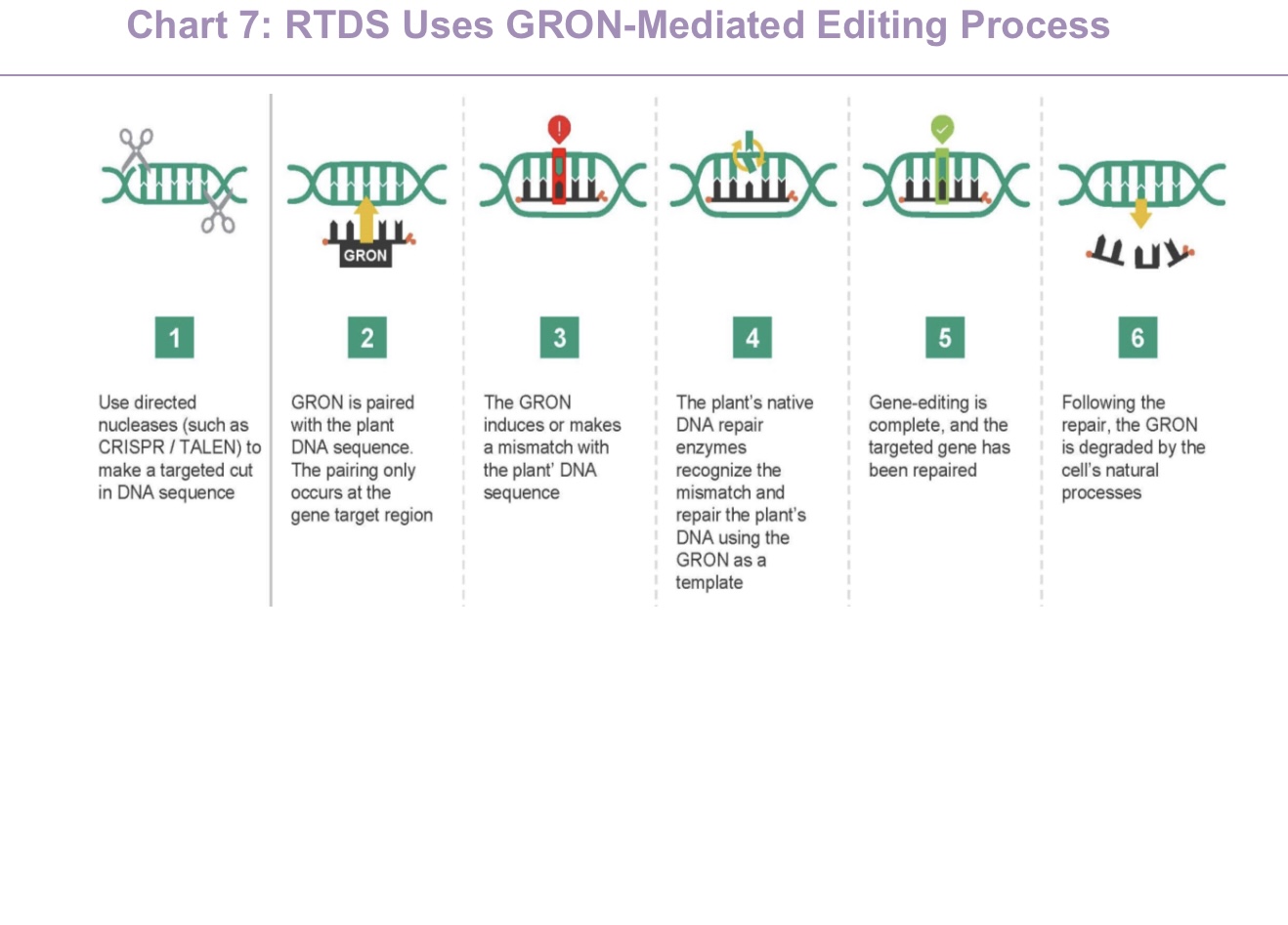
- Repair-template architecture differentiates RTDS without relying on transgenic insertion. CBUS’ differentiated editing architecture uses repair-template biology rather than relying solely on nuclease-driven gene editing. Rapid Trait Development System (RTDS) uses oligonucleotides, including Gene Repair OligoNucleotides (GRONs), to guide targeted nucleotide changes, and in certain cases combines those repair templates with deoxyribonucleic acid (DNA)-breaking reagents such as clustered regularly interspaced short palindromic repeats-associated endonuclease Cas9 (CRISPR-Cas9). The commercial relevance is that the edit is designed to be targeted and non-transgenic, with the GRON acting as a repair template, the plant cell’s native repair machinery completing the sequence change and the template subsequently degrading through natural cellular processes. FDA’s 2024 genome-editing guidance recognizes targeted oligonucleotides alongside targeted nucleases as a genome-editing approach capable of producing insertions, deletions or substitutions at specific genomic sites, while Sauer et al. in Plant Biotechnology Journal describe oligonucleotide-directed mutagenesis (ODM) as a precision genome-editing technology and identify ODM as one tool within CBUS’ RTDS. CBUS’ differentiation therefore lies in template-guided editing that supports targeted, non-transgenic trait development rather than generic access to CRISPR tools.
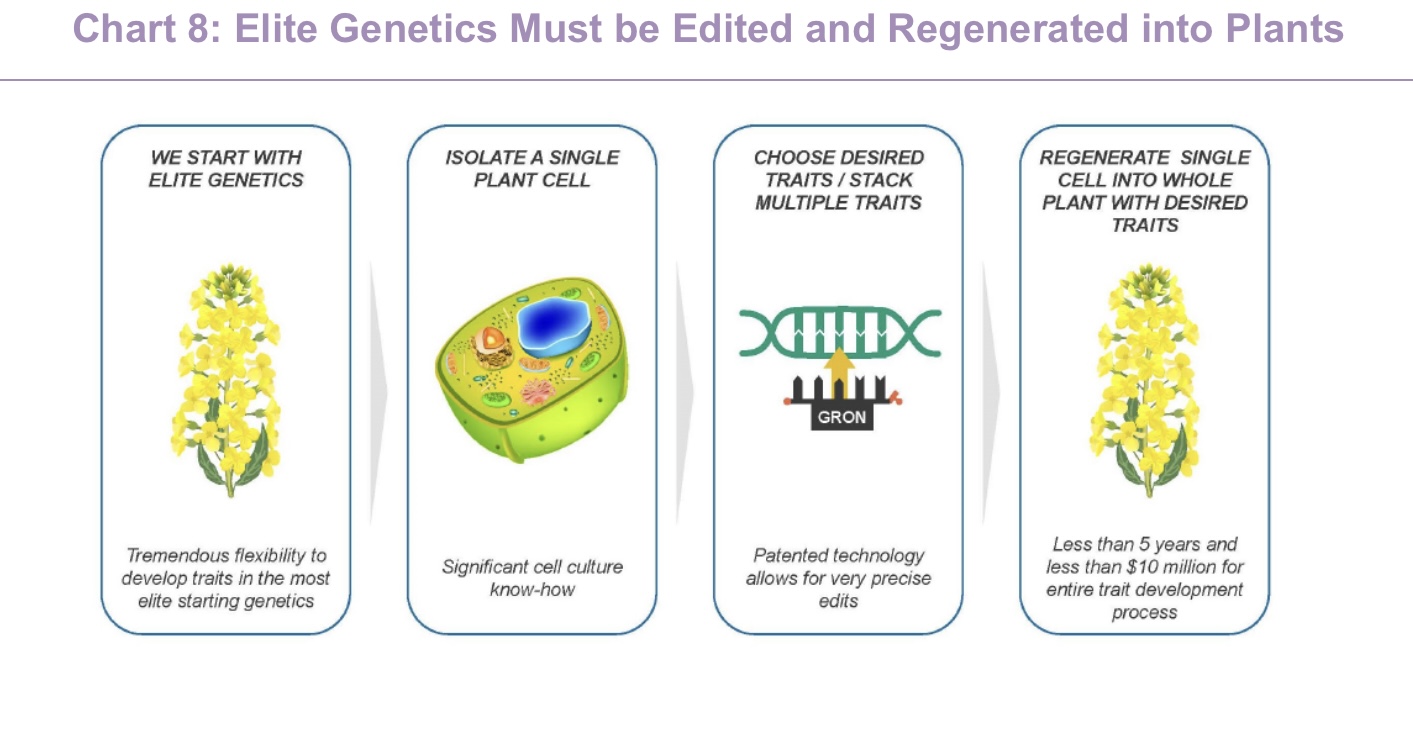
- Precision-breeding execution converts elite germplasm into partner-ready traits, addressing one of the key bottlenecks in crop gene editing. CBUS’ precision-breeding workflow converts elite germplasm into partner-ready traits, creating a practical execution moat beyond editing chemistry alone. Making a targeted genetic change is only one part of crop improvement; the commercially critical step is turning edited cells into viable plants that retain the desired trait in a genetic background already valuable to a seed-company partner. RTDS and the Trait Machine process are designed around that challenge: CBUS can edit a single cell from elite germplasm, regenerate that edited cell into a plant and return edited material for partner testing and production. Third-party plant science literature reinforces why this workflow matters, as plant transformation and regeneration remain major bottlenecks, particularly across recalcitrant crops, species and genotypes. CBUS’ advantage is therefore not simply regeneration capability, but the integration of editing, cell culture, regeneration and customer germplasm transfer into a repeatable workflow. The May 2026 handoff of gene-edited rice material in Interoc’s elite germplasm provides a timely proof point that this workflow is moving beyond laboratory capability and into customer material transfer ahead of contemplated commercialization.
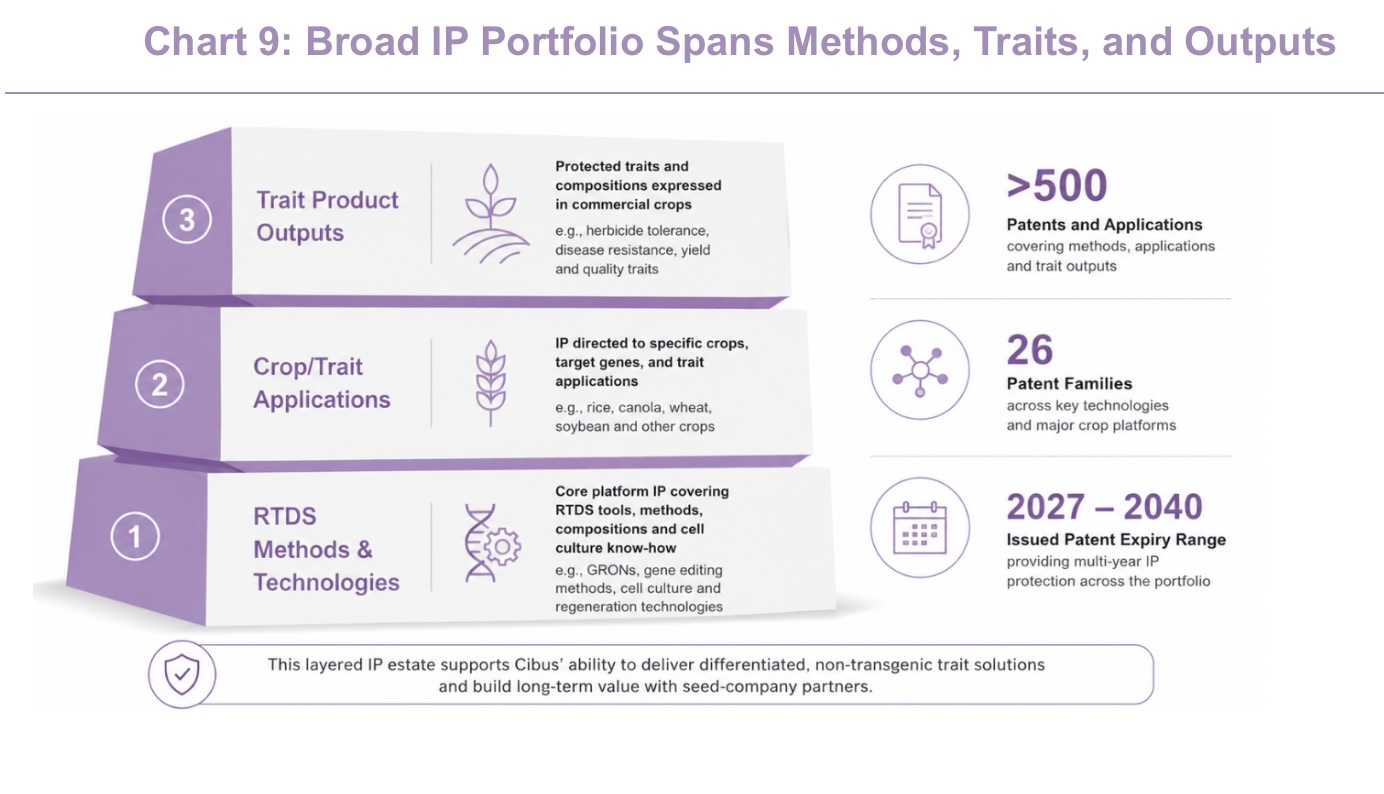
- CBUS’ IP portfolio supports platform-level defensibility across a large disclosed crop-trait royalty opportunity. CBUS’ IP estate protects both the underlying RTDS technology and selected commercial trait outputs, giving the company a broader protection base than a narrow single-trait developer. The portfolio includes more than 500 patents and patent applications worldwide across 26 patent families, with issued patents expected to expire between 2027 and 2040. These cover RTDS gene-editing methods, the Pod Shatter Reduction trait, applications of RTDS technologies and products developed through RTDS technologies. This matters because CBUS’ commercial opportunity is not limited to rice HT: the company has disclosed a multi-crop royalty opportunity across rice, canola and soybean, spanning weed management, Pod Shatter Reduction and Sclerotinia resistance.
-
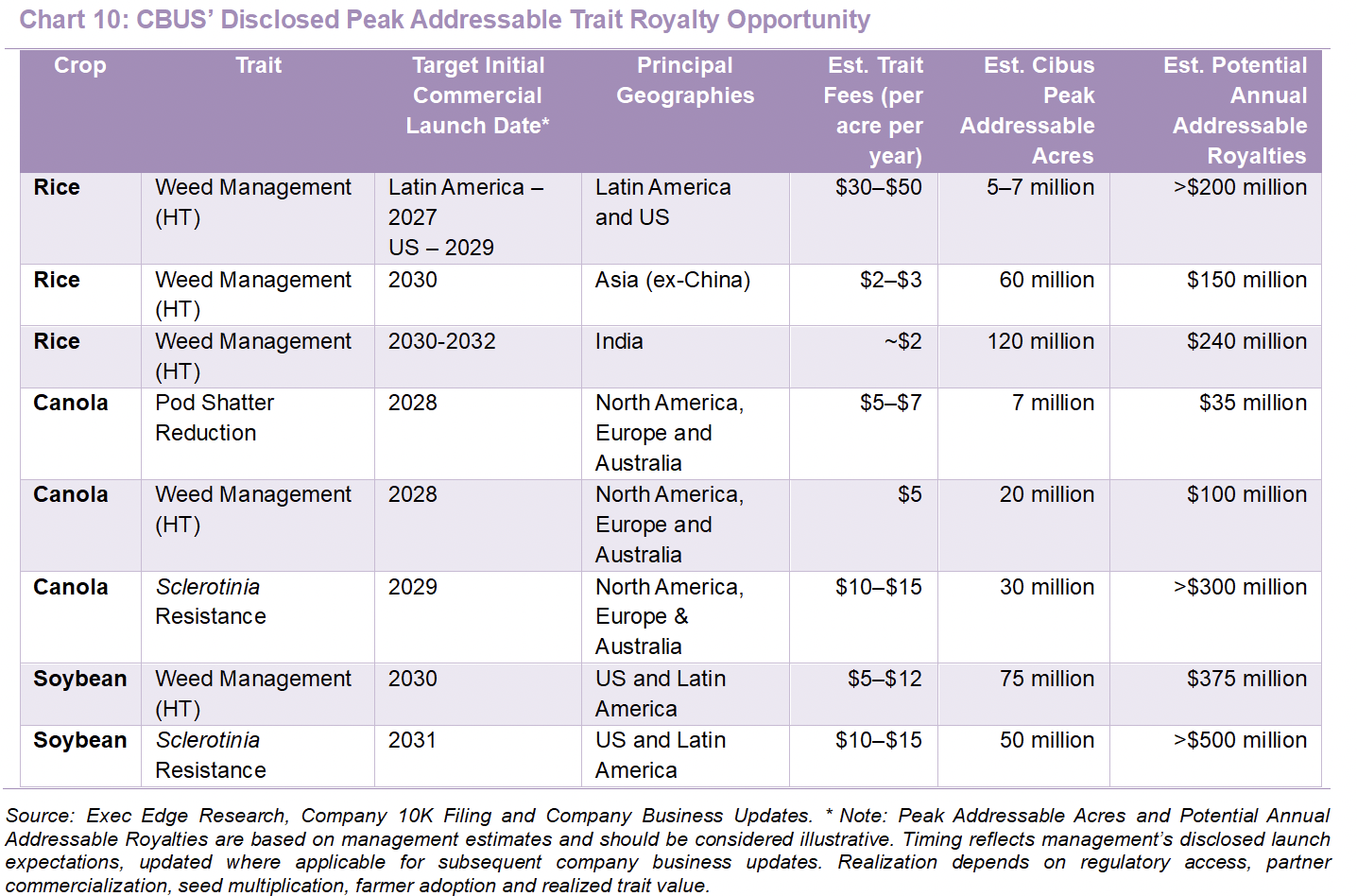
- Management-estimated potential annual addressable royalties include >$200 million for rice HT in the U.S. and LATAM, $150 million for rice in Asia excluding China, $240 million for rice in India, >$435 million across canola traits and >$875 million across soybean traits. In aggregate, these disclosed opportunities represent ~367-369 million peak addressable acres and >$1.9 billion of potential annual addressable royalties, based on management estimates. (See table on next page.) These figures remain illustrative rather than de-risked revenue, as realization depends on regulatory access, partner commercialization, seed multiplication, farmer adoption and realized trait value.
-
- In other words, the IP portfolio is intended to protect not just individual traits, but the broader process of developing and monetizing crop-trait applications across multiple crops. If rice validates the royalty model, the same IP-backed RTDS workflow could support follow-on monetization across additional traits and crops. While certain protections begin expiring in 2027, CBUS’ IP position supports its effort to monetize RTDS as a platform rather than a one-off trait development tool.
- CBUS’ non-transgenic trait profile can reduce regulatory friction in selected markets versus legacy GMO frameworks. RTDS-developed traits are designed to avoid insertion of foreign DNA, supporting the company’s position that certain edits may be evaluated similarly to changes that could occur naturally or through conventional breeding. This matters because agricultural biotechnology adoption is shaped not only by trait performance, but also by regulatory classification, import acceptance, seed labeling, farmer perception and food-chain requirements. CBUS has accumulated several useful regulatory proof points, including California Rice Commission authorization for gene-edited rice field research, USDA-APHIS not-regulated determinations for canola traits, FDA voluntary premarket meetings for PSR canola and rice HT1 / HT3, and Ecuador’s determination that HT1 and HT3 rice traits are equivalent to conventional breeding. The regulatory backdrop has turned more constructive after the European Parliament’s June 2026 adoption of new NGT rules, which creates a conventional-like route for qualifying NGT-1 plants but NGT-2 will be managed separately from NGT-1 with additional oversight. This distinction is important for CBUS: disease-resistance and Pod Shatter Reduction programs in canola / oilseed rape appear better aligned with Category 1 treatment, while HT traits remain more constrained in the EU. Regulation is therefore best viewed as asymmetry rather than blanket clearance, with CBUS and its partners likely to benefit most in markets where non-transgenic edits receive conventional-like treatment.
- Commercialization-oriented leadership strengthens CBUS’ moat as the platform moves from technical validation toward partner conversion and royalty realization. CBUS’ leadership transition improves execution odds as the platform moves from technical validation toward partner conversion and royalty realization. Craig Wichner, appointed CEO on June 8, 2026, brings operating and capital-allocation experience from Farmland LP, a U.S. farmland investment management firm with more than $350 million in assets and over 19,000 acres under management. His background in regenerative and organic farming practices is relevant because CBUS is trying to translate breakthrough plant technology into customer-ready traits with clear farmer value. Wichner’s stated priorities are getting improved traits into customers’ hands, converting near-term commercialization targets into revenue and maintaining capital discipline. The transition also preserves technical continuity: Peter Beetham, Co-Founder and former Interim CEO, remains President and Chief Operating Officer, while Greg Gocal continues as Co-Founder and Chief Scientific Officer. We view the combination of new commercialization-oriented leadership, founder-led technical continuity and board-level agribusiness experience as an execution advantage for a pre-commercial company approaching its first royalty validation window.
Industry Trends and Company Positioning
Demand-Pull for Precision-Bred Productivity Traits Supports CBUS’ Commercial Roadmap
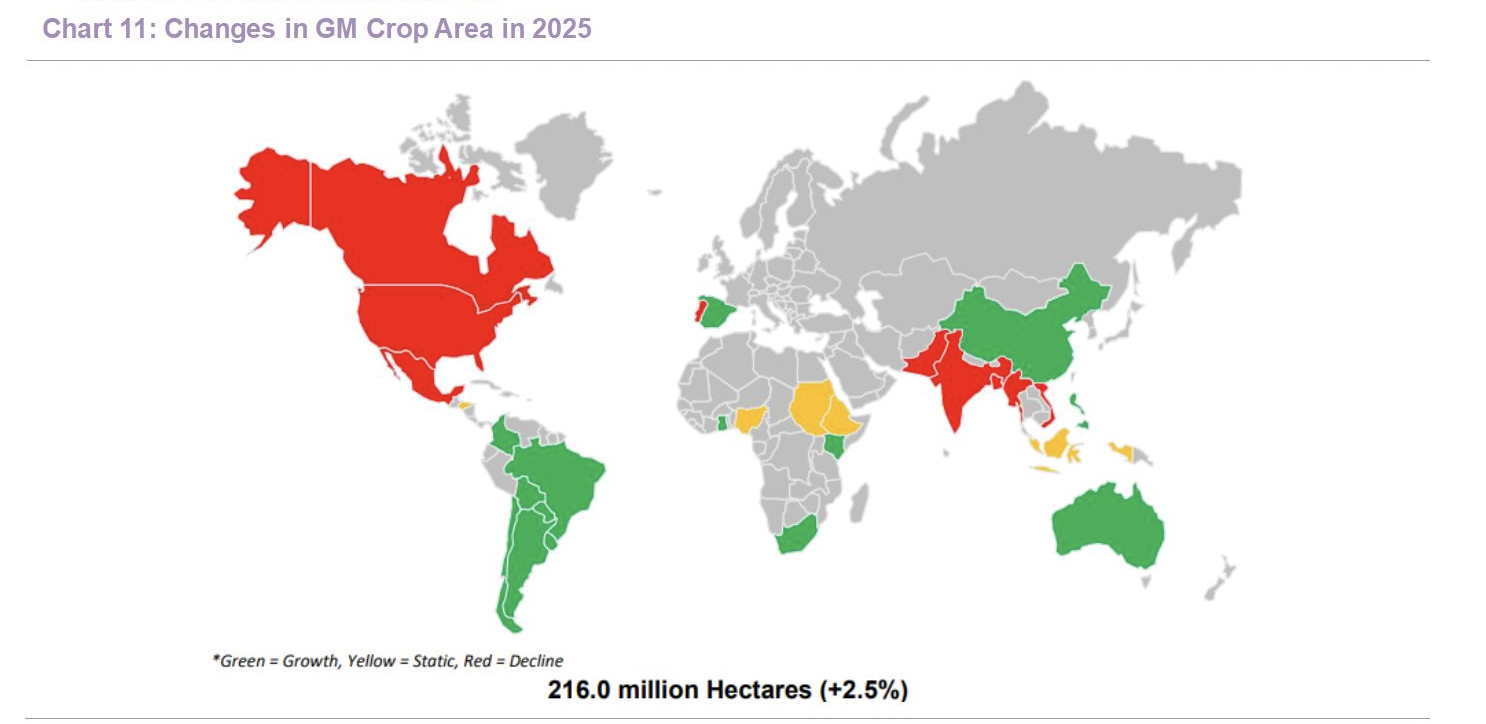
- The addressable market for precision-bred productivity traits is best framed through the seed value chain and trait-enabled planted area, rather than as a standalone gene-editing TAM. Productivity traits are monetized through seed-company channels, which makes the global seed market, GM seed market and trait-enabled planted area the most relevant third-party proxies for industry scale. The commercial precedent is already substantial: AgBioInvestor’s 2025 GM Crop Area Review reports that global GM crop area reached a record 216.0 million hectares in 2025, up 2.5% y/y, across 30 countries and 11 crops, with soybean, maize and cotton representing the largest planted categories. The same review reports global GM adoption rates of 73.9% for soybean, 76.7% for cotton, 35.8% for maize and 24.8% for canola, showing that farmers have adopted trait-enabled seed at scale where the agronomic value proposition is clear. Gene editing expands this opportunity by targeting crops, geographies and traits where transgenic approaches have historically faced regulatory, consumer or technical limitations, while still relying on the same core economic logic: traits that improve yield, reduce cost or protect farm margins can support durable seed-channel monetization.
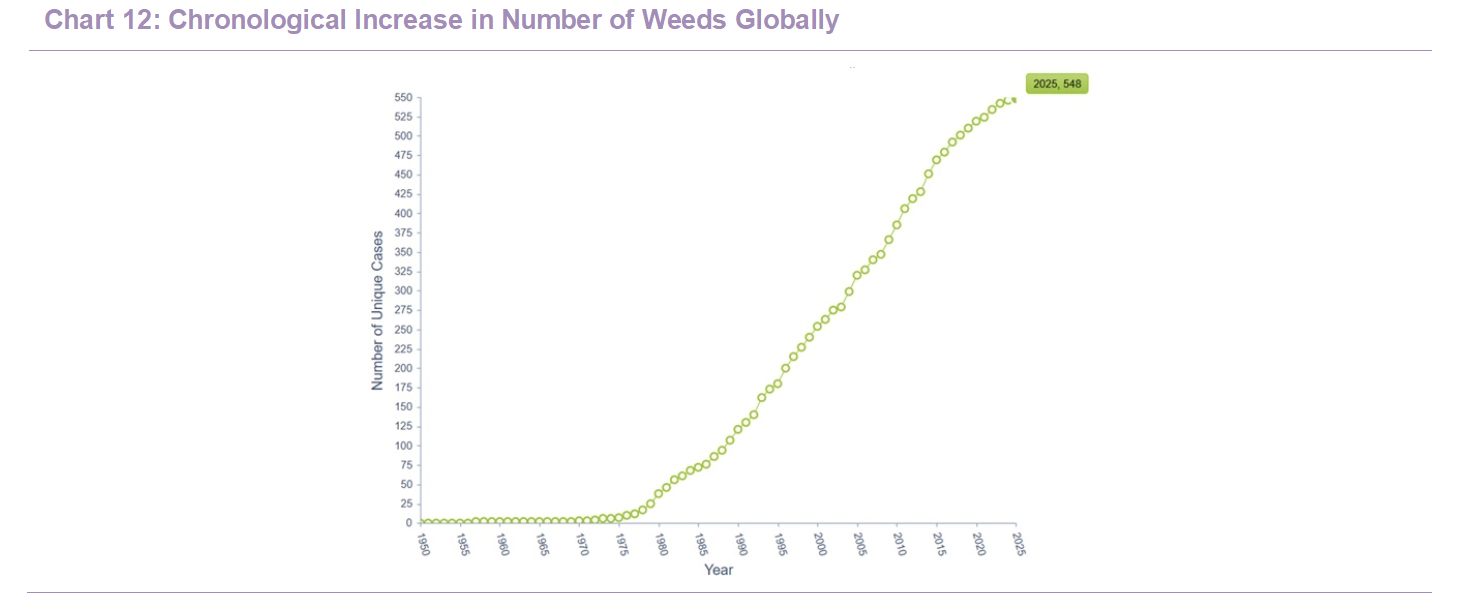
- Weed pressure and food-security priorities are increasing demand for precision-bred productivity traits. Herbicide resistance continues to broaden globally, making weed control a structural productivity issue rather than a single-crop challenge. The International Herbicide-Resistant Weed Database reported 548 unique cases of herbicide-resistant weeds globally as of May 28, 2026, spanning 275 weed species, 168 herbicides, 102 crops and 76 countries. This backdrop supports demand for new weed-management traits, especially in crops where existing GMO-based herbicide-tolerance systems are limited or unavailable. Rice is particularly relevant because it is both a strategic food-security crop and a market where weed competition can materially pressure yield and production costs. India’s 2025 launch of the country’s first genome-edited rice varieties also signals that major rice-producing countries are beginning to frame gene editing as a productivity and resource-efficiency tool. The Indian Council of Agricultural Research (ICAR) states that its genome-edited rice varieties have the potential to deliver a 19% yield increase, 20% lower greenhouse gas emissions, 7,500 million cubic meters of irrigation-water savings and improved tolerance to drought, salinity and climate stress. This points to a practical farmer-led adoption case: precision breeding is gaining relevance where it can improve weed control, lift yields, strengthen resilience and reduce resource intensity.
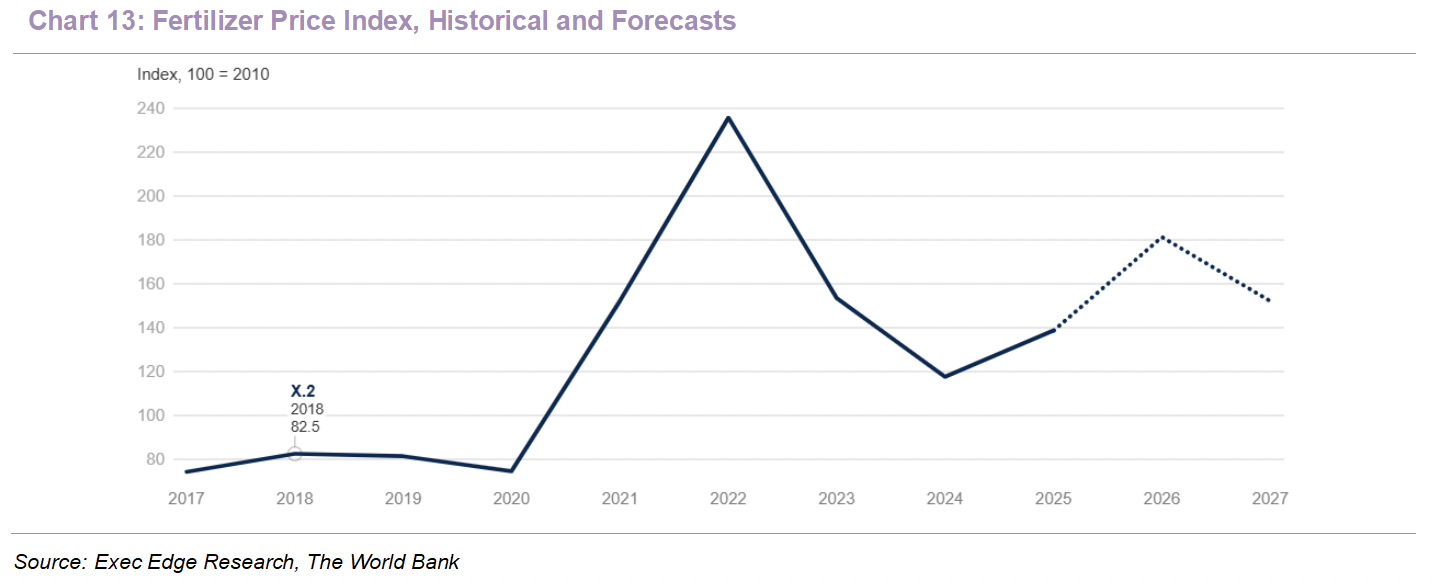
- Input volatility and crop disease pressure are increasing the value of traits that protect farm-level productivity. Fertilizer markets have become a clear pressure point for growers, particularly in nitrogen-intensive crops such as rice, wheat and canola. The World Bank reported that its fertilizer price index rose more than 12% q/q in 1Q26, reached its highest level since October 2022 by April 2026 and is projected to rise by more than 30% in 2026, supported by higher input costs, resilient demand and supply disruptions. Urea prices also moved sharply higher, reinforcing the need for traits that can improve nutrient efficiency and reduce input sensitivity. Disease and pest pressure adds a second demand driver: FAO estimates that up to 40% of global crop production is lost annually to plant pests and diseases, costing the global economy more than $220 billion, while invasive insects add at least $70 billion of economic losses. Together, these pressures strengthen the industry case for nutrient-use-efficiency, disease-resistance and weed-management traits because the value proposition extends beyond yield improvement to protecting farm margins when fertilizer, crop-protection and weather risks are elevated.
- Trait-enabled seed adoption supports future royalty economics because farmers have adopted productivity traits at scale when the value proposition is clear. U.S. adoption data provide the clearest long-duration evidence that farmers will pay for seed traits that improve weed control, insect control or operating efficiency. USDA-ERS data show that more than 90% of U.S. corn, upland cotton and soybeans are now produced using genetically engineered varieties. Herbicide-tolerant soybean acreage increased from 17% of domestic soybean acres in 1997 to 96% in 2024 and remained at 96% in 2025, while herbicide-tolerant upland cotton reached 93% and herbicide-tolerant corn accounted for ~92% of U.S. corn acres in 2025. Bt adoption also remains high, with Bt corn at 87% and genetically engineered insect-resistant cotton at 91% in 2025. This does not guarantee adoption of gene-edited traits, which may face different regulatory, channel and consumer considerations, but it supports the royalty logic: traits that solve clear farm-level problems can achieve broad and durable uptake. Farmer survey evidence points in the same direction, with Bayer’s 2024 Farmer Voice survey showing that farmers prioritize technologies that improve yields, reduce input costs and improve quality.
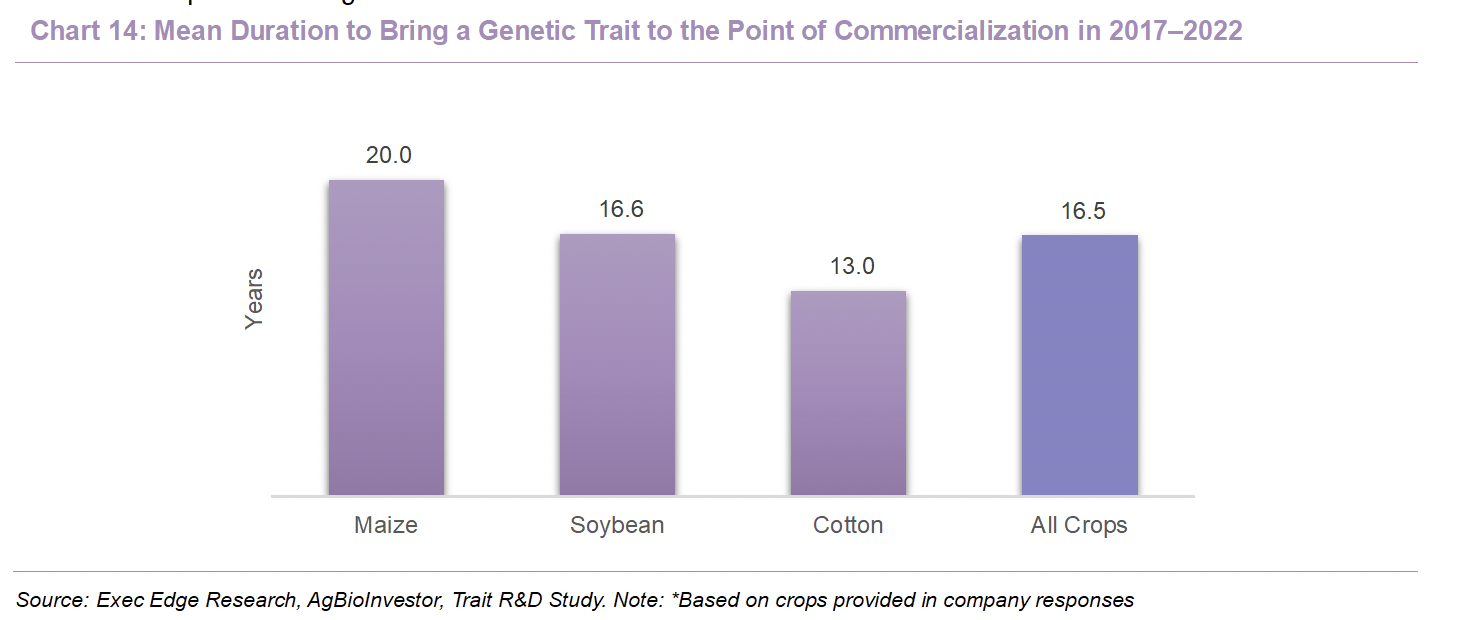
- Seed companies need faster precision-breeding tools as agronomic challenges move faster than legacy development cycles. Conventional breeding and transgenic trait development remain long-cycle processes, creating a gap between field-level pressure and new trait commercialization. CropLife International and AgBioInvestor’s 2022 trait R&D study found that the cost of discovery, development and authorization of a new plant biotechnology-derived genetic trait commercialized in 2017-2022 was $115.0 million, while the mean time to commercialization was 16.5 years. Regulatory activities represented 37.6% of total cost and 51.1% of non-consecutive development time, highlighting why faster, risk-appropriate and product-based approaches matter to seed innovation. Recent industry activity shows how gene editing is being positioned against that bottleneck: Reuters reported that InterGrain and Inari initiated a gene-edited wheat trial in Australia targeting at least 10% yield improvement, with enough seed expected for more than 45 trial sites in the 2025 growing season and potential products around 2028. InterGrain and Inari also stated that gene editing could achieve gains 10-15x faster than traditional plant breeding.
- CBUS is positioned at the intersection of rising productivity-trait demand and a royalty model that can scale if rice commercialization converts. The company’s trait portfolio maps directly to the industry drivers above: rice HT1 and HT3 address weed management across an initial 5–7 million peak addressable acres in the U.S. and LATAM; broader rice opportunities extend into Asia and India; canola and soybean programs address weed management and Sclerotinia resistance; and nutrient-use-efficiency and wheat programs provide longer-duration optionality in nitrogen-intensive crops. CBUS’ disclosed opportunity set represents ~367-369 million peak addressable acres and >$1.9 billion of potential annual addressable royalties, although those figures remain illustrative until customer agreements, regulatory clearances, seed multiplication and farmer adoption become visible at scale. The 2027 LATAM rice target is therefore the key first test of whether CBUS can translate precision-bred traits into a repeatable seed-company royalty model, while partner-funded opportunity programs provide exposure to broader productivity demand without requiring CBUS to fund every crop internally.
Gene-Editing Regulation is Moving Toward Product-Based, Conventional-Like Pathways
- Gene-edited crop regulation is increasingly diverging from legacy GMO frameworks, but market access remains country- and trait-specific. A 2026 npj Science of Plants review across 196 countries identified eight regulatory statuses for gene-edited plants, including 24 countries where gene-edited plants are allowed for any use, 37 where legislation is under discussion, 7 where gene-edited plants are regulated as transgenic plants, 3 where they are not allowed, 114 with no legislation and 10 with no data available. The same study found that countries with more permissive transgenic-plant regimes are more likely to allow gene-edited plants, suggesting that prior biotechnology familiarity may accelerate adoption of differentiated gene-editing frameworks. Regionally, the study highlights the U.S. and Canada as North American leaders, Australia as the only Oceanian market treating gene-edited plants as conventional crops, England as the only European jurisdiction allowing gene-edited plants for any use as of the study date, and several Asian markets, including Israel, Japan, China, the Philippines, India, Singapore and Thailand, as having adopted similar regulatory approaches. For the industry, this is a meaningful shift: gene editing is no longer automatically grouped with transgenic modification in every market, but developers still face a fragmented rulebook that can affect field trials, seed movement, food / feed use, import acceptance and commercialization sequencing.
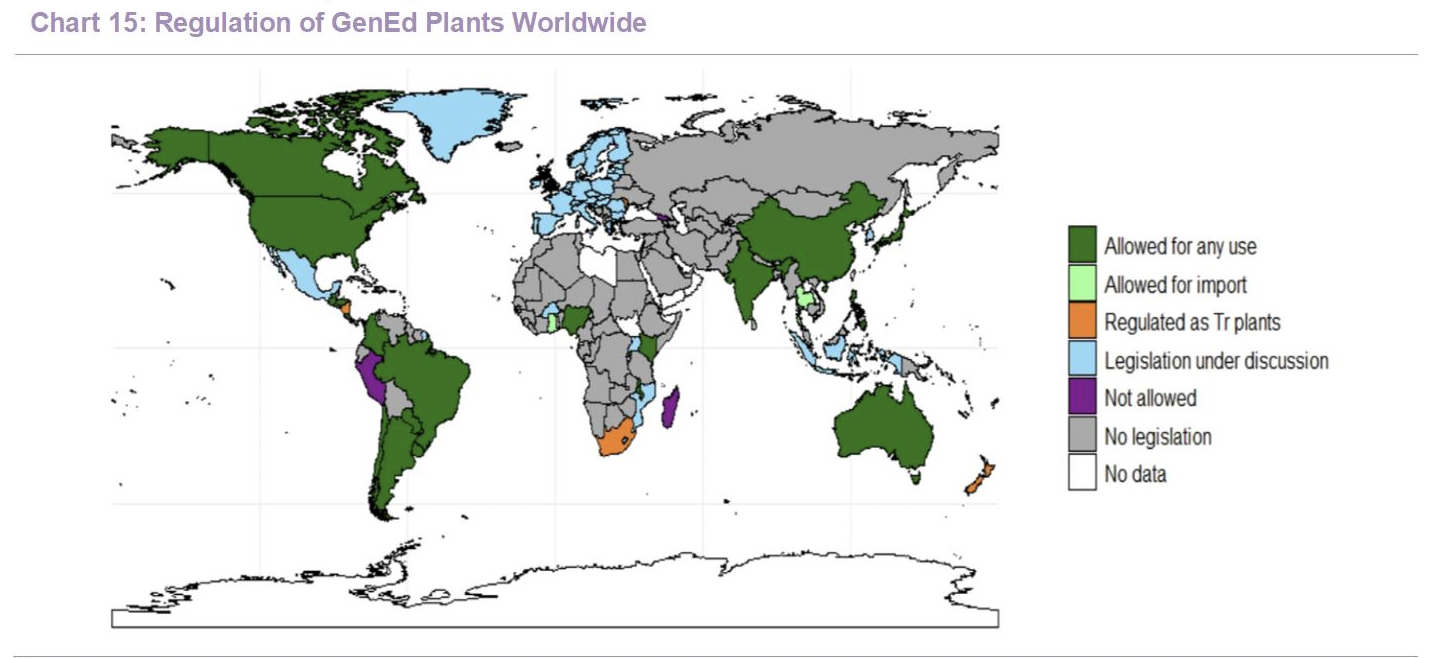
- Latin America is becoming a test market for differentiated gene-editing regulation, although implementation remains country-specific. Regional reviews describe Latin America and the Caribbean as moving toward case-by-case treatment of gene-edited crops, with regulatory approaches developing across markets such as Argentina, Brazil, Colombia, Paraguay and Peru while still varying by jurisdiction. A 2023 Frontiers in Bioengineering and Biotechnology review notes that regional gene-editing regulation remains uneven, while the Inter-American Development Bank similarly indicates that much of Latin America is coalescing around comparable genome-editing governance without a single harmonized rulebook. In practice, the key question is whether the edit introduces foreign genetic material; where it does not, certain crops may qualify for conventional seed pathways rather than transgenic approval processes. Ecuador is now an important rice-specific example: its Ministry of Agriculture and Livestock determined that Cibus’ HT1 and HT3 rice traits are equivalent to conventionally bred varieties and subject to conventional seed regulation, despite Ecuador’s prohibition on commercial planting of transgenic crops. For CBUS, this makes LATAM regulation commercially actionable, but still dependent on crop-, trait- and country-level determinations.
- The U.S. framework is becoming more operational as oversight increasingly focuses on product characteristics rather than editing method alone. USDA-APHIS describes its revised biotechnology regulations as focusing on an organism’s properties rather than the method used to produce it, allowing more targeted oversight and reduced regulatory burden for qualifying developers. Under 7 CFR Part 340, certain modified plants may be exempt where the change could otherwise have been developed through conventional breeding and is unlikely to increase plant-pest risk; developers can also request APHIS confirmation that a modified plant is not subject to Part 340. On the food-safety side, FDA’s 2024 guidance clarifies that its risk-based New Plant Variety policy applies to foods derived from genome-edited plants, with developers able to use voluntary premarket consultations or premarket meetings depending on food-safety characteristics. The U.S. system does not remove oversight, but it creates clearer separation among plant-pest risk, food / feed safety engagement and product-specific developer submissions.
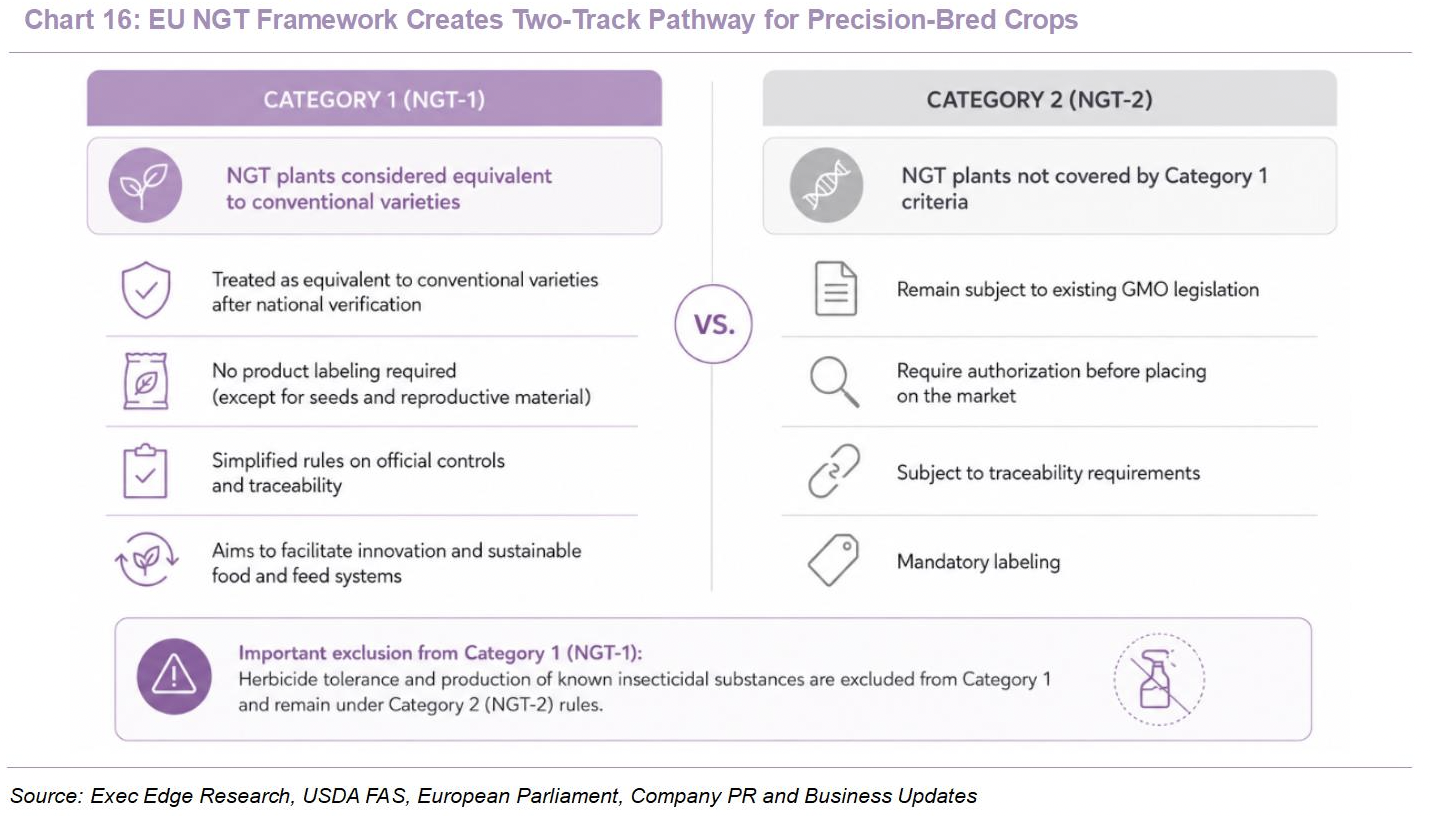
- Europe and England are moving from policy debate toward operational precision-breeding pathways, although trait-level constraints remain central to market access. England’s precision-breeding framework already operates through release notices for R&D releases and marketing notices before commercialization, with confirmed precision-bred organisms published through Defra’s public register. In the European Union, the European Parliament adopted new rules for plants developed through New Genomic Techniques in June 2026, concluding the EU legislative process and creating a differentiated NGT-1 / NGT-2 framework, with implementation pending. The new framework splits NGT plants into NGT-1 and NGT-2 categories. NGT-1 plants are those with limited changes that could have occurred through conventional breeding and, once verified, will be treated like conventional plants; NGT-2 plants will be subject to additional oversight similar but not the same as existing GMO rules, including risk assessment and authorization. The key caveat is trait-level eligibility: plants engineered for herbicide tolerance or to produce insecticidal substances cannot become NGT-1 plants. For CBUS, the update is positive for non-HT European programs such as disease resistance and Pod Shatter Reduction in oilseed rape, but HT traits remain more constrained in the EU.
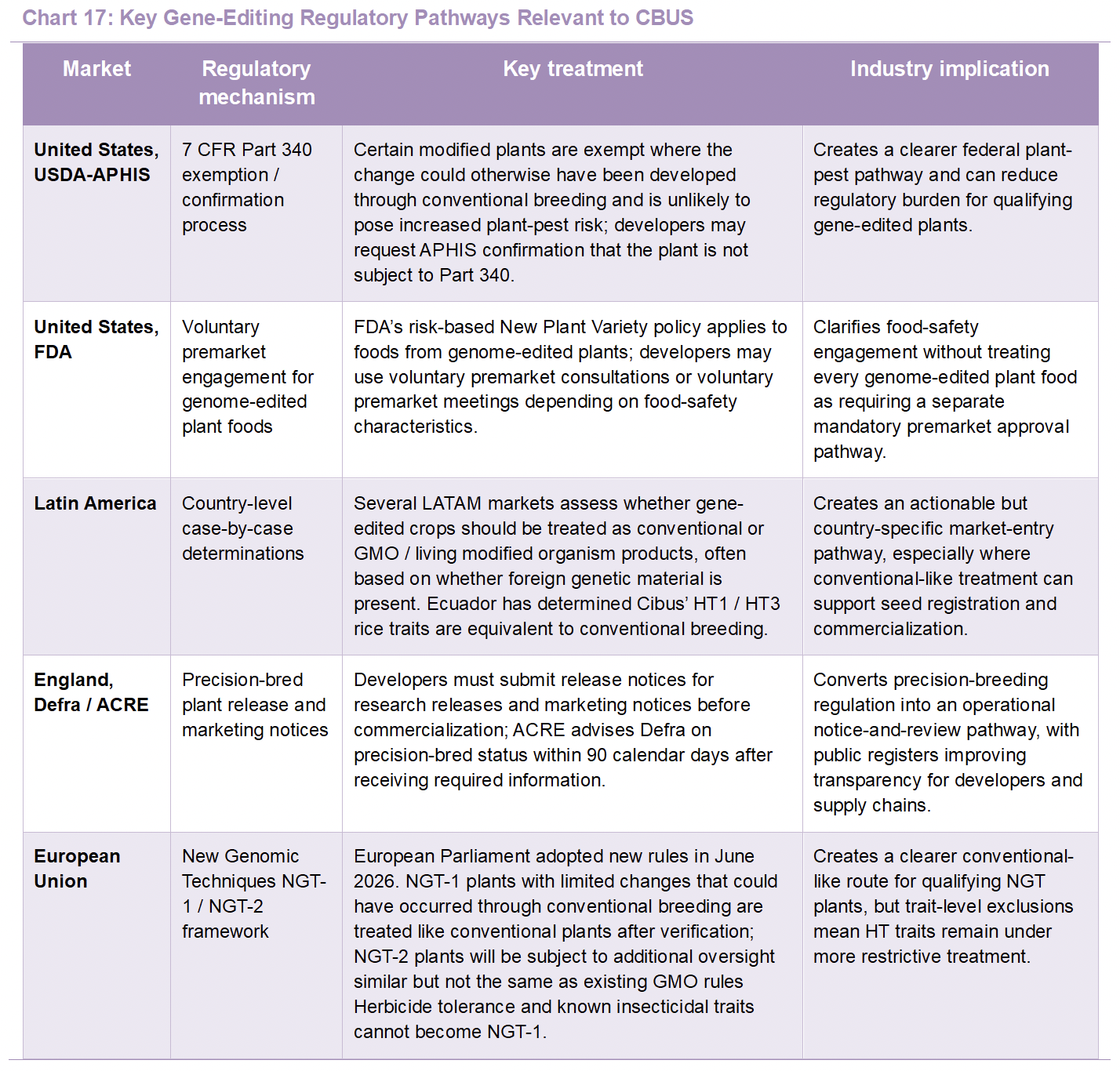
- CBUS is well positioned for regulatory regimes that separate non-transgenic gene editing from legacy GMO frameworks, though benefits remain geography- and trait-specific. CBUS’ Rapid Trait Development System (RTDS) is designed to produce non-transgenic traits, aligning the company with jurisdictions that evaluate gene-edited crops based on the nature of the final genetic change rather than the use of gene-editing tools alone. The most direct near-term read-through is in Latin America, where Ecuador’s conventional-breeding equivalence determination for HT1 and HT3 rice supports the targeted LATAM commercialization pathway. Additional rice market discussions in Brazil, Argentina and India expand the longer-term opportunity set, but commercialization will still require country-, crop- and trait-level execution. In the U.S., USDA-APHIS not-regulated determinations, FDA premarket meetings and California Rice Commission authorization support field work, food / feed engagement and staged commercialization planning. Europe is now more constructive for CBUS’ non-HT opportunity set after the European Parliament’s June 2026 approval of the NGT framework. Disease-resistance and Pod Shatter Reduction programs in canola / oilseed rape appear better aligned with Category 1 treatment, while herbicide-tolerance traits remain excluded from that route. Overall, regulation is becoming a clearer enabler for selected CBUS programs, but commercialization will still depend on country-level determinations, trait eligibility and partner execution.
Sustainable Ingredients and BioFragrances Emerge as a CPG Decarbonization Lane
- Sustainable ingredients are moving from brand-level sustainability language into formulation-level innovation across consumer packaged goods. Large CPG companies are increasingly looking beyond packaging and manufacturing efficiency toward raw materials, ingredients and product-use emissions, as Scope 3 supply-chain impact is difficult to reduce without changing what goes into the product itself. P&G’s net-zero ambition covers greenhouse gas emissions across operations and supply chain “from raw material to retailer” by 2040, underscoring why lower-carbon ingredients are becoming relevant to procurement and R&D teams, not just sustainability departments. The fragrance and flavor value chain is particularly exposed because it combines petrochemical inputs, natural extractions, agricultural feedstocks, logistics and formulation chemistry. IFRA and IOFI’s 2025 Sustainability Report similarly frames sustainability as a value-chain priority across responsible sourcing, climate action, product safety and transparent reporting. As a result, CPG customers should increasingly value ingredient suppliers that can reduce carbon intensity while preserving scent performance, product quality and consumer acceptance.
- Biotechnology is becoming a practical route to sustainable fragrance molecules because it can complement or replace petrochemical and resource-intensive natural supply chains. A 2026 Royal Society of Chemistry (RSC) Sustainability paper argues that fragrance sustainability needs to be evaluated across sourcing, production, biodegradability, formulation design and end-of-life impact. The paper cites bio-based chemicals such as biocyclamol, an identical chemical entity to dihydrofarnesol, as an example of a molecule with a significantly reduced carbon footprint and lower petrochemical-related impact. It also notes that innovative ingredients can replace scarce or resource-intensive natural materials and substitute large-volume petrochemical compounds where lower-volume alternatives can deliver the same desired effect. This matters for CPG because fragrance quality is central to categories such as home care, fabric care, personal care and beauty; lower-carbon alternatives still need to match existing standards for scent, stability, consistency and cost. The opportunity is therefore not limited to “natural” fragrance, but includes nature-identical and bio-based molecules that can preserve olfactive performance while improving carbon intensity, sourcing and supply-chain resilience.
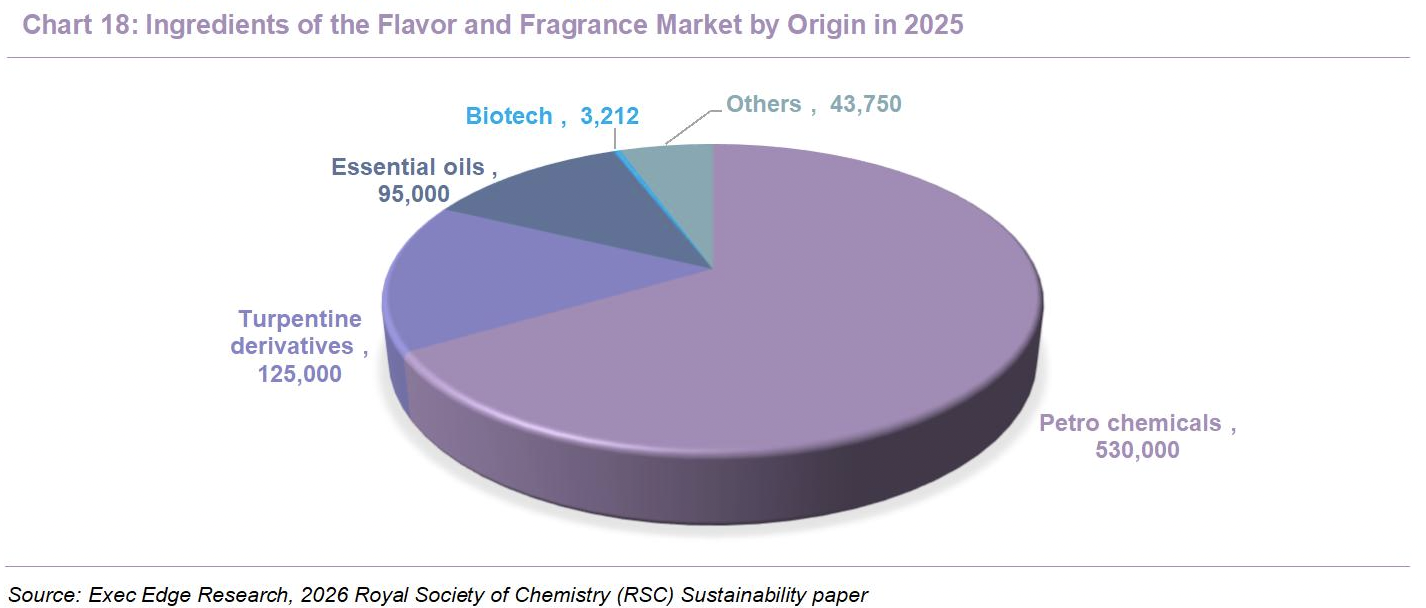
- Industry adoption is already visible as major fragrance houses commercialize biotech, renewable-carbon and upcycled ingredient platforms.
-
- Dsm-firmenich: The company states that its biotechnology capabilities use sugar fermentation, bio-conversion and advanced distillation to create ingredients from renewable carbon, with benefits including lower resource use, reduced CO2 emissions, supply reliability and consistent product quality. Its Re collection provides a concrete example, with renewable and upcycled ingredients designed to replace fragrance inputs historically derived from petrochemistry without olfactive compromise.
-
- Givaudan: The company is also investing in biotechnology for fragrance and beauty through dedicated Biotechnology Centres of Expertise and sustainable olfactive innovations. These examples show that sustainable fragrance is no longer limited to niche natural sourcing; it is becoming a competitive R&D arena where synthetic biology, fermentation, green chemistry and upcycling can expand the perfumer’s palette while helping CPG customers manage carbon, traceability and supply resilience.
- The fragrance market is large enough to support dedicated ingredient innovation, while bio-based ingredients represent the more directly relevant opportunity for CBUS. Allure, citing Euromonitor, reported that the fragrance category was expected to grow from $64.4 billion in 2023 to $68.9 billion in 2024, implying ~7.0% growth. Euromonitor separately expects fragrances to grow at a 5.5% CAGR from 2024-2029, with the category contributing 23% of absolute beauty industry growth over that period. Applying Euromonitor’s 5.5% CAGR to the $68.9 billion 2024 fragrance market implies a $72.7 billion market in 2025 and a ~$90.0 billion market by 2029, based on Exec Edge calculations. The bio-based ingredient layer is smaller but more directly aligned with CBUS’ Sustainable Ingredients program: WiseGuy Reports estimates the global bio-based flavors and fragrances market at $3.84 billion in 2025, growing to $6.5 billion by 2035, implying a 5.4% CAGR from 2026-2035. Growth is expected to be supported by consumer demand for natural and organic products, improved extraction and synthesis methods, and rising interest in bio-based alternatives that align with sustainability and carbon-reduction priorities. Personal care, cosmetics and household products are particularly relevant end markets given their reliance on fragrance performance, formulation consistency and brand-level sustainability commitments.
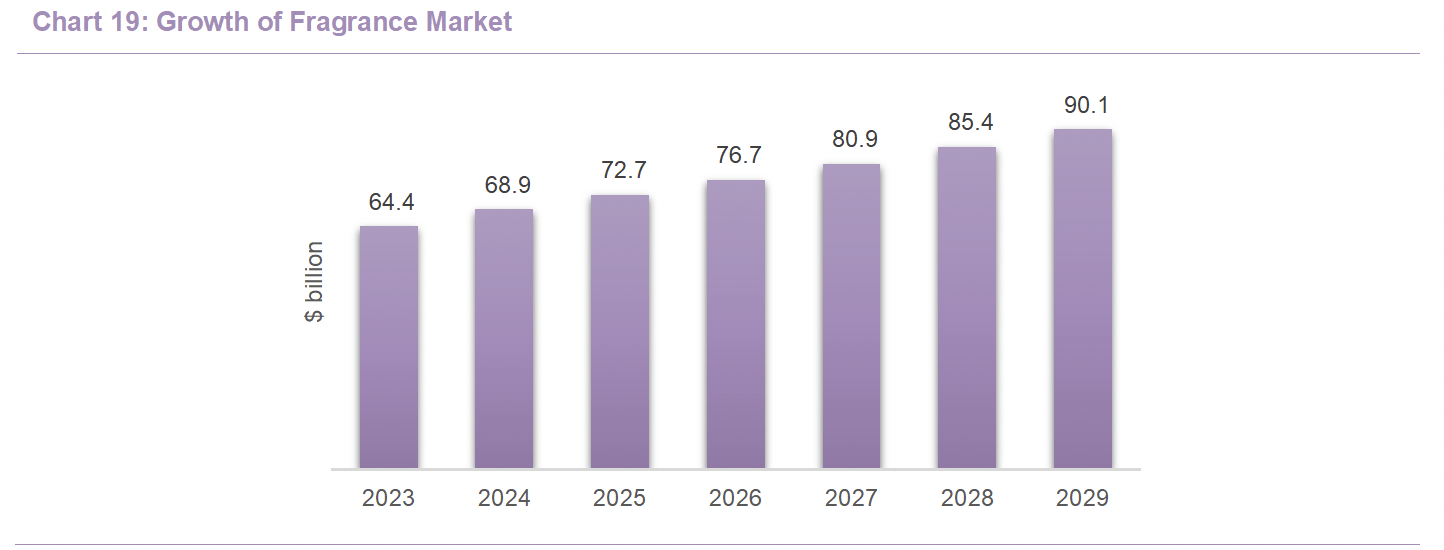
- CBUS’ Sustainable Ingredients program gives the company exposure to a focused bio-based ingredient opportunity within the broader fragrance market. The program uses yeast genetics and fermentation to produce sustainable, low-carbon fragrance ingredients, positioning CBUS where CPG customers are looking for bio-based alternatives to petrochemical inputs, costly natural extraction processes and less preferred synthetic fragrance products. The opportunity is narrower than the global fragrance category, but more directly aligned with the $3.84 billion bio-based flavors and fragrances market estimated by WiseGuy Reports. CBUS has already completed pre-commercial pilot runs for two BioFragrance products, received its first customer payment in 4Q25, and is targeting additional scale-up orders in 2H26. Fully commercialized natural BioFragrance partnerships represent a targeted $20 million to $40 million annual royalty opportunity, creating a potential near-term revenue bridge as rice advances toward LATAM commercialization.
Management Team
Craig Wichner to Lead CBUS Through Commercial Execution Phase
- CBUS’ management team now combines commercialization-focused leadership, financial discipline and founder-led scientific continuity as the company moves toward trait commercialization. New CEO Craig Wichner brings agribusiness, farmland-investment and capital-allocation experience, while co-founders Peter Beetham (President and COO) and Greg Gocal (Chief Scientific Officer) anchor platform continuity. Depth across finance, research, commercial, legal, administrative and systems functions is provided by Carlo Broos, Noel Sauer, Andrew Walker, Rosa Cheuk Kim, Jason Stokes and Steve Sanders. CBUS’ board adds agribusiness, capital-markets, royalty and governance experience under Chairman Mark Finn.

Growth Strategy
Commercial Roadmap Prioritizes Rice Royalty Conversion and Ingredients Scale-Up
- CBUS’ growth strategy prioritizes near-term commercialization in rice and Sustainable Ingredients while keeping broader crop optionality partner funded. The growth strategy is centered on converting edited material, customer relationships and pilot-scale validation into revenue-generating agreements. Rice herbicide tolerance remains the primary royalty-validation pathway, with LATAM now the clearest near-term proof point following the Interoc LOI, import permit and May 2026 material transfer, while Sustainable Ingredients provides a nearer-term commercial ramp through BioFragrance scale-up and customer-funded development activity. This sharper execution posture narrows the company’s focus around programs with the clearest route to customer delivery, pricing discussions, scale-up orders and commercial agreements. The broader platform still carries multi-crop optionality, but the near-term growth equation is increasingly defined by whether CBUS can move edited rice germplasm into partner seed systems, secure commercialization agreements with Latin American rice partners, scale BioFragrance orders with its consumer packaged goods partner, and preserve enough capital runway to bridge into initial royalty revenue.
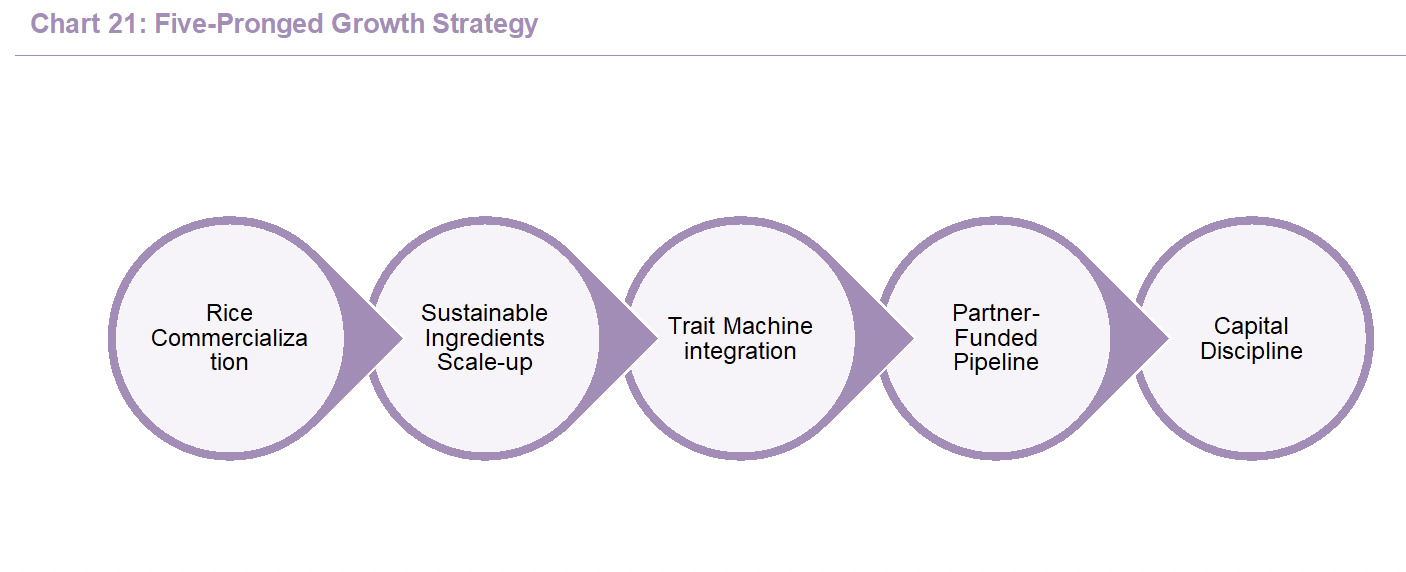
- CBUS’ rice strategy is to convert LATAM material transfers into commercialization agreements before the U.S. launch window opens. The lead productivity traits are herbicide tolerance (HT) traits HT1 and HT3, which address weed-management needs across Latin America and the U.S. and represent over $200 million of management-estimated annual addressable royalties at peak across the Americas. CBUS has seven active rice customer relationships across Latin America and the U.S., representing 5 million to 7 million peak addressable acres.
-
- Latin America is the primary near-term launch corridor, with Interoc serving as the initial anchor partner. CBUS signed a non-binding letter of intent (LOI) in January 2026, Interoc received an additional import permit in March 2026, and CBUS transferred completed gene-edited HT material in Interoc’s elite rice germplasm in May 2026. The 2027 LATAM launch target is tied to testing, seed production, commercialization agreements and launch readiness in Ecuador and Colombia, with potential phased expansion into Peru, Central America and the Caribbean.
-
- The U.S. launch target has moved from 2028 to 2029, reflecting Albaugh’s clethodim herbicide registration timeline, making LATAM execution the critical near-term proof point.
- Sustainable Ingredients provides a second commercial pathway while rice advances toward royalty conversion. The program is focused on BioFragrance products and other sustainable ingredients developed through a partner-supported model, creating a potential bridge between collaboration revenue and future crop-trait royalties. CBUS received its first customer payment in 4Q25, continued to receive customer payments in 1Q26, and is targeting additional scale-up orders for initial BioFragrance products in 2H26. The work has moved beyond proof-of-concept, as pre-commercial pilot runs validated scale-up readiness and current activities are centered on scale-up schedules, production volumes, pricing terms and final product formulations with its consumer packaged goods partner. The program is strategically useful because it can support nearer-term revenue while showing that CBUS’ biological design capabilities extend beyond seed traits. However, it remains an emerging commercial opportunity rather than a fully de-risked revenue stream, given limited disclosure on margin structure, exclusivity, order size and final commercialization terms.
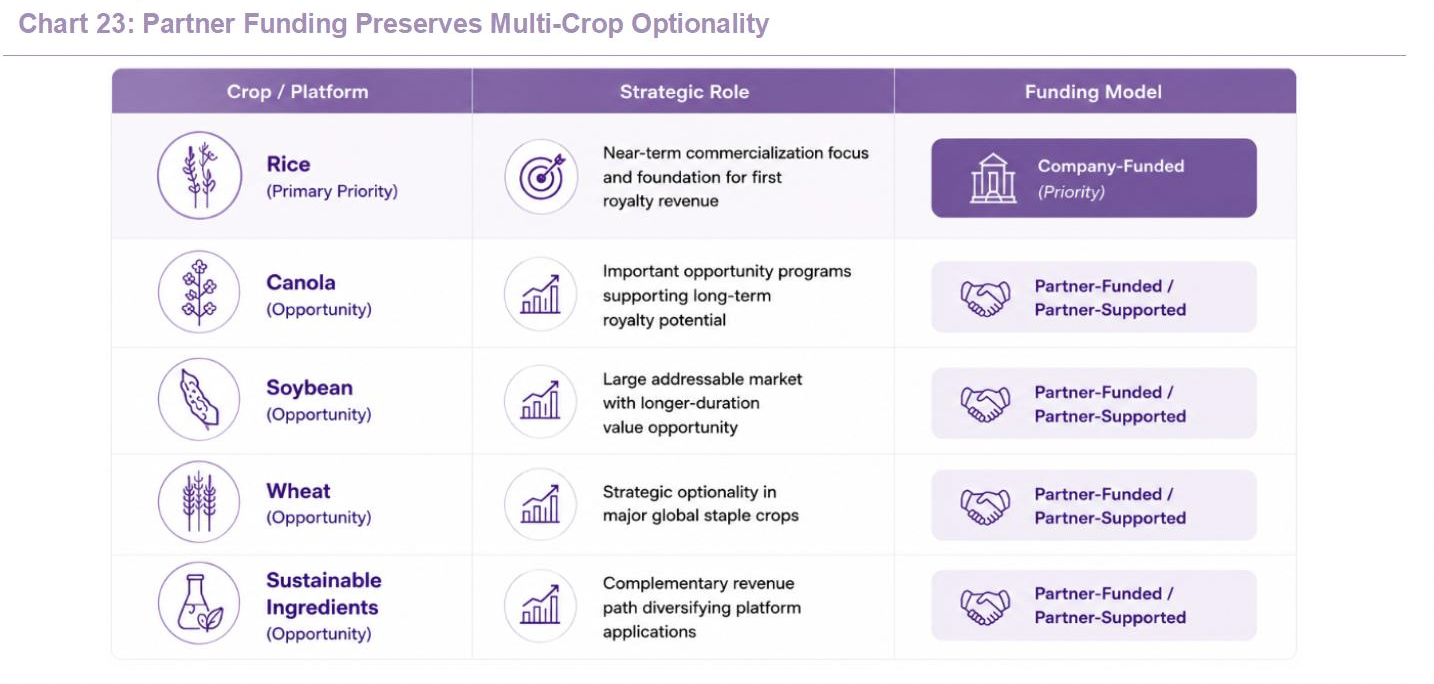
- CBUS aims to position the Trait Machine process as a recurring editing layer across partner breeding and product-development workflows. The strategic objective is not simply to license one trait into one crop, but to embed CBUS’ editing capabilities into broader customer development programs. In seed crops, the Trait Machine process allows CBUS to edit directly inside customer elite germplasm, transfer edited material back to seed-company partners, and potentially retain a share of the value created through royalties. That model could support a broader set of recurring relationships if customers use CBUS as a precision-breeding engine across crops and traits rather than as a one-off development partner. Rice is the clearest near-term example, while partner-funded wheat, canola, nutrient-use efficiency and future trait stacks represent longer-duration extensions. Sustainable Ingredients broadens the same platform logic into non-seed applications, where partner-supported BioFragrance scale-up can create an adjacent commercial pathway.
-
- The central diligence question is execution: the platform becomes more valuable as customer conversations convert into signed agreements, production materials, launch schedules, scale-up orders and royalty-bearing products, not merely as a technical capability.
- Partner-funded programs preserve platform upside while keeping internal focus on rice and Sustainable Ingredients. CBUS is keeping broader crop-trait optionality alive through partner-funded and partner-supported programs. The company’s non-rice opportunity pipeline includes canola disease resistance, Light Leaf Spot resistance in oilseed rape, nutrient-use efficiency, soybean HT2, wheat development and improved quality alfalfa. Canola and oilseed rape are the clearest examples of CBUS’ precision-breeding strategy outside rice, with CBUS participating as the gene-editing technology partner in a Defra-funded Farming Innovation Programme project targeting durable Light Leaf Spot resistance in oilseed rape. Nutrient-use efficiency also remains strategically relevant, with CBUS collaborating with the John Innes Centre on a trait opportunity that could apply across rice, wheat and canola, addressing a global challenge where only a portion of applied fertilizer is absorbed by plants. Soybean has reached successful cell editing for HT2, while wheat has progressed through regeneration of plants from single cells in a wheat cultivar. These programs extend the platform into large crops and high-value traits, but near-term internal capital allocation remains concentrated on rice commercialization and Sustainable Ingredients scale-up.
- Capital discipline is central to CBUS’ strategy as it bridges toward commercial agreements and early royalty conversion. CBUS is narrowing spend around commercial milestones while using equity financing to support the pre-royalty execution period. The company is targeting annual net cash usage of ~$30 million or less in 2026, supported by facility consolidation, workforce reductions and a tighter operating footprint. CBUS completed the closure of the Oberlin facility and consolidation into San Diego during 3Q25, substantially wound down activities at the Roseville facility, and raised $22.3 million of gross proceeds in January 2026 plus ~$15.0 million in March 2026. These proceeds are intended to support working capital, general corporate purposes and further development of rice weed-management traits. The financing extends the execution window for Interoc, additional LATAM rice partners, Sustainable Ingredients scale-up and partner-funded opportunity programs. This makes capital discipline a core part of the growth strategy, as lower cash usage improves CBUS’ ability to convert commercial milestones into revenue before requiring additional external funding.
Fundamentals and Valuation
Commercial Proof Points and Lower Cash Burn Define the Royalty Conversion Path
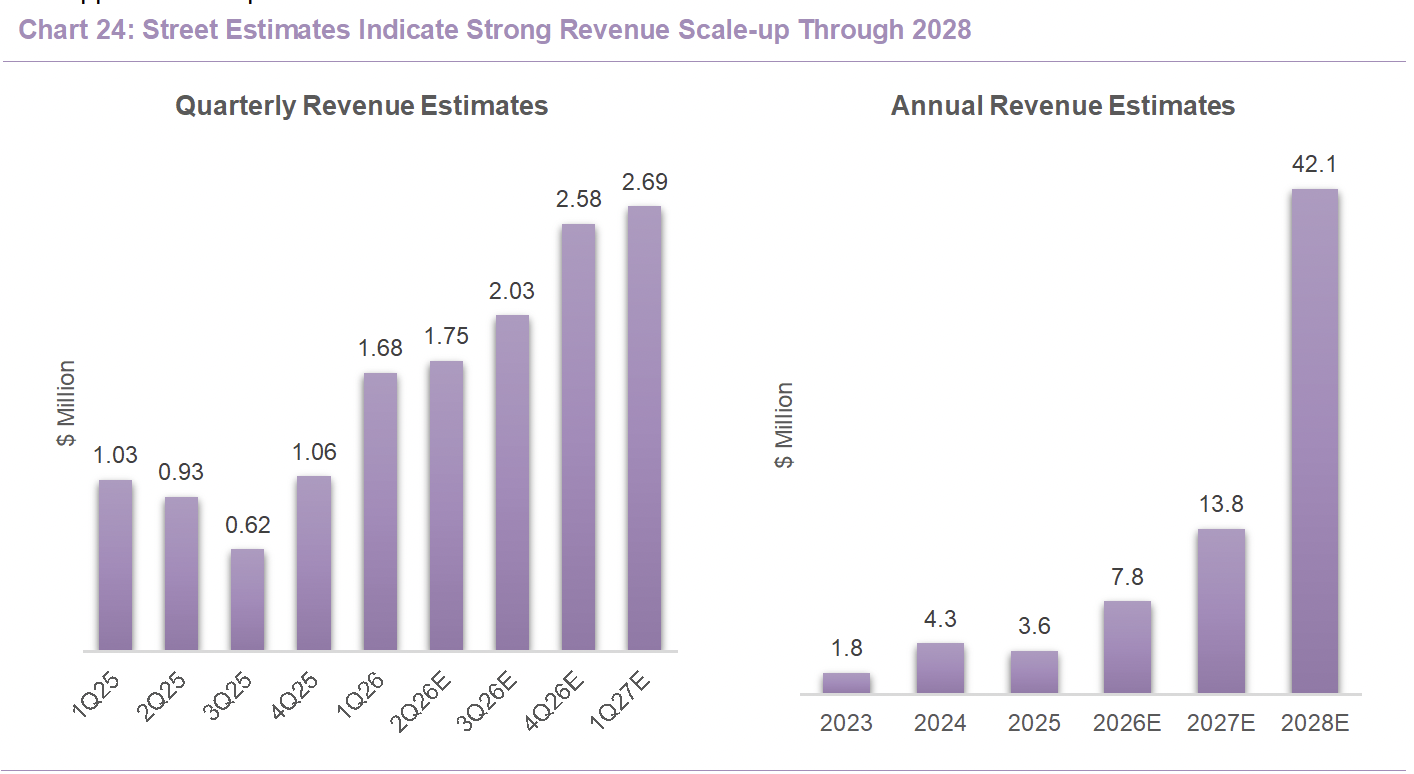
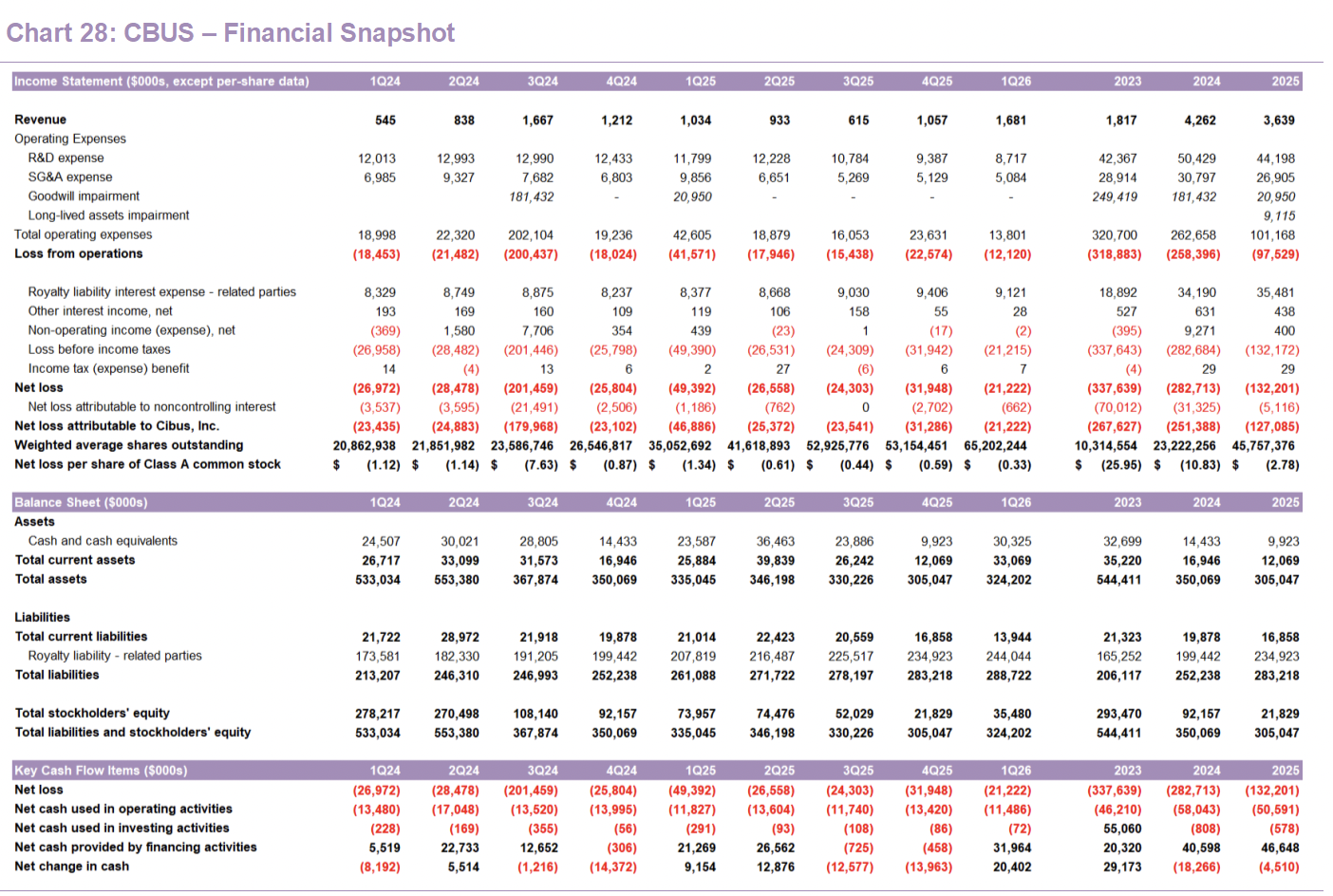
- CBUS’ revenue base remains early-stage, but disclosed commercial activity and consensus estimates point to a more visible revenue ramp through 2028. Revenue was $3.6 million in 2025, down from $4.3 million in 2024, but 1Q26 revenue increased to $1.7 million from $1.0 million in 1Q25, supported by progressing collaboration activity and timing of program payments. The near-term revenue base remains primarily collaboration-led rather than royalty-driven, with Sustainable Ingredients providing the clearest bridge through customer payments, expanded partner-funded R&D activity and targeted BioFragrance scale-up orders in 2H26. As per consensus estimates sourced from TIKR, revenue is expected to increase to $7.8 million in 2026E, and reach $42.1 million by 2028E, implying an 11.7x increase by 2028E versus 2025. Quarterly consensus also shows revenue rising from $1.7 million in 1Q26 to $2.6 million in 4Q26E and $2.7 million in 1Q27E. These estimates are not company guidance and still precede royalty validation, but the direction is consistent with CBUS’ disclosed roadmap: Sustainable Ingredients scale-up in 2H26, LATAM rice HT partner conversion ahead of the targeted 2027 launch, and partner-funded crop programs that can support broader platform monetization over time.
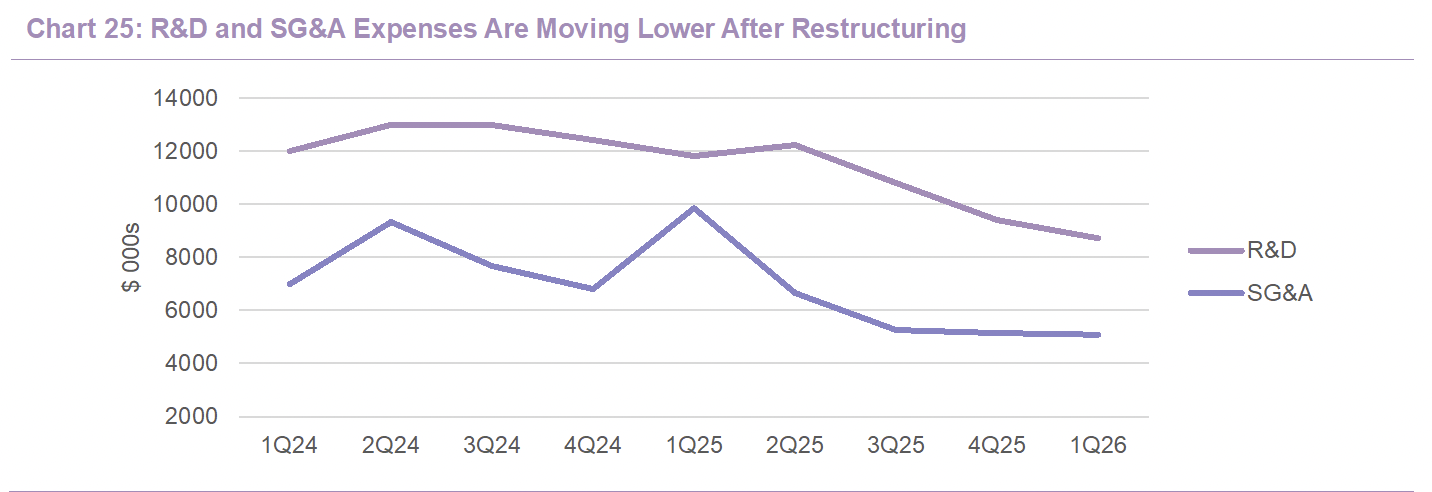
- Cost actions are creating a leaner operating base ahead of potential commercial revenue conversion. CBUS’ expense reset is improving the loss run rate before material royalty revenue begins. Research and development (R&D) expense declined to $44.2 million in 2025 from $50.4 million in 2024, while selling, general and administrative (SG&A) expense declined to $26.9 million from $30.8 million. The sharper proof point is visible in 1Q26: R&D declined to $8.7 million from $11.8 million in 1Q25, while SG&A declined to $5.1 million from $9.9 million. This creates a more favorable setup for the next phase, as incremental collaboration revenue, Sustainable Ingredients scale-up and eventual rice royalties would flow through a leaner cost base than the one CBUS carried during the broader R&D build-out. The company has also consolidated core operations into San Diego, wound down non-core facility activity and aligned internal capital around rice weed-management traits, Sustainable Ingredients and partner-funded programs. The setup is therefore improving on both sides of the model: a narrower commercial focus is reducing spend, while any successful revenue ramp would flow through a leaner operating base.
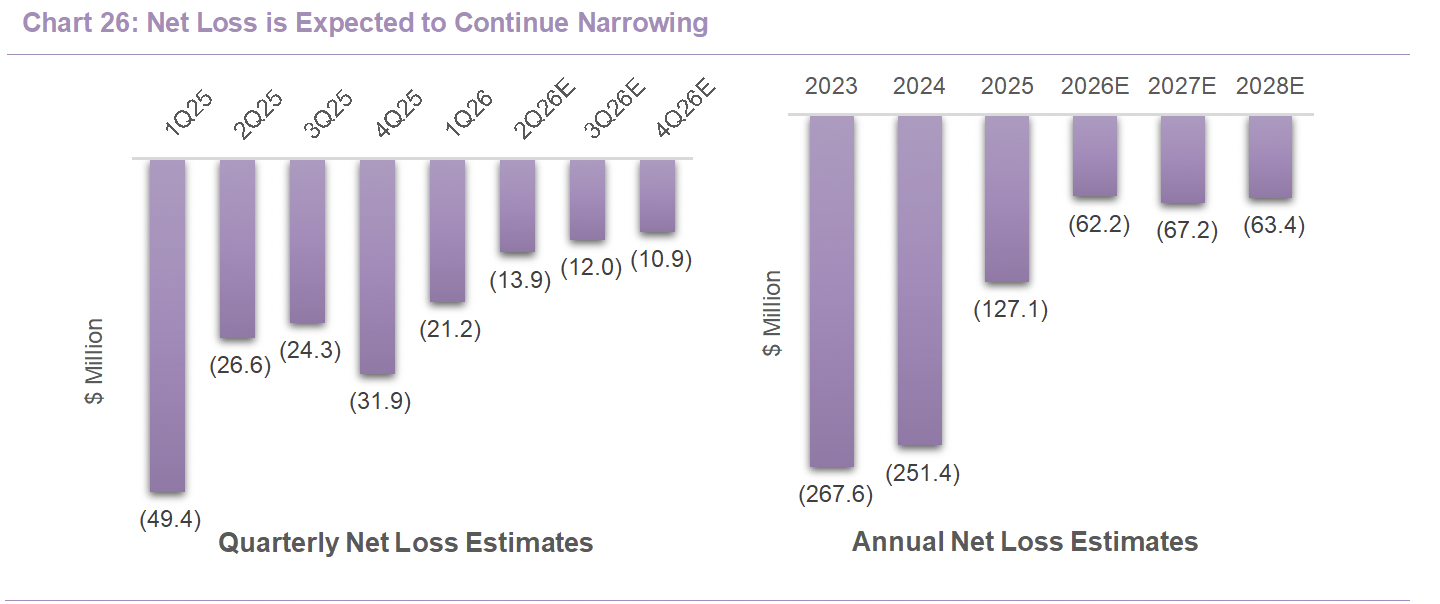
- CBUS’ loss profile is beginning to reflect the combined effect of cost discipline, narrower execution focus and early commercial activity. Net loss narrowed to $127.1 million in 2025 from $251.4 million in 2024, while 1Q26 net loss improved to $21.2 million from $49.4 million in 1Q25. The 1Q26 comparison benefited from lower R&D and SG&A spend and no repeat of the $21.0 million goodwill impairment recorded in 1Q25, but the improvement also reflects a lower operating run rate before royalty revenue becomes meaningful. Per consensus estimates sourced from TIKR, net loss is expected to narrow to $62.2 million in 2026E, while quarterly net loss is expected to decline sequentially through 4Q26E. EPS estimates show a similar reset, improving from a loss of $2.78 in 2025 to a loss of $0.92 in 2026E and $0.87 in both 2027E and 2028E. The financial trajectory increasingly reflects the same operating posture outlined by management: lower cash usage, tighter prioritization around rice and Sustainable Ingredients, and a cost base positioned to benefit if commercial revenue conversion accelerates.
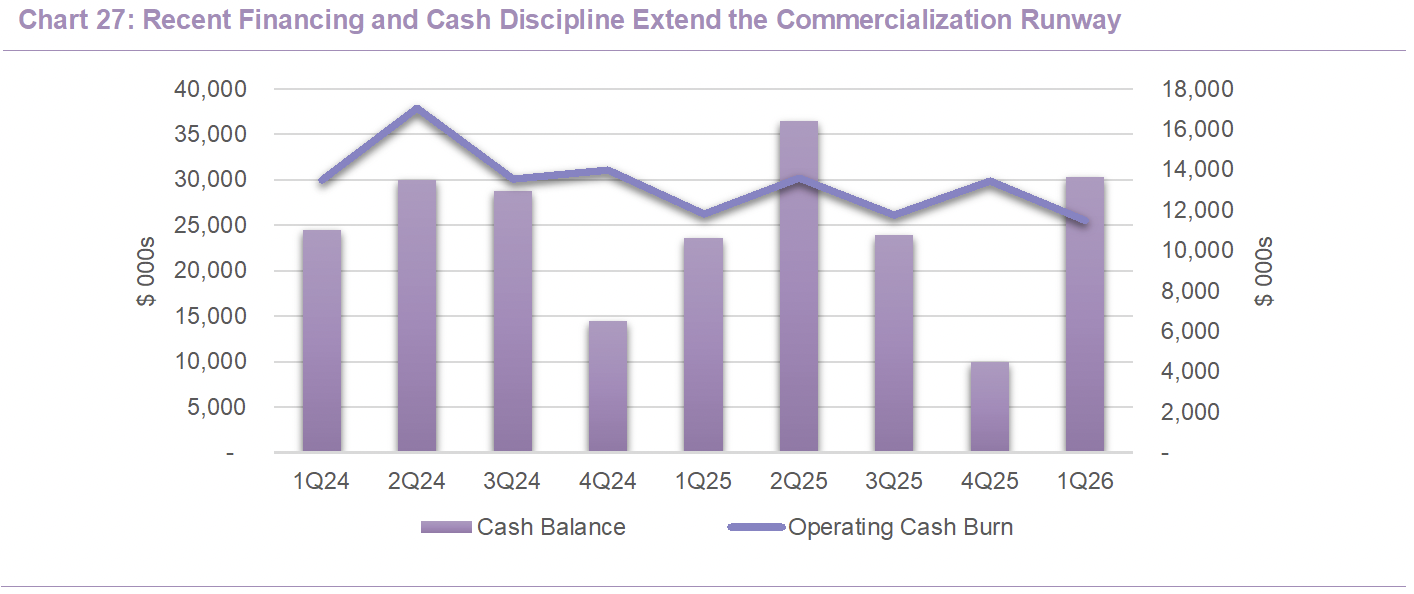
- Liquidity position has strengthened and the company has narrowed spending around the milestone window that matters most for commercialization. Cash and cash equivalents increased to $30.3 million at 1Q26 from $9.9 million at year-end 2025, supported by $22.3 million of gross proceeds from the January 2026 offering and $15.0 million from the March 2026 offering. The proceeds are being directed toward working capital, general corporate purposes and further development of rice weed-management traits, linking financing activity directly to the company’s priority commercialization program. Operating cash use was $11.5 million in 1Q26, modestly lower than $11.8 million in 1Q25, and CBUS is targeting annual net cash usage of ~$30 million or less during 2026.
-
- Existing cash is expected to fund planned operating expenses and capital expenditures into late 1Q27, excluding potential future financing. The liquidity position still requires careful management, but the combination of recent equity raises, lower cash usage and focused use of proceeds gives CBUS a clearer runway to execute on Interoc testing, LATAM commercial agreements, additional market discussions in Brazil, Argentina and India, and 2H26 Sustainable Ingredients scale-up orders.
- Financial inflection is increasingly tied to named commercial proof points and measurable execution milestones. CBUS’ financial outlook is becoming more milestone driven as the company moves closer to revenue conversion across its priority programs. The key forward drivers are now visible: rice HT material has been transferred in Interoc’s elite germplasm for testing and production ahead of the targeted 2027 LATAM launch path; additional LATAM discussions in Brazil and Argentina, along with India market exploration, create expansion optionality; Sustainable Ingredients has moved into a scale-up phase with additional BioFragrance orders targeted in 2H26; and annual net cash usage is being reset toward ~$30 million or less in 2026. Execution risk remains, but the financial story is becoming easier to underwrite as progress can be measured against specific commercial milestones alongside the broader platform thesis. Consensus estimates already reflect a sharper revenue ramp and narrowing losses; from here, progress should be measured through three operating markers: quarterly cash burn, signed rice commercialization agreements / economics, and evidence of recurring royalty or scale-up revenue.
Rice HT Anchors Valuation Framework; Platform Optionality Adds Upside
- Disclaimer: Exec Edge does not publish proprietary estimates, ratings or price targets; the valuation discussion below is therefore framed through illustrative scenarios using company-disclosed opportunity metrics and third-party consensus data.
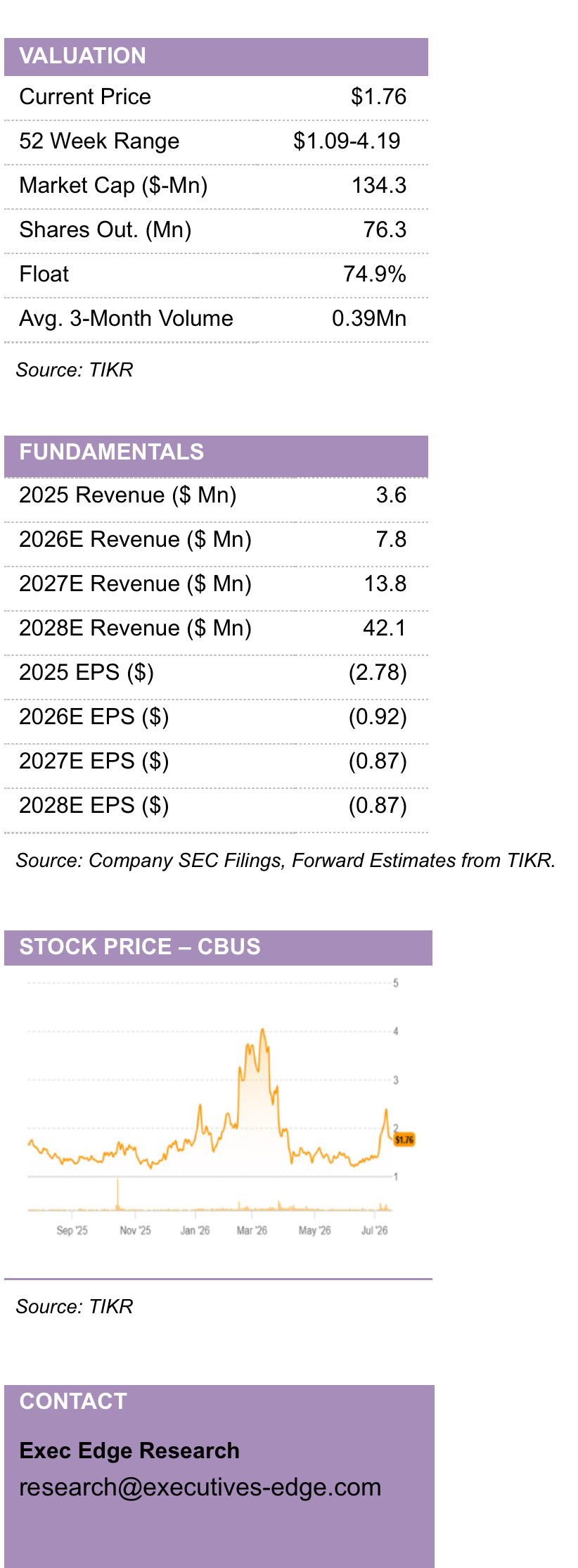
- We believe CBUS’ disclosed Americas rice HT royalty opportunity provides the cleanest base valuation anchor, while the broader trait portfolio expands the upside case. Management has framed the rice herbicide tolerance opportunity across the Americas as more than $200 million of annual addressable royalties at peak. This is not a revenue forecast and should not be treated as de-risked revenue. However, it is the most relevant starting point because rice HT is CBUS’ clearest royalty-validation pathway, supported by seven active rice customer relationships, 5 million to 7 million peak addressable acres, a targeted 2027 LATAM launch path, and Interoc testing / production activity following the May 2026 transfer of gene-edited HT material. At the current price of $1.76 as of 7/20 close, CBUS’ market capitalization is ~$134 million, meaning the current equity value represents ~0.67x the disclosed >$200 million peak annual Americas rice HT royalty opportunity before any discounting, execution-risk adjustment, or value for Sustainable Ingredients and broader platform programs.
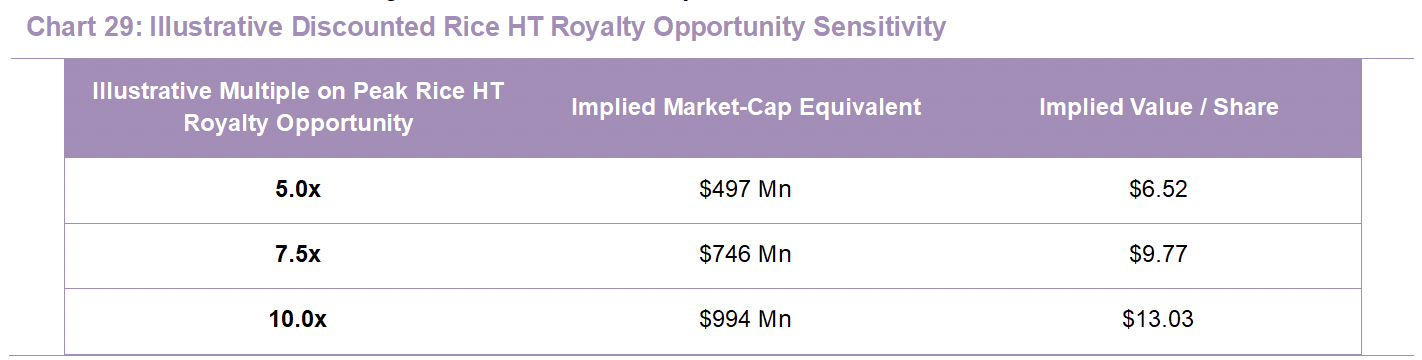
- A discounted rice-only framework suggests meaningful upside if CBUS converts its lead royalty opportunity. Applying an illustrative 5.0x-10.0x multiple to CBUS’ >$200 million disclosed peak annual Americas rice HT royalty opportunity and discounting that value back five years at 15% produces a market-cap-equivalent value range of $497 million to $994 million, or $6.52 to $13.03 per share. The upper end of the range is intended to reflect the potential economics of a mature royalty stream rather than a conventional agricultural revenue multiple, as recurring trait royalties could carry high incremental margins if commercialization is successful. The framework remains illustrative, as the appropriate value will ultimately depend on signed LATAM commercial economics, Interoc testing and production progress, farmer adoption, U.S. launch timing with Albaugh, IP durability, capital needs and the pace at which addressable acreage converts into actual royalties.
- Sustainable Ingredients and BioFragrance represent nearer-term optionality. Sustainable Ingredients is the most visible adjacent commercial pathway, supported by first customer payments, expanded partner-funded R&D activity and targeted 2H26 BioFragrance scale-up orders. Fully commercialized natural BioFragrance partnerships represent a targeted $20 million to $40 million annual royalty opportunity. Applying an illustrative 5.0x-8.0x multiple and discounting back five years at 15% implies $0.65-$2.10/share of potential incremental value. However, given limited disclosure on order size, customer economics, exclusivity, margin structure and recurring revenue mechanics, BioFragrance is best treated as execution-linked upside rather than part of the base rice HT valuation framework. Successful 2H26 scale-up orders and evidence of repeatable commercial economics could add confidence that CBUS’ platform can generate revenue beyond rice HT and support incremental value over time.
- The broader disclosed trait portfolio makes the optionality layer meaningful if CBUS proves the rice royalty model. CBUS’ disclosed productivity-trait portfolio across rice, canola and soybean represents ~367-369 million peak addressable acres and >$1.9 billion of potential annual addressable royalties, based on management estimates of peak acres and per-acre trait fees. The Americas rice HT opportunity therefore represents only a portion of the company’s disclosed royalty pool, with additional opportunities across Asia / India rice, canola Pod Shatter Reduction, canola HT, Sclerotinia resistance, soybean HT and soybean Sclerotinia resistance. Beyond these disclosed royalty pools, CBUS also retains longer-duration optionality across oilseed rape, nutrient-use efficiency, wheat, alfalfa and potential geographic expansion into Brazil, Argentina and India. These opportunities remain illustrative and depend on regulatory access, partner commercialization, seed multiplication, farmer adoption and realized trait value, but execution across even one or two additional lanes could strengthen the case that CBUS is a scalable gene-edited trait royalty platform rather than a single-trait rice story.
- Street consensus provides a useful external reference point. The current Street consensus price target of $14.67, sourced from TIKR, Investing.com, and Zacks, is modestly above the high end of the illustrative rice-only framework, suggesting the Street is assigning some credit beyond the >$200 million Americas rice HT opportunity, including Sustainable Ingredients scale-up, broader crop programs, geographic expansion and the RTDS / Trait Machine platform.
- Commercial execution is the key bridge between CBUS’ disclosed opportunity set and realizable equity value. The rice HT opportunity provides a credible base valuation anchor, and the broader >$1.9 billion disclosed royalty pool highlights the scale of longer-duration optionality, but CBUS still needs to convert visible milestones into contractual economics and recurring revenue. The most important proof points are signed LATAM rice commercialization agreements / economics, Interoc testing and production progress, 2H26 Sustainable Ingredients scale-up orders, quarterly cash burn discipline, and early evidence of recurring royalty or scale-up revenue. If these proof points emerge, CBUS could begin to reflect more of the discounted rice royalty opportunity plus incremental platform optionality.
Risks
- Funding needs: CBUS has incurred significant losses and expects operating losses to continue for several years as it funds R&D, trait validation, intellectual property protection, and commercialization activities. The company has not yet begun earning royalty revenues and has stated that additional capital may be required to support operations. Future funding may come from equity, debt, licensing, partnerships, asset sales, or strategic transactions, though availability, timing, pricing, and dilution may vary depending on market conditions and investor appetite.
- Commercial conversion: CBUS has established relationships with seed companies, but these collaborations may not necessarily become revenue-generating commercial contracts. Initial customer activity typically begins with material transfer and trait-editing work, after which edited germplasm is returned for validation. Seed companies are generally not obligated at that stage to proceed toward commercialization. CBUS must negotiate commercial terms after validation, including with LATAM rice partners such as Interoc, and any delay, unfavorable agreement, or customer decision not to commercialize could affect future milestone payments, royalties, and revenue timing.
- R&D execution: CBUS’ product development depends on complex gene-editing platforms, crop-specific cell biology, greenhouse testing, field trials, and technical validation across different plants and geographies. Trait development may take longer than expected or may not succeed at all. Traits that perform well in controlled environments may not deliver comparable results in field conditions. CBUS also continues to invest in scaling its Trait Machine process, making technology performance, repeatability, validation, and execution central to future commercialization prospects.
- Farmer adoption and trait economics: CBUS’ royalty opportunity ultimately depends on farmers recognizing sufficient value in seed products containing CBUS-developed traits. Adoption may be affected by crop economics, herbicide systems, yield performance, seed pricing, competing traits, agronomic fit, processor acceptance and regional farming practices. If growers or downstream participants do not view CBUS-enabled products as economically compelling, royalty uptake may be slower or smaller than expected.
- Competitive pressure: CBUS operates in a competitive agricultural technology market that includes major seed, crop science, chemical, biotechnology, and academic players. Many competitors have greater financial, technical, marketing, licensing, and customer relationship resources. Some potential CBUS customers may also develop gene-editing capabilities internally, reducing the pool of partners. The company’s ability to compete depends on the relevance of its RTDS platform, the pace of innovation, and its ability to show that its traits offer value versus existing or emerging alternatives.
- Partner and chemistry reliance: CBUS’ licensing model depends substantially on seed-company partners, research collaborators, and third parties that may support development, field trials, validation, regulatory work and commercialization. Even where CBUS develops valuable traits, downstream breeding, marketing, seed scale-up and product launch activities may be controlled by partners or licensees. In rice herbicide tolerance, commercialization also depends on alignment with Albaugh’s clethodim herbicide registration process, with the U.S. launch target already reset to 2029.
- Regulatory evolution: CBUS benefits from regulatory momentum in several jurisdictions, including the EU’s June 2026 approval of a differentiated NGT framework, but regulatory treatment remains evolving, trait-specific and country-specific. However, regulatory frameworks for gene-edited crops continue to evolve and vary across regions. New laws, changed interpretations, additional review requirements, environmental assessments, or labeling obligations could increase costs and extend timelines for CBUS and its customers. If regulation becomes more burdensome in key markets, customers may delay commercialization, narrow launch plans, or consider alternatives with lower regulatory complexity.
- Agriculture cyclicality: CBUS’ future royalty opportunity is tied to the agricultural sector, which is influenced by crop prices, input costs, weather, planting decisions, growing seasons, and climate-related disruptions. Commodity price volatility or changes in fertilizer, labor, energy, or water costs may affect farmer adoption of new seed products. Seasonal planting and harvest windows may also create quarterly fluctuations once CBUS begins generating commercial royalties.
- IP protection: CBUS’ competitive position depends on protecting patents, trade secrets, licensed technology, and proprietary know-how around its traits and gene-editing processes. Patent applications may not issue, granted patents may be challenged, and competitors may design around protected claims. CBUS may also need third-party licenses for certain technologies. Any inability to secure, maintain, enforce, or license key intellectual property could affect development and commercialization prospects.
Subscribe to our Weekly Newsletter to Receive All Research
Contact: