
Download the Complete Report Here
 Max Stock Ltd. (TASE: MAXO)
Strong Same-Store Sales and Record Margins Fuel Earnings Growth; Expanded Store Pipeline Strengthens Outlook.
- Key Takeaways:
- Revenue increased 17.9% to ILS 470.4 million, driven by sustained customer traffic growth, larger baskets and strong 11.2% comparable-store sales growth.
- Record 48.1% gross margin, supported by favorable FX, drove 45.7% adjusted EBITDA growth, highlighting strong earnings conversion from higher sales and favorable merchandise costs.
- Seven planned company-operated openings in 2027 strengthen growth visibility, adding approximately 7,500 net square meters toward the 110,000 sqm target.
- 9M free cash flow approached ILS 180 million, supporting ILS 130 million in dividends alongside continued investment in stores and logistics.
- Strong operating fundamentals, above-peer profitability and an expanding growth runway support rerating potential.
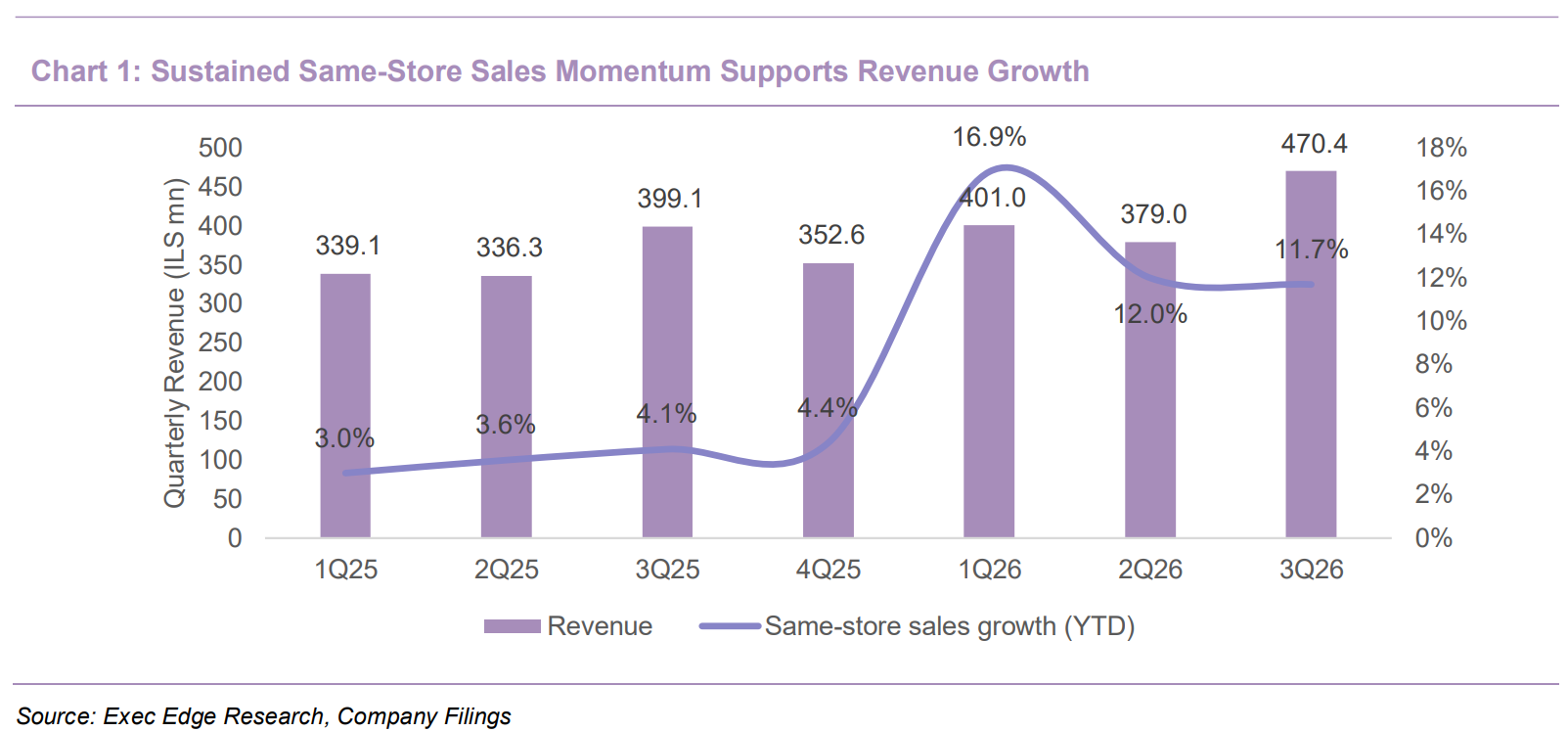
- Sustained comparable-store sales momentum and expanding store contributions reinforce MAXO’s leadership in Israel’s extreme-value retail market. Revenue increased 17.9% y/y to ILS 470.4 million in 3Q26, accelerating from 12.7% growth in 2Q26, driven by 11.2% comparable-store sales growth and contributions from new locations. For 9M26, revenue increased 16.4% to ILS 1,250.4 million, supported by 11.7% comparable-store sales growth, demonstrating the consistency of demand across the year. This marked the thirteenth consecutive quarter of positive comparable-store sales growth, underscoring the consistency of MAXO’s value-retail proposition and its ability to capture increasing household spending. Stronger productivity across existing stores, complemented by continued network expansion, provides a solid foundation for sustained revenue growth.
- Higher customer traffic and mix-driven basket expansion reinforce the strength of MAXO’s existing-store growth engine. Transaction volumes increased approximately 7% y/y in 3Q26, while average basket size grew nearly 4%, reflecting both stronger customer activity and higher spending per visit. Importantly, comparable-store sales increased 11.0% during July to October, a period capturing the full Jewish holiday season in both years, confirming that strong underlying demand extended beyond favorable quarterly holiday timing. Management attributed the increase in basket size to favorable merchandise mix rather than broad-based price increases, highlighting the contribution from higher-ticket products while preserving MAXO’s value positioning. Annualized sales per net square meter increased 10.8% to ILS 23,217 during 9M26, demonstrating improving store productivity as broader assortments, higher-ticket merchandise and larger value packs drive greater spending per visit. Together, these trends reinforce the scalability of MAXO’s existing-store growth model.
- Broadening merchandise assortment is helping MAXO capture a greater share of household spending and drive higher basket values. Housewares, representing approximately 26% of product sales, grew 11.0% y/y during 9M26, while party supplies, storage and consumables increased 18.4% and toys and baby products grew 19.9%. The company-defined Other category, comprising more than 25 subcategories and approximately 28% of product sales, expanded nearly 30%, supported by confectionery, cleaning and personal care products, textiles and seasonal merchandise. Increased penetration of furniture, larger packs and other higher-ticket products is supporting basket expansion without relying on broad-based price increases. The widening assortment reinforces MAXO’s relevance across everyday household needs and discretionary purchases, strengthening its competitive positioning in Israel’s value-retail market.
- Company-operated stores remain MAXO’s primary growth engine, with greater direct ownership strengthening revenue capture and control over store-level economics. Revenue from company-operated stores increased 19.2% y/y to ILS 436.1 million in 3Q26, accounting for approximately 93% of consolidated sales, compared with 5.7% growth in merchandise sales to franchisees. Revenue from franchise commissions and fees declined to ILS 4.7 million from ILS 5.4 million, partly reflecting the shift toward direct operation of selected shop-in-shop categories. Internalizing these categories enables MAXO to capture merchandise revenue and associated gross profit rather than primarily commission income, while strengthening control over assortment and store execution. This expands MAXO’s revenue opportunity within its existing footprint and increases its participation in store-level merchandise economics.
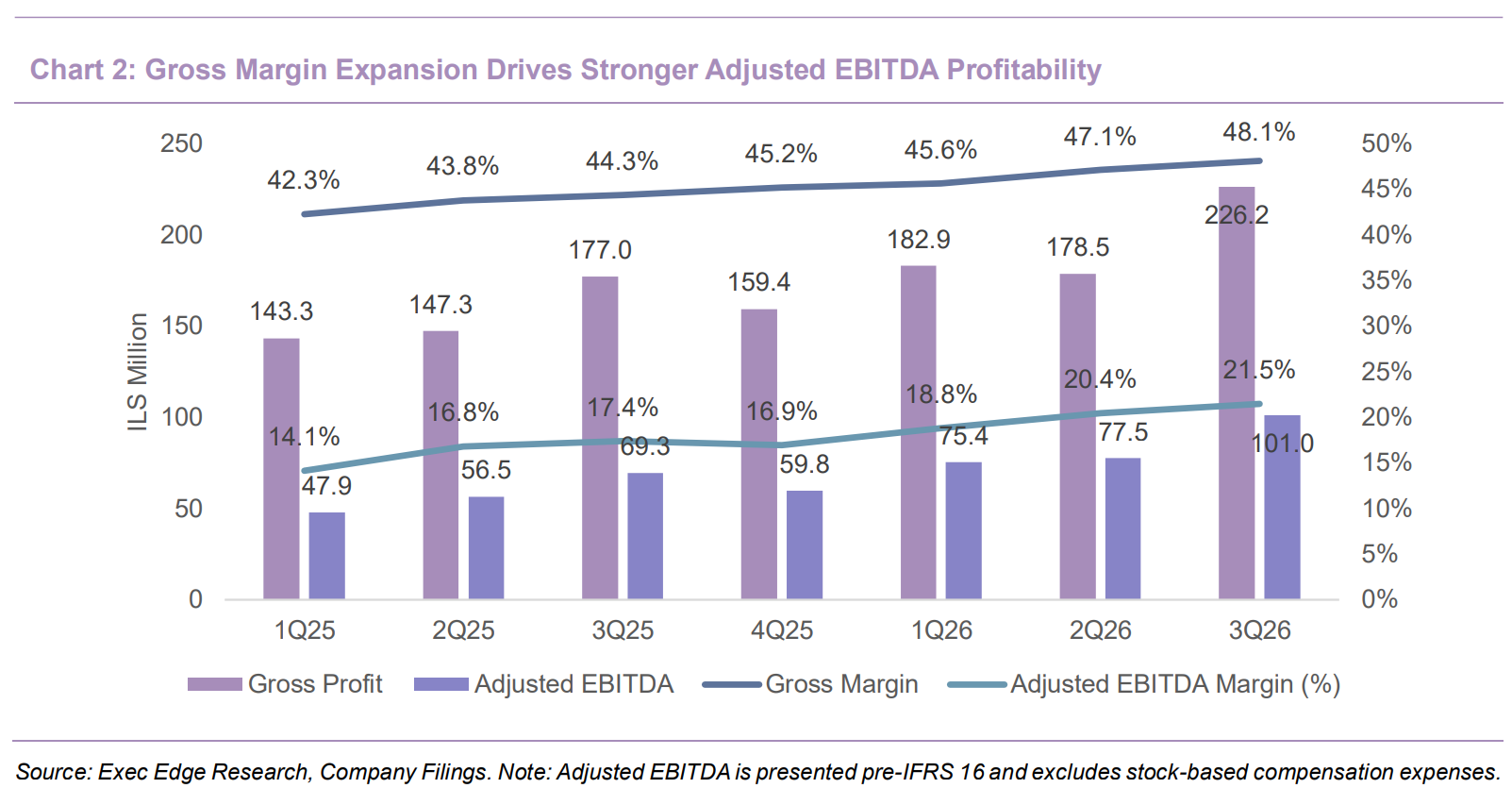
- Favorable currency movements and strong sales growth drove record gross margins and a 45.7% y/y increase in adjusted EBITDA. Gross profit increased 27.8% to ILS 226.2 million in 3Q26, with gross margin expanding approximately 380 basis points from 44.3%, exceeding the 47.1% achieved in 2Q26. Management attributed the entire y/y gross-margin expansion in 3Q26 to the stronger Israeli shekel, which reduced imported merchandise costs. For 9M26, gross margin increased to 47.0% from 43.5%, also benefiting from improved supplier terms, lower shipping costs and the normalization of logistics expenses following the 2025 distribution-center transition. While the record quarterly margin reflects exceptional currency tailwinds, the underlying sourcing and logistics improvements reinforce MAXO’s longer-term profitability framework.
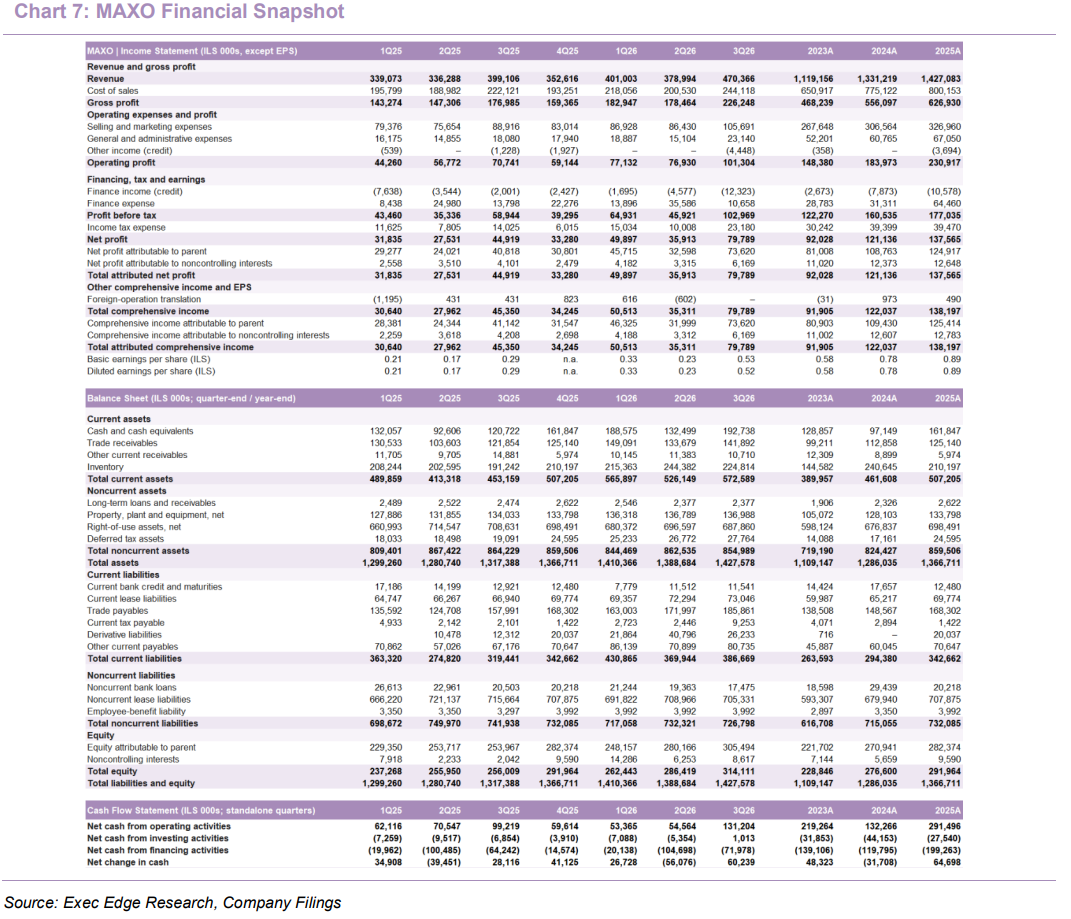
- Higher gross profitability more than offset increased operating expenses, driving substantial EBITDA margin expansion. Selling, general and administrative expenses increased 20.4% y/y to ILS 128.8 million in 3Q26, reflecting higher payroll, municipal taxes and store-related expenses, with SG&A rising modestly to 27.4% of revenue from 26.8% a year earlier. Nevertheless, operating profit increased 43.2% to ILS 101.3 million, while adjusted EBITDA rose to ILS 101.0 million from ILS 69.3 million, expanding the adjusted margin to 21.5% from 17.4%. For 9M26, adjusted EBITDA increased 46.1% to ILS 253.9 million, with margin expanding to 20.3% from 16.2%. These figures reflect adjusted EBITDA before the impact of IFRS 16, demonstrating stronger profitability after rental costs as gross-margin expansion more than absorbed higher operating expenses.
- Strong operating earnings and favorable financing movements translated into significant net income and EPS growth. Consolidated net income increased 77.6% y/y to ILS 79.8 million in 3Q26, with net margin expanding to 17.0% from 11.3%. Net financing income reached ILS 1.7 million versus an expense of ILS 11.8 million a year earlier, supported by ILS 10.8 million of foreign exchange hedging income compared with a loss of ILS 4.6 million in 3Q25. Adjusted net income attributable to shareholders increased to ILS 75.3 million from ILS 40.8 million, while adjusted EPS rose 84.0% to ILS 0.54 from ILS 0.29. The shareholder share of adjusted net income increased to 92.4% from 90.9%, reflecting the growing contribution from wholly owned stores. Reported operating profit also included ILS 4.4 million of other income from lease-liability derecognition, compared with ILS 1.2 million a year earlier, while adjusted EBITDA excludes these gains. The sharp earnings acceleration reflects both operating improvements and favorable financing movements, with greater direct ownership supporting faster growth in earnings attributable to shareholders.
- MAXO continues to expand its nationwide footprint through new store openings and existing-store optimization, strengthening its geographic reach and sales capacity. The network comprised 65 stores at September 30, 2026, including 40 company-operated locations and 25 franchises, with approximately 70,900 net square meters of company-operated selling space. During 9M26, MAXO opened stores in Beer Sheva, Or Akiva and Ad Halom, alongside a new franchised Mini Max location in Hod Hasharon. The Ad Halom store added approximately 1,600 net square meters in a catchment serving more than 250,000 residents, while the closure of an older Beer Sheva location reflected ongoing network optimization. A subsequent approximately 800-square-meter expansion in Kiryat Yam increased company-operated selling space to approximately 71,700 square meters by November 17, compared with 66,400 square meters at year-end 2025.
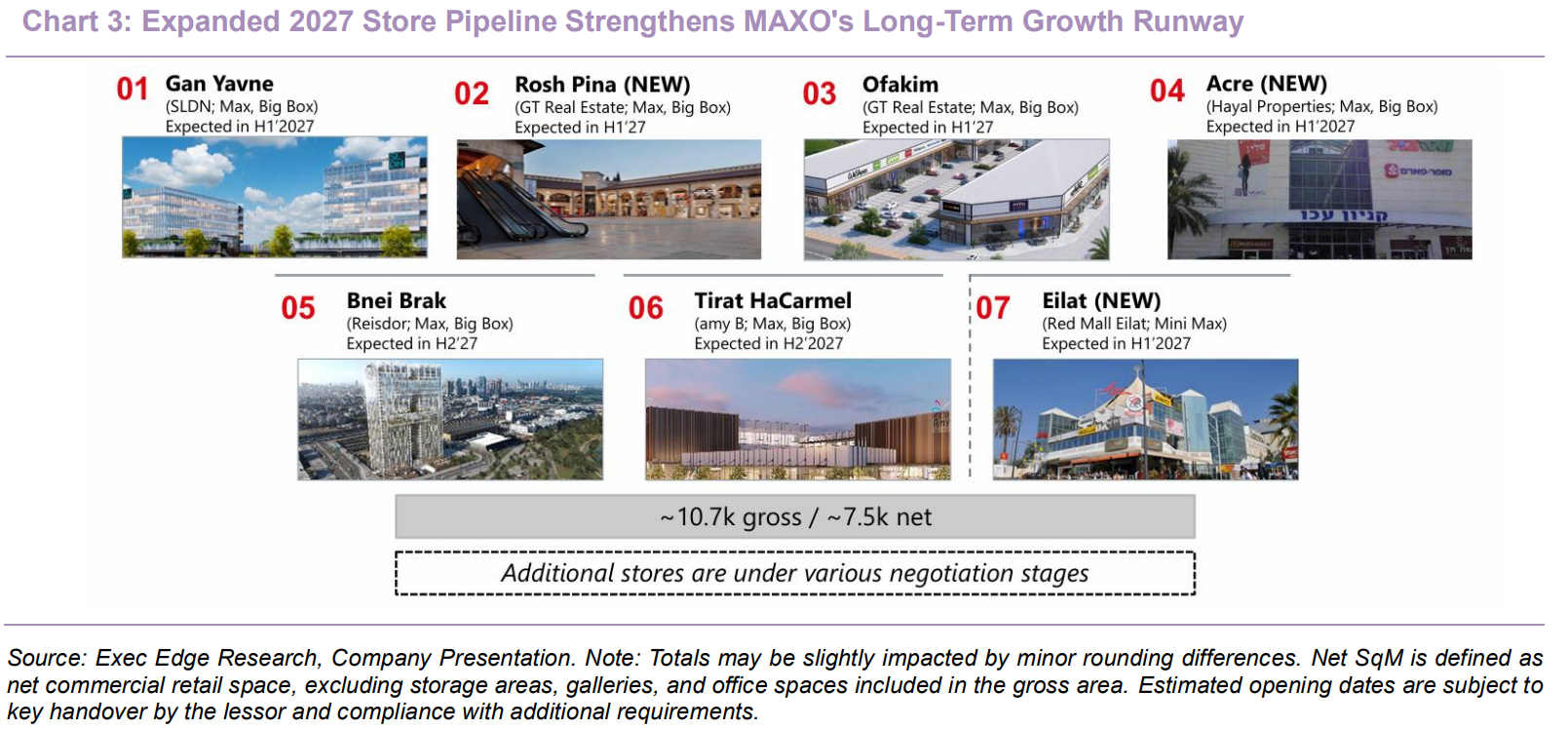
- An expanded seven-store pipeline for 2027 materially strengthens growth visibility and accelerates progress toward MAXO’s long-term footprint objective. The company plans seven company-operated openings in 2027, exceeding its established objective of three to five annually. Six stores are planned under the larger Max format, including Gan Yavne, Rosh Pina, Acre, Ofakim, Tirat HaCarmel and Bnei Brak, alongside a smaller Mini Max location in Eilat. The pipeline represents approximately 10,700 gross square meters and 7,500 net square meters of additional space, equivalent to around 10.5% of the current company-operated footprint. Successful execution would expand net selling area toward 79,000 square meters, advancing MAXO toward its target of approximately 110,000 square meters by 2030 and reinforcing store expansion as a significant driver of medium-term revenue growth.
- The planned company-operated Mini Max store in Eilat represents a potential new growth avenue, extending MAXO’s direct ownership model into smaller urban locations. MAXO currently operates 20 Mini Max franchise locations, generally averaging approximately 200 square meters, compared with approximately 1,792 net square meters for the larger Max format. Direct ownership would allow MAXO to capture store-level merchandise sales and profits rather than primarily wholesale and franchise-related revenue, potentially broadening its expansion opportunities beyond large commercial destinations. The Eilat opening will provide an initial test of the smaller format’s directly operated economics and scalability. Successful execution could support future replication in locations where a full-size Max store may not be viable.
- Increasing direct sourcing is strengthening MAXO’s purchasing economics and creating a structural opportunity for further margin improvement. Direct imports accounted for approximately 70% of merchandise sourcing in 2025, up from 50% in 2019, with a longer-term objective of approximately 85%. Purchasing directly from overseas suppliers reduces intermediary costs, improves assortment control and allows MAXO to capture additional sourcing margins as volumes scale. This strategy complements expansion into higher-ticket categories and provides an opportunity to strengthen merchandise profitability beyond the favorable currency benefits recorded in 2026. As direct sourcing increases, investment in inventory management and logistics capacity will become increasingly important to sustaining purchasing efficiencies and supporting profitable growth at scale.
- Planned logistics expansion will provide the infrastructure required to support a substantially larger store network and greater direct-import penetration. MAXO is evaluating an expansion of its Shomria distribution center from approximately 31,000 to 41,000 square meters and has signed an agreement for a new approximately 45,000-square-meter facility in Ofakim. The Ofakim center is expected to support higher inventory volumes, reduce reliance on third-party storage and improve replenishment efficiency as the chain expands toward 110,000 net retail square meters. Rental commencement is expected in December 2028, with base rent of approximately ILS 1.7 million per month and estimated fit-out investment of ILS 20 million. With meaningful operational benefits expected beyond 2027, these investments position MAXO to scale direct sourcing and store expansion more efficiently over the longer term.
- Inventory conversion improved during 3Q26, strengthening working-capital efficiency following the merchandise buildup earlier in the year. Inventory declined to ILS 224.8 million at September 30 from ILS 244.4 million at June 30, a reduction of approximately ILS 19.6 million during a quarter of strong sales. Inventory remained 17.6% above the ILS 191.2 million recorded a year earlier, reflecting the larger store network and expanded sourcing requirements. Trade payables increased to ILS 185.9 million from ILS 158.0 million y/y, providing some offsetting supplier financing. For 9M26, inventory absorbed ILS 14.6 million of cash compared with a release of ILS 49.5 million in the prior-year period. The sequential inventory reduction highlights improving merchandise turnover and supports MAXO’s ability to translate stronger sales into cash generation as its store network expands.
- Strong free cash flow generation continues to provide substantial capacity for expansion and shareholder distributions. Operating cash flow increased 32.2% y/y to ILS 131.2 million in 3Q26, supported by higher net income and improved inventory conversion. For 9M26, operating cash flow reached ILS 239.1 million versus ILS 231.9 million a year earlier, with working-capital investment partly offsetting earnings growth. After approximately ILS 11.4 million of capital expenditure and ILS 47.9 million of lease payments, free cash flow totaled approximately ILS 180 million, equivalent to 71% of adjusted pre-IFRS 16 EBITDA. This compares favorably with MAXO’s longer-term historical conversion average of approximately 56%, reinforcing the company’s ability to convert earnings into cash while funding its expanding operations.
- A healthy net cash position and disciplined capital allocation provide flexibility to fund growth while maintaining shareholder returns. MAXO ended September with ILS 192.7 million in cash and ILS 29.0 million of bank debt, resulting in net cash of approximately ILS 163.7 million excluding lease liabilities, up 87.5% y/y. The company distributed ILS 130 million in dividends during 9M26, comprising ILS 80 million in April and ILS 50 million in September, while continuing to invest in its store network. The combination of strong liquidity, recurring cash generation and disciplined capital deployment positions MAXO to fund its expanding store network and logistics infrastructure while sustaining shareholder distributions.
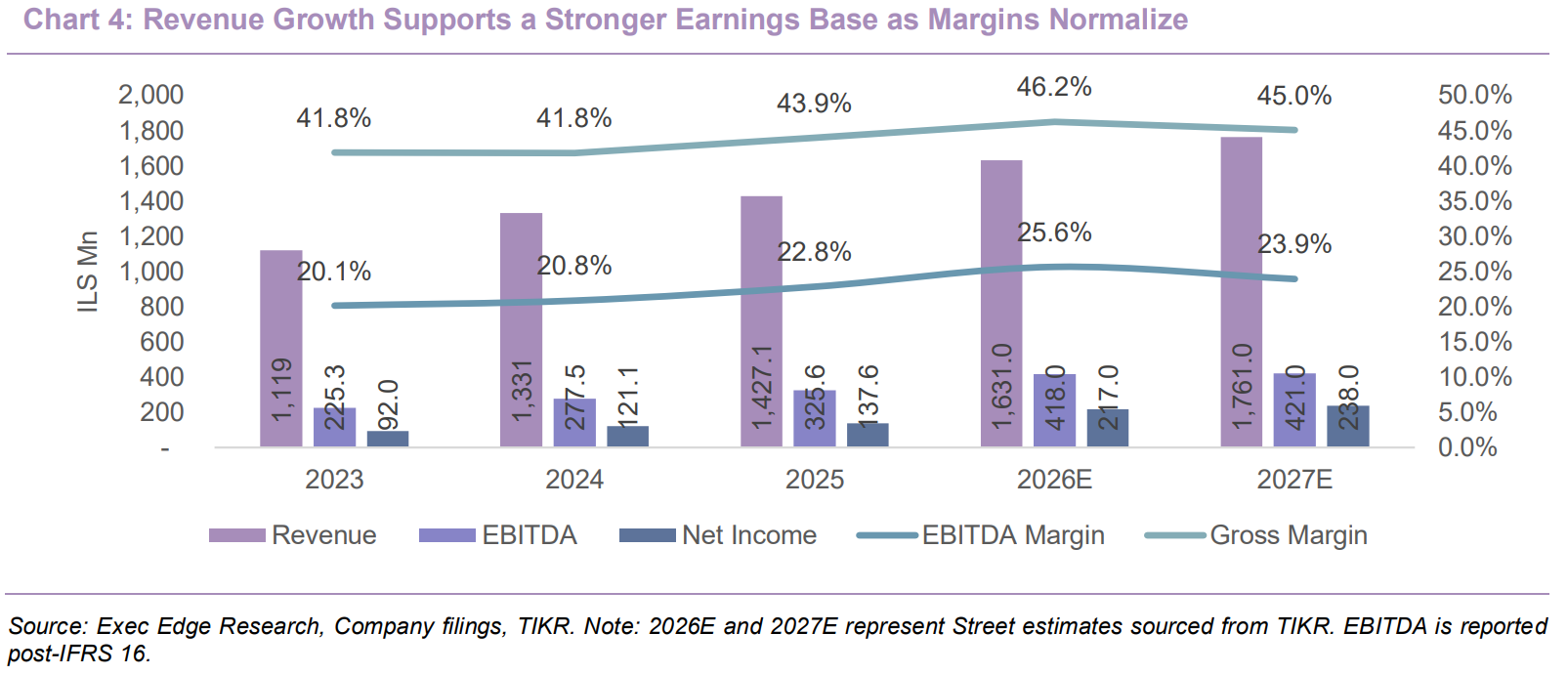
- Strong operating momentum and sustained margin strength position MAXO for a solid finish to 2026, with potential for further earnings outperformance. Street estimates sourced from TIKR project revenue of ILS 1,631 million in 2026, up 14.3% y/y, and net income of ILS 217 million, up 57.7%. This implies 4Q26 revenue of approximately ILS 380.6 million, up 8% y/y, and net income of ILS 51.4 million. Importantly, Street gross-margin expectations appear conservative, with the full-year estimate of 46.2% implying a fourth-quarter margin of approximately 43.6%, despite MAXO delivering 47.0% during 9M26 and management expecting 4Q26 gross margin of at least 46%. Achieving a 46% fourth-quarter margin would lift the full-year margin to approximately 46.8%, implying around ILS 9.2 million of potential gross-profit upside relative to Street expectations, assuming revenue remains in line. This gap between management commentary and implied Street expectations provides a tangible opportunity for earnings upside as MAXO closes out 2026.
- Accelerated store expansion and improving sales productivity support continued growth through 2027, reinforcing MAXO’s longer-term earnings trajectory. Street estimates sourced from TIKR project revenue of ILS 1,761 million in 2027, up 8.0% y/y, with net income increasing 9.7% to ILS 238 million. The expanded seven-store pipeline, representing approximately 7,500 additional net square meters, provides an incremental growth driver alongside healthy comparable-store sales, broader merchandise categories and increasing direct sourcing. Street expectations incorporate normalization of the exceptional 2026 profitability, with gross margin normalizing to 45.0% in 2027 from 46.2% and reported EBITDA margin normalizing to 23.9% from 25.6%. This implies EBITDA of approximately ILS 421 million in 2027 versus ILS 418 million in 2026, reflecting relatively stable operating earnings despite continued topline expansion. Importantly, the expected margin normalization reflects the fading of exceptional currency tailwinds rather than a deterioration in underlying store economics. Continued store expansion, higher sales productivity and improving sourcing economics provide a foundation for sustained earnings growth beyond this normalization period.
Earnings Momentum and Store Expansion Support Further Rerating Potential
- Disclaimer: Exec Edge does not publish proprietary estimates, ratings, price targets, or investment recommendations. The valuation discussion below is illustrative only and is based on company filings, management commentary, and third-party data and estimates. It does not constitute a recommendation, price target, rating, or prediction of future pricing.
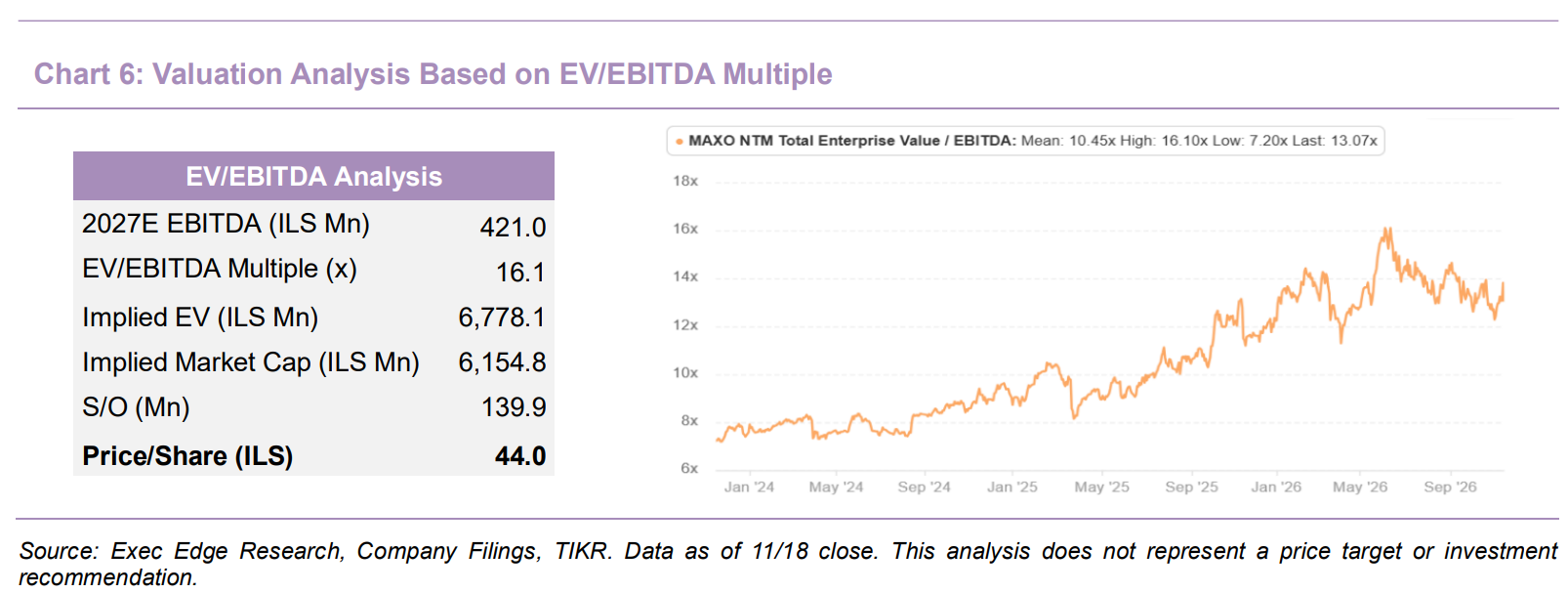
- MAXO’s improving operating fundamentals and expanding store network support further rerating potential. At an equity market capitalization of ILS 4,866 million and enterprise value of ILS 5,489 million, MAXO trades at approximately 13.0x 2027E EV/EBITDA, based on Street estimates sourced from TIKR. This represents approximately a 19% discount to its three-year peak NTM EV/EBITDA multiple of 16.1x. The discount comes against stronger operating fundamentals, with 11.7% comparable-store sales growth, 46.1% adjusted EBITDA growth and approximately ILS 180 million of free cash flow during 9M26. As exceptional currency-related margin benefits normalize in 2027, sustained store productivity and the accelerated expansion pipeline provide important support for the longer-term earnings trajectory and potential valuation convergence toward historical highs.
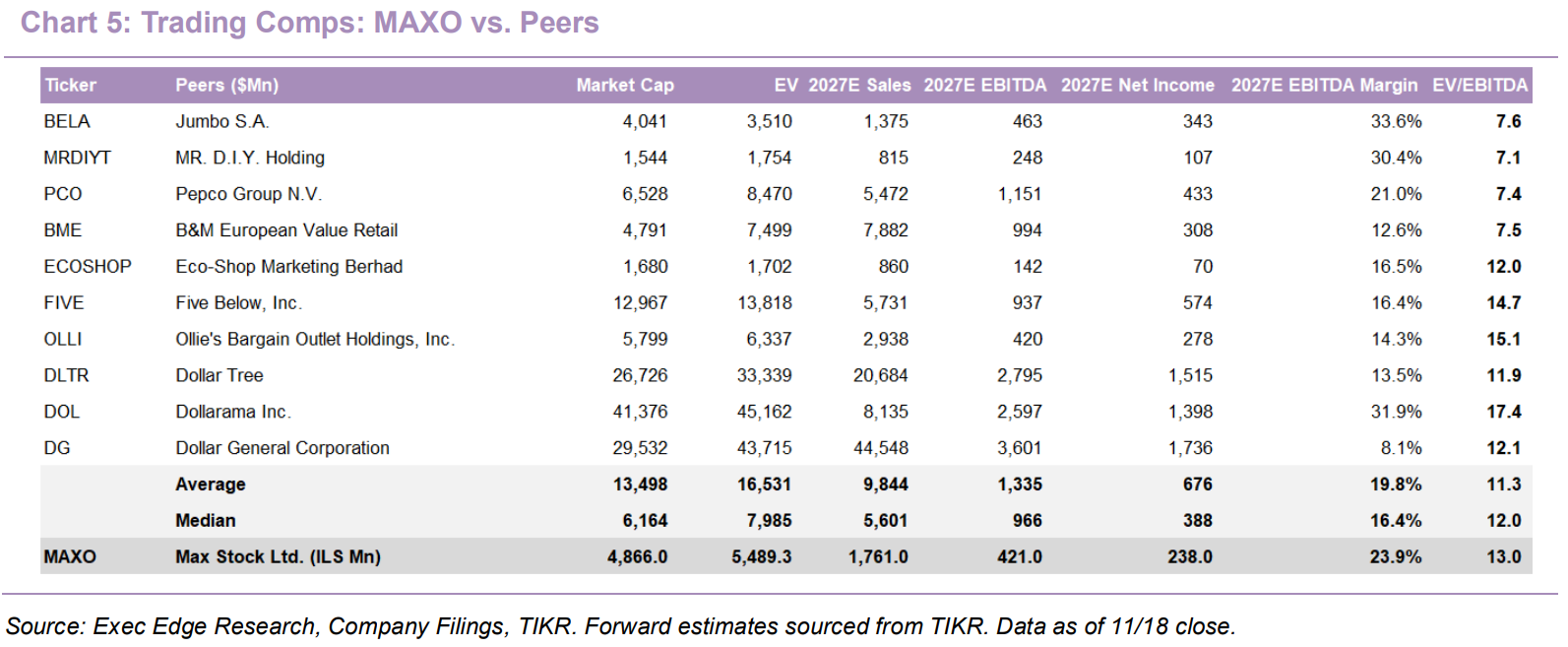
- Above-average profitability and complementary growth drivers support MAXO’s premium valuation relative to international value-retail peers. MAXO’s 13.0x 2027E EV/EBITDA compares with a peer average of 11.3x and median of 12.0x, representing premiums of approximately 15% and 9%, respectively. The company’s estimated 2027 EBITDA margin of 23.9% compares favorably with the peer average of 19.8% and median of approximately 16.4%, demonstrating substantially stronger profitability. MAXO also trades below higher-valued operators such as Five Below at 14.7x, Ollie’s Bargain Outlet at 15.1x and Dollarama at 17.4x. Despite differences in geographic exposure, merchandise mix and operating models, MAXO’s higher profitability, sustained comparable-store growth and visible store expansion pipeline support its premium positioning within the peer group.
- MAXO’s historical peak valuation multiple provides a framework for illustrating potential rerating upside. Applying the historical peak EV/EBITDA multiple of 16.1x to approximately ILS 421 million of 2027E EBITDA results in an illustrative enterprise value of ILS 6,778 million. Adjusting for the company’s net financial obligations and noncontrolling interests yields an implied equity value of approximately ILS 6,155 million, or ILS 44.0 per share based on 139.9 million shares outstanding. This represents approximately 26.5% above the current share price of ILS 34.78. While Street estimates imply relatively stable EBITDA in 2027 as exceptional FX benefits normalize, sustained store productivity, successful execution of the expanded store pipeline, increasing direct sourcing and strong cash conversion provide a foundation for earnings growth beyond 2027 and potential valuation convergence toward historical levels. We note that this analysis is illustrative and should not be interpreted as a price target or recommendation.
Read Exec Edge’s Initiation on Max Stock Ltd. Here
Subscribe to our Weekly Newsletter to Receive All Research
Contact: