Download the Complete Report Here
 REX American Resources Corp. (REX)
Record Second Quarter Driven by Stronger Crush Margins and 45Z; Draft Class VI Permits Advance CCS Project; Valuation Remains Reasonable
- Key Takeaways:
- Record 2Q EPS of $1.06 versus $0.22 y/y, as stronger crush economics and 45Z drove gross profit to $53.3 million and gross margin to 31.6%, up ~2,260 bps.
- 45Z income increased to $18.4 million from $7.5 million sequentially, lifting first-half credits to $26.0 million and strengthening gross profit.
- One Earth remains on track for year-end 2026 construction completion and a phased ramp toward 175 million gallons, with approximately 200 million gallons targeted around early to mid 2027.
- Draft Class VI permits materially advance CCS, while exports, California E15 and stronger co-product pricing support a constructive industry backdrop.
- Valuation remains reasonable, with REX trading below historical and peer benchmarks despite stronger earnings, improving project visibility and multiple re-rating catalysts.
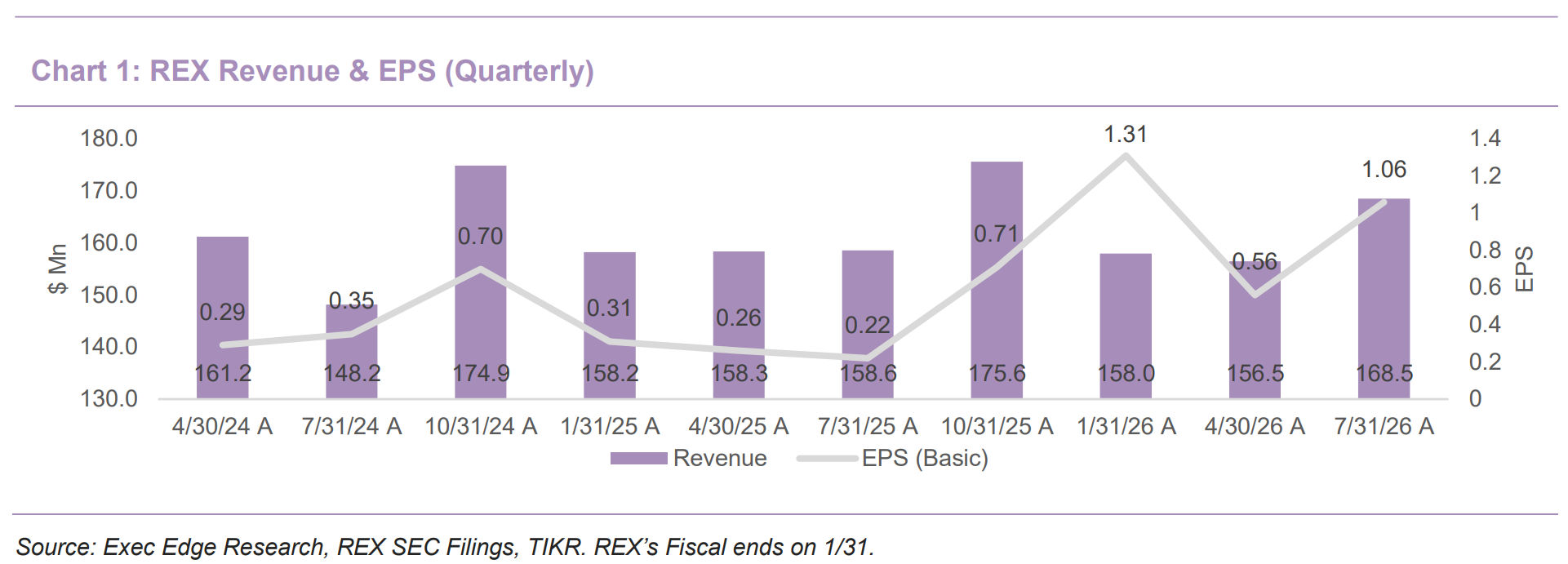
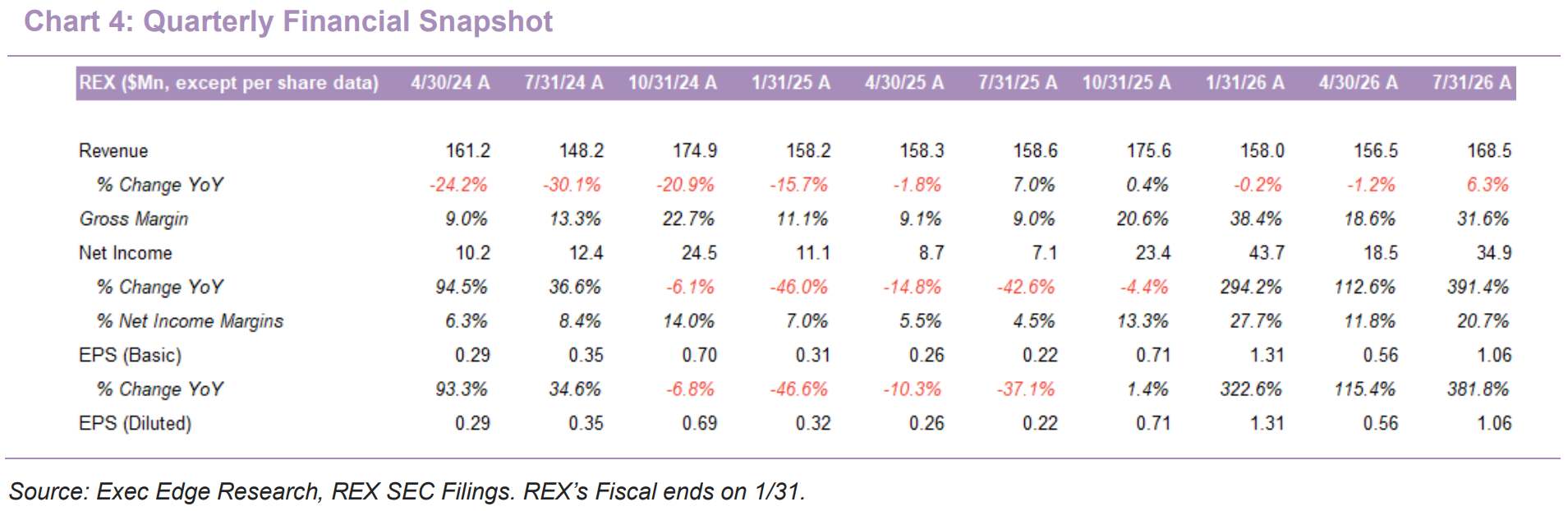
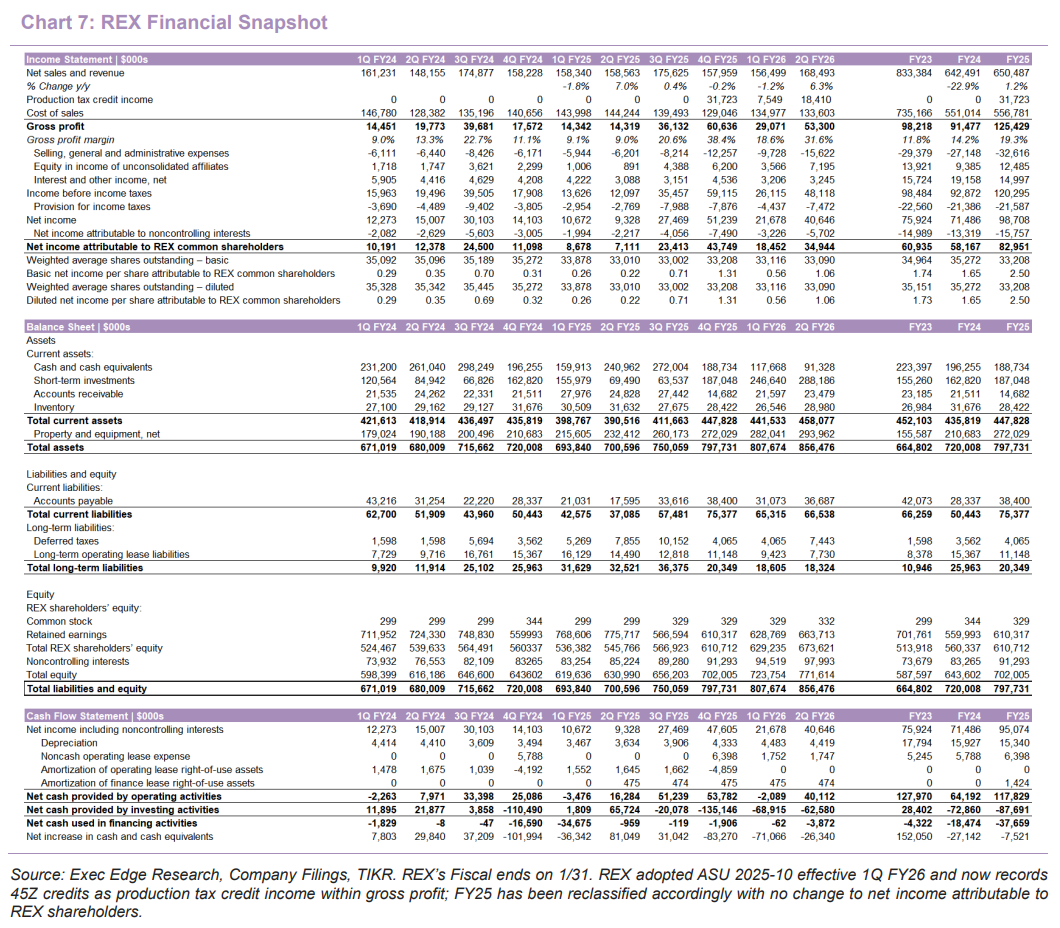
- Record second-quarter earnings reflected materially stronger core ethanol economics alongside a larger 45Z contribution. REX reported 2Q FY26 net sales and revenue of $168.5 million, up 6.3% from $158.6 million in 2Q FY25, while gross profit increased to $53.3 million from $14.3 million and gross margin expanded to 31.6% from 9.0%. 45Z production tax credit income contributed $18.4 million during the quarter, while core profitability also improved sharply, with gross profit excluding 45Z at approximately $34.9 million, up roughly 144% y/y. Income before taxes increased to $48.1 million from $12.1 million, and net income attributable to REX shareholders reached $34.9 million versus $7.1 million. Diluted EPS increased to $1.06 from $0.22, marking the strongest fiscal second quarter in company history and extending REX’s profitability streak to 24 consecutive quarters.
- Improved crush margins were the principal operating driver, with stronger ethanol and co-product pricing broadening the earnings improvement. Consolidated ethanol sales were 70.6 million gallons, consistent with 70.6 million gallons in the prior-year quarter, while realized ethanol pricing net of hedging increased to $1.78 per gallon from $1.75. Ethanol revenue reached approximately $125.8 million, representing 74.7% of quarterly revenue. Dried distillers grain ASP increased 16% to $166.55 per ton from $143.63, with volume of 145,081 tons versus 148,017 tons, generating approximately $24.2 million of revenue. Distillers corn oil provided another meaningful margin contribution, with volume increasing to 24.3 million pounds from 23.1 million and ASP rising 33% to $0.72 per pound from $0.54, resulting in approximately $17.6 million of revenue. Modified distillers grains contributed another $0.8 million at an ASP of $65.10 per ton. The improvement across ethanol, DDG and corn oil is consistent with a stronger crush environment and reinforces the earnings contribution from product mix as REX prepares to add incremental One Earth capacity.
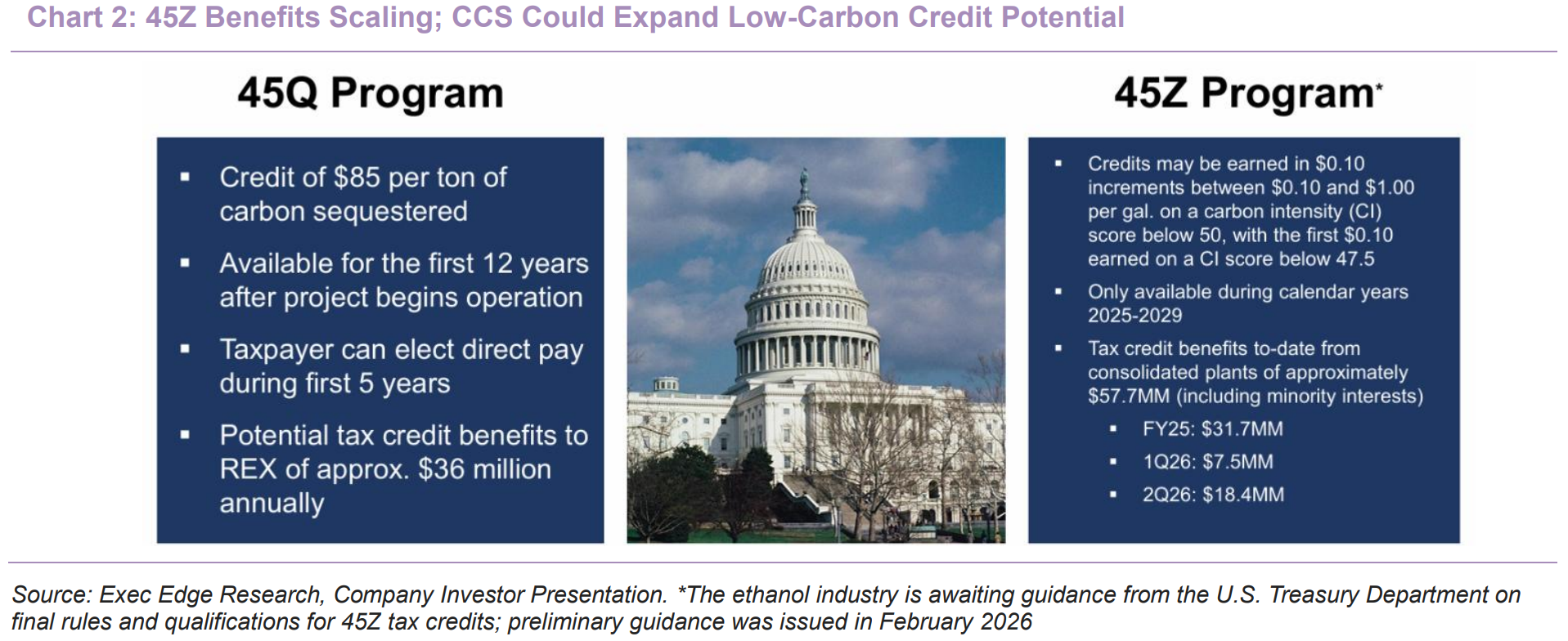
- 45Z has become a material and increasingly visible earnings layer, with the quarterly contribution more than doubling sequentially. REX recognized $18.4 million of 45Z production tax credit income in 2Q, up from $7.5 million in 1Q, bringing 1H FY26 credits to approximately $26.0 million, net of estimated monetization expenses. REX currently intends to sell the transferable 45Z credits earned in FY26, compared with using FY25 credits to offset taxes due. Including $31.7 million recognized in FY25, cumulative 45Z benefits from consolidated facilities have reached approximately $57.7 million, including minority interests. The 2Q credit represented approximately 34.5% of reported gross profit of $53.3 million, while the first-half contribution represented approximately 31.5% of gross profit of $82.4 million. Because 45Z is recorded within gross profit rather than revenue, its growing contribution is making reported margins structurally less comparable with prior periods and should scale further as One Earth adds production volumes eligible for the credit.
- CCS creates a second economic layer through 45Q and potentially higher 45Z economics. Under the current framework, 45Z credits can be earned in $0.10 per gallon increments from $0.10 to $1.00 per gallon based on carbon intensity, with the first $0.10 available below a CI score of 47.5 and the program currently extending through calendar 2029. The 45Q framework provides an $85 per ton credit for qualifying sequestered carbon for 12 years following project commencement, with direct pay available during the first five years, and REX estimates potential annual 45Q benefits of approximately $36 million. During the 2025 to 2029 overlap period, REX can elect the economically more attractive program, providing flexibility to optimize credit economics as CCS lowers carbon intensity and final 45Z rules become clearer.
- One Earth remains the principal organic volume growth driver, with a phased path from approximately 150 million to 200 million gallons of annual capacity. The facility currently produces approximately 150 million gallons annually, with construction for the next capacity step progressing on schedule and additional production expected to come online before the end of 2026. The first operating milestone is approximately 175 million gallons, a roughly 17% increase from the current level. Following that step, additional EPA and Illinois EPA approvals are required before production can move toward approximately 200 million gallons, with production expected to approach that level around early to mid-2027. Reaching 200 million gallons would represent approximately 33% growth from the current One Earth base and would expand ethanol, co-product and eligible 45Z production while leveraging REX’s existing Corn Belt infrastructure and market access.
- Draft Class VI permits represent the most significant CCS regulatory milestone to date and materially reduce federal permitting uncertainty around the One Earth project. On August 17, the EPA issued draft Class VI permits for three injection wells with combined storage capacity of approximately 90 million tons, with the September presentation projecting final EPA permits in November 2026. Construction of the carbon capture and compression facility is substantially complete, with facility testing remaining. Cumulative investment in the ethanol expansion and CCS projects reached approximately $191.2 million at 2Q FY26-end, up from $176.3 million at 1Q-end and approximately $166 million at FY25-end. With the federal process materially advanced, the remaining project sequence centers on the approximately 5-mile connector pipeline, Illinois EPA approvals and local zoning requirements, with the pipeline approval appearing to be the principal milestone.
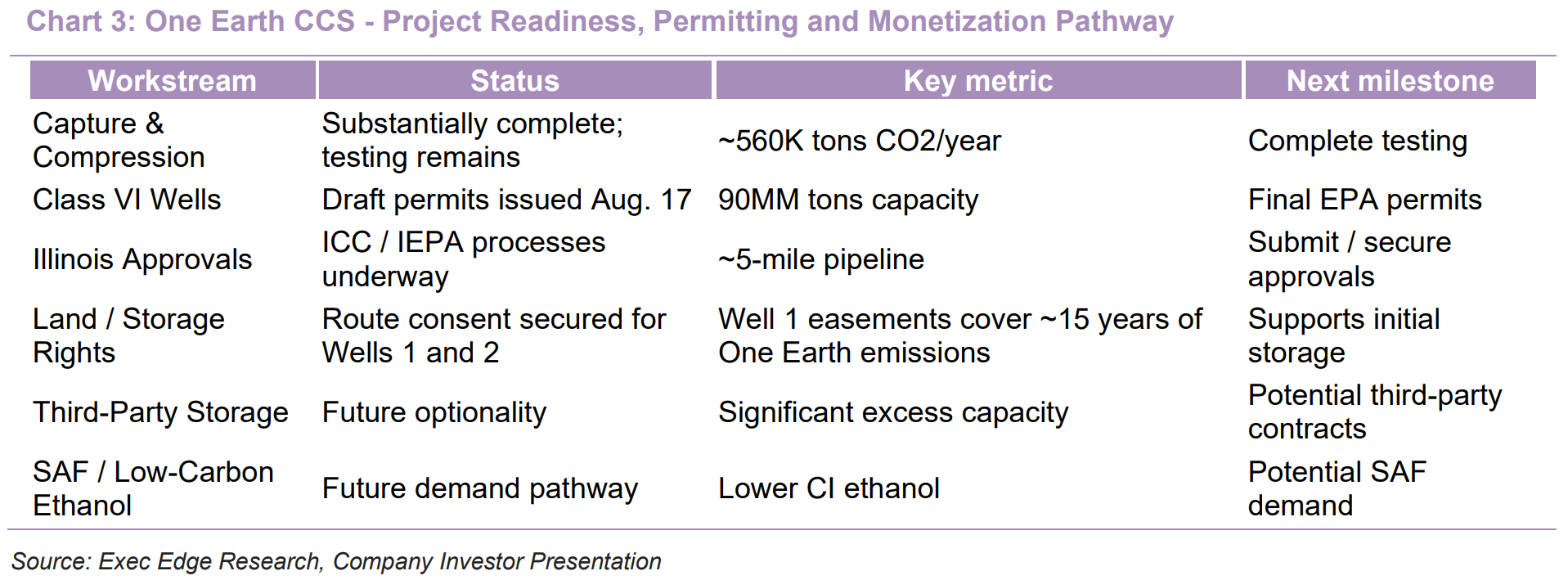
- Excess storage capacity creates meaningful third-party sequestration optionality and expands One Earth’s longer-term low-carbon fuel positioning. The project is designed to sequester approximately 560,000 tons of CO2 annually from One Earth following the expansion, compared with approximately 90 million tons of total storage capacity across the three wells. REX has secured consent from 100% of landowners for the pipeline route associated with Wells 1 and 2 and sufficient subsurface easements for Well 1 to sequester all One Earth emissions for approximately 15 years. The substantial excess capacity creates a potential fee-generating opportunity from third-party emitters, while lower-carbon ethanol could also support additional demand from sustainable aviation fuel markets. These opportunities remain longer-term, with REX currently focused on completing and permitting its own CCS project before pursuing third-party sequestration.
- Export growth and California E15 broaden the demand backdrop as One Earth prepares to add production capacity. U.S. ethanol exports increased approximately 13% during the first six months of 2026, with continued record export demand supporting industry fundamentals entering 3Q. California’s approval of E15 creates another meaningful demand channel, with management citing approximately 695 million gallons of potential consumption. Recent RIN exemption developments could pressure RIN economics, although management does not expect a major impact on ethanol sales given that the exemptions span both D4 and D6 credits and export demand remains strong. Together, sustained export growth and broader E15 adoption improve the industry’s ability to absorb incremental production as REX moves first toward 175 million gallons and subsequently approximately 200 million gallons at One Earth.
- Higher incentive compensation absorbed some operating leverage, while unconsolidated affiliates provided a materially larger earnings contribution. SG&A increased to $15.6 million from $6.2 million y/y, primarily reflecting higher incentive compensation tied to stronger results and restricted stock awards issued during the quarter. Equity in income of unconsolidated affiliates increased to $7.2 million from $0.9 million, benefiting from stronger industry conditions and production tax credit contributions at REX’s non-consolidated facilities. Interest and other income was broadly stable at $3.2 million versus $3.1 million y/y, reinforcing that the earnings improvement was primarily driven by operating performance, 45Z and stronger affiliate profitability.
- Liquidity and working capital strengthened despite higher project spending, reinforcing REX’s ability to fund One Earth and CCS internally. REX ended 2Q with $379.5 million of cash, cash equivalents and short-term investments, up from $364.3 million at the end of 1Q and $310.5 million a year earlier, while continuing to carry no bank debt. Working capital increased to $391.5 million from $376.2 million sequentially and $353.4 million y/y. First-half operating cash flow increased to $38.0 million from $12.8 million, while capital expenditures rose to $35.0 million from $28.9 million. REX currently expects to spend another $20 million to $30 million across its projects during the remainder of FY26, with all expenditures funded from available cash. The balance sheet therefore continued to strengthen even as cumulative One Earth and CCS spending reached $191.2 million, preserving flexibility for additional capital deployment as the projects move toward completion.
- Working-capital movements remained manageable, with higher receivables and prepaid assets offset by stable inventory and stronger cash generation. Accounts receivable increased to $23.5 million at July 31 from $14.7 million at FY25-end, while inventory was broadly stable at $29.0 million versus $28.4 million and accounts payable declined to $36.7 million from $38.4 million. During the first half, accounts receivable represented an $8.8 million use of operating cash and prepaid and other assets represented a $27.3 million use, while inventory absorbed only $0.6 million. Despite those uses, cash flow from operations increased nearly threefold to $38.0 million from $12.8 million, reflecting materially stronger earnings despite working-capital outflows.
- Capital allocation remains focused on completing organic growth projects, while repurchases and selective M&A retain strategic relevance. REX acquired approximately $1.6 million of treasury stock during 1H FY26 versus $33.4 million in the prior-year period, while first-half capital expenditures were $35.0 million and cumulative One Earth and CCS investment reached $191.2 million. Share repurchases have historically been a preferred method of distributing capital, and REX continues to evaluate acquisitions of ethanol plants and businesses in adjacent industries. With $379.5 million of cash and short-term investments, no bank debt and the major One Earth and CCS investments moving toward completion, the balance between additional organic investment, repurchases and selective acquisitions should become increasingly important to the equity story.
- Outlook remains constructive, with 3Q results expected to exceed the prior-year period as 45Z, exports and stronger core ethanol economics support the second-half setup. At this early stage of 3Q FY26, REX expects to remain profitable and anticipates results above the prior-year period, when diluted EPS was $0.71 on revenue of $175.6 million. First-half FY26 EPS reached $1.62 versus $0.47 y/y, while 45Z benefits totaled approximately $26.0 million and export demand remained strong. The One Earth expansion remains on track for construction completion by the end of 2026, with production expected to step toward approximately 175 million gallons, while the three draft Class VI permits represent another important step in advancing CCS. The medium-term setup remains tied to sustained crush economics, continued 45Z monetization, the One Earth ramp toward 175 million gallons followed by permitting toward approximately 200 million gallons, and completion of the remaining CCS approvals.
Valuation: Execution Across One Earth and CCS Supports Re-Rating Potential
- Disclaimer: Exec Edge does not publish proprietary estimates, ratings, price targets, or investment recommendations. The valuation discussion below is illustrative only and is based on company filings, management commentary, and third-party data and estimates. It does not constitute a recommendation, price target, rating, or prediction of future pricing.
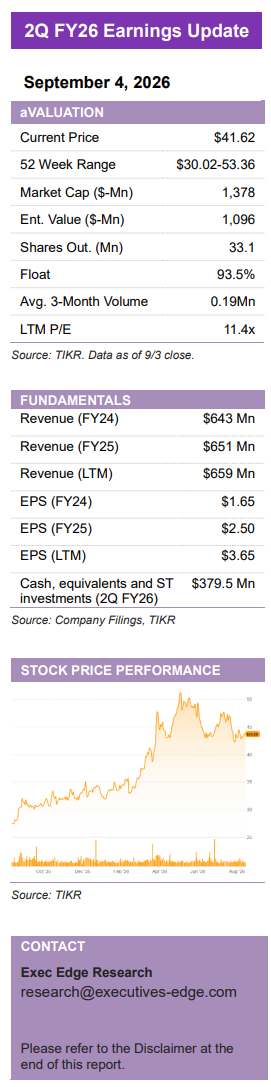
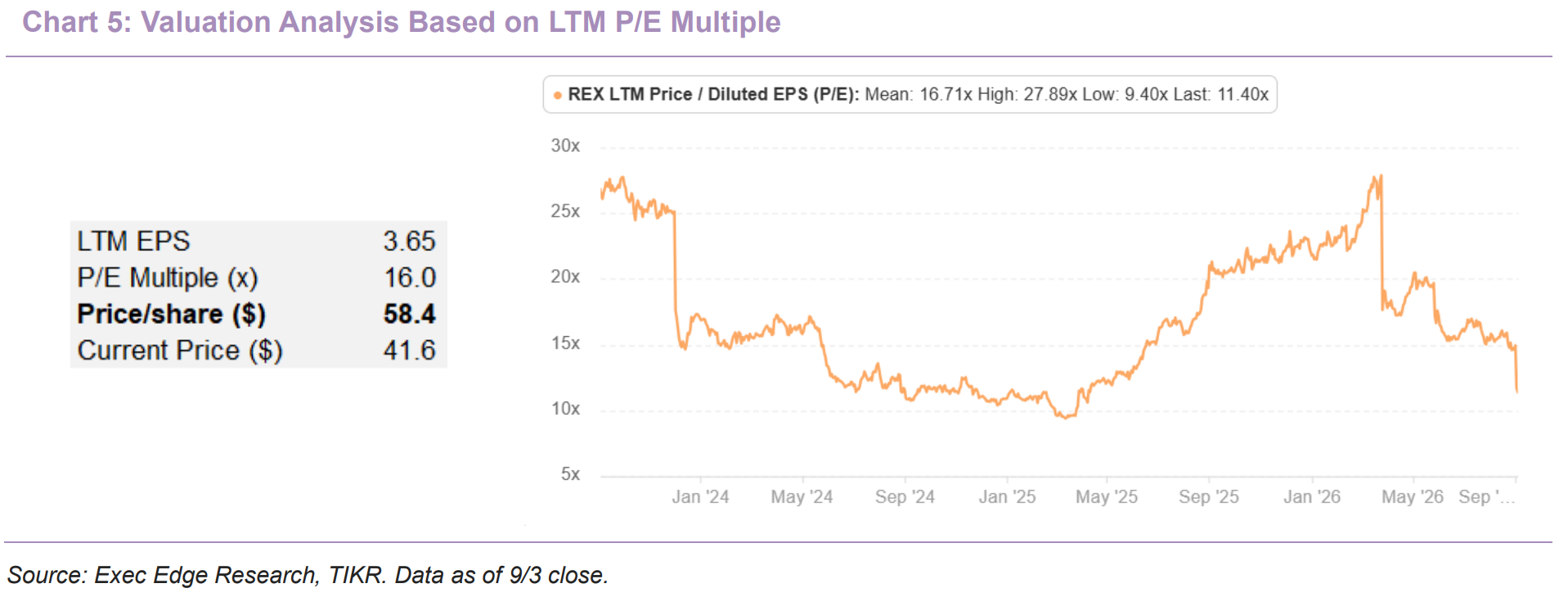
- Valuation remains reasonable following the step-up in earnings and improving visibility across One Earth, 45Z and CCS. At the September 3 close of $41.62, REX has a market capitalization of approximately $1.38 billion and enterprise value of ~$1.1 billion, and trades at 11.4x LTM EPS of $3.65, down from 16.6x at the end of the prior quarter and well below its three-year peak of 27.9x. We apply a 16x illustrative P/E multiple, representing an approximately 23% premium to the current profitable peer average of 13.0x, but still roughly 43% below REX’s three-year peak. We believe this modest premium to peers is supported by REX’s 24 consecutive profitable quarters, $379.5 million of liquidity, no bank debt, growing 45Z contribution, approaching One Earth capacity ramp and advancing CCS development, while the substantial discount to history appropriately reflects continued commodity, policy and permitting risk. Applying 16x to LTM EPS implies an illustrative value of approximately $58.4 per share. We note that cash, cash equivalents and short-term investments of $379.5 million equate to approximately $11.47 per share, or ~28% of the current share price, with REX continuing to carry no bank debt.
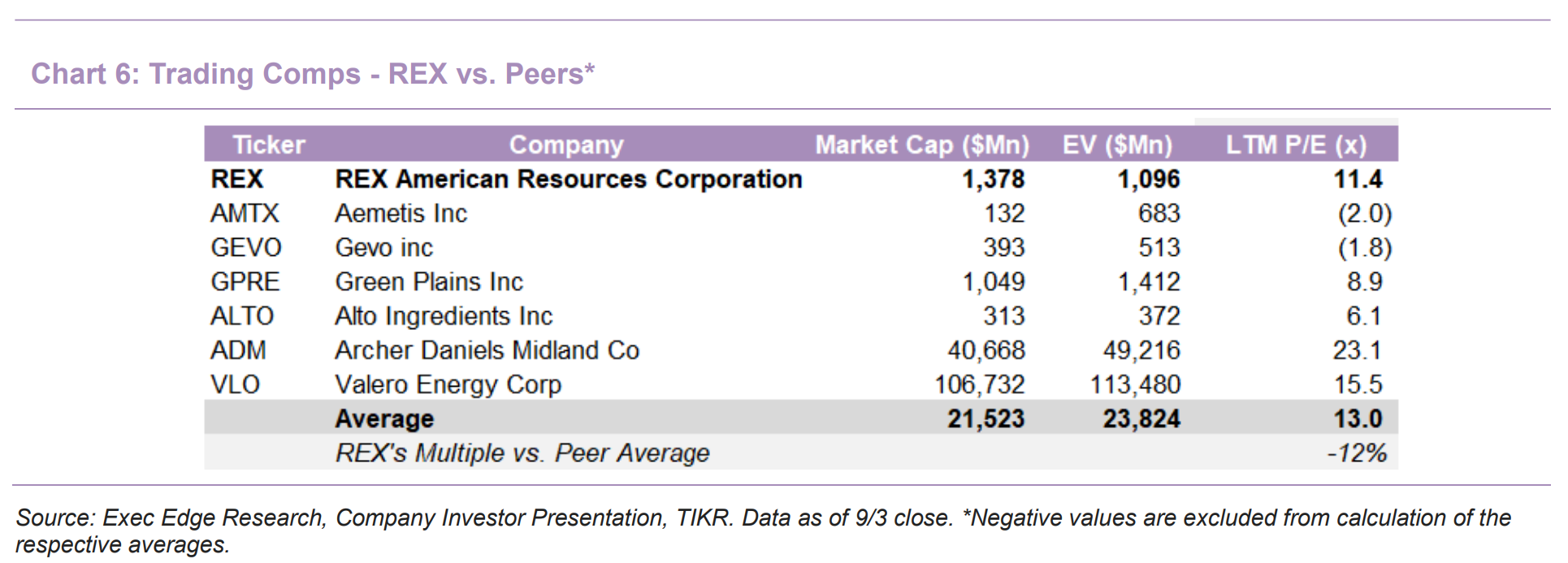
- Peer valuation provides a secondary cross-check, with REX trading below the profitable-peer average while maintaining substantial balance-sheet flexibility. GPRE trades at 8.9x LTM earnings, ALTO at 6.1x, ADM at 23.1x and VLO at 15.5x. The peer average is approximately 13.0x, placing REX’s 11.4x multiple at roughly a 12% discount. The discount remains notable given REX’s 24 consecutive profitable quarters, strong balance sheet and improving visibility across 45Z, One Earth and CCS.
- Further re-rating increasingly depends on execution across a visible set of catalysts. 45Z has already contributed approximately $26.0 million in 1H FY26, so the next drivers are whether those economics remain durable and improve as carbon intensity declines. Milestones include sustained core crush profitability and 45Z contribution, commissioning of One Earth toward approximately 175 million gallons and progression toward 200 million gallons, conversion of the draft Class VI permits into final approvals, advancement of the Illinois pipeline and environmental permitting processes, and disciplined deployment of $379.5 million of liquidity through organic growth, repurchases or selective acquisitions. Continued delivery across these areas would improve visibility into the durability and scale of REX’s earnings base as its low-carbon growth investments move closer to commercial operation.
Read Exec Edge’s Initiation on REX Here
Subscribe to our Weekly Newsletter to Receive All Research
Contact: