Download the Complete Report Here
 Xanadu Quantum Technologies (XNDU)
Optical-Loss Progress and Higher Wafer Throughput Advance Hardware Roadmap as Growth Investment Accelerates
- Key Takeaways:
- XNDU advanced hardware execution, achieving 0.085 dB edge-coupling loss while increasing thin-film lithium niobate and silicon nitride fabrication by 75% and 50%.
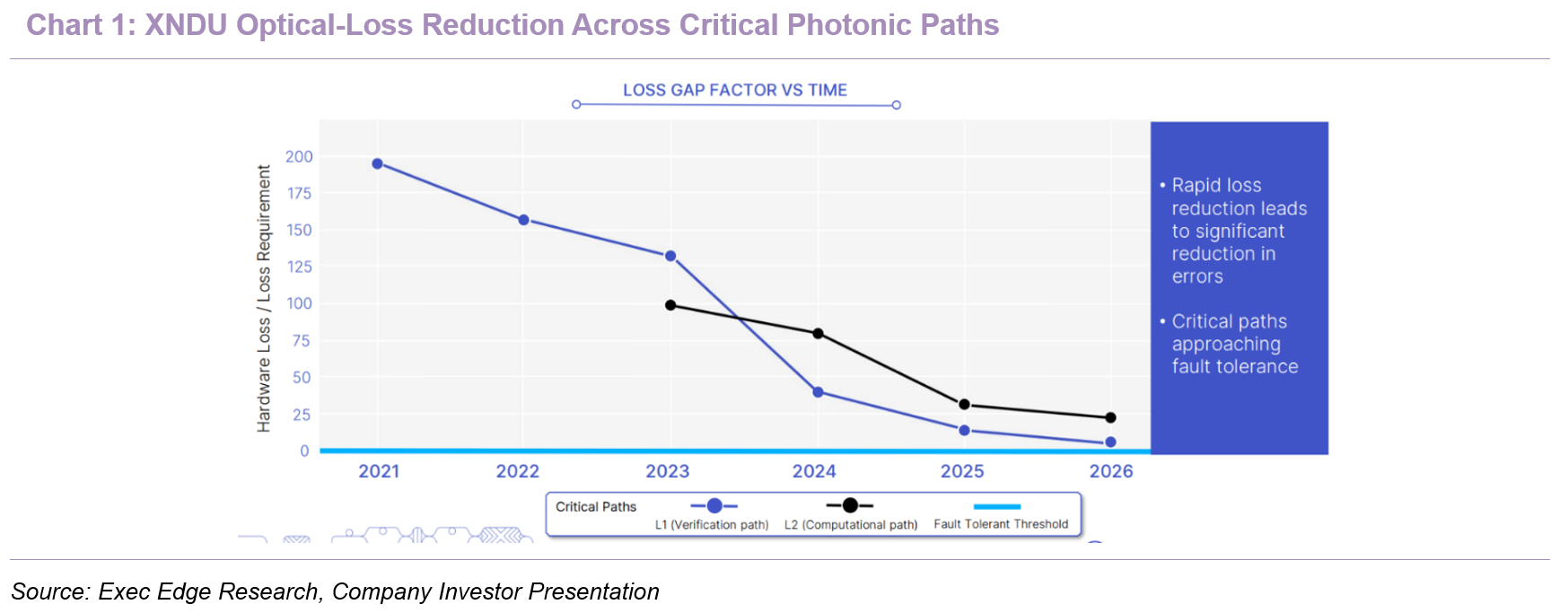
- Higher wafer throughput accelerates qubit-factory iteration, with the aggregate optical-loss gap reduced by up to 200x and 5-10x remaining.
- PennyLane expanded through QROM, Frontier, Lockheed Martin training, and bank engagements, strengthening the developer funnel while monetization remains early.
- Project OPTIMISM is nearing a potential update, while $312.8 million of cash and $67.2 million of ATM proceeds support faster roadmap investment.
- Valuation remains milestone-driven, with rerating dependent on further loss reduction, qubit-factory progress, funding conversion, and partner monetization.
- XNDU’s 2Q26 hardware progress and higher fabrication activity are beginning to translate post-listing capital into faster roadmap execution. XNDU’s second public-company quarter provided more tangible evidence that its expanded capital base is supporting measurable photonic-component improvements and a faster development cadence. The company achieved average edge-coupling loss of 0.085 dB per facet, supported by its internal advanced photonic chip-packaging facility, customized fiber and fiber-array work with Corning, and wafer-singulation support from DISCO. The 0.085 dB result represents a significant component-level improvement and, according to XNDU, may be the lowest edge-coupling loss achieved in the industry.
- Lower edge-coupling loss strengthens hardware efficiency, but broader progress toward fault tolerance still depends on reducing losses across the full system. Each transition between fiber and photonic chips introduces loss, making lower coupling loss increasingly important as XNDU connects more chips and modules. Edge coupling, however, is only one of approximately 16–17 major loss contributors across the end-to-end system, alongside qubit generation, beam splitters, phase shifters, ring resonators, optical propagation pathways, gates, and detector efficiency. The 0.085 dB result therefore represents an important component-level milestone, but not a standalone measure of total system readiness.
- XNDU’s remaining 5-10x loss gap provides a more measurable framework for tracking progress toward fault tolerance. The aggregate optical-loss gap has declined by as much as 200x over roughly four years, with a further 5-10x reduction still required to reach the threshold for scalable fault-tolerant operation. This gives investors a clearer benchmark for evaluating whether future hardware improvements are translating into meaningful progress against the company’s long-term roadmap.
- XNDU is addressing the remaining loss gap through both hardware improvement and architectural simplification. Progress is coming from more chip runs and improvements across fabrication, packaging, propagation loss, coupling, and detector efficiency, while architectural changes are designed to reduce the number of components and optical operations photons must traverse. XNDU expects to provide a more detailed loss and hardware roadmap around the end of summer or Analyst Day, consolidating these contributors into two principal optical paths and extending the framework toward 2029-2030. The update should be an important near-term catalyst by providing clearer benchmarks around current performance, required thresholds, timing, and system dependencies.
- Higher wafer throughput should accelerate development cycles across the company’s two core material platforms. Fabrication activity increased approximately 75% for thin-film lithium niobate and 50% for silicon nitride. Silicon-nitride availability through NY CREATES increased from approximately 100 to 150 wafers, while thin-film-lithium-niobate activity through WaferTech, a UMC subsidiary, increased from slightly above 100 to approximately 175 wafers per month. XNDU expects both corridors to increase further.
- The higher cadence should improve iteration speed and increase the productivity of R&D investment. More wafer availability allows the company to run additional design, fabrication, testing, and redesign cycles in parallel, helping identify process limitations faster and feed improved components into the qubit-factory architecture. Combined with XNDU’s foundry-compatible approach and access to established semiconductor and photonics infrastructure, this should improve repeatability, process control, and throughput while reducing execution risk at each development cycle.
- Albany expansion should strengthen XNDU’s access to U.S. semiconductor infrastructure and engineering talent. XNDU is expanding its U.S. operations around Albany, New York, where proximity to semiconductor research, photonics infrastructure, foundry partners, and government stakeholders should improve coordination across design, fabrication, packaging, and testing. U.S. headcount has increased more than fivefold since 2023, with further significant growth expected by year-end. The public listing has also improved recruiting visibility and compensation flexibility through liquid equity awards, broadening the pool of specialized engineering candidates. Together, the expanded U.S. footprint and deeper talent base should support higher tapeout and wafer activity, greater parallel component development, and a faster hardware iteration cadence.
- QROM improvements demonstrate how software innovation can reduce future hardware requirements and reinforce the value of the full-stack model. The company published a patent-filed quantum read-only memory, or QROM, technique that cuts required Toffoli-gate operations by roughly half by reducing unnecessary data-movement and unlocking steps. Because QROM is a common subroutine for loading classical data into quantum algorithms, lower gate requirements could ultimately reduce physical-qubit, error-correction, and runtime needs, easing the burden on the hardware roadmap; the implementation is already available through PennyLane. XNDU also trained a Fourier-based quantum-machine-learning model with more than one million parameters to learn the distribution of ribosomal RNA, demonstrating the software stack’s ability to support increasingly complex scientific workloads, although commercial applicability remains early.
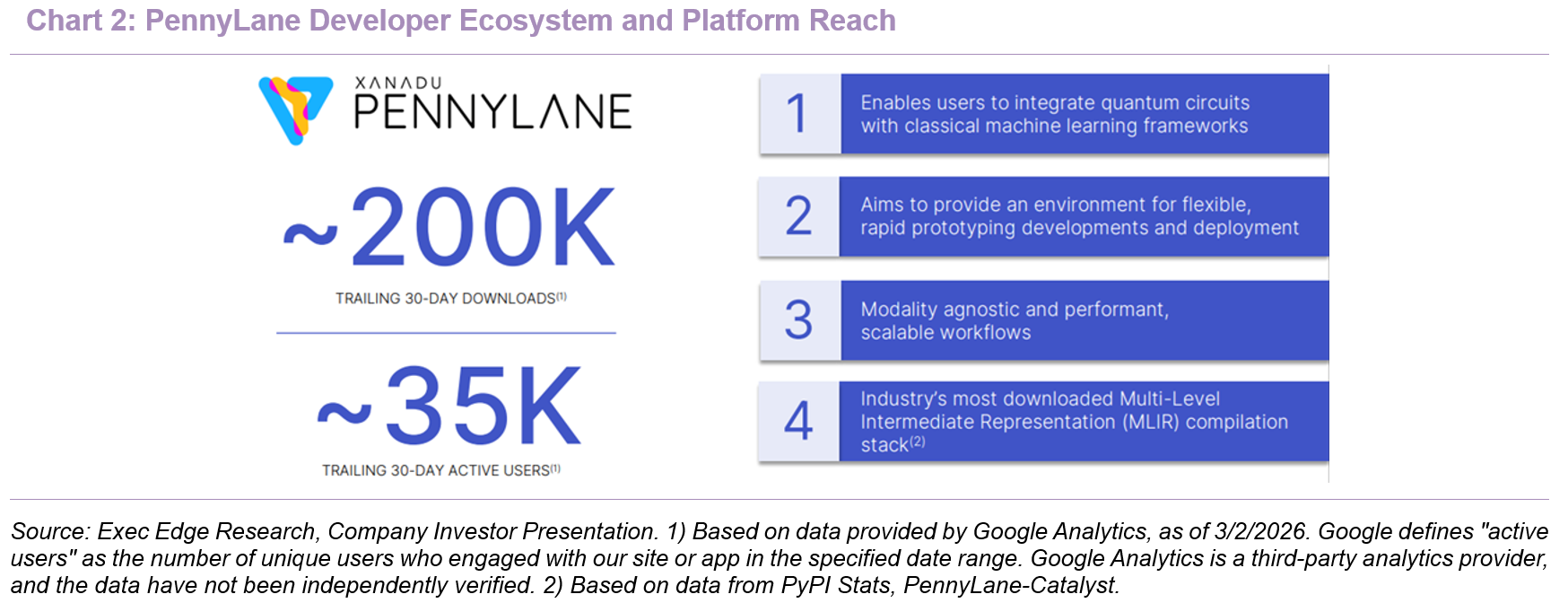
- PennyLane continues to expand its developer reach and strengthen XNDU’s future customer funnel, while monetization remains early. The company released PennyLane 0.45 and Catalyst 0.15, improving end-to-end algorithm development and compilation, while the foundational PennyLane paper surpassed 2,000 citations. Active users, university relationships, and corporate engagement continue to grow, with the latest disclosed metrics at more than 35,000 active users, approximately 200,000 monthly downloads, and roughly 150 university partners. PennyLane remains more important today as a developer and customer-acquisition funnel than as a software revenue driver, with researchers and enterprises trained on the platform potentially becoming future users of enterprise software, application-development services, and quantum-compute access as fault-tolerant hardware becomes available toward 2029-2030.
- Partnership activity is increasingly supporting application development, workforce readiness, and future enterprise adoption. The company expanded its Lockheed Martin relationship through a joint quantum-machine-learning and workforce-training initiative that uses PennyLane, educational resources, and dedicated workshops to train AI developers and research engineers through the Quantum Talent Pipeline. The program addresses a shortage of internal quantum specialists while broadening PennyLane adoption across aerospace and defense. XNDU also brought PennyLane and its Lightning simulator to Oak Ridge National Laboratory’s Frontier supercomputer, enabling distributed quantum simulation across AMD-powered nodes; renewed its multi-year Rolls-Royce collaboration in computational fluid dynamics and aerodynamics; continued research with Fidelity FCAT; and disclosed advanced-stage engagements with several major banks focused on systematic-risk modeling and multi-input correlations. Engagement with Los Alamos and membership in the Unitary Foundation further extend the company’s research, talent-development, and open-source ecosystem.
- The expanding partner ecosystem strengthens XNDU’s future customer funnel. These relationships broaden the developer base, identify high-value applications, and increase the likelihood that future demand comes from organizations already familiar with the platform. Revenue remains primarily government- and milestone-driven, however, making the ecosystem more valuable today for application IP, technical validation, workforce readiness, and future procurement pathways than as a recurring-revenue engine.
- Project OPTIMISM is nearing a potential funding decision that could materially reduce the capital intensity of XNDU’s manufacturing roadmap. The program remains in final discussions, with a potential update expected over the next one to two months. It could provide up to C$390 million of support from the governments of Canada and Ontario for photonic packaging, wafer-level testing, heterogeneous integration, and quantum-module assembly. If finalized, the funding would strengthen XNDU’s manufacturing capacity while supporting Canada’s sovereign quantum supply chain. The program should not be viewed as unrestricted upfront liquidity, however, as funding is expected to be received over time against qualifying R&D and capital investments; final terms, eligible expenditures, cost-sharing requirements, and reimbursement timing will determine the ultimate balance-sheet and cash-flow benefit.
- DARPA Stage C could provide an important external validation point for the company’s fault-tolerance roadmap. DARPA remained the principal driver of 2Q26 revenue through Stage B of the Quantum Benchmarking Initiative, with XNDU indicating that required milestones are being met and expressing confidence around potential advancement to Stage C. Selection would matter beyond incremental funding by providing independent validation of the company’s loss-reduction and fault-tolerance progress, strengthening the credibility of its hardware roadmap, and increasing visibility with U.S. government and sovereign-compute customers. Continued progress through DARPA’s benchmarking process could also improve the longer-term pathway toward government procurement.
- The synthetic ATM expands funding flexibility for roadmap acceleration. XNDU established a synthetic ATM facility with Yorkville Advisors for up to $300 million over 36 months, allowing the company to issue up to 30 million Class B shares with no minimum usage requirement. During 2Q26, the company raised $67.2 million through the issuance of 5.5 million shares at an average net price of $12.28, with the company retaining flexibility to draw selectively based on market conditions and valuation. The facility reduces near-term financing risk and supports additional engineering, wafer, and manufacturing investment; however, future issuance will need to translate into measurable optical-loss reduction, qubit-factory progress, and faster roadmap execution.
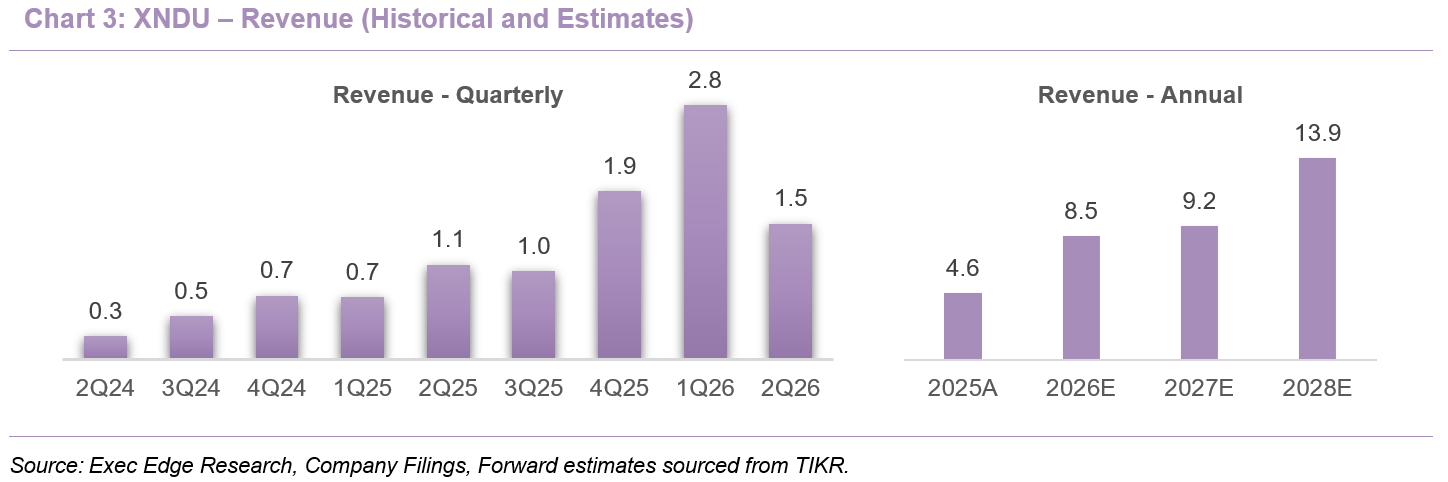
- Revenue remains early-stage, concentrated, and largely program-driven. 2Q26 revenue increased 43% y/y to $1.5 million from $1.1 million but declined approximately 47% from $2.8 million in 1Q26, primarily reflecting the timing of DARPA Stage B revenue and milestone recognition. Two customers represented approximately 75% of 2Q26 revenue and 79% of 1H26 revenue, reinforcing the limited recurring nature of the current revenue base. Until revenue shifts toward scalable software subscriptions, cloud access, system sales, IP licensing, or repeatable application-development work, quarterly results should be viewed primarily as evidence of technical engagement and government validation rather than product-market maturity.
- Street estimates imply a gradual revenue build as government programs and partner activity begin to contribute more meaningfully. Street estimates sourced from TIKR call for revenue to increase from $4.6 million in 2025 to $8.5 million in 2026 and to $13.9 million in 2028. The revenue base remains modest relative to XNDU’s investment requirements and sensitive to contract timing, but the progression suggests the company is beginning to establish the building blocks for commercialization as government programs and strategic partnerships contribute to reported sales.
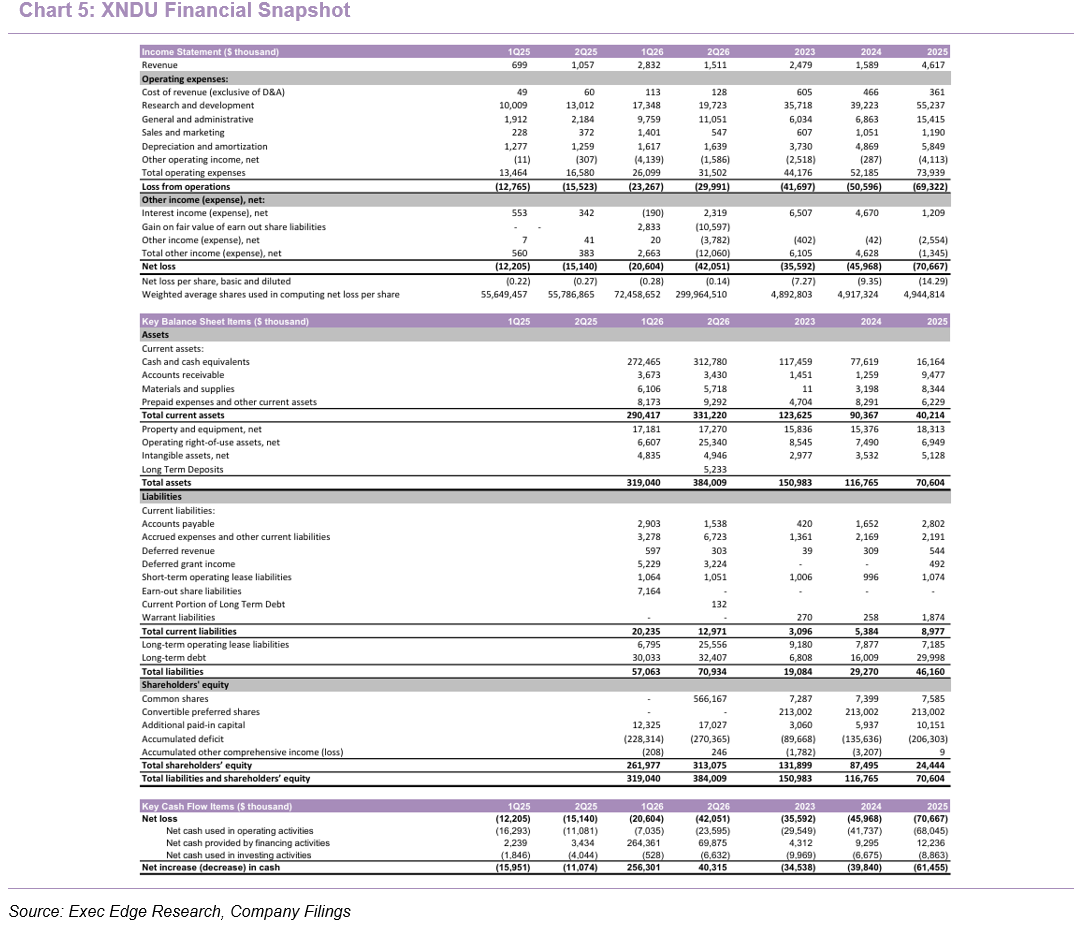
- Higher R&D and capex are beginning to translate the post-listing capital base into a faster engineering cadence. R&D expense increased to $19.7 million from $17.3 million in 1Q26, driven by engineering and manufacturing hiring, stock-based compensation, and broader development activity, while G&A rose to $11.1 million from $9.8 million on higher headcount, public-company costs, and capital-markets activity. Capital expenditures increased to $6.4 million from $0.3 million as the company invested in specialized equipment for chip testing, process refinement, and manufacturing scale-up. The step-up is consistent with the broader roadmap, as higher wafer throughput and tapeout activity require additional engineering capacity, testing infrastructure, and process-control capabilities, providing a clearer test of whether incremental capital is accelerating hardware development.
- Spending is expected to step up further through 2H26 as hiring, tapeouts, and manufacturing investment increase. R&D growth is expected to accelerate into 3Q26 as engineering headcount and tapeout activity rise, while capex should increase further through the second half to support manufacturing and R&D infrastructure. XNDU did not provide explicit quarterly or annual expense guidance, but more detailed engineering and spending metrics are expected around Analyst Day and the end-of-summer hardware roadmap, which should provide a better framework for assessing whether the higher investment cadence is translating into faster technical milestone delivery.
- Wider adjusted EBITDA losses reflect the deliberate step-up in R&D and public-company investment. Adjusted EBITDA loss widened to $21.3 million from $13.9 million in 1Q26 and $13.4 million in 2Q25, driven by higher R&D, G&A, and lower grant revenue, while GAAP net loss increased to $42.1 million. The GAAP result included $12.5 million of fair-value losses, $4.7 million of stock-based compensation, and $2.3 million of non-recurring transaction and financing expenses, which explain much of the gap between reported net loss and underlying operating investment. The core trend, however, remains one of higher spending and wider losses as XNDU accelerates engineering, manufacturing, and public-company buildout.
- Physical infrastructure commitments are increasing alongside XNDU’s manufacturing and engineering buildout. The company recognized a $19.1 million operating lease liability for a new Toronto facility under a 15-year term, driving much of the increase in long-term lease liabilities to $25.6 million from $7.2 million at year-end. The expanded footprint supports higher manufacturing, testing, and engineering activity as the roadmap scales, although it also increases the fixed-cost base ahead of scaled commercialization.
- The expanded balance sheet provides substantial capacity to accelerate technical execution. XNDU ended 2Q26 with $312.8 million of cash and approximately $32.5 million of debt, implying net cash of roughly $280 million. Operating cash use was $30.6 million in 1H26 versus $27.4 million a year earlier, while investing outflow totaled $7.2 million. Liquidity reflects the post-SPAC capital raise, supplemented by $67.2 million of 2Q26 synthetic ATM proceeds, providing flexibility to expand wafer activity, engineering headcount, and manufacturing infrastructure. Near-term financing risk remains limited, but with R&D and capex expected to increase through 2H26, the more relevant measure of capital efficiency will be whether higher spending translates into faster optical-loss reduction, qubit-factory progress, and broader roadmap execution.
Differentiated Architecture and Milestone Progress Support a Potential Valuation Rerating
- Disclaimer: Exec Edge does not publish proprietary estimates, ratings, price targets, or investment recommendations. The valuation discussion below is illustrative only and is based on company filings, management commentary, and third-party data and estimates. It does not constitute a recommendation, price target, rating, or prediction of future pricing.
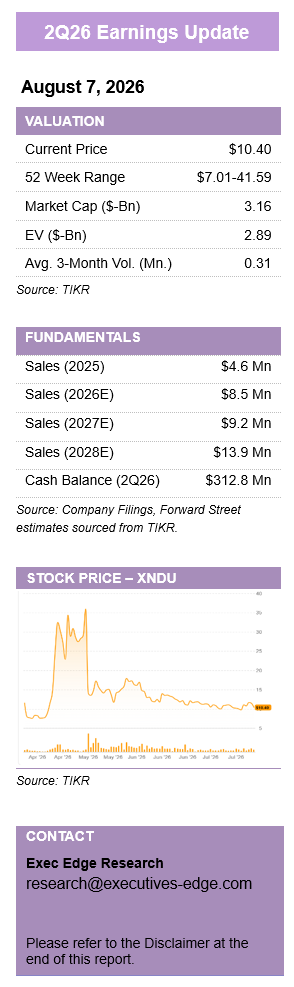
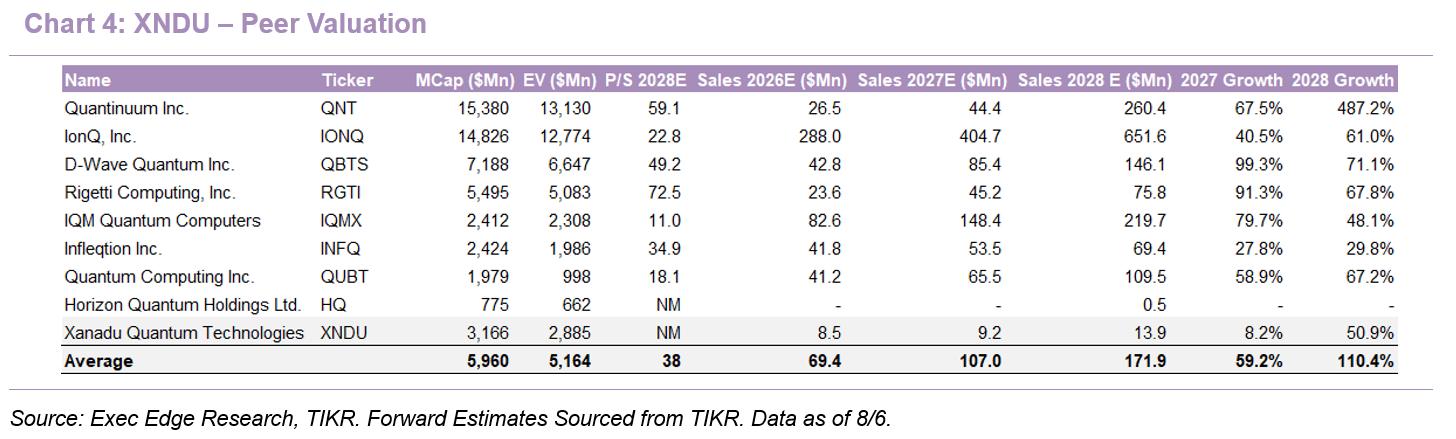
- XNDU’s valuation has reset despite measurable technical and ecosystem progress and remains below listed quantum peers. At $10.4 per share, XNDU trades at a market capitalization of approximately $3.2 billion and enterprise value of roughly $2.9 billion, compared with approximately $4.1 billion and $4.3 billion, respectively, at the time of the May earnings update. This represents a roughly 22% decline in market capitalization and 33% reduction in EV despite progress in optical loss, materially higher wafer throughput, expanded manufacturing capacity, and broader software and partner engagement. XNDU’s current market capitalization is also roughly 47% below the peer average of about $6.0 billion, while its EV is approximately 44% below the roughly $5.2 billion peer average. The valuation gap is notable given XNDU’s scarce pure-play photonic exposure, differentiated architecture, and full-stack positioning, although relative valuation remains sensitive to differences in revenue scale, technical maturity, and commercialization timelines across quantum platforms.
- Architecture credibility, funding capacity and milestone execution remain the more relevant valuation framework. XNDU ended 2Q26 with $312.8 million of cash and has increased fabrication activity by approximately 75% for thin-film lithium niobate and 50% for silicon nitride, while the aggregate optical-loss gap has narrowed by as much as 200x over roughly four years, with a further 5-10x reduction estimated to remain. These metrics provide a more useful framework for assessing whether higher R&D, capex, and infrastructure investment are reducing technical risk and accelerating development. The upcoming detailed loss and hardware roadmap should therefore be particularly important for valuation, as it is expected to provide clearer benchmarks around current performance, required thresholds, timing, and the path toward the 2029-2030 roadmap.
- Rerating potential remains tied to measurable technical, funding, and commercial catalysts. Key drivers include further reduction in the remaining 5-10x optical-loss gap, continued increases in wafer and tapeout velocity, qubit-factory progress, DARPA Stage C advancement, finalization of Project OPTIMISM, updated PennyLane adoption metrics, and conversion of strategic partnerships into paid or procurement-linked demand. Successful execution across these milestones could support a narrowing of XNDU’s current valuation discount as technical risk declines and revenue visibility improves. Conversely, slower loss reduction, qubit-factory delays, rising R&D and capex without comparable technical progress, additional ATM dilution, or continued uncertainty around government funding could constrain rerating potential.
Download the Complete Report Here
Read Exec Edge’s Initiation on Xanadu Quantum Here
Watch IPO Edge Fireside Chat with Xanadu Founder & CEO Christian Weedbrook
Subscribe to our Weekly Newsletter to Receive All Research
Contact: