Download the Complete Report Here
 Brazil Potash Corp. (GRO)
Definitive Power Agreement, Profert Enactment and Engineering Progress Strengthen Autazes’ Construction Readiness; Valuation Remains Attractive.
- Key Takeaways:
- Gera Center’s definitive 28-year power agreement is expected to remove ~$33 million of upfront construction capex and deliver ~$10 million in lifetime savings.
- Full-project FEED coverage, targeted for completion in 2Q27, strengthens lender readiness and supports GRO’s ~$1.8 billion construction debt financing strategy.
- Profert enactment and favorable judicial rulings strengthen government and regulatory support, while AI-powered sorting tests introduce additional long-term production potential.
- 3Q26 operating loss narrowed 77% y/y to $2.8 million, while cash remained strong at $68.6 million despite increased project development spending.
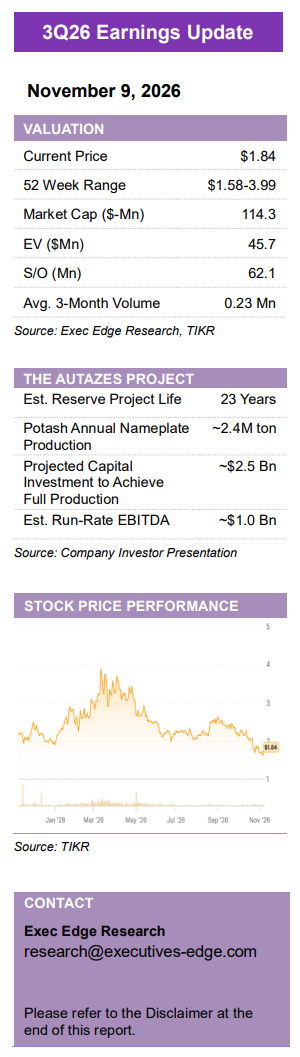
- At $1.84, GRO trades at approximately $45.7 million basic EV, with construction financing remaining the principal catalyst for unlocking Autazes’ long-term value.
- Gera Center’s definitive power agreement converts GRO’s infrastructure financing strategy into tangible execution progress, reducing upfront construction funding requirements. In September, GRO converted its May non-binding MOU into a 28-year build-own-operate agreement under which Gera Center will finance, construct, own and operate a modular diesel power plant. The agreement covers five years of construction power and 23 years of backup capacity, supporting mine shafts, processing facilities and port infrastructure until connection to Brazil’s national grid. The 20 MW installation will comprise 45 modular generators, initially providing 10 MW before reaching full capacity during the first construction year. Mobilization is targeted within 120 days of the order to proceed, with minimum availability requirements of 98% monthly and 98.5% annually. The definitive contract strengthens execution visibility and establishes a precedent for third-party infrastructure investment.
- The agreement reduces upfront construction funding requirements while improving overall project economics. GRO expects the arrangement to remove ~$33 million from Autazes’ initial construction budget and generate ~$10 million in net savings over its 28-year term. The structure replaces upfront equipment expenditure with contractual operating payments, including cost recovery during construction, lowering pre-production funding needs. The $33 million reduction primarily improves financing flexibility, while the $10 million represents the estimated lifetime economic benefit. GRO is pursuing similar arrangements for the powerline, river port, steam plant and trucking system, potentially extending upfront capex reductions across other infrastructure requirements as it assembles the ~$2.5 billion construction financing package.
- Full-project FEED coverage strengthens Autazes’ engineering readiness and establishes a clearer roadmap toward construction. Wood and Promon Engenharia are progressing FEED for the processing plant, tailings facilities, river barge port and associated roads, complemented by the underground mine shafts and development scope awarded to WSP UK and Redpath Deilmann in June. Engineering completion is targeted for 2Q27, providing an important milestone for construction planning and lender diligence. The underground FEED contract has a potential value of ~$26 million, with an initial $4.3 million Early Works phase authorized for geotechnical investigations, freeze modelling and shaft design. During the quarter, GRO commenced on-site workforce training, advanced geotechnical drilling arrangements and continued early construction activities, including road development. The coordinated programs should refine construction sequencing, technical specifications and capital requirements, particularly for the two mine shafts on the project’s critical path.
- GRO continues to advance its ~$1.8 billion construction debt financing strategy through multilateral bank and export credit agency discussions. The targeted debt financing would cover approximately 72% of Autazes’ estimated $2.5 billion capital requirement, with the remaining funding expected to come from strategic project-level equity and third-party infrastructure arrangements. The financing strategy also includes potential proceeds of ~$150 million from Franco-Nevada’s royalty option, which is triggered after GRO raises capital representing at least 30% of total project completion costs. The definitive Gera agreement demonstrates progress in reducing direct construction funding requirements through third-party infrastructure investment. Together, these initiatives provide multiple avenues to bridge the remaining funding gap, although securing binding financing commitments remains the key prerequisite for full-scale construction.
- Profert’s enactment strengthens Autazes’ construction economics through potential tax savings and expanded government support for domestic fertilizer production. In September, President Luiz Inácio Lula da Silva signed the legislation into law without vetoes, establishing potential federal tax incentives, authorizing BNDES financing for new fertilizer capacity and introducing domestic-content requirements beginning at 2% in 2027 and rising to 10% by 2037. An earlier company analysis indicated that Profert, combined with existing SUFRAMA benefits, could provide up to $190 million in tax savings against Autazes’ $2.5 billion capital budget. However, the November update more conservatively estimates potential savings in the tens of millions of dollars, with the ultimate benefit dependent on implementation rules and project eligibility. Realization of these incentives would reduce construction costs and lower GRO’s overall funding requirements.
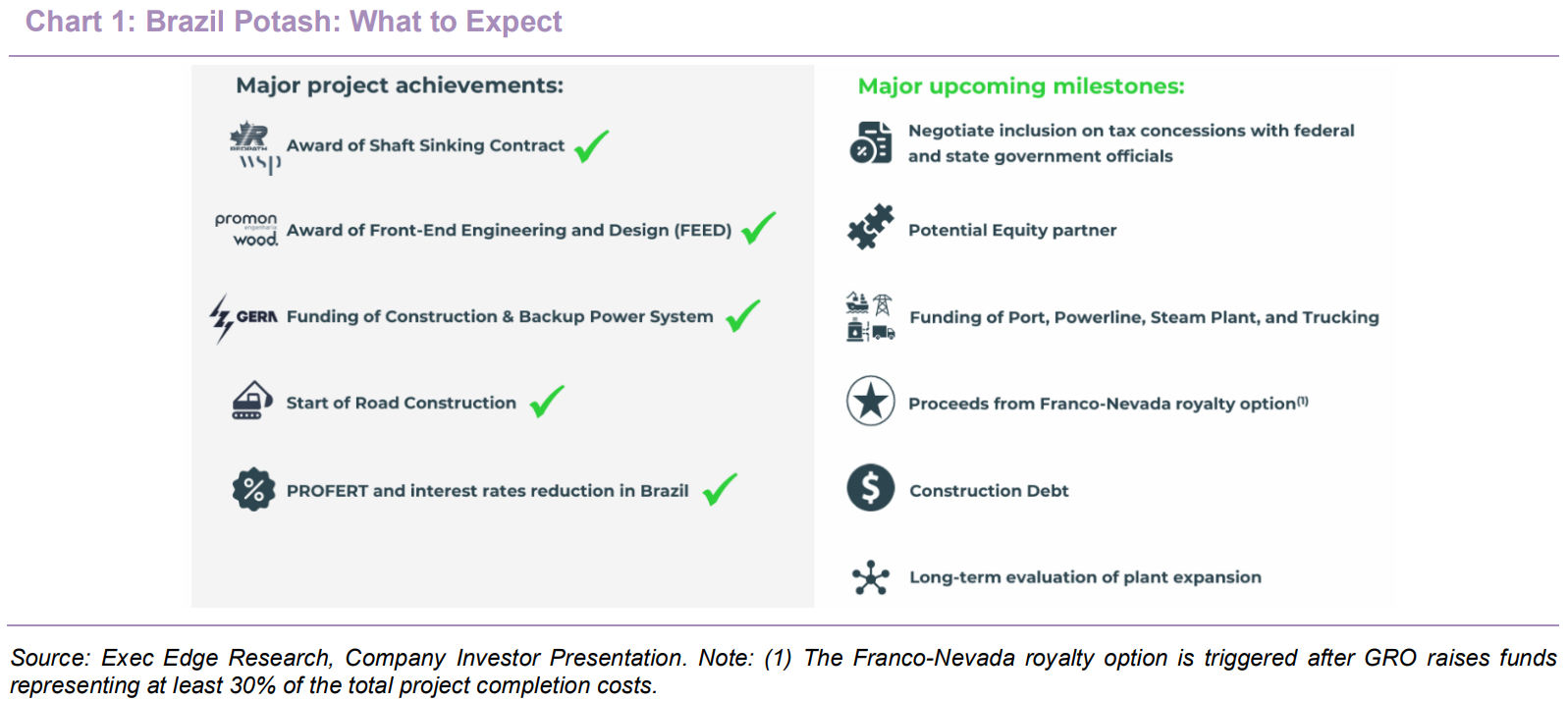
- Expanded government-backed financing initiatives could improve GRO’s access to lower-cost, long-term construction capital. In August, Brazil announced R$4 billion in additional BNDES-administered financing and working-capital support for the fertilizer industry, within a broader R$18.5 billion package. The company’s investor presentation also highlights preferential financing conditions approved by Brazil’s National Monetary Council, including a 3.0% annual government funding-source interest rate and potential tenors of up to 20 years with a four-year grace period. These programs could lower financing costs and improve funding flexibility for capital-intensive developments such as Autazes. Combined with multilateral and export credit agency participation, they broaden GRO’s potential funding sources as it works toward securing construction financing.
- Favorable judicial rulings strengthen Autazes’ construction licensing position and reduce regulatory uncertainty. In August, Brazil’s Supreme Federal Court rejected a petition seeking to suspend prior favorable rulings and halt construction activities, upholding the project’s 21 installation licenses covering the mine, processing plant, port and supporting infrastructure. The decision maintained earlier rulings supporting the Indigenous consultation process, completed in September 2023 with participation from 34 of 36 Mura villages and more than 90% support among participating villagers. The Federal Public Defender’s Office subsequently appealed the decision, although the favorable rulings remain effective pending its outcome. GRO continues to pursue the Mining Concession required before commencing mining operations. Sean Keating was appointed Chief Legal Officer effective October 1, 2026. Together, these developments reinforce the regulatory foundation for construction planning and financing discussions.
- Initial AI-powered X-ray Transmission sorting results highlight potential to improve Autazes’ processing efficiency, increase production and extend mine life. In October, GRO reported positive preliminary testwork conducted with ERCOSPLAN, demonstrating the ability to separate higher-grade potash mineralization from lower-grade material before processing. Testing on material larger than approximately 8 mm increased KCl concentration from roughly 13% to 27%, rejecting approximately 20% of the tested lower-grade material, which contained only 1% to 2% KCl. ERCOSPLAN expects approximately 40% to 55% of mined material to exceed the tested size threshold. The technology could increase production without requiring a third mine shaft or enable recovery from lower-grade sections of the deposit, extending potential mine life. Larger-scale testing and further engineering and economic evaluation are planned after commercial production begins, positioning the technology as longer-term upside potential beyond the existing 2.4 million-ton annual production plan and ~23-year reserve life.
- Autazes’ commercial positioning remains underpinned by substantial contracted offtake, Brazil’s import dependence and a structural logistics advantage. Approximately 91% of the project’s planned 2.4 million tons of annual production is covered by long-term take-or-pay agreements with Amaggi, Keytrade and Kimia, providing substantial sales visibility once operations begin. Amaggi’s logistics arrangements also support distribution through Brazil’s inland river network into major agricultural markets. Brazil imported approximately 96% of its potash requirements in 2025, reinforcing the importance of developing a large-scale domestic supply source. Historical technical studies indicate transportation times of approximately 2.5 days from Autazes to key farming regions versus around 107 days for Canadian imports. Together, contracted demand, domestic market access and lower delivered costs underpin Autazes’ attractive long-term project economics.
3Q26 Financials Reflect Cost Normalization and Increased Project Development Activity
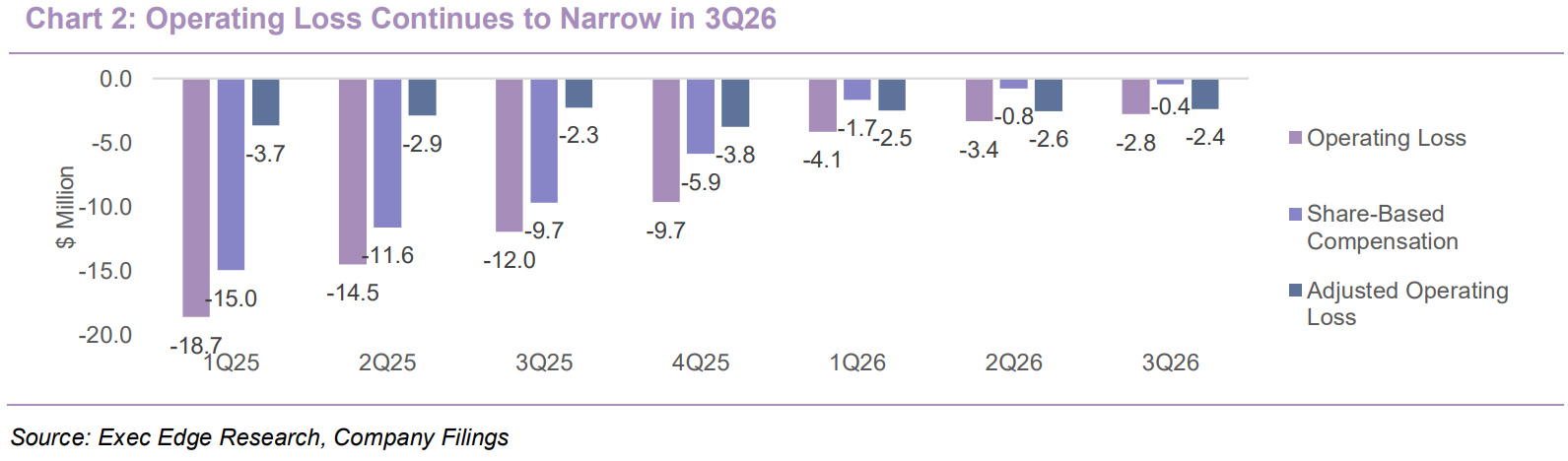
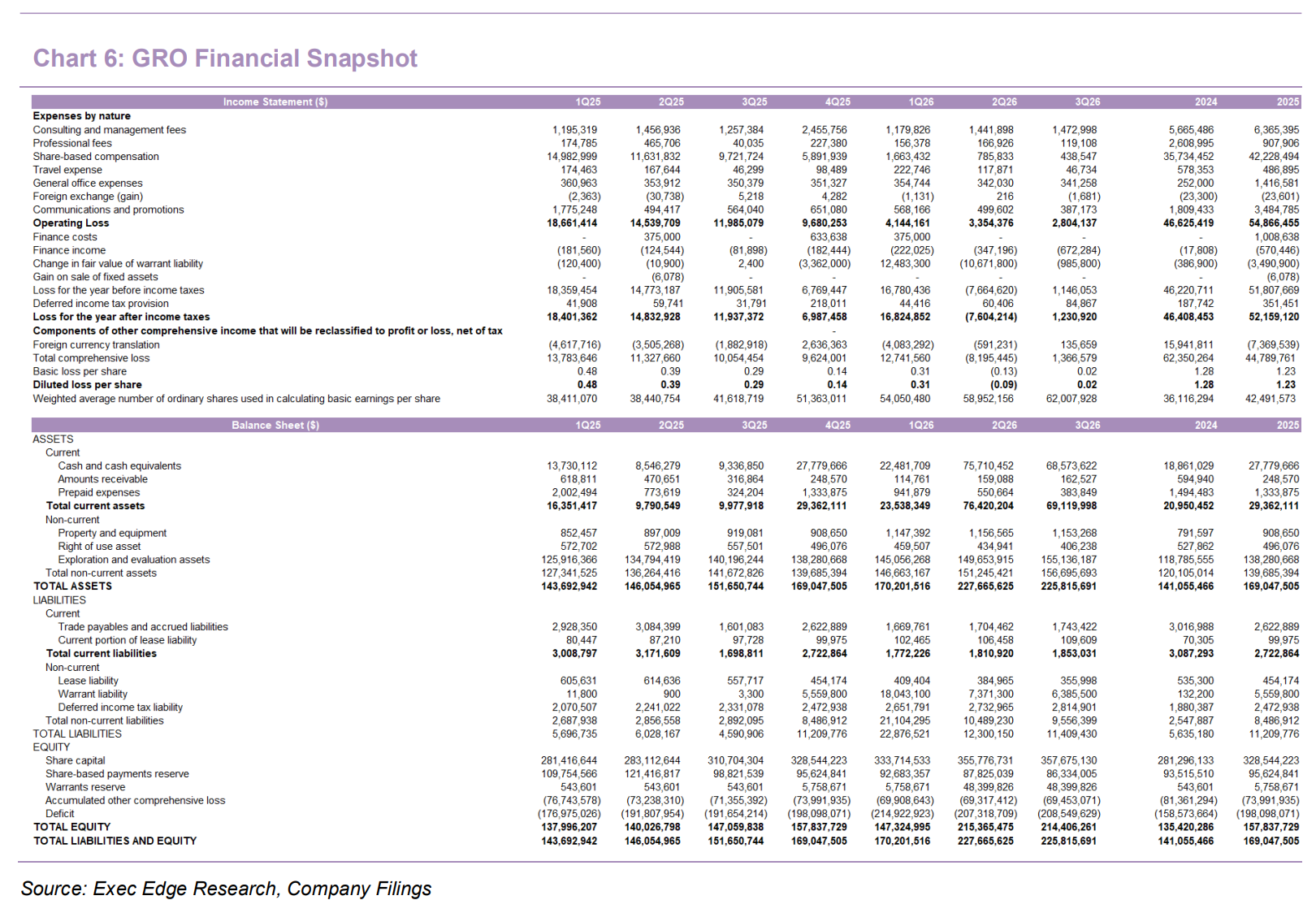
- 3Q26 operating loss narrowed 77% y/y, primarily reflecting lower non-cash compensation, while underlying corporate spending remained broadly stable. Operating loss narrowed to $2.80 million from $11.99 million in 3Q25, primarily reflecting a 95% y/y reduction in share-based compensation to $0.44 million from $9.72 million. Excluding this non-cash expense, operating loss was broadly stable at $2.37 million versus $2.26 million a year earlier and improved 8% sequentially. Communications and promotional spending declined 31% y/y to $0.39 million, while consulting and management fees increased 17% to $1.47 million. For 9M26, operating loss narrowed 77% to $10.30 million, with share-based compensation falling to $2.89 million from $36.34 million. Excluding share-based compensation, operating loss improved 16% to $7.41 million, reflecting lower underlying corporate costs.
- Reported net loss narrowed sharply, supported by lower non-cash compensation, warrant revaluation gains and higher finance income. Net loss declined to $1.23 million, or $0.02 per share, from $11.94 million, or $0.29 per share, in 3Q25. The quarter included a $0.99 million warrant revaluation gain and $0.67 million of finance income, compared with a negligible warrant loss and $0.08 million of finance income a year earlier. For 9M26, net loss improved 77% to $10.45 million from $45.17 million, or $0.18 versus $1.14 per share, despite a $0.83 million warrant revaluation loss.
- Cash deployment increasingly reflects accelerating Autazes development activity, while corporate cash consumption remains contained. Net cash used in operating activities declined 18% y/y to $7.28 million in 9M26 from $8.85 million, while investing outflows increased 59% to $10.57 million from $6.63 million. Cash additions to exploration and evaluation assets rose 65% to $11.62 million from $7.02 million, driven by increased project development spending. On a standalone quarterly basis, operating cash use declined to $2.16 million in 3Q26 from $2.96 million in 2Q26, while investing outflows increased to $4.44 million from $3.84 million. Exploration and evaluation cash additions reached approximately $5.49 million in 3Q26, lifting the asset balance to $155.14 million at September 30 from $149.7 million in June. The spending shift underscores GRO’s progression toward construction readiness, with a greater share of capital directed toward engineering and site development rather than corporate overhead.
- GRO’s strong liquidity position provides funding visibility through 2027 as the company advances engineering and construction financing discussions. Cash and equivalents totaled $68.57 million at September 30, compared with $75.7 million in June and $27.78 million at year-end 2025, while working capital stood at $67.27 million versus $74.6 million and $26.64 million, respectively. The May equity offering generated $63.23 million in gross proceeds and approximately $58.87 million net of issuance costs, materially strengthening the balance sheet. GRO remains free of conventional borrowings, with $0.47 million in lease liabilities and $6.39 million in warrant liabilities. The company also retains an unused $125 million at-the-market equity facility. Management expects existing cash to fund planned activities through 2027, supporting FEED completion and construction financing efforts.
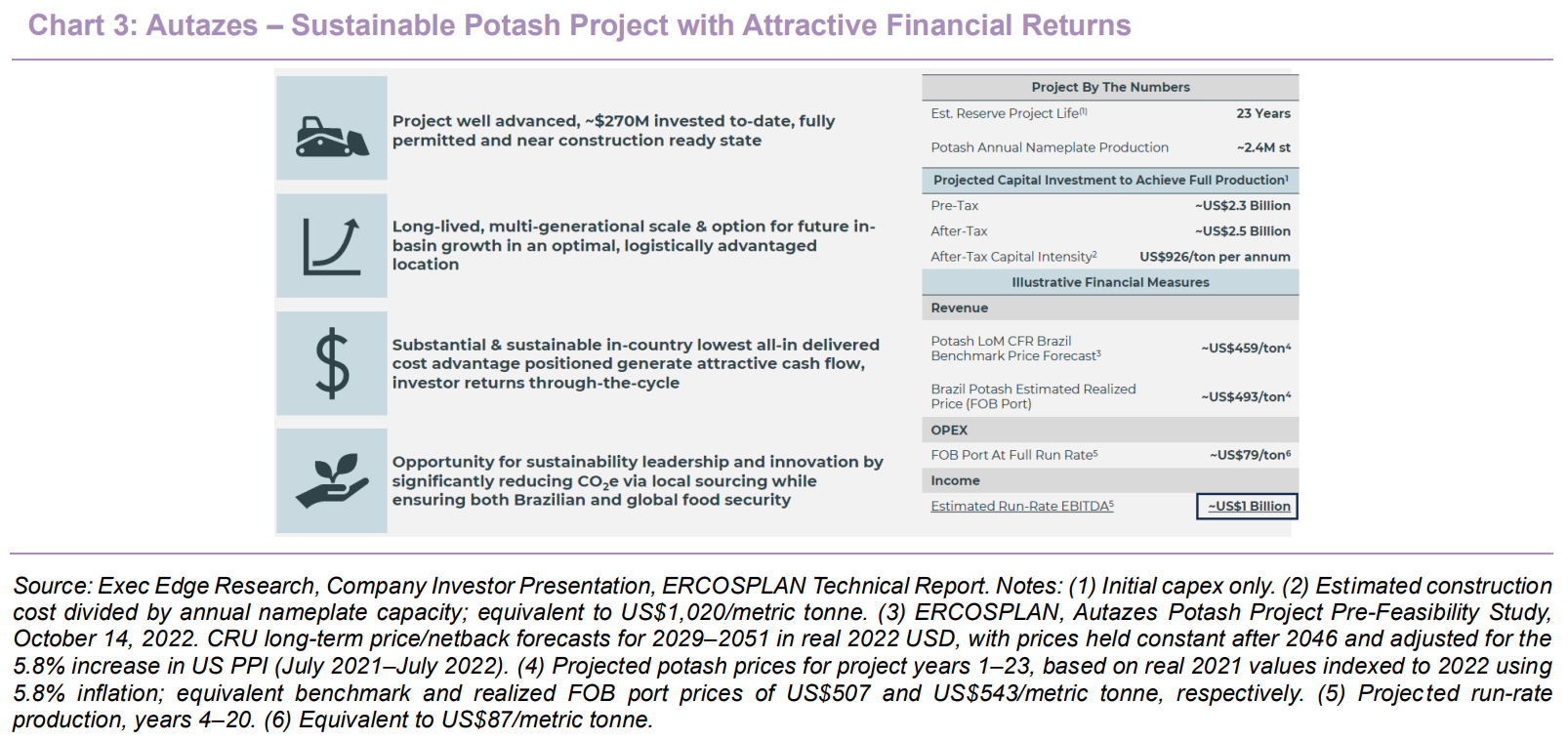
- Autazes’ long-term financial profile remains attractive, with substantial EBITDA potential underpinned by large-scale production and a structural cost advantage. Based on the October 2022 ERCOSPLAN technical study, the project targets approximately 2.4 million short tons of annual production over a 23-year reserve life, with management illustrating steady-state EBITDA potential of approximately $1.0 billion. Assumed realized potash prices of approximately $493 per short ton FOB port and operating costs of $79 per short ton imply a substantial operating spread, supporting strong potential operating margins and cash generation at full production. The estimated $2.5 billion initial construction investment remains the principal capital requirement to unlock these long-term economics.
Attractive Valuation Relative to Long-Term EBITDA Potential
- Disclaimer: Exec Edge does not publish proprietary estimates, ratings, price targets, or investment recommendations. The valuation discussion below is illustrative only and is based on company filings, management commentary, and third-party data and estimates. It does not constitute a recommendation, price target, rating, or prediction of future pricing.
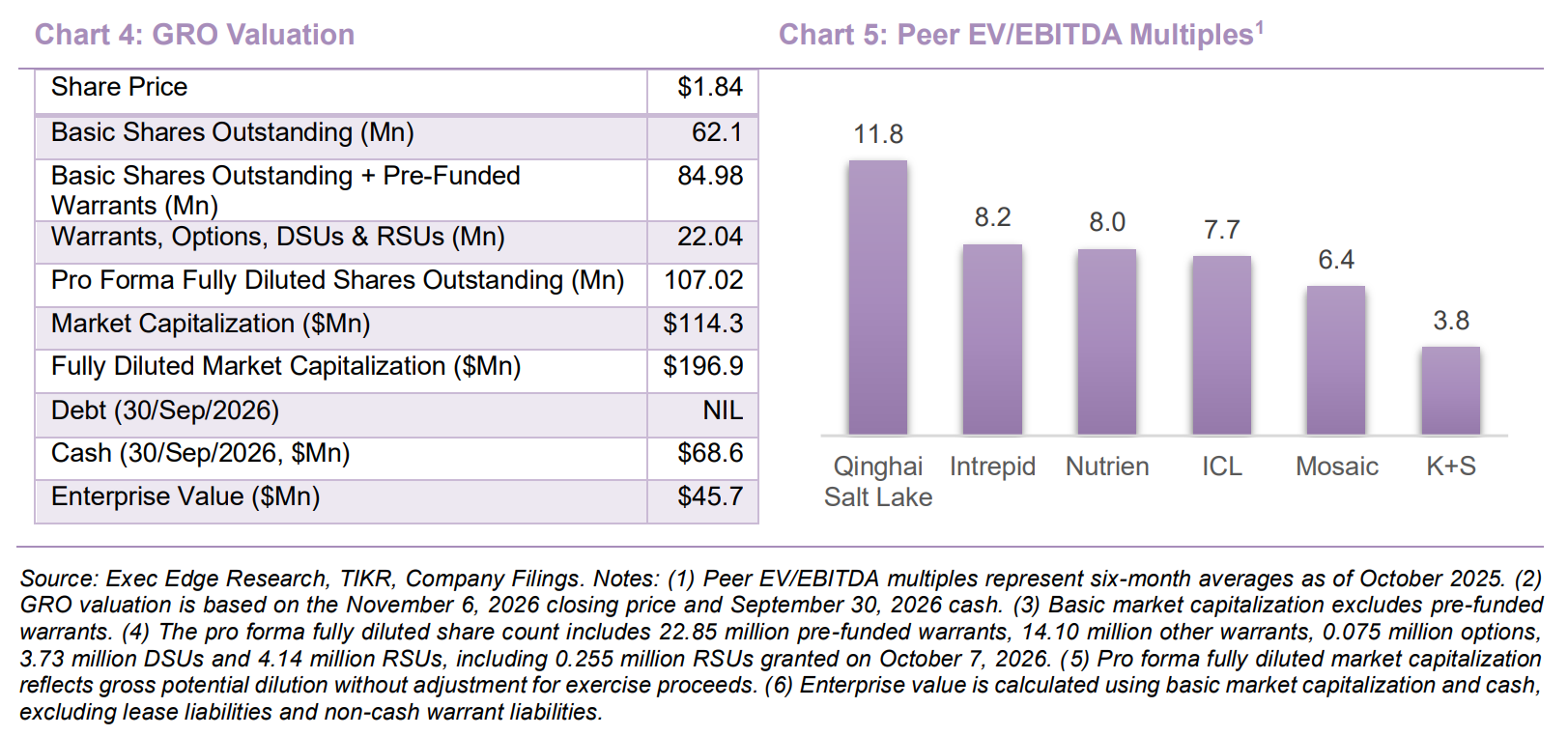
- GRO’s valuation remains attractive relative to Autazes’ long-term earnings potential despite continued progress in construction readiness and financing. At the November 6 closing price of $1.84, GRO has a market capitalization of $114.3 million and an enterprise value of $45.7 million. This compares with an EV of $57.5 million in August, representing a 20.5% decline despite progress on infrastructure funding, government incentives and licensing. Including 22.85 million pre-funded warrants increases the economic share count to approximately 84.98 million, implying a market capitalization of $156.3 million and cash-adjusted EV of $87.8 million. Additional warrants and equity awards remain relevant to the fully diluted valuation.
- Peer valuation illustrates substantial long-term value creation potential as Autazes progresses toward commercial production. GRO’s investor presentation indicates a historical median EV/EBITDA multiple of 7.8x across established potash producers, ranging from 3.8x for K+S to 11.8x for Qinghai Salt Lake, based on six-month averages as of October 2025. Applying this multiple to management’s approximately $1.0 billion steady-state EBITDA assumption implies an illustrative production-stage EV of $7.8 billion, compared with GRO’s current basic EV of $45.7 million. The significant valuation gap reflects the project’s development stage, approximately $2.5 billion construction requirement and associated financing and execution risks, while highlighting the scale of potential value creation as financing and construction risks are progressively addressed.
- Construction financing and execution milestones remain the principal catalysts for GRO’s valuation rerating. The definitive Gera agreement, Profert enactment and favorable judicial rulings have strengthened the project’s development outlook, complementing approximately 91% contracted offtake and attractive long-term operating economics. Key catalysts include FEED completion in 2Q27, binding multilateral and ECA debt commitments, strategic project-level equity participation, additional infrastructure financing agreements and commencement of major construction. Progress toward a fully funded construction plan should narrow the development-stage discount and support greater recognition of Autazes’ long-term earnings potential. We continue to view GRO as attractively valued, with securing construction financing representing the critical inflection point for value realization.
Read Exec Edge’s Initiation on Brazil Potash Corp. Here
Subscribe to our Weekly Newsletter to Receive All Research
Contact: