Download the Complete Report Here
 Alpha Compute Corp. (ALP)
ALPHA-01 Moves to Revenue Generation; $21-23 Million Run Rate and Expanding Pipeline Support Scale-Up
- Key Takeaways:
- FY26 largely reflects legacy strategic phases; ALP’s live compute operations and contracted revenue provide the more relevant basis for assessing its growth trajectory.
- ALPHA-01 is operational with 504 B200 GPUs and $16.1 million of annual contracted revenue, while ALPHA-02 targets late-3Q26 deployment with 576 B300 GPUs.
- GAMEE adds 120 million users and a scaled application layer, creating new monetization channels and potential internal demand for ALP’s compute infrastructure.
- Enzo Villani’s appointment as President strengthens oversight of strategy, capital allocation, and execution as ALP scales its compute and GAMEE platforms.
- Management’s $21 million-$23 million annualized revenue run-rate outlook and $200+ million qualified pipeline support visible near-term scale-up and contract-conversion potential.
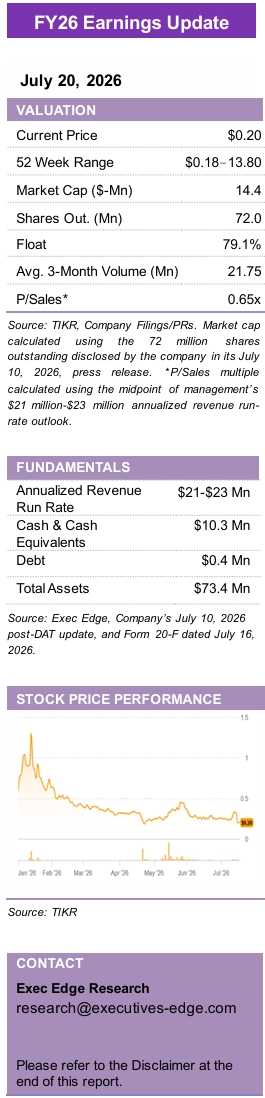
- Modestly valued as ALP trades at 0.65x annualized run-rate sales versus the 7.52x peer average, leaving room for rerating as revenue, margins, and deployment milestones are delivered.
- FY26 financials provide limited insight into the business ALP operates today, with the future trajectory now dependent on contracted AI-compute revenue, deployment execution, and pipeline conversion. The fiscal year ended March 31, 2026 (FY26) captured the transition from legacy biotechnology operations through the digital-asset phase and only the earliest costs associated with establishing the company’s GPU infrastructure. Nearly all economically relevant developments including the ALPHA-01 customer contract, receipt of the $7.5 million reservation payment, the GAMEE acquisition, and the transition to a $21 million-$23 million annualized revenue run rate occurred after fiscal year-end. Investors should therefore assess ALP primarily through the operating status and economics of its compute clusters, pace of new contract awards, and ability to convert infrastructure deployments into reported revenue and cash flow.
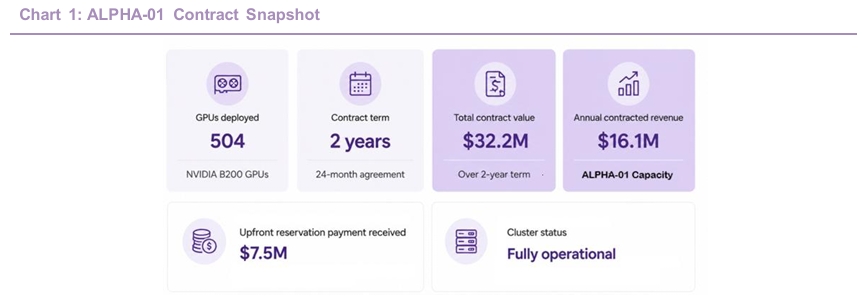
- ALPHA-01 has moved ALP from concept-stage infrastructure development to a live, contracted AI compute operator. The company’s first enterprise-scale deployment comprises 504 NVIDIA B200 GPUs housed in a hydroelectric-powered Canadian data center under a two-year, $32.2 million agreement with a frontier AI research laboratory. The cluster is fully operational and processing customer workloads, supporting $16.1 million of annual contracted revenue versus approximately $30,000 of quarterly compute revenue before the contract. ALP also received the full $7.5 million upfront reservation payment, strengthening cash-conversion visibility over the 24-month term. The agreement is the first commercial proof point that ALP can source capacity, secure an enterprise customer, deploy a Blackwell cluster, and monetize it under a long-duration infrastructure arrangement.
- Multi-year leasing contracts provide recurring revenue visibility while reducing dependence on variable customer utilization. ALP operates as a GPU infrastructure landlord, financing or leasing hardware, securing data-center capacity and power, and then contracting dedicated compute capacity to customers under two- to five-year agreements. Pricing is generally based on an hourly compute rate, but customers commit to reserved capacity and guaranteed uptime, resulting in recurring monthly revenue irrespective of whether the GPUs are used at 100% throughout the period. Recent negotiations have increasingly focused on four- and five-year contracts, which would secure revenue for most of the approximately five-year economic life of the equipment and reduce residual-value exposure. Software and firmware services provide an incremental revenue opportunity where customers require a complete confidential-compute stack rather than bare-metal infrastructure alone.
- Targeted contract margins of 20%-25% establish an initial framework for evaluating compute economics as reported revenue begins to scale. ALP is pursuing two primary deployment structures: leasing an existing server cluster and re-leasing the capacity to an enterprise customer at a positive spread, or purchasing servers, financing them through a project-level vehicle, and deploying them at a colocation facility. Across both structures, the company is targeting margins of approximately 20%-25%, with owned-server transactions currently indicating annual returns of roughly 25%-30%. Owned deployments require larger upfront deposits and carry greater exposure to financing rates, power costs, maintenance, colocation expense, and hardware values, but they also provide greater control and higher potential returns. As ALP develops a deployment record and expands its asset base, lower financing costs and improved procurement terms could support incremental margin upside beyond the initial project economics.
- ALPHA-02 is the next major deployment milestone and is expected to approximately double ALP’s operating Blackwell fleet. The Sweden cluster will comprise 576 NVIDIA B300 GPUs across 72 Dell XE9780 servers and remains targeted for commissioning in 3Q26, taking the combined ALPHA-01 and ALPHA-02 footprint above 1,080 GPUs across Canada and Sweden. The servers have an aggregate cost of approximately $40.9 million, of which $8.6 million had been deposited as of March 31, leaving approximately $32.3 million of remaining hardware consideration. The initial data-center agreement covers 1,213 kW under a 60-month term, with a fixed monthly colocation payment of approximately €163,700 plus variable electricity expense estimated at €0.126 per kWh. ALPHA-02 will therefore validate ALP’s ability to coordinate hardware delivery, project financing, colocation readiness, power availability, networking, installation, customer contracting, and commissioning within the targeted quarter.
- Asset-backed, non-recourse financing is central to ALP’s ability to scale infrastructure without relying primarily on corporate equity. The company generally expects to contribute approximately 20%-30% of deployment cost, with lenders financing roughly 70%-80% against the GPU equipment and associated contracted cash flows. This structure is intended to align debt service with customer payments while limiting recourse to ALP’s broader balance sheet. The Vertical Data-related opportunity, subject to closing conditions and lender review, is expected to support approximately $43 million of additional financing for procurement and deployment of B300 capacity. The ability to pair customer deposits, long-duration offtake contracts, and project-level debt will directly influence dilution, return on invested capital, and the speed at which ALP can convert its pipeline into operating clusters.
- ALPHA-03 and ALPHA-04 extend the multi-cluster roadmap. The company continues to describe both clusters as in process and expects them to build on the 504-GPU Canadian and 576-GPU Swedish foundation. However, the initial Phase II right of first refusal covering another 1,017 kW at the Sweden facility has expired, meaning future expansion at that location will require a renewed agreement or alternative capacity. ALP is evaluating additional data-center locations, long-term power contracts, real estate, energy rights, and potentially greater ownership across the infrastructure stack. Over time, vertical integration could reduce third-party cost leakage, improve control over deployment schedules and power availability, and support margins above the initial 20%-25% target, although these initiatives will require greater scale and additional project capital.
- The $200+ million qualified pipeline reflects late-stage enterprise opportunities with multi-year contract visibility. Potential customers include frontier AI research laboratories, large enterprises, hyperscalers, sovereign entities, and government-related users seeking either dedicated bare-metal capacity or a complete confidential-compute deployment. Individual opportunities generally begin at approximately 500 B200 or B300 GPUs and $16 million-$20 million of annual revenue, while larger inquiries range from 2,000 to 10,000 GPUs. ALP defines qualified opportunities as transactions that have progressed into advanced commercial negotiations involving master service agreements, service-level agreements, final pricing, contract terms, or legal redlines. Management expects a high conversion rate given the maturity of these discussions, although no specific percentage or closing timetable was provided, making signed contracts, customer deposits, and financed deployment plans the clearest measures of pipeline quality.
- Additional enterprise contracts, ALPHA-02 commissioning, revenue conversion, and greater reporting transparency are the primary milestones over the next two quarters. A second and third customer agreement would provide stronger evidence of repeatability than the initial $32.2 million ALPHA-01 contract alone, while successful ALPHA-02 deployment would approximately double the operating fleet. Reported results should also begin to demonstrate how the $16.1 million annual contracted revenue converts into recognized revenue, gross profit, operating cash flow, customer receivables, and deferred revenue. ALP currently reports semiannually as a British Virgin Islands foreign private issuer, with the next formal reporting period covering the six months ending September 30, 2026. The company is evaluating more frequent disclosure, potentially including quarterly or selected monthly operating updates, which would improve visibility into deployment progress and financial conversion.
- Customer acquisition has initially been driven by technical credibility, the Cocoon relationship, senior industry networks, and organic inbound demand rather than a large conventional enterprise-sales organization. ALP’s work on Telegram’s Cocoon confidential-inference network provided an early reference architecture and generated inquiries from enterprises and developers seeking similar privacy-focused deployments. The company has since expanded business development toward regulated industries, government customers, sovereign entities, and AI research laboratories where data protection, compliance, and model confidentiality represent material barriers to using shared-cloud infrastructure.
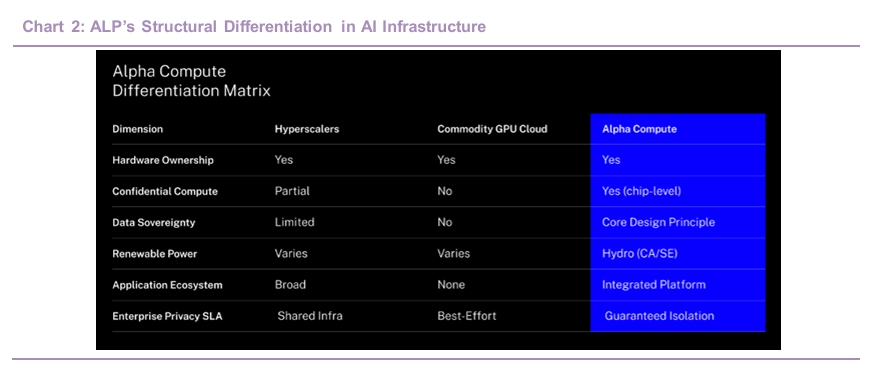
- Confidential compute remains ALP’s primary competitive differentiator in regulated AI infrastructure. The company combines dedicated GPU capacity with firmware, software, trusted execution environments, and third-party attestation to support end-to-end encrypted AI workloads. The technology layer is being developed through Telegram’s Cocoon protocol and ALP’s Shroud developer access point, providing customers with the ability to independently verify that sensitive data and models remain isolated from ALP, hardware vendors, and other third parties. This architecture is targeted toward financial services, healthcare, government, defense, and other regulated industries that may be unable to place sensitive workloads in conventional shared-cloud environments. ALP’s bare-metal deployment model also provides customers with dedicated infrastructure and greater control over data residency and privacy, although additional enterprise contracts will be required to demonstrate that confidential-compute functionality consistently supports higher pricing, stronger margins, or longer contract terms.
- AI infrastructure demand remains strong, while tightening data-protection requirements reinforce the case for confidential compute. Management cited approximately $650 billion-$725 billion of annual AI-infrastructure spending by large hyperscalers, with power and GPU availability increasingly constraining supply. At the same time, implementation of frameworks including the EU AI Act is raising compliance requirements around sensitive data and AI workloads, supporting demand for hardware-level privacy and independently verifiable attestation. The expansion of non-recourse project financing across the sector also supports ALP’s asset-backed deployment strategy.
- The “Own Your Data” campaign extends ALP’s marketing strategy toward broader awareness of data sovereignty and hardware-enforced privacy. ALP launched the campaign around the market open and close on CNBC, Fox Business, and Newsmax, reinforcing its confidential-compute positioning among investors and potential enterprise users. Campaign spending, lead generation, conversion rates, and customer-acquisition returns have not been disclosed.
- GAMEE adds a scaled consumer and application layer that could create internal demand for ALP’s compute infrastructure. The company acquired a 60% controlling interest in GAMEE in May 2026, bringing approximately 120 million registered users, more than 61 million Telegram users, and over 10 billion lifetime gameplays into the ecosystem. GAMEE generated approximately $3.5 million of revenue in 2025, while estimated 1Q26 revenue increased 56% y/y to $926,000 from $593,000. During the quarter, the platform attracted approximately 5.57 million users and generated 88.5 million gameplays, with around 1.7 million monthly active users and 150,000 daily active users. These engagement levels provide a potential distribution channel for AI-enabled games, digital agents, advertising, rewards campaigns, and other consumer applications that could run on ALP-owned infrastructure.
- Early campaign traction provides initial evidence that GAMEE can convert engagement into monetizable brand partnerships. Its Azuki collaboration attracted approximately 315,000 users and generated 27 million gameplays, reached the top 200 Telegram Mini Apps, and sold out its associated sticker offering within ten minutes. GAMEE also secured $500,000 of development fees and a $500,000 marketing budget for Gold Fest, a $2 million gamified real-asset campaign, demonstrating revenue opportunities across development services, sponsored campaigns, advertising budgets, and user engagement.
- Alpha Games formalizes GAMEE’s role as ALP’s consumer application and distribution layer. The division is led by GAMEE founder Bozena Rezab and is focused on integrating GAMEE’s 120 million registered users with ALP’s compute infrastructure. Planned initiatives include greater use of ALP GPUs for internal game development, creation of a confidential AI advertising network, and Phase II agentic gameplay targeted for 4Q26, which would allow users to connect or rent AI agents to compete in dedicated prize pools. These initiatives provide more defined pathways to translate GAMEE’s user base into application revenue, advertising, agent-related monetization, and recurring demand for ALP’s GPU capacity.
- We think the strategic value of GAMEE depends on converting its user base into higher monetization and infrastructure utilization rather than relying only on its current revenue contribution. ALP paid $3.5 million of upfront consideration, comprising $1.5 million of cash and $2.0 million of equity, and is required to purchase $2.0 million of GMEE tokens within 90 days of closing. Additional year-one and year-two consideration is linked to GAMEE reaching EBITDA thresholds of $1.2 million and $1.6 million, respectively, bringing total potential consideration to as much as $11 million and aligning a meaningful portion of the purchase price with operating performance. Integration with ALP’s confidential-compute platform is targeted within two fiscal quarters, making AI-enabled engagement, monetization, and compute consumption the key measures of whether GAMEE becomes a meaningful application-layer growth engine.
- Enzo Villani’s appointment as President strengthens executive oversight as ALP moves from platform buildout toward operational scale. Effective July 16, Villani adds responsibility for corporate strategy, capital allocation, and operating execution while continuing as Executive Chairman and Chief Investment Officer. The newly formed President’s Office preserves continuity in balance-sheet and investment management while broadening accountability for cluster deployment, financing, and execution across the compute and GAMEE platforms.
- Management’s $21 million-$23 million annualized revenue run-rate outlook establishes the first meaningful forward financial benchmark for the new business. The estimate is based primarily on the $16.1 million ALPHA-01 annual contract and GAMEE’s acquired revenue base and represents a substantial increase from approximately $30,000 of quarterly compute revenue before the anchor customer went live. The most relevant forward indicators are therefore reported ALPHA-01 revenue, the 20%-25% targeted contract margin, GAMEE’s post-acquisition contribution, ALPHA-02 deployment timing, and additional enterprise contract announcements.
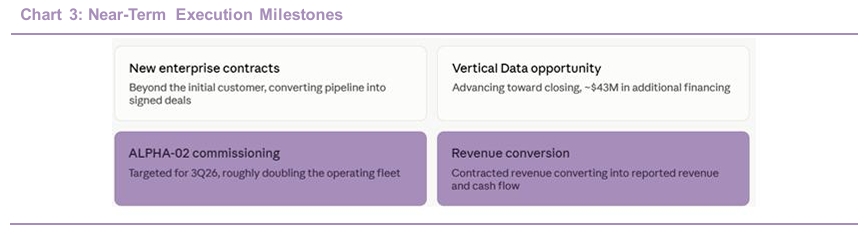
- Near-term execution will be critical to validating the scalability and repeatability of ALP’s AI infrastructure strategy. Over the next two quarters, the primary milestones include securing additional enterprise contracts beyond the initial customer, advancing the Vertical Data-related financing opportunity, commissioning ALPHA-02 in 3Q26 – which is expected to approximately double the operating fleet – and demonstrating the conversion of contracted revenue into reported revenue, gross profit, and cash flow.
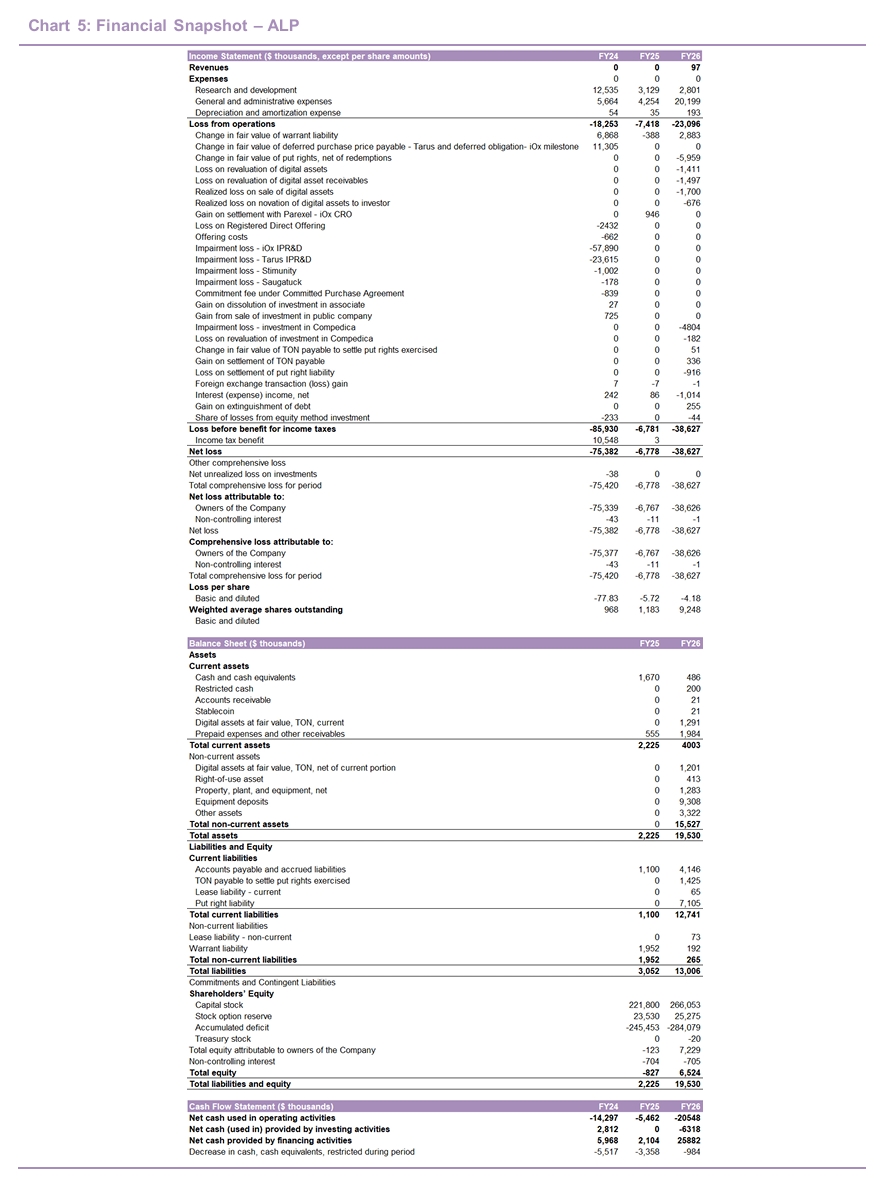
- FY26 reported results primarily reflect transition expenses and legacy activities and should not be used as the principal baseline for the compute business. Revenue was $97,000 compared with no revenue in FY25, while the net loss increased to approximately $38.6 million from $6.8 million. Operating expenses rose to approximately $23.1 million from $7.4 million, including higher professional fees, transaction costs, payroll, capital-raising expenses, digital-asset losses, and impairment of the legacy Compedica investment. More than half of the annual loss was attributed to one-time or legacy-related items that are not expected to define the forward compute model. Neither the $16.1 million ALPHA-01 annual contract nor GAMEE revenue was included in FY26, making the next reporting period the first meaningful indication of the company’s current operating performance.
- The balance sheet has improved materially since fiscal year-end as the company moved from transition-stage funding toward customer-backed compute operations. At March 31, ALP had approximately $0.5 million of cash and cash equivalents, or approximately $0.7 million including restricted cash, against roughly $13 million of current liabilities. These conditions contributed to the auditor’s going-concern qualification based on the historical fiscal year-end balance sheet. By July 13, cash had increased to approximately $10.3 million, reflecting the $7.5 million ALPHA-01 payment, ATM proceeds, and other post-year-end transactions.
- The company projects approximately $25 million of cash flow needs between July 13, 2026 and fiscal year-end March 2027, which it expects to address through contracted compute revenue, additional customer agreements, project financing, and capital-market flexibility. The more relevant forward consideration is whether ALP can increasingly pair customer deposits and non-recourse infrastructure financing with each new cluster rather than depend primarily on corporate equity.
- The legacy digital-asset treasury wind-down formally closes ALP’s prior token-treasury strategy and further aligns the balance sheet with the compute business. The company initiated the return of approximately $6 million of TON/GRAM to legacy investors, removing the related put-option liabilities, with only approximately $0.2 million remaining for return to the final legacy shareholder. Going forward, ALP will hold GRAM solely as consideration earned for confidential compute delivered to Telegram’s Cocoon network rather than as a discretionary treasury asset, preserving the commercial relationship with Telegram while reducing mark-to-market volatility unrelated to operating performance.
- Following the legacy DAT wind-down, ALP projected an unaudited balance sheet comprising approximately $73.4 million of assets, $20.5 million of equity, $0.4 million of debt, and $34.4 million of GPU lease liabilities.
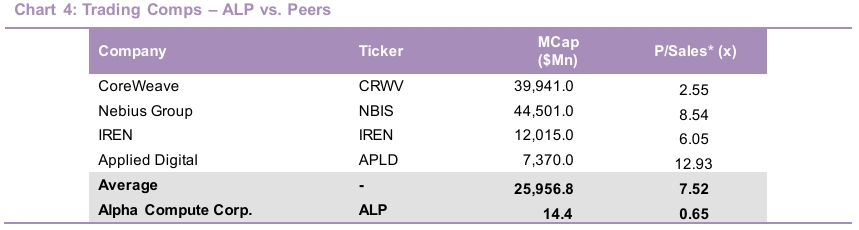
- Valuation remains highly compressed relative to ALP’s contracted revenue base and management’s near-term revenue run-rate outlook. The valuation analysis presented is for illustrative purposes only and does not constitute a price target or a buy/sell/hold recommendation. At a current share price of $0.20 and market capitalization of $14.4 million, ALP trades at approximately 0.65x the midpoint of management’s $21 million-$23 million annualized revenue run-rate outlook.
- Peer valuation highlights the degree to which ALP continues to trade at a steep discount to AI infrastructure comparables despite visible revenue scale-up. ALP trades at approximately 0.65x annualized run-rate sales, compared with CoreWeave at 2.55x NTM sales, Nebius Group at 8.54x, IREN at 6.05x, Applied Digital at 12.93x, and a peer average of 7.52x. The discount remains substantial even after accounting for ALP’s earlier-stage profile, smaller operating fleet, and single live enterprise customer, particularly because the company already has $16.1 million of annual contracted revenue, a fully operational 504-GPU B200 cluster, a $21 million-$23 million annualized revenue run rate, a targeted 20%-25% contract margin, and more than $200 million of qualified pipeline. This creates a constructive relative valuation setup: as ALP demonstrates conversion of ALPHA-01 contracted revenue into reported revenue and margins, commissions ALPHA-02, and converts additional pipeline into signed contracts, the current multiple leaves room for the valuation gap versus AI infrastructure peers to narrow.
Source: Exec Edge Research, ALP SEC Filings