Download the Complete Report Here
 Hamilton Beach Brands (HBB)
Core Recovery, Premiumization and Adjacent Growth Strengthen HBB’s Growth Outlook and Re-Rating Potential
- Scaled asset-light appliance platform extending into commercial and health markets. HBB designs, markets and distributes branded household appliances, specialty housewares, commercial foodservice equipment and connected medication-management solutions, generating $606.9 million of revenue and shipping more than 25 million appliances in 2025. The company outsources substantially all manufacturing while retaining product development, engineering, quality assurance, marketing and distribution, keeping capex near 1% of revenue. This model combines a scaled consumer foundation with growing Commercial and Health platforms, while preserving capital for brand investment, innovation and adjacent growth opportunities.
- A defensible business model built on reinforcing brand strength, category breadth, retailer access and repeatable innovation. Hamilton Beach, Proctor Silex and Weston provide broad mass-market reach, while Lotus and licensed CHI products extend into premium applications. HBB participates in more than 50 categories, ranked second among U.S. national small-kitchen-appliance brands by 2025 unit sales and draws on 300,000+ annual consumer touchpoints to support product development. Established retail relationships and an asset-light sourcing network reinforce the platform, making its competitive position broader than any single brand, product or patent.
- Five growth pillars broaden mix across premium, commercial, digital and health markets. Recent initiatives include wider Lotus distribution, new core-product placements, Sunkist commercial products, foodservice-chain trials, AI-optimized content across 500 SKUs and expanding specialty-pharmacy partnerships; Health remained on track to grow 2026 sales 50%. Execution now hinges on converting these initiatives and incremental advertising into sustained revenue growth, better mix and profitable sell-through.
- A large addressable market provides multiple growth pockets aligned with HBB’s positioning. U.S. small-appliance sales grew 1.0% in 2025, while kitchen electrics increased 4.1% and replacement accounted for 52% of 4Q25 purchases. HBB’s strong unit position and accessible price points support replacement demand, while its lower dollar share and roughly 1% position in an estimated $4.2 billion premium TAM leave meaningful premiumization headroom. Commercial automation, home-administered therapies and AI-mediated discovery add further growth avenues.
- Recovering fundamentals, a stronger balance sheet and a wide peer discount support further re-rating potential. Revenue increased 11.6% y/y in 2Q26 and management maintained its outlook for 2026 revenue growth approaching mid-single digits while raising gross-margin and operating-profit guidance. Reported earnings remain elevated by the $36.5 million tariff refund and related benefits, while HBB ended 2Q26 with $51.5 million of net cash. We do not issue ratings, recommendations or price targets; however, at 0.72x LTM P/S versus a 1.27x peer average, HBB retains meaningful re-rating potential if margin improvement, adjacency growth and disciplined capital allocation are sustained.
Company Overview
HBB – A Scaled Appliance Platform Spanning Consumer, Commercial and Health Markets
- Hamilton Beach Brands Holding Company (NYSE: HBB) pairs a scaled consumer-appliance franchise with growing commercial and healthcare platforms. The company operates through its wholly owned operating subsidiary, Hamilton Beach Brands, Inc. as an asset-light designer, marketer and distributor of branded small electric household appliances, specialty housewares, commercial foodservice equipment and connected healthcare solutions. HBB reports through two segments: Home and Commercial Products, which includes consumer appliances sold primarily in North America and commercial equipment sold to restaurants, fast-food chains, bars and hotels; and Health, which generates device-lease and software-licensing revenue from specialty pharmacies and pharmaceutical companies. Approximately two-thirds of commercial sales are generated in the U.S., while the remainder comes from international markets. HBB operates at annual revenue of approximately $600 million to $650 million and annual unit volumes of 25 million to 30 million. This scale gives HBB three distinct routes to market: high-volume consumer retail, relationship-led commercial distribution and a developing healthcare channel. The company’s vision is to achieve leadership positions across consumer, commercial and health appliances, with the established consumer franchise providing the foundation for this broader ambition.
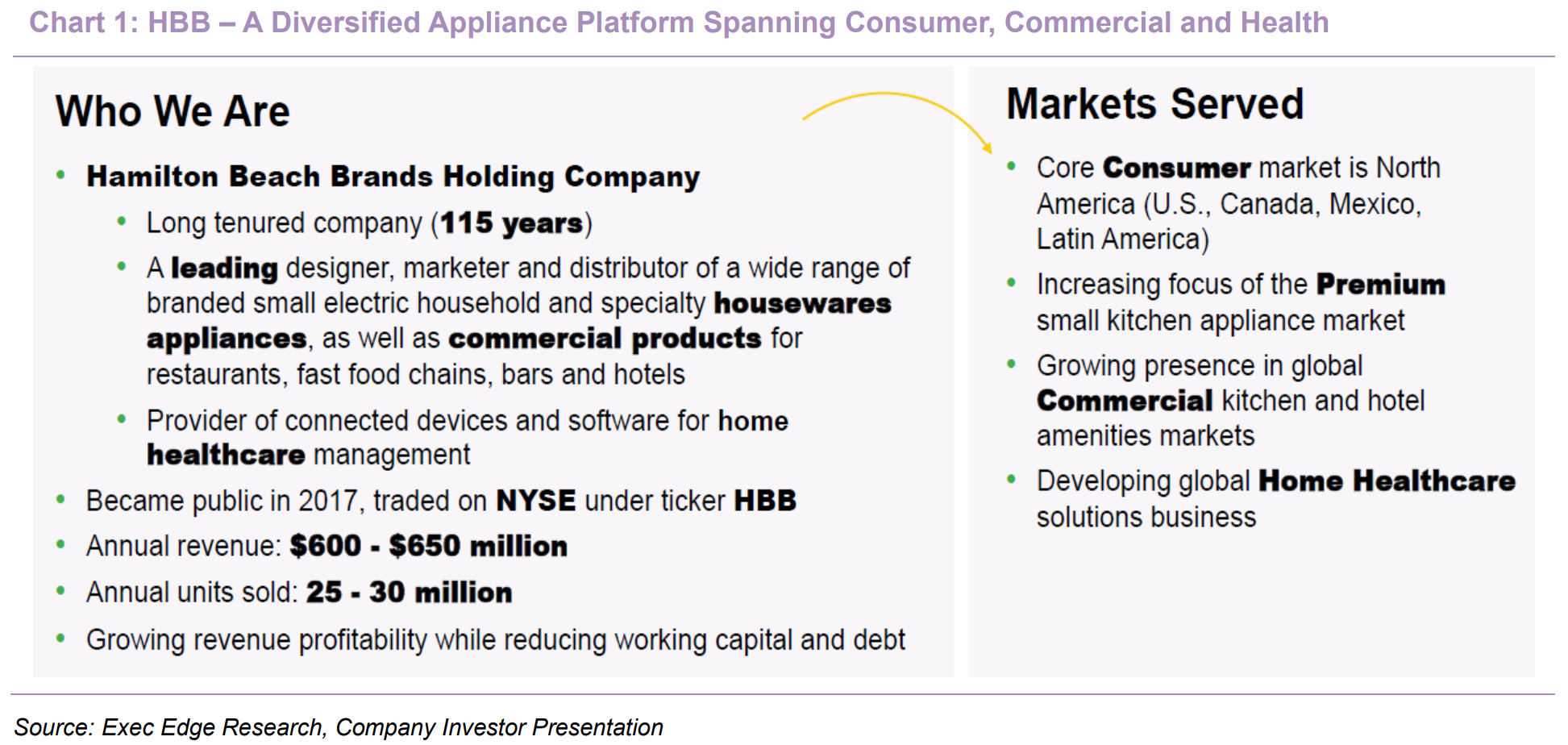
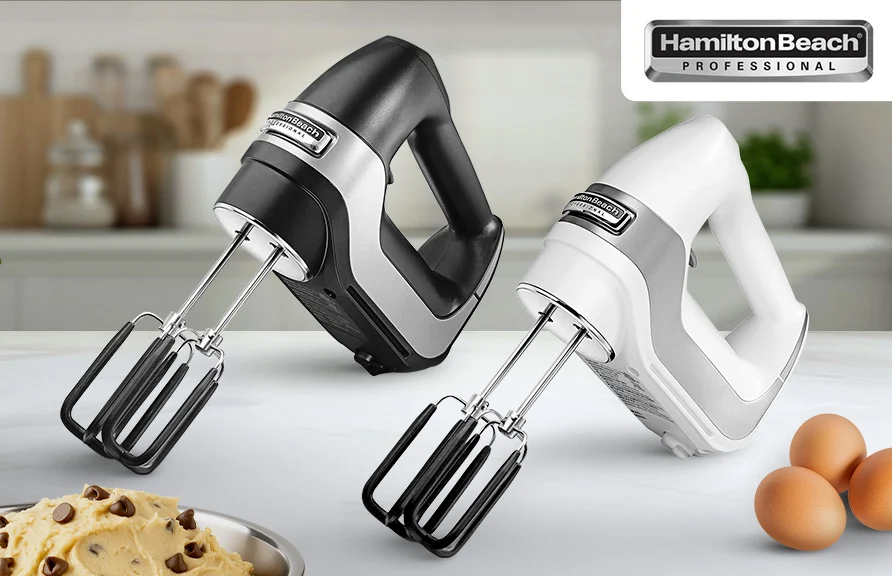
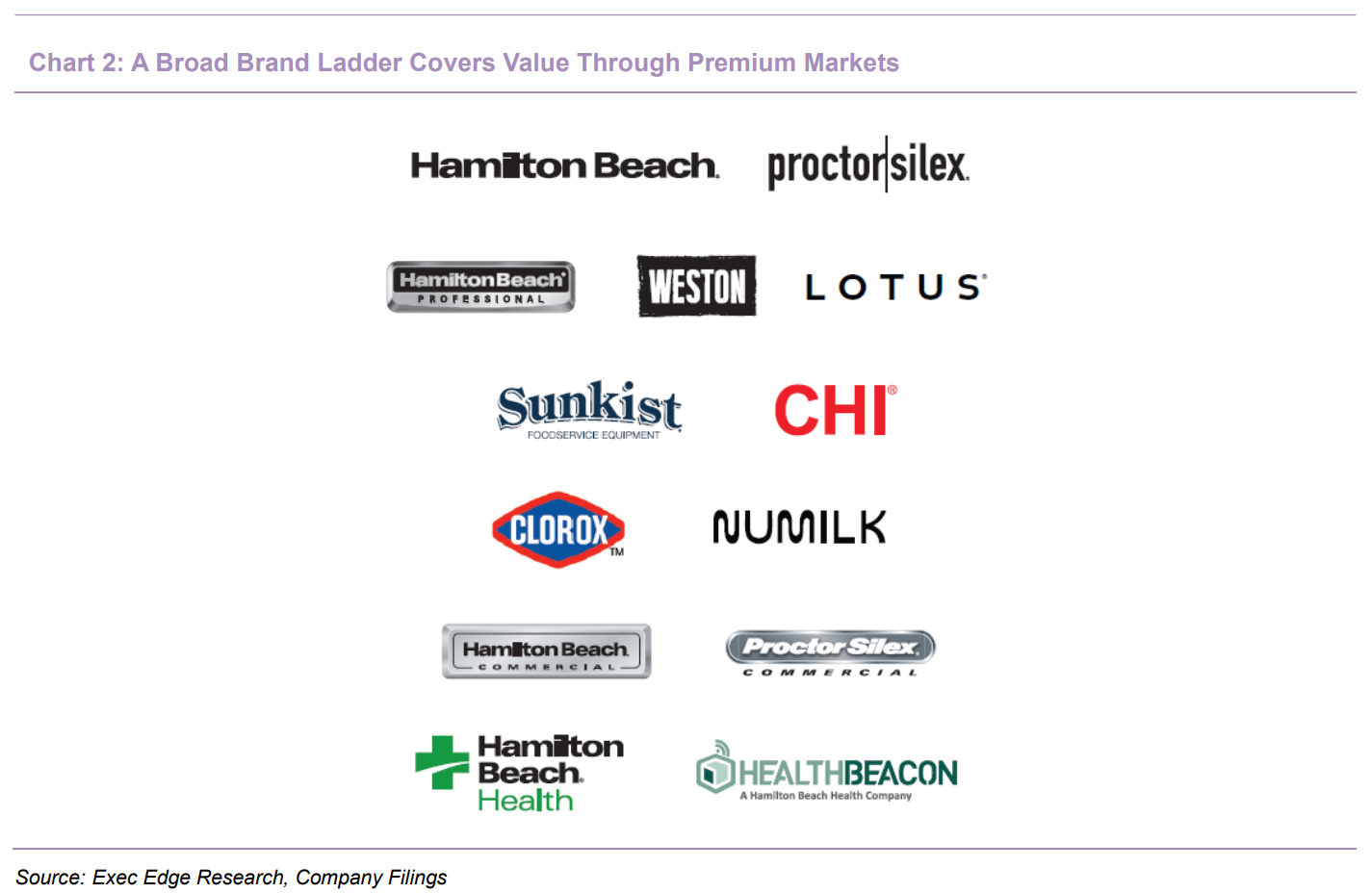
- This diversified platform combines established brands, broad category coverage and multiple price points under one portfolio. Owned consumer brands include Hamilton Beach, Proctor Silex and Weston, supplemented at the premium end by Hamilton Beach Professional and Lotus. HBB markets commercial products under Hamilton Beach Commercial and Proctor Silex Commercial, licenses CHI for premium garment care and Clorox for selected home appliances, and has multiyear arrangements to design, market and distribute Sunkist commercial juicers and sectionizers and Numilk plant-based milk makers. Together, these brands span a good-better-best assortment across more than 50 product categories, including coffee makers, air fryers, blenders, food processors, grills, irons, juicers, mixers, slow cookers, toasters and toaster ovens. The Hamilton Beach trademark is material to the business, although HBB does not depend on any individual patent, copyright or license. Health-related intellectual property is separately identified as important to the Health segment. Hamilton Beach was the #2 U.S. small-kitchen-appliance national brand by units sold and #4 by dollar sales in 2025. This combination of brand familiarity, product breadth and price-point coverage enables HBB to address a wide range of consumers and retail formats, while supporting continued product innovation and portfolio expansion.
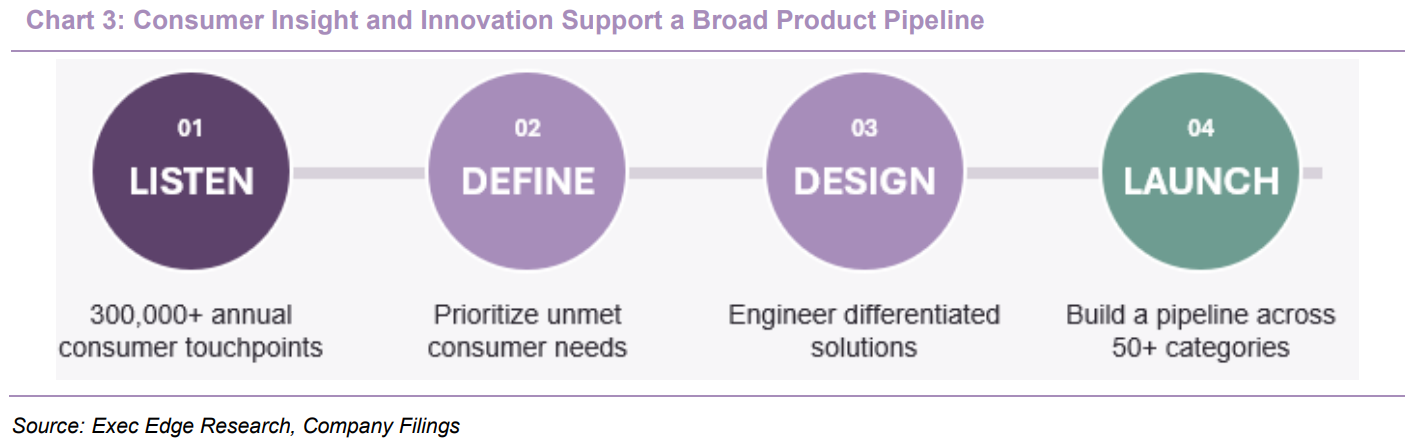
- Consumer-led innovation converts HBB’s portfolio breadth into a recurring pipeline of differentiated products and digital content. HBB spent $13.2 million on product design and development in 2025 and applies its Good Thinking philosophy to identify consumer pain points and translate them into product features. The company gathers data and feedback from 300,000+ consumer touchpoints annually and launched more than 200 product platforms over the five years through 2025. In 2025, HBB introduced 49 new product platforms and shipped more than 25 million appliances, with recent development concentrated in higher-value applications, connected features and underpenetrated categories. This sustained innovation cadence supports HBB’s competitiveness across design, quality, price, features and product relevance. In physical retail, new products help HBB compete for limited shelf space; online, product content, ratings and reviews influence discoverability and conversion. Its brands averaged approximately 4.5 stars across major platforms at year-end 2025, supporting its ecommerce positioning. HBB is consequently increasing digital, social and influencer marketing while using artificial intelligence to improve content creation and targeting. The product-development engine therefore connects consumer insight with both product innovation and the digital merchandising needed to support conversion.
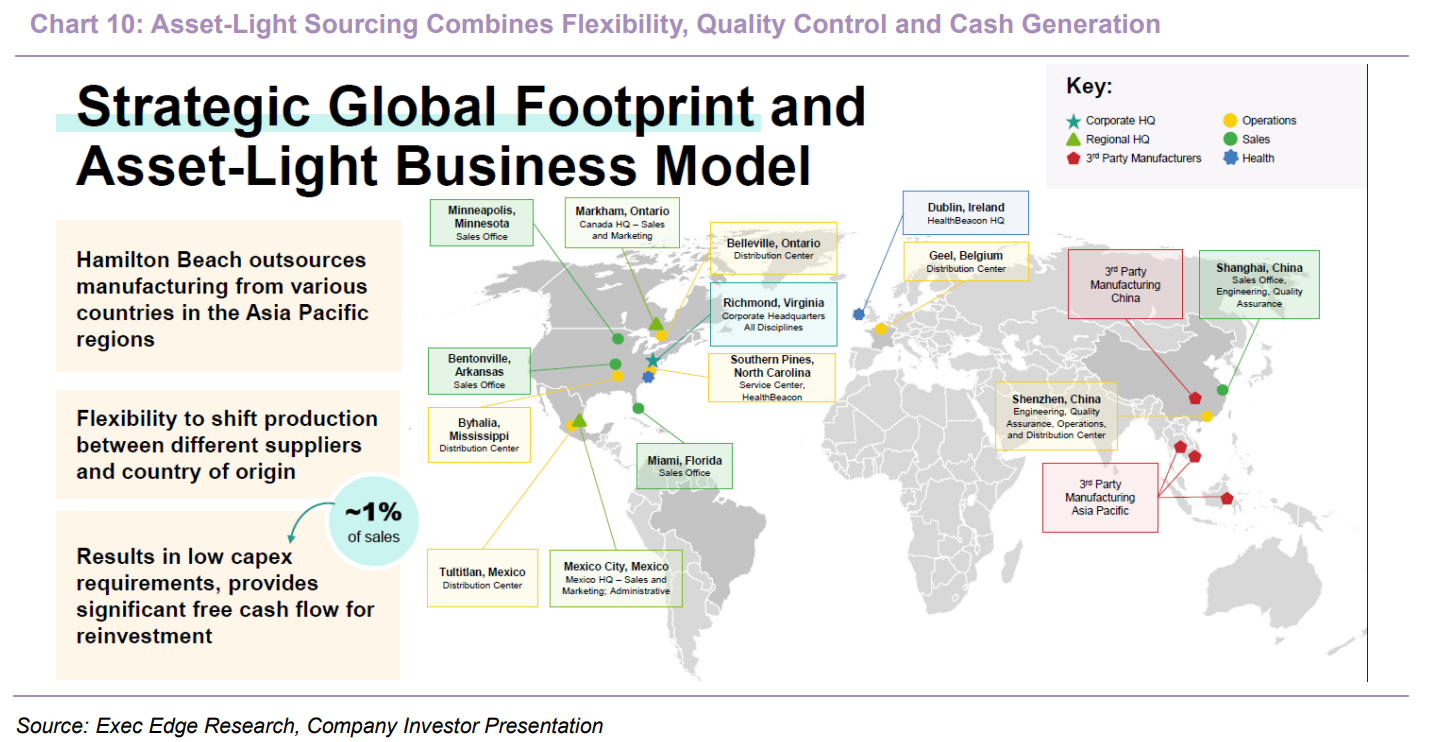
- The product engine is supported by an asset-light supply chain and broad, concentrated retail distribution. HBB outsources manufacturing while retaining control over product specifications, engineering, quality assurance, marketing and distribution. HBB sourced inventory from approximately 70 suppliers in 2025, with one supplier representing more than 10% of purchases, and continued to obtain a majority of finished products from China. HBB nevertheless expanded sourcing across the Asia-Pacific region and can shift procurement among China, Indonesia, Vietnam and Thailand, supported by regional engineering and quality teams. This broader sourcing network provides greater flexibility as tariffs, freight costs and supplier economics change. The model also limits capital intensity, with capital expenditure of approximately 1% of sales, leaving cash available for working capital, brand investment and growth initiatives. The company distributes through mass merchants, ecommerce retailers, department stores, warehouse clubs, specialty retailers, distributors and commercial customers. This broad reach is accompanied by meaningful customer concentration: Walmart represented 29% of 2025 revenue, Amazon represented 19%, and the five largest customers represented 62%. Consumer demand also peaks during the fourth-quarter holiday season, requiring HBB to build and finance inventory before the principal selling period.
- The consumer franchise supports measured expansion into premium, commercial and healthcare applications with distinct demand drivers. HBB’s premium offering includes Lotus and licensed CHI garment-care products; Commercial centers on Hamilton Beach Commercial, Proctor Silex Commercial and partnerships such as Sunkist; Health combines connected devices with software-based medication-management services. Commercial represented ~10% of 2025 revenue and remained profitable, while Health became profitable in 3Q25 and remained profitable through 2Q26 as patient subscriptions and partner programs expanded. These adjacencies broaden HBB’s revenue mix beyond the high-volume consumer foundation. They also introduce different operating requirements: commercial customers emphasize durability, service and chain qualification, while Health products face additional healthcare, manufacturing, data-privacy and security regulation. HBB uses licensing, alliances and selective acquisitions to enter adjacent applications without developing every capability internally. The result is a more diversified platform with access to higher-value revenue streams, although Commercial and Health remain modest relative to the core consumer business.
Right-to-Win
Brand, Innovation and Operating Capabilities Reinforce HBB’s Competitive Position
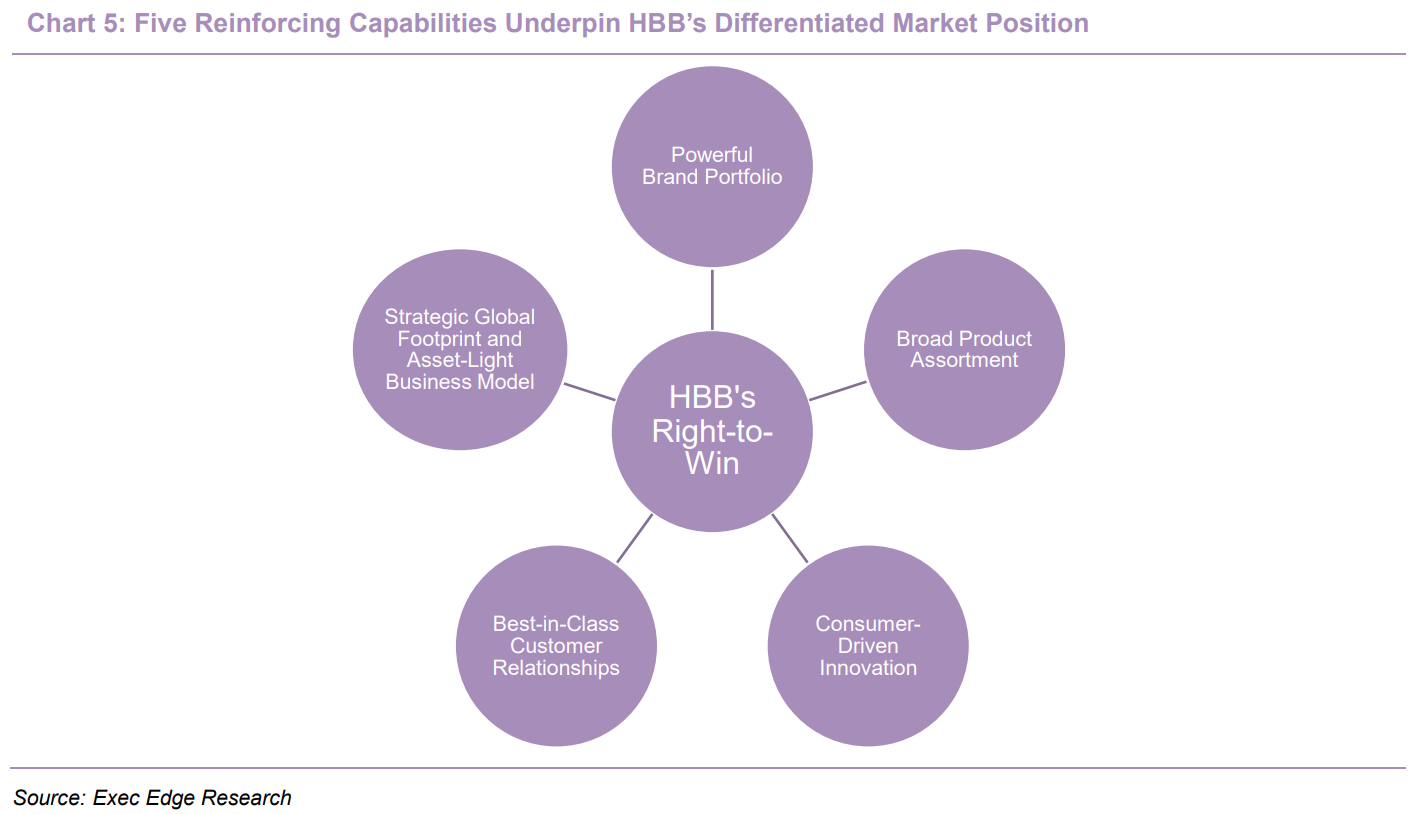
- HBB’s right-to-win rests on five reinforcing capabilities that together strengthen brand relevance, retailer access and operating flexibility. The flagship Hamilton Beach brand provides recognition and accumulated consumer trust, while a portfolio spanning multiple price points and more than 50 categories increases HBB’s relevance to retailers and diversifies exposure across household needs. This breadth is supported by the Good Thinking innovation system, which connects consumer feedback with design, testing, quality assurance and supplier execution. Established relationships across retail, ecommerce and commercial channels provide routes through which new products can reach customers at scale. Finally, an asset-light global sourcing network allows HBB to retain control over specifications and quality while limiting manufacturing capital requirements. The competitive advantage comes from how these capabilities reinforce one another: brand strength supports placement, assortment breadth deepens retailer relevance, consumer insight sustains product development, and sourcing flexibility supports reliable execution. Together, they create a more defensible competitive position than any single product, patent or customer relationship. We discuss each of these elements below.
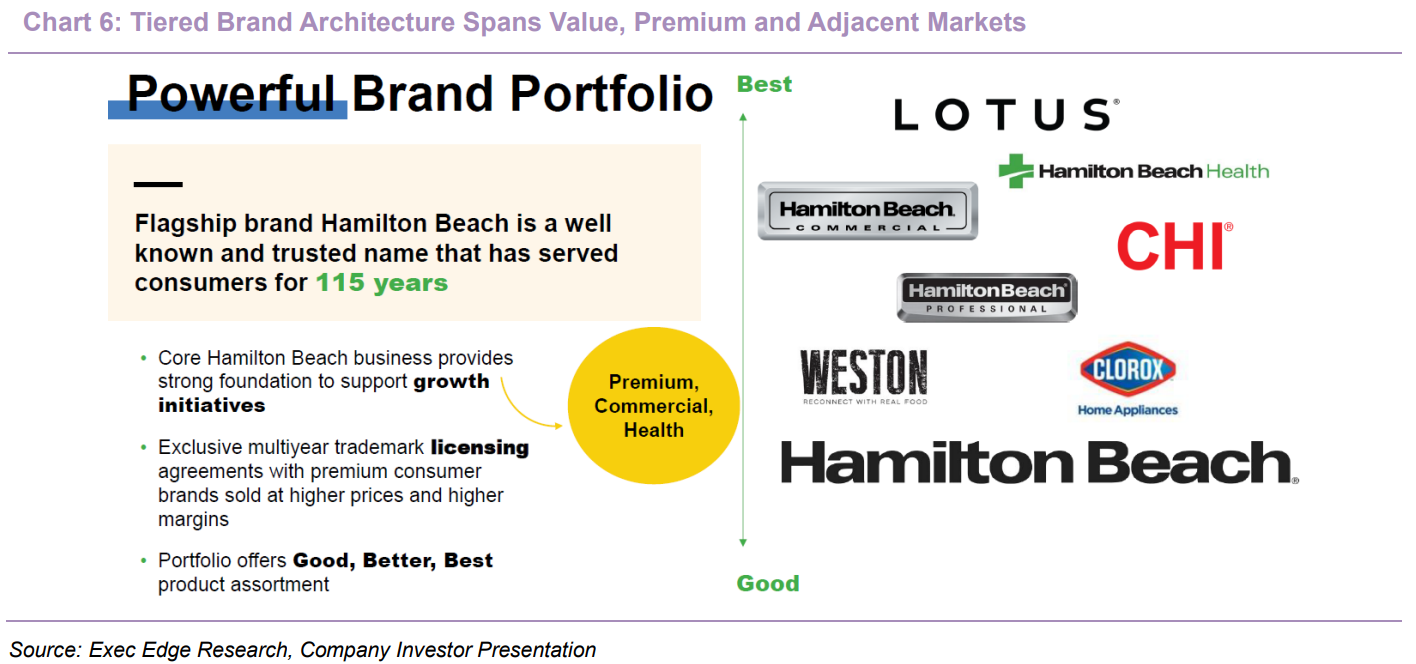
- HBB’s century-old flagship brand anchors a tiered portfolio spanning value, premium, commercial and healthcare applications. The Hamilton Beach trademark, which HBB identifies as material to its business, provides the portfolio with established consumer recognition and a foundation that extends beyond any single appliance category. Around that flagship, HBB combines owned brands with exclusive, multiyear trademark licenses to address good, better and best price points, as well as distinct consumer, commercial and healthcare applications. The strategic value lies in extending established brand recognition across multiple price points and end markets. The accessible Hamilton Beach franchise supports high-volume participation, while premium and specialist brands allow HBB to address consumers or customers seeking differentiated features, professional performance or higher service levels. This structure gives HBB flexibility to respond to changes in consumer spending without repositioning one brand across incompatible price points. It also provides retailers with differentiated propositions under one supplier relationship, supporting HBB’s relevance across a broader range of categories and price points.
- HBB’s brand architecture strengthens its right-to-win by combining consumer trust with established retailer access and category breadth. Brand reputation has been built through product performance, retail availability, service support and repeated consumer experience. Hamilton Beach ranked as the #2 U.S. small-kitchen-appliance national brand by units sold in 2025, while HBB participates in more than 50 product categories and uses established distribution capabilities to extend both owned and licensed brands. HBB can use this foundation to introduce adjacent products, support licensed brands and enter specialist applications without building every commercial capability from the ground up. The portfolio also reduces dependence on any individual patent, copyright or license, none of which HBB considers individually critical to the overall business. The moat therefore rests in the combination of brand recognition, retailer acceptance, category experience and licensing relationships rather than any individual product or intellectual property asset. Maintaining product relevance, quality and continued brand investment remains essential to preserving that advantage.
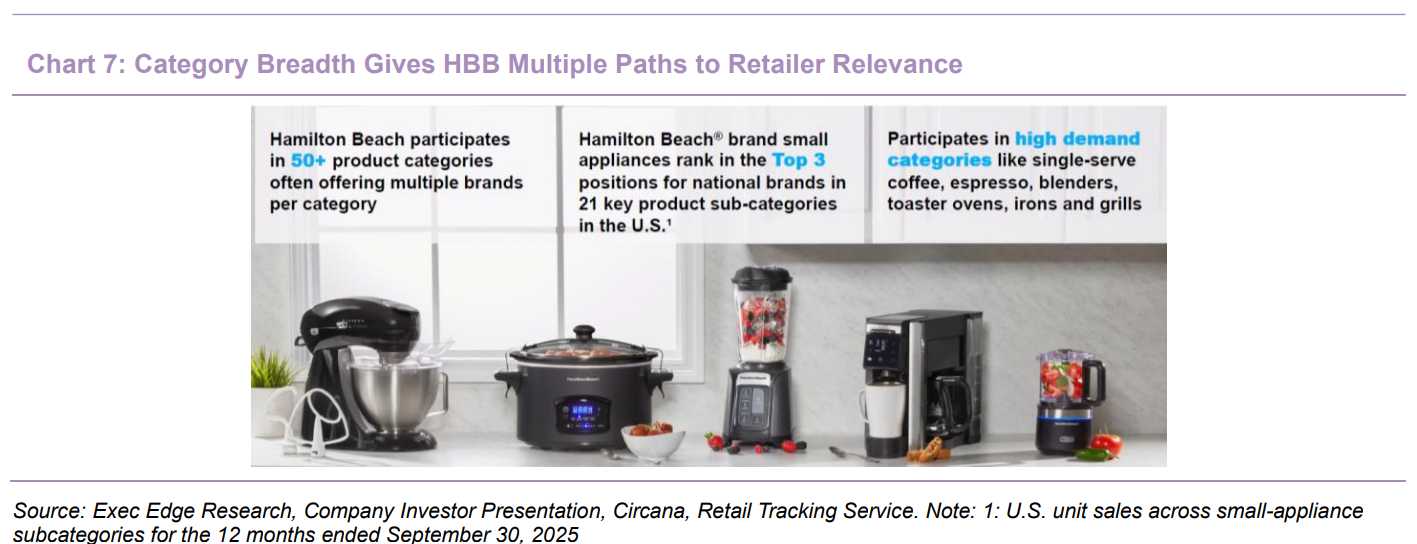
- Category breadth deepens retailer relevance and strengthens HBB’s competitive position across multiple household needs. HBB participates in more than 50 product categories, frequently offering multiple brands or price tiers within the same category. This breadth is supported by meaningful positions in individual markets: Hamilton Beach small appliances ranked among the top three national brands in 21 key U.S. product subcategories by unit sales for the 12 months ended September 30, 2025 (Circana Retail Tracking Service, as reproduced in HBB’s January 2026 investor presentation). The assortment also deepens HBB’s relevance to retailers. Retailers can work with HBB across coffee preparation, food preparation, cooking, garment care and other household applications, potentially simplifying category planning, product onboarding and vendor coordination. Meanwhile, HBB can participate in several demand pools without depending on one appliance cycle or consumer trend. Multiple brands and price points within categories also allow HBB to address differentiated retailer formats, from mass merchants and ecommerce platforms to department stores and specialist channels.
- Shared product, sourcing and distribution capabilities make this breadth more defensible across categories. A broad assortment allows product design, quality assurance, sourcing, sales, distribution and digital-content capabilities to be applied across many revenue opportunities. Consumer observations gathered in one category may inform usability, controls, materials or cleaning features elsewhere, while established retailer relationships can provide routes to market for adjacent introductions. This reuse of capabilities can lower the incremental effort required to develop, source and commercialize new products across the portfolio. Breadth can also create complexity, particularly in working capital, forecasting and SKU management, so assortment size alone does not establish a moat. The right-to-win rests on combining broad category participation with the shared capabilities needed to manage and commercialize that assortment effectively.
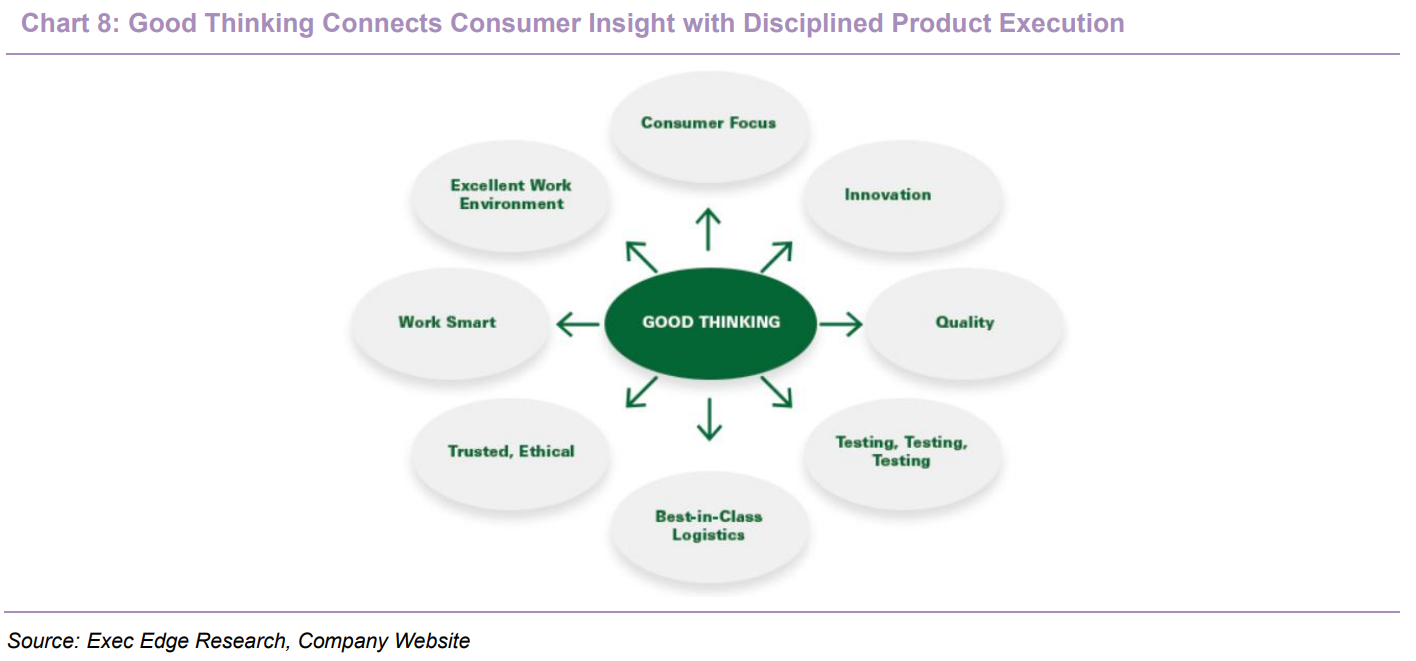
- HBB’s Good Thinking system reinforces its right-to-win by linking consumer insight with repeatable product development, testing and quality. HBB treats consumer-driven innovation as part of a broader operating system encompassing fact-based decision-making, repeated testing, quality assurance, logistics and disciplined working practices. Supporting infrastructure includes product-development teams, a test kitchen and UL-certified laboratory in Richmond, as well as engineering and quality-assurance resources in Asia. HBB invested $13.2 million in product development during 2025, following $13.7 million in 2024 and $12.4 million in 2023. Together, these resources connect consumer needs with product design, manufacturability, quality and delivery, all of which influence whether an innovation achieves retailer acceptance and sustained consumer adoption.
- The feedback-to-shelf process supports repeatable innovation across HBB’s broad assortment. HBB draws on 300,000+ consumer touchpoints annually and launched over 200 product platforms during the five years preceding January 2026. Insights can therefore be tested and reused across HBB’s broad assortment rather than remaining confined to individual product teams. The advantage lies in combining consumer insight with established testing, supplier coordination and quality-control capabilities across categories. Activity levels alone do not demonstrate innovation success, however, and the moat ultimately depends on converting this system into strong ratings, repeat retail placements and commercially successful products. HBB’s right-to-win therefore rests on the repeatability and commercial effectiveness of its innovation process, not simply the volume of launches.
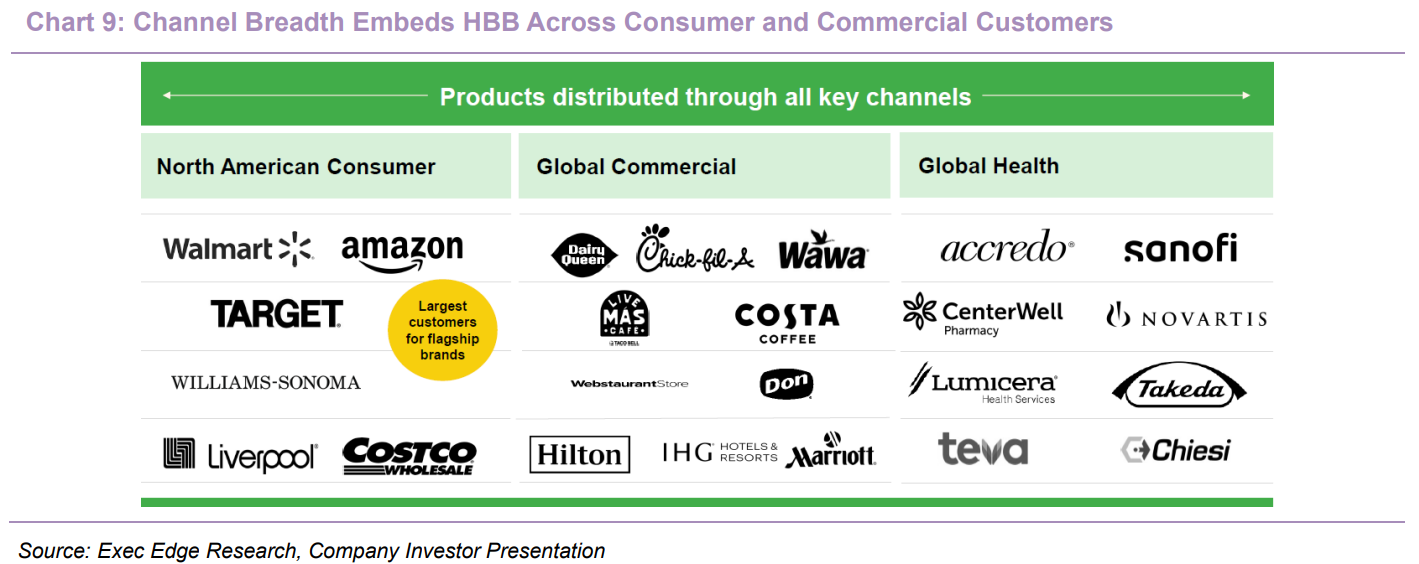
- Broad channel access and established customer relationships strengthen HBB’s right-to-win across multiple end markets. HBB distributes consumer products through mass merchants, ecommerce platforms, warehouse clubs, department stores, distributors and other specialist channels, while its commercial business serves restaurants, food-service operators, hotels and institutional customers. Health operations add relationships with pharmaceutical manufacturers and specialty pharmacies. This coverage gives HBB access to several customer decision-making structures and reduces reliance on one route to market, even though individual customers remain significant. Walmart represented 29% of 2025 revenue and Amazon represented 19%, while HBB’s five largest customers collectively accounted for 62%. These figures indicate substantial customer concentration, but they also show that HBB has secured meaningful positions with retailers whose scale, vendor requirements and performance standards raise the bar for sustained participation. Product breadth further increases HBB’s relevance by allowing customer discussions to cover multiple categories, brands and price points rather than individual SKUs.
- Established relationships can lower placement friction and improve the path to market for new products. Customers gain experience with HBB’s product quality, fulfillment, category support, digital content and responsiveness, potentially reducing the perceived risk of allocating shelf space or online visibility to new products. HBB, in turn, develops knowledge of customer-specific price architecture, promotional calendars, packaging requirements and replenishment processes. This accumulated operating knowledge can shorten the path from product concept to commercial placement and reinforce HBB’s credibility across multiple categories. However, the customer network represents a soft moat rather than contractual lock-in. HBB generally does not have long-term supply contracts with its consumer retail customers, and retailers control access to limited shelf space while retaining significant negotiating leverage. Customer concentration also means that a lost program, reduced purchasing or adverse inventory action could materially affect performance. The right-to-win therefore rests on accumulated operating credibility and multi-category relevance, while placements must continue to be earned through product performance and execution.
- Serving that customer network through outsourced production preserves capital while retaining control over specifications and quality. HBB designs and specifies its products while relying primarily on third-party manufacturers, supported by internal engineering, quality-assurance, sourcing and distribution capabilities. Approximately 70 suppliers manufactured products for HBB in 2025, with only one accounting for more than 10% of purchases. This structure limits the capital committed to manufacturing facilities and allows investment to be directed towards brands, product development, customer support and growth opportunities. Capital expenditure has historically represented approximately 1% of sales, supporting cash generation relative to a vertically integrated manufacturing model. The model nevertheless retains meaningful internal control over execution. HBB maintains product-development and testing capabilities in Richmond, engineering and quality resources in Asia, and distribution infrastructure serving its principal markets. These functions allow HBB to retain responsibility for product specifications, quality and commercialization while using external manufacturing capacity.
- Sourcing optionality and in-house quality capabilities strengthen the defensibility of the asset-light model. HBB has expanded its sourcing base across the Asia-Pacific region and can shift production between suppliers or countries when economics, capacity or trade conditions change. The advantage lies in managing supplier qualification, product transfers, quality consistency and inventory coordination across multiple countries and customer channels. The model also provides flexibility to scale successful products without constructing dedicated plants. However, it does not eliminate supply-chain risk. A majority of products continued to be sourced from China in 2025, HBB generally lacks long-term manufacturing contracts, and supplier transitions can require additional testing, tooling and operational coordination. The right-to-win therefore rests on adapting the sourcing network while preserving product quality, customer service and capital discipline, rather than simply outsourcing production.
Industry Trends and Company Positioning
Targeted Category Growth Supports HBB’s Premiumization Opportunity
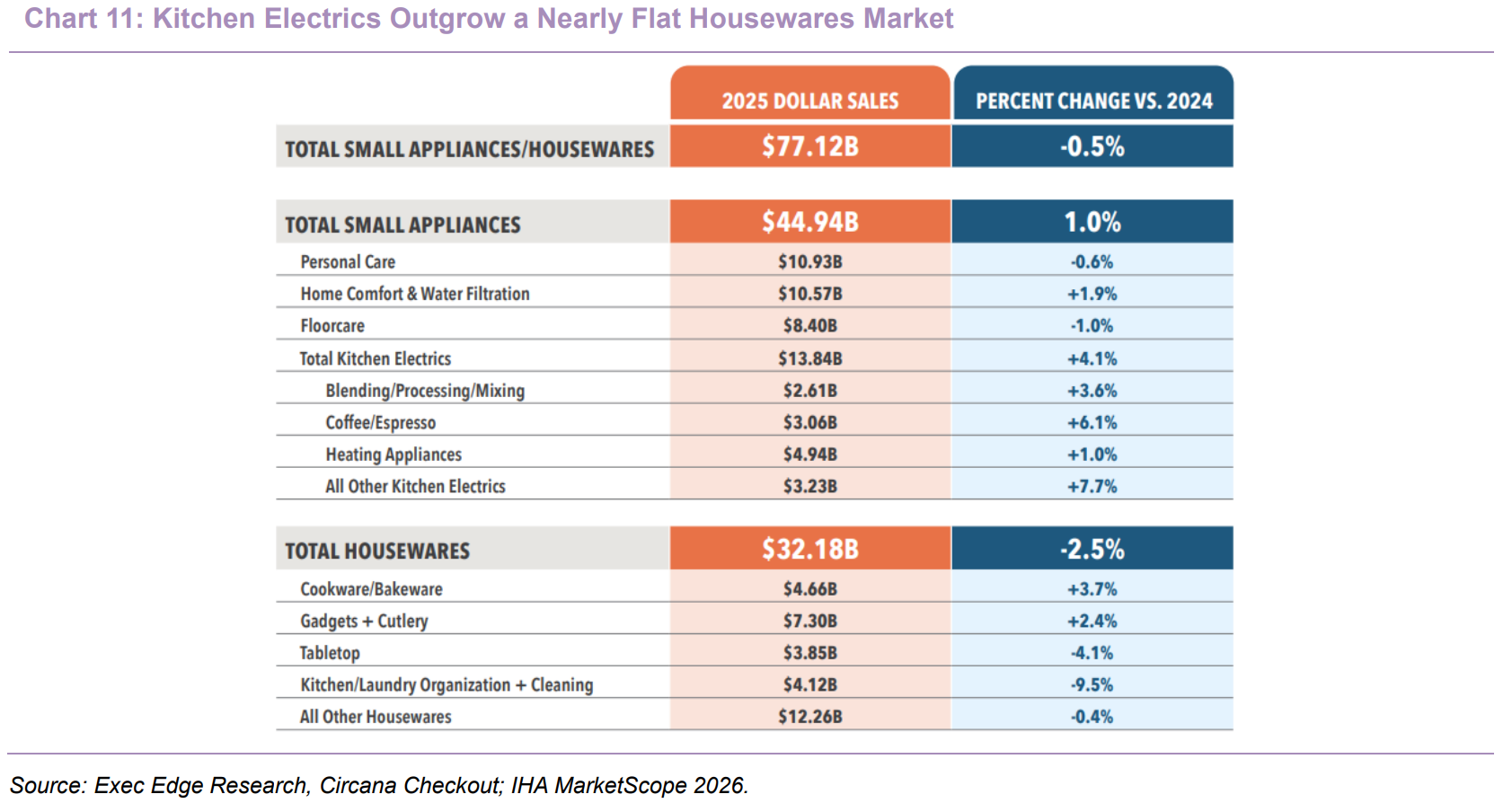
- Selective category growth favors HBB’s exposure to kitchen electrics and supports premiumization. According to Euromonitor, U.S. consumer-appliance retail volumes were flat in 2025, while retail value increased 4%, indicating that pricing and product mix contributed more to growth than broad unit expansion. The IHA/Circana MarketScope 2026 presents a similar picture: total U.S. small-appliance and housewares sales declined 0.5% to $77.12 billion, but small appliances grew 1.0% to $44.94 billion. Kitchen electrics were a relative bright spot, increasing 4.1% to $13.84 billion as eating and entertaining at home supported demand. Growth was concentrated in coffee and espresso, up 6.1% to $3.06 billion; blending, processing and mixing, up 3.6% to $2.61 billion; and other kitchen electrics, up 7.7% to $3.23 billion. By contrast, several adjacent categories were flat to declining, reinforcing the selective nature of category growth. Looking forward, NIQ expects North American small-domestic-appliance value sales to grow 1.0% in 2026, supported by replacement cycles and demand for premium features, health, hygiene and convenience. This backdrop favors HBB’s concentration in high-use kitchen categories while increasing the importance of innovation, product mix and premium expansion as drivers of growth.
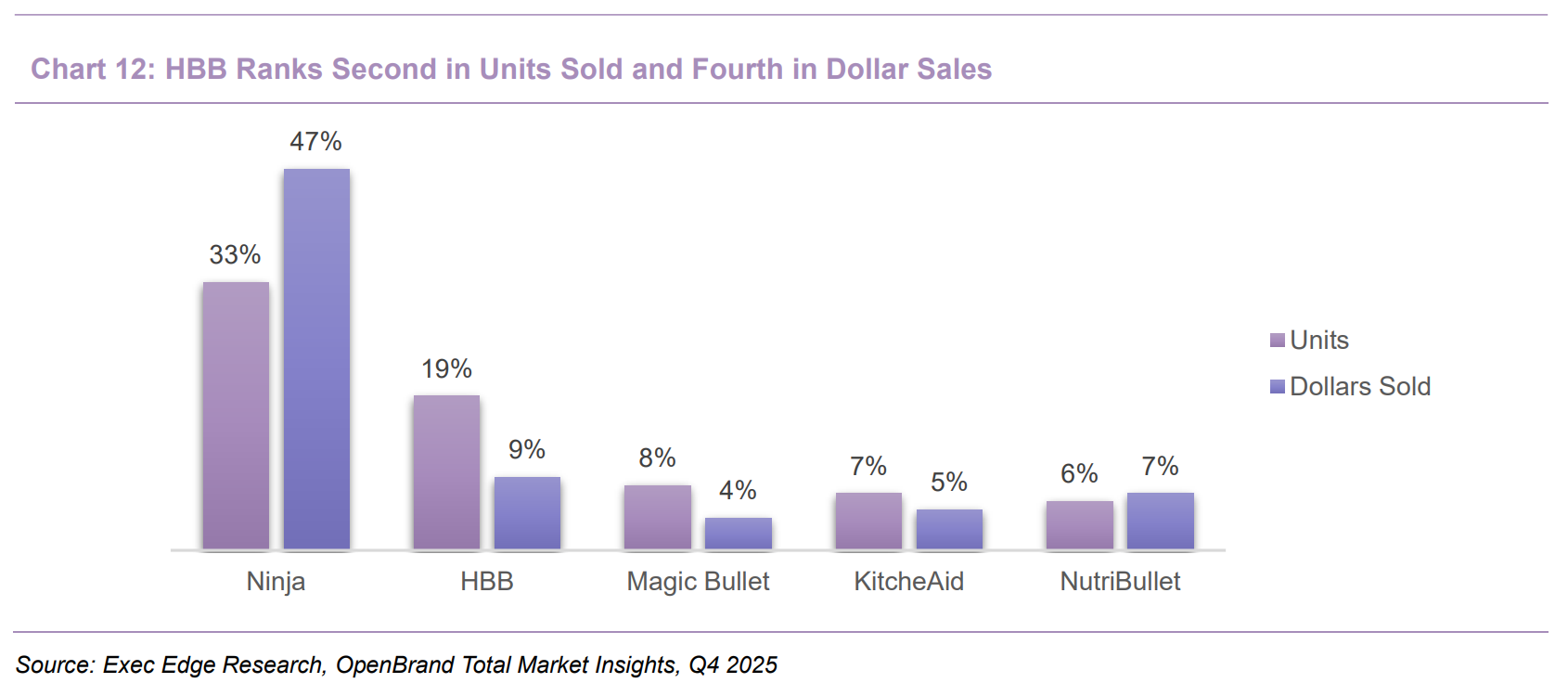
- HBB’s unit leadership materially exceeds its dollar share, reinforcing the strategic case for premiumization. HBB ranks as the #2 U.S. small-kitchen-appliance national brand by units sold and #4 by dollars sold, highlighting both substantial household penetration and lower revenue captured per unit. According to OpenBrand, Hamilton Beach ranked second with 19% unit share in Q4 2025 but captured only 9% of category dollars, compared with Ninja’s 33% unit share and 47% dollar share across air fryers, blenders, coffee makers, mixers and vacuums. The product-level comparison points in the same direction: OpenBrand identified Hamilton Beach’s model 50180 as the panel’s leading SKU, with 4.0% unit share at a $26 average price, while Ninja’s BE200 captured 3.7% at a $50 average price. Broader category research reinforces HBB’s volume credentials. Euromonitor estimates that HBB led U.S. food-preparation appliances with 21% retail volume share in 2025, while its small-cooking-appliance analysis places HBB second with 14%. While these datasets use different category definitions and should not be combined mechanically, they consistently position HBB as a scaled volume competitor. This provides a strong distribution and brand foundation, with premiumization offering a path to improve dollar capture without displacing HBB’s established value franchise.
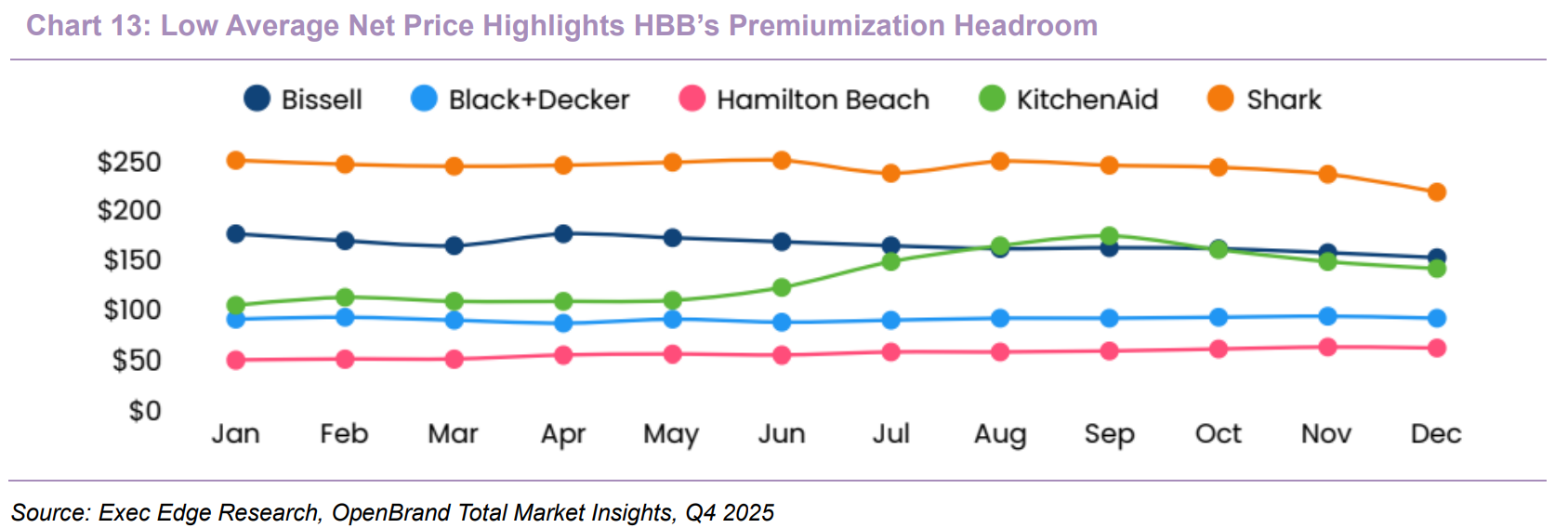
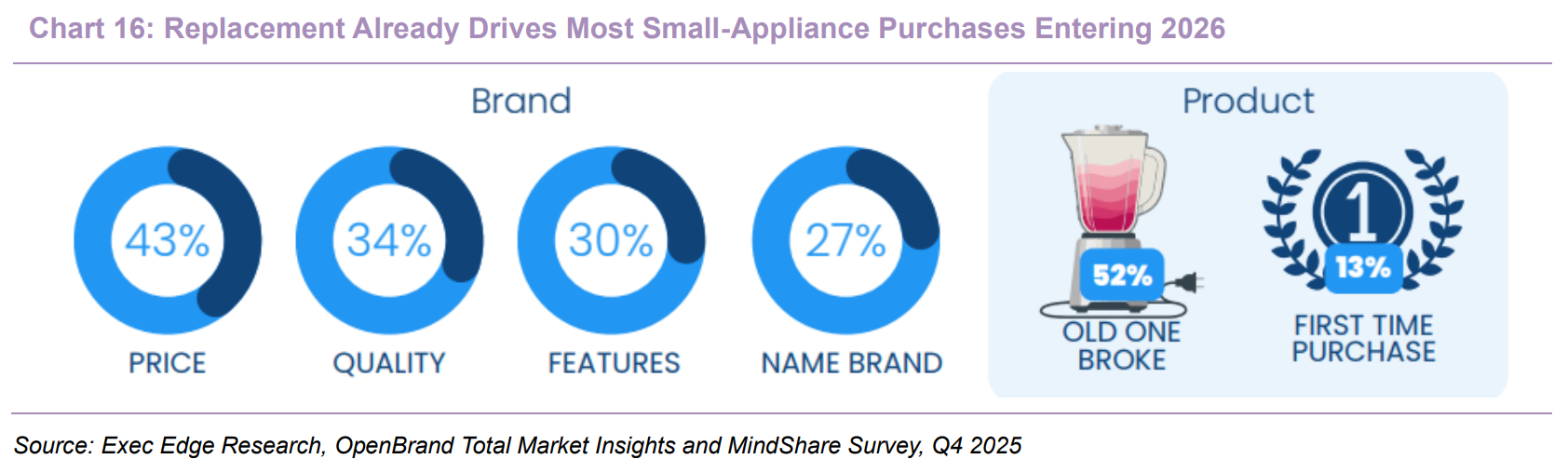
- The unit-to-dollar gap makes premiumization HBB’s clearest route to better mix and incremental market share. OpenBrand’s average-net-price data provide a clear explanation: HBB remained the lowest-priced tracked brand throughout 2025, with average net price generally around $50-$60, materially below Black+Decker, KitchenAid, Bissell and Shark. This positioning has supported broad unit penetration, but it also indicates scope to increase revenue per unit through selective pricing and a larger mix of premium products. Average net price also reflects category and SKU mix, so the data should not be interpreted as evidence of broad pricing power. OpenBrand identifies price as the leading brand-purchase driver for 43% of consumers, ahead of quality at 34% and features at 30%, while products priced below $200 represent roughly three-quarters of units. This suggests HBB’s premiumization opportunity is more likely to come from differentiated functionality and mix improvement than broad-based pricing across the value portfolio. That approach is consistent with Euromonitor’s view that multifunctionality and premium features are supporting U.S. small-cooking-appliance growth. Circana estimated the relevant U.S. premium TAM at ~$4.2 billion at year-end 2024, with HBB holding only ~1% share, highlighting substantial headroom to increase dollar share while preserving its established volume franchise.
- Lotus and CHI provide HBB with distinct owned and licensed routes into premium price points. Lotus Professional moved from a 2025 exclusive launch to broader distribution in 2Q26 after early sell-through exceeded expectations. Lotus Signature is scheduled for 4Q26 and early 2027, while a key retail partner is expanding shelf space. CHI provides a complementary garment-care platform, with distribution expanding across mass retail, ecommerce and department-store channels. These initiatives diversify HBB’s premium exposure, while sustained sell-through will determine whether the broader premium strategy can support durable mix improvement and justify continued brand investment.
Post-Tariff Normalization Supports a Replacement-Led Demand Recovery
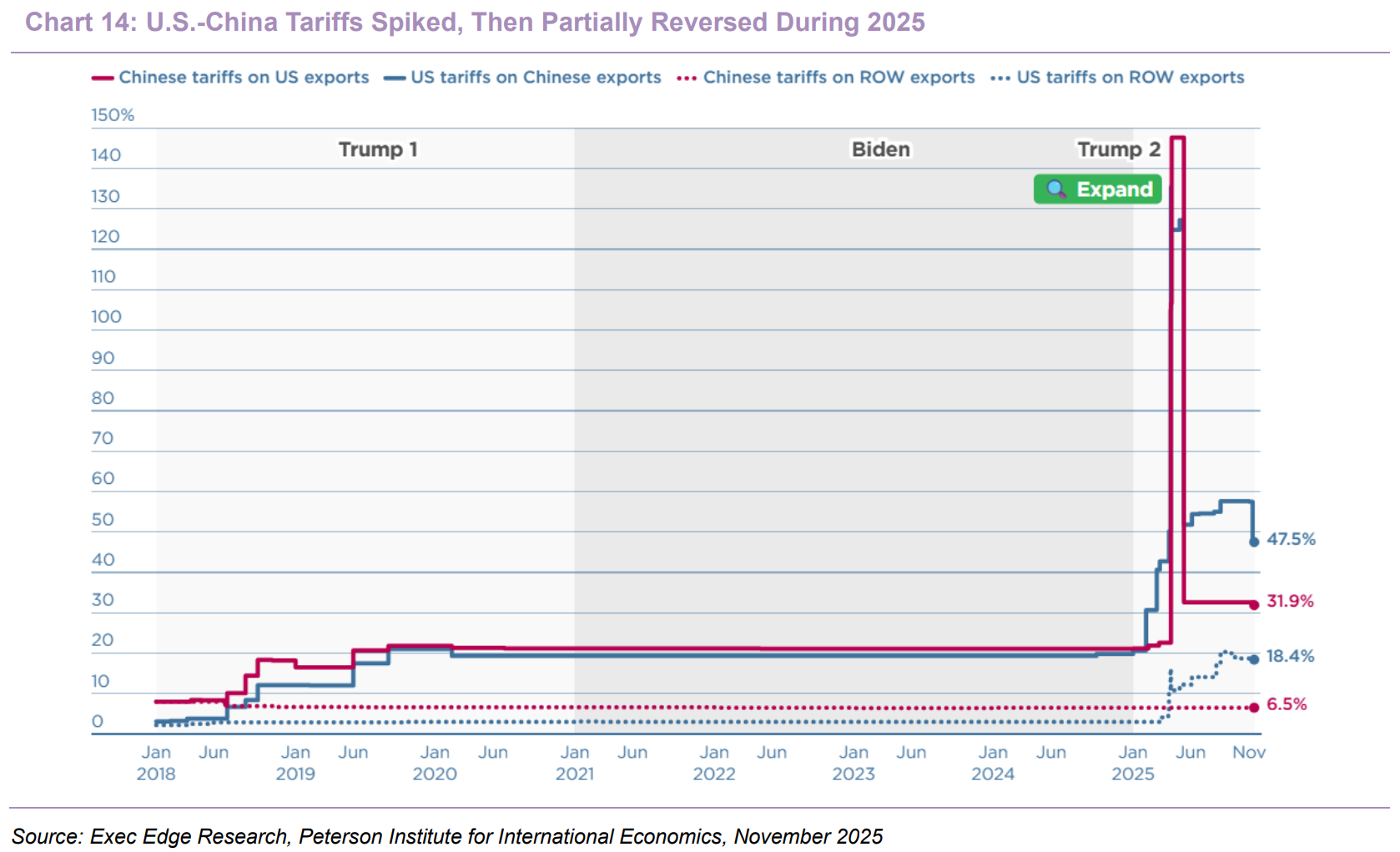
- Tariff volatility disrupted normal replenishment, driving front-loaded imports, order pauses and a broad inventory reset. The U.S. raised tariffs on Chinese imports sharply during 2025, with the effective average tariff rate estimated by the Peterson Institute for International Economics to have increased from 20.7% in January to 127.2% in early May before falling to 47.5% by November. This speed mattered as much as the peak, as retailers and suppliers could not confidently set landed costs, selling prices or reorder points. The Federal Reserve’s May 2025 Beige Book reported that businesses stockpiled foreign inputs before tariffs, while some customers postponed or cancelled orders. The resulting volatility was visible at U.S. ports, where imports reached 2.36 million TEU in July as retailers pulled merchandise forward before volumes declined later in the year. For appliance suppliers such as HBB, the result was a sequencing shock in which early receipts inflated inventories before retailers reassessed stock, pricing and supplier exposure.
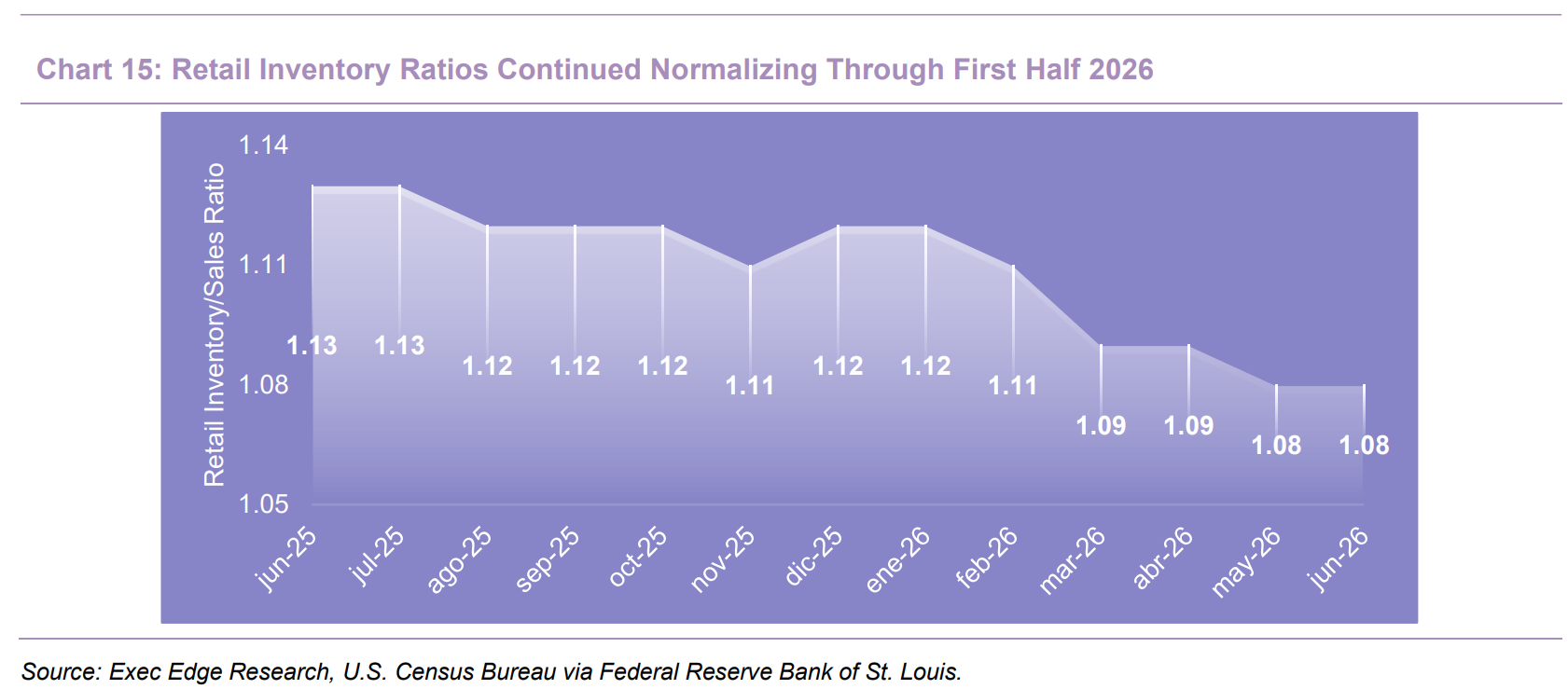
- Leaner inventories improve the demand setup in 2026, although consumer demand remains uneven and price sensitive. U.S. Census Bureau data published through FRED show that the seasonally adjusted ex-auto retail inventory-to-sales ratio declined from 1.12x in January to 1.08x in June, below 1.13x a year earlier, indicating a leaner retail inventory backdrop. Import activity also recovered later in the half, with major U.S. ports handling 2.24 million TEU in May, up 14.9% y/y, although NRF and Hackett Associates attributed much of the increase to front-loading ahead of expected tariff changes rather than stronger sell-through. Consumer conditions improved late in the half, with real PCE increasing 0.4% m/m in June, but the 2.7% saving rate and still-elevated inflation point to continued pressure on discretionary spending. For HBB, this suggests a cleaner replenishment environment, but not yet a broad-based demand recovery.
- Replacement demand is strengthening the 2026 category floor and aligns with HBB’s value positioning. According to OpenBrand, 52% of small-appliance purchases in Q4 2025 were triggered by an old product breaking, compared with 13% for first-time purchases. OpenBrand also found that products priced at $199 or less represented roughly three-quarters of units, reinforcing the importance of accessible price points when consumers replace failed products. The replacement pool is broadening as high-frequency kitchen appliances bought during 2020-21 reach later-life stages. Under its tracked home-durables definition, Circana still forecasts 2026 dollar sales down 1.2% to ~$41.8 billion and units down 4.9%, suggesting replacement demand is providing support rather than driving a broad category rebound. IHA/Circana identifies high-frequency products entering replacement as a growth pocket, while Euromonitor similarly points to pandemic-era purchases reaching end of life as global small-appliance volumes stabilize. Euromonitor also warns that long replacement cycles and economic pressure continue to restrain mature categories. For HBB, strong brand recognition, broad distribution and accessible price points position the core franchise well for replacement-led purchasing, while premiumization provides an opportunity to capture higher value from that demand.
- HBB’s tariff mitigation and value positioning leave it well placed for replacement-led demand. HBB has used its Byhalia foreign trade zone, diversified sourcing across Asia and selective pricing to reduce tariff disruption, while U.S. consumer volumes recovered in 2Q26 and inventory declined 28.2% to $115.1 million. The company is also reinvesting part of the tariff-related upside into promotion and brand building while preparing two single-serve coffee platforms for 2H26. HBB’s broad distribution, recognizable brands and accessible price points should support participation in replacement-led purchasing, while premium mix and sustained sell-through will determine how much of that demand translates into higher-value growth.
Digital Discovery Shifts Toward AI-Led Search and Recommendation
- Digital channels now shape most small-appliance discovery, increasing the value of strong product content and brand visibility. According to NIQ’s Home Appliances Outlook 2026, online channels now account for more than half of global small-domestic-appliance purchases, making digital visibility especially important for categories such as blenders, coffee makers and food-preparation products. NIQ’s March 2026 digital-shelf analysis also observes that consumers move repeatedly among search results, retailer applications, reviews, social content and physical stores rather than following a linear purchase funnel. For small appliances, this puts greater weight on ratings, reviews, search visibility, product imagery and clearly communicated use cases when consumers compare similar products across price points and features. Established brands can retain an advantage through recognition and accumulated reviews, but broad distribution alone no longer guarantees consideration. For HBB, this increases the importance of maintaining strong digital presentation alongside its established retail reach.
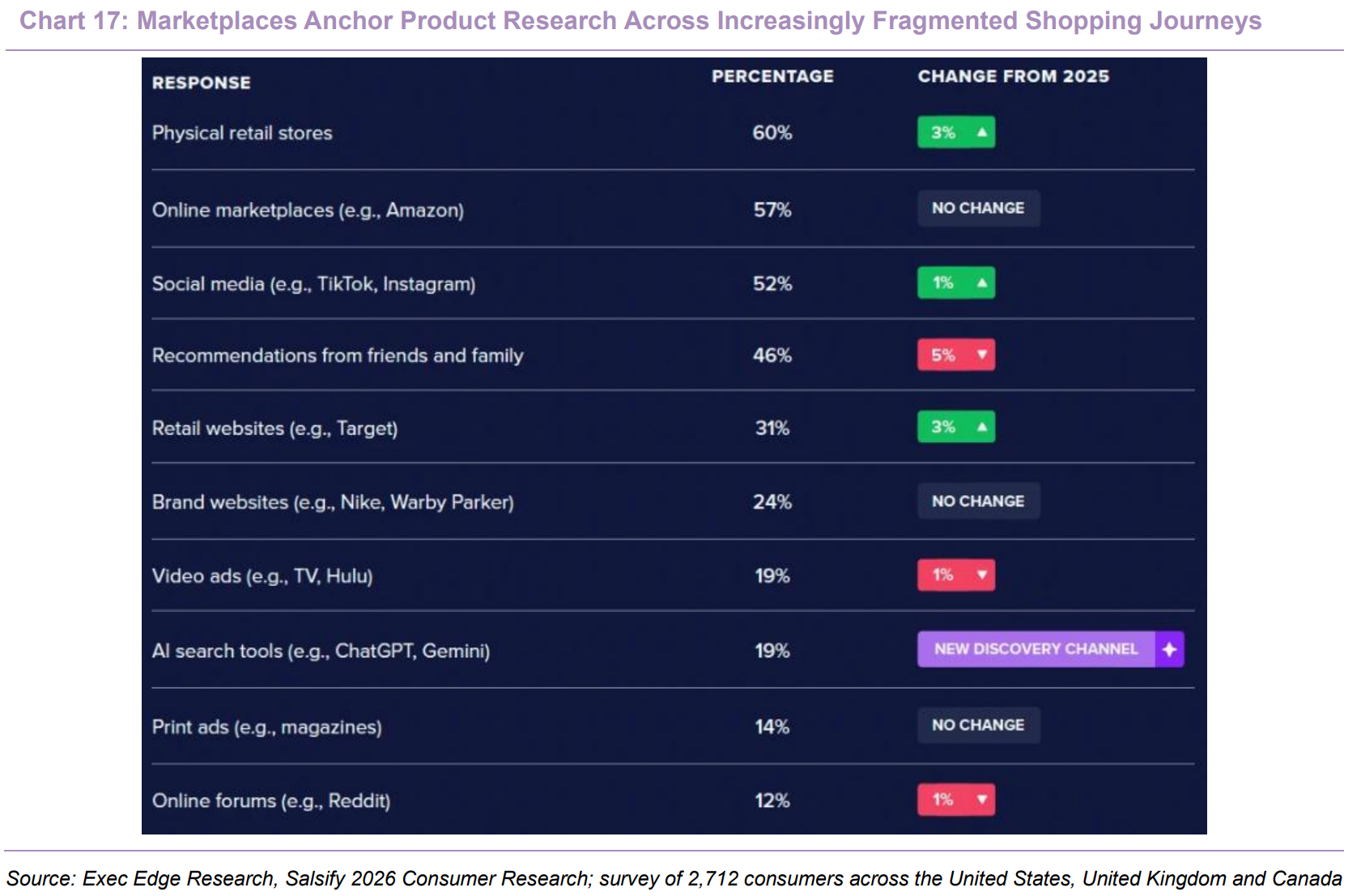
- Generative AI is beginning to reshape product discovery and compress consumer consideration sets. Adobe Analytics found that traffic from generative AI tools to U.S. retail websites increased 138% y/y in May 2026, reaching its highest level since Adobe started measuring this in October 2024, suggesting AI-driven traffic is extending beyond seasonal shopping periods. AI-referred visitors also converted more strongly than other traffic sources. Leading retailers are increasingly embedding conversational discovery directly into shopping environments: Amazon combined Rufus with Alexa+ to launch Alexa for Shopping in May 2026, while Google is working with retailers including Walmart, Shopify and Wayfair to integrate product discovery and checkout into Gemini-supported shopping. Consumers can increasingly describe a specific need and receive a curated set of recommendations rather than review dozens of listings. This can shorten product research but also narrow the consideration set, increasing the importance of being surfaced by AI-led recommendation systems. For appliance brands such as HBB, the opportunity is higher-intent discovery, while the risk is greater platform influence over which products consumers encounter.
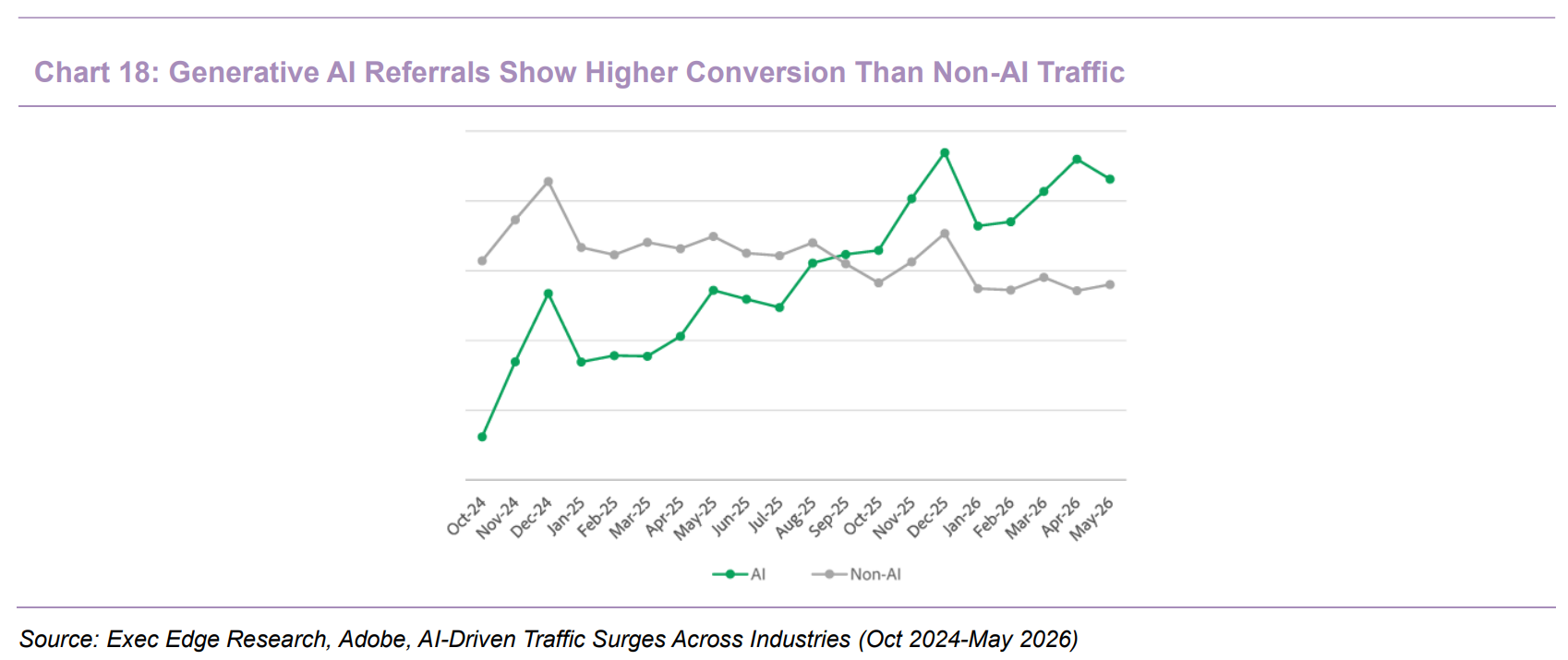
- As algorithms curate smaller consideration sets, structured product information becomes increasingly important to digital visibility. Google’s Shopping Graph now contains more than 60 billion product listings incorporating attributes such as inventory, prices and reviews, while new Merchant Center tools are being designed to show brands their visibility in AI-led shopping journeys and identify missing structured attributes. NIQ similarly emphasizes that accurate descriptions, strong imagery, ratings, availability and consistent information across retailer and brand websites determine digital-shelf visibility and conversion. The challenge is that content created for human browsing is not always sufficiently readable or explicit for AI systems; eMarketer reports that approximately one-third of content on an average retail product page cannot be interpreted by large language models. This increases the importance of complete specifications, standardized terminology, clear use cases and credible review signals across major digital endpoints. Paid media can support visibility, but structured product data and measurement are increasingly important to whether products are surfaced and converted. For HBB, this makes its 500-SKU content build and product-level recommendation tracking directly relevant to digital competitiveness.
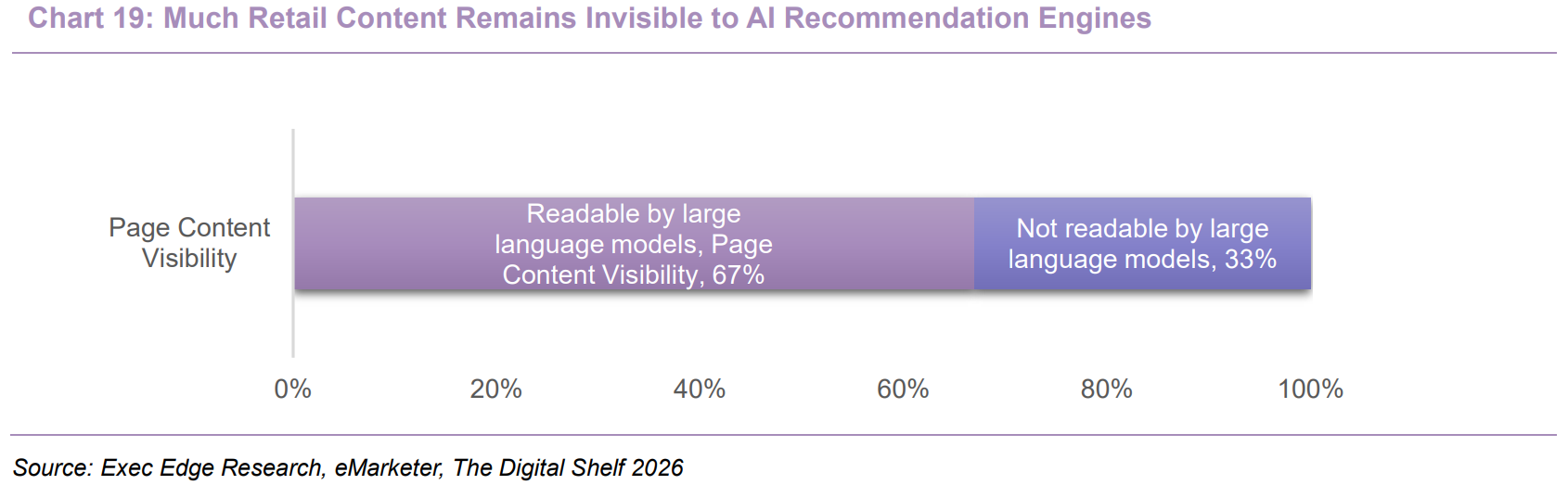
- HBB is building the content, media-testing and measurement capabilities needed to compete for AI-mediated consideration. A 500-SKU content build is structuring product information for discovery across leading AI platforms, while a controlled three-month ChatGPT advertising pilot will inform a potential scaling decision before 4Q26. HBB is also developing product-level measurement to compare how frequently AI platforms recommend its products relative to competitors. These initiatives are financially relevant because Amazon represented 19% of 2025 revenue and small-appliance discovery increasingly begins online. Together, structured content can improve recommendation eligibility, paid testing can assess acquisition potential and product-level measurement can link visibility to conversion. The more important evidence will be whether these initiatives translate into stronger recommendation share, qualified traffic and incremental revenue as AI-led commerce develops.
Beverage Growth and Automation Strengthen Commercial Equipment Demand
- Cold-beverage growth is increasing demand for specialized commercial preparation equipment. According to Technomic, the nonalcoholic foodservice-beverage market generated $264.1 billion of consumer spending in 2025, representing 23% of foodservice sales. Although total beverage volume declined 0.6%, cold-beverage spending increased 3.4%, versus 1.2% for hot beverages, while cold-coffee volume rose 3.4%. Freshly prepared cold coffees, smoothies, iced teas and lemonades also support customization and premium pricing, with Technomic finding that cold coffee can be priced 20%-30% above traditional hot coffee. This favors equipment that can deliver multiple recipes consistently, support single-serve demand and maintain service speed during peak periods. Technomic expects cold-beverage volume to grow at a 1.9% CAGR through 2030, compared with 0.1% for hot beverages, supporting a more attractive equipment-growth pocket than headline foodservice volumes imply.
- Labor pressure is increasing the value of programmable, durable and easily serviced equipment. The National Restaurant Association estimates that average restaurant operating expenses increased 36% between 2019 and 2026, including a 41% rise in hourly employee earnings, while 42% of operators were unprofitable in 2025. Against this backdrop, the 2026 Rational and Statista Kitchen Barometer found that 64% of 250 restaurant and hotel kitchen operators across five countries experienced significant staffing bottlenecks, while 78% planned to modernize kitchen technology. Reporting from the 2026 National Restaurant Association Show similarly identified beverage innovation, process-specific automation, embedded controls, reliability and serviceability as leading equipment priorities. For equipment suppliers such as HBB, these pressures increase the relevance of products that reduce manual steps, shorten training and standardize output while maintaining reliability during peak demand.
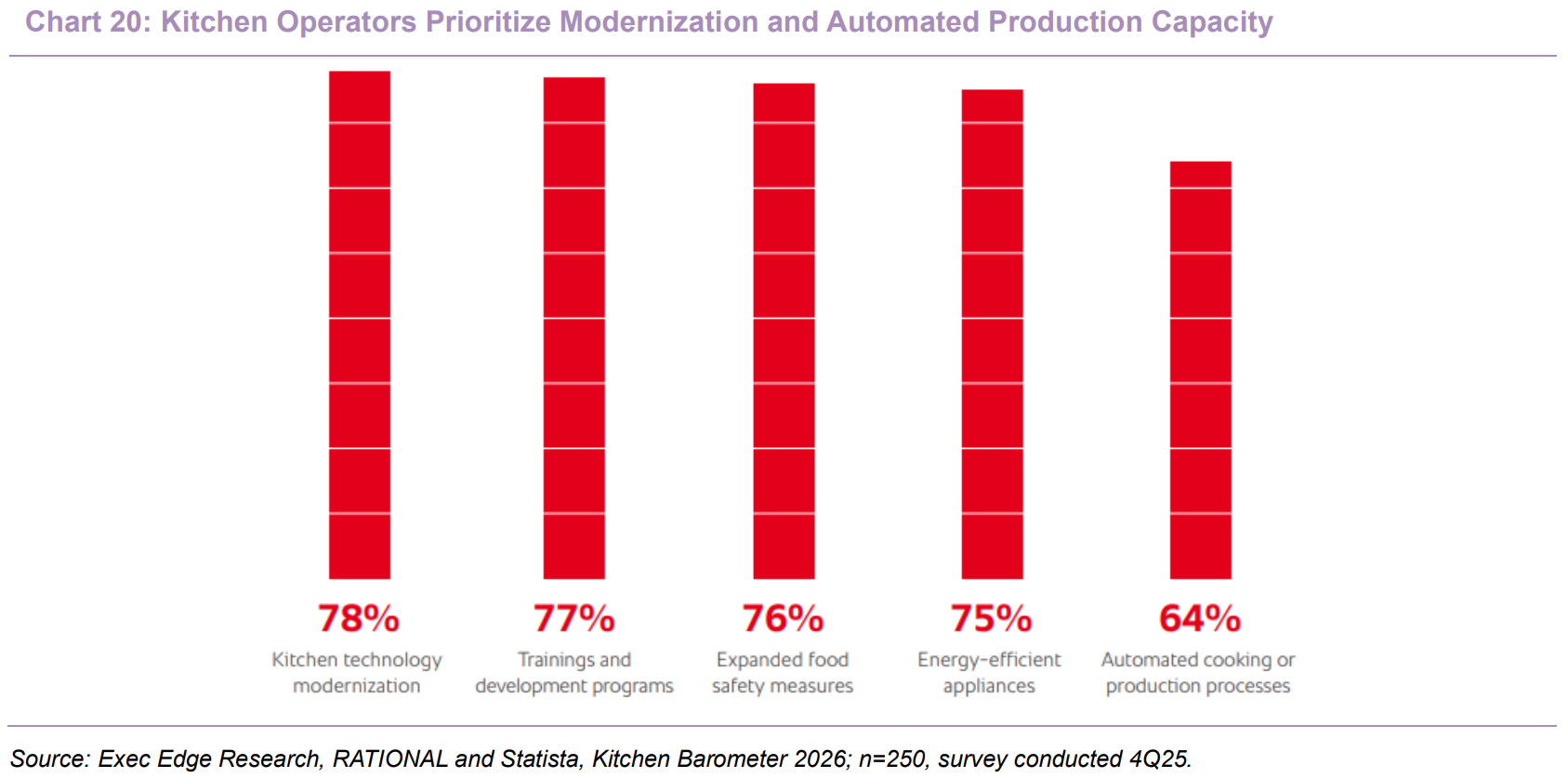
- This demand pattern maps closely onto HBB’s strongest commercial products and current chain placements. Summit Edge and Eclipse automate blend cycles, support programmable recipes and emphasize consistency, durability and quieter operation. Eclipse is being added at a national coffee chain, while a spindle mixer has secured a QSR placement in Central America and Sunkist juicers and sectionizers continue to exceed expectations. The Titan food processor, scheduled for 4Q26, is also attracting regional-chain testing. Commercial-product revenue increased 4.8% y/y to $28.2 million in 1H26. The alignment between beverage growth and labor-saving functionality strengthens HBB’s commercial relevance, with further upside dependent on converting product tests into scaled chain rollouts and demonstrating clear customer efficiency benefits.
Home-Administered Specialty Therapies Increase Adherence Needs
- Specialty-drug growth is moving more high-value treatment into mail-order, home-health and self-administration workflows. According to the American Journal of Health-System Pharmacy, U.S. specialty-drug spending increased 15.2% to $485.4 billion in 2025, representing 53.0% of total prescription expenditure. Mail-order pharmacies accounted for $217.8 billion, or 44.9%, and their five largest specialty drugs were all self-injectables. Several of these products treat inflammatory conditions in dermatology and rheumatology, where long-duration therapy and regular dosing make persistence particularly important. Home-healthcare specialty-drug spending was smaller at $15.6 billion but expanded 33.9%, demonstrating that treatment value is migrating beyond hospitals and clinics. IQVIA separately estimates that self-administered parenteral therapies grew at a 15% five-year CAGR through 2024, twice the rate of clinician-administered products, and represented 60% of parenteral market value. This shift increases the number of high-value doses administered without direct clinical observation and expands the need for scalable home-medication support.
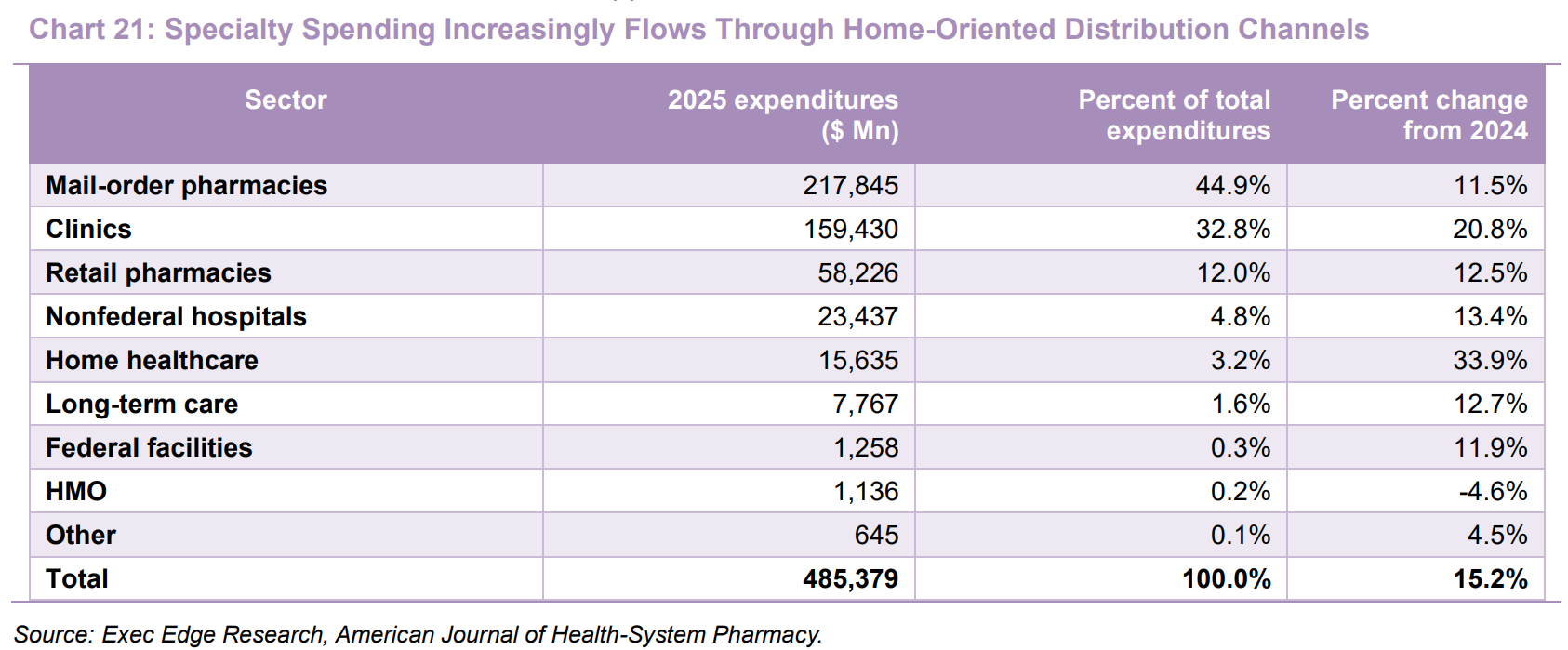
- As treatment decentralizes, adherence evidence and timely patient intervention become increasingly important parts of specialty-care infrastructure. A JAMA Network Open study of 125,474 adults initiating GLP-1 therapies found that 46.5% of patients with type 2 diabetes and 64.8% without diabetes discontinued treatment within one year. The result does not isolate avoidable nonadherence, since affordability, adverse events and clinical decisions also affect persistence, but it illustrates the difficulty of sustaining long-duration injectable treatment outside supervised settings. Connected devices can provide pharmacies and pharmaceutical manufacturers with more timely evidence than refill claims alone. A 2026 retrospective post-market study of two connected growth-hormone injection devices reported 12-month mean adherence of 92.5% and 92.4%, with more than 85% of patients maintaining the study’s acceptable adherence threshold. The broader opportunity lies in capturing medication events, identifying missed doses and enabling targeted support, rather than merely dispensing another connected container.
- This trend aligns directly with HBB’s connected medication-management model and targeted therapeutic expansion. Hamilton Beach Health has managed more than 1.2 million injections and is adding specialty-pharmacy and pharmaceutical partnerships. Its 3Q26 pill-management pilot initially targets dermatology and rheumatology, overlapping with therapeutic areas represented among leading self-administered specialty drugs. Health revenue increased 48.4% y/y to $4.8 million in 1H26, while segment profit improved to $0.2 million from a $1.7 million loss. The platform could benefit as treatment shifts home and manufacturers demand adherence data, but its small scale, customer-conversion requirements and need to demonstrate better patient and economic outcomes remain important constraints.
Growth Strategy
Innovation, Premiumization and Diversification Underpin HBB’s Next Growth Phase
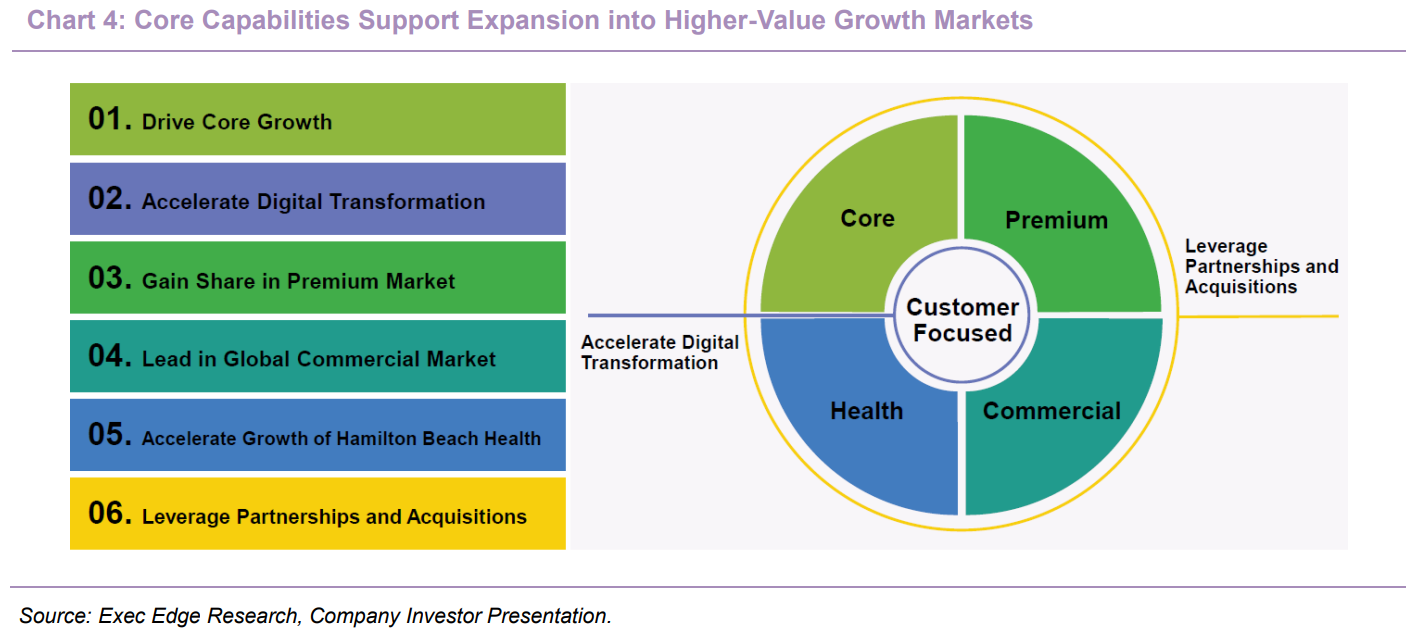
- HBB’s five-pillar strategy targets growth beyond a recovery in the core consumer business. HBB’s stated growth strategy organizes execution around five operating pillars: (1) drive core growth, (2) gain premium share, (3) lead in global commercial markets, (4) accelerate digital transformation, and (5) scale Hamilton Beach Health. The framework combines HBB’s broad consumer distribution with premium, commercial and health adjacencies, while digital investment supports discovery and conversion across the portfolio. Management has paired these priorities with an incremental $6 million of planned advertising in 2026 and intends to reinvest a portion of its tariff-refund proceeds in brand-building. The breadth of these initiatives provides multiple avenues for growth beyond the core, although execution remains dependent on consumer demand, retailer adoption and launch timing. We discuss the five growth strategy pillars in detail below.
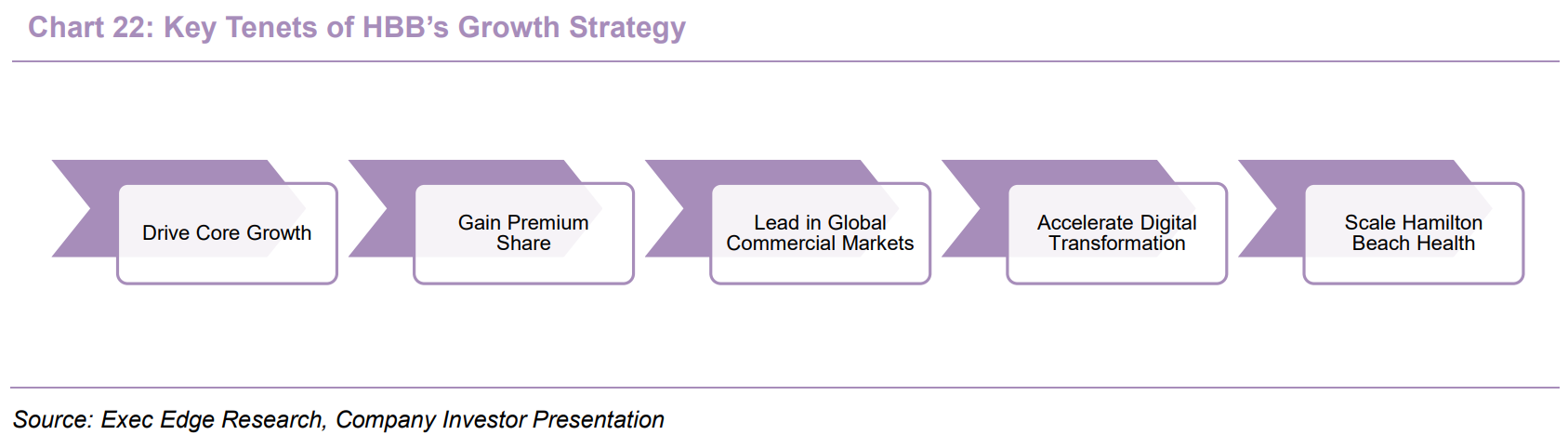
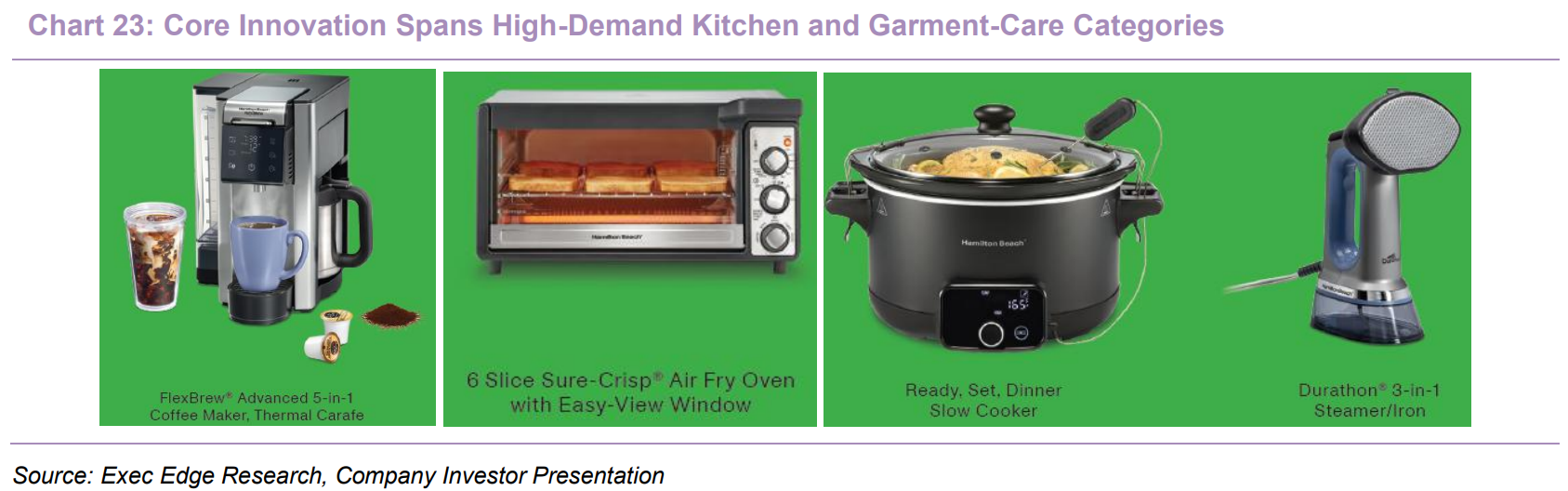
- Core growth depends on translating HBB’s innovation pipeline into broader retail placement and sustained category share gains. The company’s core strategy seeks to grow revenue and market share in a mature, promotion-intensive appliance market by refreshing high-demand categories, solving identifiable consumer needs and earning incremental shelf and digital placement. HBB participates in more than 50 product categories and ranked second among U.S. national small-kitchen-appliance brands by units sold for the 12 months ended September 30, 2025, giving new platforms an established channel base. Its Good Thinking process is designed to translate consumer feedback into differentiated features across coffee, blending, food preparation, cooking and garment care. This combination of category breadth and innovation creates multiple opportunities to win retailer programs, although core performance remains sensitive to discretionary spending and retailer inventory decisions. Sustained growth therefore depends on launch productivity and marketing support, not category participation alone.
-
- Execution across 2025 and 1H26 began converting the innovation pipeline into new products, placements and demand support. HBB introduced 49 new product platforms and shipped more than 25 million appliances in 2025, while advancing blender systems, single-serve coffee and garment-care platforms. In 1H26, three blender kitchen systems gained traction, the redesigned Durathon iron launched with strong retailer reception, and HBB expanded its garment-steamer assortment. Distribution also widened through new placements at a leading mass-market retailer, additional shelf space at two major wholesale clubs and planned fall programs with a leading department store. Two single-serve coffee platforms remained scheduled for 2H26, providing another opportunity to strengthen an important category. HBB also began ramping a new advertising agency and increased digital, social-media and influencer support. Together, these initiatives connect product innovation with broader distribution and consumer awareness, supporting the potential for sustainable core share gains.
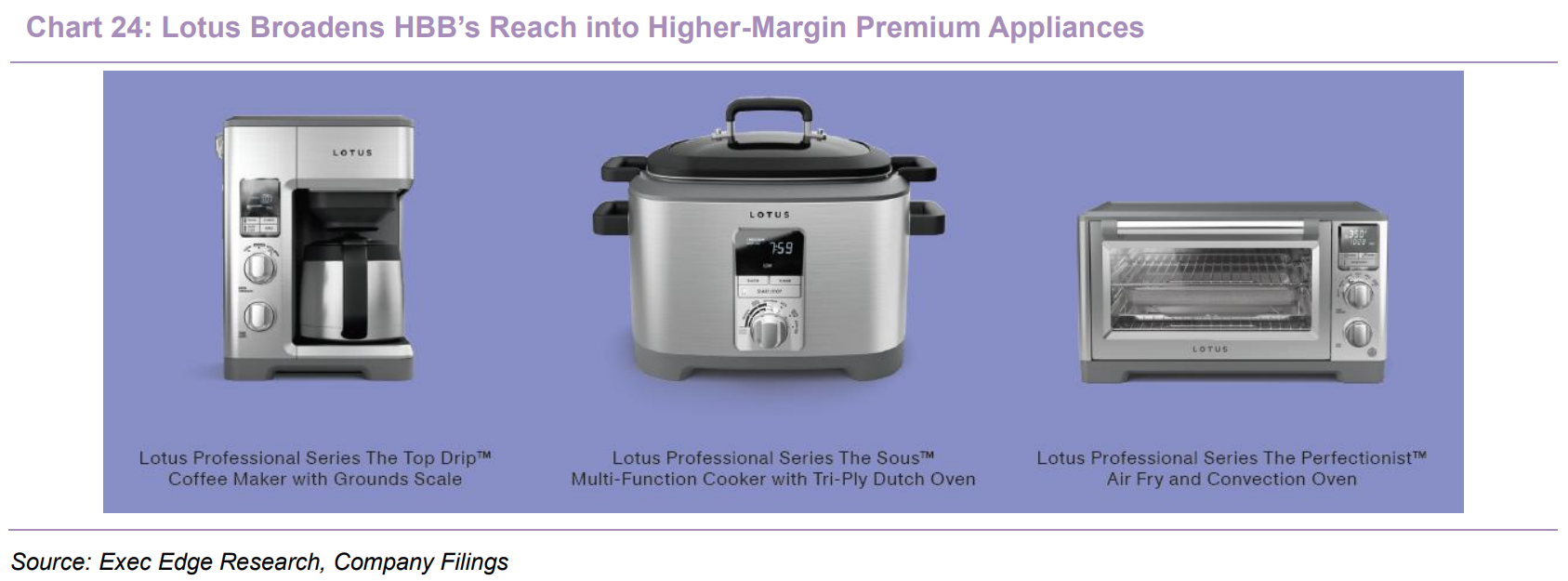
- Premium expansion gives HBB a path to improve portfolio mix by extending its capabilities into higher price points. The strategy addresses a U.S. premium small-appliance market estimated at ~$4.2 billion, where HBB held ~1% share at year-end 2024, per Circana, by combining owned brands such as Lotus and Hamilton Beach Professional with licensed CHI offerings. Lotus gives HBB a proprietary platform spanning coffee, cooking and countertop appliances, while CHI extends an established salon brand into garment care. Premium products carry structurally higher margins, and management views premium consumers as comparatively resilient through uncertain demand conditions, making share gains strategically relevant to both revenue quality and margin mix. The opportunity remains at an early stage, however, and requires sustained brand investment, selective distribution and continued retailer sell-through.
- The 2025 Lotus launch and broader 1H26 rollout established an initial retail platform for premium expansion. HBB introduced Lotus Professional through an exclusive national retailer in 2025, supported the brand with several million dollars of investment and reported strong double-digit sell-through. After the exclusivity ended in 1Q26, HBB began rolling Lotus Professional to additional retailers, while the original partner committed more shelf space. The latest timetable places Lotus Signature launches in 4Q26 and early 2027, with brand support expected to continue beyond 2026. HBB also expanded CHI distribution in 1H26: a leading mass retailer carried three CHI steam irons and three garment steamers in stores and online, the online assortment added collapsible and retractable-cord steamers, another national retailer added the CHI Travel Steamer, and a warehouse club listed the CHI Lava 360 Precision Iron online. A successful department-store test is scheduled to expand the CHI 360 Precision Iron across all doors in 3Q26. Together, these placements broaden premium execution beyond Lotus while HBB continues building the owned brand.
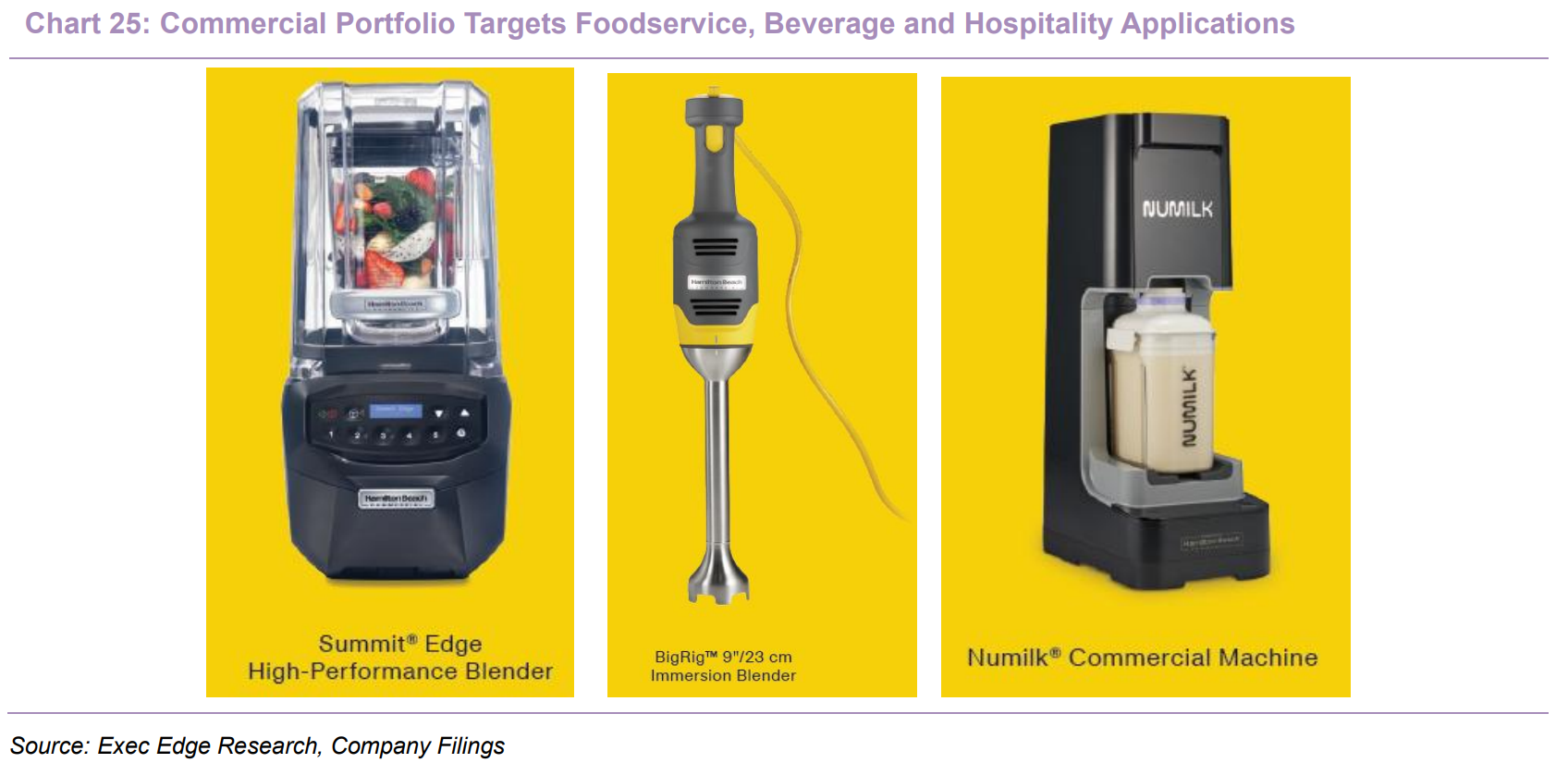
- HBB is scaling Commercial as a higher-margin growth platform across global foodservice and hospitality customers. The commercial strategy applies HBB’s engineering experience in blending, mixing and food preparation to a global market with different demand drivers from retail appliances. Growth is expected to come from product innovation, penetration of regional and global chains, international expansion and partnerships such as Sunkist and Numilk. Commercial represented approximately 10% of 2025 revenue and delivered strong, profitable results, making the business a meaningful mix lever rather than a peripheral adjacency. Chain placements can also create repeat equipment demand across multiple locations and geographies. Commercial rollouts typically require product testing, customer qualification and reliable service, making conversion from initial placements into broader programs an important execution milestone.
- Partnership launches and chain placements across 2025 and 1H26 broadened the commercial product and customer base. In 2025, the Summit Edge high-performance blender continued gaining foodservice traction, while HBB entered a long-term Sunkist partnership and launched branded commercial juicers and sectionizers in 2Q25. Those Sunkist products continued to exceed expectations through 1H26. HBB also remained on track to place the Eclipse blender with a leading national coffee chain and secured a spindle-mixer placement for a U.S. fast-food operator’s Central American locations. Hospitality distribution broadened when a national hotel chain added HBB irons and hair dryers across approximately 770 U.S. locations, with HBB pursuing similar programs across another six to seven flagship chains. The next product test is the Titan food processor, scheduled for 4Q26 and aimed at a roughly $90 million global food-processor market, with several regional food chains preparing trials. Together, these initiatives show a progression from product development and testing to chain approval and broader multi-location deployment.
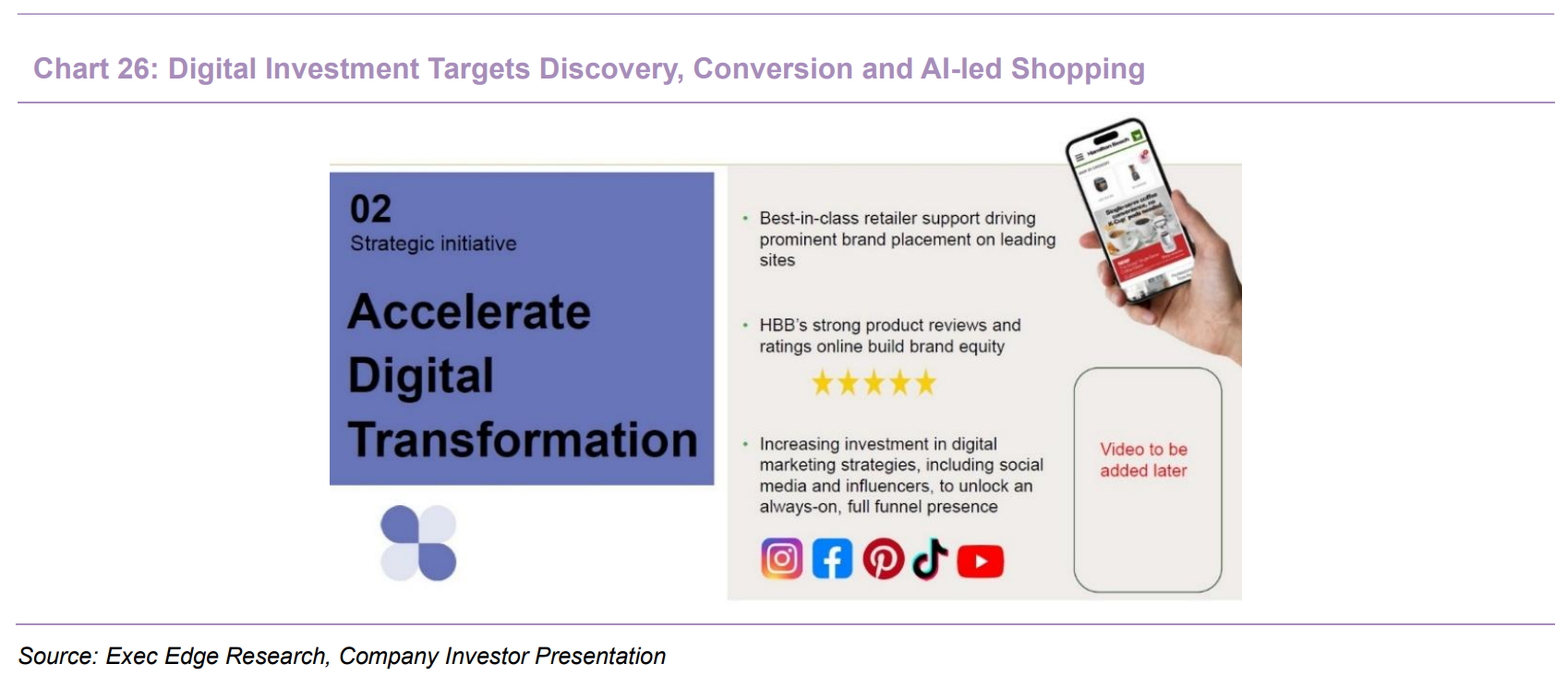
- Digital transformation is intended to preserve HBB’s discoverability as appliance shopping shifts toward AI-mediated search and recommendations. HBB aims to connect content, paid media and measurement so products remain visible when consumers research, compare and purchase across retailer sites, social platforms and emerging AI interfaces. Online competition increasingly depends on compelling content, brand reputation, ratings and reviews, with HBB’s brands averaging above 4 stars across major platforms. The strategy therefore extends beyond ecommerce operations: HBB is building an always-on, full-funnel presence designed to improve product discovery, consideration and conversion. Product-level measurement should also help HBB assess whether emerging AI channels translate increased visibility into measurable recommendation and revenue outcomes.
- Digital investment moved from broader marketing support in 2025 to specific AI-search and measurement initiatives in 1H26. During 2025, HBB expanded digital, social-media and influencer marketing and used AI to support content creation, audience targeting and efficiency across its digital ecosystem. In 1H26, HBB added resources focused on discoverability and AI shopping, selected a new advertising agency to lead its digital strategy from 2H26 and began an AI-optimized content build covering 500 SKUs. HBB also launched a controlled three-month test on ChatGPT’s advertising platform and started building measurement infrastructure to compare product-level recommendations against competitors. These initiatives are supported by an incremental $6 million advertising plan for 2026, while management also intends to reinvest a portion of tariff-refund proceeds into additional brand-building and marketing programs. Together, structured catalog content, paid-channel testing and attribution tools provide a test-and-scale framework for determining whether improved digital visibility translates into incremental conversion and revenue.
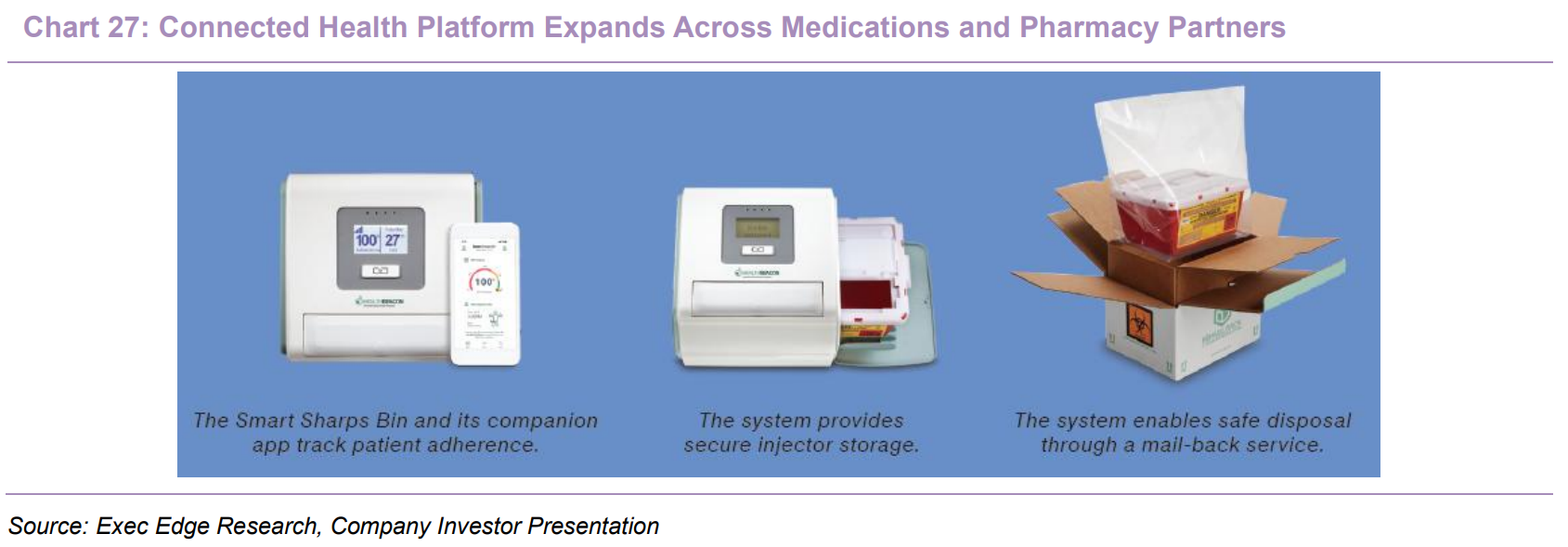
- Connected medication management gives HBB a path to build a broader, profitable healthcare platform with recurring revenue. Hamilton Beach Health combines HealthBeacon’s software and data-analytics capabilities with HBB’s device engineering, product-development and distribution strengths. The business sells through specialty pharmacies and pharmaceutical manufacturers, generating device-lease and software-licensing revenue while helping patients manage chronic therapies at home. Its initial Smart Sharps Bin platform tracks injection adherence, supports secure storage and enables mail-back disposal; the longer-term strategy is to add medications, clients and device formats while improving patient feedback and experience. This creates a revenue stream with different end-market drivers and a higher-margin profile than the core consumer business. However, expansion depends on partner adoption, device performance, patient engagement and healthcare regulation, which may make rollout timing less predictable than conventional appliance launches.
- Profitable growth through 1H26 supported expansion beyond injections into broader medication-adherence applications. Hamilton Beach Health produced positive operating profit in 3Q25 and 4Q25, approximately 18 months after the HealthBeacon acquisition, as specialty-pharmacy partnerships expanded, HealthBeacon Harmony software launched with Novartis and the patient subscription base grew nearly 50%. By 2Q26, the business had recorded a fourth consecutive profitable quarter, remained on track to increase 2026 sales by 50% and had managed more than 1.2 million injections. HBB added another injectable drug to the Smart Sharps Bin platform and continued adding specialty-pharmacy and pharmaceutical partners. The next adjacency is a pill-management platform scheduled for a 3Q26 pilot, initially targeting dermatology and rheumatology before potential expansion to other therapeutic areas. This progression from profitable injectable programs into broader medication adherence expands the potential use cases for HBB’s connected-health platform.
Management Team
Experienced Leadership Team Blends Operating Knowledge with Financial Expertise
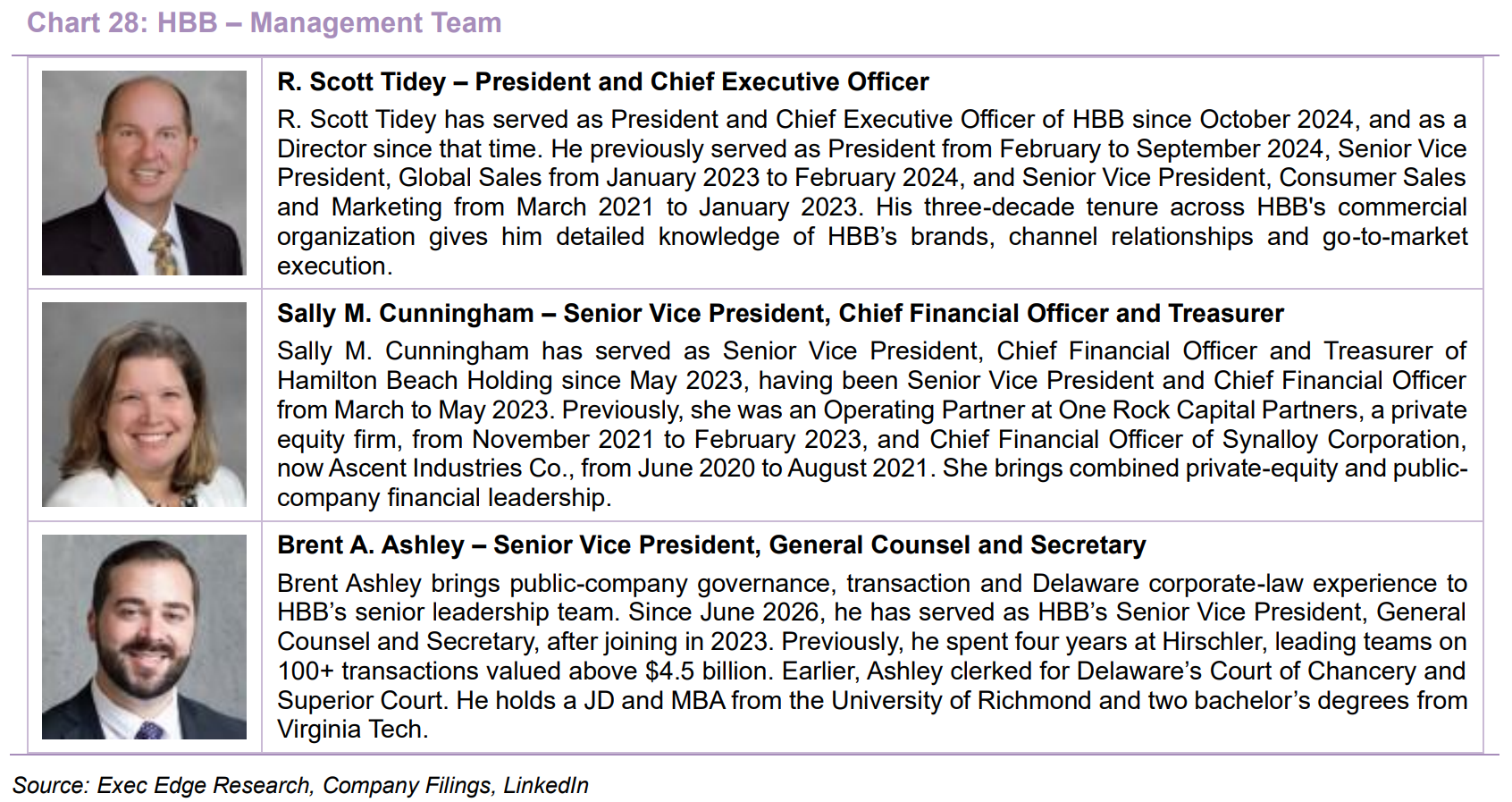
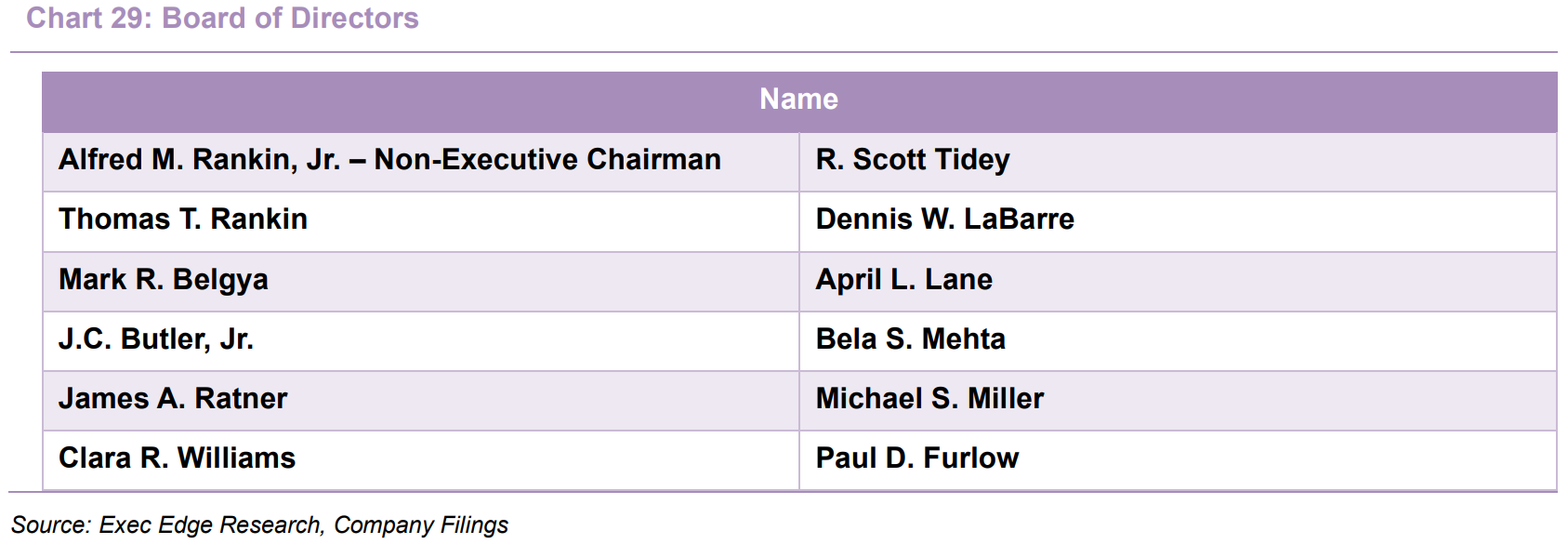
- Long-tenured operating leadership is complemented by financial, legal and board-level expertise. President and CEO R. Scott Tidey has served in the top role since October 2024 after more than three decades across HBB’s sales and marketing organization, providing detailed knowledge of its brands, channels and operating model. CFO Sally M. Cunningham, appointed in 2023, adds private-equity and public-company finance experience as HBB balances growth investment, shareholder returns and acquisition optionality. Brent A. Ashley is Senior Vice President, General Counsel and Secretary. The board adds experience across consumer products, industrial operations, retail, capital markets and governance, while the Rankin family’s voting control provides continuity. Execution against HBB’s five growth pillars, ERP implementation, tariff mitigation and disciplined deployment of its strengthened balance sheet will provide key measures of the leadership team’s progress.
Fundamentals & Valuation
Revenue Recovery and Better Margin Outlook Support Improving Fundamentals
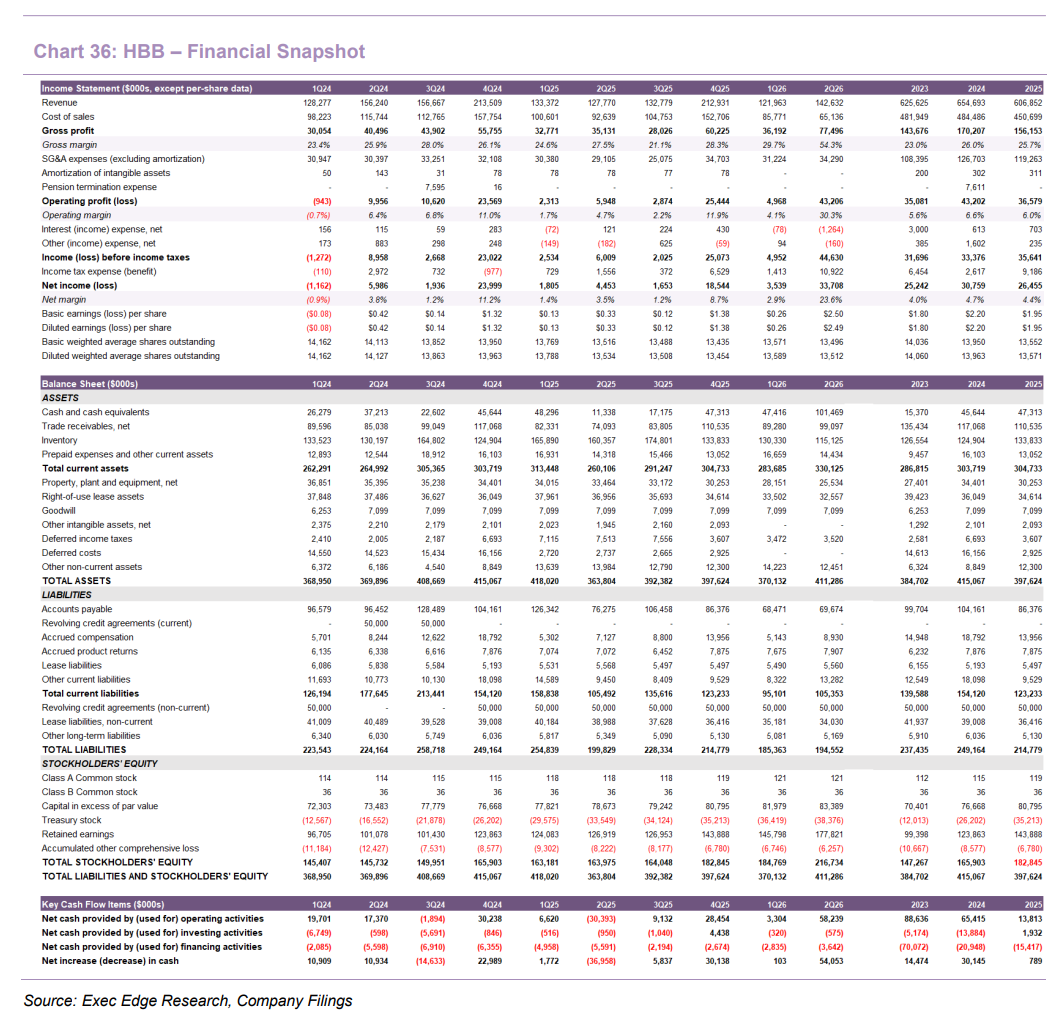
- Improving operating trends support the 2026 recovery, although reported profitability includes substantial temporary tariff benefits. HBB entered 2026 following a disrupted year in which revenue declined 7.3% to $606.9 million and operating profit fell 15.3% to $36.6 million, as tariff uncertainty caused retailers to pause purchasing and reduced U.S. consumer volumes. Performance began improving sequentially in 4Q25, when gross margin recovered to 28.3% and operating profit reached $25.4 million, followed by 29.7% gross margin in 1Q26 despite an 8.6% revenue decline. The 2Q26 results extended that recovery through higher volumes and improved underlying execution. However, the reported 54.3% gross margin, $43.2 million of operating profit and $33.7 million of net income included substantial non-recurring tariff benefits, with gross margin at 26.1% excluding those benefits. The quarter therefore provides clearer evidence of recovering retailer purchasing and consumer volumes than of a step-change in normalized profitability. The more relevant indicators are the sustainability of revenue growth, normalized gross margin and the durability of earnings as temporary tariff benefits roll off and purchasing patterns normalize.
- Beneath the headline volatility, revenue recovery is being driven by improving retailer purchasing and renewed consumer volumes. Revenue increased 11.6% y/y to $142.6 million in 2Q26, primarily because U.S. consumer volumes recovered from 2Q25, when retailers paused orders while reassessing tariffs, pricing and inventory. For 1H26, revenue increased 1.3% to $264.6 million from $261.1 million, as the second-quarter recovery offset the 8.6% decline recorded in 1Q26. Management nevertheless maintained its expectation for 2026 revenue growth to approach the mid-single-digit range, inclusive of the headwind from the expired Bartesian license. That outlook implies stronger 2H26 growth, supported by new retail placements, product launches, premium and commercial expansion and increased advertising. Improving retailer purchasing provides a stronger base from which these initiatives can contribute incremental growth. However, part of the 2Q26 increase reflects an unusually weak comparison period, making sustainable consumer sell-through more important as comparisons normalize. Retailer inventory levels, discretionary consumer demand and the revenue contribution from new placements will determine whether HBB can maintain growth after the favorable 2Q25 comparison passes.
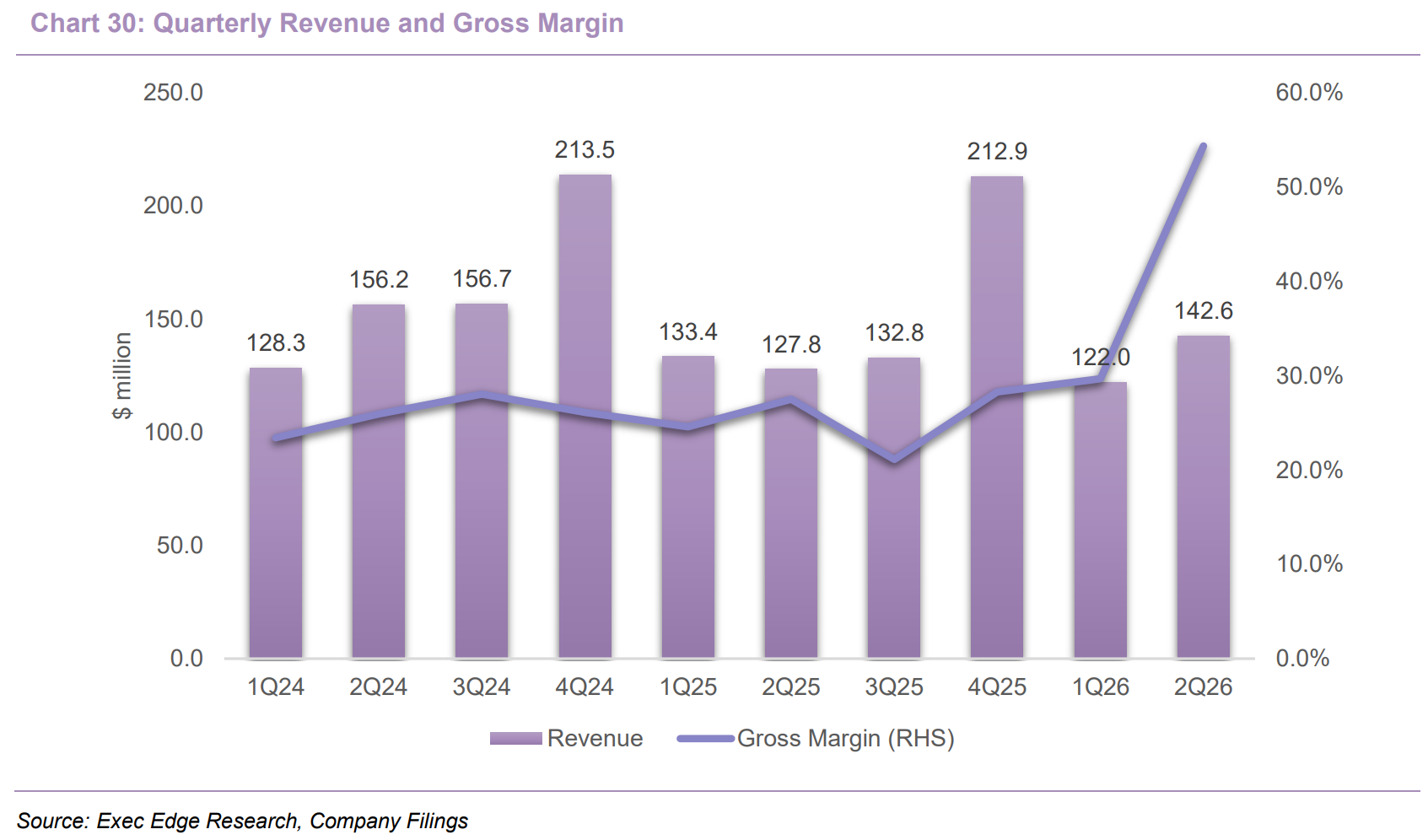
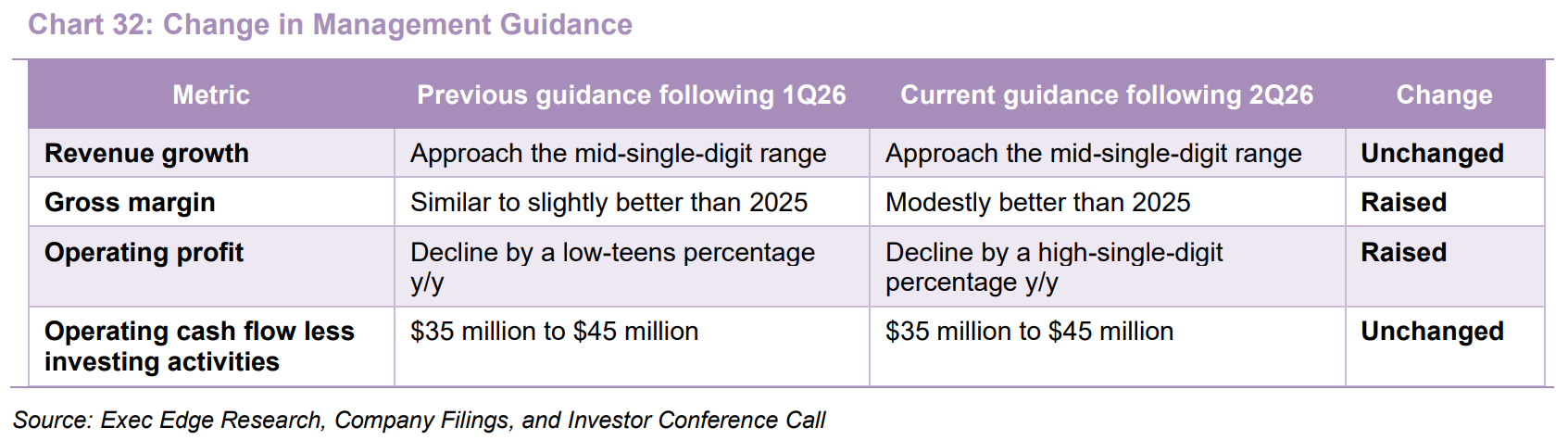
- Pricing, sourcing and mix gains supported a higher 2026 gross-margin outlook despite mixed underlying 2Q26 margins. Reported gross margin increased to 54.3% in 2Q26 from 27.5% in 2Q25, but this included a $36.5 million tariff refund and additional benefit from the sell-through of inventory no longer subject to IEEPA tariffs. Excluding both benefits, gross margin was 26.1%, below the prior-year quarter but slightly above the 25.7% reported for 2025. Management raised its 2026 gross-margin outlook from similar to slightly better than 2025 to modestly better than 2025. Pricing actions, sourcing diversification, foreign-trade-zone benefits and the increasing contribution from higher-margin Commercial and Health operations provide potential structural support. Management expects higher commodity costs and freight rates to largely offset the temporary inventory benefit in 2H26, while indicating further margin opportunities from pricing, sourcing and business mix beyond 2026. The key measure will be whether underlying margins remain above the 2025 level as temporary tariff-related benefits roll off. Sustained improvement would provide evidence that HBB is retaining the benefits of its mitigation actions and favorable business mix.
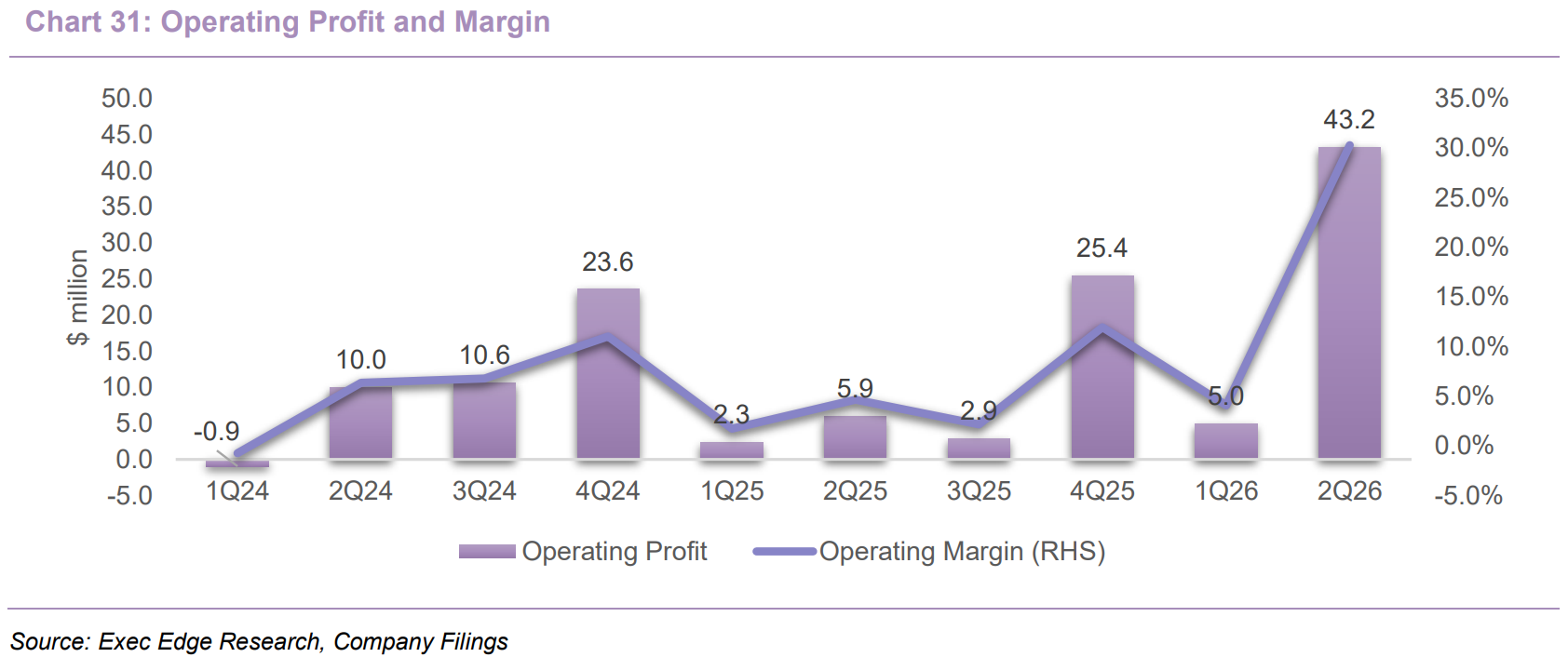
- Operating-profit guidance improved despite higher growth investment and transitional ERP expense. SG&A increased 17.5% y/y to $34.3 million in 2Q26, reflecting higher performance-based incentive expense and $1.4 million of accelerated depreciation related to HBB’s legacy ERP system. Reported operating profit rose to $43.2 million from $5.9 million, but the result included substantial non-recurring tariff benefits and management did not disclose a fully adjusted operating-profit figure. Excluding refund proceeds from guidance, HBB now expects 2026 operating profit to decline by a high-single-digit percentage, improved from the previous low-teens decline. This outlook includes approximately $6 million of incremental advertising and $6 million of accelerated ERP depreciation. The ERP expense is transitional and should eventually roll off. This creates potential operating leverage as the ERP expense normalizes, while returns on the additional marketing investment will depend on its ability to generate durable revenue growth. The incremental advertising is an intentional growth investment rather than a transitional expense, with management also planning additional brand-building programs aimed at supporting demand beyond 2026.
- Tariff-related gains elevate reported EPS well above HBB’s underlying earnings trend. Net income increased to $33.7 million, or $2.49 per diluted share, in 2Q26 from $4.5 million, or $0.33 per share, in the prior-year period. The increase largely followed the tariff refund through gross profit and operating income, while HBB also recognized $1.2 million of interest associated with the tariff refunds, contributing to $1.3 million of net interest income in 2Q26. The resulting 23.6% net margin is therefore not representative of normalized profitability. Reported operating profit, the disclosed tariff bridge and normalized tax and interest assumptions provide a cleaner basis for assessing recurring earnings. A portion of the refund is being reinvested in brand-building and marketing programs, making the return generated by that spending an important future earnings consideration.
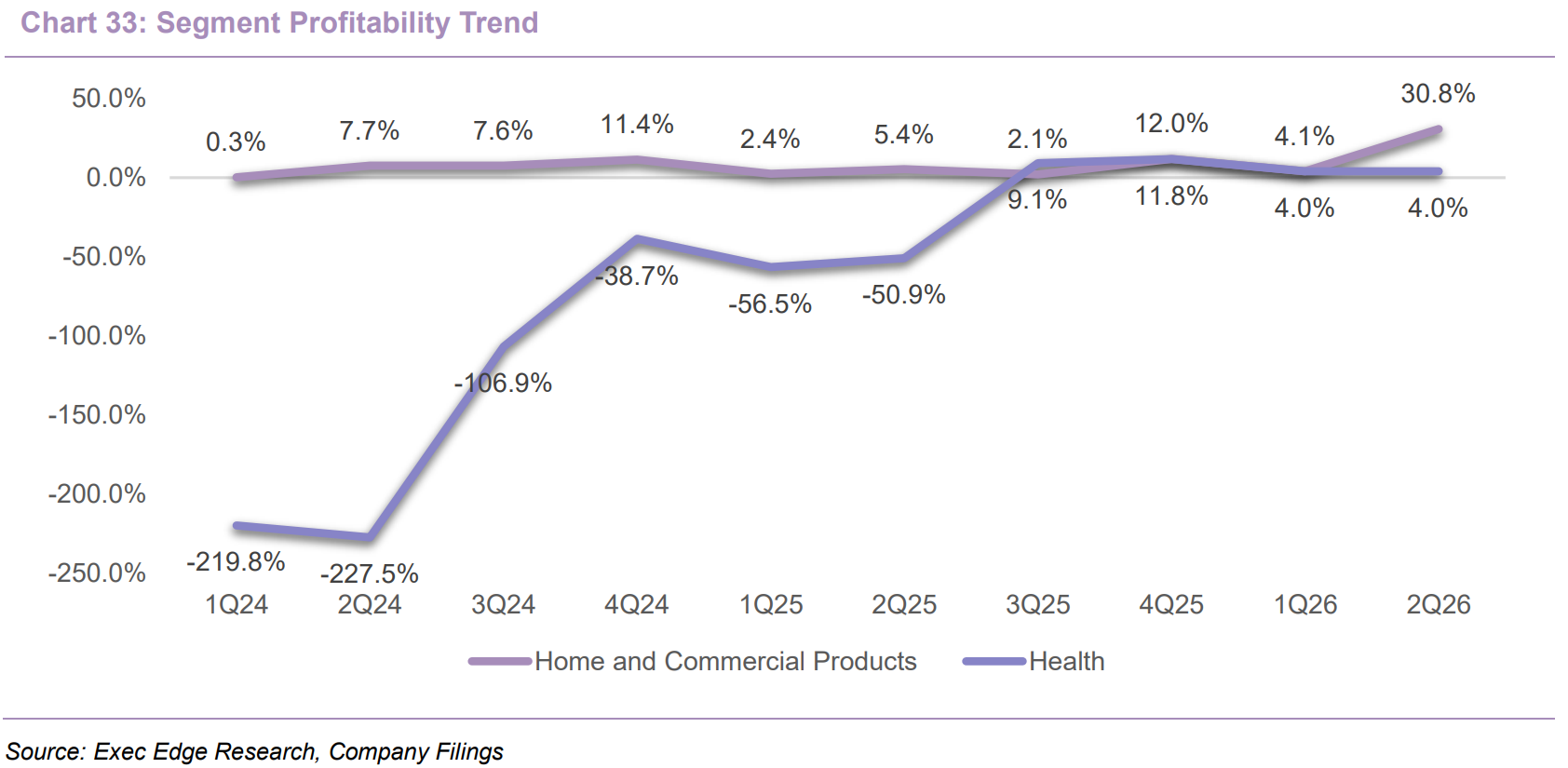
- Core recovery is driving near-term earnings, while Health is emerging as a profitable growth contributor. Home and Commercial Products generated $140.2 million of revenue in 2Q26, up 11.2% y/y, as U.S. consumer volumes recovered from the prior-year retailer purchasing pause. Segment profit increased to $43.1 million from $6.8 million, producing a 30.8% margin, although this included the quarter’s tariff-related benefits and is not representative of normalized profitability. Across 1H26, segment revenue increased only 0.7% y/y, indicating that the strong second quarter largely offset the first-quarter decline rather than establishing broad-based acceleration. Health delivered the more structural improvement, with revenue increasing 44.9% y/y to $2.5 million and segment profit reaching $0.1 million from a $0.9 million loss, marking its fourth consecutive profitable quarter. For 1H26, Health revenue increased 48.4% and segment profit improved to $0.2 million from a $1.7 million loss. Although Health represented only 1.7% of 2Q26 revenue, its growth and improving economics support a gradually more favorable business mix.
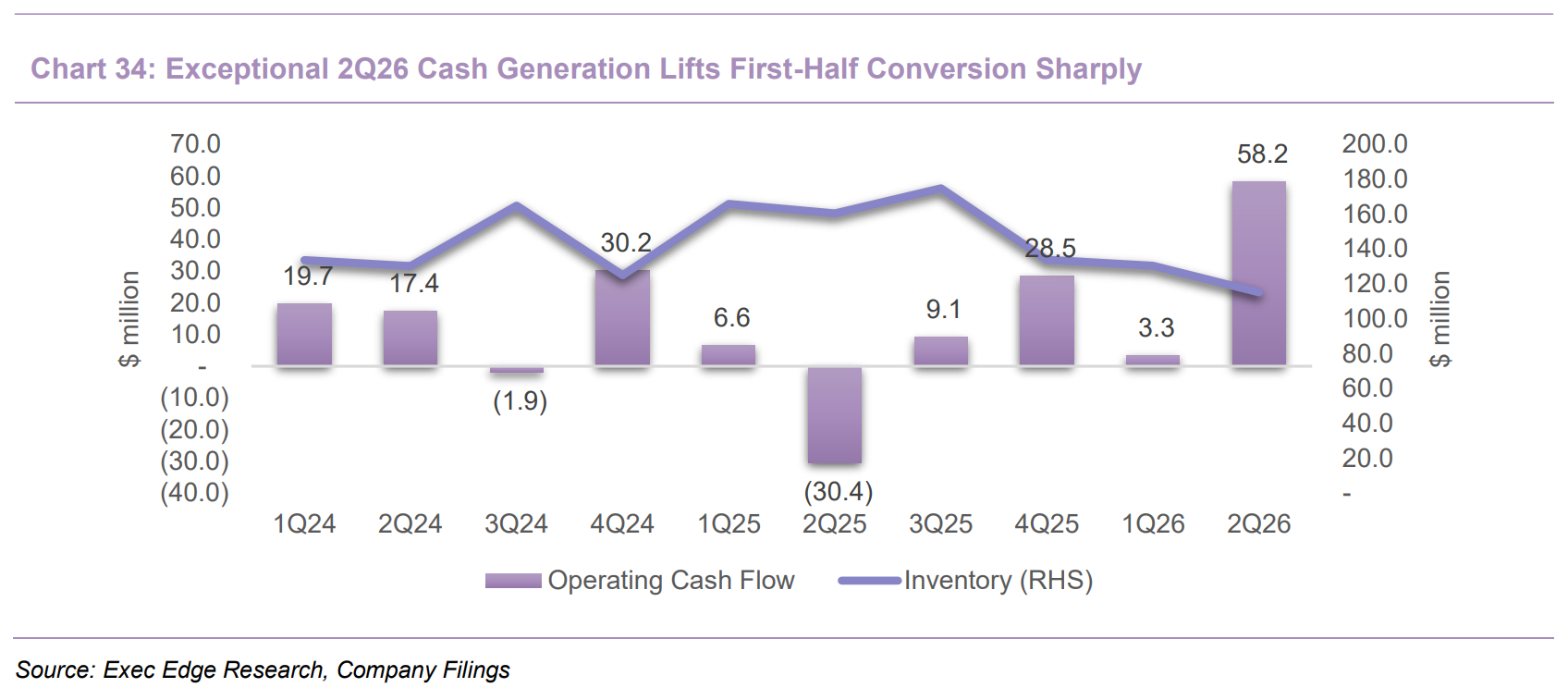
- Cash conversion improved sharply in 2Q26, supported by working-capital normalization and one-time tariff proceeds. Operating cash flow reached $58.2 million in 2Q26, lifting 1H26 generation to $61.5 million from a $23.8 million outflow in 1H25. The improvement reflected the tariff refund and lower working capital, with inventory declining to $115.1 million at quarter-end from $160.4 million a year earlier. Capex remained modest, leaving 1H26 operating cash flow less investing activities at approximately $60.6 million.
- Management retained its 2026 guidance of $35 million to $45 million for operating cash flow less investing activities, underscoring that first-half cash generation benefited from non-recurring and timing-related factors. Sustainable conversion will depend on maintaining leaner working capital without constraining service levels.
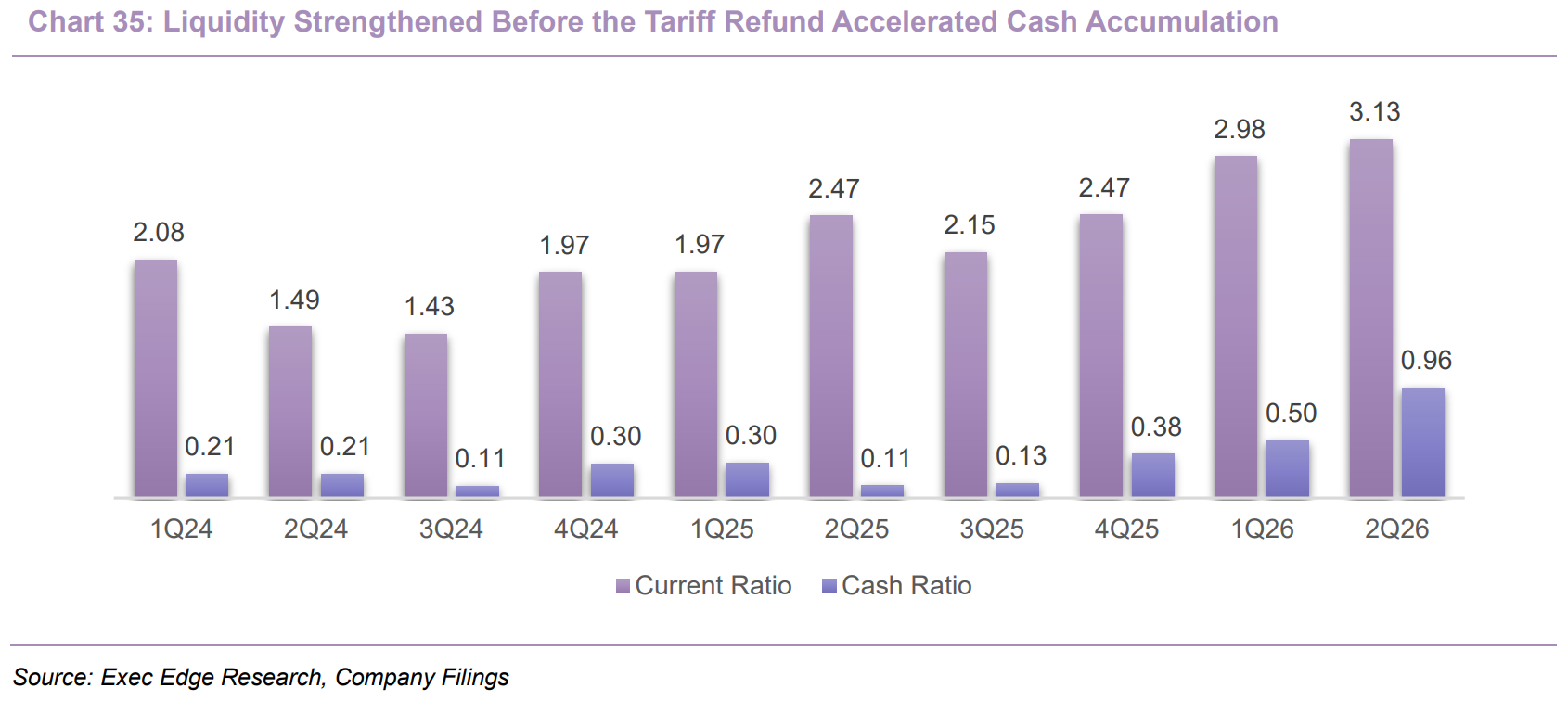
- The resulting net-cash position materially strengthens financial flexibility and increases the importance of disciplined capital allocation. Cash increased to $101.5 million at June 30, 2026 from $11.3 million a year earlier, while debt remained $50.0 million, moving HBB from $38.7 million of net debt to $51.5 million of net cash. Liquidity is consequently ample, with a 3.13x current ratio, although this measure is temporarily elevated by the tariff-refund proceeds. HBB allocated $2.0 million to share repurchases and $1.7 million to dividends during 2Q26, retaining most of the incremental liquidity. Management indicated that its capital-allocation philosophy remains unchanged and balances shareholder returns with investments intended to increase long-term growth and EPS. The stronger balance sheet provides greater flexibility to fund organic growth, strategic investments or acquisitions while continuing shareholder returns. Capital allocation now becomes a more important component of the investment case, with value creation dependent on the returns generated from retained cash and any incremental deployment.
Recent Re-Rating Narrows the Gap, but Valuation Discount Leaves Further Upside
- Disclaimer: Exec Edge does not publish proprietary estimates, ratings, price targets, or investment recommendations. The valuation discussion below is illustrative only and is based on company filings, management commentary, and third-party data and estimates. It does not constitute a recommendation, price target, rating, or prediction of future pricing.
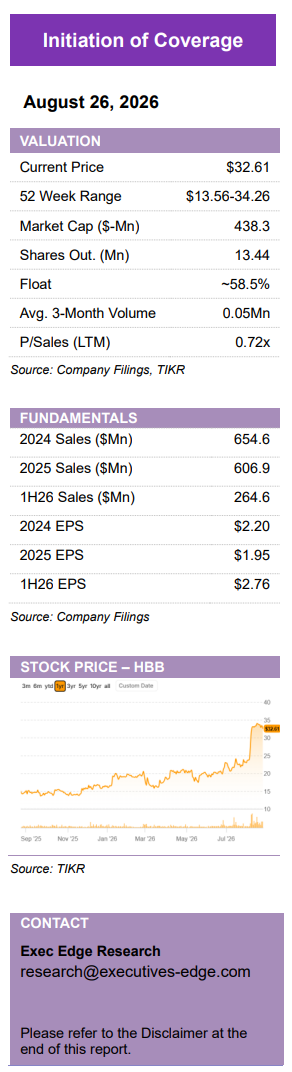
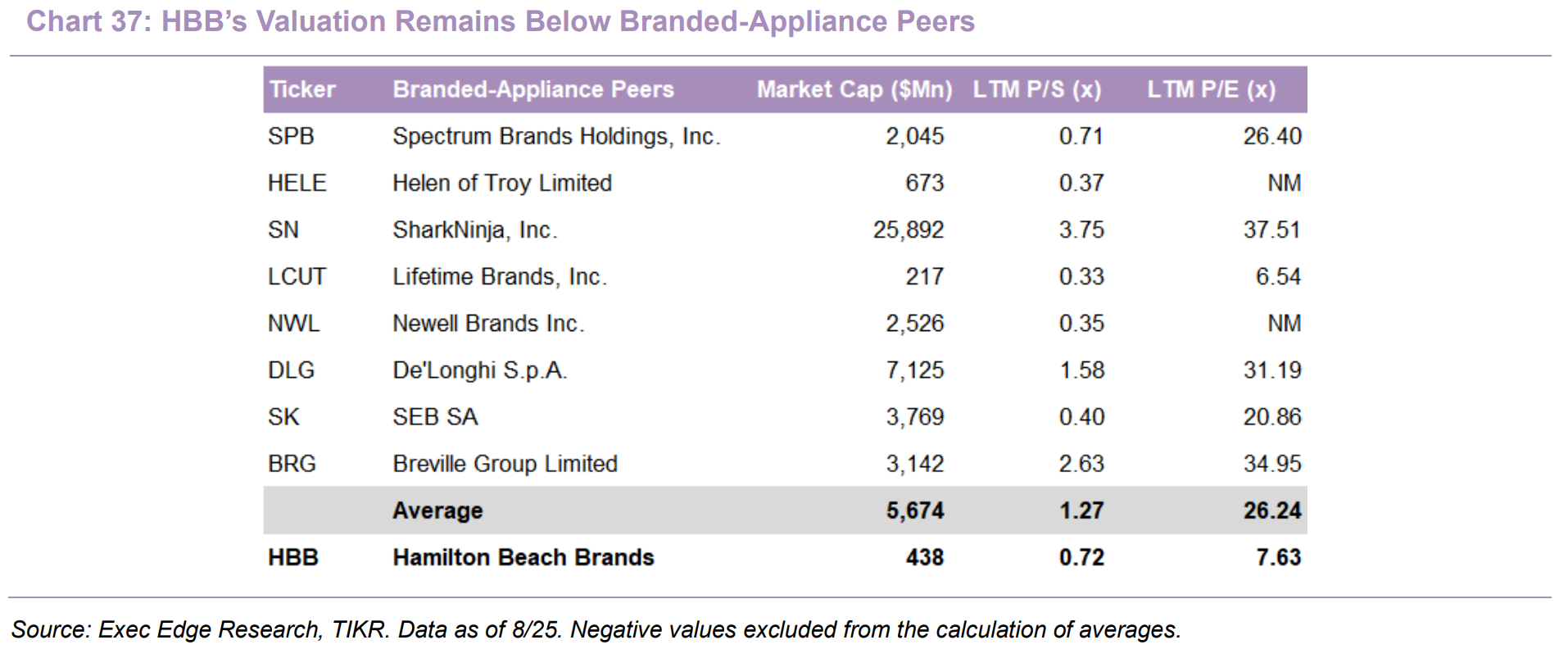
- HBB’s recent re-rating reflects improving fundamentals, although a meaningful valuation discount to branded-appliance peers remains. The recent share-price re-rating reflects recovering U.S. Consumer volumes, improved 2026 margin and operating-profit guidance, and a materially stronger balance sheet. Even after this move, HBB trades at 0.72x LTM P/S versus a 1.27x average across a peer group spanning Spectrum Brands, Helen of Troy, SharkNinja, Lifetime Brands, Newell Brands, De’Longhi, SEB and Breville, representing an approximately 43% discount. The peer group contains meaningful differences in scale, growth, margins and product mix, particularly among higher-growth premium businesses, so full convergence should not be assumed. However, the remaining discount leaves room for further re-rating if HBB demonstrates that the current recovery can translate into sustainable revenue growth, better normalized margins and an increasing contribution from Premium, Commercial and Health.
- P/S provides the cleanest relative valuation framework while HBB’s reported earnings remain affected by unusual tariff-related benefits. Applying the peer-average 1.27x LTM P/S multiple to HBB’s approximately $610.3 million of LTM revenue would imply an illustrative equity value of approximately $772 million, or roughly $57 per share. This represents a full-convergence reference rather than a price target or base-case assumption, given the differences in growth, scale and profitability across the peer set. Importantly, the framework does not require full convergence to support additional upside. Continued progress against HBB’s growth strategy, sustained consumer sell-through, improving business mix and disciplined deployment of its net-cash position could support gradual narrowing of the current P/S discount over time.
- Reported P/E also indicates a substantial peer discount, but it is a less reliable valuation anchor at this stage. HBB trades at 7.63x LTM P/E versus a 26.24x peer average, a 71% discount. However, HBB’s LTM earnings include the $36.5 million tariff refund, related interest income and inventory sell-through benefits. We therefore view P/E as a useful relative reference but place greater weight on P/S until a normalized recurring earnings base is established.
- Further re-rating now depends on HBB converting improving fundamentals into a more durable growth and earnings profile. Sustained consumer sell-through, continued progress in Commercial and Health, improving normalized gross margins and measurable returns on incremental growth investment would support further narrowing of the peer discount. Conversely, weaker demand, renewed retailer inventory pressure or margin slippage would limit the case for additional multiple expansion. The remaining valuation opportunity therefore rests less on recovery from depressed conditions and more on proving that HBB can sustain better growth, margins and cash generation through the next phase of execution.
Technical Analysis
Volume-backed Breakout Strengthens Trend; Overbought Conditions Raise Pullback Risk
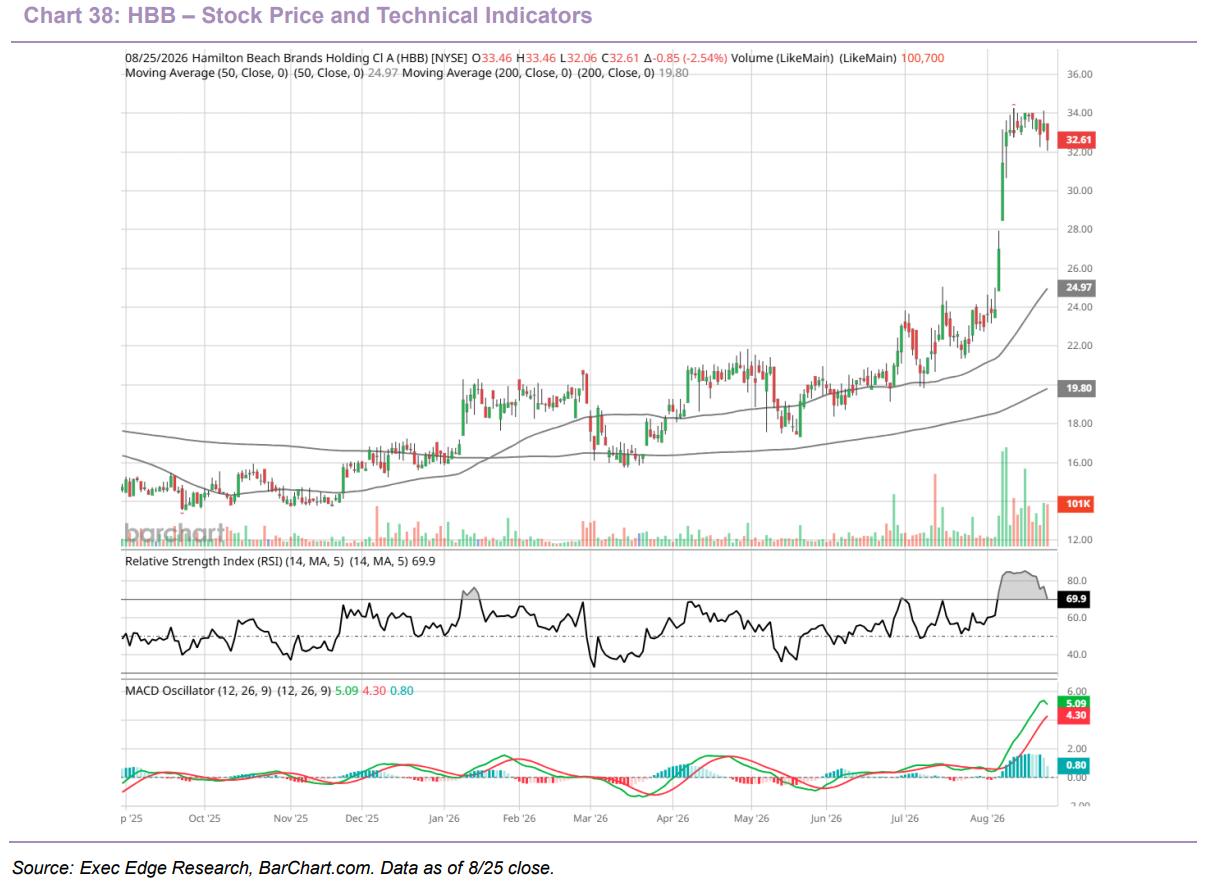
- HBB’s daily chart confirms a powerful breakout, although overbought weekly momentum increases near-term consolidation risk. The shares closed at $32.61 on August 25 and traded 30.6% above the 50-day moving average of $24.97 and 64.7% above the 200-day moving average of $19.80, with both moving averages rising. On the weekly chart, HBB has delivered a higher-high and higher-low price pattern for most weeks since mid-May. This indicates strong positive momentum and shows that the stock has largely retained its gains as it has moved higher. The moving-average alignment and price pattern reinforce the medium-term uptrend. HBB broke above July resistance near $24-$25 and surged into the $32-$34 area during August. Heavy breakout volume provided price-and-volume confirmation. Daily momentum remains positive but has moderated: the RSI has declined to 69.9, marginally below the 70 overbought threshold, while the MACD line of 5.09 remains above its 4.30 signal line. The positive 0.80 histogram indicates continuing upside momentum, although its recent narrowing suggests some loss of acceleration. Weekly indicators confirm the underlying strength but continue to show that the move is extended: weekly RSI has eased to 76.5 but remains above the overbought threshold, while the weekly MACD line of 3.43 is above its 1.72 signal line and has produced a positive 1.71 histogram. These readings do not reverse the bullish trend, but they increase the probability of consolidation or a pullback before another advance. Repeated August peaks around $34.00-$34.50 establish immediate resistance; a decisive close above this zone, preferably with renewed volume, could open a move toward the $35 and $36 levels. Initial support sits near $32.00-$32.50, followed by $31.00 and the breakout-day low near $28.50.
Ownership
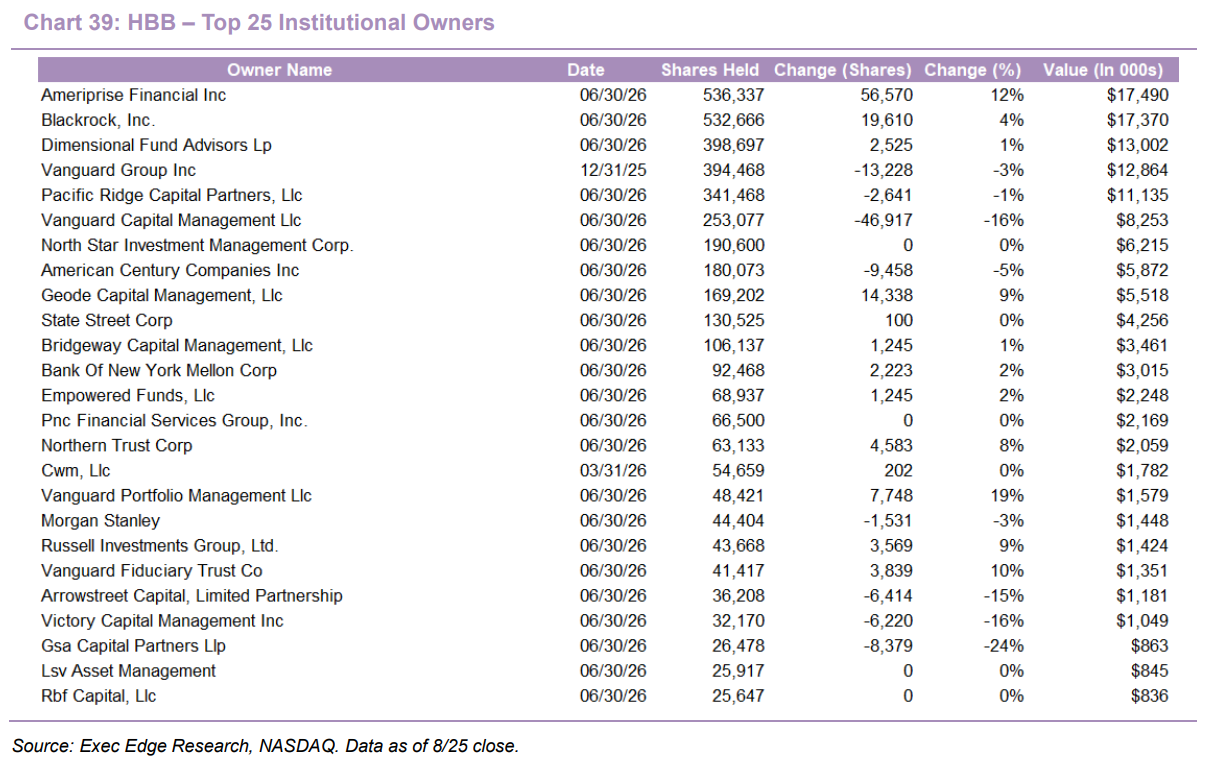
Top 25 Institutional Owners
Risks
- Customer concentration. HBB sells primarily through mass merchandisers, ecommerce retailers, department stores and warehouse clubs, and its five largest customers accounted for approximately 62% of 2025 revenue. Insolvency, bankruptcy, order reductions or a work stoppage at any key customer could disrupt sales and leave the company unable to find alternative distribution outlets on comparable terms. Continued retail consolidation increases customers’ bargaining strength and pricing pressure, while private-label competition from larger retailers adds further margin risk. Customer retention, order cadence and channel diversification remain central to revenue stability.
- Competitive intensity. HBB competes against numerous branded and private-label small-appliance manufacturers and must continually enhance existing products and launch new ones that meet evolving consumer needs. Rapid technological change, including AI-enabled shopping and discovery, and shifting distribution channels could erode market share if HBB fails to keep pace. Consumer spending is also seasonal, typically peaking in the fourth quarter, concentrating demand risk around a narrow window. Innovation execution, channel investment and holiday-season performance will therefore remain key indicators of competitive positioning.
- Distribution center concentration. HBB operates only one distribution center per region, so a disruption from severe weather, natural disaster, labor shortage, equipment failure or cybersecurity incident at any single facility could cause significant delays or lost sales. Alternative facilities with sufficient capacity may not be readily available, may cost substantially more, or may take considerable time to become operational. While business continuity plans are in place, an extended outage could still impose material revenue loss and incremental cost to restore full capacity. Facility resilience and continuity planning are therefore important to sustaining consistent order fulfillment.
- Supplier concentration. HBB depends on third-party suppliers for substantially all of its products and generally operates on a purchase-order basis without long-term manufacturing contracts. The company sourced inventory from approximately 70 suppliers in 2025, with one supplier accounting for more than 10% of purchases. Supplier loss or disruption could therefore affect product availability, lead times and costs until alternative arrangements are secured. HBB has broadened its sourcing base across Asia-Pacific, but supplier qualification, production transfers and quality-control requirements can limit how quickly sourcing can be shifted.
- Tariff and trade-policy exposure. HBB’s global sourcing model leaves the company exposed to changes in U.S. tariffs and broader trade policy, particularly given that a majority of finished products were sourced from China in 2025. Tariff actions in 2025 materially increased product costs and disrupted retailer purchasing patterns, although the IEEPA tariffs were subsequently invalidated and HBB received related refunds in 2026. Future tariffs, changes in country-specific trade treatment or shifts in customs policy could again pressure costs, pricing and demand. HBB has responded through sourcing diversification, pricing actions and use of its Byhalia foreign-trade zone, but these measures may not fully offset future trade-policy changes.
- Product liability. HBB faces product-liability, warranty and recall exposure across household, commercial and connected-health products. A design defect, manufacturing failure or inadequate warning could require corrective action, disrupt retailer relationships and increase legal, remediation and insurance costs. Because HBB outsources substantially all manufacturing, quality control depends on effective supplier oversight as well as internal testing and assurance. A material incident could also damage the Hamilton Beach brand and licensed-brand relationships, reducing sell-through beyond the affected product. HBB’s quality systems mitigate but cannot eliminate this risk.
- Family voting control. HBB’s dual-class structure gives Class B Common ten votes per share versus one vote for Class A Common. As of the March 9, 2026 record date, Alfred M. Rankin, Jr., Thomas T. Rankin, J.C. Butler, Jr. and Clara R. Williams, all members of or related to the Rankin family, beneficially owned approximately 14.4% of Class A Common and 90.3% of Class B Common, representing approximately 73.8% of total voting power. This concentration limits minority shareholders’ influence over governance and major corporate actions independent of operating performance.
- Growth-adjacency execution. HBB’s longer-term growth and mix-improvement strategy depends partly on scaling Premium, Commercial and Health from relatively small bases. Slower retailer adoption of Lotus and CHI, delays in converting Commercial trials into broader chain programs, or slower expansion of healthcare partnerships could limit the contribution from these higher-value businesses and leave HBB more dependent on its mature core consumer franchise. Health also introduces additional regulatory, device-performance and partner-adoption requirements that can make rollout timing less predictable. Successful execution across these adjacencies will be important to sustaining growth and improving portfolio mix.
Subscribe to our Weekly Newsletter to Receive All Research
Contact: