Download the Complete Report Here
Horizon Quantum Holdings Ltd. (HQ)
Triple Alpha Progress and Expanding Hardware Ecosystem Reinforce HQ’s Quantum Software Infrastructure Strategy.
- Key Takeaways:
- First quarter as a public company reinforced HQ’s positioning as a differentiated quantum software infrastructure platform centered around Triple Alpha and hardware-agnostic orchestration.
- Triple Alpha and Beryllium continued advancing toward higher-level quantum abstraction, while Ember-1 strengthened HQ’s real-time software-hardware integration capabilities.
- Partnerships with IonQ, Alice & Bob, and AQT materially expand HQ’s multimodal ecosystem exposure across trapped-ion, superconducting, and fault-tolerant architectures.
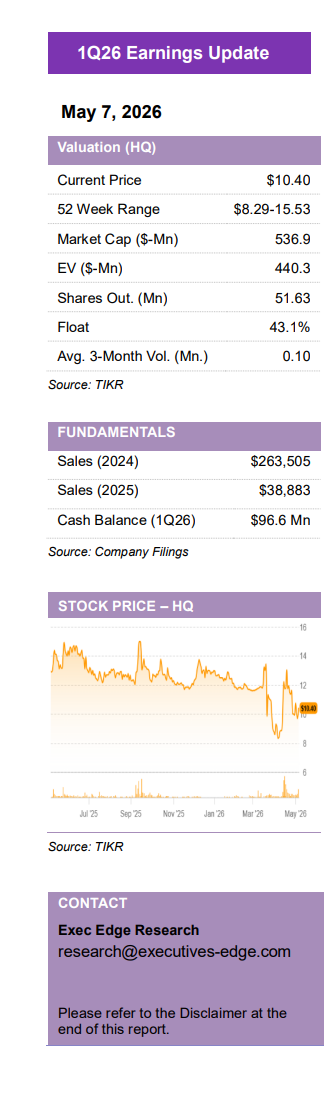
- Exited 1Q26 with $96.6 million in cash following the de-SPAC transaction, providing runway to scale R&D, hardware integration, and commercialization efforts.
- Differentiated small-cap quantum software infrastructure pure play trading at a meaningful discount to larger publicly traded quantum peers.
- First quarterly earnings report as a public company reinforced HQ’s positioning as a long-duration quantum software infrastructure platform. During the quarter, the company completed its de-SPAC transaction with dMY Squared Technology Group, with the combined entity beginning trading on Nasdaq on March 20, 2026, under the ticker HQ.
- Following the transaction, quarter-end cash balance increased significantly to $96.6 million from $0.2 million at year-end 2025, supported by approximately $98.2 million in net proceeds. The strengthened balance sheet provides meaningful financial runway to accelerate R&D initiatives, expand hardware integration efforts, and further advance the Triple Alpha platform. These developments come at a time when rapid advancements in quantum computing hardware, alongside breakthroughs in error correction, suggest the industry is approaching a key inflection point, with quantum advantage drawing increasingly closer.
- Triple Alpha remains central to HQ’s strategy of building higher-level software abstractions capable of accelerating broader quantum computing adoption. The company’s software stack progresses through multiple abstraction layers beginning with Hydrogen, a portable quantum assembly language designed to function across future hardware architectures, followed by Helium, an imperative quantum programming language supporting more advanced runtime capabilities, and ultimately Beryllium, an object-oriented quantum programming language intended to abstract away much of the underlying quantum mechanics from developers. Strategically, Beryllium enables code reuse, object-oriented design, and reusable software libraries that could create network effects across the quantum developer ecosystem over time. Importantly, the long-term objective extends beyond improving quantum programming efficiency and instead centers on automating the acceleration of classical code on quantum systems.
- Beryllium development and deeper hardware integration advance Triple Alpha’s commercial readiness. During the quarter, HQ continued advancing Beryllium toward a more feature-complete development environment while simultaneously strengthening interoperability with underlying quantum infrastructure. The company’s focus on higher-level software tooling and runtime integration increasingly resembles modern accelerated computing frameworks, where developers can leverage advanced computing infrastructure without directly interacting with low-level hardware architecture. Over time, continued improvements in usability, abstraction, and runtime orchestration could materially expand the addressable developer ecosystem and accelerate broader enterprise adoption.
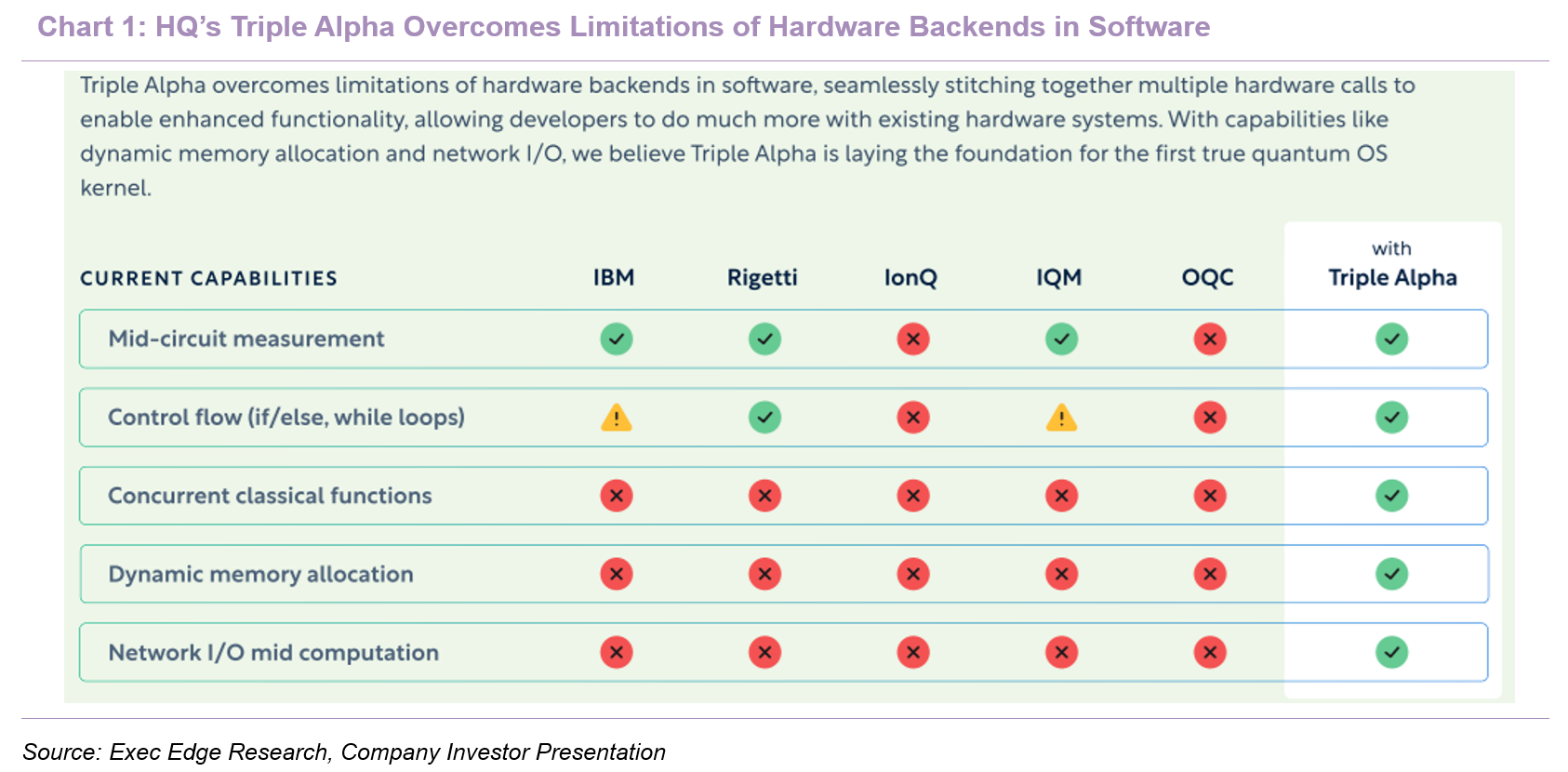
- Ember-1 launch marks a strategic shift toward in-house hardware integration, enabling deeper software-hardware optimization and faster capability development. In January, HQ held the inauguration of its first quantum computer Ember-1, located at its Singapore headquarters. The system is based on a Rigetti Novera 9-qubit superconducting processor, Quantum Machines’ OPX1000 control electronics, and a dilution refrigerator assembled internally by HQ. The launch positions HQ as what appears to be the first quantum-focused software company operating its own quantum hardware stack rather than relying exclusively on third-party cloud access. Strategically, direct hardware ownership allows the company to bypass external software layers and cloud APIs, enabling tighter integration between Triple Alpha and underlying control systems while accelerating development of real-time execution infrastructure, pulse-level programming, and runtime orchestration capabilities.
- IonQ partnership materially strengthens HQ’s multimodal infrastructure strategy and expands the company’s exposure to potentially commercially relevant quantum workloads. In April 2026, HQ announced a strategic agreement with IonQ that includes the planned deployment of a 256-qubit trapped-ion quantum system expected to be installed during calendar 2027. The anticipated scale and fidelity of the system could position HQ closer to practical quantum advantage in select chemistry-related workloads, while significantly accelerating the company’s multimodal testbed roadmap. The company also highlighted this as a major one-off capital expenditure, with more normalized CapEx expected outside of this, and noted that the investment decision was made in the context of overall cash usage and potential funding support from various jurisdictions. Strategically, the addition of the IonQ system expands HQ’s capabilities beyond superconducting architectures into atom-based systems while strengthening its positioning as one of the few organizations globally operating commercial quantum systems across multiple modalities. Direct access to both solid-state and trapped-ion architectures should also improve Triple Alpha’s ability to function as a genuinely hardware-agnostic orchestration layer capable of supporting multiple future quantum computing architectures.
- Partnerships with Alice & Bob and AQT further strengthen the company’s positioning as a hardware-agnostic quantum software infrastructure platform rather than a company tied to a single computing architecture. In January 2026, HQ announced a collaboration with Alice & Bob focused on integrating cat-qubit emulators with Triple Alpha to streamline development of fault-tolerant quantum software, while the partnership with AQT in April 2026 is designed to integrate Triple Alpha with trapped-ion processors and simulators. Strategically, these relationships expand HQ’s exposure across multiple competing hardware modalities and reinforce the company’s broader objective of positioning Triple Alpha as a universal orchestration and development layer capable of supporting whichever architectures ultimately emerge as leaders in fault-tolerant quantum computing. HQ currently tracks ~40 leading quantum hardware manufacturers globally and continues prioritizing collaborations where its software stack can materially improve programmability and application complexity.
- Deep bench of proven technology, finance, and public company leadership strengthens governance and execution oversight. HQ has significantly strengthened both its board and executive leadership team with experienced industry veterans spanning technology, finance, legal, and large-scale organizational development.
- Danielle Lambert brings deep expertise in talent building from her time as VP of Human Resources at Apple, where she helped scale teams behind flagship products such as the iPod, iPhone, iPad, and Apple Retail, and later played a key role in founding Nest Labs prior to its acquisition by Alphabet.
- Peter Oey, currently CFO of Grab, adds strong financial and public market experience, having previously served as CFO of LegalZoom ahead of its IPO and CFO of MyLife, along with earlier leadership roles at Activision Blizzard.
- Jill Turner contributes over two decades of global HR leadership across Fortune 500 technology companies, currently serving as CHRO of Broadcom and previously holding senior roles at Honeywell and Lumen Technologies (formerly CenturyLink).
- Harry You brings extensive public company and capital markets expertise as a board member at Broadcom, former lead independent director at IonQ, and former CFO at Accenture and Oracle, in addition to serving as EVP at EMC.
- HQ also appointed Catherine Fitzsimons as Chief Legal Officer, adding additional legal, governance, and organizational oversight capabilities as the company transitions into its next phase as a publicly traded quantum infrastructure platform.
- Collectively, the depth of experience across technology scaling, public company operations, capital markets, and organizational leadership provides HQ with increasingly robust governance and execution oversight as it advances its long-term roadmap.
- Go-to-market centers on usage-based cloud monetization and hardware-linked on-prem licensing, positioning Triple Alpha as a runtime-driven infrastructure model. Revenue generation is expected to occur primarily through two channels: cloud access and on-prem deployment. For cloud, applications built using Triple Alpha would run through its proprietary stack, enabling a usage-based pricing model similar to API-driven platforms like AWS, where revenue scales alongside compute consumption and delivered application value. For on-prem systems, pricing is expected to follow a licensing model tied to underlying hardware capabilities, resembling enterprise infrastructure software models such as Windows Server or VMware. Near-term efforts remain focused on deep integration with hardware providers and continued advancement of the technology stack, with monetization expected to scale alongside broader quantum advantage and real-world application adoption.
- Platform aims to abstract quantum complexity, enabling broader enterprise adoption without requiring specialized quantum expertise. HQ is focused on automating the acceleration of classical workloads onto quantum systems through higher-level programming abstractions built into languages such as Beryllium. By embedding quantum acceleration within reusable software libraries and runtime infrastructure, the platform allows developers to leverage quantum computing capabilities without directly interacting with low-level quantum mechanics. Strategically, this approach addresses key bottlenecks around developer accessibility, scalability, and knowledge transfer that could otherwise constrain broader quantum adoption.
- Early enterprise engagement appears concentrated in computationally intensive industries where quantum acceleration could eventually create meaningful economic value. HQ disclosed that inbound requests for early access to Triple Alpha are currently concentrated across financial services, pharmaceuticals and chemistry, energy, automotive, aerospace and defense, and broader large technology companies. The company also highlighted use cases ranging from energy trading and machine learning-based geological modeling to materials science, photovoltaics, and computational chemistry. While commercialization remains early-stage, the breadth of inbound interest reinforces the view that software abstraction and developer accessibility could become increasingly important as quantum hardware capabilities improve and commercial adoption expands over time.
- Strong inbound ecosystem engagement and accelerated hiring activity suggest the company is scaling from a research-led organization toward a broader platform execution phase. HQ ended the quarter with 52 full-time employees compared to 29 a year ago, representing 79% y/y headcount growth and an 18% sequential increase from 4Q25. Scientists, engineers, and technical personnel continued representing approximately 60%-80% of total staffing, reinforcing the company’s strong R&D orientation. Inbound hardware ecosystem interest currently appears to exceed the company’s existing engineering capacity, supporting the aggressive hiring undertaken over the past year.
- Improving hardware scalability and advances in error correction increasingly shift the quantum computing bottleneck toward software abstraction and orchestration. HQ continues positioning Triple Alpha around the view that long-term quantum adoption will depend not only on better hardware, but on software infrastructure capable of automating algorithm generation and abstracting away quantum complexity from developers. Current quantum systems remain early-stage and limited in capability, with most architectures still lacking features such as dynamic execution and modern runtime flexibility. However, rapid progress in hardware scalability, multi-round error correction, and fault-tolerant architectures increasingly supports the view that software orchestration, developer accessibility, and runtime integration could emerge as key competitive differentiators as the industry matures.
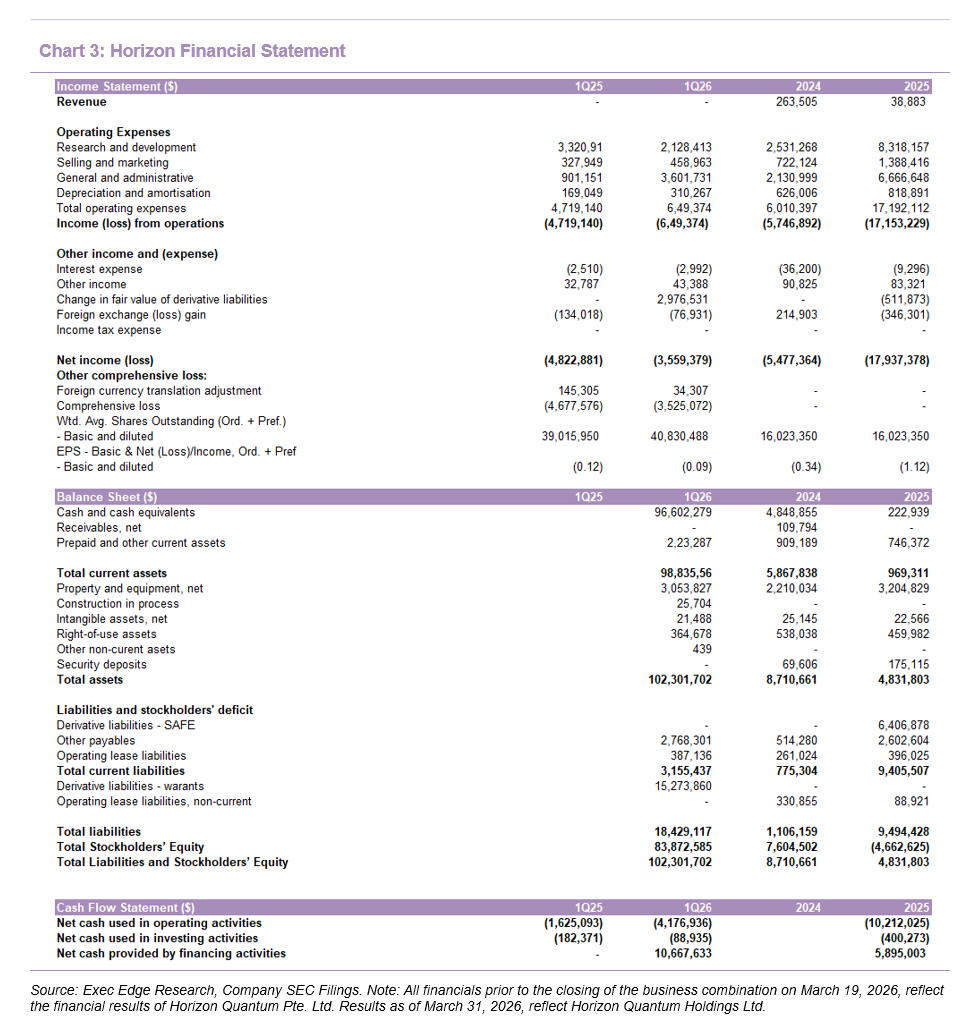
- Financially, the quarter reflected the expected profile of a newly public, development-stage quantum infrastructure company aggressively investing in R&D, ecosystem integration, and public company readiness. Total operating expenses increased to $6.5 million in 1Q26 from $4.7 million in 1Q25, the widening loss was largely due to hiring, primarily for science and engineering teams. Headline R&D expense declined 36% y/y to $2.1 million primarily due to a large one-time stock compensation catch-up adjustment in the prior-year period; however, excluding that adjustment, underlying R&D expenses increased approximately 135% y/y driven largely by doubling the science and engineering headcount alongside incremental hardware testbed costs. Sales and marketing expense increased 40% y/y to $0.46 million, while G&A increased 300% to $3.6 million from $0.9 million in prior year period, reflecting higher headcount, systems implementation, and one-time costs associated with becoming a public company.
- Widening operating losses reflect continued investment in talent, while net loss narrows due to non-cash gains from balance sheet revaluations post de-SPAC. Operating loss increased to $6.5 million from $4.7 million y/y, primarily driven by higher hiring across the organization. However, net loss improved to $3.6 million ($0.09/share) versus $4.8 million ($0.12/share) last year, supported by a $3.0 million non-cash gain. This was largely due to a $5.3 million gain from the fair value remeasurement of warrant liabilities, partially offset by a $2.3 million loss related to SAFE liability reassessment and settlement upon conversion into equity. The warrant gain was driven by a 35% decline in share price between March 19 and March 31.
- Adjusted EBITDA reflects continued investment in platform development and organizational scaling. EBITDA loss improved to $3.3 million from $4.7 million y/y; however, adjusted EBITDA loss widened to $4.1 million from $1.8 million, primarily driven by increased hiring and ongoing investment in science and engineering capabilities. Management indicated that the majority of planned hiring has already been completed, with only modest additions expected going forward, suggesting adjusted EBITDA losses should remain broadly in line with 1Q levels in the near term before stabilizing.
- The de-SPAC transaction has materially strengthened HQ’s balance sheet and provides meaningful flexibility to fund its long-term software and hardware integration roadmap. HQ ended 1Q26 with $96.6 million in cash and equivalents compared to just $0.2 million at year-end 2025, driven primarily by approximately $98.2 million in net proceeds associated with the PIPE financing and de-SPAC transaction. Net cash used in operating activities during the quarter totaled $4.2 million compared to $1.6 million a year earlier, reflecting accelerated hiring and infrastructure expansion. Despite planned investments in its multimodal testbed strategy, HQ still appears structurally more capital-light than hardware-centric quantum peers given its software-focused business model. While deployment of the IonQ trapped-ion system represents a significant future capital expenditure, the majority of costs associated with the initial Ember-1 system have already been incurred, with the company also evaluating available support programs and refundable R&D tax credits to partially offset future investments.
- Strong financing inflows post de-SPAC materially improved liquidity and provide meaningful runway for continued platform investment. Net cash from financing activities totaled $101 million in 1Q26, driven primarily by PIPE proceeds and the business combination with dMY, alongside a smaller contribution from SAFE issuances prior to closing. With most transaction-related expenses now paid, the company appears well-capitalized to support ongoing R&D investment, hardware integration initiatives, and broader execution against its long-term roadmap.
- Prior testbed CapEx largely behind the company, with only minor residual payments remaining. Management indicated that most of the capital expenditure related to the Rigetti-based system was incurred over the past few years, with only a small remaining payment (primarily for the dilution refrigerator) still due, suggesting that the bulk of this investment is now largely behind the company.
Small Cap Software Infrastructure Pure Play in Quantum Computing
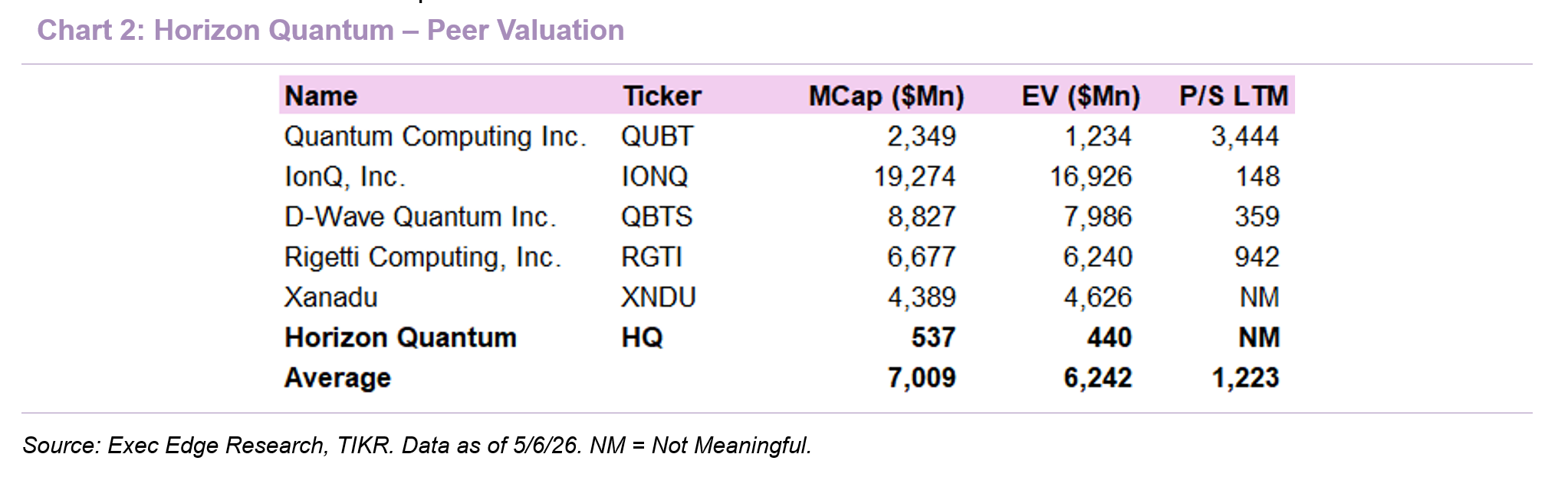
- HQ appears increasingly differentiated as one of the few publicly traded quantum companies focused primarily on software infrastructure and orchestration rather than proprietary hardware commercialization. Please note that the following analysis is for illustrative purposes only and is not meant to constitute a stock recommendation, price target, or buy/sell/hold recommendation.
- Unlike most publicly traded quantum companies that remain heavily tied to proprietary hardware development, HQ is positioning itself as a hardware-agnostic software infrastructure layer designed to operate across multiple future quantum computing architectures. As the broader industry progresses toward higher qubit counts, improved error correction, and eventual fault tolerance, software abstraction, runtime orchestration, and developer accessibility could emerge as increasingly important bottlenecks to large-scale adoption. In that context, HQ’s focus on building higher-level orchestration and execution infrastructure through Triple Alpha potentially positions the company within a differentiated and strategically valuable layer of the quantum computing stack.
- The company’s positioning is further strengthened by its expanding multimodal hardware ecosystem, including partnerships with IonQ, Alice & Bob, and AQT alongside the launch of its internally operated Ember-1 system. Rather than competing directly in the increasingly capital-intensive race to commercialize quantum hardware, the company is building software infrastructure intended to function across superconducting, trapped-ion, and potentially future fault-tolerant architectures. Following the de-SPAC transaction, HQ exited 1Q26 with approximately $96.6 million in cash, providing meaningful flexibility to continue scaling Triple Alpha, deepen hardware integration, and expand its long-term commercialization roadmap.
- Despite its differentiated software-centric positioning and expanding ecosystem integration, HQ continues to trade at a meaningful discount to several publicly traded quantum peers on a market capitalization basis, which could support incremental re-rating potential over time as the company continues executing against its infrastructure strategy and the broader market increasingly differentiates between hardware manufacturers and software infrastructure providers.
Download the Complete Report Here
Read Exec Edge’s Initiation on Horizon Quantum Here
Subscribe to our Weekly Newsletter to Receive All Research
Contact: