By Exec Edge Editorial Staff
The Offshore Technology Conference in Houston is where the global offshore energy industry takes stock of itself — where companies stake claims, signal ambitions, and compete for the attention of the developers, financiers and procurement officers who control the next generation of projects. Around the OTC 2026 event earlier this month, Wison New Energies marked three achievements that, taken together, describe a company that has spent a decade and a half building toward this moment.
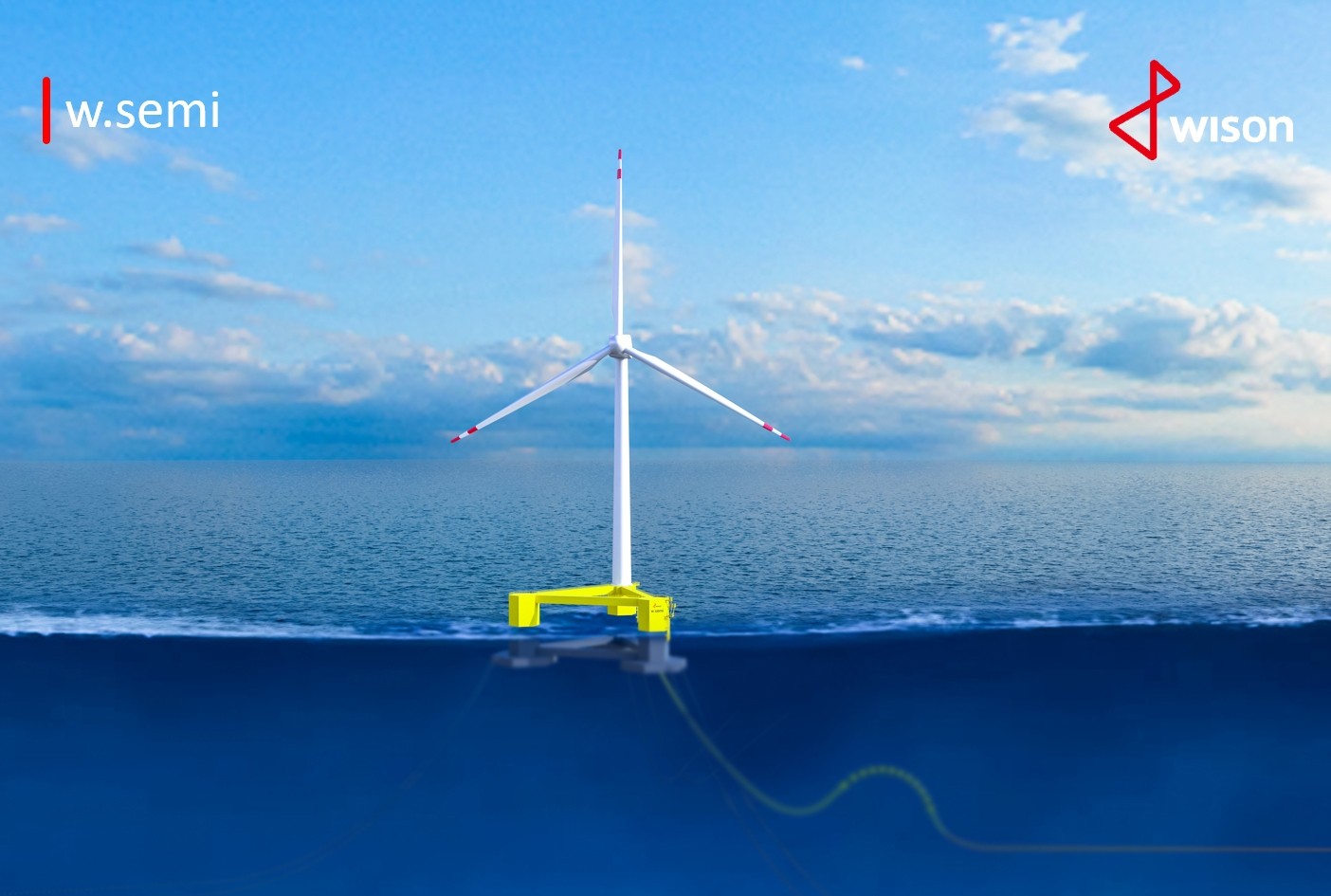
Wison received its first U.S. patent in floating wind technology for the proprietary “w.semi” offshore wind turbine platform.
Shortly after OTC concluded, Wison announced it had received its first U.S. patent in floating wind technology: Patent No. 12,606,278 B2, covering the proprietary “w.semi” floating offshore wind turbine platform. During the conference itself, Lloyd’s Register granted Wison an Approval in Principle for its Harsh Environment Internal Turret FPSO design, designated RD234, following an independent concept-stage safety review. Also at OTC, Dr. Weimin Chen, Director of Offshore Wind at Wison New Energies, delivered a peer-reviewed technical paper comparing floating wind platform configurations for very large turbines.
These accomplishments are the product of a deliberate, long-running strategy to be a key part of the American market through technology partnerships, U.S.-held intellectual property and relationships with some of the most recognized names in the U.S. energy industry.
An American Foundation: Horton, Baker Hughes, and Chart Industries
Wison’s U.S. roots date to 2009, when the company entered a joint venture with deepwater engineering pioneer Ed Horton to form Horton Wison Deepwater, Inc. (HWD), a Houston-based entity. The venture combined Horton’s extensive deepwater platform patent portfolio with Wison’s fabrication capacity, and in 2012 produced a tangible result: the CX-15, the world’s first Buoyant Tower drilling and production platform, designed by HWD, fabricated at Wison’s Nantong yard, and installed offshore Peru.
The joint venture was later renamed Wison Offshore Technology, Inc. (WOT), which became a wholly owned subsidiary of Wison in 2016. Through WOT, Wison consolidated Horton-origin offshore engineering capabilities, including Buoyant Towertechnology and a related portfolio of more than 130 American-registered patents, supporting its continued development in floating energy solutions and connecting directly to the floating wind work Dr. Chen presented at OTC 2026.
Wison’s U.S. commercial relationships extend further. In 2022, the company signed a joint development agreement with Chart Industries, the Georgia-based manufacturer of cryogenic and heat-transfer equipment, designating Chart as the exclusive provider of cold boxes for Wison’s FLNG products. That same year, Wison awarded Baker Hughes a contract to support a 2.4 million metric tons per annum FLNG project, the first of several Baker Hughes awards. In 2023, Wison contracted Baker Hughes again for four liquefaction modules for an onshore LNG plant. At Gastech 2024 in Houston, Wison formalized both relationships further with additional strategic agreements, unveiling its Generation 2 FLNG, a design that reduces emissions by 35 percent compared to earlier models, achieved in part through technology supplied by Baker Hughes and Chart Industries. Chart is now in the process of being acquired by Baker Hughes in a $13.6 billion transaction announced in July 2025, consolidating Wison’s two largest U.S. supply partners under one roof.
Wison’s supply chain, at the technology and equipment level, runs through American companies, a fact that matters to U.S. project developers, government procurement processes, and the financiers and insurers who increasingly scrutinize the industrial provenance of floating energy assets.
OTC 2026: Three Announcements, One Message
The U.S. patent for the w.semi is the first American intellectual property protection Wison has secured in floating wind. The w.semi is a modular semi-submersible platform designed for mass production and near-shore final assembly in shallow-draught ports, engineered for the large-capacity turbines now entering commercial deployment, suited for the Mediterranean, the North Sea and the U.S. West Coast. It is one of five floating offshore wind turbine concepts in Wison’s portfolio. Owning patented U.S. IP converts Wison into something specific in the eyes of American counterparties: a company with proprietary technology protected under U.S. law, which matters to project developers, government procurement processes, and financiers who want assurance a technology is defensible.
The Lloyd’s Register AiP covers the RD234 FPSO configured for demanding metocean conditions, with an internal turret mooring system that allows the vessel to weathervane, in other words, to rotate to face prevailing waves and wind, a critical capability in high-sea-state locations. Ian Crehan, Global Head of Energy Solutions at Lloyd’s Register, said floating production systems are becoming more complex and the cost of getting early decisions wrong is rising, and that independent assurance at concept stage helps reduce uncertainty and allows projects to move forward with greater technical confidence. Loy Wee Meng, Senior Product Manager of Wison’s FPSO Product Center, noted that with the harsh-environment design completed, Wison now holds the portfolio to address 90 percent of current world FPSO demand.
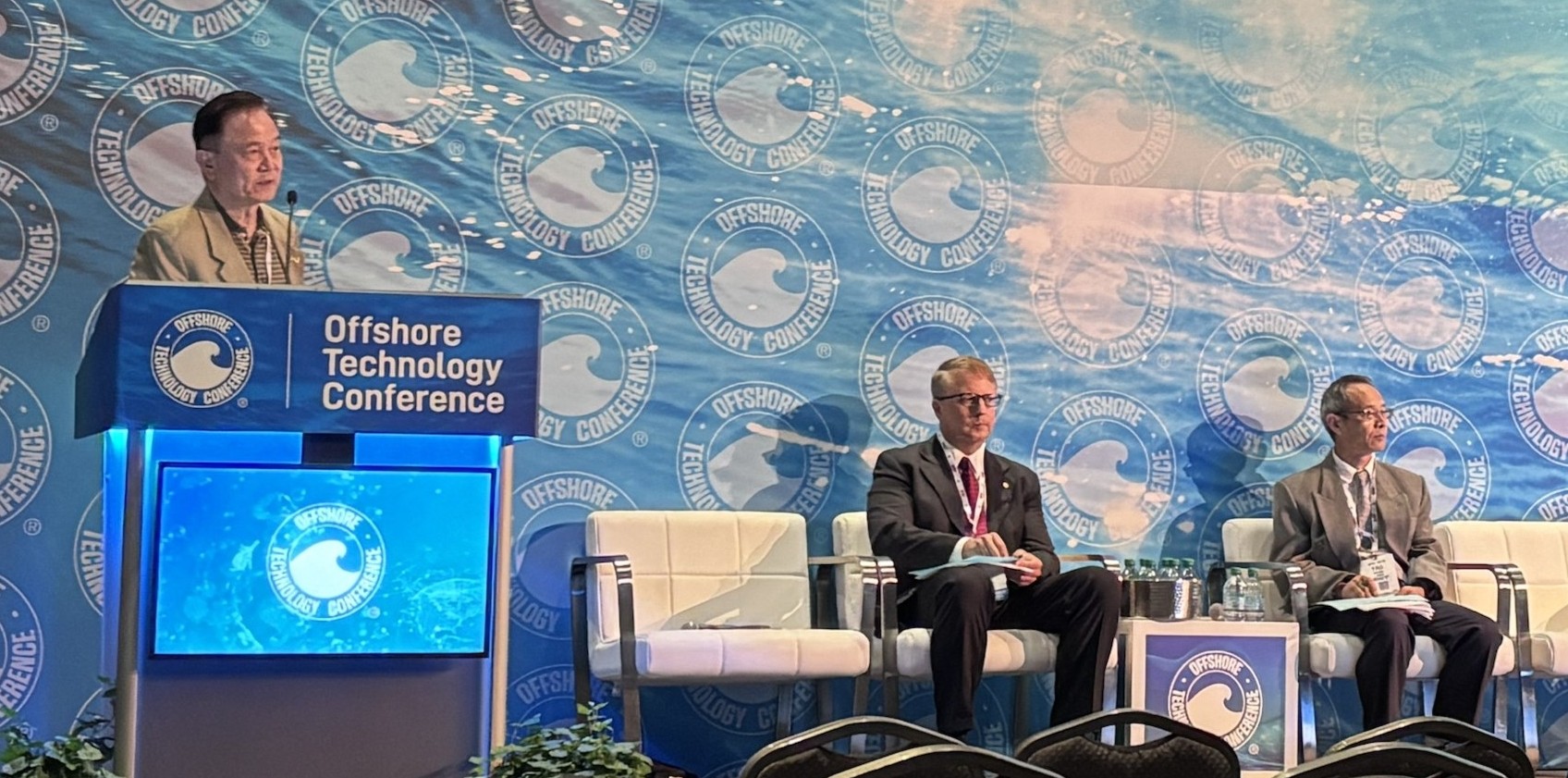
During his speech, Dr. Weimin Chen, Director of Offshore Wind at Wison New Energies, said, “Platform optimization requires an integrated assessment of structural dynamics, hydrodynamics and coupled responses.”
Dr. Chen’s OTC 2026 paper, co-authored with colleagues Pan Xujie, Su Lingyu, and Fang Zhichao, compared three- and four-column semi-submersible platform configurations for very large turbines. The four-column design showed advantages in frequency separation — keeping the platform’s natural vibration away from turbine blade frequencies — and in yaw reduction, as the centrally mounted turbine produces more symmetrical aerodynamic loading and lower long-term maintenance costs. “Platform optimization requires an integrated assessment of structural dynamics, hydrodynamics, and coupled responses,” Dr. Chen said.
Why It Matters
The backdrop is a global energy system under significant stress. Strait of Hormuz security threats have pushed Brent crude above $100 per barrel; the EIA estimated in April that geopolitical disruptions forced Gulf producers to shut in more than nine million barrels per day at peak.
The IEA’s 2025 World Energy Outlook noted that wind can enhance energy security precisely because it harnesses domestic resources less vulnerable to fossil-fuel chokepoints. More than 80 percent of global offshore wind potential lies in water too deep for fixed-bottom foundations — floating platforms are the necessary infrastructure layer.
Turbines now exceed 15 megawatts per unit; the next generation pushes past 20. The modular, mass-production design of the w.semi addresses the central cost challenge that has slowed floating wind’s commercial scale: bespoke, one-off platform fabrication. A standardized, patented design built for industrial production is the difference between a demonstration project and a genuine instrument of energy security.
The floating wind market analysts project will grow from $3.2billion in 2026 to $25.4 billion by 2031. Wison’s accomplishments around OTC in Houston — a U.S. patent, a Lloyd’s certification, a peer-reviewed paper and a 15-year track record of American partnerships behind it — made the case that scalable, proprietary floating infrastructure built by a company already embedded in the U.S. market is no longer a distant ambition.
READ MORE
Final Agenda and Registration – 2nd Princeton CorpGov Forum: Endowments, Activism and Entertainment
Never Miss our Weekly Highlights HERE