Download the Complete Report Here
 Xanadu Quantum Technologies (XNDU)
Wafer Iteration and Partner-Led Commercialization Support Photonic Quantum Roadmap
- Key Takeaways:
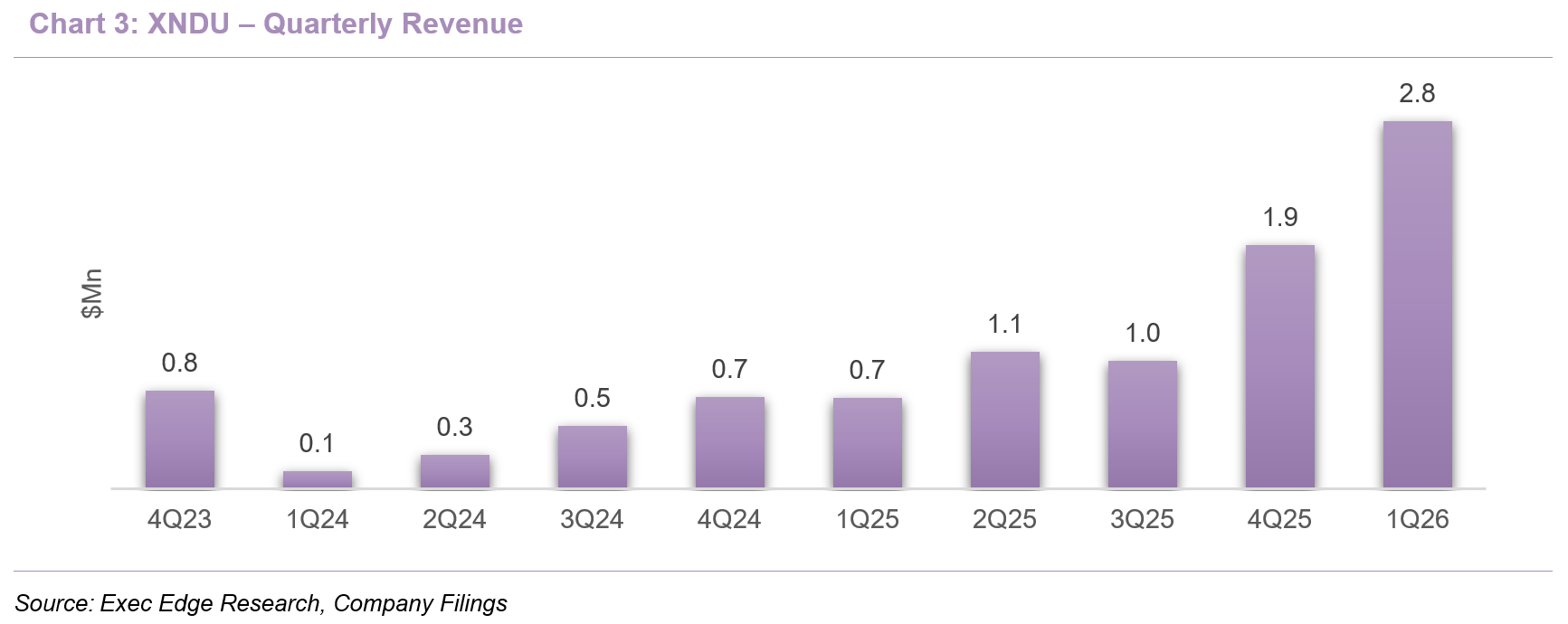
- XNDU’s first public-company quarter reinforced roadmap execution, with revenue increasing 4x y/y to $2.8 million.
- Post-SPAC proceeds, Project OPTIMISM, DARPA, and a planned $300 million ATM expand flexibility for faster wafer iteration.
- Partnerships with AMD, Lockheed Martin, TELUS, and Fidelity support application development and commercialization pathways.
- PennyLane remains a strategic developer funnel, with 35,000+ active users, 200,000 monthly downloads, and 150 university partners.
- Valuation remains supported by scarce photonic exposure, with upside tied to loss reduction, qubit-factory progress, and partner monetization.
- Public listing and capital infusion shift XNDU into funded roadmap execution. XNDU completed its business combination with Crane Harbor Acquisition Corp. in 1Q26 and began trading on both Nasdaq and the Toronto Stock Exchange under the ticker XNDU. The listing represented more than a capital raise; it marked a transition from early-stage research toward large-scale engineering and commercialization. The transaction generated ~$302 million in gross proceeds, which, together with ~$285 million (C$390 million) of anticipated Canadian and Ontario government funding currently under negotiation, is expected to support XNDU’s roadmap toward a quantum data center by 2029-2030.
- 1Q26 revenue increased 4x y/y to $2.8 million from $0.7 million, primarily driven by revenue recognized from DARPA QBI Stage B participation.
- Government funding and ATM flexibility broaden the roadmap funding stack. XNDU is in discussions with the governments of Canada and Ontario for up to ~$285 million, or C$390 million, under Project OPTIMISM to advance domestic quantum manufacturing capabilities, while DARPA QBI Stage B contributed to 1Q26 revenue and could provide a path toward a potentially meaningful Phase C opportunity. The Canadian Quantum Champions Program adds another layer of government-backed validation, with these programs supporting more than funding by validating the roadmap, creating potential procurement pathways, strengthening sovereign quantum infrastructure, and helping offset manufacturing intensity across photonic packaging, test and measurement, heterogeneous integration, and module assembly. Importantly, anticipated Canadian government funding is expected to be received gradually as qualifying R&D investments are made rather than upfront on the balance sheet.
- XNDU also plans to establish a $300 million synthetic ATM facility, with any primary share issuance proceeds flowing directly to the balance sheet to support future development and cash reserves.
- Partnerships are expanding across application development and commercialization pathways. XNDU highlighted active relationships with AMD, Lockheed Martin, TELUS, and Fidelity Center for Applied Technology, building on earlier work with Mitsubishi Chemical, Rolls-Royce, Riverlane, Corning, Applied Materials, EV Group, and other industrial partners. The structure of these relationships matters more than the number of logos: defense and aerospace partners can support application IP and future procurement pathways, telecom and finance partners can help identify commercial workloads, and materials / industrial partners can support use-case development ahead of full-scale quantum data-center availability.
- Manufacturing partnerships support faster iteration and lower execution risk across the hardware roadmap. Hardware-focused relationships with AMD, Corning, EV Group, Applied Materials, and other manufacturing partners provide access to established infrastructure, engineering expertise, and high-volume production capabilities. These relationships can help accelerate chip iteration cycles, improve wafer access, support packaging and module assembly, and reduce per-iteration costs, strengthening XNDU’s ability to scale from R&D prototypes toward fault-tolerant photonic quantum systems.
- Selective commercial strategy prioritizes high-value partners over low-quality services revenue. XNDU is not chasing services revenue that could divert technical talent from the 2029-2030 roadmap, instead focusing on partnerships that support application development, technical validation, manufacturing scale, and eventual procurement. Lockheed Martin is a paid partnership focused on quantum machine learning, while AMD supports hybrid quantum-classical computing and FPGA-enabled workflows. XNDU highlighted a 20-qubit, 35 million-gate quantum computational fluid dynamics simulation with AMD that delivered a 25x workflow acceleration versus CPUs for aerospace and engineering applications. These relationships are meaningful because they represent early application work that could inform future demand for cloud-based quantum compute, enterprise software, and quantum data-center access, rather than generic logo validation.
- PennyLane remains a strategic developer funnel, with monetization still a future opportunity. PennyLane reached more than 35,000 active users and approximately 200,000 monthly downloads, while the platform now has roughly 150 university partners, including the University of Toronto, Johns Hopkins University, and the University of Maryland. The three-year University of Maryland National Quantum Lab partnership is focused on workforce development and commercialization across the Mid-Atlantic, reinforcing PennyLane’s role as a low-cost customer acquisition engine rather than a current software revenue driver. By training researchers, developers, and enterprises on its platform before fault-tolerant hardware is commercially available, XNDU is building developer mindshare that could support future demand for enterprise PennyLane, QCAST, cloud access, software subscriptions, and application-development work.
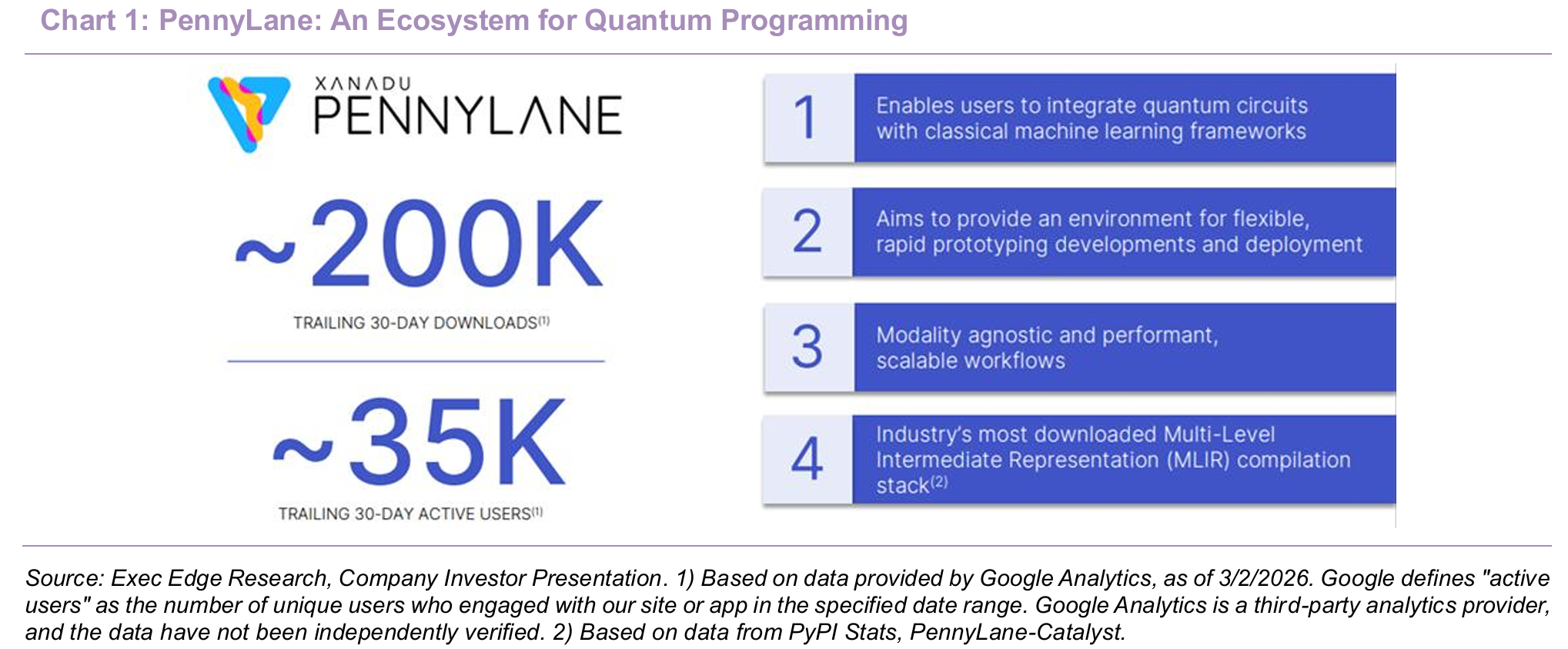
- Hardware-agnostic software positioning strengthens ecosystem relevance across quantum modalities. PennyLane continues to grow as one of the leading hardware-agnostic quantum software platforms, with Qiskit identified as a primary competitor and NVIDIA increasingly active in the broader software ecosystem. PennyLane’s ability to work across multiple quantum hardware modalities remains a key differentiator, while Catalyst extends XNDU’s software stack through a hardware-agnostic quantum compiler that can support multiple platforms.
- The recent Oak Ridge National Laboratory collaboration further expands PennyLane’s relevance, allowing Frontier and broader OLCF users to write and execute quantum programs directly on the Frontier supercomputer through PennyLane’s Lightning simulator, with MPI integration enabling distributed quantum simulation across multiple compute nodes. Monetization remains early, but potential pathways include enterprise licensing, usage-based models, cloud access, and paid application work such as Lockheed Martin, with more specialized internal software remaining tailored to XNDU’s photonic systems.
- Photonics-based architecture remains XNDU’s core long-term differentiator. XNDU’s approach combines a modular, networked architecture designed to scale like modern data centers with the ability to leverage existing semiconductor and photonic manufacturing supply chains. The architecture also operates primarily at room temperature after initialization, reducing reliance on continuous cryogenic cooling, while supporting flexible real-time error correction with potentially lower overhead requirements. Gate speeds of approximately 100 MHz, which XNDU believes are roughly 10x–1,000x faster than competing approaches, could become a meaningful advantage as systems scale. While fault tolerance remains the industry-wide challenge, XNDU believes its modular photonic architecture has largely addressed the networking component, shifting the key execution focus toward chip performance, optical-loss reduction, and system-level scale.
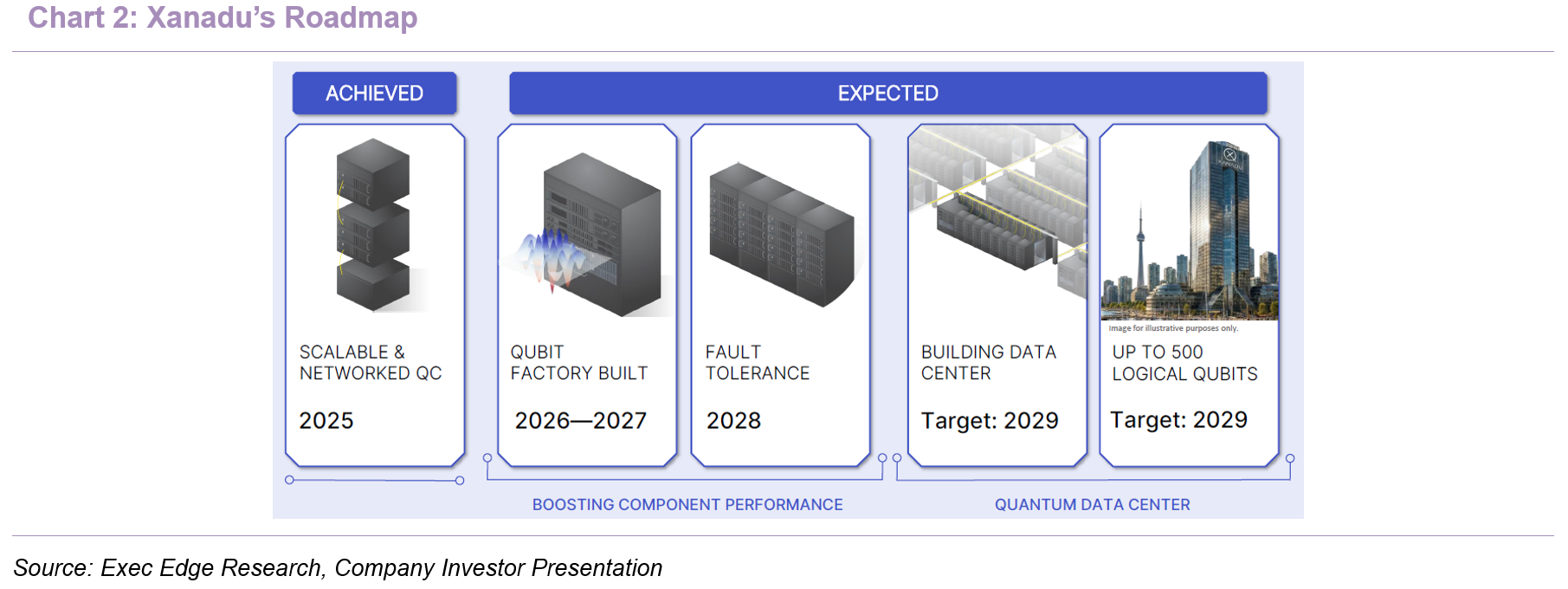
- Aurora anchors XNDU’s roadmap toward scalable, fault-tolerant quantum computing. Aurora is the world’s first modular, scalable, and networked photonic quantum computer, featuring 12 logical qubits across 35 photonic chips connected through 13 kilometers of fiber optics, with room-temperature operation and real-time error-correction decoding. With the networking component largely established, XNDU’s focus has shifted toward improving photonic chip performance through optical-loss reduction, where the company delivered a 60% y/y improvement in 2025. The roadmap targets a qubit factory by 2026-2027, fault-tolerant operations by 2028, and a quantum data center capable of scaling toward up to 500 logical qubits by 2029-2030, alongside continued expansion of manufacturing capabilities.
-
- Optical-loss reduction is now the central technical execution metric. XNDU has achieved up to a 200x reduction in certain loss pathways since 2021-2022, though future gains are expected to become more incremental as systems approach the threshold required for commercially useful quantum computing applications. Increased chip iteration remains the primary driver of progress, with manufacturing runs typically taking two to five months before wafers are tested, redesigned, and returned to foundries for further optimization. Loss reduction is being driven primarily by chip design optimization, supported by process enhancements around surface roughness, etching, fiber-to-chip coupling, and material structures using established platforms such as lithium niobate. The company’s ability to leverage mature telecom / datacom manufacturing ecosystems through partners such as UMC and Tower Semiconductor is important because it allows XNDU to use established process nodes and existing fabrication infrastructure rather than requiring entirely new tools or materials. Increasing access to advanced 300mm tools, including through Applied Materials, should further support iteration speed, process control, and continued loss reduction over time.
- Manufacturing strategy supports the transition from lab-scale systems to industrial photonic chip production. XNDU is increasingly focused on turning its photonic architecture into a scalable manufacturing advantage by combining internal photonic integrated circuit design with external fabrication partners across substrates such as silicon nitride and lithium niobate. Building on Project OPTIMISM, the company is working to establish domestic semiconductor and photonic manufacturing infrastructure across photonic chip packaging, wafer-level testing, and quantum module assembly, while leveraging existing telecom photonics and semiconductor infrastructure rather than building a fully bespoke supply chain.
- The recently announced EV Group partnership adds industrial wafer bonding and lithography capabilities, with a focus on heterogeneous integration that enables multiple materials to be combined onto a single photonic chip. Alongside manufacturing relationships with Tower Semiconductor, Applied Materials, and Corning, the strategy is designed to improve chip iteration speed, support foundry-compatible production, and move XNDU from R&D prototypes toward higher-volume manufacturing over time.
- The qubit factory represents a central milestone in XNDU’s roadmap toward scalable, fault-tolerant quantum computing. The qubit factory is designed to reliably generate large volumes of photonic GKP qubits on demand, which is a foundational requirement for large-scale quantum computation. GKP qubits are particularly important within XNDU’s architecture because they help tolerate optical loss, one of the primary technical challenges facing photonic quantum systems. The qubit factory remains one of the most difficult remaining components of the roadmap, with many subsequent milestones becoming materially easier once scalable qubit generation is achieved. While XNDU already has an early MVP-style version of the architecture through Aurora, continued loss reduction, component optimization, and system-level assembly remain critical to achieving fault-tolerant quantum computing at scale.
- Leadership additions support public-company execution and roadmap discipline. XNDU expanded its executive and board bench as part of its public-market transition, adding finance, legal, semiconductor, defense, government, and capital markets experience. CFO Michael Trzupek and Chief Legal Officer Natalie Wilmore strengthen financial discipline, securities compliance, and governance, while board additions with semiconductor, defense, and capital markets backgrounds support XNDU’s foundry-compatible manufacturing strategy, sovereign-compute positioning, and long-term roadmap funding needs.
- Revenue growth remains early-stage and service-led. XNDU reported 1Q26 revenue of $2.8 million, up 4x year-over-year from $0.7 million and above approximately $1.9 million in 4Q25, with growth primarily driven by revenue recognized from DARPA QBI Stage B participation. While the growth is notable, revenue remains lumpy and tied to government programs, paid partnerships, and milestone-based work rather than recurring software or cloud consumption. Until revenue begins shifting toward scalable QCAST access, enterprise PennyLane subscriptions, on-premise systems, IP licensing, and recurring support, we view the revenue line primarily as evidence of engagement and validation rather than proof of product-market maturity.
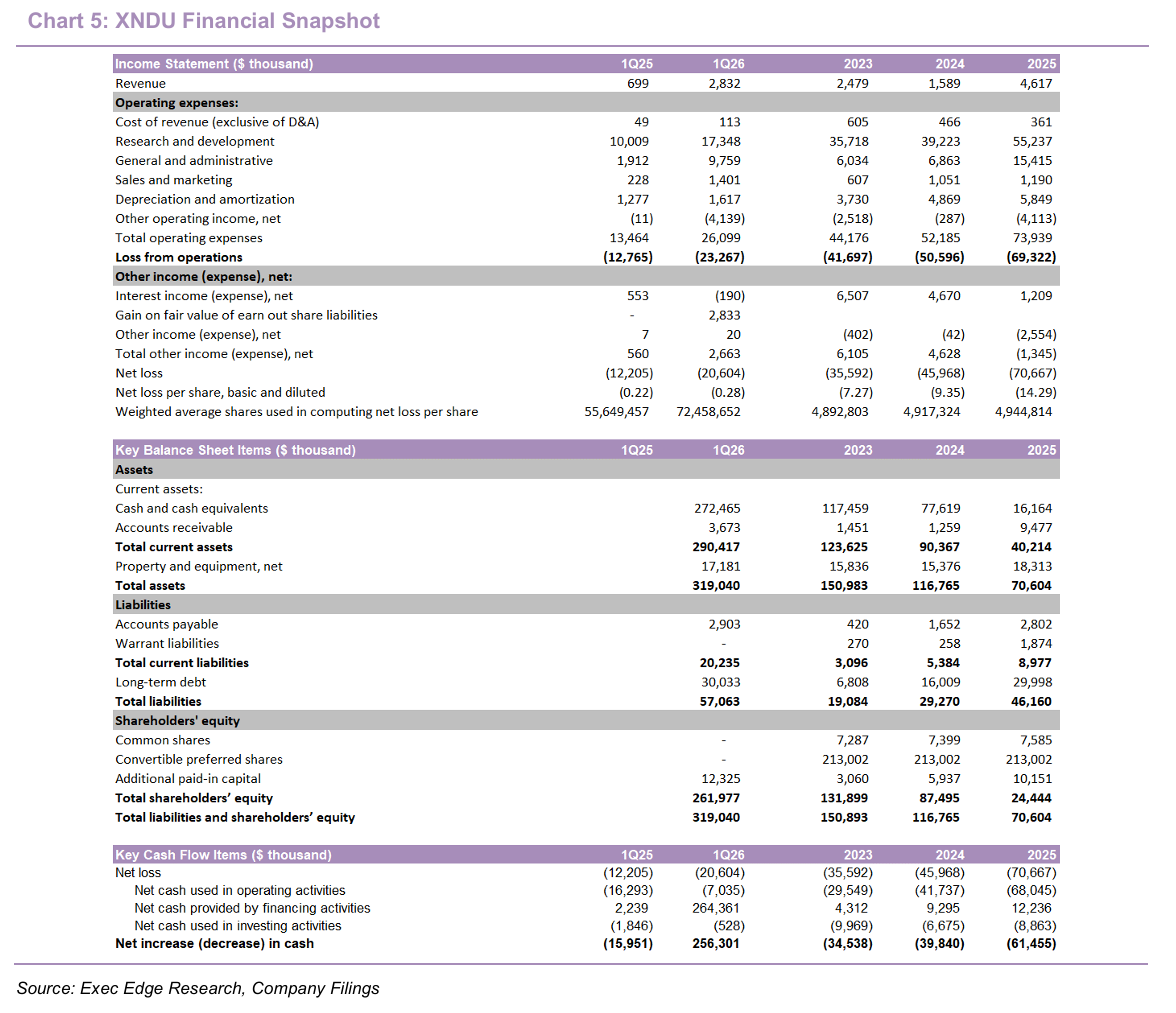
- Losses widened as XNDU remains in a deliberate investment phase. Net loss increased to $20.6 million, or $0.28 per share, in 1Q26 compared with a net loss of $12.2 million in the prior-year period, while adjusted EBITDA loss was $13.9 million versus $10.6 million in 1Q25. The widening loss reflects continued investment in hardware development, software infrastructure, talent, and public-company costs following the March 2026 listing.
- R&D expense increased 73% y/y to $17.3 million, driven by engineering talent, wafer iterations, foundry activity, and process development, while G&A also increased meaningfully due in part to non-recurring SPAC and public-listing costs. Operating expenses are expected to increase through 2026 as XNDU accelerates engineering hiring and wafer production activity, with more detailed guidance on operating expenses and engineering metrics expected later this summer.
- Balance sheet reset strengthens roadmap funding. Following the Crane Harbor business combination, XNDU ended 1Q26 with $272.5 million in cash and equivalents, up from $16.2 million at year-end 2025, supported by approximately $302 million in gross proceeds, including a $275 million oversubscribed PIPE. The company also had $30.0 million of long-term debt and 298.5 million shares outstanding, with more than 250 million legacy shares subject to 180-day lock-up provisions until September 2026. While the planned $300 million synthetic ATM facility and potential sovereign funding programs improve financial flexibility, they also introduce dilution and share-overhang risk. The stronger liquidity position should support faster technical progress, including higher chip-run velocity, improved optical-loss performance, expanded engineering capacity, greater manufacturing readiness, and continued progress toward the 2029-2030 target of up to 500 logical qubits.
Differentiated Photonic Quantum Platform with Long-Duration Commercial Optionality
- Differentiated photonic quantum platform remains attractively positioned relative to listed quantum peers. Please note that the following valuation analysis is for illustrative purposes only and is not meant to be a stock recommendation, price target, or buy/sell/hold recommendation.
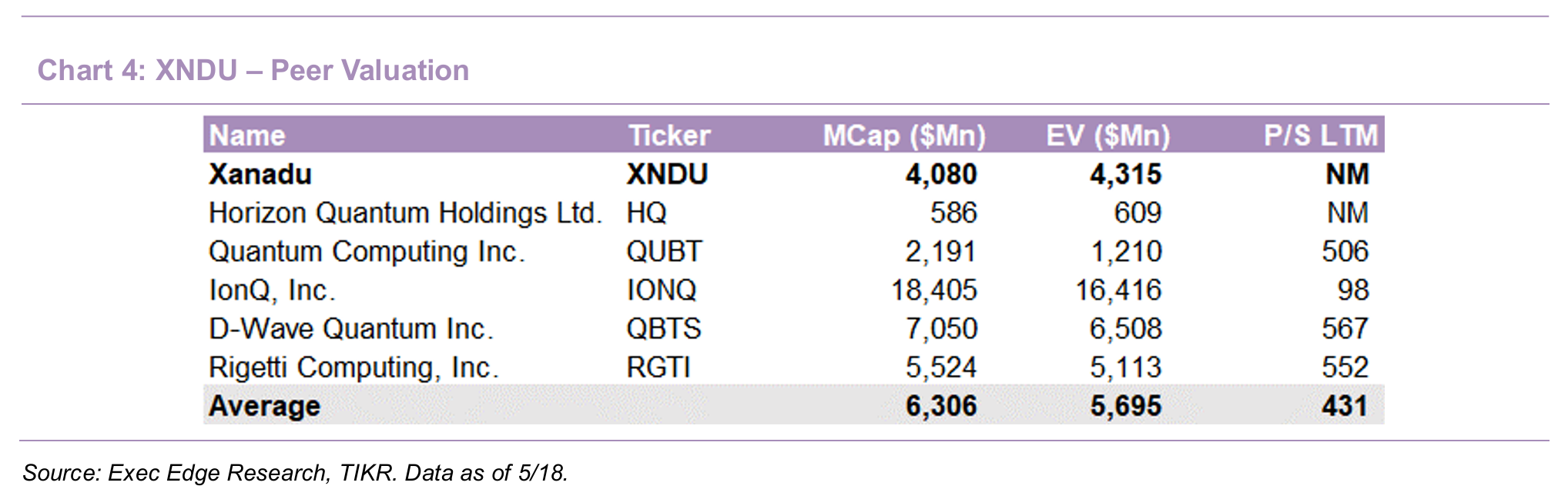
- We believe XNDU remains a scarce public-market asset, offering exposure to a full-stack quantum computing platform that combines differentiated photonic hardware, the PennyLane software ecosystem, and a roadmap toward quantum data-center infrastructure. As of May 18, 2026, XNDU had a market capitalization of ~$4.1 billion and an enterprise value of ~$4.3 billion, compared with the listed quantum peer average of ~$6.3 billion in market capitalization and ~$5.7 billion in enterprise value. XNDU remains smaller than larger public quantum peers such as IonQ, D-Wave, and Rigetti on absolute market capitalization, despite differentiated photonic architecture, Aurora’s 12 logical qubits, PennyLane’s 35,000+ active users and 200,000 monthly downloads, and a strengthened post-listing cash position.
- Near-term revenue multiples remain less relevant than architecture credibility, funding runway, and milestone execution. Valuation across the quantum computing sector remains largely decoupled from current revenue given the early stage of commercialization, and XNDU’s P/S multiple is not especially meaningful given its limited revenue base. Listed quantum peers trade at elevated LTM P/S multiples, with the peer average at approximately 431x, suggesting investors are underwriting long-duration platform potential rather than near-term sales. For XNDU, the more relevant valuation framework is whether its photonic architecture, Aurora roadmap, PennyLane developer ecosystem, government funding potential, and strategic partnerships can translate into a commercially useful quantum platform over time.
- Rerating potential should be tied to measurable technical, commercial, and funding milestones. We continue to see XNDU’s valuation supported by architectural scarcity and full-stack positioning, with further upside dependent on execution rather than sector enthusiasm alone. Key milestones include continued optical-loss reduction, faster chip-run velocity, qubit-factory progress, advancement toward fault-tolerant operations, finalization of Project OPTIMISM, and conversion of strategic partnerships into recurring or repeatable revenue streams. Upside should also be supported if XNDU demonstrates that it can scale beyond early logical-qubit milestones, improve manufacturing repeatability, monetize software and partner relationships, and use government support to reduce net capital intensity. Conversely, delayed loss reduction, slower wafer iteration, higher-than-expected burn, ATM-related dilution, government funding uncertainty, or peer multiple compression could constrain valuation upside.
Download the Complete Report Here
Read Exec Edge’s Initiation on Xanadu Quantum Here
Watch IPO Edge Fireside Chat with Xanadu Founder & CEO Christian Weedbrook
Subscribe to our Weekly Newsletter to Receive All Research
Contact: