Download the Complete Report Here
 Barfresh Food Group, Inc. (BRFH)
Education Recovery Continues as Near-Term Manufacturing Pressure Resets 2026 Outlook; Long-Term Growth Thesis Remains Intact
- Key Takeaways:
- Revenue increased 190% y/y to $4.7 million as Arps added scale and supply continuity, while frozen beverage and food revenue grew 9%.
- Manufacturing inefficiencies drove gross margin to negative 3.2%, prompting reductions to 2026 revenue and adjusted EBITDA guidance.
- Education recovery remains intact, with returning customers, new district wins and inventory preparation supporting stronger core Barfresh growth through the 2026-27 school year.
- Defiance remains a key strategic catalyst, with partial commissioning targeted by year-end 2026 and materially improved production economics expected thereafter.
- Stock has reacted negatively to the print, but at 0.93x 2026E sales and a greater than 40% discount to peers, valuation increasingly discounts near-term execution risk while the medium to long-term growth thesis and rerating drivers remain intact.
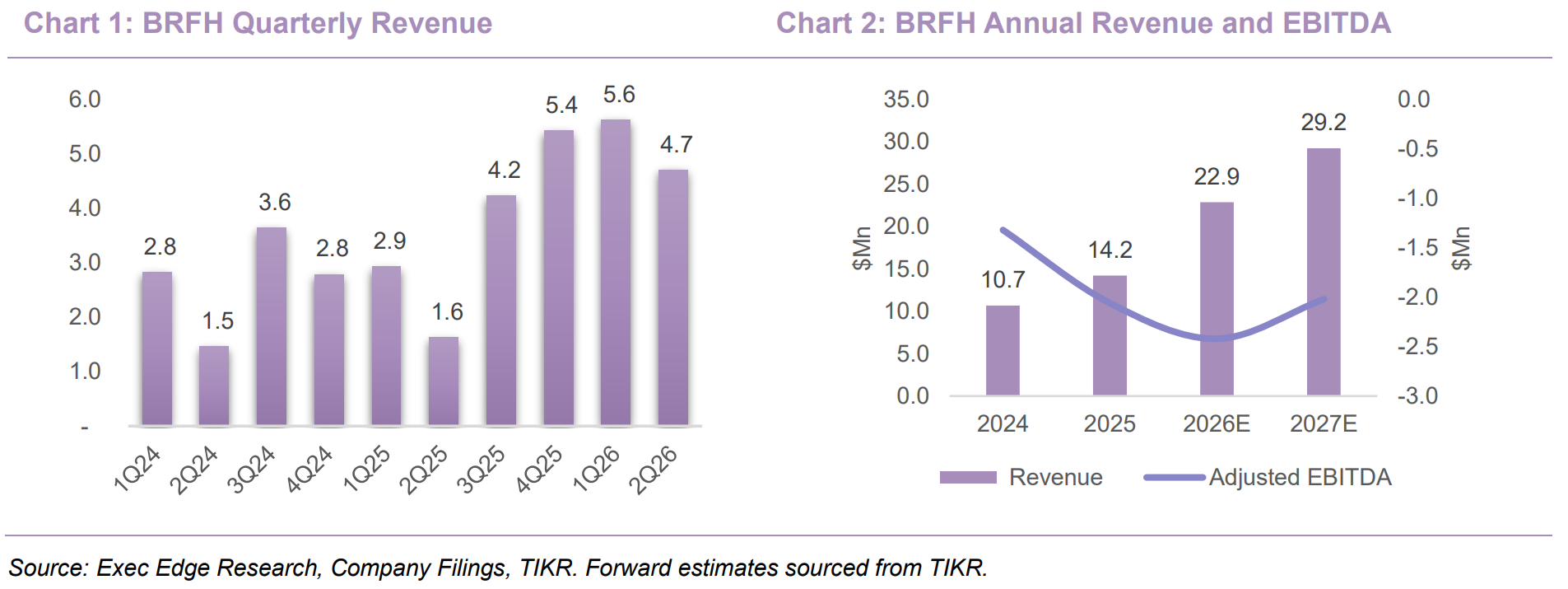
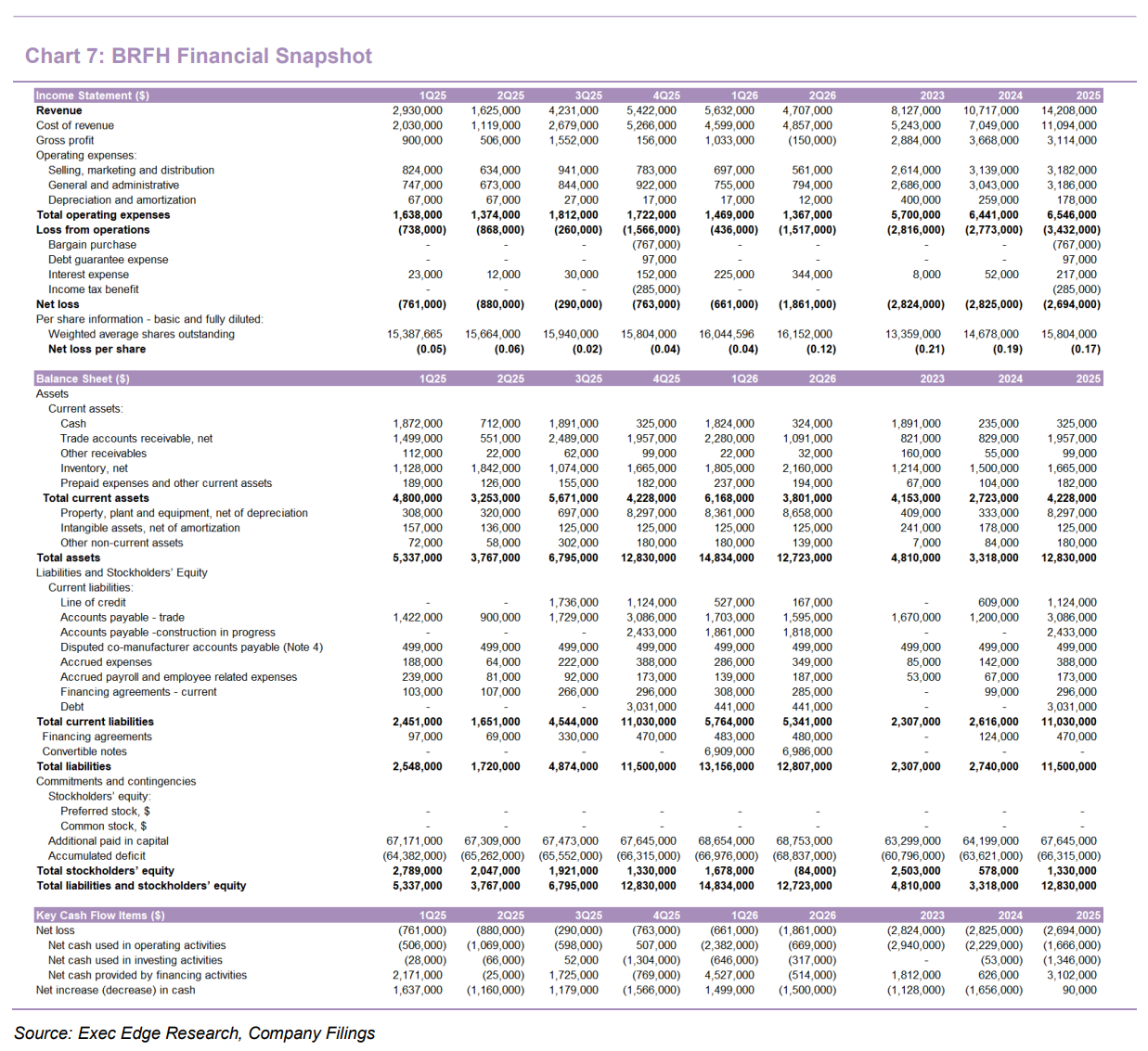
- Strong topline growth and continued education-channel rebuilding were offset by slower-than-expected manufacturing efficiency at the existing Arps facility. BRFH reported 2Q26 revenue of $4.7 million, up 190% y/y from $1.6 million but down 16% sequentially from $5.6 million in 1Q26 and approximately 9.5% below the low end of $5.2 million guidance. Arps Dairy contributed $3.2 million, including $2.9 million from raw and processed milk, while frozen beverage and food revenue, consisting primarily of legacy Barfresh products, increased 9% y/y to approximately $1.8 million. Consolidated growth remained heavily acquisition-driven, with milk representing roughly 62% of quarterly revenue and core Barfresh recovery not yet fully reflected in reported results. Arps continues to provide supply continuity, while new district wins and returning education customers are expected to contribute more meaningfully with the 2026-27 school year. The principal 2Q pressure point was therefore production, where a slower and more costly manufacturing ramp weighed on gross margin and adjusted EBITDA recovery.
- Profitability remained pressured by manufacturing inefficiencies, but improving throughput and a more favorable product mix support sequential recovery in 2H26. Gross margin declined to negative 3.2% in 2Q26 from 31.1% in 2Q25 and approximately 18% in 1Q26, while adjusted EBITDA fell to a $1.2 million loss from a $600,000 loss a year ago. The pressure reflected startup costs, equipment limitations and lower than planned productivity at the existing Arps facility, with the impact extending into legacy Barfresh production. Management indicated that repairs and process improvements are improving throughput and yields, while a greater mix of higher margin education products should provide additional support as the 2026-27 school year ramps. Together, these factors support management’s expectation for adjusted EBITDA to improve to a $0.5 million loss to breakeven in 2H26.
- Arps has restored supply continuity for BRFH, but scaling owned production has required more investment and operational work than initially anticipated. As more Barfresh volume shifted in-house, operating the facility at the required production levels highlighted additional equipment and infrastructure needs that had not been apparent before the acquisition. BRFH therefore moved ice cream production out to prioritize its core smoothie portfolio, while repairs, equipment servicing and process refinements have since improved throughput and yields. Management indicated that a significant portion of the corrective work has already been completed and that remaining requirements at the existing facility should be relatively modest, with focus increasingly shifting to Defiance.
- Internal production continued to increase, with cost per case and production reliability now the key measures of progress. The Arps facility produced 53% of legacy product volume in 2Q26, up from roughly 50% in 1Q26, while the remaining 47% was supplied by two co-manufacturers. This has allowed BRFH to maintain customer supply despite the loss of two prior manufacturing partners, while retaining co-manufacturing capacity as a buffer during the transition. Progress through 2H26 should increasingly be measured by whether higher internal throughput translates into lower unit costs and gross margin recovery, supporting the economic case for vertical integration ahead of the larger Defiance facility coming online.
- Guidance revision quantifies the impact of the slower manufacturing ramp and makes operational efficiency an important 2H26 focus. 2026 revenue guidance was reduced to $23 to $26 million from $28 to $32 million, while adjusted EBITDA guidance was reduced to a loss of $1 million to $2 million from positive $3.2 to $3.8 million. At the respective midpoints, this represents a $5.5 million reduction in expected revenue and an approximately $5.0 million reset in adjusted EBITDA. Management attributed most of the EBITDA revision to ~$1.8 million of higher Arps processing costs, $0.8 million from the loss of the ice cream mix business and $0.8 million of higher material costs, with another $1.2 million tied to delayed legacy Barfresh revenue recovery and unrealized freight and storage synergies. Street’s 2026 revenue estimate of $22.9 million (source: TIKR) sits just below management’s $23 to $26 million guide, suggesting expectations are already relatively conservative; delivery within the range could support upward estimate revisions. Management’s breakdown of the guidance revision indicates that the downgrade is primarily tied to manufacturing efficiency, integration timing and delayed cost savings, making cost per case, throughput and gross margin recovery important operating markers through 2H26.
- The revised outlook still supports meaningful sequential improvement in 2H26, while education growth and manufacturing progress provide the foundation for continued growth into 2027. With 1H26 revenue of $10.3 million, management’s 2026 guidance implies $12.7 to $15.7 million of revenue in 2H26, with sequential improvement expected in both 3Q26 and 4Q26 as new school districts and returning customers ramp. Management also expects 2H26 adjusted EBITDA to improve to a loss of $0.5 million to breakeven from a $1.46 million loss in 1H26, supported by higher throughput, better cost absorption and a more favorable mix of core Barfresh products. Looking into 2027, Street estimates call for revenue of $29.2 million and adjusted EBITDA of negative $2 million (source: TIKR), implying ~28% revenue growth versus 2026 estimates and a modest improvement in adjusted EBITDA from negative $2.4 million. The revenue growth and modest EBITDA improvement reflect expectations for broader education rollouts, continued customer recovery and gradual improvement in manufacturing economics, while the lower margin Arps milk business remains relatively stable.
- Education channel momentum continues to build, with new district wins and customer reactivations supporting a stronger 2H26 setup. Several recently won districts began serving BRFH products during the 2025-26 school year and are expected to expand across all locations in the 2026-27 school year, while additional education wins are expected as remaining bids close. BRFH is also reengaging customers that removed products from menus following prior supply disruptions. The timing of these wins helps explain why frozen beverage and food revenue increased 9% y/y in 2Q26, as much of the first half still reflected purchasing decisions made during the prior school year. Management expects incremental 2H26 growth to be driven primarily by higher margin Barfresh products, while the Arps milk business remains relatively stable, supporting a more favorable revenue mix as school-year orders ramp.
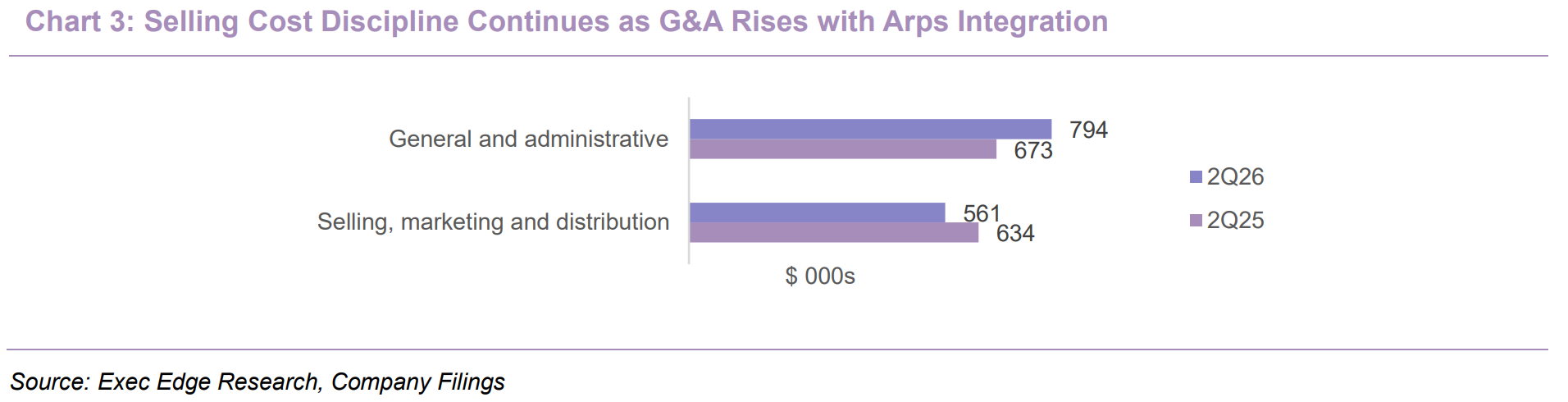
- BRFH’s broker-led commercial model continues to support customer recovery while keeping costs well controlled. Selling, marketing and distribution expense declined 12% y/y to $561,000 in 2Q26 from $634,000, with sales and marketing expense down 28% to $256,000 as the company increasingly relied on brokers to communicate improved supply reliability and rebuild relationships with school districts. Single-serve products are also reducing equipment maintenance requirements in the education channel, providing operating leverage as volume scales. Storage and outbound freight expense increased to $305,000 from $276,000, reflecting the delivery requirements of processed milk, but the broader commercial cost structure remains relatively lean. This should support better operating leverage as higher margin Barfresh volume becomes a larger share of the mix, provided manufacturing efficiency continues to improve.
- The 44,000-square-foot Defiance facility remains the central strategic catalyst for BRFH’s transition to normalized production economics. BRFH is targeting partial commissioning of core products by year-end 2026, with remaining products expected to follow shortly thereafter. The facility is designed to provide greater throughput, improved production flexibility and more efficient unit economics than the existing plant, directly addressing the equipment reliability and processing constraints that affected 2Q26 results. The company also has a $2.4 million government grant available for qualifying equipment purchases. While the existing Arps facility has already improved supply continuity and reduced reliance on third-party manufacturers, successful commissioning of Defiance should be the more important driver of margin normalization and capacity expansion heading into 2027. The transition will also require careful production sequencing, with the existing facility lease running through September 30 and partial commissioning at Defiance targeted by year-end.
- BRFH has outlined a planned financing path to complete Defiance, although execution remains an important near-term consideration as project costs have increased. The company used proceeds from its $7.5 million convertible financing to repay the mortgage and other obligations, leaving the Defiance property owned free and clear and available to support planned financing. BRFH expects to combine a new property-backed mortgage with equipment financing to fund the remaining build, while ~$6.6 million of construction obligations remain under the current plan. The $2.4 million grant should offset a portion of equipment costs, although funded phases must be completed by year-end 2026. With project costs running above initial expectations, financing and construction timing remain important milestones ahead of partial commissioning.
- Operating expense discipline provided some offset to manufacturing pressure, although higher G&A and financing costs weighed on overall profitability. Selling, marketing and distribution expense declined 12% y/y to $561,000 from $634,000 and was down from approximately $697,000 in 1Q26, reflecting greater use of the broker network and lower equipment-related costs. G&A increased 18% y/y to $794,000 from $673,000, primarily due to higher personnel, recruiting and administrative costs associated with Arps Dairy, while total operating expenses remained broadly flat y/y at $1.37 million. Net loss widened to $1.86 million from $880,000 y/y, with interest expense increasing to $344,000 from $12,000 as acquisition and facility financing became a larger part of the cost structure.
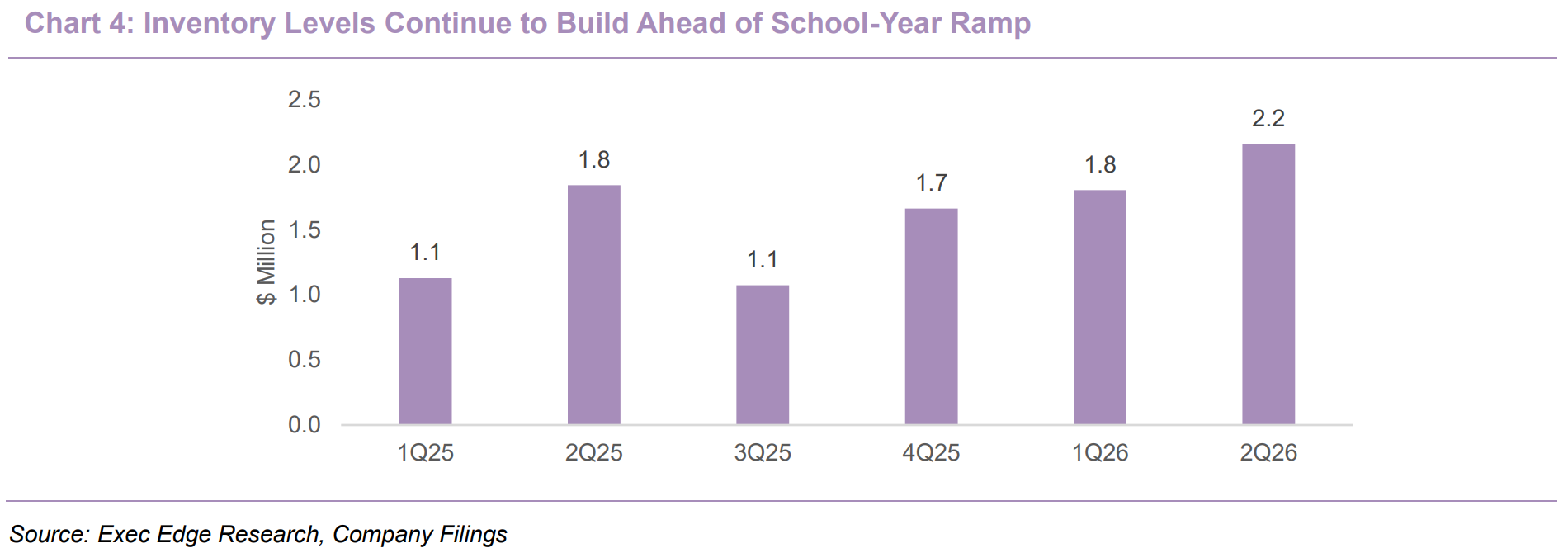
- Working capital is being positioned for the new school year, with inventory supporting production readiness as education volumes ramp. Inventory increased approximately 30% from year-end 2025 to $2.16 million, driven by raw materials and packaging rising to $1.17 million from $684,000, while finished goods remained broadly stable at approximately $1.0 million. This mix suggests the build is primarily supporting higher production rather than reflecting an accumulation of unsold finished product. Management also indicated that inventory has continued to build through the summer and that current internal capacity, supplemented by co-manufacturers, is sufficient to support existing, returning and newly won school business. Given the supply interruptions experienced last year, maintaining this production buffer should help BRFH convert improving education demand into more consistent revenue.
- Liquidity remains supported by receivables financing and planned funding sources as the manufacturing build progresses. BRFH ended June with $324,000 of cash and $1.09 million of trade receivables, while operating cash use increased to $3.05 million in 1H26 from $1.58 million a year ago as the company absorbed integration costs, built inventory and reduced trade payables. Receivables facilities provide an additional liquidity buffer, with approximately $3.58 million of borrowing availability at quarter end, subject to eligible collateral. Converting the back-to-school inventory build into sales and receivables, while securing planned financing for Defiance, remains an important balance-sheet consideration through the remainder of 2026.
- The March convertible financing provides BRFH with funding flexibility, although interest cost and potential dilution remain considerations. BRFH raised $7.5 million through senior convertible notes and used a portion of the proceeds to repay the existing mortgage, leaving the Defiance property unencumbered and available to support planned property-backed financing. The notes carry a 10% coupon during the first 12 months and are convertible at $2.90 per share, while investors also received approximately 2.35 million warrants exercisable at $3.20. Interest expense increased to $344,000 in 2Q26 from $12,000 a year ago, reflecting the higher financing burden. Management does not currently plan an equity raise and continues to prioritize mortgage and equipment financing; successful execution of that plan would help limit incremental dilution as BRFH completes the Defiance build.
Attractive Valuation as Education Recovery Progresses and Manufacturing Normalizes
- Disclaimer: Exec Edge does not publish proprietary estimates, ratings, price targets, or investment recommendations. The valuation discussion below is illustrative only and is based on company filings, management commentary, and third-party data and estimates. It does not constitute a recommendation, price target, rating, or prediction of future pricing.
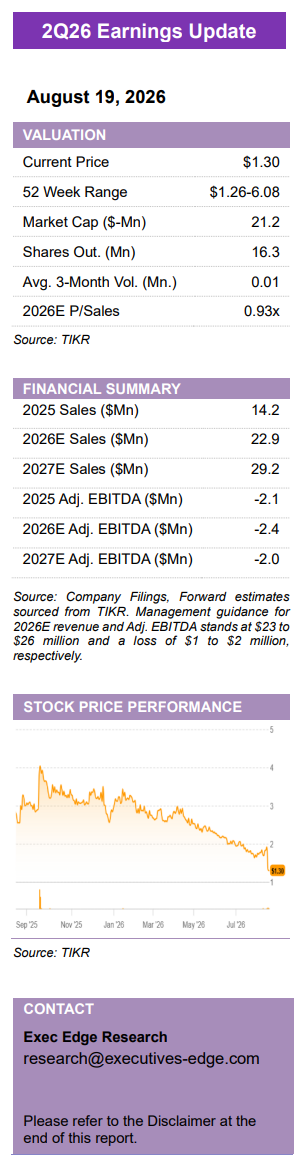
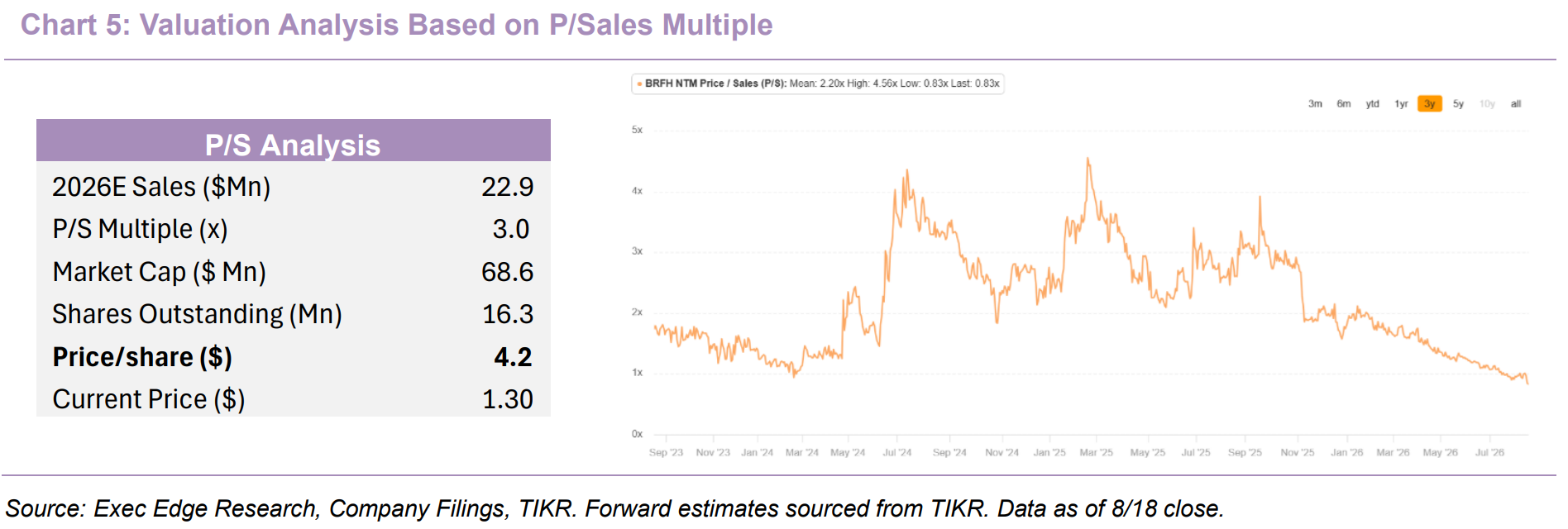
- Stock has reacted negatively to the latest earnings print, but our analysis suggests BRFH’s current valuation increasingly discounts the near-term operating pressure reflected in the guidance reset, while the medium to long-term opportunity from education growth and vertical integration remains intact. At $1.30 per share and an approximately $21 million market capitalization, BRFH trades at 0.93x 2026E P/Sales. The selloff reflects the slower manufacturing ramp and reduced 2026 outlook, while the longer-term education opportunity and strategic rationale for vertical integration remain intact. Importantly, the Street estimate sits slightly below the low end of management’s $23 to $26 million 2026 revenue guidance, suggesting current expectations are already relatively conservative. Delivery within the guidance range, particularly toward the upper end, could support upward estimate revisions and strengthen confidence in the medium to long-term growth and margin recovery trajectory.
- A return toward BRFH’s historical valuation range highlights meaningful rerating potential as execution improves. The stock has de-rated and currently trades well below its three-year peak of 4.5x NTM P/Sales. Applying a 3.0x P/Sales multiple, approximately one-third below the historical peak, to the $22.9 million 2026E Street revenue implies an illustrative market capitalization of approximately $68 million, or roughly $4.2 per share, while 2027E Street revenue of $29.2 million provides additional forward growth support. However, the path to rerating remains contingent on execution across key operating milestones, including education revenue growth through the 2026-27 school year, gross margin recovery, improved efficiency at the Arps facility, progress toward the 2H26 adjusted EBITDA target, and successful commissioning of the Defiance facility.
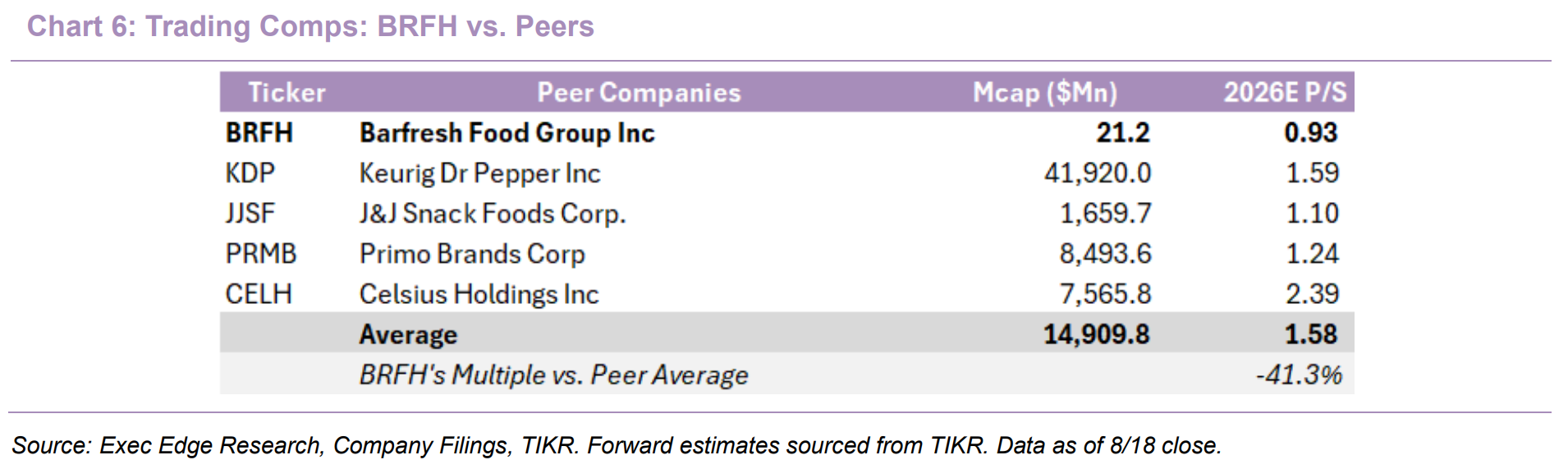
- Relative valuation has also become compelling, with BRFH trading at a greater than 40% discount to peers. BRFH’s 0.93x 2026E P/Sales multiple compares with a peer average of 1.58x, representing an approximately 41% discount. Applying the peer average to the $22.9 million 2026E Street revenue estimate sourced from TIKR implies an illustrative equity value of approximately $36 million, or roughly $2.2 per share. This framework assumes only convergence toward the peer average, with further rerating potential if BRFH delivers within management’s revenue guidance, demonstrates sequential margin improvement, and executes on the Defiance transition, supporting the medium to long-term growth and margin recovery thesis.
Read Exec Edge’s Initiation on Barfresh Food Group Here
Subscribe to our Weekly Newsletter to Receive All Research
Contact: