Download the Complete Report Here
 Cibus, Inc. (CBUS)
Interoc Expands Rice Pipeline to Five Traits; Platform Revenue and Cost Discipline Advance as LATAM Launch Moves to 2028
- Key Takeaways:
- Rice commercialization advanced as Interoc testing began and the relationship expanded from two to five traits, although initial LATAM launch timing moved to 2028.
- Sustainable Ingredients drove 36% YTD revenue growth, with additional BioFragrance scale-up orders still targeted for 2H26 and a $20-$40 million opportunity.
- R&D and SG&A declined ~$5 million y/y, while quarterly cash usage fell 19% sequentially despite targeted technology and personnel investment.
- Deeper seed-company relationships and improving regulatory alignment across the U.S., LATAM and Europe broaden the platform opportunity and support additional commercialization pathways.
- Valuation remains attractive relative to the >$200 million peak Americas rice HT royalty opportunity, with Sustainable Ingredients providing additional upside as scale-up activity converts into commercial revenue.
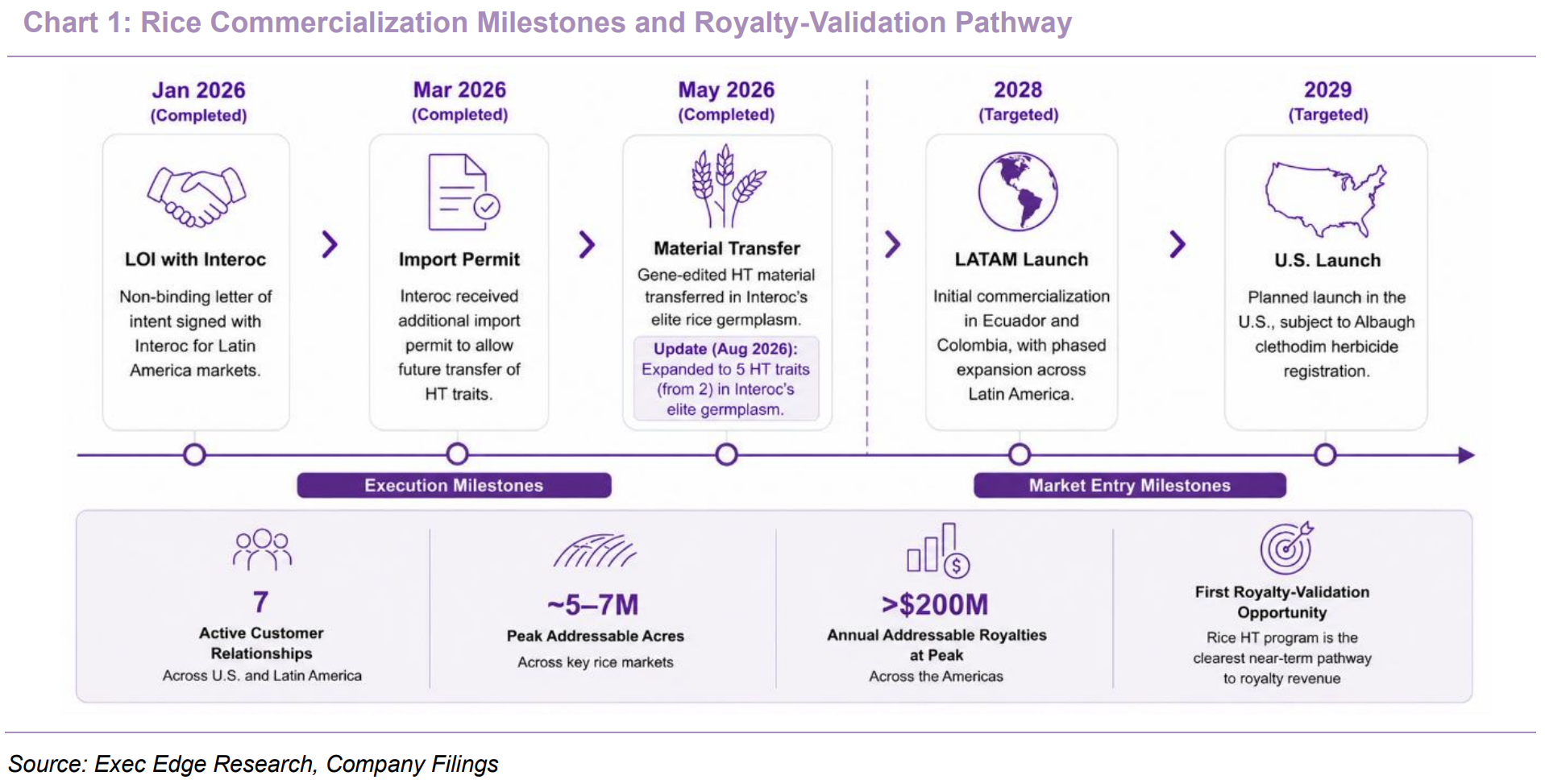
- New CEO Craig Wichner is driving a sharper focus on commercial execution as initial LATAM rice commercialization moves to 2028. Wichner, appointed CEO in June after joining the Board in November 2025, has outlined three monetization pathways for the business: platform-program revenue, per-acre trait royalties and deeper multi-trait relationships with seed-company partners. Near-term revenue remains concentrated in Sustainable Ingredients, while rice advances toward commercialization. Revenue increased 6.5% y/y to $1.0 million in 2Q26, while 1H26 revenue rose 36% to $2.7 million from $2.0 million, driven by Sustainable Ingredients collaboration activity. In rice, testing of HT traits transferred into Interoc germplasm is underway, Fedearroz remains on track for a 2028 launch and Interoc has the potential for a limited 2028 launch focused on hybrid varieties. Rice remains the first significant test of CBUS’ royalty model, representing 5-7 million peak addressable acres and >$200 million of potential annual royalties across the Americas.
- The Interoc expansion from two traits to five is the clearest strategic proof point because it begins to validate CBUS’ ambition to become a recurring editing engine rather than a one trait licensor. The August amendment adds three potential future traits, shifting the contemplated relationship toward a multi-trait product pipeline and allowing the same RTDS and Trait Machine infrastructure to support repeated development programs within a single customer. That model is increasingly supported by execution across crops: CBUS has improved 10 customer canola and winter oilseed rape lines, returned six of those lines, and delivered three improved rice lines to a U.S. customer, while targeting an approximately 12-month editing turnaround across crops after demonstrating that cadence in canola. If replicated across CBUS’ seven existing rice seed-company customers, the opportunity becomes less dependent on individual trait launches and increasingly reflects an embedded breeding-platform relationship with recurring development and royalty potential.
- Rice remains the core royalty-validation pathway, but the move to a 2028 LATAM launch increases the importance of tangible commercial milestones over the next 12-18 months. CBUS maintains seven rice seed-company customers across Latin America and the U.S., while discussions continue with additional companies in Brazil and Argentina and several large participants in India. Latin America represents the bulk of the 5-7 million peak addressable acres and >$200 million annual Americas royalty opportunity, while the U.S. launch remains targeted for 2029 alongside Albaugh’s herbicide-registration timeline. During the quarter, CBUS advanced field trials of an improved first-generation trait and continued work to identify the genetic changes associated with increased herbicide tolerance and seed fertility. Technical progress remains encouraging, but the next stage of valuation de-risking increasingly depends on successful partner testing, definitive commercial agreements, seed production and launch readiness. Initial royalties are now expected with commercial acres in 2028 and to build through 2029 as adoption expands.
- Interoc’s increased focus on hybrid rice could strengthen the durability and strategic value of CBUS’ royalty model over time as the route to commercialization evolves. Latin American rice has historically been weighted toward conventional and inbred varieties, but management expects hybrid penetration to increase as the market evolves, following a progression already seen in crops such as corn and canola. Interoc is emphasizing hybrid varieties, while Fedearroz remains more oriented toward conventional varieties, giving CBUS exposure to both routes to market. Hybrid adoption could be particularly attractive for the platform model because differentiated proprietary seed provides a stronger vehicle for stacking multiple productivity traits and deepening recurring relationships with seed-company partners. In that context, Interoc’s expansion from two contemplated traits to five could ultimately prove more valuable than a series of standalone licenses, particularly if CBUS becomes embedded in the partner’s ongoing breeding and product-development pipeline.
- Sustainable Ingredients assumes greater importance as the near-term revenue bridge, with 1H26 collaboration revenue increasing 36% and additional BioFragrance scale-up orders still targeted for 2H26. CBUS generated $2.7 million of revenue in 1H26 versus $2.0 million a year earlier, including $1.0 million in 2Q26 versus $0.9 million y/y, with the YTD increase driven by Sustainable Ingredients collaboration agreements. The initial BioFragrance program received its first customer payment in 4Q25 and has entered the commercial ramp-up phase, with the partner having already validated ingredient performance. The remaining steps are scaling production to commercial volumes, establishing supply terms and pricing, and ultimately moving to commercial production orders. Management continues to expect additional scale-up orders for the initial BioFragrances during 2H26, while fully commercialized partnerships could represent $20-$40 million of annual revenue. With first rice royalties now expected in 2028, successful conversion of BioFragrance activity into larger commercial orders is increasingly important to building revenue and partially funding the path to the rice launch.
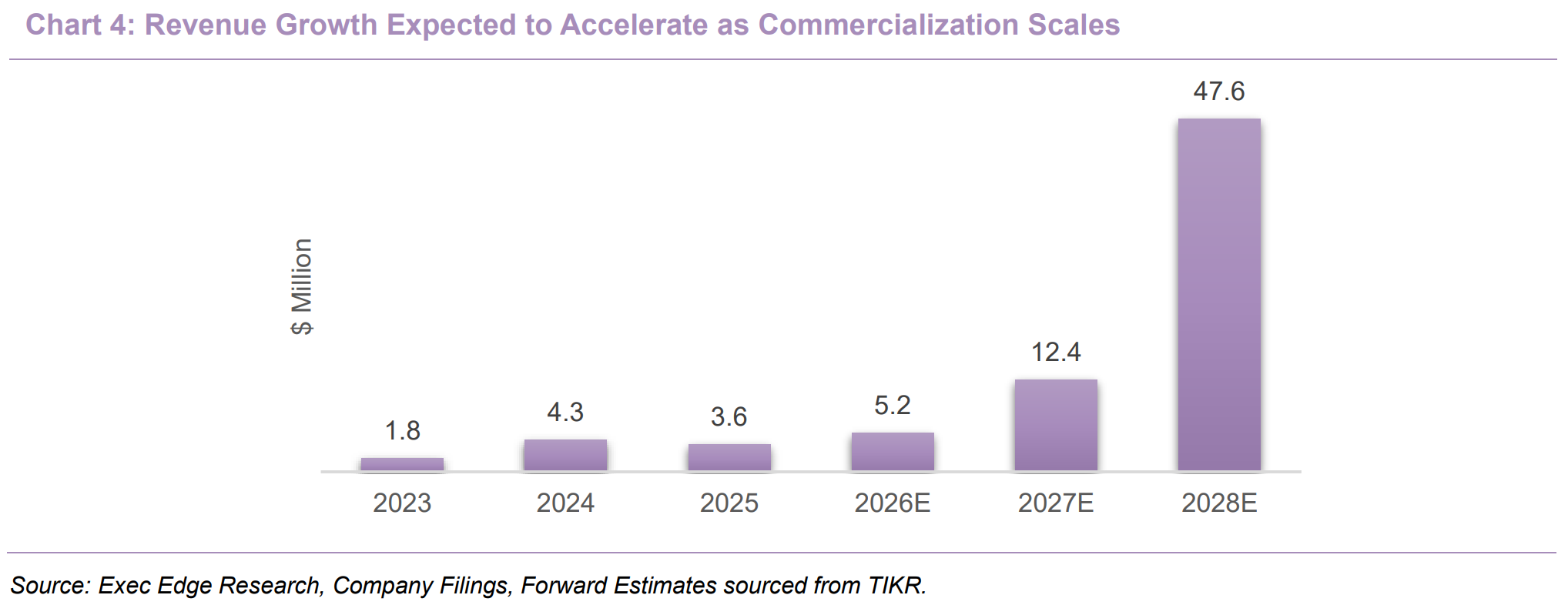
- The Sustainable Ingredients opportunity extends beyond the initial BioFragrance products, providing an early test of whether CBUS can replicate its platform model across multiple end markets. Additional fragrance molecules can build on the same edited-yeast platform and underlying process, reducing the amount of foundational work required for subsequent products, while the partner-funded lauric oils program in soybean extends the strategy into plant-derived specialty ingredients. The model is attractive because external partners can help fund development while CBUS retains exposure to commercialization economics without owning downstream consumer distribution or the end-consumer relationship. BioFragrance therefore matters not only as a potential $20-$40 million annual revenue opportunity, but as an emerging validation point for whether the company’s editing capabilities can generate revenue beyond row-crop trait royalties. With 2Q26 revenue still only $1.0 million and Street estimates sourced from TIKR indicating approximately $5.2 million of 2026 revenue, execution on 2H26 scale-up activity is increasingly important to delivering the revenue ramp embedded in current estimates.
- Regulatory momentum broadened materially during the quarter, improving commercial optionality across Europe while adding validation in the U.S. and LATAM. The European Union approved rules in June that generally allow precision-edited crops with genetic changes comparable to conventional breeding and no added foreign DNA to receive conventional-like treatment, with implementation now entering an approximately two-year period. Herbicide-tolerant plants and plants engineered to produce insecticidal substances remain excluded from that treatment, making disease resistance and Pod Shatter Reduction more directly relevant European opportunities. CBUS expects Pod Shatter Reduction in winter oilseed rape to be its first planned submission under the new framework, complementing England’s existing Precision Bred Organisms regime. Ecuador has confirmed HT1 and HT3 rice traits are equivalent to conventional breeding, while Peru has established a case-by-case technical framework under which gene-edited products lacking foreign DNA may be excluded from its MVO classification and GMO moratorium. USDA-APHIS has determined CBUS traits are not regulated articles subject to its biotechnology regulations, and the FDA completed review of the altered-lignin alfalfa trait with no further questions. For the programs covered by these determinations, commercial execution is increasingly shifting toward partner conversion, definitive agreements and seed deployment as regulatory pathways become clearer.
- Customer acquisition is centered on converting technical programs into deep, multi-product relationships, increasing the economic value of seed-company partnerships while improving development efficiency. CBUS’ commercial model starts by editing a partner’s elite germplasm, returning improved material and then expanding the relationship as the customer opens more of its breeding roadmap to the platform. Interoc’s expansion from two contemplated rice traits to five provides early evidence of that strategy, while CBUS continues discussions beyond its seven existing rice customers with seed companies in Brazil, Argentina and India. Europe provides an additional business-development channel, supported by a small local team with decades of seed-industry experience and established relationships across the region.
- Partner-funded programs allow CBUS to preserve broader crop optionality without spreading internal capital evenly across the portfolio. Nutrient Use Efficiency work with the John Innes Centre remains partner funded, with edited canola material expected to transfer in 3Q26 and potential applicability across rice, wheat and canola; Pod Shatter Reduction is moving toward expanded U.K. trials after two years of encouraging field results in customer germplasm; and second-generation canola herbicide-tolerance trials continue to show tolerance levels consistent with a potential new weed-management solution. This structure allows CBUS to keep advancing potentially valuable programs while concentrating internal resources on rice, Sustainable Ingredients and technologies that can accelerate multiple customer programs, improving capital efficiency while retaining longer-duration platform upside.
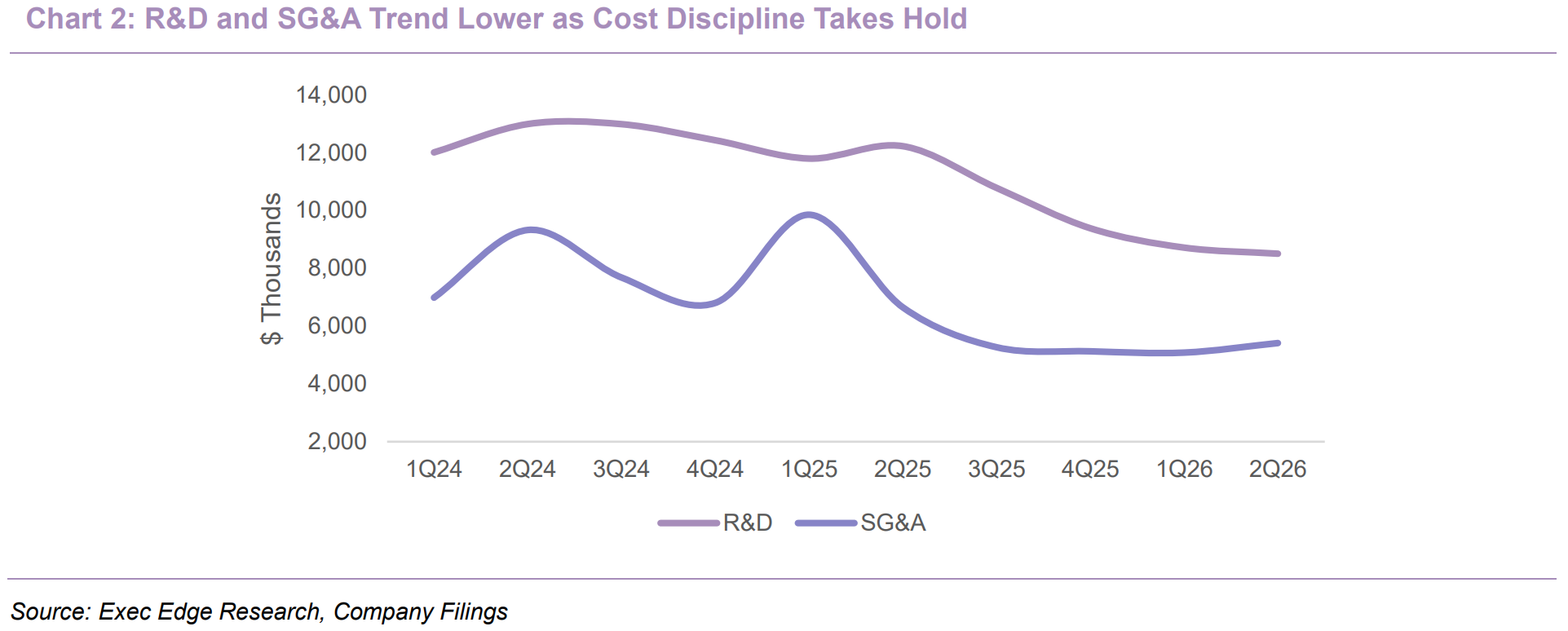
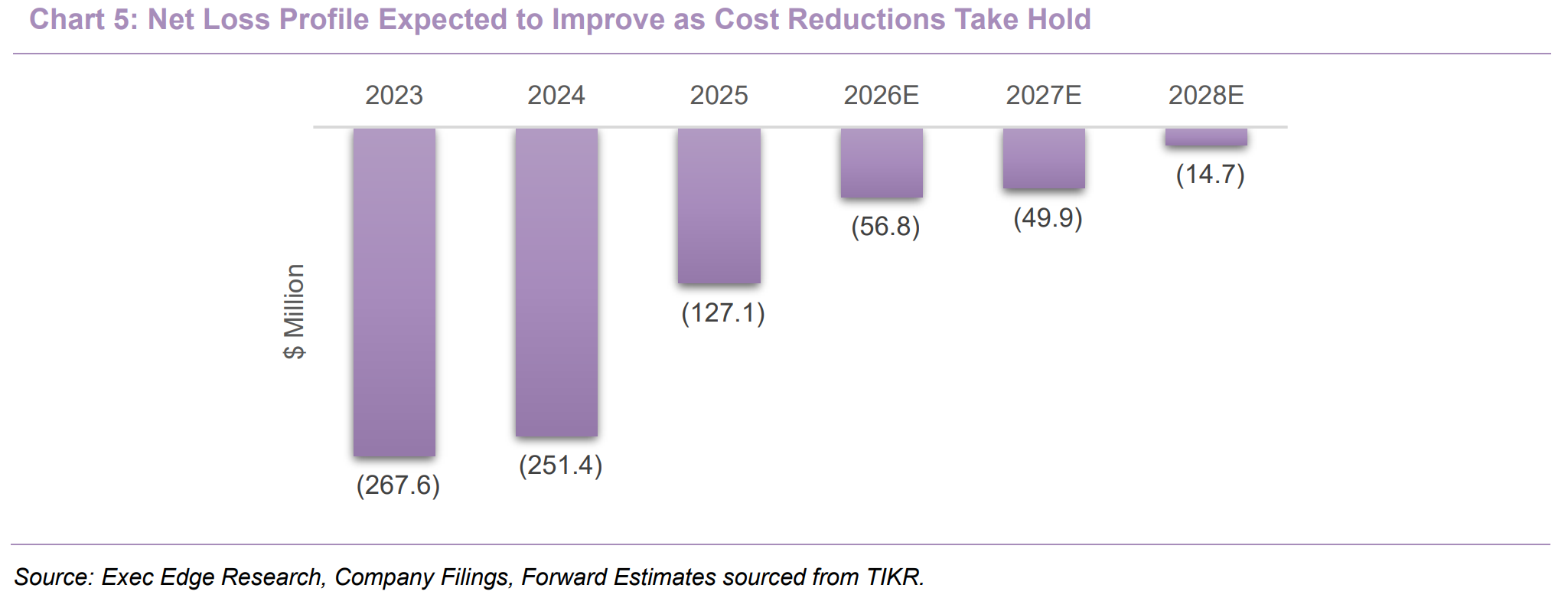
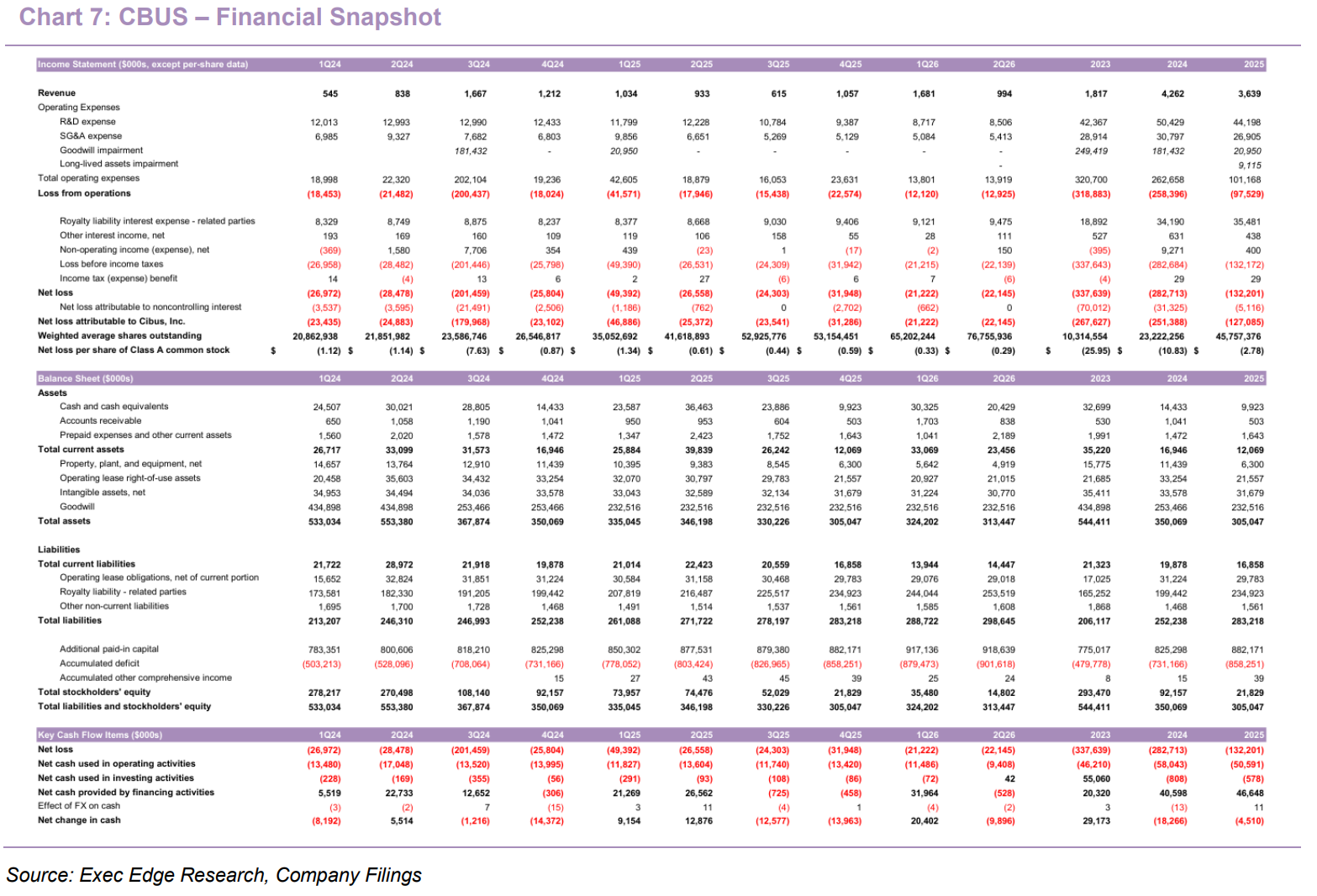
- Cost discipline remains visible in the P&L, while selective investment in technology and AI is intended to increase development capacity without rebuilding the prior expense structure. R&D declined 30% y/y to $8.5 million from $12.2 million, while SG&A fell 19% to $5.4 million from $6.7 million, bringing R&D and SG&A combined down nearly $5 million, or 26%, to $13.9 million. Operating loss consequently narrowed 28% to $12.9 million from $17.9 million, while net loss improved 17% to $22.1 million from $26.6 million and loss per share narrowed to $0.29 from $0.61. The gap between operating and net loss remains largely driven by $9.5 million of non-cash related-party royalty-liability interest expense, up from $8.7 million y/y, representing the largest reconciling item. Additional non-core savings are expected as facility consolidation is completed, while management is redirecting part of those savings toward commercial priorities, personnel and technology, including company-wide AI deployment aimed at improving employee productivity at less than the cost of equivalent incremental headcount. Over time, these investments could allow the same organization to support more crop and customer programs, helping platform revenue scale against a leaner cost base.
- Cash burn continues to trend lower, improving operating efficiency as CBUS funds the path to commercialization. Cash and cash equivalents declined to $20.4 million at June 30 from $30.3 million at March 31, while quarterly net cash usage declined approximately 19% sequentially and 31% y/y. Net cash used in operating activities was $20.9 million in 1H26 versus $25.4 million in 1H25, a $4.5 million improvement, and management is moving toward approximately $9 million of quarterly usage while targeting an annualized net cash-usage run rate of ~$35 million or less exiting 2026. Importantly, working capital was not a source of cash support: accounts payable declined to $5.6 million from $8.1 million at year-end, accrued compensation fell to $2.6 million from $3.1 million, while accounts receivable increased to $0.8 million from $0.5 million. With PP&E declining to $4.9 million from $6.3 million and 1H26 capital purchases of only about $0.1 million, the funding requirement remains primarily operating rather than capital-intensive. Existing cash is expected to support planned operating expenses and capital requirements into early 1Q27 absent additional financing, leaving capital access central to the near-term investment case as CBUS bridges toward BioFragrance scale-up and first rice royalties in 2028.
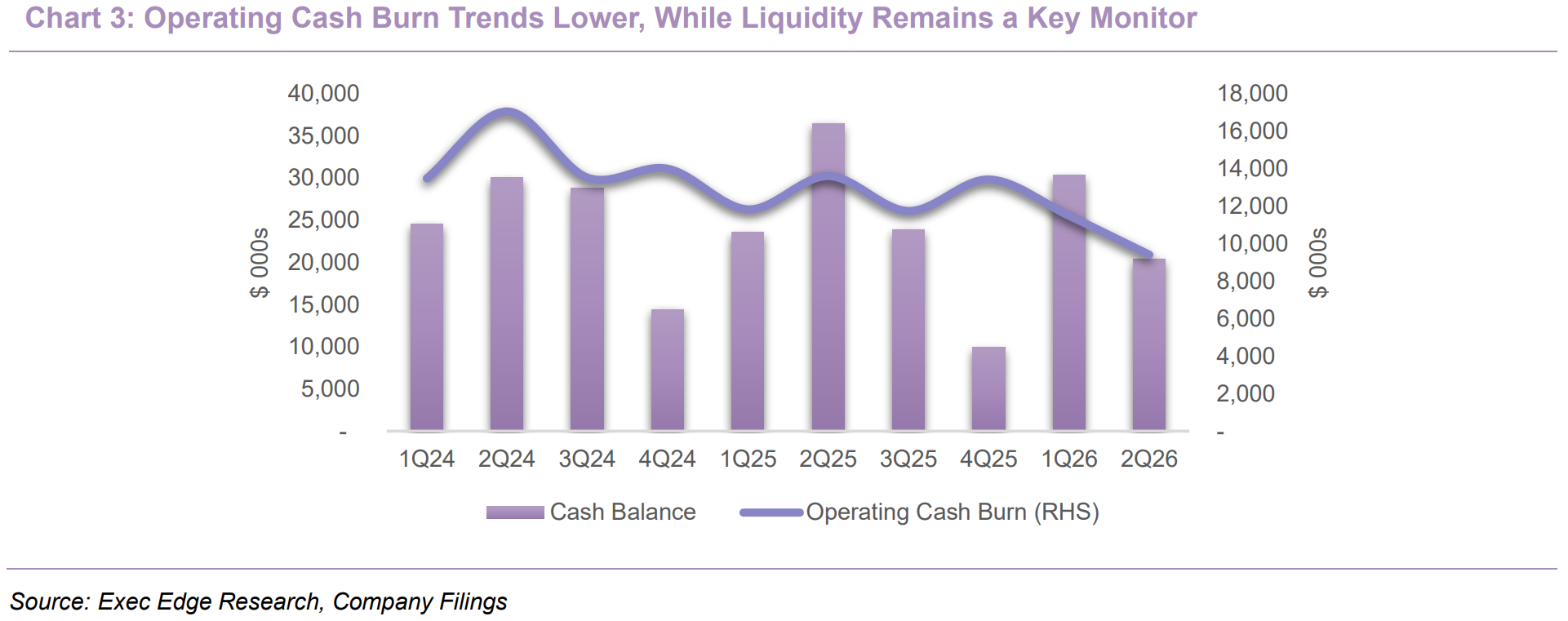
- Balance sheet reflects substantial equity funding during 1H26, providing near-term liquidity, while the new ATM adds additional financing flexibility. CBUS generated $31.4 million of net financing cash flow in 1H26, including approximately $19.8 million of net proceeds from the January offering and $13.6 million from the March offering. In May, the company also established a $50 million ATM facility with Jefferies, with only minimal utilization through June 30, preserving additional capacity should market conditions support further issuance. The ATM therefore provides an important bridge option, while the timing and economics of future issuance will remain relevant to per-share value creation as CBUS works toward BioFragrance scale-up and initial rice royalties in 2028.
- The near-term outlook points to a stronger revenue trajectory and continued narrowing of losses, supported by Sustainable Ingredients activity and a structurally lower cost base ahead of rice commercialization in 2028. As a near-term reference point, 3Q26E revenue is estimated at approximately $1.3 million based on Street estimates sourced from TIKR, as BioFragrance scale-up activity and collaboration milestones become more important. Annual estimates call for revenue to increase from $3.6 million in 2025 to $5.2 million in 2026E, $12.4 million in 2027E and $47.6 million in 2028E, reflecting a larger commercialization inflection as rice royalties begin to contribute. The lower operating-cost base should also support continued improvement in earnings, as annual loss is expected to narrow from $127.1 million in 2025 to $56.8 million in 2026E, $49.9 million in 2027E and $14.7 million in 2028E. Key milestones over the balance of the year remain additional BioFragrance scale-up orders, successful Interoc testing and progress toward a definitive LATAM commercialization agreement ahead of initial rice royalties in 2028.
 Rice HT Anchors Valuation Framework; Platform Optionality Adds Upside
- Disclaimer: Exec Edge does not publish proprietary estimates, ratings, price targets, or investment recommendations. The valuation discussion below is illustrative only and is based on company filings, management commentary, and third-party data and estimates. It does not constitute a recommendation, price target, rating, or prediction of future pricing.
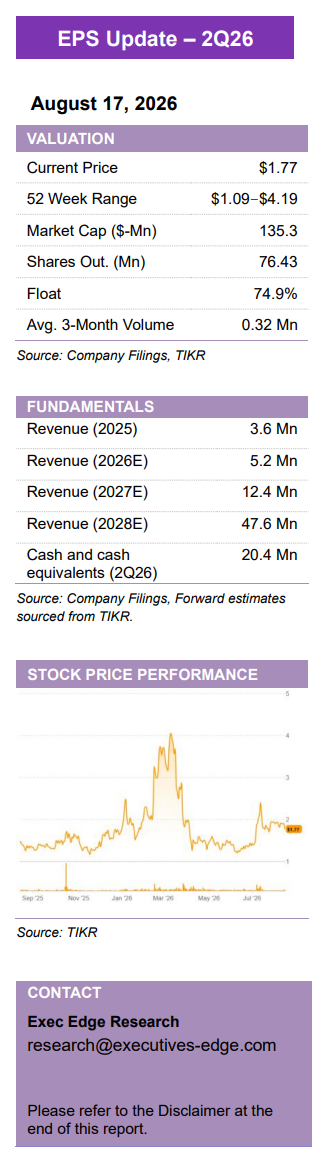
- CBUS’ disclosed Americas rice HT royalty opportunity remains the cleanest base valuation anchor, while the broader trait portfolio provides substantial longer-duration optionality. Management continues to frame the Americas rice herbicide-tolerance opportunity at ~5–7 million peak addressable acres and >$200 million of potential annual royalties at peak. This is not a revenue forecast and should not be treated as de-risked revenue, but remains the most relevant starting point given rice HT is CBUS’ clearest royalty-validation pathway. The opportunity is supported by seven active rice seed-company relationships, ongoing testing of material transferred into Interoc germplasm and the August expansion of the contemplated Interoc relationship from two traits to five. At a share price of approximately $1.77, CBUS’ 76.43 million shares outstanding imply an equity value of approximately $135.3 million, equivalent to ~0.68x the disclosed >$200 million peak Americas rice royalty opportunity before assigning value to Sustainable Ingredients or the broader crop portfolio. The important change this quarter is timing rather than addressable economics: initial LATAM commercialization has moved from late 2027 to 2028, increasing the importance of execution, financing and adoption in determining how much of the disclosed opportunity investors are willing to recognize.
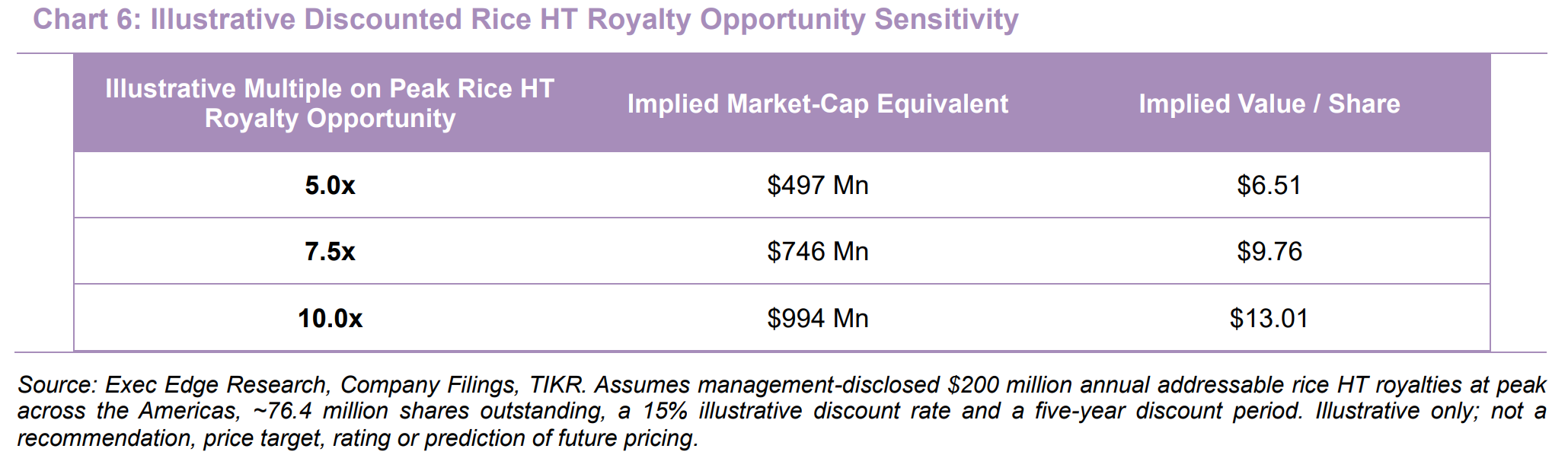
- A discounted rice-only framework continues to illustrate substantial valuation sensitivity if CBUS converts its lead royalty opportunity into recurring acreage economics. Applying an illustrative 5.0x-10.0x multiple to $200 million of peak annual Americas rice HT royalties and discounting the resulting value back five years at 15% produces an equity-value-equivalent range of approximately $497 million to $994 million, or $6.51-$13.01 per share using 76.43 million shares outstanding; the 7.5x midpoint implies approximately $746 million, or $9.76 per share. The framework is intended to capture the potential economics of a mature royalty stream rather than apply a conventional agricultural revenue multiple, since successful trait royalties should carry materially higher incremental margins than a seed-manufacturing model. Importantly, this remains an illustrative sensitivity rather than a forecast: realizable value depends on definitive LATAM commercial economics, successful Interoc testing and seed production, farmer adoption, Albaugh’s U.S. herbicide-registration timeline, IP durability, capital requirements and the pace at which the 5–7 million-acre opportunity converts into royalty-bearing acreage. The move to a 2028 LATAM launch does not alter the underlying methodology, but increases the importance of commercial agreements and launch readiness in determining how much of the illustrative value investors are willing to recognize.
- Sustainable Ingredients adds nearer-term optionality and could become increasingly relevant to valuation if current scale-up activity converts into repeatable commercial economics. Sustainable Ingredients supported $2.7 million of 1H26 revenue, up 36% y/y, following the first BioFragrance customer payment in 4Q25, with additional scale-up orders still targeted for 2H26. Management estimates that fully commercialized BioFragrance partnerships could represent $20-$40 million of annual revenue. Applying an illustrative 5.0x-8.0x multiple and discounting the resulting value back five years at 15% implies approximately $0.65-$2.10 per share of incremental value. We would not include that value in the base rice case at this stage, however, given limited disclosure around commercial order size, pricing, margin structure, exclusivity and recurring economics. The more important near-term valuation driver is whether 2H26 scale-up orders convert into larger commercial activity and whether subsequent fragrance products can move through the same edited-yeast process with lower incremental development requirements.
- The broader trait portfolio adds meaningful optionality, but valuation still hinges on execution and funding discipline. Management’s productivity-trait pipeline spans ~367-369 million acres and >$1.9 billion of potential annual royalties, versus 5-7 million acres and >$200 million for Americas rice HT. Programs extend across rice, canola, soybean and longer-duration traits, with Interoc’s expansion from two to five traits signaling deeper customer engagement. However, these opportunities remain less de-risked than rice, and the shift of LATAM royalties to 2028, alongside $20.4 million of cash and runway into early 1Q27, keeps execution and financing risk central. The key rerating drivers remain a definitive LATAM commercialization agreement, successful Interoc testing and launch preparation, 2H26 BioFragrance scale-up orders and disciplined funding execution. Progress across these milestones would support greater recognition of the rice royalty base while increasing the value attributed to Sustainable Ingredients and the broader trait portfolio.
- Street consensus provides a useful external reference point. The current mean Street price target of $14.33, sourced from TIKR, sits above the $13.01 high end of the illustrative rice-only framework, suggesting consensus incorporates some value beyond the Americas rice HT opportunity, including Sustainable Ingredients scale-up, broader crop programs, geographic expansion and the RTDS / Trait Machine platform.
Read Exec Edge’s Initiation on Cibus, Inc. Here
Subscribe to our Weekly Newsletter to Receive All Research
Contact: