Download the Complete Report Here
 Einride AB (ENRD)
Record Contracted ARR Growth Strengthens Revenue Visibility; Autonomous Commercialization Gains Momentum
- Key Takeaways:
- Revenue conversion is accelerating, with 3Q growth of 27% sequentially and reaffirmed guidance supporting a strong 4Q26 exit.
- Record contracted demand significantly strengthens growth visibility, with CARR surging 76% to $167 million and supporting over 65% of the December 2027 revenue run-rate target.
- Fleet scaling and improving unit economics underpin the path to breakeven, with Tesla Semi deployments supporting 2027 expansion and electric operations driving the 2028 cash flow target.
- Autonomous commercialization and NVIDIA collaboration strengthen ENRD’s technology moat, with driverless hours up 57% and a clearer pathway toward highway autonomy and asset-light licensing.
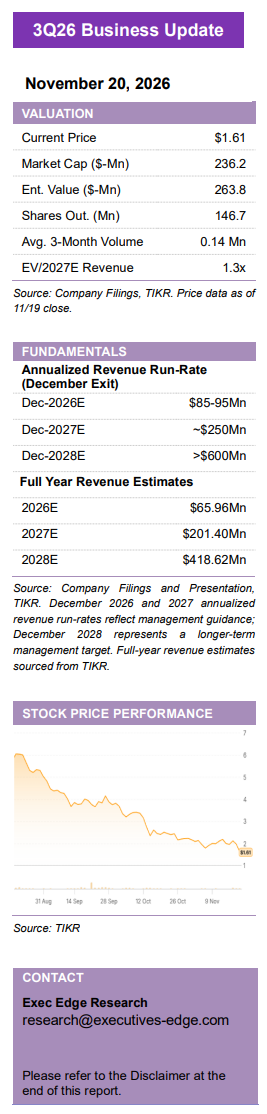
- Valuation disconnect creates meaningful re-rating potential, with shares trading at 1.3x 2027E and 0.6x 2028E revenue despite improving commercial visibility and expanding technology opportunities.
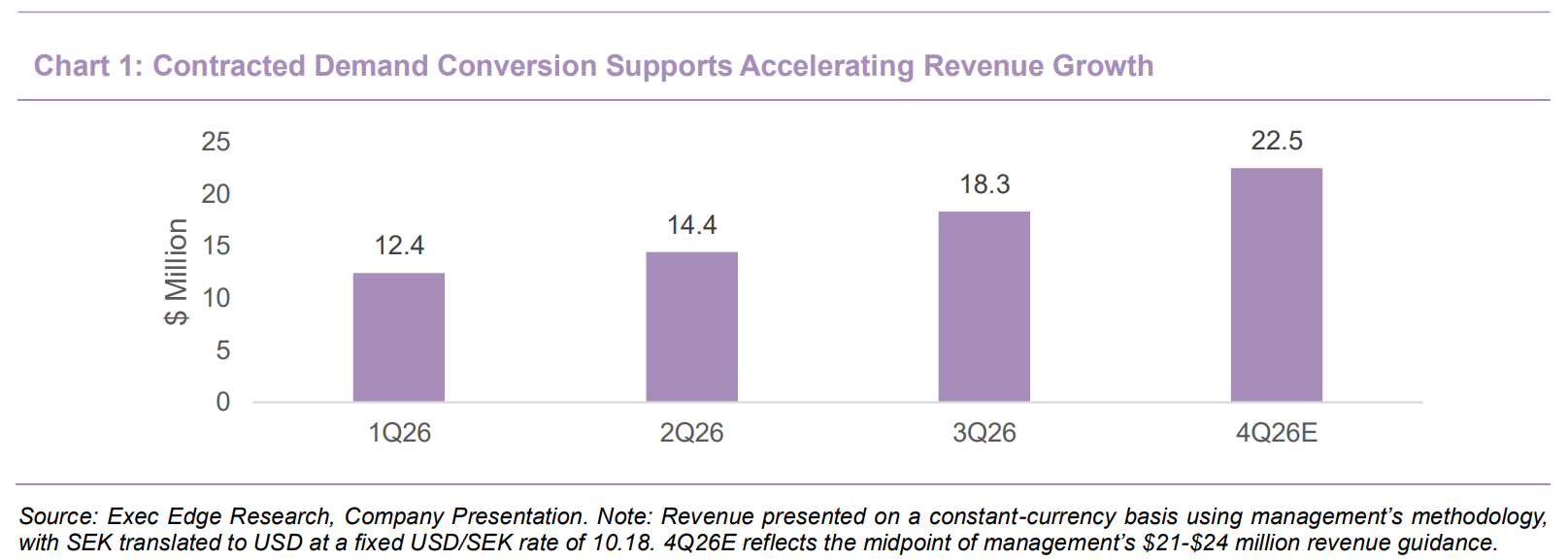
- Revenue acceleration in 3Q26 reinforces ENRD’s transition from contracted demand to scaled commercial deployment. Constant-currency revenue increased 27% sequentially to $18.3 million from $14.4 million in 2Q26, driven by expanded capacity with existing customers and new deployments. Reported revenue grew 25% sequentially to $19.1 million. ENRD reaffirmed its 2H26 constant-currency revenue guidance of $39 million to $42 million, representing 60% to 73% y/y growth and implying approximately $21 million to $24 million in 4Q26, or 13% to 30% sequential growth. The September annualized revenue run-rate reached $76 million versus $49 million in December 2025, supporting the guided $85 million to $95 million December 2026 exit rate. The accelerating revenue trajectory reinforces ENRD’s commercial scaling thesis, with contracted demand increasingly translating into operating revenue and fleet deployment and utilization emerging as the primary growth drivers.
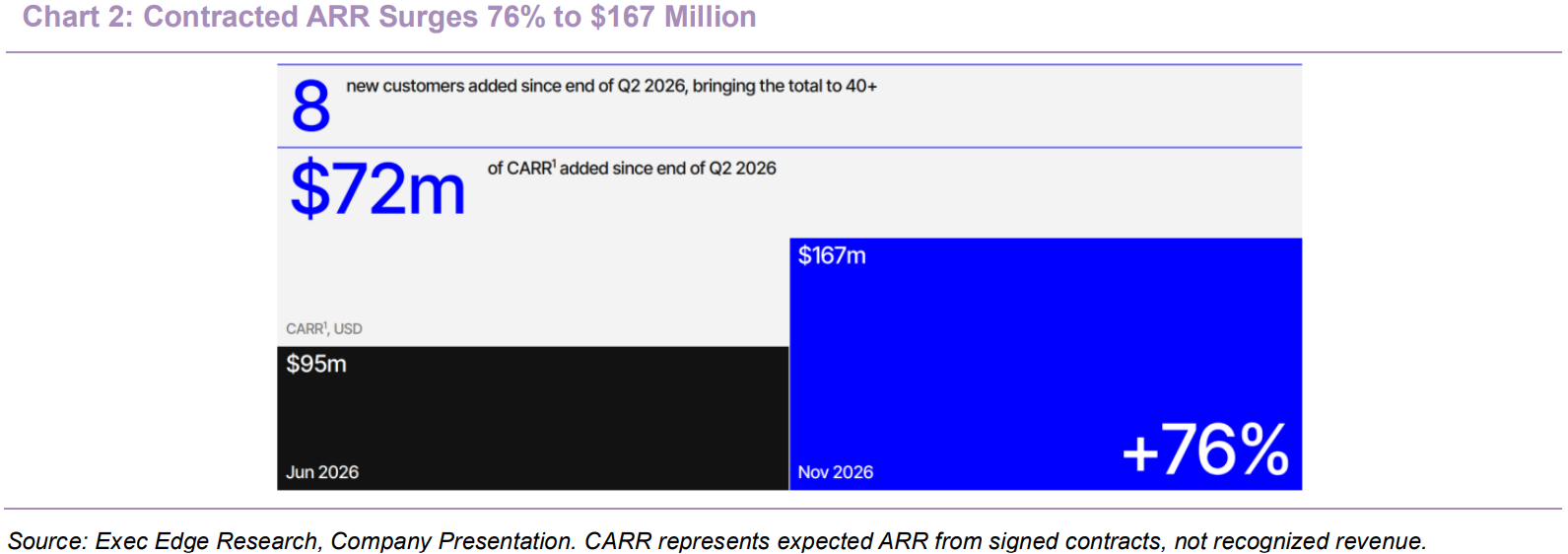
- Record contracted ARR growth strengthens ENRD’s 2027 revenue visibility and reinforces its commercial scaling thesis. Contracted annual recurring revenue (CARR) surged 76% to $167 million as of November 2026 from $95 million at June-end, representing $72 million of additional signed customer commitments. Growth came from expansion with existing customers and eight new customer additions, taking the total to more than 40 global shippers. Importantly, over 65% of the newly introduced $250 million December 2027 annualized revenue run-rate guidance is already covered by CARR, providing meaningful visibility into next year’s targeted revenue scale. This represents approximately 2.6x to 2.9x the guided December 2026 exit rate, with much of the planned expansion supported by contracted rather than prospective customer demand. The sharp increase in signed commitments strengthens revenue visibility and shifts the investment focus increasingly toward converting contracted capacity into operating revenue as ENRD scales its fleet.
- Enterprise customer expansion and favorable electric freight economics continue to strengthen commercial momentum. ENRD added eight new customers since June, maintaining its focus on large transportation buyers across FMCG, industrials, food, and retail. The strategy centers on initial deployments that establish operating relationships before expanding into additional routes and markets. Lidl’s Swedish operations illustrate this approach, with annual electric freight distance increasing 76% from 474,000 to 832,000 kilometers. Existing customer relationships also underpin ~$800 million of potential ARR through non-binding Joint Business Plans, with ENRD targeting a mid-single-digit share of customer freight in selected markets and higher penetration within individual hubs. Rising diesel prices, up ~64% since March 2026, have further strengthened the economic case for electric freight, where electricity accounts for approximately 5% of total operating costs versus 25% to 35% for diesel fuel, supporting customer adoption and creating additional opportunities to convert ENRD’s $800 million JBP pipeline into signed contracts.
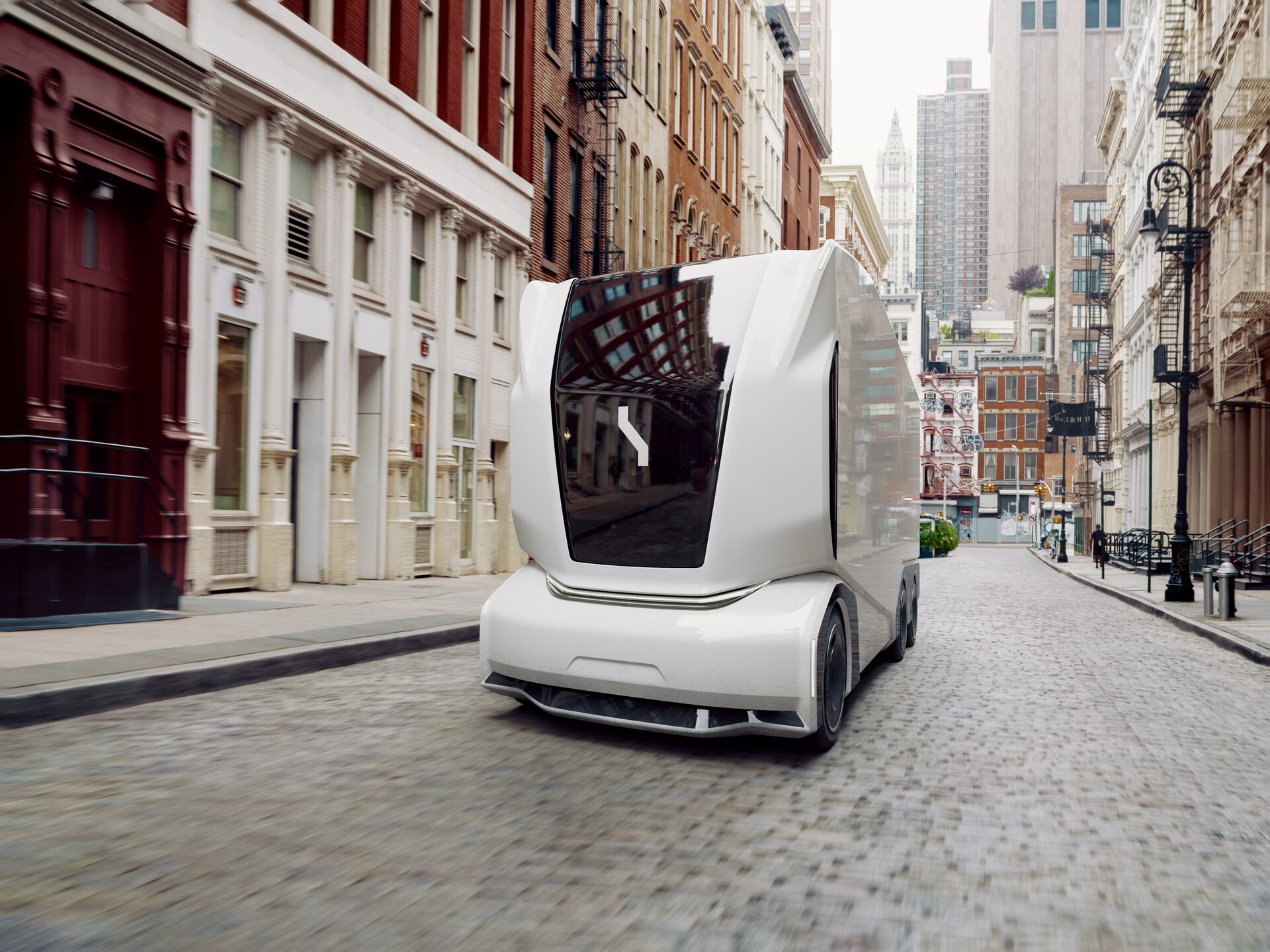
- Tesla Semi rollout and improving fleet utilization underpin a substantial step-up in 2027 revenue productivity. ENRD currently operates more than 260 electric and 10 autonomous trucks, with initial deployments of the 500 Tesla Semis expected before year-end 2026 and most vehicles entering service during 2027. The trucks will operate on Saga AI under existing customer contracts, supporting the targeted $250 million December 2027 annualized revenue run-rate. Importantly, management expects to achieve the $250 million December 2027 annualized revenue target with approximately 800 trucks, implying approximately $312,500 in annualized revenue per vehicle as utilization improves. The rollout builds on existing enterprise deployments, including Amazon’s 75-truck program, and supports growth through both fleet expansion and higher revenue per truck.
- Expanding charging access and network optimization support faster conversion of contracted demand into active capacity. Customer deployment timelines range from several weeks to five or six months, depending largely on charging availability and operating requirements. With truck availability improving, ENRD is increasingly focused on coordinating charging infrastructure through third-party networks, customer-site installations, and infrastructure partnerships, including Tesla in the U.S. Saga AI supports this process by identifying profitable routes based on freight demand and charging access, allowing ENRD to expand utilization and network density as infrastructure develops.
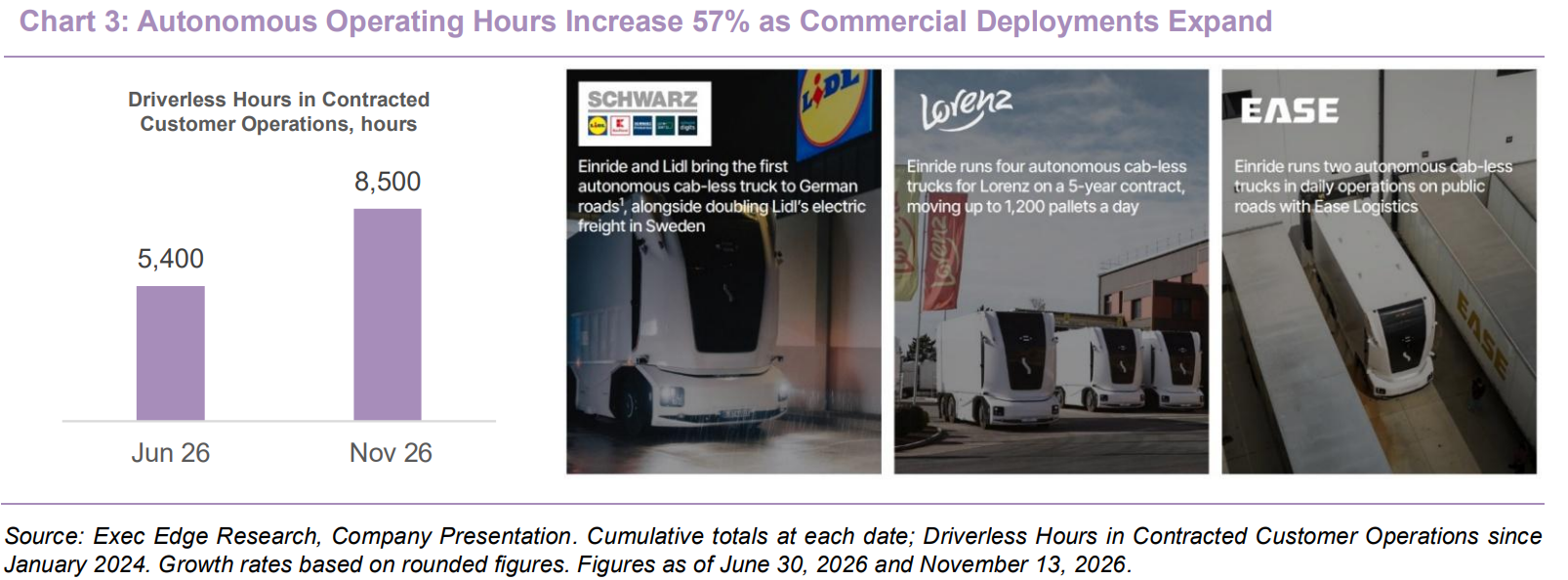
- Autonomous commercialization advances with three new deployments and a 57% increase in driverless operating hours. Cumulative driverless hours reached approximately 8,500 in November from 5,400 in June, with ENRD operating 10 autonomous trucks and holding driverless permits across four countries and five U.S. states. In Germany, ENRD launched cab-less public-road operations for Lidl, targeting more than 3,000 pallets over four months, while its broader relationship with Lidl and parent Schwarz Group has expanded to 19 trucks across three markets. ENRD also deployed four autonomous trucks for Lorenz Snacks under a five-year contract, handling up to 1,200 pallets daily, and two trucks for EASE Logistics in Ohio. These deployments demonstrate ENRD’s progression from autonomous validation toward recurring commercial operations across multiple customers and operating environments, reinforcing the scalability of its autonomous freight platform.
- NVIDIA collaboration advances ENRD’s highway autonomy roadmap through a more capital-efficient AI development model. ENRD plans to leverage NVIDIA Alpamayo, a 34 billion parameter reasoning model, to develop its next-generation Einride Driver, distilling it into an approximately 1 billion parameter model optimized for heavy-duty trucks. The system is designed to run on NVIDIA’s dual-Thor Hyperion platform, supported by NVIDIA Halos safety architecture and Cosmos simulation tools. ENRD’s revenue-generating fleet can collect up to 5.4 terabytes of raw data per truck per hour, providing proprietary training data without developing a large foundation model from scratch. A live-road evaluation is planned for 2H27, with highway autonomy targeted for 1H28, extending ENRD’s existing commercial driverless capabilities toward longer-distance freight.
- Saga AI’s growing operational data advantage strengthens ENRD’s freight economics and autonomous development capabilities. The platform has optimized more than two million days of transport orders, reduced planning time by over 80%, and draws on more than 20 million miles of customer operations. By integrating freight planning, vehicle allocation, charging, and driver scheduling, Saga AI helps deliver a 5% to 10% TCO advantage over diesel today. ENRD expects this advantage to reach 25% to 30% as autonomous trucks approach half of its fleet, with autonomous truck savings potentially reaching 35%. Importantly, data generated through electric freight operations also trains Einride Driver, linking current commercial activity directly to future autonomous capabilities.
- Flip AI and new partnerships expand ENRD’s software monetization opportunities beyond its operating fleet. Launched in August, Flip AI automates charging diagnostics, maintenance workflows, and fleet management, building on Flipturn’s footprint of more than 5,000 charging ports and 250 MW of managed capacity. ENRD is also developing independent licensing streams for Saga AI and Einride Driver, with the DAF partnership progressing toward software integration in 2027. In defense, a new partnership with UNIQAI Systems adds AI-driven mission planning to ENRD’s autonomous logistics platform, complementing its existing Centinus collaboration. ENRD estimates a $7 billion to $13 billion defense market opportunity through 2030. Together, these initiatives extend ENRD’s addressable market beyond owned-fleet operations and establish a pathway toward higher-margin, asset-light revenue streams as software licensing and autonomous technologies commercialize.
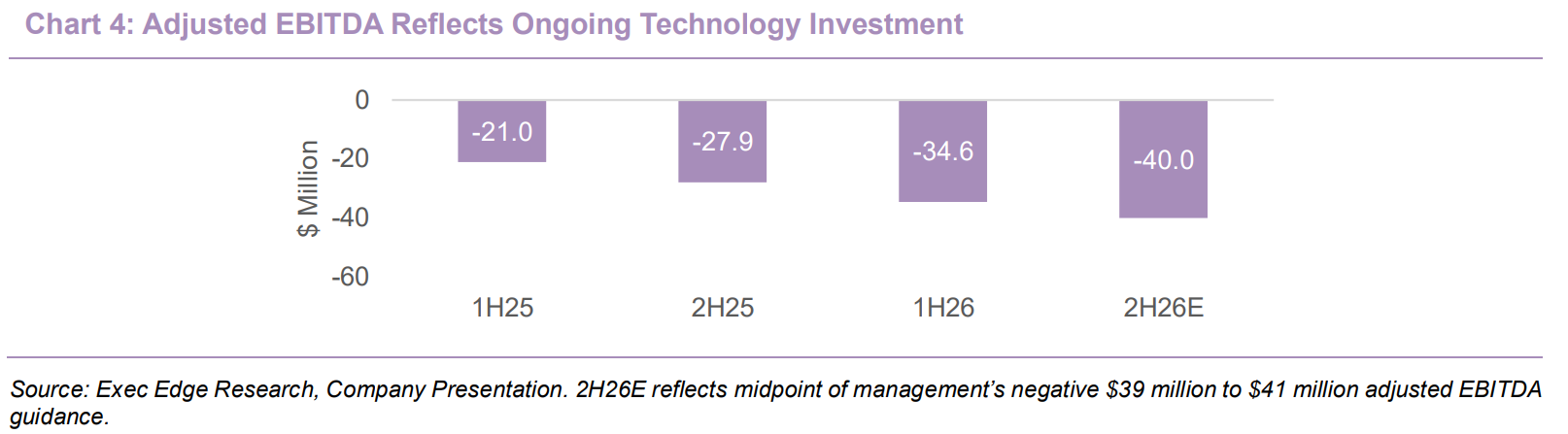
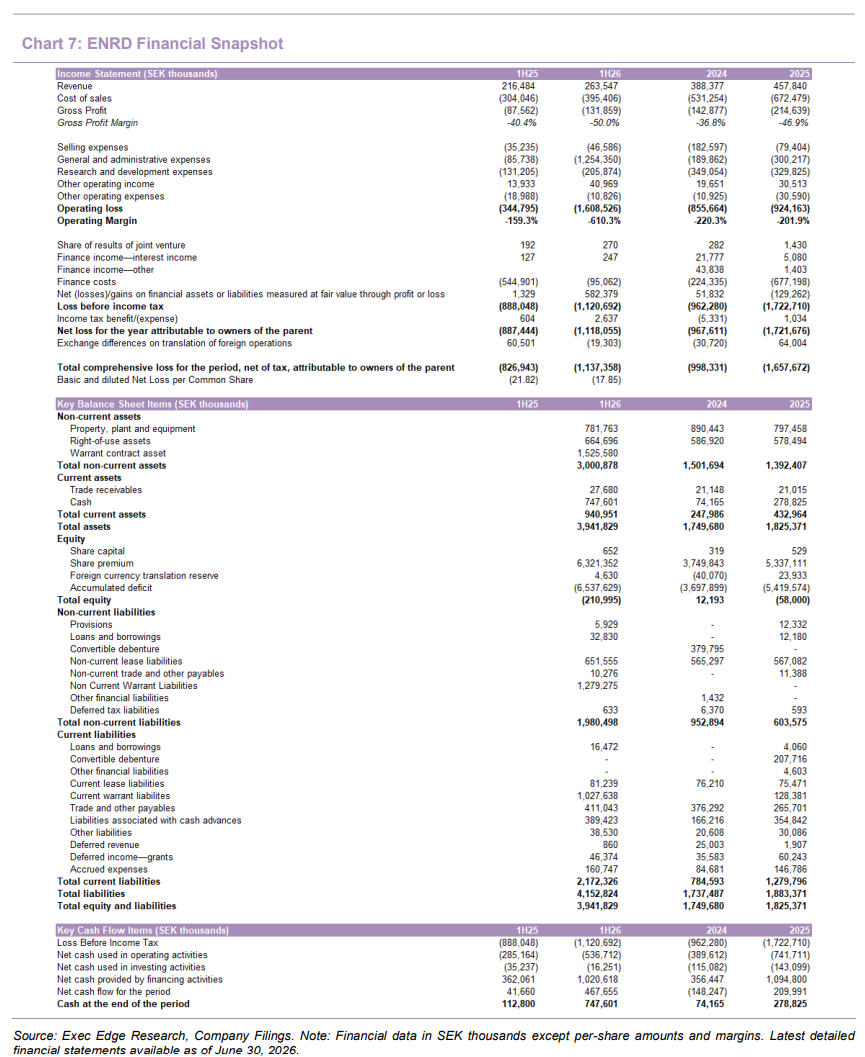
- Contribution margins remain on track despite higher investment in technology and commercial expansion. ENRD reaffirmed 2H26 contribution-margin guidance of 21% to 23%, compared with 20.7% in 1H26, supported by improving fleet utilization. 3Q adjusted EBITDA was negative $20.3 million, while 2H26 loss guidance was revised to $39 million to $41 million from $35 million to $37 million, reflecting increased R&D, commercial, and public company spending. Reported net profit of $95.3 million included approximately $133.8 million of non-cash fair-value gains and therefore does not reflect underlying operating performance. The combination of improving contribution margins and elevated investment spending highlights the importance of scaling revenue and fleet utilization to drive operating leverage and narrow losses as ENRD progresses toward its 2028 breakeven target.
- Third-party fleet financing supports capital-efficient expansion, while liquidity and funding remain critical to ENRD’s growth trajectory. Cash declined to $53 million at September-end from $77 million in June. In 1H26, operating cash outflows increased to SEK536.7 million from SEK285.2 million in 1H25, despite SEK143 million of working-capital inflows. ENRD expects to fund vehicle expansion primarily through asset-backed facilities and contracted cash flow financing, with certain arrangements targeting up to 100% financing of vehicle costs. This structure supports the Tesla rollout while directing corporate resources toward technology and commercial growth. Management also confirmed that additional capital will be required before 2028 cash flow breakeven and is evaluating financing opportunities. Separately, a September arbitration award favored BYD for approximately $56 million plus costs and fees, relating to 116 electric trucks, with ENRD intending to challenge the decision. The potential liability is material relative to ENRD’s $53 million cash balance, reinforcing the importance of securing additional capital while scaling toward breakeven.
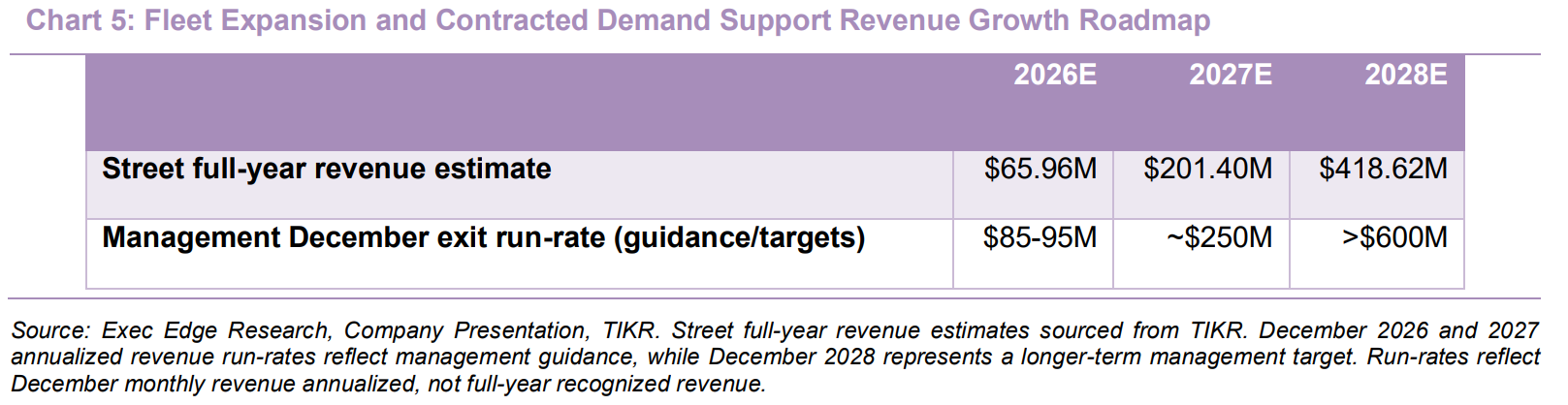
- Electric fleet expansion provides a clear path toward 2028 cash flow breakeven, with substantial revenue growth potential beyond. ENRD expects approximately $250 million in annualized revenue by December 2027, followed by management targets of more than $600 million by December 2028 and $2 billion by December 2030. Street estimates sourced from TIKR project full-year revenue of $65.96 million in 2026, $201.4 million in 2027, and $418.62 million in 2028, implying growth of approximately 205% in 2027 and 108% in 2028. Cash flow breakeven is targeted for 2028 with 1,500 to 2,000 vehicles in operation, centered around approximately 1,750 trucks. Importantly, the breakeven framework is driven predominantly by electric freight operations, with limited autonomous contribution assumed, providing a path based on fleet deployment, utilization, and contribution margins. Autonomous commercialization and software licensing provide incremental growth and margin expansion opportunities beyond the electric freight-led breakeven model.
Contracted Revenue Visibility and Autonomous Commercialization Support Re-Rating
- Disclaimer: Exec Edge does not publish proprietary estimates, ratings, price targets, or investment recommendations. The valuation discussion below is illustrative only and is based on company filings, management commentary, and third-party data and estimates. It does not constitute a recommendation, price target, rating, or prediction of future pricing.
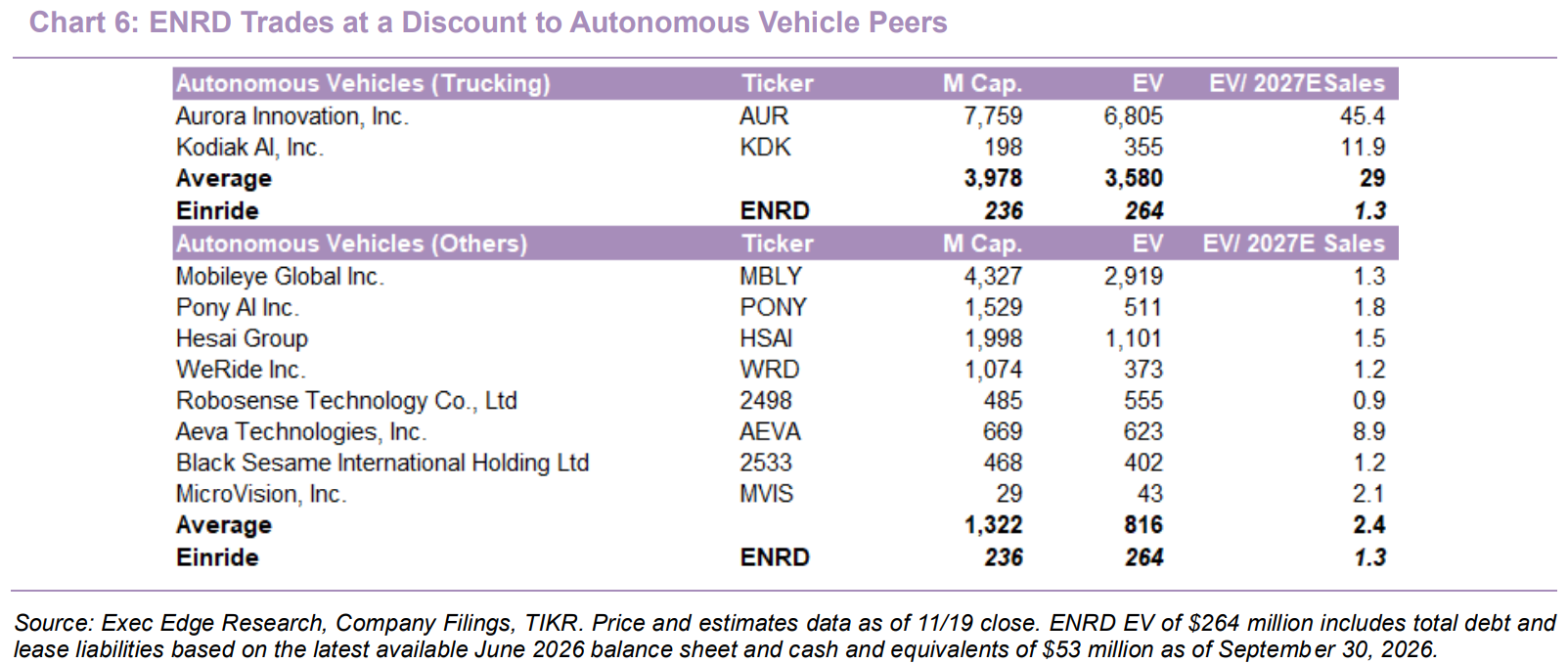
- ENRD’s valuation has reset sharply despite accelerating contracted demand, improving revenue visibility, and a more defined path to scale. As of 11/19 close, ENRD has a market capitalization of $236 million and an indicative enterprise value of $264 million. Shares have declined 73.3% from the August update, despite contracted ARR increasing 76% to $167 million. At current EV, ENRD trades at approximately 4.0x 2026E, 1.3x 2027E, and 0.6x 2028E Street revenue estimates. The December 2027 annualized revenue run-rate guidance of $250 million is supported by over 65% contracted coverage and a planned fleet of approximately 800 trucks, while the 2028 roadmap targets cash flow breakeven with 1,500 to 2,000 vehicles. The divergence between strengthening commercial fundamentals and sharply compressed forward valuation multiples creates meaningful re-rating potential as ENRD translates contracted demand into revenue growth, improving fleet economics, and operating leverage.
- ENRD trades at a substantial discount to autonomous trucking peers despite its established revenue base and growing commercial autonomy footprint. Aurora Innovation and Kodiak AI trade at 45.4x and 11.9x EV/2027E Sales, respectively, implying a direct trucking peer average of approximately 29x, while the broader autonomous vehicle and sensing peer group trades at an average of approximately 2.4x. ENRD’s 1.3x 2027E revenue screens below both groups despite its established electric freight operations, $167 million contracted ARR base, and expanding autonomous deployments. While differences in revenue maturity and business models limit direct comparability, ENRD’s combination of contracted freight operations, growing autonomous deployment experience, and emerging software licensing capabilities supports a differentiated valuation proposition relative to pure-play autonomy developers.
- Contracted revenue conversion, improving fleet economics, and capital-efficient deployment provide tangible catalysts for valuation re-rating. ENRD’s $167 million contracted ARR base, planned 500-truck Tesla Semi rollout, and $250 million December 2027 annualized revenue run-rate guidance establish a framework for substantial growth over the next 12 to 18 months. Higher fleet utilization, contribution-margin expansion beyond the guided 21% to 23% range, and increasing software and autonomous monetization should strengthen the operating profile. Importantly, management’s 2028 cash flow breakeven framework is driven predominantly by electric freight operations, with autonomous commercialization and software licensing providing incremental margin and growth upside. The key monitorable remains funding, with $53 million of cash, continued adjusted EBITDA losses, and additional corporate capital required before 2028 breakeven. At current valuation, ENRD offers significant leverage to successful commercial execution, with contracted revenue conversion, improving unit economics, and greater funding visibility providing the foundation for a sustained re-rating.
Read Exec Edge’s Initiation on ENRD Here
Subscribe to our Weekly Newsletter to Receive All Research
Contact: