Download the Complete Report Here
 GrabAGun Digital Holdings Inc. (PEW)
Topline Beat and 290 bps of Margin Expansion Reinforce Digital Platform Thesis; PEW Logistics Scaling and Regulatory Modernization Add Optionality. Attractively Valued.
- Key Takeaways
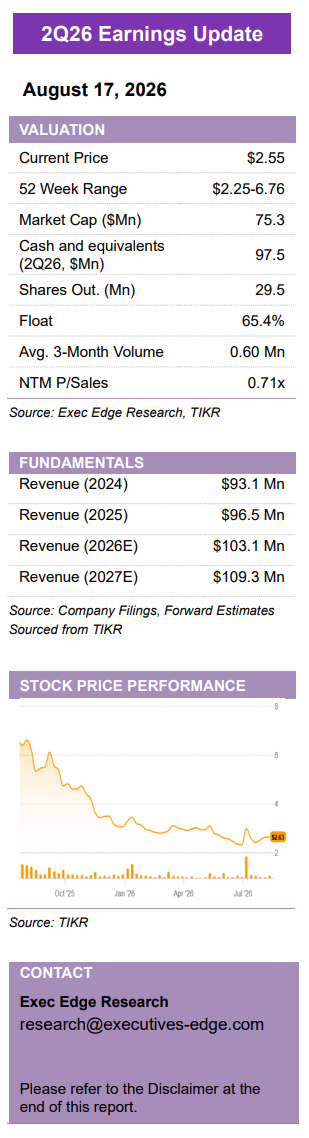
- PEW delivered $23.2 million of 2Q26 revenue, up 9.4% y/y and 4.0% above Street estimates, while gross margin expanded 290 bps to 13.5%.
- Higher AOV, favorable mix and AI-driven pricing supported revenue quality, with marketing cost remaining ~1% of revenue.
- PEW Logistics reached $1.9 million of cumulative GMV and added a third manufacturer, Backwoods Suppressors, broadening validation across regulated product categories.
- Regulatory modernization could reinforce PEW’s digital and compliance moat, while G&A normalization from 3Q26 supports improving operating leverage.
- Valuation remains compelling at 0.71x NTM P/Sales and negative EV despite continued growth, margin expansion and platform optionality.
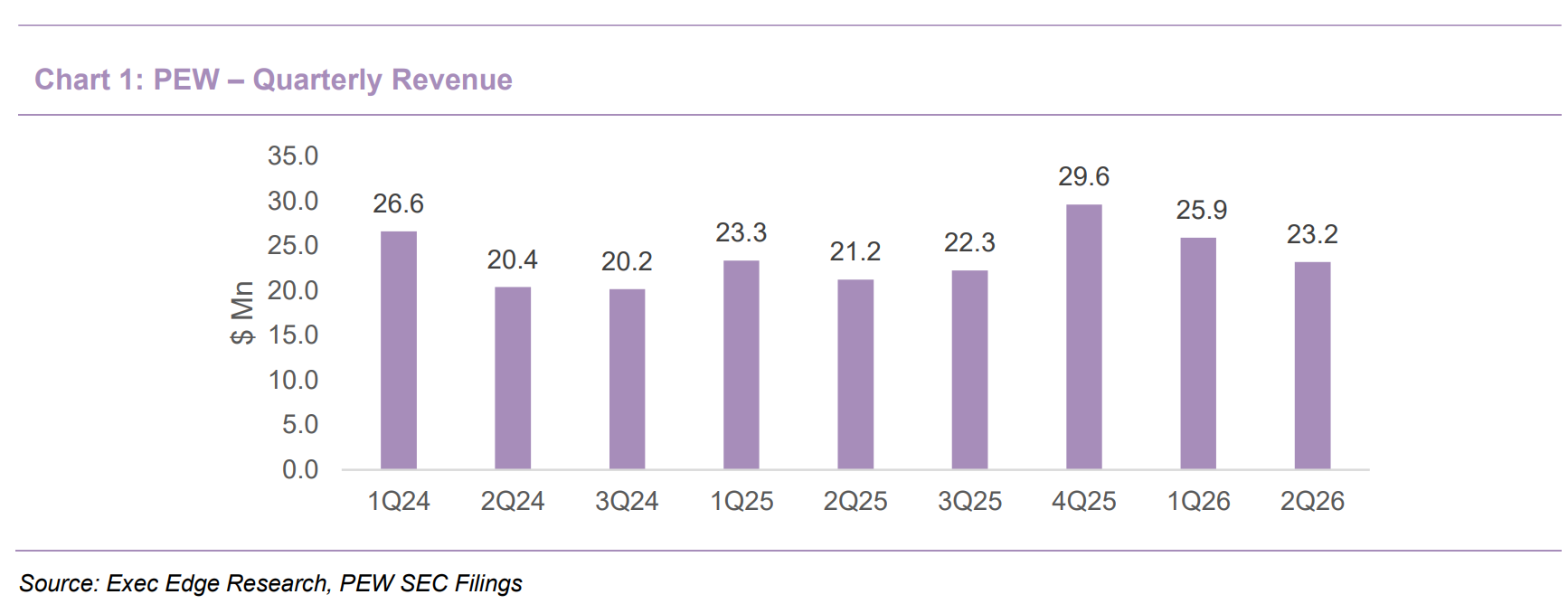
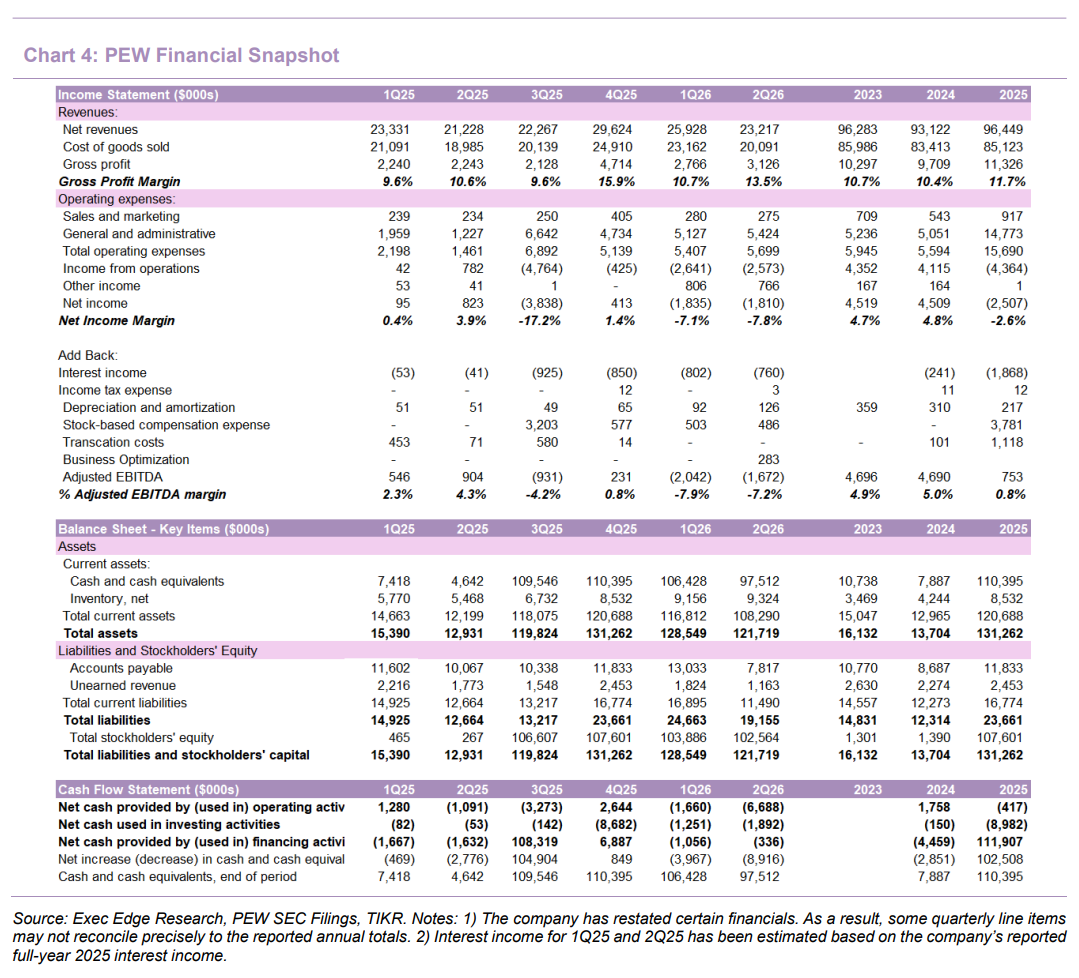
- 2Q26 revenue beat and 290 bps of gross margin expansion strengthened the quality of PEW’s topline performance. PEW reported net revenue of $23.2 million in 2Q26, up 9.4% y/y from $21.2 million and ahead of the $22.3 million Street estimate by $0.9 million, or approximately 4.0%. Revenue increased $2.0 million while cost of goods sold increased only 5.8% to $20.1 million from $19.0 million. Gross profit consequently increased 39.4% y/y to $3.1 million from $2.2 million, while gross margin expanded approximately 290 bps to 13.5% from 10.6%. The divergence between 9.4% revenue growth and 39.4% gross profit growth was a key financial development in the quarter, reflecting AI-driven pricing optimization, improved sourcing, favorable product mix and the initial contribution of PEW Logistics.
- Firearms remained the primary revenue engine, although 2Q26 growth was entirely price and mix led. Firearms sales increased 8.5% y/y to $19.3 million, driven by a 12% increase in average selling price that more than offset a 4% decline in firearm sales volumes. The same pattern was evident through 1H26, with firearm revenue up 9.5% to $41.0 million as average selling prices increased 12% while volumes declined 3%. The mix shift toward higher-priced firearms therefore explains much of the revenue outperformance, with 2Q26 growth driven more by monetization and product mix than underlying unit demand.
- Non-firearms growth was also driven by substantially higher realized pricing and mix despite continued pressure on underlying volumes. Non-firearms revenue increased approximately 7.5% y/y to $3.6 million, reflecting a 30% increase in average selling price that offset an 18% decline in unit volumes, consistent with continued softness in ammunition and a richer mix of adjacent products. For 1H26, non-firearms revenue increased 9% to $7.8 million as average selling prices increased 25% while volumes declined 13%, reinforcing that category growth remained price and mix driven despite weaker underlying unit demand.
- Digital engagement remains healthy, with higher AOV and strong mobile penetration supporting monetization despite softer product volumes. PEW ended 2Q26 with approximately 1.4 million registered accounts and 17.1k monthly transactions across roughly 73,000 active SKUs, while average order value increased 7.4% y/y to $489. The platform generated approximately 10.3 million average monthly page views, maintained a 0.7% conversion rate, average session duration of 4.9 minutes and a 37% bounce rate. Mobile accounted for approximately 71% of sessions, 70% of transactions and 68% of revenue, versus roughly 67%, 70% and 64%, respectively, in 1Q26. Taken together, the data suggest PEW is monetizing a stable conversion funnel through higher basket values and sustained mobile engagement despite softer unit volumes.
- Customer acquisition remained unusually efficient despite double-digit traffic growth, supporting scalability of the digital model. Sales and marketing expense was only $0.3 million in 2Q26, or approximately 1.2% of revenue, compared with $0.2 million in 2Q25, even as revenue increased 9.4% and traffic increased 12.6%. The approximately 1% marketing intensity highlighted on the call reflects a lean acquisition profile supported by years of technology investment, supplier relationships and customer trust rather than dependence on aggressive paid acquisition. Customer lifetime value increased 4.1% y/y to $819.41, supporting continued customer monetization as traffic expands. The combination of 12.6% traffic growth, 4.1% LTV growth and ~1% marketing intensity remains an important advantage as PEW scales higher-margin platform services across the same digital customer and technology infrastructure.
- PEW Logistics expanded into the suppressor category with the addition of Backwoods Suppressors, marking its third manufacturer on the platform. KelTec established initial domestic firearms validation, Derya extended adoption to an international manufacturer, and Backwoods adds suppressors, further demonstrating that PEW’s compliance, fulfillment and technology stack can support a wider range of manufacturer requirements. The platform enables manufacturers to operate brand-owned, mobile-friendly DTC storefronts, retain customer relationships and first-party data, and access compliant fulfillment without building additional infrastructure internally. PEW’s existing FFL network places a licensed dealer within 15 miles of approximately 97% of the U.S. population, while average checkout-to-delivery time remains just under three business days. The expansion also provides exposure to a rapidly growing suppressor category, with more than 845,000 suppressor applications submitted in the first five months of 2026 following elimination of the $200 federal transfer tax in January. This combination gives manufacturers national distribution, regulatory workflows and customer-facing infrastructure while supporting PEW’s broader effort to scale its asset-light DTC fulfillment model across regulated product categories.
- PEW Logistics is progressing toward a more diversified service revenue stream with recurring components as the platform scales. Cumulative GMV increased from approximately $1.3 million at the end of 1Q26 to more than $1.9 million through 2Q26, while service revenue reached $0.2 million in 2Q26 and $0.4 million in 1H26. The platform generates revenue across fulfillment, e-commerce hosting and storage, with hosting and storage providing recurring components as manufacturers remain on the platform. The existing GrabAGun supplier base provides a sizeable target universe, while early implementations are providing proof points that could support faster manufacturer onboarding as adoption builds. As additional manufacturers are onboarded, these revenue streams could increase Logistics’ contribution while improving overall revenue visibility.
- The new fulfillment and headquarters facility remains on schedule for 4Q26 and should increase physical capacity ahead of continued scaling in both businesses. Acquired in 4Q25 for approximately $8.25 million, the facility expands PEW’s operational footprint by approximately 2.5x and is expected to increase capacity across both the core e-commerce business and PEW Logistics. The investment provides additional infrastructure to support future volume growth and should improve PEW’s ability to scale fulfillment without requiring a comparable increase in fixed infrastructure.
- Potential modernization of the lawful firearms purchasing process could reinforce PEW’s digital and compliance moat, although any benefit remains optionality. Recent federal proposals contemplate modernizing aspects of lawful firearms purchasing while maintaining background checks and other core safeguards, potentially reducing transaction friction without eliminating the compliance infrastructure required to complete firearm sales. PEW has spent more than 15 years building digital commerce, automated compliance and nationwide FFL connectivity, with its network placing a licensed dealer within 15 miles of approximately 97% of the U.S. population. A more digitally enabled purchasing framework could therefore support conversion and online-channel penetration in the core GrabAGun business while increasing the value proposition of PEW Logistics to manufacturers seeking compliant direct-to-consumer capabilities.
- The key strategic implication is that modernization could lower friction for consumers without lowering the compliance barrier for competitors. PEW’s regulatory sophistication has historically functioned as a barrier to entry in online firearms commerce rather than simply a cost of doing business, and that advantage could become more valuable if lawful purchasing processes become increasingly digital while existing safeguards remain intact. Companies with established compliance, fulfillment and FFL infrastructure could be better positioned than retailers or manufacturers attempting to build these capabilities from scratch, potentially supporting higher core conversion, faster online-channel migration and greater manufacturer demand for PEW Logistics.
- PEW reported a net loss in 2Q26 as higher operating expenses outweighed the improvement in gross profit. Net loss was $1.8 million versus net income of $0.8 million in the prior-year period, primarily reflecting higher G&A and other operating expenses associated with the company’s transition to a public company and investments supporting growth initiatives. Adjusted EBITDA was a loss of $1.7 million versus income of $0.9 million in 2Q25, as incremental spending on PEW Logistics and additional growth resources more than offset the benefit from higher gross profit.
- G&A should stabilize and moderately flatten as initial public-company and ramp-up costs phase out, improving visibility into PEW’s underlying operating leverage. Operating expenses increased to $5.7 million in 2Q26 from $1.5 million in the prior-year period, reflecting incremental public-company infrastructure, continued PEW Logistics investment and higher headcount. As 2Q25 was a pre-public period, the y/y comparison remains unusually difficult, but management expects expense comparisons to become more like-for-like beginning in 3Q26 and G&A to moderate through the remainder of 2026 and into 2027. With gross profit already up 39.4% y/y in 2Q26, a flatter expense base should allow a greater portion of incremental gross profit to translate into improved adjusted EBITDA over time.
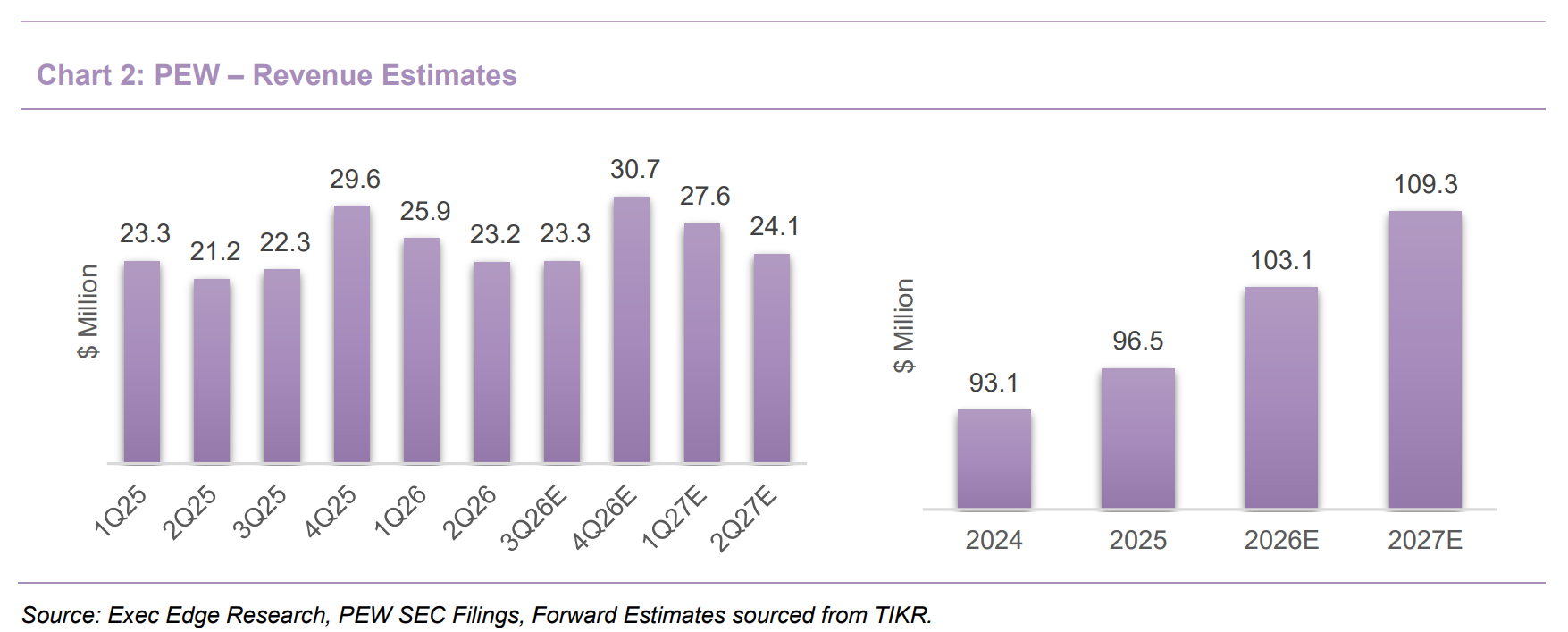
- The forward revenue setup has strengthened, with Street estimates moving higher following 2Q26 while first-half performance continues to support the growth trajectory. Street estimates sourced from TIKR indicate that 3Q26 revenue is expected at approximately $23.3 million, while the 2026E revenue estimate has increased to $103.1 million from $101.9 million last quarter, a 1.2% raise, and 2027E revenue has increased to $109.3 million from $108.5 million, a 0.7% increase. PEW generated $49.1 million in the first six months of 2026, up 10.3% y/y, leaving approximately $54.0 million required in 2H26 to achieve the revised 2026 estimate. That compares with approximately $51.9 million generated in 2H25 and implies roughly 4% second-half growth. Seasonality remains relevant, with summer typically softer and Q4 and Q1 historically stronger periods, but the upward estimate revisions reinforce confidence in the current trajectory without requiring a material acceleration in second-half growth.
- Working capital remains broadly healthy despite the quarter-end cash decline, with supplier concentration improving and no evidence of inventory impairment. PEW ended 2Q26 with $97.5 million of cash, $9.3 million of inventory and $7.8 million of accounts payable, with cash down $8.9 million sequentially from $106.4 million in 1Q26, primarily reflecting payment timing as accounts payable fell from approximately $13.0 million. Major wholesale distributors represented approximately 38% of inventory and product costs in 2Q26 versus 39% in 2Q25, while concentration declined more meaningfully to 39% for 1H26 from 47% in 1H25. No inventory valuation provision was required during either 2026 or 2025, and the inventory returns reserve declined to $0.2 million from $0.3 million at year-end. This suggests the $9.3 million inventory balance remains broadly healthy while PEW’s supplier base has become somewhat more diversified on a first-half basis. With the quarter-end A/P movement characterized as timing related and expected to rebound, second-half cash conversion should provide a clearer indication of the underlying working-capital profile.
- Capital allocation remains disciplined, although all first-half repurchase activity occurred in 1Q26 rather than during the second quarter. PEW repurchased 769,518 shares for approximately $2.36 million, or $2.39 million including excise tax, during 1H26, with the entire amount purchased during 1Q26 and no common shares repurchased in 2Q26. The company had $8.7 million remaining under its original $20 million authorization at June 30, while shares outstanding declined to approximately 29.5 million from 30.0 million at year-end. With $97.5 million of cash and the stock trading below quarter-end cash per share of $3.31, the remaining authorization continues to provide meaningful flexibility, while management continues to balance repurchases against investment in PEW Logistics, the core e-commerce business and new facility, while maintaining expense discipline and flexibility for potential M&A.
- M&A remains part of the long-term strategy, but PEW continues prioritizing valuation discipline over transaction volume. The company remains actively engaged with potential targets, although private-company valuation expectations remain dispersed and PEW has no intention of completing a transaction simply for the sake of adding scale. Nearly $100 million of cash provides capacity to pursue e-commerce, brand, technology, logistics or other strategically relevant assets when pricing aligns with long-term return requirements. Combined with ongoing organic investment and the remaining buyback authorization, PEW’s liquidity provides flexibility to allocate capital toward the highest-return opportunity as the platform scales.
- CFO transition preserves continuity while adding additional public-company finance experience. Co-Founder and CFO Justin Hilty is retiring after more than 15 years with PEW but will remain in an advisory role to support knowledge transfer, while Jonathan Terry will assume the CFO role after serving in a senior finance position at YETI. Terry previously served as CFO of Outschool, Outdoorsy/Roamly and RetailMeNot, and held senior finance leadership roles at Arrow Electronics, bringing experience across FP&A, capital allocation, M&A and public-company financial management. The transition comes as PEW manages approximately $97.5 million of cash and an $8.7 million remaining repurchase authorization, with the finance function moving into a more normalized public-company operating phase.
Attractive Valuation Supported by Cash-Backed Asymmetry and Peer Discount
- Disclaimer: Exec Edge does not publish proprietary estimates, ratings, price targets, or investment recommendations. The valuation discussion below is illustrative only and is based on company filings, management commentary, and third-party data and estimates. It does not constitute a recommendation, price target, rating, or prediction of future pricing.
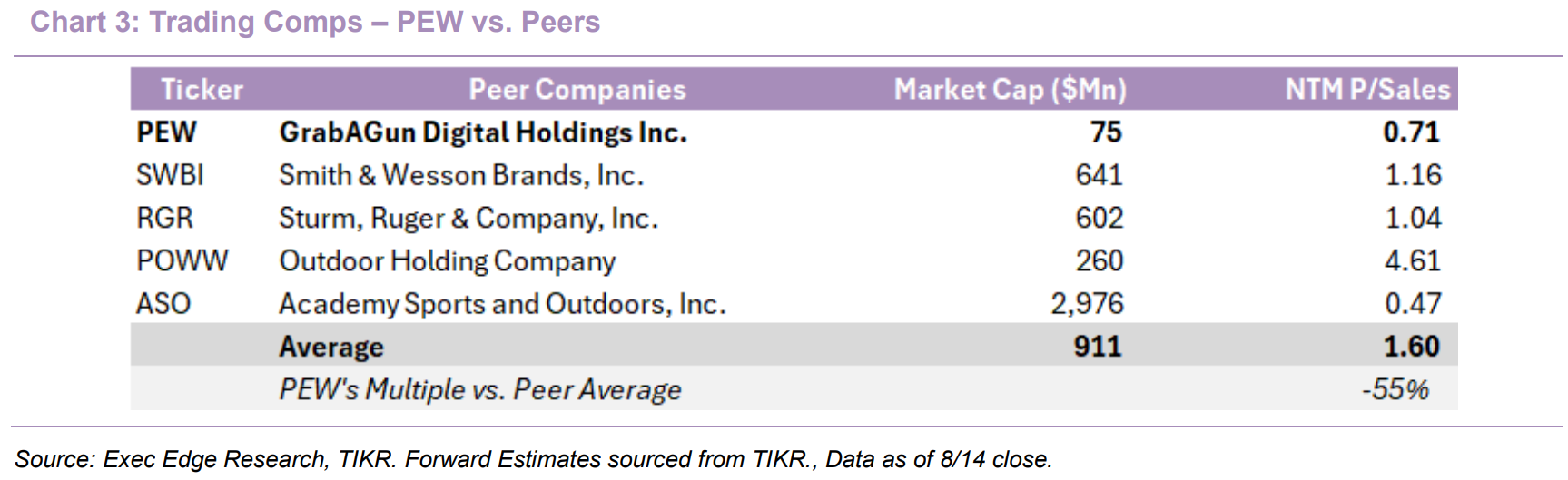
- Stock is attractively valued as PEW’s current market cap remains below its cash balance, implying little value for the core business. At the 8/14 close, PEW’s market cap was approximately $75.3 million, compared with $97.5 million of cash and equivalents, and roughly $7.7 million of long-term debt. This implies a negative enterprise value of approximately $14.5 million, suggesting that the market is assigning little value to PEW’s digital platform, PEW Logistics and other growth initiatives.
- Peer valuation also supports the discount argument. PEW trades at 0.71x NTM P/Sales, below the peer group average, despite a cash-rich balance sheet, more than $100 million of expected 2026 revenue, and a developing higher-margin platform revenue stream through PEW Logistics. We believe the discount can narrow as PEW continues to grow its core e-commerce business, benefits from higher AOV and favorable product mix, scales PEW Logistics beyond its three current manufacturers, and begins leveraging its larger fulfillment facility from 4Q26. The $97.5 million cash balance also provides flexibility for buybacks and disciplined M&A.
- Rerating potential is tied to execution across both the core e-commerce platform and PEW Logistics. Key drivers include sustaining revenue growth through higher-value firearm sales and non-firearms growth, maintaining recent gross-margin gains through pricing and mix optimization, and reducing adjusted EBITDA losses as public-company costs normalize from 3Q26. Further PEW Logistics adoption, including additional manufacturers from its existing pipeline and expansion into new categories such as suppressors, could increase the contribution from higher-margin service revenue. Additional upside could come from greater utilization of the 2.5x larger fulfillment facility, opportunistic share repurchases, disciplined M&A and continued industry modernization.
Read Exec Edge’s Initiation on PEW Here
Subscribe to our Weekly Newsletter to Receive All Research
Contact: