
Download the Complete Report Here
 Canton Strategic Holdings, Inc. (CNTN)
Canton Network Operations and Locking Services Support Recurring Income and Upside Potential
- CNTN turns network participation and company-owned coins into operating income. Nasdaq-listed Canton Strategic Holdings operates on Canton, a digital network that helps financial institutions move and manage assets. It earns Canton Coin (CC) as a Super Validator providing shared network infrastructure. Through Locking-as-a-Service (LaaS), it also commits its own coins to meet customers’ network requirements and receives agreed compensation. Customers can meet their coin commitments without buying CC themselves, preserving capital for product development and their own operating needs. The company retains ownership, combining service income with exposure to the value of its coins.
- Significant CC holdings and experienced leadership support the service business. At June 30, CNTN held 3.714 billion CC, giving it resources to support customer contracts and network obligations. Approved validator allocations, custody arrangements and initial contracts provide a base for expansion. Chairman and CEO Mark Wendland’s experience at DRW and Citadel complements a team familiar with institutional trading, finance and operations. These capabilities help CNTN manage assets, serve customers and build relationships across the Canton Network.
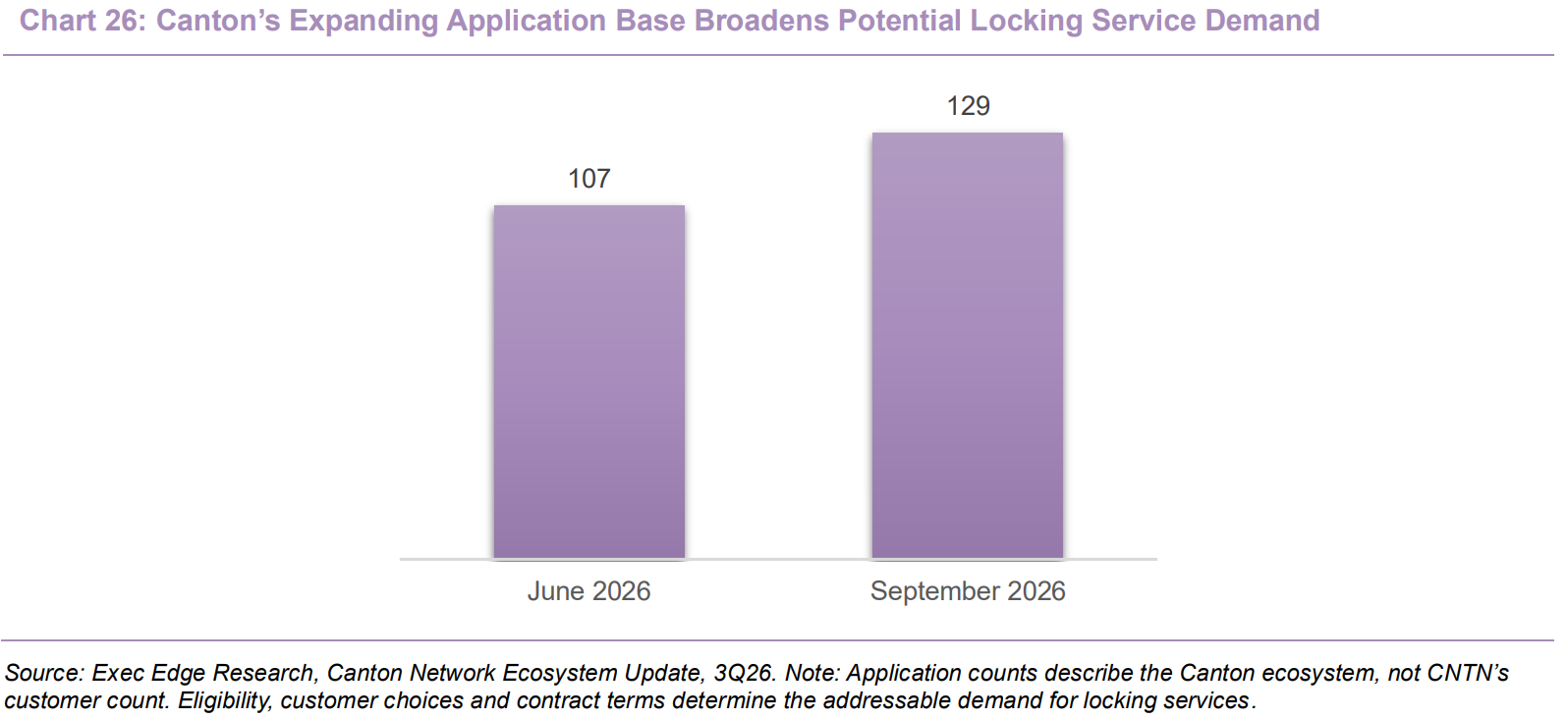
- Growing financial activity on the Canton Network can expand customer demand. Banks and other financial firms are using digital networks to trade securities, finance assets and offer investment funds. Canton allows applications to work together while keeping sensitive transaction details private. Its Featured Applications increased from 107 to 129 during 3Q26. These eligible network applications form a potential customer pool for locking services. Wider adoption could therefore help CNTN win more contracts.
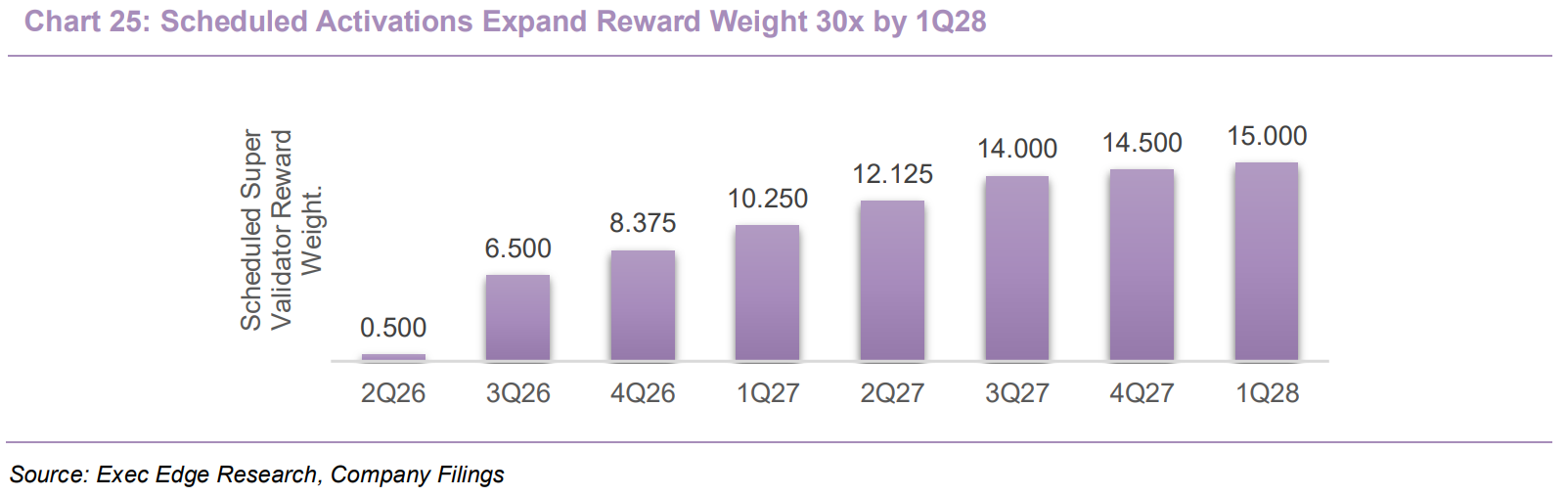
- A scheduled 30x increase in active validator weight and new locking contracts support growth and operating leverage. CNTN’s schedule envisages a 30x increase in active validator weight by 1Q28, increasing its participation in network rewards. Activation depends on deliverables, qualifying holdings and approvals. New locking contracts can support growth. Revenue of $1.50 million covered 56.9% of adjusted operating expenses in 2Q26. Management expects costs to remain largely fixed as revenue expands, creating scope for the business to become profitable.
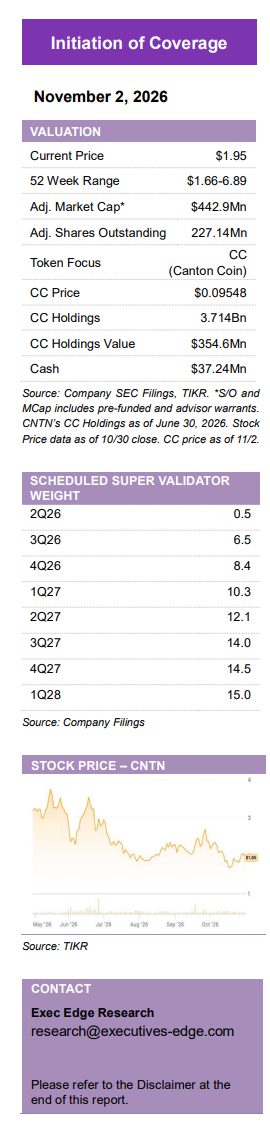
- Substantial coin and cash backing supports CNTN’s valuation, with operating growth offering additional value. At the October 30 share price of $1.95, adjusted equity value is $442.9 million. June-end coin holdings and cash are worth $391.9 million using the November 2 CC price, before taxes and other liabilities. The shares therefore trade only modestly above gross coin and cash backing. Infrastructure peers Coinbase, Circle and Securitize trade at an average 8.6x forward sales, providing a reference for how investors value revenue-generating platforms. Growing validation and LaaS income could improve profitability and strengthen recognition of CNTN’s operating business, while coin appreciation and productive capital deployment provide further opportunities for shareholder value creation.
Company Overview
CNTN – A Public Market Gateway to Institutional Tokenization Through the Canton Network
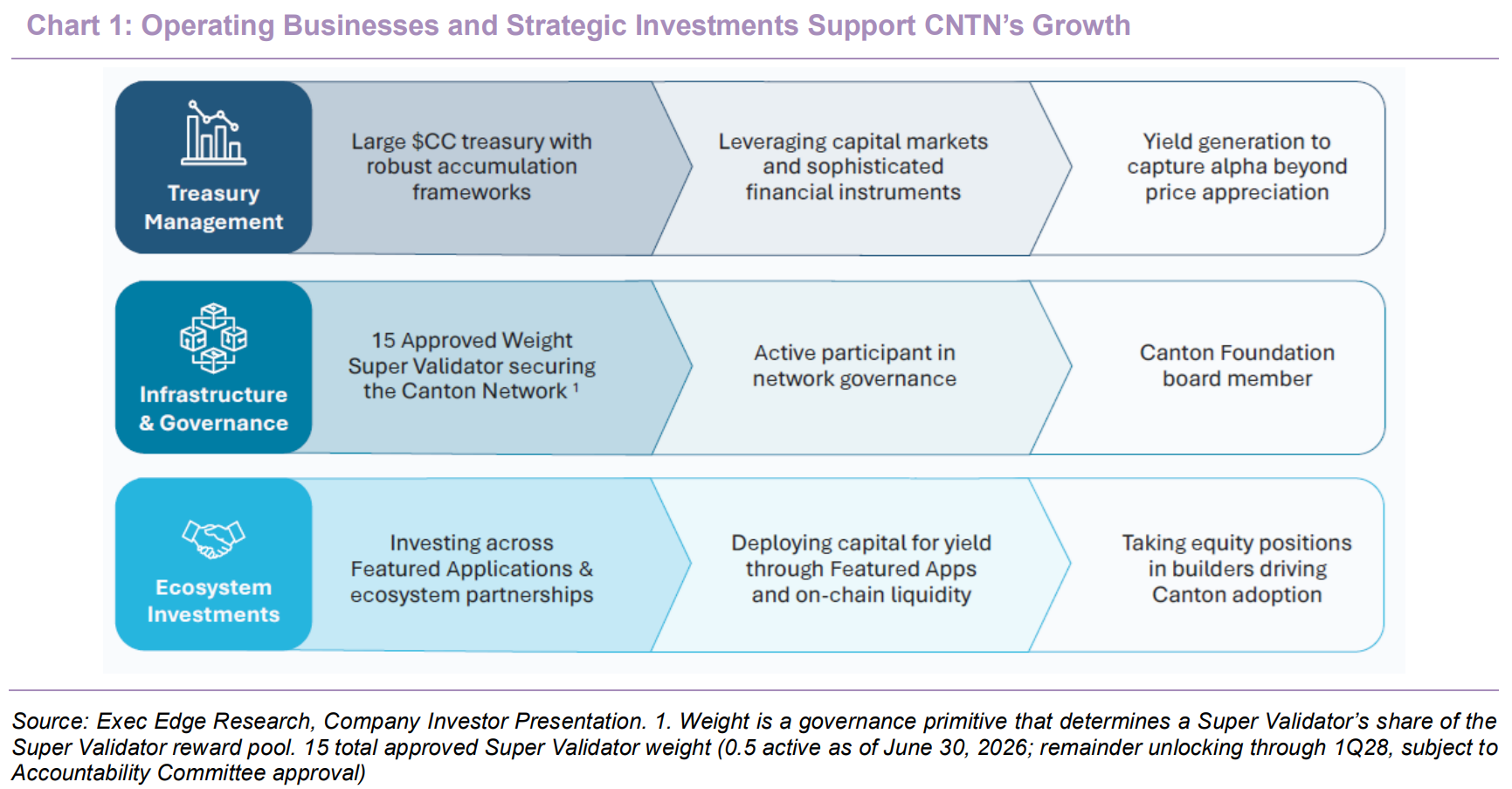
- Canton Strategic Holdings, Inc. (Nasdaq: CNTN) operates Super Validator and customer locking businesses, supported by a strategic Canton Coin treasury, to participate in the institutional adoption of the Canton Network. Super Validator operations earn Canton Coin (CC), the network’s native digital asset, for supporting shared infrastructure that coordinates activity across Canton applications. Through locking-as-a-service (LaaS), the company commits its own CC for eligible customers, retaining ownership while receiving compensation through an agreed rate, a share of customer network rewards, or equity consideration. Its coin holdings support these services, qualifying network commitments, and prospective investments in applications and businesses that expand Canton’s institutional use. Its customers include eligible Super Validators and Featured Applications, a designation for qualifying Canton applications. These activities span three reinforcing pillars: active treasury management, infrastructure and governance, and ecosystem investment. Together, they give CNTN income from activities performed on the network while preserving potential value creation through CC appreciation and income-generating deployment of its holdings. Chairman and Chief Executive Officer Mark Wendland oversees the Canton-focused business, supported by a management team with experience in treasury operations, capital markets, and financial technology.
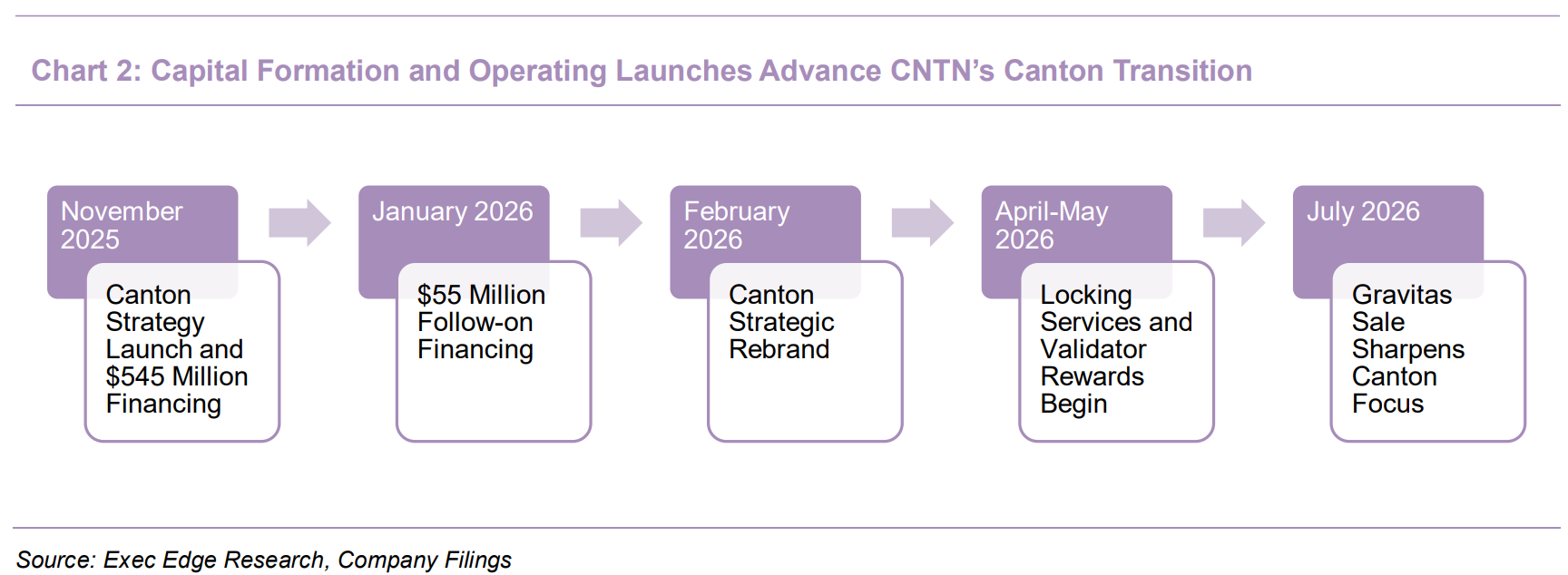
- CNTN’s transition to Canton combines a substantial capital base with revenue-generating network operations. Formerly known as Tharimmune, the company previously operated as a clinical-stage biotechnology developer. In November 2025, the company launched its Canton strategy and closed a private placement with approximately $545 million of gross proceeds, comprising cash and in-kind Canton Coin contributions. Mark Wendland became chief executive officer as the company began building the new business. A further registered offering in January 2026 raised approximately $55 million, and the February name change reflected the transition. The strategy targets Canton’s role in digitizing financial markets, combining infrastructure participation with commercial deployment of company-owned coins. During 2026, the company launched locking services and began earning Super Validator rewards. On July 17, 2026, CNTN sold Gravitas Life Sciences, LLC, concentrating its operating business on Canton while retaining certain oncology assets. Sale consideration included a $3.5 million unsecured seller note bearing 15% payment-in-kind interest, plus contingent development milestone payments. These retained interests preserve potential future financial contributions from the former biotechnology business.
- The company’s operating businesses support institutional use of Canton’s privacy-enabled, interoperable infrastructure. A blockchain records agreed transactions across participating computers; Canton’s architecture lets separately governed applications connect so related transfers either complete together or do not occur, a process known as atomic settlement. Its Global Synchronizer coordinates those transfers without requiring every participant to see every underlying transaction. That structure addresses a practical requirement for banks, exchanges, and asset managers that need to work across institutions while preserving confidentiality. Canton Coin supports the shared infrastructure: participants burn CC to obtain dollar-denominated credits that pay for network capacity. Burning removes those coins from circulation, while eligible application and infrastructure operators can earn newly issued CC for their contributions. This allows institutions to assess network usage costs in dollar terms while CC provides the economic mechanism supporting the infrastructure. CNTN participates in this infrastructure as a Super Validator and a provider of locking services. Validation earns CC for supporting the network, while locking helps eligible participants meet coin-commitment requirements and generates compensation from customer agreements that use company-owned coins. These activities give CNTN sources of operating income in addition to ownership of CC, differentiating its business model from treasury vehicles whose economic exposure primarily reflects their coin reserves. Note: CNTN is a participant in the Canton ecosystem and is separate from Digital Asset, the developer of the Canton technology.
- CNTN’s approved Super Validator allocations provide a path to expanding its infrastructure income. As a Super Validator, CNTN helps run the Global Synchronizer, the shared infrastructure that keeps Canton applications coordinated. Its tasks include participating in network consensus, maintaining the service’s availability, and supporting the processes through which eligible participants earn Canton Coin. CNTN can receive CC rewards for this work. The amount it may earn depends in part on its active weight, which determines its share of the reward pool allocated to Super Validators; approved weight is an allocation that becomes active only after specified conditions are met. As of June 30, 2026, CNTN had approved Super Validator reward weight totaling 15, including 4 under Canton Improvement Proposal 0102 (CIP-0102) and 11 under CIP-0114, while 0.5 was active and earning rewards. Activation remains subject to deliverables, qualifying holdings and network approvals. The Super Validator Accountability Committee, established in 3Q26, reviews compliance and recommends action to the relevant governance bodies. The published schedule envisages active weight reaching 15 by 1Q28, a 30x increase from the initial active weight, subject to these conditions. CNTN began active minting in May 2026 and reported its first network validation revenue in 2Q26. The applicable Super Validator commitment framework initially requires locking 70% of lifetime Super Validator rewards. Rewards are earned in CC and measured in dollars for financial reporting, while activation of additional approved weight expands CNTN’s capacity to earn those rewards.
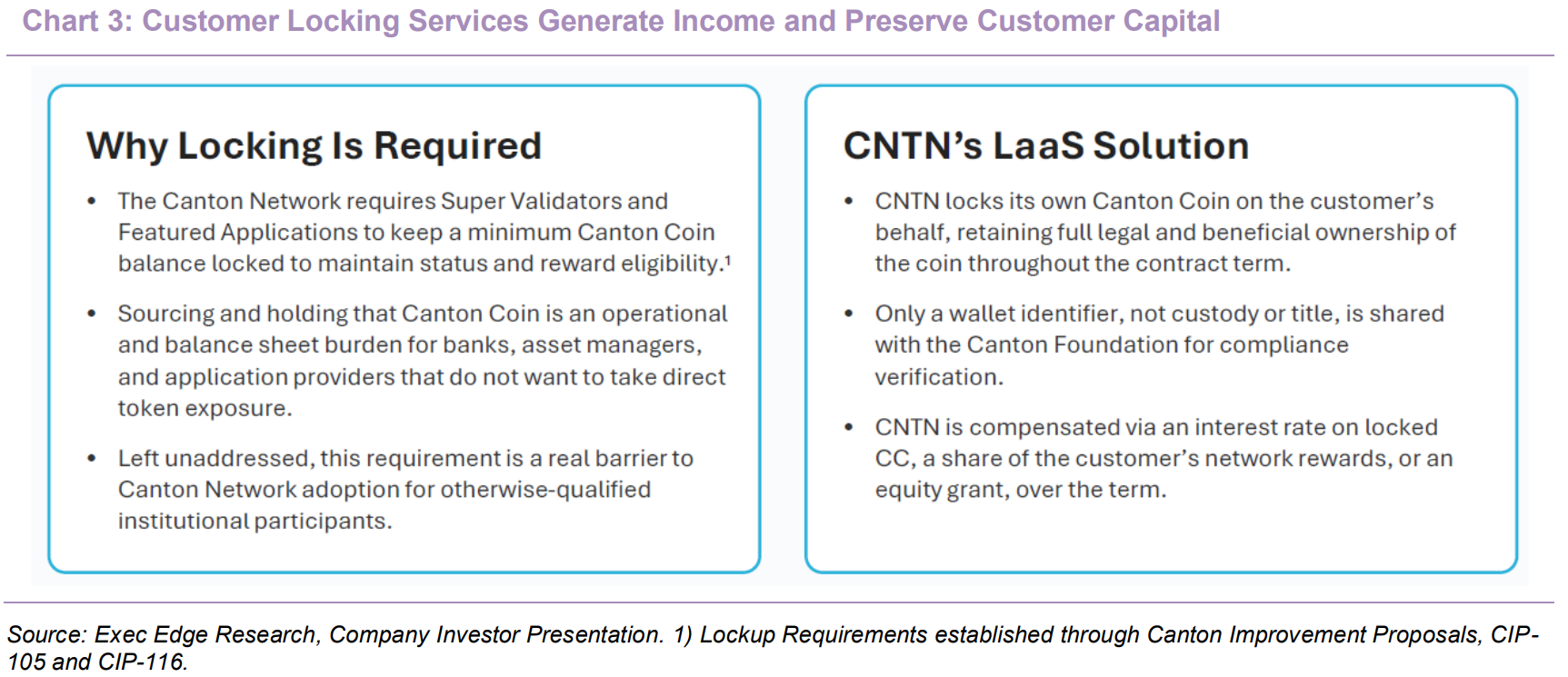
- The Locking-as-a-Service (LaaS) business monetizes CNTN’s coin holdings while enabling capital-efficient participation in the Canton Network. Certain Super Validators and Featured Applications, a designation for eligible applications, must associate qualifying locked CC with their network activity to maintain status or reward eligibility. The service lets these participants meet their commitments without acquiring the required coin balances themselves, preserving capital for operations and application development. CNTN places its own coins in an identified wallet for a customer’s contract term, allowing the Canton Foundation to verify the commitment. The customer receives the benefit of the verified lock, while CNTN retains legal and beneficial ownership of the coins; the underlying asset is not transferred to the customer. Contract compensation can be a stated rate on the locked balance, a share of the customer’s network rewards, or an equity grant earned over the service period. The company began offering the service on April 23, 2026, and announced its public launch on June 23, 2026. Locking became the primary source of CNTN’s reported other revenue in 2Q26, its first revenue quarter under the Canton operating strategy.
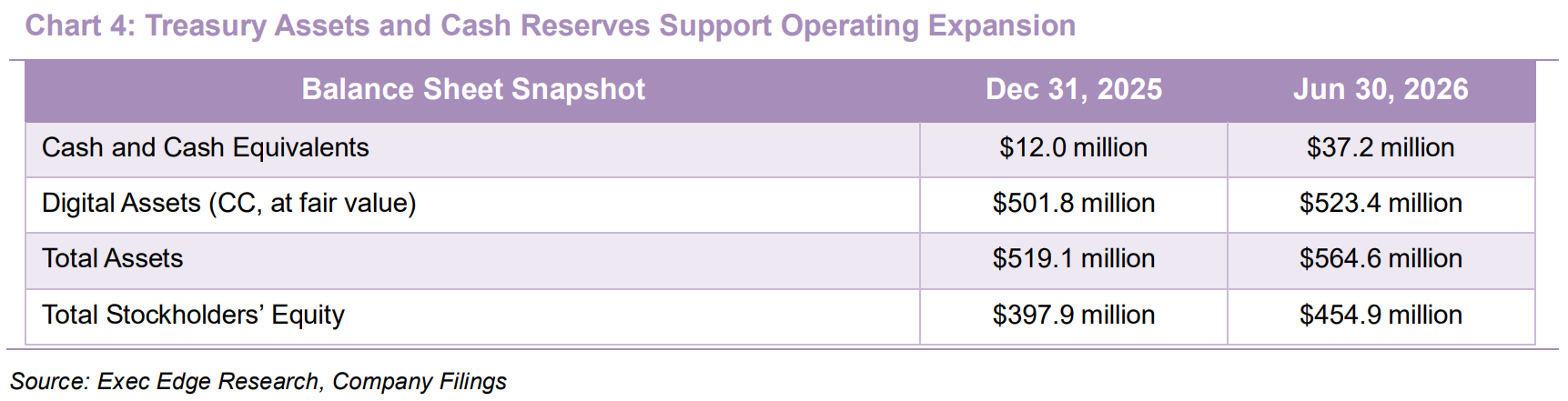
- A substantial Canton Coin treasury supports operating expansion and provides additional avenues for shareholder value creation. At June 30, 2026, the company held 3,714,204,876 CC with a reported fair value of $523.4 million. It acquired coins through its financing-backed treasury strategy and can add coins through network rewards or customer arrangements that pay in CC. Additional acquisitions may include market purchases, negotiated transactions, and other treasury activities as conditions permit. Service income is earned through validation activity and customer contracts, while CC appreciation can increase the treasury’s value, providing a further source of returns alongside income-generating deployment. The company holds substantially all of its coins through institutional custodial arrangements and uses multiple custodians to spread custody exposure. These holdings are allocated across network commitments, customer services, and potential ecosystem investments, with existing contractual obligations and capital allocation decisions determining the balance available for further deployment.
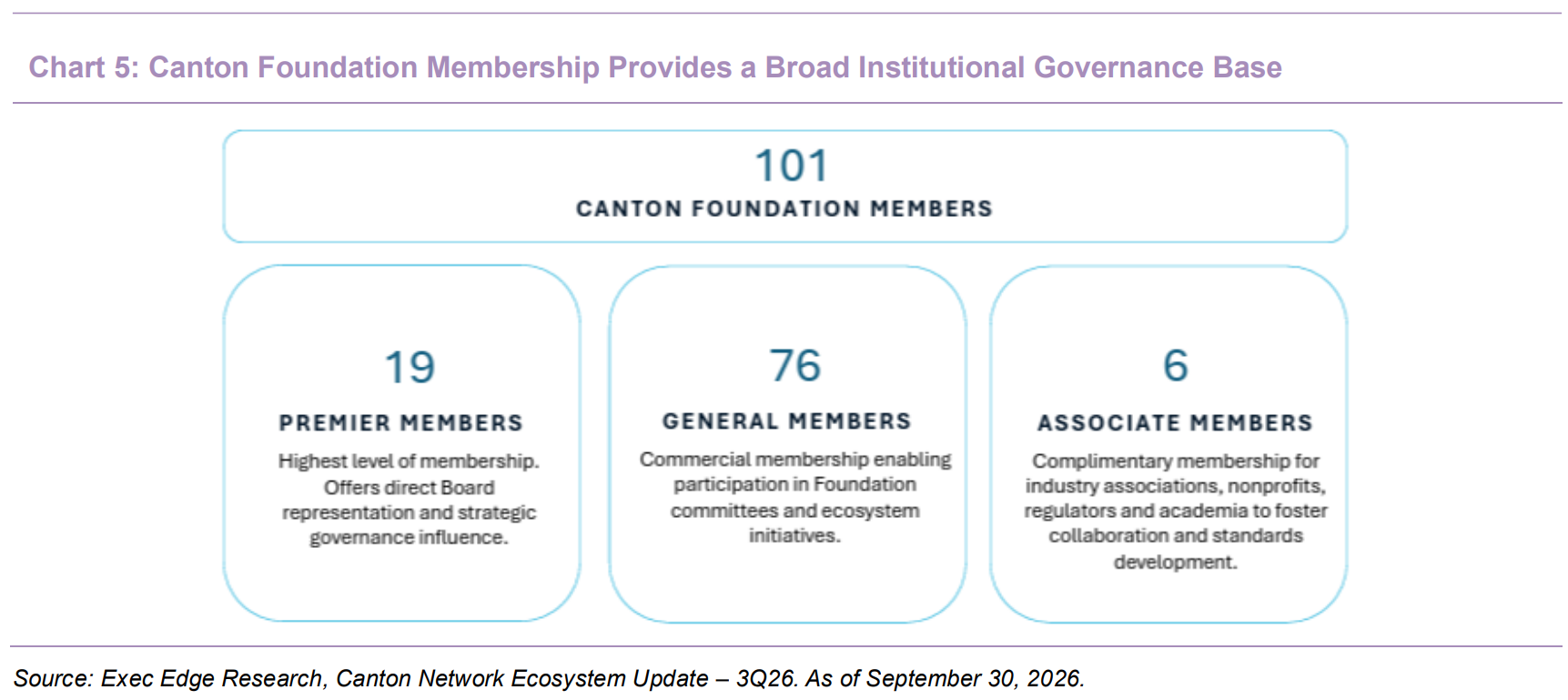
- Ecosystem investment offers a route to broader commercial participation and value creation as institutional activity moves onto Canton. Its stated areas of interest include tools and services for asset issuance, settlement, collateral movement, and other capital-markets workflows. Such support may take the form of building or sponsoring applications, investing in providers, or receiving equity as consideration under a locking agreement. These prospective activities form the ecosystem investment pillar of CNTN’s business, with potential returns through application-level ownership and additional commercial relationships. The company participates in the Canton Foundation, and Wendland joined its board in March 2026. CNTN also publishes quarterly Canton ecosystem research and hosts public webinars, activities associated with part of its approved Super Validator program. Together, investment, governance participation, and institutional outreach support broader network adoption while creating opportunities to expand CNTN’s services and income-generating deployments.
Right-to-Win
Network Access, Locking Capabilities and Operating Scale Support Right-to-Win
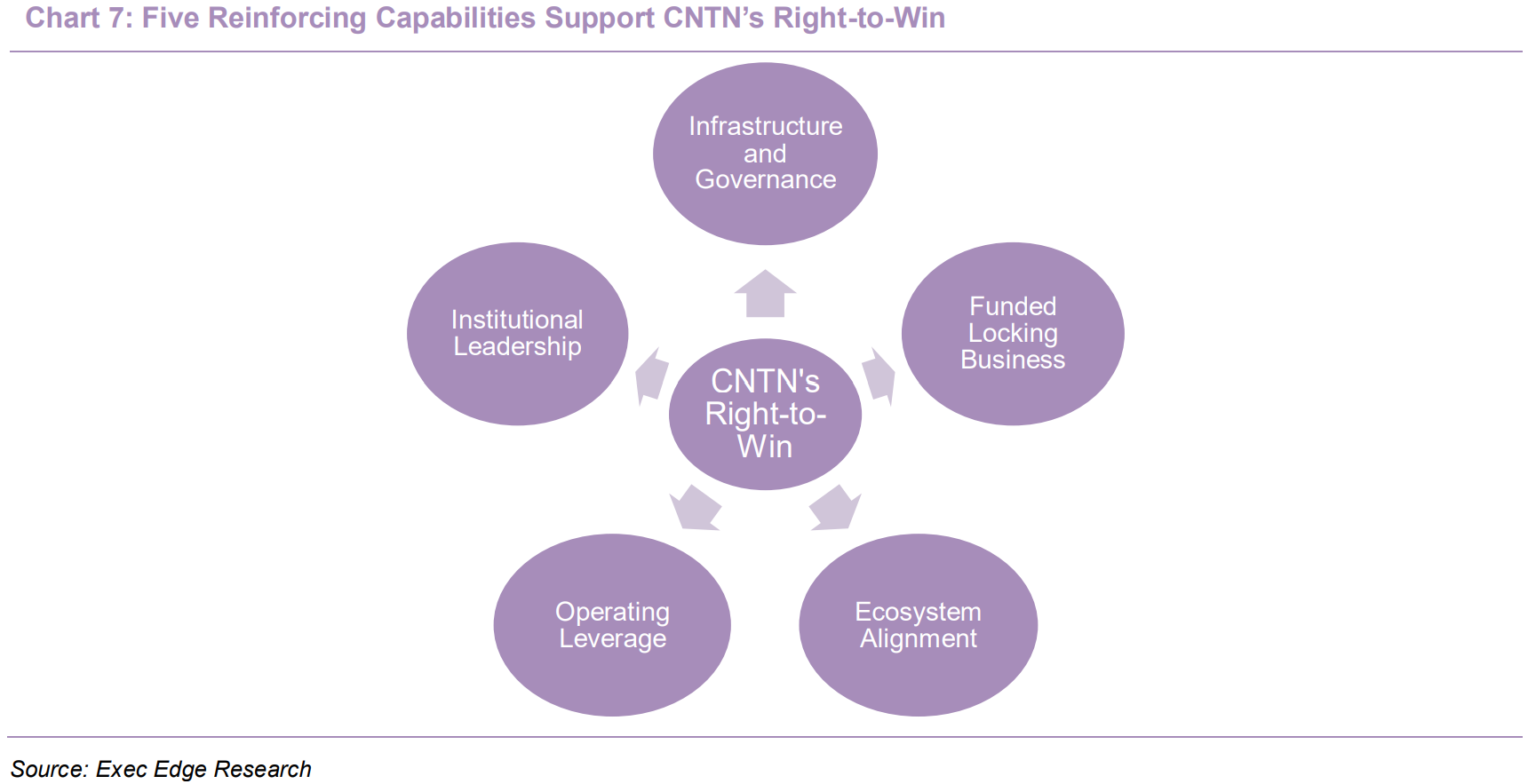
- We believe CNTN’s right-to-win rests on combining approved infrastructure access, a funded locking business and institutional expertise to generate returns beyond passive Canton Coin exposure. Five capabilities underpin this position: an established infrastructure and governance position, a funded locking service, alignment with application builders, a scalable operating platform, and institutional leadership. Together, they connect CNTN’s resources with services and counterparties that can support operating growth through validation rewards, contractual service income and potential equity participation. Their significance lies in the combination of approved network participation, deployable assets, execution experience, and commercial relationships that would require time and capital to assemble.
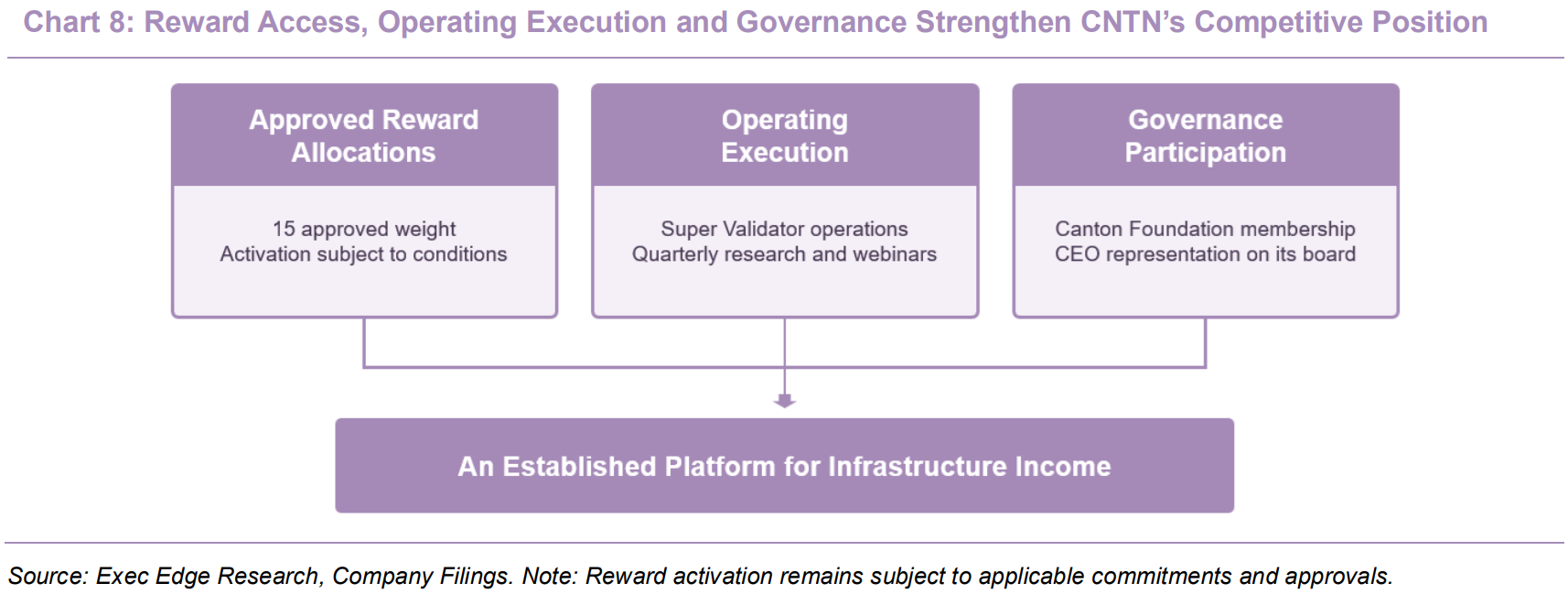
- Approved reward allocations and governance participation underpin CNTN’s competitive position within Canton’s institutional ecosystem. As a Super Validator, it participates in the Global Synchronizer, which coordinates transactions across independently governed applications while preserving their privacy controls. At June 30, 2026, the company had approved Super Validator reward weight totaling 15 under two Canton Improvement Proposals. This establishes an allocation of network reward rights that becomes active as the applicable conditions are fulfilled. Its operating role is complemented by Canton Foundation membership and Mark Wendland’s election to the Foundation’s board in March 2026. The Foundation oversees network standards and the validator framework, giving CNTN a forum for participation in the infrastructure’s development. Together, these positions connect CNTN’s reward-generating operations with participation in the governance framework shaping its commercial environment.
- We believe this combination strengthens CNTN’s ability to earn infrastructure income and develop services around institutional requirements. Replicating the position would require securing comparable governance-approved reward allocations and fulfilling the associated operating and capital commitments. CNTN has already secured approved weight of 15, with activation supported by its quarterly research and webinar program under CIP-0102 and qualifying coin holdings under CIP-0114. The April and July updates, followed by publication of the third-quarter report on October 14, demonstrate continued delivery of the research component of the program. Foundation participation also gives CNTN opportunities to contribute to the governance discussions shaping its operating environment. The competitive value lies in combining an approved route to recurring rewards with the capital and execution capabilities needed to activate and sustain those allocations. Its reward rights remain governed by network rules and performance obligations, making reliable execution central to preserving the position and earning income from it over time.
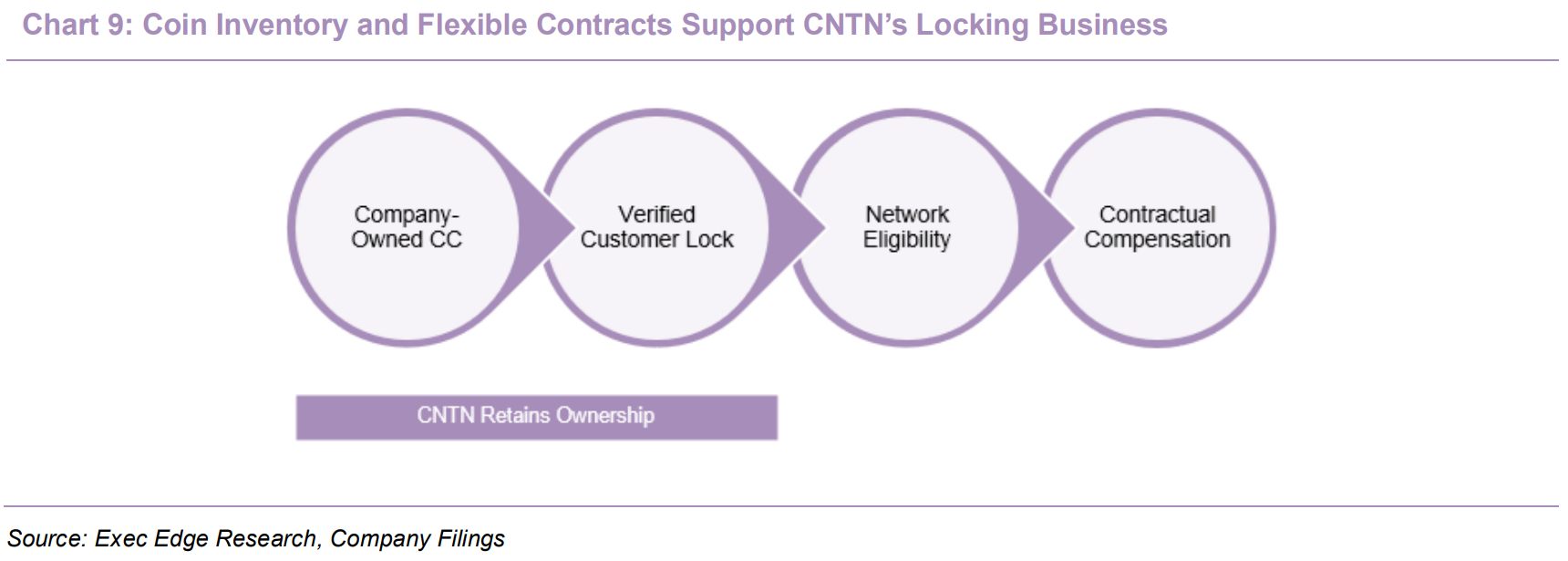
- A substantial coin inventory and flexible Locking-as-a-Service (LaaS) contracts position CNTN to monetize a recurring need among Canton participants. At June 30, 2026, the company held 3.714 billion CC, providing a base of company-owned assets that can support customer arrangements, subject to existing commitments. Super Validators seeking to maintain the applicable reward weight, and applications seeking Featured App status, must satisfy qualifying CC locking requirements, and CNTN enables customers to meet those requirements without acquiring the entire balance themselves. The company retains legal and beneficial ownership throughout the arrangement and receives compensation under agreed contractual terms. Initial commercial execution contributed approximately $1.30 million of other revenue in 2Q26, primarily from locking services. Compensation can comprise a stated rate, a share of customer network rewards, or equity consideration, giving CNTN flexibility in how it structures relationships with different types of counterparties.
- We believe the combination of customer capital efficiency and productive treasury deployment is a key strength of CNTN’s locking business. Funds that would otherwise be committed to acquiring CC can remain available for application development and other operating needs. For CNTN, the same arrangement turns an existing asset base into a service that earns income over the contract term while retaining exposure to the underlying coins’ value. The network’s continuing commitment requirements give the service a defined operating purpose, while flexible compensation helps accommodate customers with different funding profiles and commercial priorities. Delivering comparable arrangements requires available coin inventory, custody infrastructure, contract execution, and the ability to maintain verifiable commitments. CNTN has already assembled these components and established initial customer transactions, demonstrating its ability to convert treasury resources into commercial income.
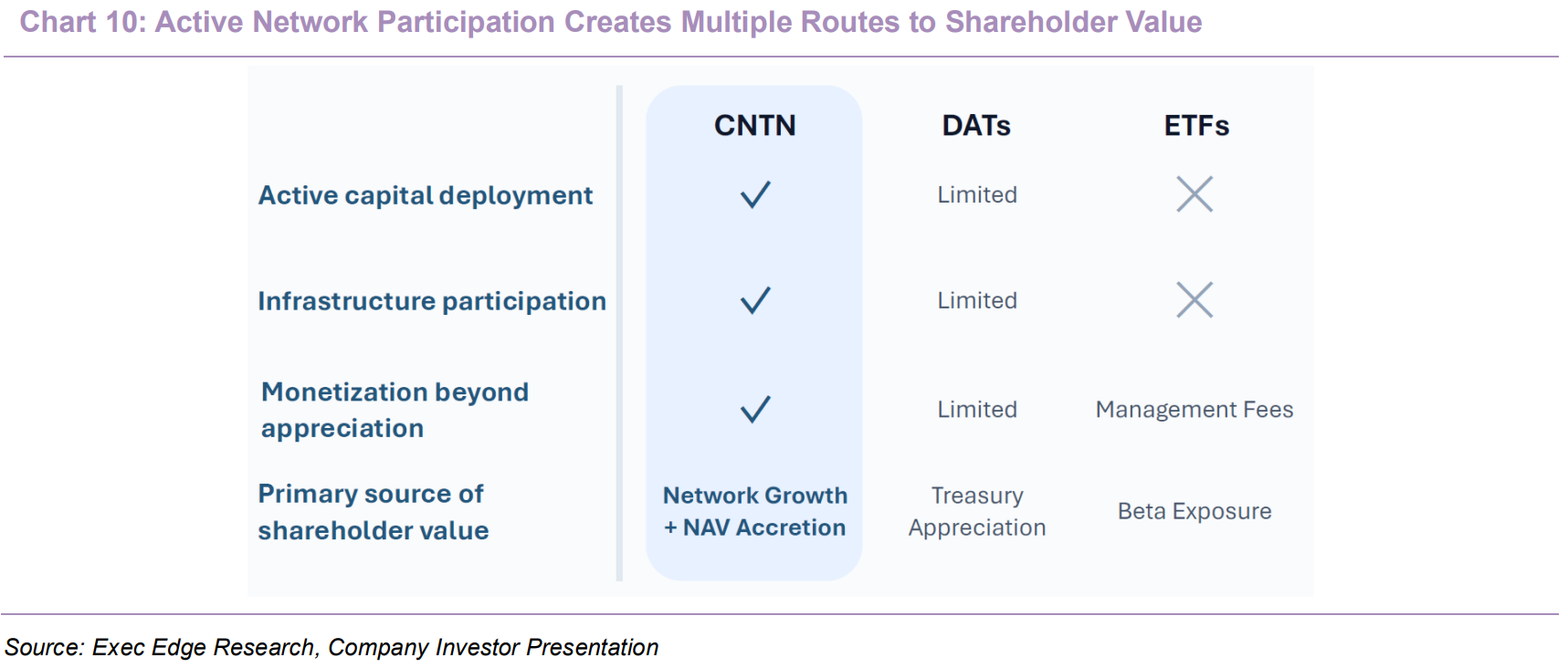
- Commercial relationships with Canton builders give CNTN opportunities to earn service income and participate in application-level value creation. The company treats capital deployment, network participation, and ecosystem investment as reinforcing activities, with institutional adoption creating opportunities across the company’s business. Locking-as-a-Service arrangements put this model into practice, generating income while supporting application providers and other network participants. Selected agreements can include equity consideration earned over the service period under the applicable contract terms. CNTN is named among the infrastructure providers supporting Interstice Digital’s cross-chain swap engine, launched in August 2026 with FalconX. In locking arrangements, capital commitments and ongoing service obligations can combine income generation with potential equity participation.
- We believe this alignment differentiates CNTN’s exposure to Canton adoption by combining infrastructure rewards with customer income and potential investment returns. Service agreements provide contractual consideration, reward-sharing arrangements can link income to customer activity, and equity participation can create exposure to application-level value creation. Supporting a builder’s network commitments may also help that customer direct resources toward developing products and attracting users, improving the commercial environment in which CNTN operates. For shareholders, these relationships create additional routes to returns alongside CC appreciation, with contractual income and potential equity participation connecting CNTN to the businesses using the network. Its value depends on the terms and performance of specific relationships, with the existing locking business providing an operating foundation from which broader participation can develop.
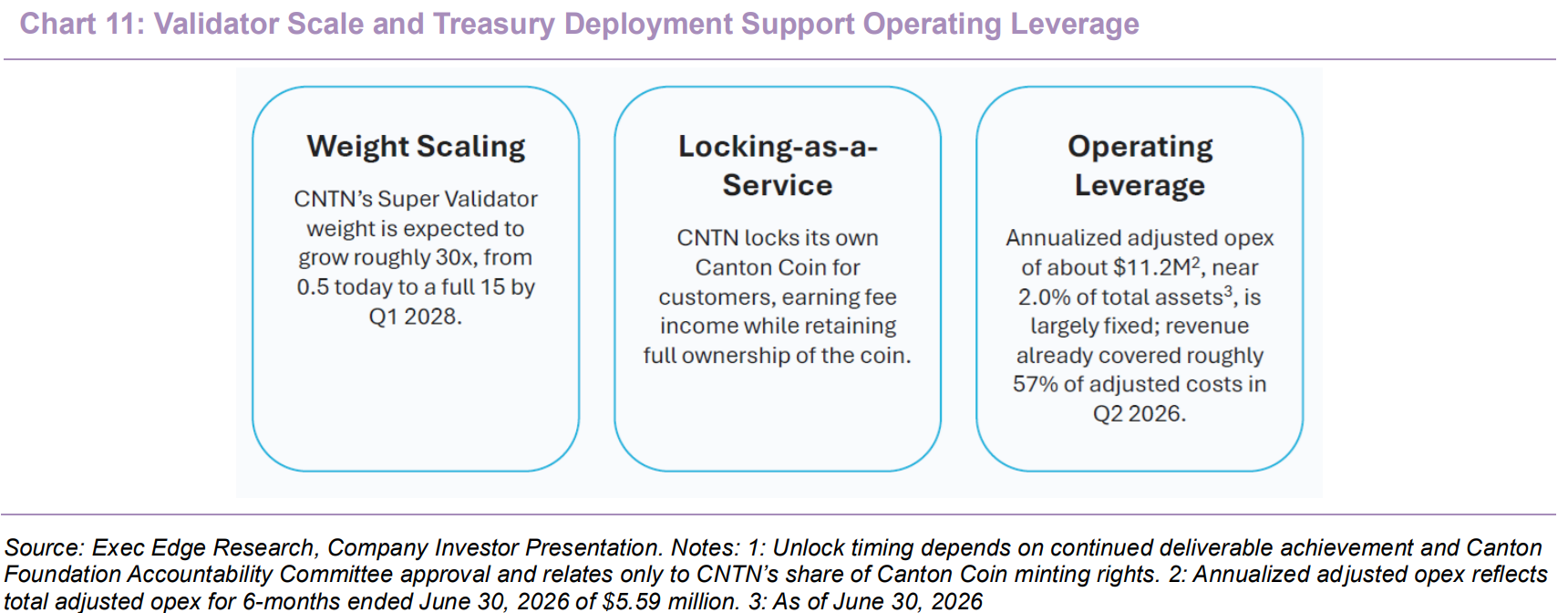
- A largely fixed operating platform creates scope for validation and locking revenue to scale at high incremental margins. The platform combines infrastructure, custody arrangements, control functions, and commercial relationships. Management expects this cost base to remain largely fixed as activity expands. Active Super Validator reward weight determines participation in network rewards, while customer locking commitments generate contractual consideration using company-owned assets. Expanding either activity can therefore increase income through deployment of an existing platform. In 2Q26, the first partial revenue quarter, $1.50 million of revenue covered 56.9% of adjusted operating expenses of $2.63 million, despite only 0.5 of the 15 approved Super Validator weight being active. These resources support multiple commitments and allow the company to pursue incremental business without rebuilding the underlying operating framework for each customer.
- We believe this scalability strengthens CNTN’s earnings potential as approved reward allocations activate and more treasury assets generate service income. Additional active weight can increase reward participation without requiring an equivalent expansion in the technical platform, while further locking contracts can use established custody and servicing processes. This creates a route to improving profitability through operating execution as well as asset deployment. Additional locking balances may require capital, but that requirement is distinct from a proportionate increase in operating expenses. Management’s largely fixed cost assumption creates scope for improving operating margins as revenue expands. The opportunity is to grow income faster than the expense base, with the outcome dependent on contract economics, CC prices and the costs of supporting additional activity.
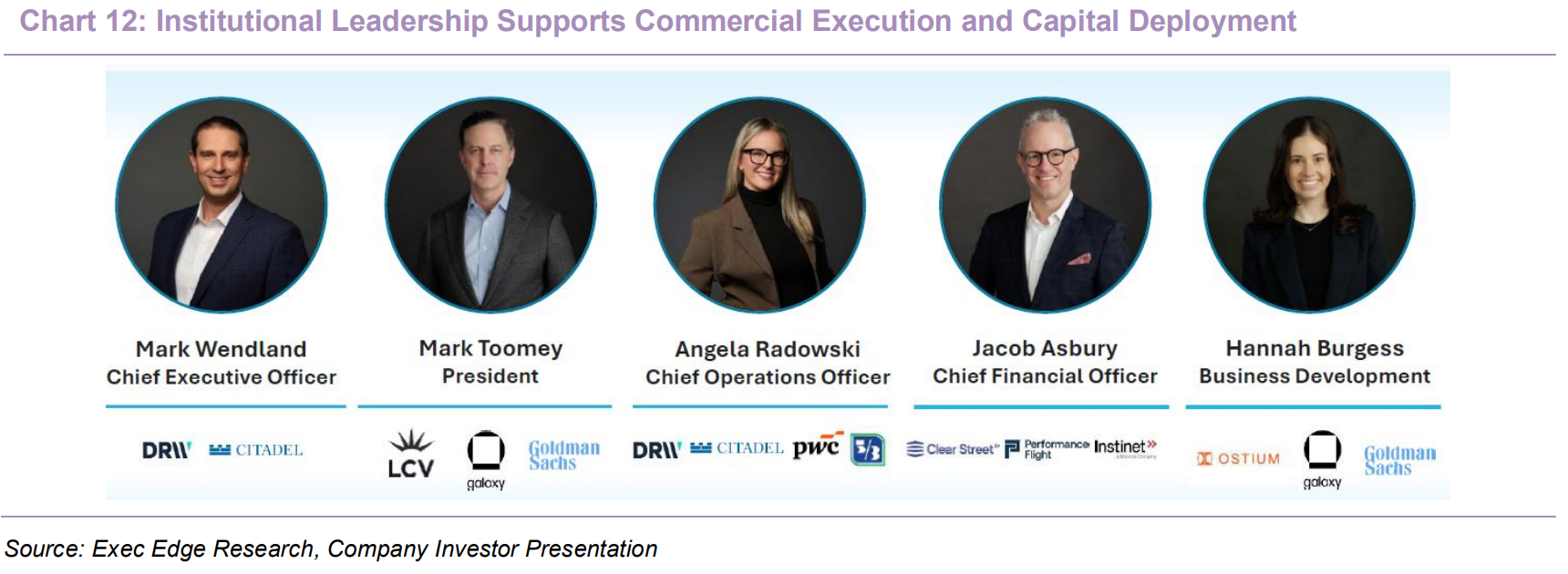
- Institutional leadership strengthens CNTN’s ability to manage treasury assets, execute commercial agreements and engage financial-market participants. Chief Executive Officer Mark Wendland previously served as a partner and chief operating officer at DRW and held senior roles at Citadel. President Mark Toomey brings experience from Liberty City Ventures, Galaxy Digital, and Goldman Sachs, linking institutional distribution with digital asset markets. Chief Financial Officer Jacob Asbury previously served as CFO of Clear Street and Instinet, while Chief Operating Officer Angela Dominy Radkowski held operations strategy responsibilities at DRW and roles within Citadel’s treasury and engineering organizations. The board adds financial reporting, legal, and technology experience, including Sean Galvin’s appointment as Audit Committee Chair and the July election of Pamela Carter and Rishi Nangalia. Together, these backgrounds combine institutional market knowledge with the operating and financial disciplines needed to develop CNTN’s Canton businesses.
- We believe this combination supports execution across CNTN’s network operations, LaaS business and investment activities. Institutions evaluating a service provider need confidence in its ability to understand financial workflows and deliver against contractual obligations. The team has already launched Super Validator operations and Locking-as-a-Service, with both contributing to CNTN’s first operating revenue in 2Q26. Its commercial approach accommodates fee, reward-sharing and equity consideration, putting institutional finance experience to work in deploying the company’s coin holdings. This provides initial evidence of execution across the infrastructure and customer-service businesses underpinning CNTN’s investment case.
Industry Trends and Company Positioning
Institutional Tokenization is Moving from Pilots Toward Broader Commercial Adoption

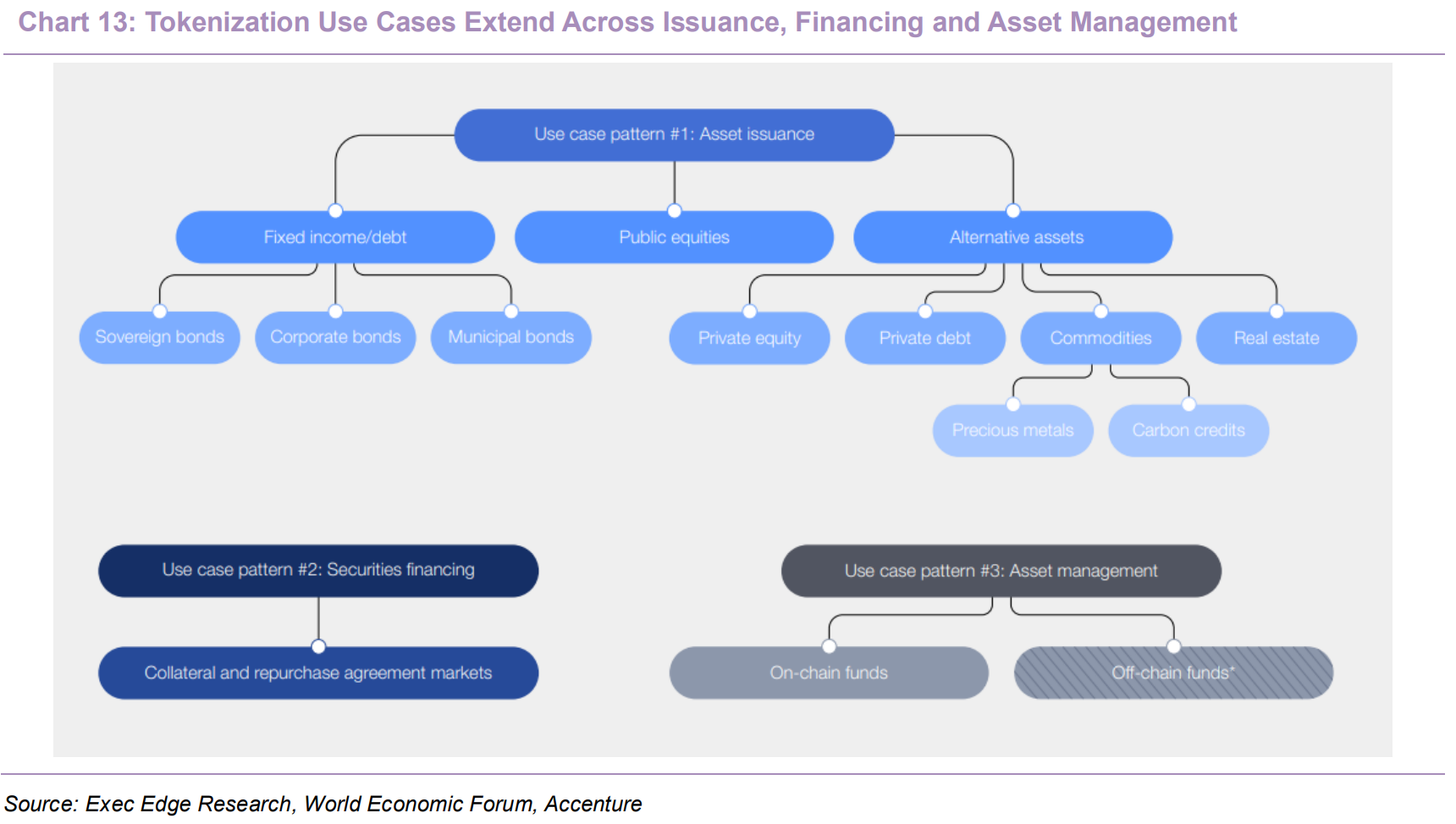
- Institutional tokenization is opening a market for infrastructure and services that support the issuance, financing and management of financial assets. Tokenization creates a digital representation of an asset, such as a bond or fund share, on a shared electronic ledger maintained through blockchain or similar technology. The underlying investment exposure can remain familiar, while ownership records, transfers and servicing move onto digital infrastructure. Where appropriately designed, this infrastructure connects ownership records with rules governing transfers, payments and other events, reducing the need for institutions to repeatedly reconcile separate records. The World Economic Forum groups the principal applications into asset issuance, securities financing and asset management, illustrating the breadth of the opportunity across established financial activities. The U.S. Securities and Exchange Commission similarly recognizes several structures for tokenized securities, including securities issued directly in tokenized form and digital representations supported by conventional records. These approaches allow institutions to introduce tokenization around existing products and systems. We believe the commercial opportunity extends beyond issuing tokens to the infrastructure and services required to support recurring investment and financing activity.
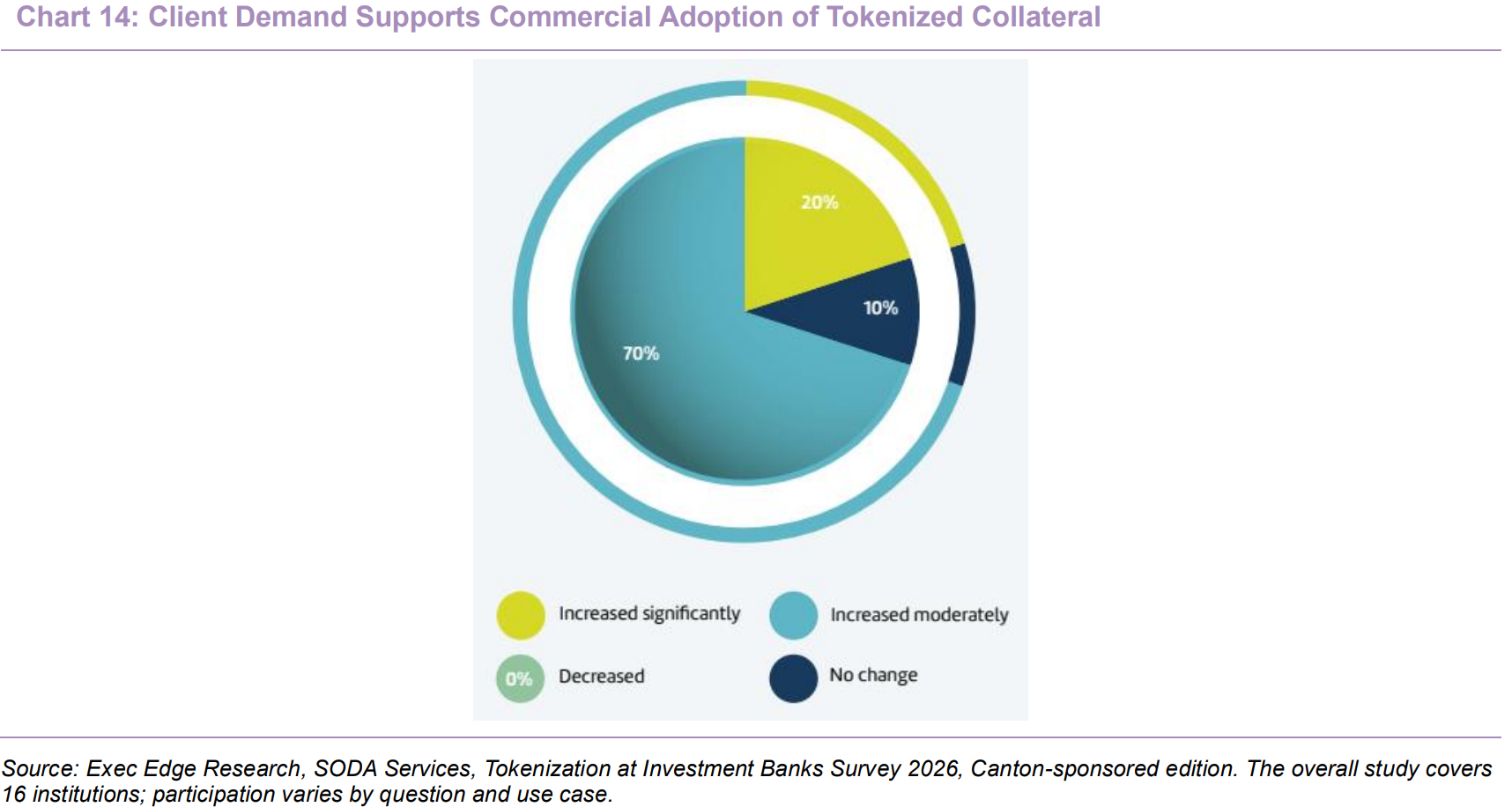
- Production trades, recurring volumes and business-line funding show institutional tokenization moving into commercial use. On July 15, 2026, DTCC converted securities held at its Depository Trust Company subsidiary into tokens used in real production trades, with more than 30 firms participating. The transactions covered equities, Treasuries, repo, securities lending and margin workflows. The conversion of DTC-held securities into tokens occurred on Canton and Hyperledger Besu, demonstrating connectivity between conventional custody and blockchain environments. The July production event preceded the broader tokenization service launch, expected in 4Q26. In August, Virtu Financial and M1X Global completed a repo on Tradeweb using USDM1, a sovereign bond issued natively on Canton, as collateral, with securities delivery, cash settlement and return completed atomically onchain. Broadridge reported that its Distributed Ledger Repo platform processed $7.5 trillion of transactions during September 2026, equivalent to average daily volume of $359 billion. These figures measure transaction flows, including repeated financing activity, rather than outstanding tokenized assets. Banks are also committing business resources to these applications. SODA’s 2026 survey, covering 16 major sell-side financial institutions overall, found that 50% of respondents to its collateral/repo funding question identified the business line as the source of funding. Among respondents to its client-demand question, 90% reported an increase over the preceding 24 months, comprising 70% reporting moderate growth and 20% significant growth. Together, live transactions, repeat activity and customer demand strengthen the commercial case for investment in tokenization infrastructure.
- Digital issuance is extending tokenization into established funding channels and creating demand for lifecycle services. Alongside platforms that tokenize securities already in custody, issuers can create securities directly on digital infrastructure and distribute them through established banking relationships. Euroclear’s Digital Financial Market Infrastructure supports the issuance, distribution and primary settlement of digitally native notes, while connecting them with its conventional infrastructure for subsequent market activity. In September 2026, Hana Bank issued a $100 million digitally native note through this platform, with Standard Chartered supporting structuring, execution and distribution, and Citi acting as issuing and paying agent. The bond was listed on Singapore Exchange and enabled same-day settlement. Euroclear’s wider issuance experience includes banks and development institutions across several regions, indicating that adoption is spreading through established funding channels. Participation by banks, market infrastructures and exchanges allows digital issuance to build on existing distribution and servicing relationships. Each issuance creates ongoing servicing needs, from maintaining ownership records to processing interest payments and coordinating settlement. As these processes become established, institutions can bring subsequent offerings to market more readily, supporting recurring business for infrastructure and service providers.
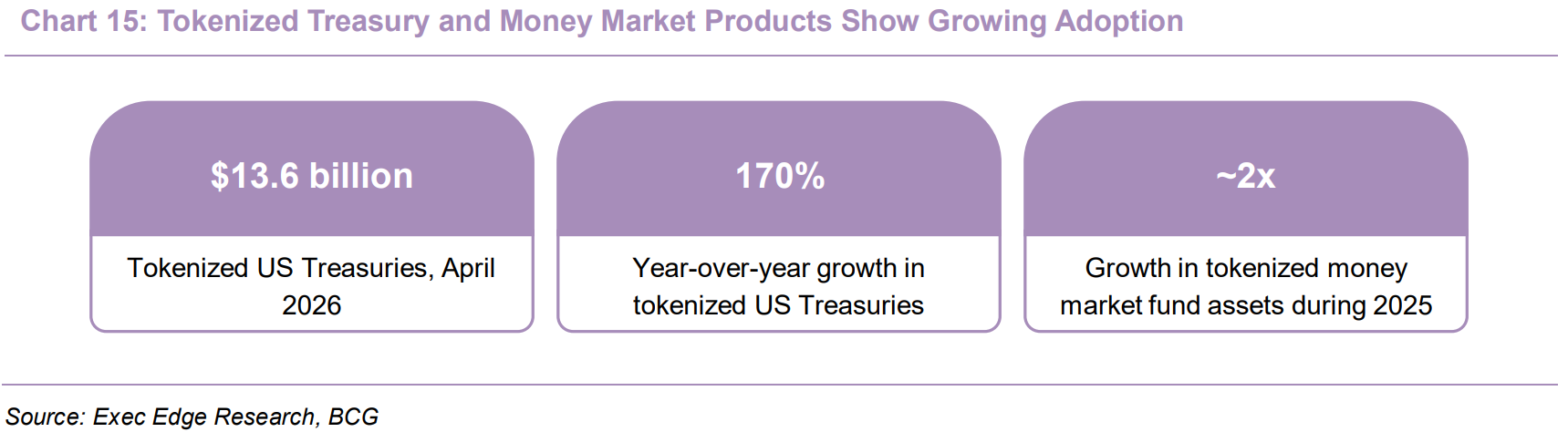
- Tokenized funds are building investor adoption around familiar products and established distribution channels. Funds offer a familiar starting point because professional portfolio management, investment mandates and fund governance can remain in place while the recording or distribution of shares changes. According to BCG’s 2026 Global Asset Management Report, tokenized U.S. Treasuries reached $13.6 billion in April 2026, an increase of 170% year over year, while tokenized money market fund assets roughly doubled during 2025. This growth is being accompanied by new offerings from established managers. In March 2026, Northern Trust Asset Management introduced a digitally enabled share class for its NIF Treasury Instruments Portfolio, initially available through BNY’s LiquidityDirect platform using Goldman Sachs’ digital asset technology. The arrangement maintains a blockchain mirror of customers’ share ownership, with the intermediary responsible for that record; the fund itself does not invest in cryptoassets. Such structures allow managers to introduce digital access without changing the underlying investment mandate. We believe this provides a practical route to broader adoption, combining familiar portfolios with existing customer relationships and distribution platforms. Growth in fund participation can, in turn, support demand for digital recordkeeping and investor servicing.
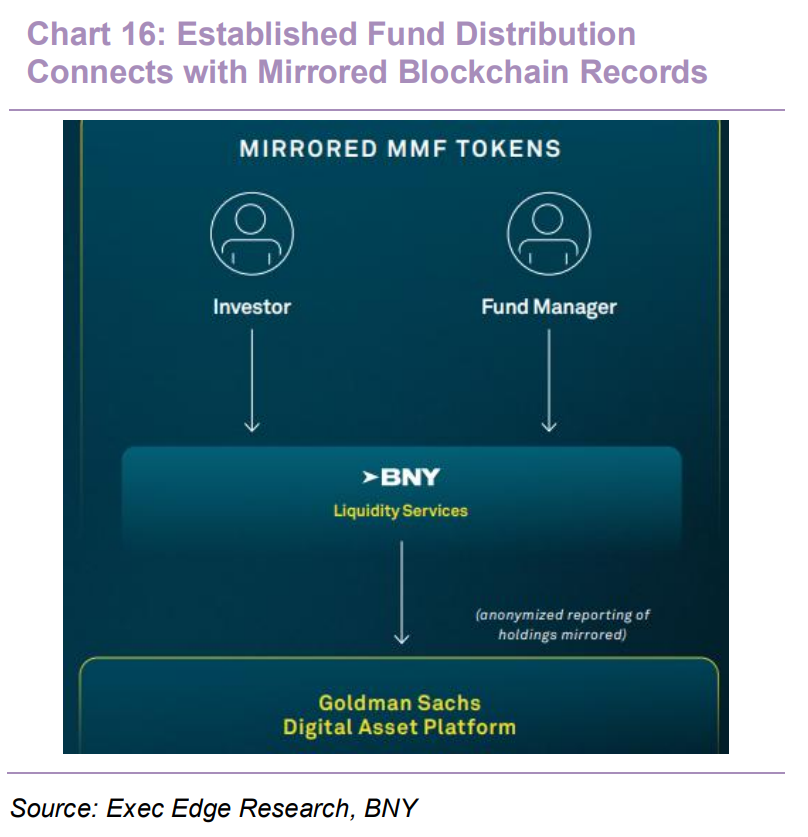 Established distribution and servicing networks are turning tokenized funds into repeatable commercial offerings. BNY and Goldman Sachs introduced a tokenized money market fund solution in July 2025 that connects BNY’s LiquidityDirect platform with Goldman Sachs’ digital asset platform. The initial participating managers included BlackRock, BNY Investments Dreyfus, Federated Hermes, Fidelity Investments and Goldman Sachs Asset Management. Under that arrangement, BNY maintains the official fund books and records, while blockchain tokens mirror customers’ holdings. Institutions are also extending beyond mirrored records to digitally native funds. In July 2026, BNY launched Digital Transfer Agency capabilities supporting digitally native funds, including legal representation of fund books and records on a public blockchain. Its announcement identified the Baillie Gifford Enhanced Yield Fund as an offering already brought to market. Broadridge’s DLX provides another example of lifecycle infrastructure, connecting issuance, trading, financing, settlement and servicing for tokenized securities. These platforms give asset managers and issuers different ways to introduce tokenized products through established investment channels. For infrastructure and service providers, the opportunity is to support multiple funds through common distribution, recordkeeping and servicing capabilities, making subsequent launches easier to execute and creating scope for recurring revenue as participation expands.
- Clearer regulatory pathways are reducing implementation uncertainty for institutional tokenization. In the U.S., a joint SEC staff statement in January 2026 clarified how federal securities laws apply across tokenization structures, including the continued application of underlying securities obligations. The December 2025 staff no-action letter for DTC separately provided conditional relief for a specified tokenization service, while the SEC approved Nasdaq’s rule changes enabling trading in eligible tokenized securities in March 2026. In September, the SEC also granted temporary, conditional relief for specified venues trading tokenized U.S. stocks, providing another defined route for developing onchain secondary markets. The SEC’s September 1 proposal to modernize transfer-agent rules also addresses electronic recordkeeping and blockchain technology. In the United Kingdom, the FCA’s April 2026 policy statement finalized guidance for authorized fund managers using distributed ledger technology, including digital ownership registers, alongside optional direct-dealing rules for traditional and tokenized funds. The European Union’s DLT Pilot Regime provides a supervised framework for eligible financial instruments and associated trading and settlement infrastructure. Together, these developments give institutions a clearer basis for committing resources to product launches and supporting infrastructure. The commercial benefit is greater visibility into the requirements for issuance, distribution and trading, helping firms move projects from regulatory assessment toward implementation.
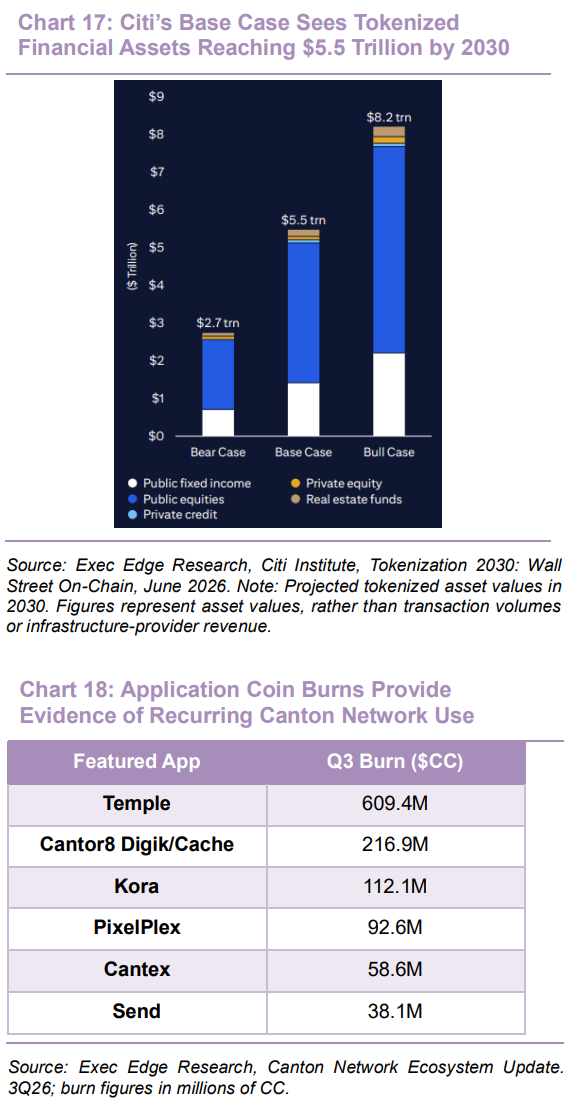 Growth in tokenized financial assets can expand demand for the infrastructure and services supporting institutional markets. Citi Institute’s June 2026 analysis projects tokenized financial assets could reach $5.5 trillion by 2030 in its base case, with bear and bull scenarios of $2.7 trillion and $8.2 trillion, respectively. These estimates represent asset values, distinct from transaction volumes or infrastructure-provider revenues. Public equities account for approximately $3.6 trillion of Citi’s base case, with public fixed income contributing $1.4 trillion, placing established securities at the center of projected expansion.
Recurring financial activity turns tokenized asset growth into a commercial opportunity for infrastructure providers, spanning issuance, trading, financing and servicing. We believe repeat transactions and broader institutional participation are therefore more meaningful indicators of commercial progress than individual launch announcements. As these activities scale, they can support demand for connected infrastructure and specialist services across the asset lifecycle. Adoption and fee activity can progress at different rates: Canton reported 3Q26 network fees of $157 million, down 18% q/q, while its burn-to-mint ratio increased from 0.65 to 0.69.
CNTN’s validation and locking businesses provide established routes to monetize Canton’s institutional adoption. Its Super Validator operations help run the network’s shared synchronization infrastructure and earn Canton Coin rewards, while Locking-as-a-Service deploys company-owned coins to meet qualifying customers’ network commitments. This can allow eligible Super Validators and Featured Applications to participate without independently sourcing the required token balances, with CNTN retaining ownership and earning contractual compensation. Both businesses began contributing revenue in 2Q26, establishing an operating foundation as institutional activity develops. We believe LaaS provides the clearest direct link between ecosystem expansion and customer growth: additional eligible participants can broaden demand for locking services. Validation offers a complementary income stream, with reward participation determined by active weight and network rules. The company also seeks to build, back and invest in applications, creating opportunities to develop commercial relationships and participate in application-level value creation. Together, these activities connect CNTN’s infrastructure position and coin inventory with the businesses bringing financial activity onto Canton.
Canton’s Privacy and Control Strengthen CNTN’s Institutional Positioning

- Privacy and application control are becoming decisive factors in institutional blockchain adoption. Banks, asset managers and corporate treasuries need to protect customer information, positions, pricing and transaction terms while providing relevant records to authorized counterparties, service providers and supervisors. Platforms must therefore let institutions determine who can view information, authorize transactions and verify records. The Bank for International Settlements identifies confidentiality as a prerequisite for its proposed unified-ledger architecture, supported by restricted data access and encryption. Recent research by The Tie, published through Canton in September 2026, similarly examines selective disclosure as an approach that preserves authorized access while protecting confidential information. For institutions, commercial usability requires both confidentiality and effective oversight: sensitive positions must remain protected while auditors, supervisors and compliance teams receive appropriate access. We believe platforms that meet these requirements across connected applications are better positioned to win institutional deployments, making privacy an important competitive capability as tokenization scales.
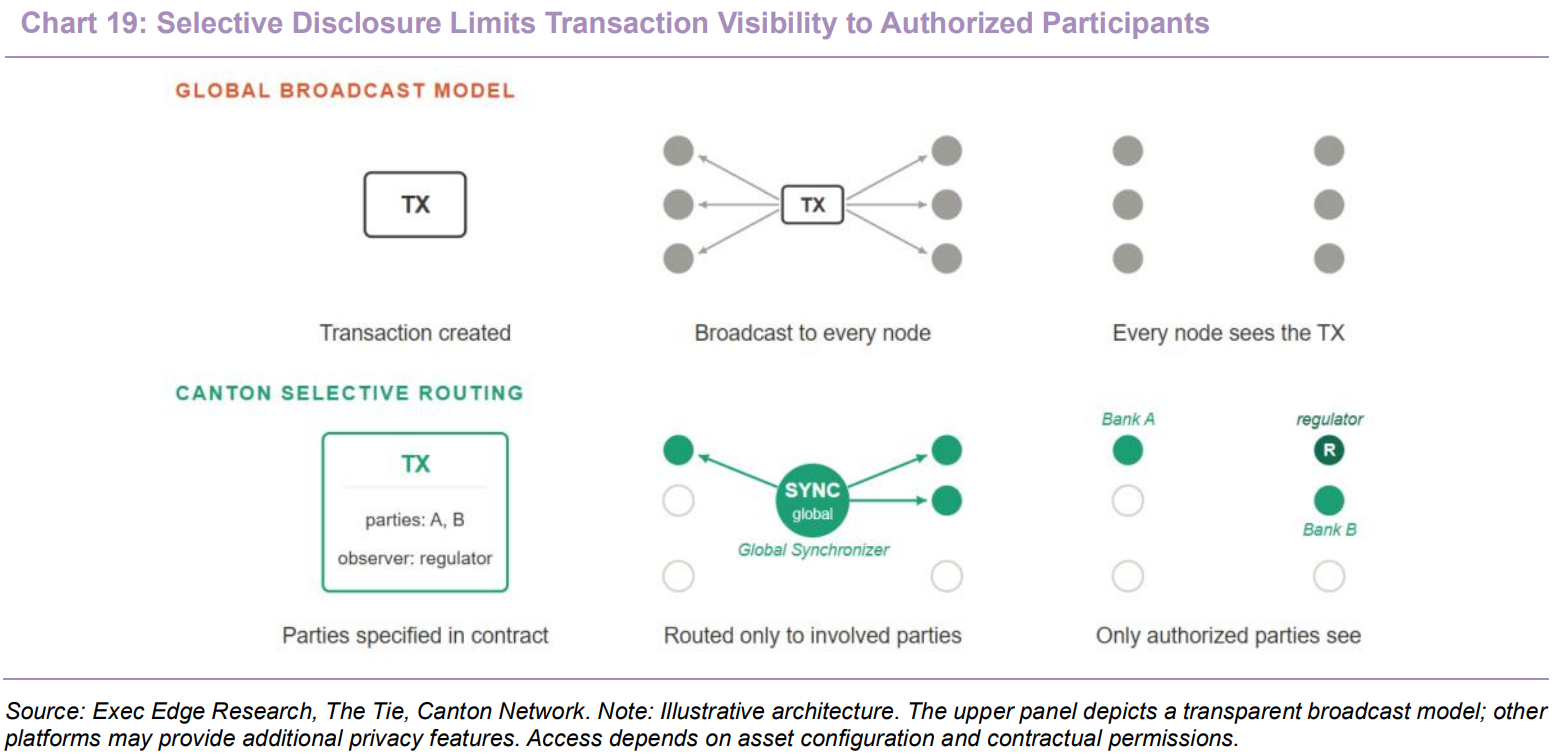
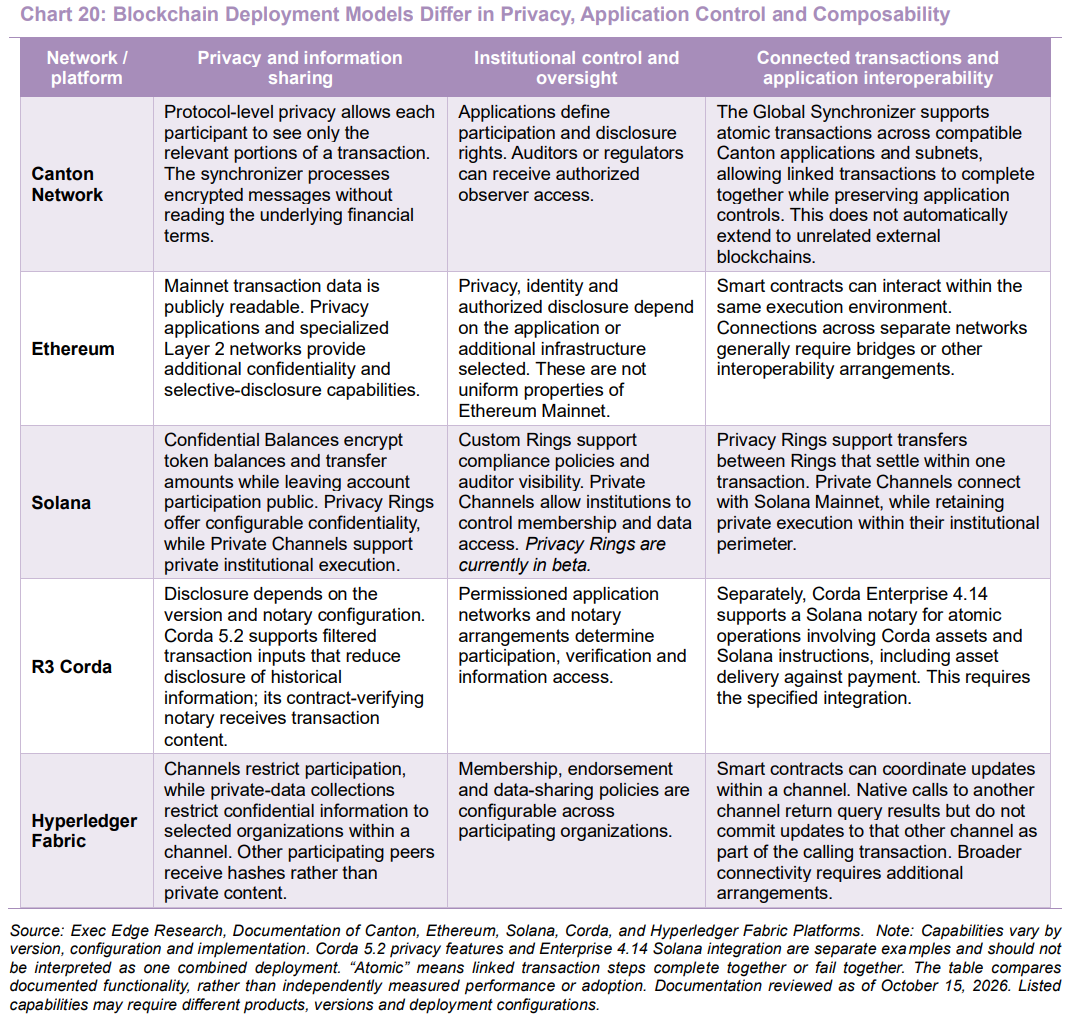
- Canton combines selective disclosure and coordinated execution to address institutions’ need for both confidentiality and connected transactions. Canton embeds selective disclosure within its protocol, allowing participants to view the portions of a transaction relevant to their roles while the synchronizer coordinates encrypted messages. Its Global Synchronizer supports linked transactions across compatible Canton applications, providing a common coordination mechanism while preserving application-level permissions. This allows institutions to connect financial workflows while retaining control over sensitive information. Competing platforms also provide relevant capabilities. Ethereum’s ecosystem includes privacy applications and specialized Layer 2 networks, while Solana documents several distinct privacy tools: confidential token balances and transfers, institution-controlled Private Channels, and configurable Privacy Rings. Privacy Rings remain in beta. Corda supports selective information sharing and, through its Enterprise 4.14 Solana notary, specific atomic transactions connecting Corda assets with Solana payments or other instructions. Fabric enables confidential information sharing among selected organizations through private-data collections. The competitive distinction lies in how these capabilities work together and which additional components institutions must implement. Canton brings granular disclosure and coordinated execution into a common architecture designed for institutional applications, supporting workflows that require confidentiality across multiple counterparties. This combination strengthens its positioning as institutions connect tokenized assets with payment, collateral and settlement processes.
- Controlled disclosure helps institutions combine confidential transactions with compliance and monitoring requirements. A practical example is TRM Labs’ work with Canton, which combines access permissions with blockchain risk analysis. Under the described model, an asset issuer or designated authority acts as a guardian, governing access to private transaction data. A trusted execution environment is designed to protect that information while allowing the analysis needed to generate risk signals. Compliance teams can receive pseudonymized information about higher-risk activity, while parties with asset-level responsibilities can receive broader authorized visibility. Requests from law enforcement follow a structured approval process through the guardian. The model shows how confidential financial activity can remain subject to oversight without exposing transaction details to unrelated participants. The Tie distinguishes privacy-preserving stablecoins from Canton Coin, which is more transparent by design, and describes arrangements ranging from confidential business payments to transparent organizational treasuries. This flexibility allows different assets and applications to serve different disclosure needs on the same network. For institutional adoption, the practical benefit is infrastructure that can accommodate customer confidentiality, risk monitoring and authorized audit access within connected financial workflows.
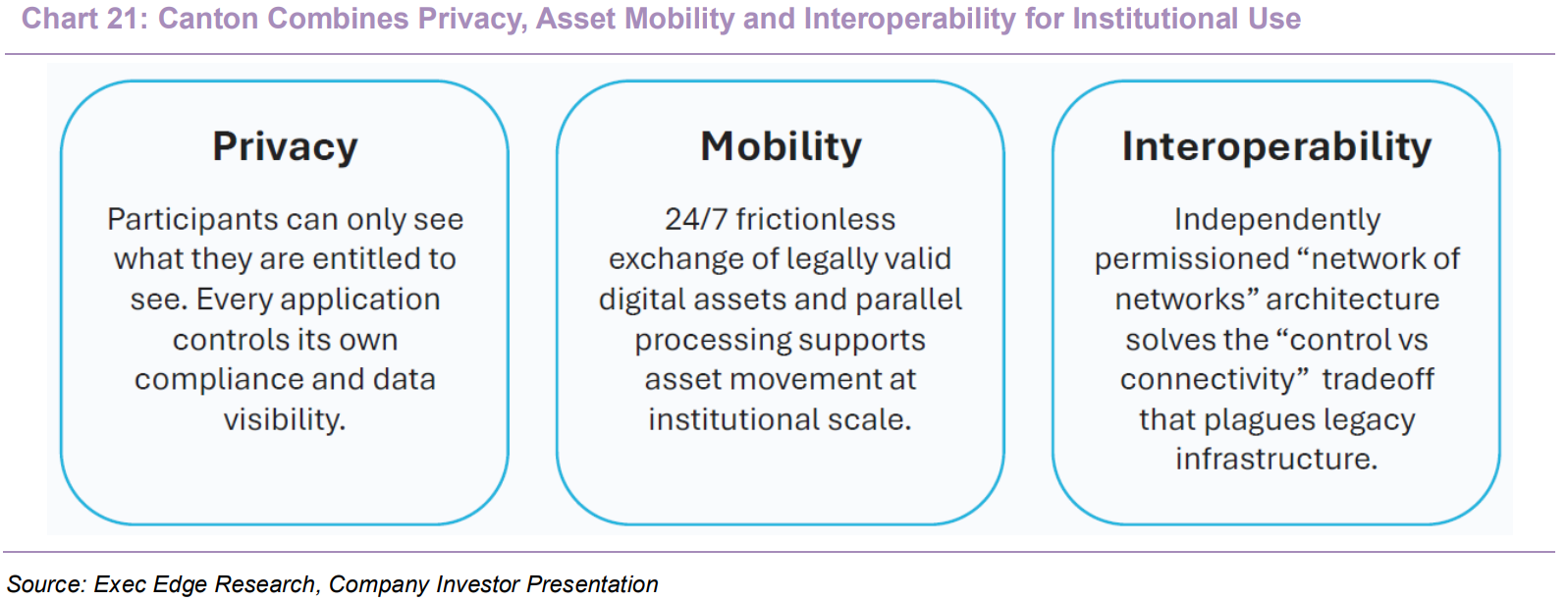
- Canton’s privacy architecture strengthens the institutional proposition behind CNTN’s operating businesses. Its Super Validator operations support coordination across compatible applications while those applications retain their permissions and information controls. We believe Canton’s ability to combine privacy with authorized oversight supports its appeal to institutions deploying tokenized assets and applications. CNTN can monetize this participation through validation rewards and customer locking agreements, supporting institutional activity while applications manage their own privacy and compliance requirements.
Interoperability Connects Digital Assets with Established Financial Market Infrastructure
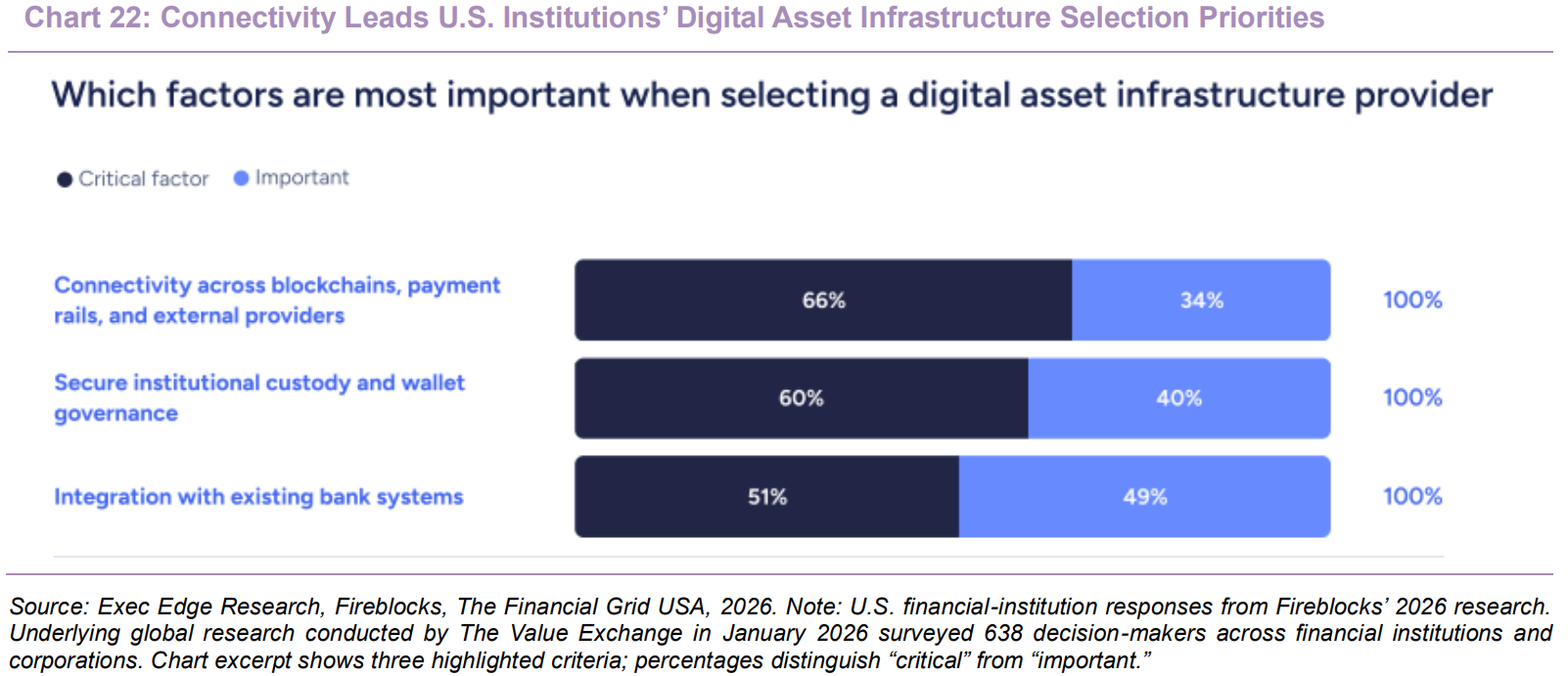
- Interoperability is becoming a purchasing requirement as financial institutions connect digital assets with established market infrastructure. Institutions need connectivity across blockchains, payment and custody systems, and existing banking platforms. Fireblocks’ 2026 research found that 66% of U.S. financial institutions rated connectivity across blockchains, payment rails and external providers as critical when selecting infrastructure providers. Another 34% rated it important. Integration with existing bank systems was critical for 51% and important for 49%. These findings make connectivity a commercial selection criterion alongside custody and operating resilience. A tokenized asset becomes more useful when institutions can hold, trade, finance and settle it through connected services. Providers that enable these workflows are better positioned to win deployments, creating demand for integration services and shared infrastructure as institutional activity scales.
- A lasting hybrid financial system creates sustained demand for connectivity between digital assets and established institutions. In the EY-Parthenon and Coinbase January 2026 survey, 59% of respondents to the relevant question expected integration challenges when investing in or holding tokenized assets. EY’s accompanying analysis also reported that 53% preferred a traditional finance platform with crypto capabilities, supporting demand for digital services within familiar operating environments. State Street’s 2025 research provides a longer-term perspective: 50% expected a hybrid traditional and digital investment environment to persist for at least ten years before becoming fully digital, while 14% expected the hybrid model to remain permanently. We believe this makes interoperability an enduring commercial requirement as institutions adopt different technologies at different speeds. Providers that connect tokenized assets with existing custody, banking and servicing arrangements can help customers expand digital activity while preserving established relationships. Common standards, including the Common Domain Model, can support this connectivity by giving systems a consistent, machine-readable representation of financial products and lifecycle events.
- CNTN’s Super Validator role provides an income-generating position in Canton’s shared transaction infrastructure. Its Super Validator operations support the Global Synchronizer, allowing linked transaction steps to complete together while applications retain their individual controls. As more assets and applications become available for coordinated transactions, the network can support a broader range of settlement and collateral workflows. CNTN earns rewards for supporting this infrastructure, with its participation determined by active weight and network rules. External connections require dedicated integrations; CNTN participates through the Global Synchronizer and services supporting eligible applications. LayerZero, Chainlink and Wormhole advanced interoperability milestones during 3Q26, with full production rollouts subject to further implementation.
Canton’s Capital Commitments Support CNTN’s LaaS Opportunity
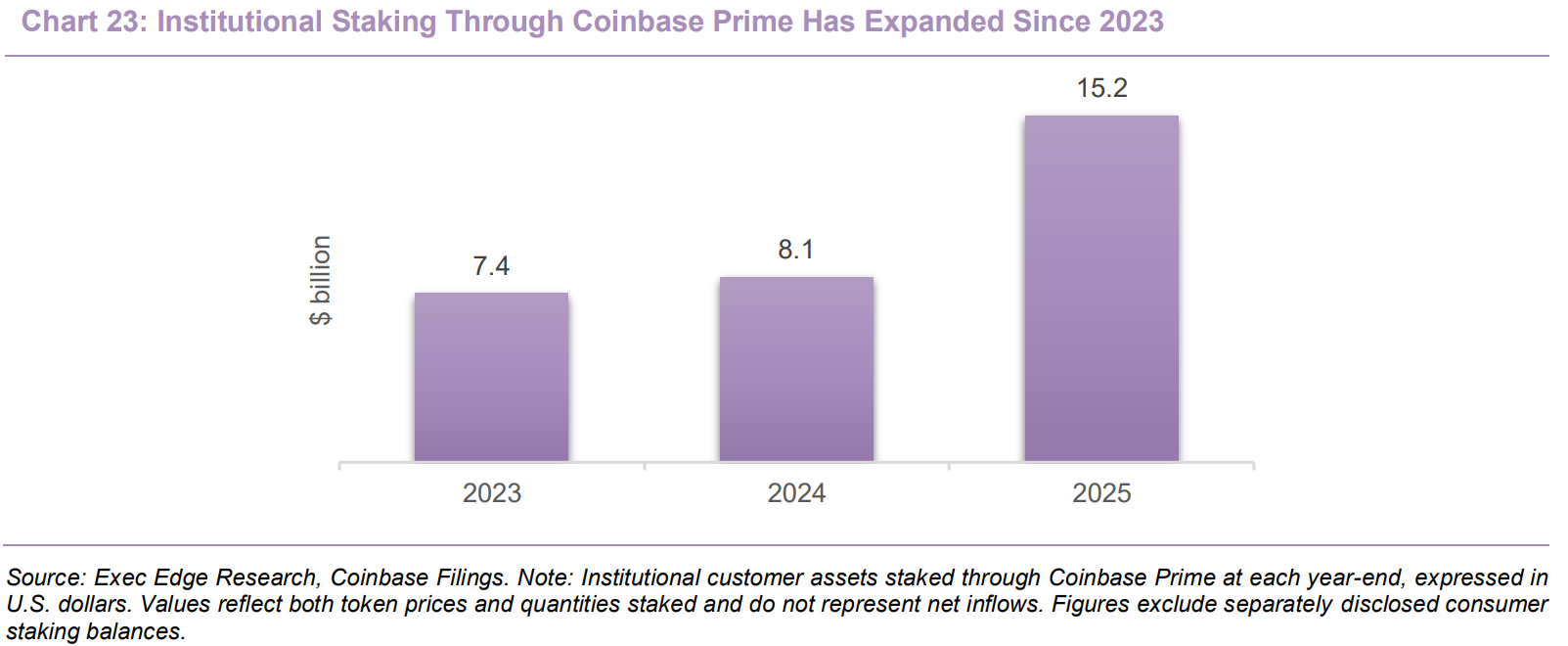
- Institutional blockchain participation is creating demand for specialist services that manage committed capital and network operations. In proof-of-stake networks, participants commit tokens to support transaction validation and receive rewards for performing the required services. Depending on the protocol, misconduct can result in financial penalties, creating incentives for dependable operations. Token owners can delegate validation to specialist operators, separating capital ownership from the technical work required to maintain infrastructure. Coinbase disclosed more than $15.2 billion of institutional customer assets staked through Coinbase Prime at December 2025, compared with more than $8.1 billion in 2024 and more than $7.4 billion in 2023. Although dollar balances also reflect token prices, these disclosures demonstrate substantial institutional participation through external infrastructure. This supports a commercial market for providers that combine technical execution, asset controls and customer servicing.
- Capital efficiency and operational complexity strengthen the commercial case for specialist network services. An institution must determine how much capital it can commit, when it becomes available again and who controls the assets throughout the arrangement. Running infrastructure internally adds secure key management, continuous monitoring, software maintenance and reporting requirements. In the EY-Parthenon and Coinbase January 2026 survey, 34% of respondents identified staking or yield management among their digital-asset capability priorities over the following two years. AMINA’s research describes how institutional participation increasingly incorporates custody, reporting and specialist operating arrangements. Delegation addresses technical execution, while services that supply qualifying coin commitments can reduce customers’ need to acquire and hold tokens where network rules permit. These are distinct commercial offerings, but both allow customers to access network participation through providers with established operating capabilities. Clear ownership rights, commitment terms and reporting arrangements are therefore important competitive factors in winning institutional business.
- Canton’s locking requirements give CNTN a defined customer need to monetize through LaaS. Super Validator reward weight and Featured Application eligibility are linked to defined CC commitments. Through LaaS, the company locks company-owned CC for customers, allowing them to meet applicable requirements without purchasing the coins themselves. CNTN retains legal and beneficial ownership and receives contractual compensation through a stated rate, reward sharing or equity, depending on the arrangement. The service began contributing revenue in 2Q26, demonstrating initial demand for deploying CNTN’s inventory against customer commitments. For customers, the benefit is capital efficiency, preserving funds for application development and operations. For CNTN, additional agreements can turn more available holdings into income-generating assets while retaining exposure to CC appreciation. Growth in eligible Canton participants can broaden this opportunity, with deployable coin balances, contract economics and customer execution determining the resulting commercial contribution.
Growth Strategy
Scaling Validation and Locking Services Through Strategic Capital Deployment
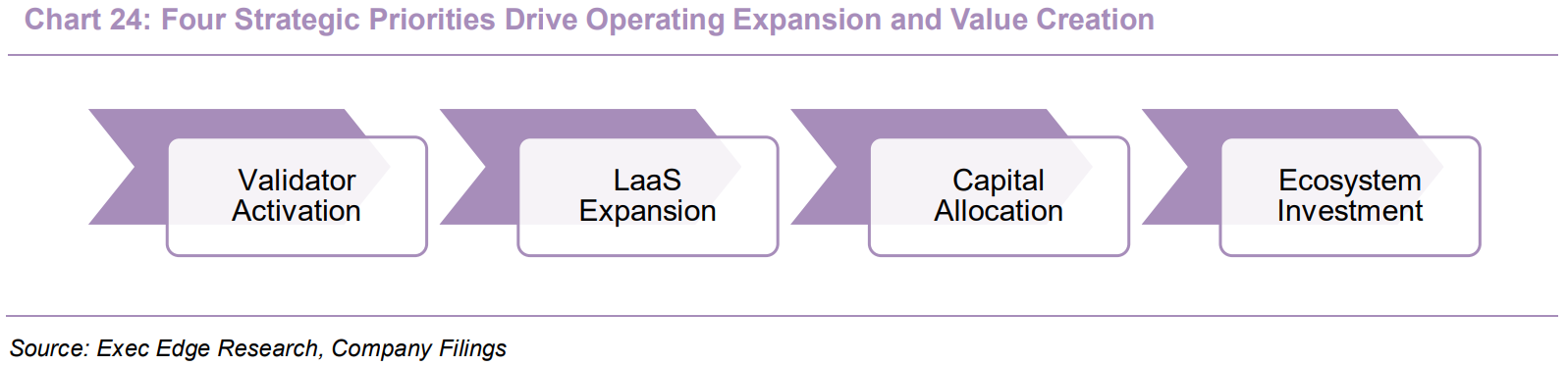
- Super Validator activation and Locking-as-a-Service expansion anchor CNTN’s strategy for scaling operating income. Capital deployment and ecosystem investment complement these operating priorities. Activating approved weight expands CNTN’s reward-generating capacity, while additional locking arrangements develop its customer revenue base. Deploying more coin holdings into income-generating activities and supporting application builders can increase asset utilization and broaden commercial opportunities. Management expects a largely fixed cost base to support operating leverage as revenue increases. Together, these initiatives provide routes to operating income growth beyond Canton Coin price appreciation while retaining treasury appreciation as a potential contributor to shareholder value.
- A scheduled 30x expansion in active Super Validator weight provides an identifiable path to greater validation income. The company’s published schedule envisages active reward weight increasing from the initial 0.5, which began earning rewards in May 2026, to 15 by 1Q28, subject to the applicable conditions and approvals. Weight determines CNTN’s share of the CC reward pool for Super Validators, so each approved activation expands its recurring reward-generating capacity. The execution path combines two programs. Under Canton Improvement Proposal 0102 (CIP-0102), CNTN earns releases by publishing quarterly ecosystem research and conducting public webinars, linking its investor education activity with its network commitments. CIP-0114 adds weight tied to maintaining the required CC holdings and completing quarterly reviews. Publication of the third-quarter report on October 14 provides further evidence of delivery under the research program. As approved tranches activate, CNTN can earn ongoing rewards and, following separate verification and approval, receive accumulated rewards associated with previously inactive weight. Management expects the additional reward income to be supported by a largely fixed cost base, allowing the validation business to expand without a proportionate increase in operating expenses. Execution therefore centers on delivering the quarterly program, maintaining qualifying holdings, and securing committee approvals. The 30x increase concerns active weight rather than a corresponding revenue multiple: income also depends on CNTN’s weight relative to total network reward weight, the available reward pool and CC prices. Beyond the activation period, scheduled reductions in coin issuance and the allocation to Super Validators also affect longer-term earnings capacity.
- Scaling Locking-as-a-Service through new customer agreements and additional coin commitments is another key element of CNTN’s growth strategy. The service began in April 2026, followed by a public launch announcement in June, after network governance introduced coin commitments for Super Validators and Featured Applications. These requirements create a customer need that CNTN addresses by committing its own CC under contract, enabling participants to meet their obligations while directing their capital toward operations and application development. CNTN has already completed arrangements, with locking services contributing the majority of its $1.30 million of other revenue in 2Q26. Canton’s Featured Applications increased from 107 at June 30 to 129 at September 30, 2026, broadening the potential market for qualifying locking services. Further growth depends on customer demand, commitments and contract economics. The growth approach uses three forms of consideration: a stated rate on locked coins, a share of customer network rewards, or an equity grant. That mix allows CNTN to pursue fee income, participate in application activity, or develop an ownership interest in a builder, depending on the agreement. Additional contracted balances and customer relationships provide a route to expanding service income using assets CNTN already owns. Compensation received in CC can add to the resources available for further deployment, subject to existing commitments and settlement terms. Growth indicators include contracted balances, new agreements and compensation terms. CIP-0104, still being implemented at September 30, aims to tie application rewards to measured traffic, making customer activity relevant to reward-sharing economics.
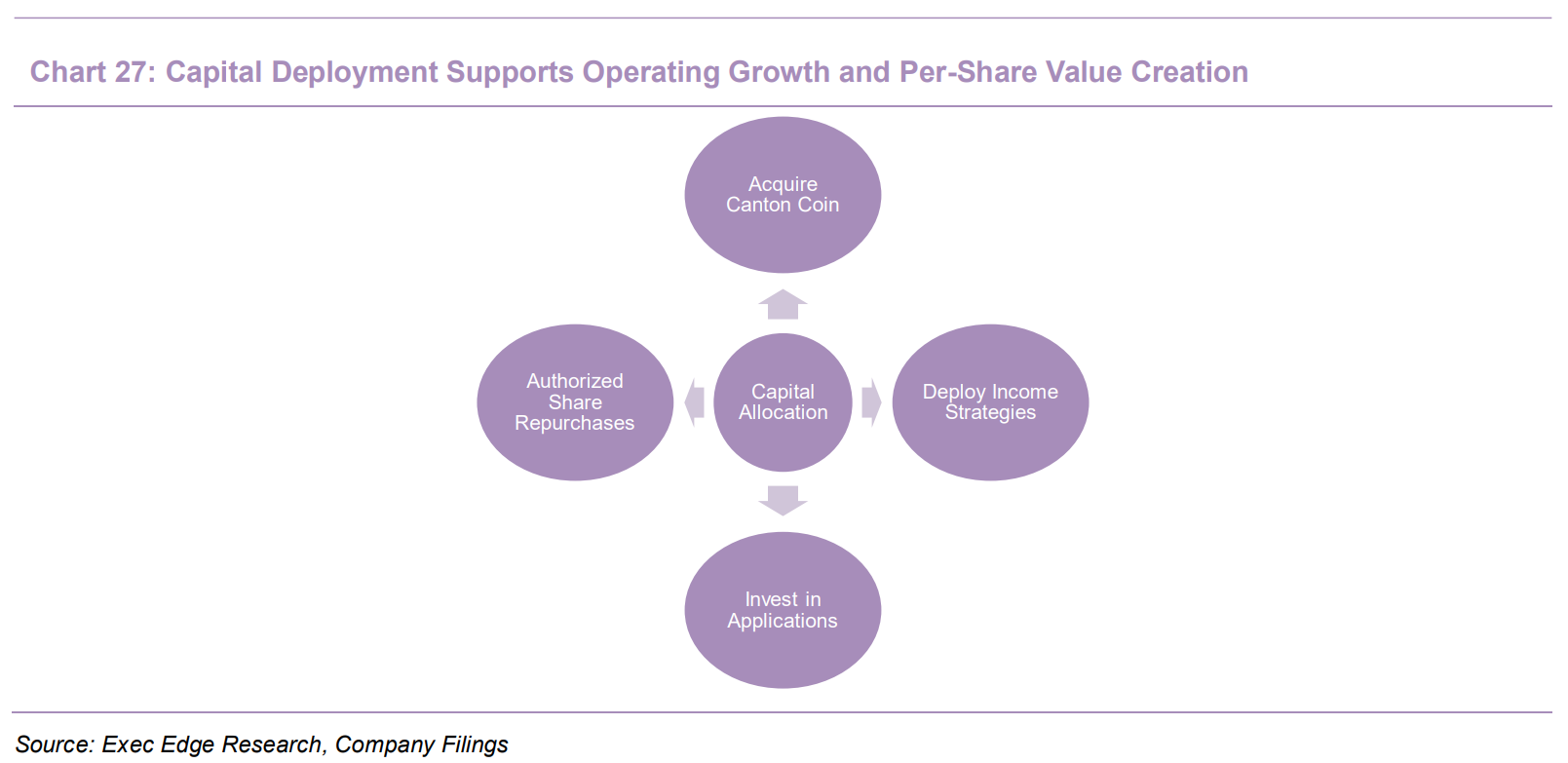
- Active capital deployment supports CNTN’s growth strategy by expanding income-generating assets and targeting returns on a per-share basis. The company’s treasury framework combines maintaining and growing CC holdings with using those assets in locking arrangements, qualifying network commitments, and other income opportunities. Coins earned through validation and customer contracts can add to the resources available for further deployment. The amended ATM program, established in March 2026, permits up to $300 million of gross share sales and provides access to financing as market conditions permit. This capacity can fund additional coin acquisitions and ecosystem investments, with shareholder benefits depending on deployment returns relative to the dilution incurred. CNTN also began selling cash-secured CC put options in 2Q26, receiving premiums and accepting an obligation to purchase coins at agreed prices if exercised, with reported earnings reflecting settlements and fair-value changes. Management may evaluate lending, secured financing, and other CC-linked instruments to generate yield or manage exposure. Its $50 million share repurchase authorization, announced in June, adds another capital allocation option; no purchases were completed under the program during 2Q26. CNTN therefore allocates capital across operating activities, coin acquisitions, ecosystem investments, and shareholder returns. Deployment decisions must also preserve the qualifying holdings supporting approved reward allocations and the balances committed under existing customer agreements. We believe the investment significance is the ability to combine service income, selected CC-linked returns and potential coin appreciation, while directing capital toward opportunities that improve value per share.
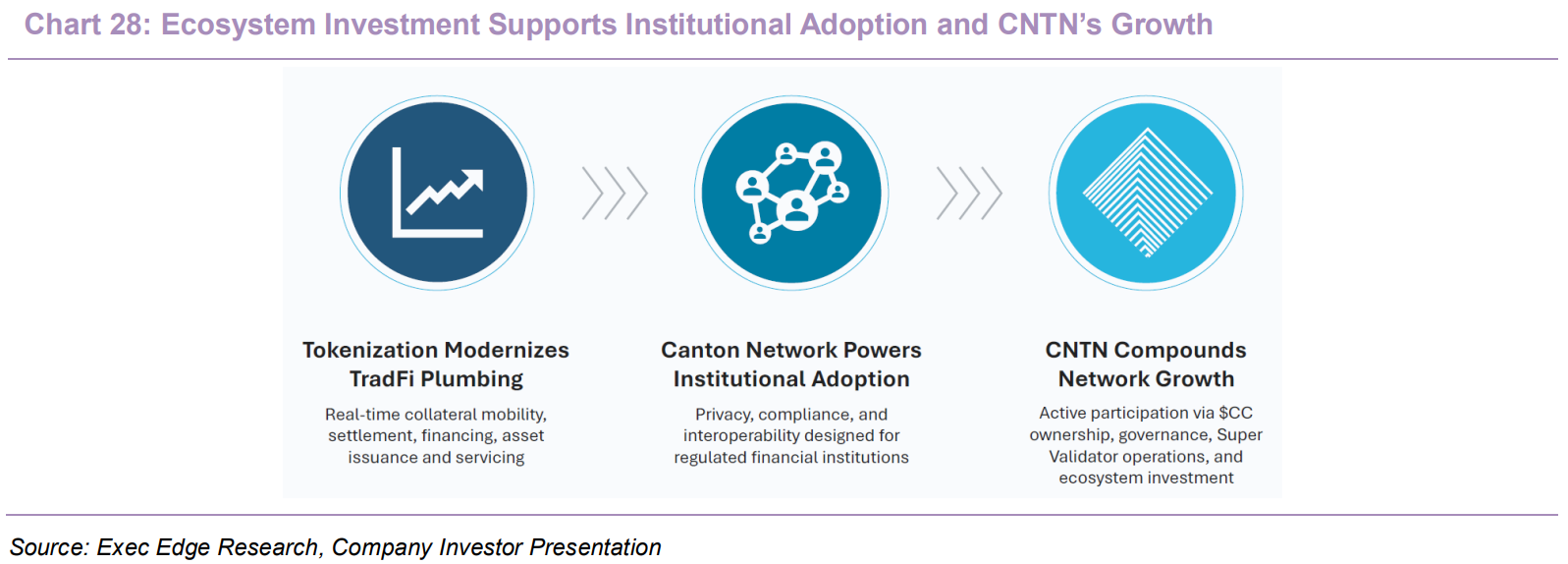
- Ecosystem investment and institutional partnerships extend CNTN’s growth strategy into new customer relationships and application-level opportunities. The company identifies building, acquiring, investing in, and incubating businesses that improve Canton’s liquidity and functionality as strategic levers. Its focus extends to infrastructure connecting financial institutions with digital markets, including custody, asset issuance, settlement, collateral management, and payments. Institutional engagement combines capital support with commercial relationships and education about the network. CNTN can also obtain equity through selected locking contracts, creating a connection between its commercial service and participation in application businesses. Institutional participation broadened in 3Q26, with Super Validator approvals for a16z crypto, LSEG, Marex, Paxos, Shinhan Asset Management and TreasurySpring. This demonstrates broader network participation, rather than disclosed CNTN customer relationships. As more eligible participants build on Canton, CNTN seeks additional customer relationships, income-generating deployments, and investments in application businesses, alongside stronger utility for CC. The growth contribution will emerge through completed partnerships, investments and application launches, with Locking-as-a-Service already providing a commercial channel for supporting builders and earning income.
- Tokenizing its own equity would deepen CNTN’s participation in Canton’s financial-market infrastructure. On October 29, 2026, the company announced an agreement with TSV LLC to make its common shares available in tokenized form on Canton and engaged Fairmint as transfer agent. The planned shares would carry the same rights as its Nasdaq-listed common stock, with trading designed for 24/7 availability and settlement in which both sides complete together.
Management Team
Experienced Leadership Combines Institutional Expertise with Operational Discipline
- A leadership team spanning institutional treasury, trading operations, digital assets and financial technology supports CNTN’s operating and investment goals. Led by Mark Wendland, whose previous leadership roles include DRW and Citadel, the team brings experience in capital markets relationships, financial reporting, and operational execution. (Bios of management team below.) The Board adds expertise in derivatives regulation, accounting, public company governance, and financial technology. Six of its seven members qualify as independent directors under Nasdaq rules. The July 2026 election brought Sean Galvin, Pamela L. Carter, and Rishi Nangalia onto the board, strengthening its financial, legal, and technology experience. Together, these backgrounds support the execution and oversight of CNTN’s treasury management, network operations, institutional partnerships, and responsibilities as a listed company.


Fundamentals & Valuation
Operating Leverage and Financial Flexibility Support Earnings Growth
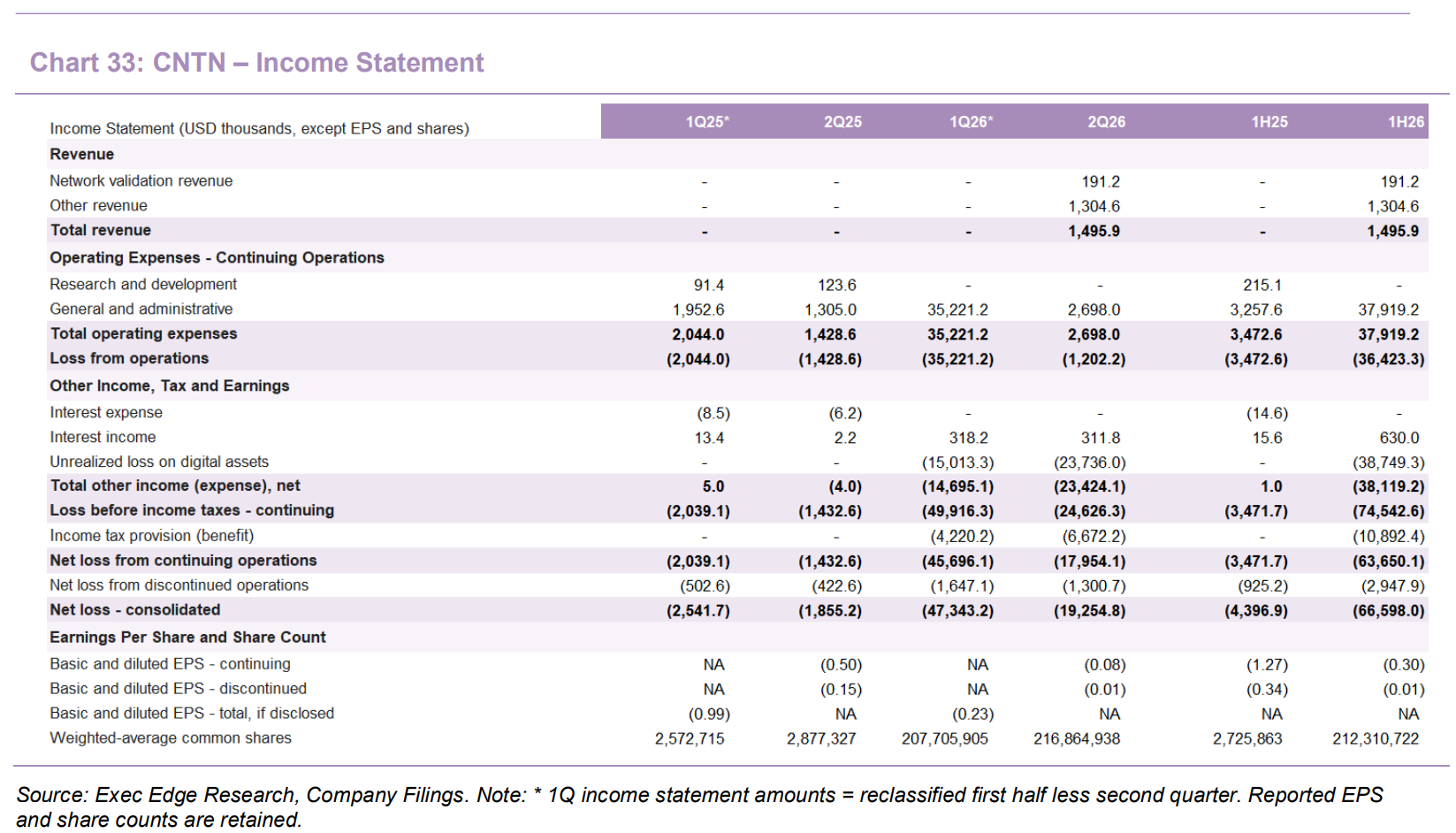
- Initial revenue from validation and Locking-as-a-Service establishes an operating base with scope to expand as approved capacity activates and customer commitments grow. Revenue reached $1.50 million in 2Q26, comprising $0.19 million of network validation revenue and $1.30 million of other revenue, primarily locking services. Locking commenced in April and active Super Validator minting began in May, making this a partial operating quarter. The revenue mix demonstrates that customer arrangements are already contributing alongside network rewards. LaaS provides a customer-driven source of income, while CC option activity can add variability to quarterly revenue. Full-quarter operations and additional customer commitments can expand revenue from the initial base, while 2Q26’s catch-up rewards should be distinguished from recurring income.
- Scheduled validator activation and additional LaaS contracts provide two distinct routes to a larger revenue base. At June 30, 2026, CNTN had active reward weight of 0.5 against total approved weight of 15, with scheduled activation to 15 by 1Q28 representing a 30x increase. Locking income can expand through additional deployed balances and customer agreements, compensated through rates, reward shares or equity. Initial catch-up rewards should be distinguished from ongoing minting. Revenue progression will reflect CNTN’s relative network weight, the available reward pool, contract deployment and CC prices. The earnings opportunity combines greater reward participation with increased income-generating use of existing holdings.
- A largely fixed cost base creates a scalable earnings platform as validator and LaaS revenue expands. In 2Q26, revenue covered 56.9% of adjusted operating expenses of $2.63 million, while adjusted EBITDA loss narrowed to $0.82 million from $1.13 million in 2Q25. The company’s adjusted EBITDA measure retains interest income, which contributed $0.31 million in 2Q26. Management expects additional service revenue to contribute at high incremental margins through a largely fixed operating platform. Annualized 1H26 adjusted operating expenses of $11.18 million represented approximately 2.0% of June 30 total assets, highlighting the relatively small operating cost base supporting CNTN’s asset deployment. We believe activating approved validator weight and expanding customer locking balances provide a path toward operating profitability, provided income growth outpaces the costs of supporting additional activity.
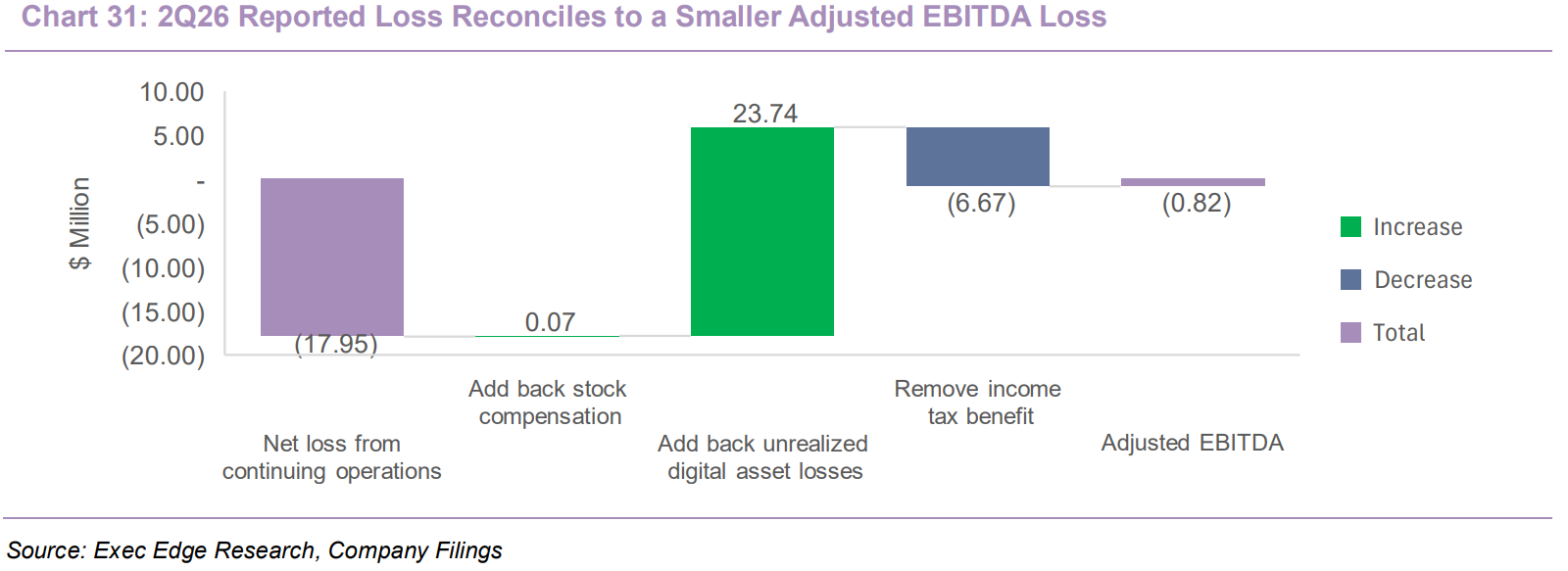
- Adjusted performance provides a clearer view of the developing operating business, while coin valuation and equity compensation remain relevant to shareholder returns. CNTN recorded a $17.95 million loss from continuing operations in 2Q26, including $23.74 million of unrealized digital asset losses and a $6.67 million income tax benefit. Excluding these items and $0.07 million of stock compensation produces the company’s adjusted EBITDA loss of $0.82 million. Separately, 1Q26 included $32.23 million of advisor-related stock compensation associated with the November 2025 financing. The narrower adjusted loss shows the initial revenue contribution against operating costs, while changes in CC value affect the treasury and equity compensation carries an economic cost for shareholders.
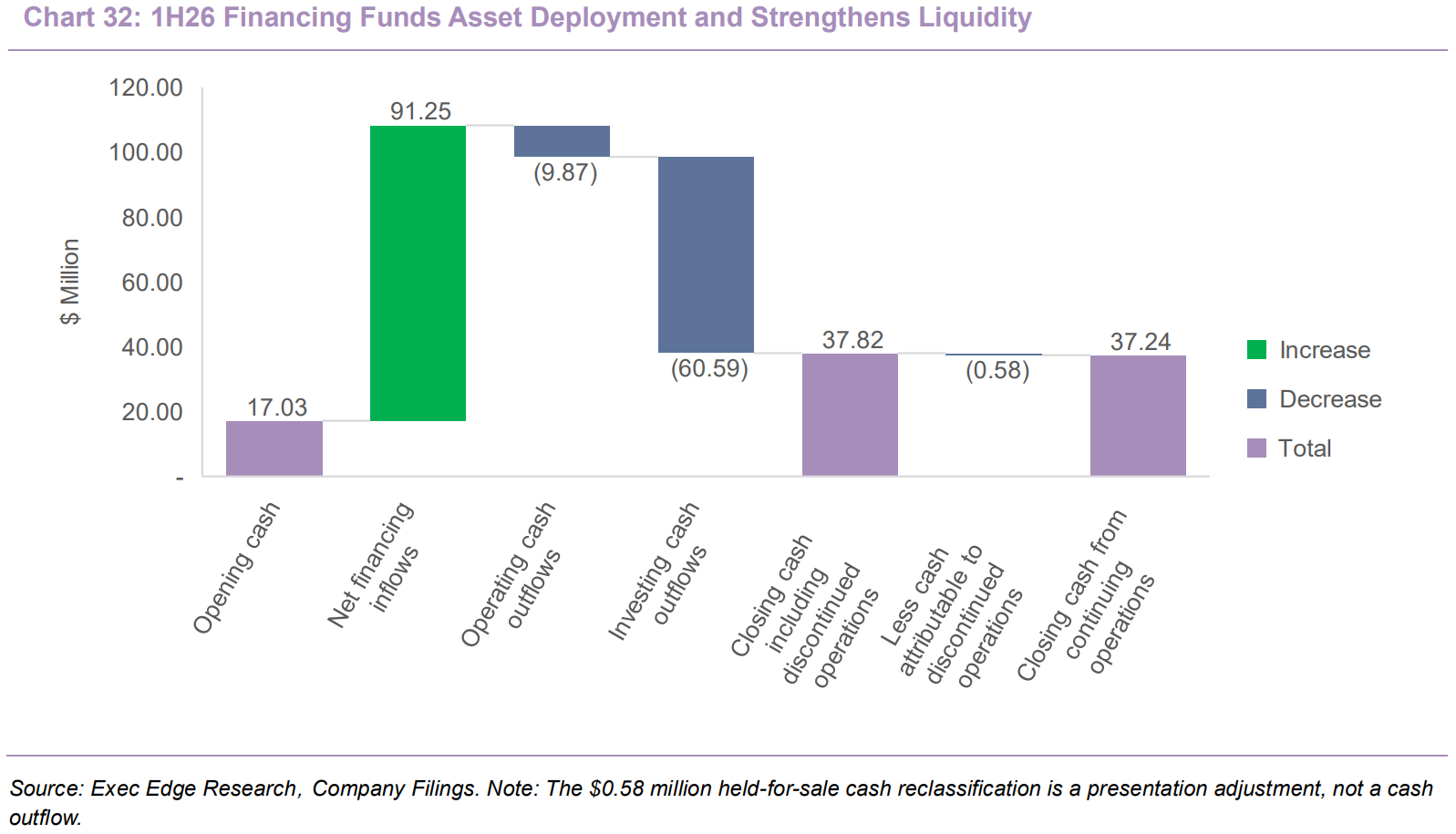
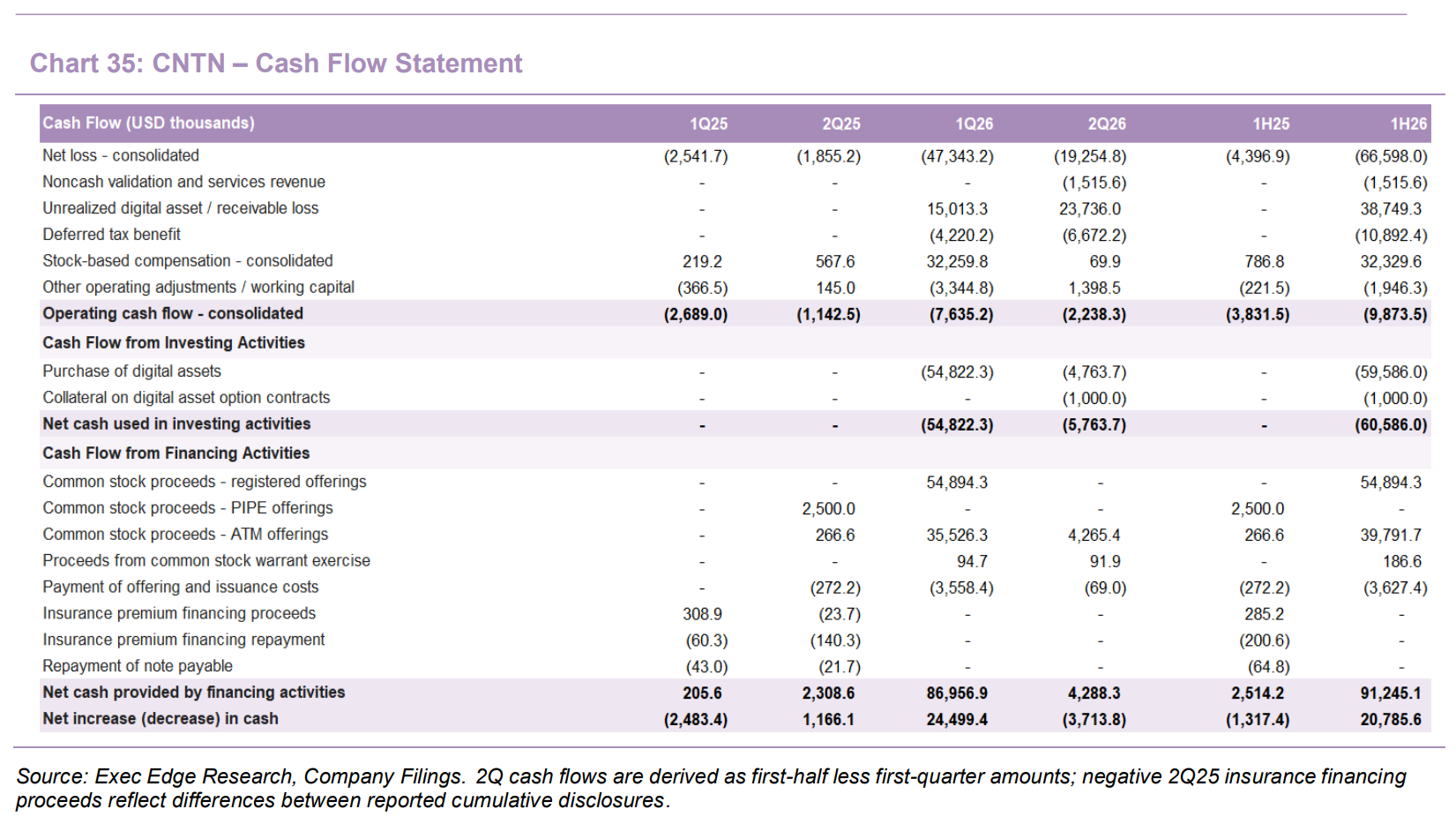
- Converting service income into usable liquidity will strengthen CNTN’s ability to fund operations and reinvest in growth. Continuing operations used $5.42 million of operating cash in 1H26, alongside $4.45 million used by discontinued operations. Validation and service activities generated $1.52 million of non-cash revenue, adding economic resources without equivalent immediate cash receipts. CC received through operations can increase deployable assets, while liquidity depends on settlement terms and monetization. Reward-locking obligations and customer commitments also influence how much of those holdings is available for deployment or conversion into cash. Separately, $59.59 million of CC purchases represented capital deployed to expand the treasury supporting CNTN’s operating and investment activities. The Gravitas sale shifts the focus of future funding needs toward CNTN’s Canton operations and growth initiatives.
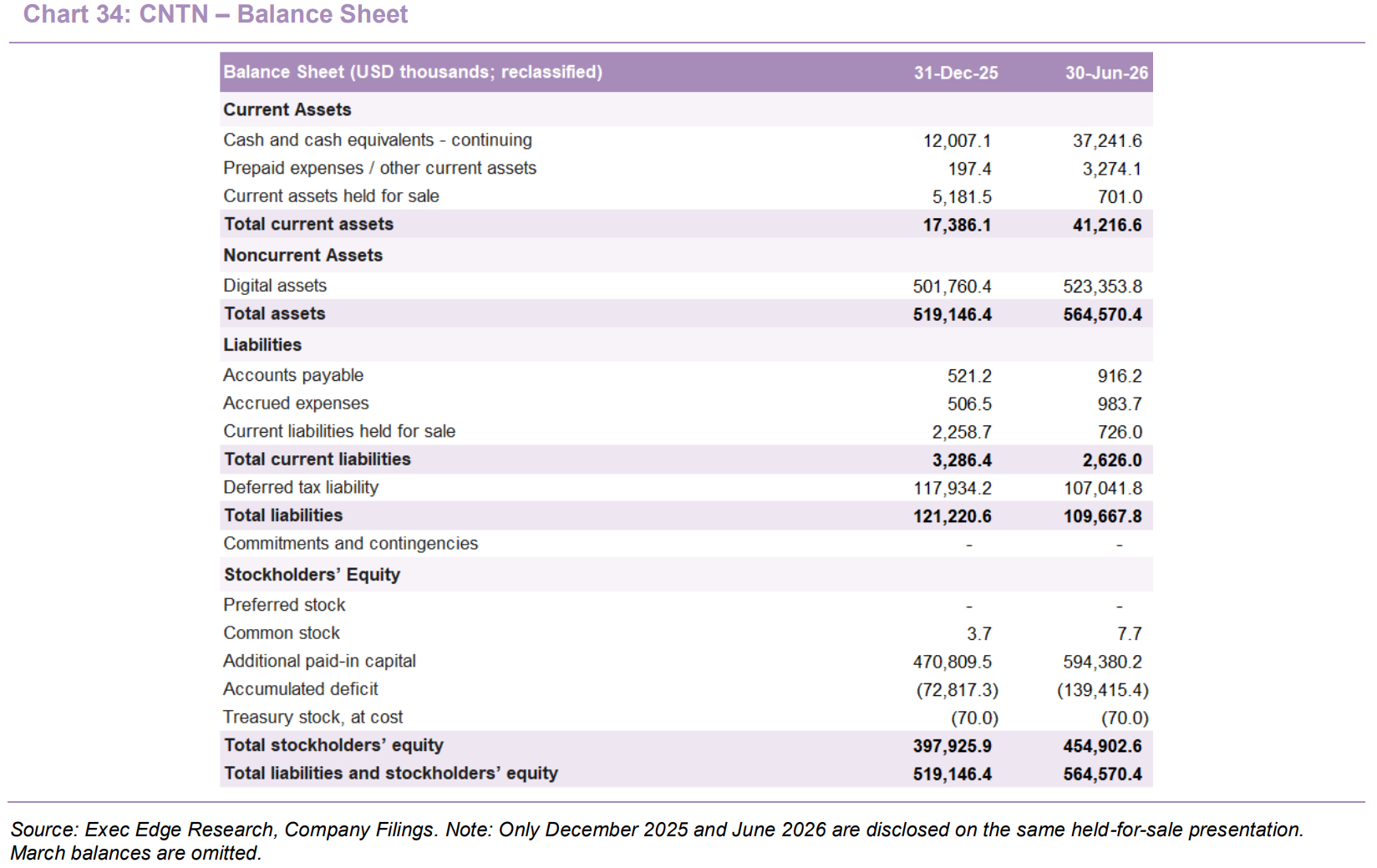
- An interest-bearing debt-free balance sheet and substantial cash reserves provide financial flexibility for operating expansion and opportunistic investment. At June 30, 2026, the company reported $37.24 million of cash, up from $12.01 million at December 31, 2025, $564.57 million of total assets, and $454.90 million of stockholders’ equity. Its 3.714 billion CC holdings, valued at $523.35 million, provide resources for qualifying network commitments and customer locking arrangements. Greater deployment of available holdings into LaaS contracts can expand income, while cash reserves support operating needs and new investments. Total liabilities of $109.67 million primarily comprised a $107.04 million deferred tax liability, reflecting future tax exposure relevant to the net value of the treasury. Cash covered total current liabilities of $2.63 million by 14.2x, providing a substantial cushion against near-term balance-sheet obligations.
- Financing has expanded CNTN’s growth capacity, with deployment returns and capital discipline determining value creation. Net financing cash inflows totaled $91.25 million in 1H26, including $54.89 million from the registered offering and $39.79 million from ATM sales before issuance costs. These resources supported coin acquisitions, operating expenditure, and liquidity reserves. Per-share outcomes depend on operating income and asset value generated relative to the equity issued to fund deployment, including the economic share base represented by pre-funded warrants. The $50 million repurchase authorization provides another allocation option, although no shares were repurchased under the program during 2Q26. We believe the opportunity is to translate the enlarged capital base into higher income and asset value per share through productive deployment and selective capital returns.
Operating Growth and Asset Backing Support Rerating Potential
- Disclaimer: Exec Edge does not publish proprietary estimates, ratings, price targets, or investment recommendations. The valuation discussion below is illustrative only and draws on company-reported information and third-party market data and estimates. It does not constitute a recommendation, price target, rating, or prediction of future pricing.
- We believe CNTN should increasingly be valued as an operating business, with its Canton Coin treasury supporting revenue generation and providing substantial asset backing. Super Validator operations earn network rewards, while Locking-as-a-Service generates contractual compensation from deploying company-owned coins. Additional validator activation and customer contracts provide routes to revenue growth, with a largely fixed cost base supporting operating leverage. Revenue growth, margins and earnings potential should therefore carry increasing weight in valuation alongside the value of its CC holdings. The treasury strengthens this operating proposition through income-generating deployment while preserving exposure to CC appreciation.
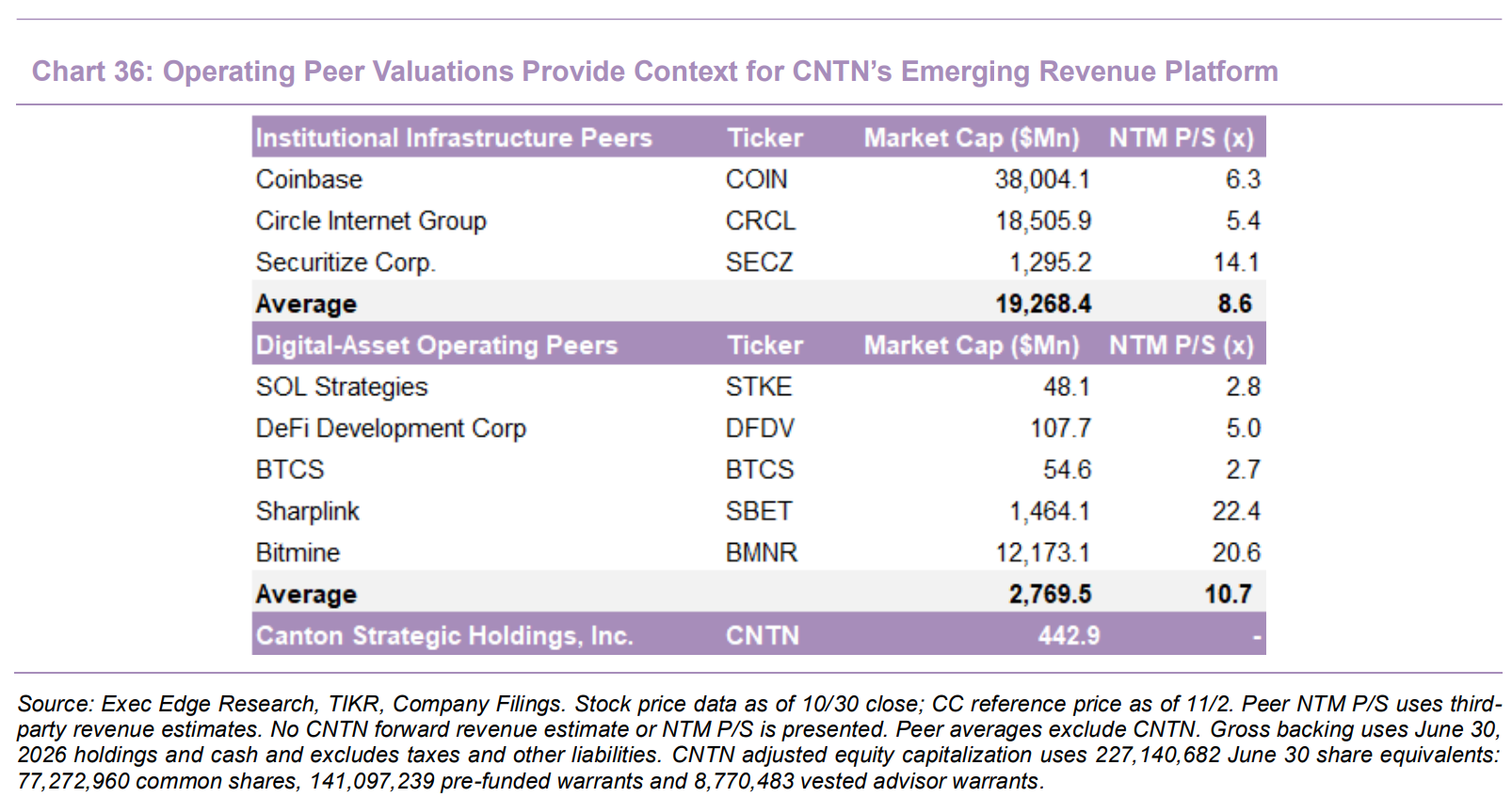
- Current pricing offers operating-business optionality alongside substantial coin and cash backing. At $1.95 per share as of the October 30 close, the company has an adjusted equity capitalization of $442.9 million, including pre-funded and advisor warrants. Its June-end holdings of 3.714 billion CC, repriced at the November 2 price of $0.09548, represent $354.6 million, while June-end cash adds $37.24 million. Together, these assets total $391.9 million, or approximately $1.73 per share equivalent. The shares therefore trade only modestly above gross coin and cash backing, suggesting limited value is currently attributed to the operating platform before adjusting for taxes and other net liabilities. Validation and LaaS already generate revenue, with additional validator activations and customer contracts providing identifiable paths to growth. We believe these activities can expand revenue faster than costs, supporting greater recognition of the operating business alongside its asset backing.
- CNTN’s first operating revenue marks the beginning of monetization, with substantial approved validator capacity still to activate. The company reported $1.50 million of revenue in 2Q26, comprising $0.19 million from validation and $1.30 million of other revenue, primarily LaaS. LaaS launched in April, while active validator minting began in May at 0.5 weight. The validation contribution also included a catch-up release of previously accumulated rewards. Against this initial operating base, CNTN held total approved weight of 15, with scheduled activations through 1Q28 representing a 30x increase from the initial active weight. Management has not issued formal revenue guidance, but the published schedule provides identifiable milestones for assessing expansion of the validation business.
- Scheduled activations and LaaS expansion provide complementary paths to a larger earnings base. CNTN’s published schedule envisages total active weight reaching 6.5 in 3Q26, 8.375 in 4Q26, 10.25 in 1Q27 and 12.125 in 2Q27, before reaching 15 in 1Q28. Releases depend on fulfilling the applicable requirements and receiving approvals. Higher active weight increases reward participation, with revenue also reflecting total network weight, reward allocations and CC prices. LaaS provides a separate commercial growth channel through additional customer agreements and greater deployment of available coin balances. Management expects a largely fixed operating platform to support these activities, creating scope for revenue growth to translate into stronger earnings.
- Operating peer valuations show how revenue generation can become a more meaningful component of CNTN’s market value. Coinbase, Circle Internet Group and Securitize trade at an average 8.6x NTM P/S, while the selected digital-asset operating peers average 10.7x. The digital-asset operating peer group includes only companies with operating activities beyond token holdings and mining. These groups provide market references for institutional blockchain infrastructure and productive digital-asset deployment, although their business mix and revenue economics differ from CNTN’s. These peer valuations illustrate the importance the Street places on revenue-generating digital-asset platforms. For CNTN, delivery against the published validator activation schedule and expansion of LaaS would establish a broader revenue base, with operating leverage strengthening the earnings contribution. We believe that progress can support greater recognition of the operating franchise alongside its coin and cash backing.
- We believe execution can turn CNTN’s operating optionality into a recognized source of shareholder value. Investors gain exposure to validation and LaaS growth at a valuation only modestly above the gross value of CNTN’s existing coin holdings and cash. Additional validator activations, broader LaaS deployment and revenue growth ahead of expenses can demonstrate the earnings potential of its funded platform. CC appreciation provides a complementary source of value, while ecosystem investments could add commercial opportunities. We believe sustained operating income can bring greater recognition of this optionality, with disciplined capital allocation determining how that progress translates into per-share value creation.
Risks
- Network adoption: CNTN’s operating opportunity depends on the Canton Network attracting sustained institutional activity. Adoption requires financial institutions to integrate new infrastructure, obtain internal approvals and demonstrate practical benefits from tokenized transactions. Slower implementation could delay demand for locking services and weaken the network activity and token economics supporting CNTN’s broader business. Participant announcements need to translate into active applications, customer relationships and recurring commercial activity to support revenue expansion.
- Reward realization: CNTN’s validation growth depends on converting approved Super Validator allocations into active reward-generating weight. At June 30, 2026, active weight was 0.5, while another 14.5 remained subject to milestone requirements and network review. Delays in meeting deliverables or obtaining approvals could shift the timing of revenue expansion. Growth in total network reward weight, scheduled reductions in coin issuance and the Super Validator allocation, or governance changes could also reduce CNTN’s reward income. The planned increase in weight does not establish a corresponding increase in revenue.
- Revenue scaling: CNTN’s operating businesses have a limited revenue history, making their sustainable earnings profile difficult to assess. Validation and locking services began generating revenue in 2Q26, and initial validation revenue included a one-time release of previously accumulated rewards. Locking revenue depends on contract terms and may be received through tokens, customer reward shares or equity. If recurring earnings expand more slowly than expenses, the path to sustained operating profitability could take longer.
- Token volatility: CNTN’s operating model generates productive returns from Canton Coin, but its dollar earnings and asset values remain sensitive to the token’s market price. Lower prices could reduce the dollar value of rewards and token-denominated service payments, even as token quantities increase. Fair-value movements in existing holdings also flow through reported earnings and may outweigh underlying operating progress. CC-linked option positions add price and settlement exposure.
- Liquidity management: CNTN must balance the productive deployment of Canton Coin with access to cash for operating expenses and investments. Limited market liquidity or adverse trading conditions could make token sales slower or more costly. CNTN’s own reward-locking obligations, qualifying holding requirements and customer commitments constrain the balances available for monetization or redeployment. Longer-term flexibility depends on managing these commitments, token monetization and cash requirements together.
- Custody security: CNTN relies on custodians, technology infrastructure and trading counterparties to safeguard and deploy its digital assets. Cyberattacks, private-key loss, software failures or service-provider disruption could interrupt operations or restrict access to tokens. The company uses institutional custodians and diversifies custody arrangements, although shared technology dependencies can limit the protection provided by multiple providers. Retaining legal and beneficial ownership under locking contracts does not eliminate operational, cybersecurity or counterparty risks.
- Regulatory evolution: CNTN operates within an evolving legal and tax framework for digital assets and blockchain services. Changes in token classification, custody requirements or rules governing validation could increase compliance costs or affect permissible activities. Classification of CC as a security could also create investment-company regulatory exposure, potentially requiring changes to CNTN’s asset holdings or business activities. Tax treatment may influence after-tax returns and require cash payments even where income is recognized without a corresponding cash receipt.
- Competitive pressure: CNTN competes for capital, institutional relationships and opportunities to deploy its Canton Coin holdings productively. Other digital-asset businesses and larger financial institutions may have greater resources, established customer networks or lower funding costs. Additional providers of locking and related infrastructure services could place pressure on commercial terms or reduce CNTN’s share of available opportunities. Greater competition could reduce locking yields, constrain customer acquisition and lower returns on deployed capital.
- Capital allocation and dilution: CNTN’s growth strategy may require additional equity financing to fund coin acquisitions, ecosystem investments and operating needs. Share issuance, pre-funded warrants and equity compensation can dilute existing shareholders, while unfavorable market conditions may restrict access to capital or increase its cost. Expanding total assets or operating income does not necessarily improve value per share. Shareholder outcomes depend on issuance terms, deployment returns and disciplined allocation across operating activities, investments and capital returns.
Subscribe to our Weekly Newsletter to Receive All Research
Contact: