
Download the Complete Report Here
 Swarmer, Inc. (SWMR)
Commercial Momentum Builds as SkyKnight Expands and Platform Reach Broadens
- Key Takeaways:
- Revenue rose 57% y/y to $216K, while $1.5 million of SkyKnight invoicing and $1.4 million of collections reflected stronger underlying commercial activity.
- SkyKnight contracted value increased from $2.9 million to $3.9 million, while unchanged upgrade options preserve total potential economics of approximately $14.2 million.
- Oak Grove, Lantronix, Brightline, Molfar and Powerus broaden SWMR’s customer acquisition, data, compute and platform-integration ecosystem across additional unmanned platforms.
- Gross margin reached 84.8%, while $26 million+ of ELOC funding expands flexibility for engineering, integrations and potential investments in complementary defense technologies.
- Valuation carries a clear premium, but remains defensible given combat validation, scalable licensing economics and the operating leverage embedded in the forward growth outlook.
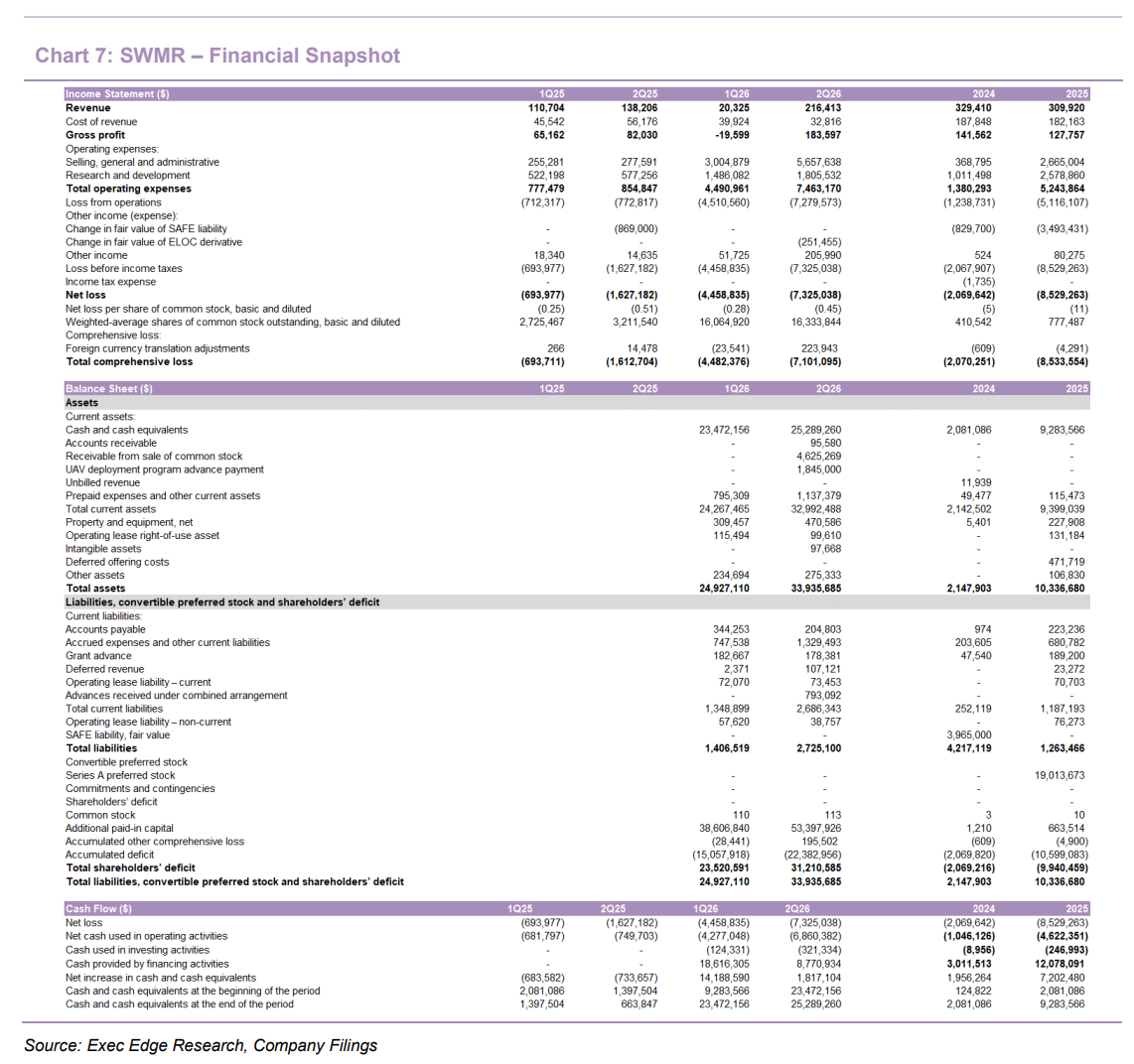
- Revenue accelerated sharply from 1Q26, with SkyKnight license delivery and cash collection providing a better indication of underlying commercial progress than reported revenue alone. SWMR reported 2Q26 revenue of $216,413, up 56.6% y/y from $138,206 and more than 10x the $20,325 reported in 1Q26. The company invoiced approximately $1.5 million under the SkyKnight program and collected $1.4 million following license delivery, while only approximately $0.2 million was recognized as revenue, $0.1 million was deferred and the remaining amount was recorded as an advance. Certain deployment, integration and market-development payments associated with the program also reduced recognized revenue under the combined arrangement, creating a meaningful gap between commercial activity and revenue in the quarter.
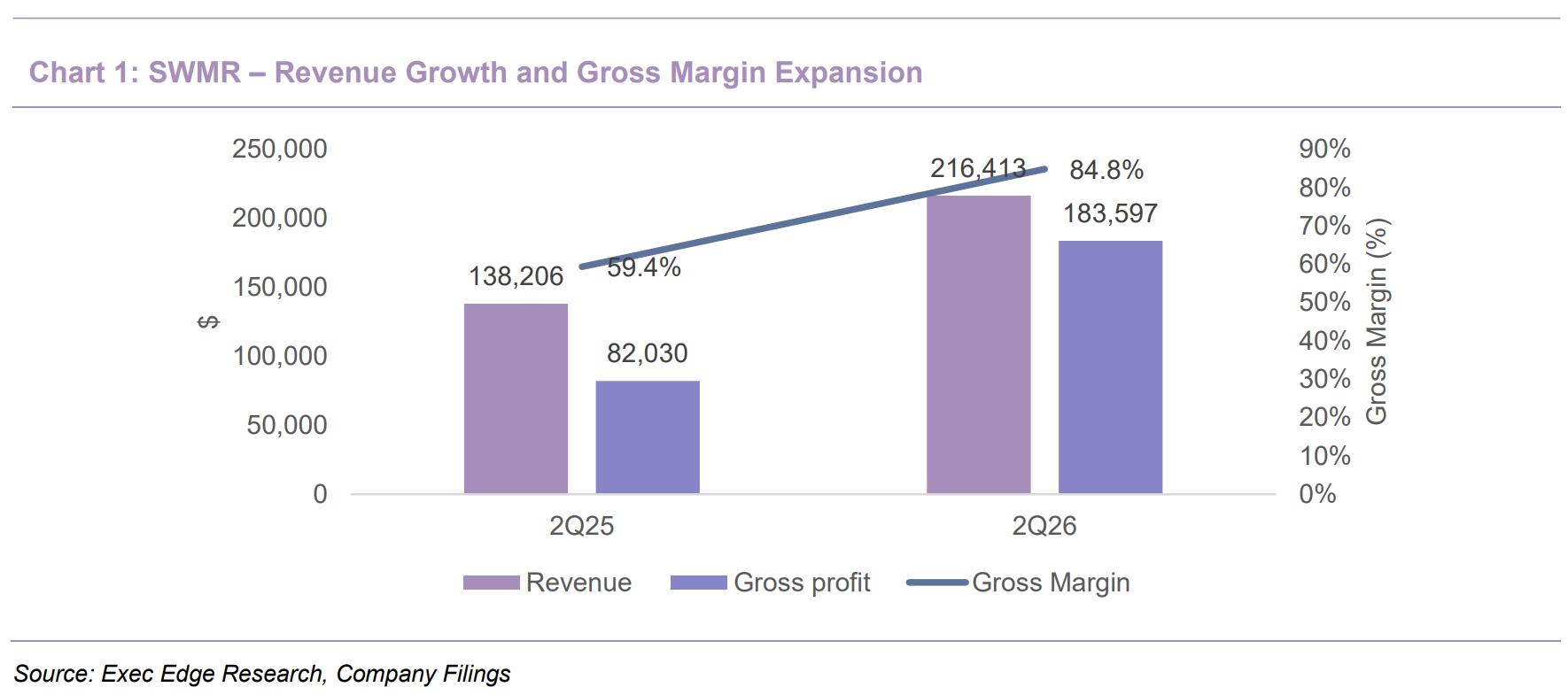
- Gross profit improved to $183,597, with gross margin expanding to 84.8% from 59.4% y/y, while net loss widened to $(7.3) million from $(1.6) million y/y as SWMR continued investing in engineering, product development and platform integration. Overall, 2Q26 showed stronger underlying commercial execution, with delivered licenses and cash collections advancing materially ahead of reported revenue while the sharp improvement in gross margin provided early evidence of the software model’s underlying operating leverage as licensing scales.
- SWMR’s differentiation rests on a hardware-agnostic autonomy layer reinforced by combat data. As drone production scales, the challenge is increasingly coordinating large numbers of autonomous platforms rather than manufacturing hardware alone. SWMR’s software is designed to coordinate systems across air, land and maritime domains, while 100,000+ combat missions in Ukraine since April 2024 provide real-world data that informs ongoing improvements in autonomy and AI performance.
- SkyKnight remains the clearest validation of SWMR’s licensing model, with contracted value expanding approximately 34% only weeks after the initial award without consuming the original upgrade optionality. The program’s contracted license value increased from approximately $2.9 million to $3.9 million after Meta Bureau increased projected production of its fixed-wing platform, while existing operating-system-to-full-autonomy upgrade options remain intact and could still lift the combined arrangement to approximately $14.2 million. Importantly, the approximately $1.0 million incremental award was outside the scope of the initial option structure rather than an exercise of previously disclosed upgrades. The original arrangement covered full-autonomy licenses across SkyKnight’s quadcopter and fixed-wing platforms together with operating-system licenses on planned production that can subsequently be upgraded to SWMR’s full platform. This structure gives SWMR two potential monetization layers as partner volumes grow: additional autonomy licenses as manufacturers increase production and higher-value software attach when OS-only units are upgraded over time.
- SkyKnight’s scale relative to larger Ukrainian manufacturers highlights the potential replicability of the licensing model across a broader OEM base. SkyKnight is not among the largest UAV producers in Ukraine, with SWMR estimating that more than 20 manufacturers currently ship higher volumes, yet one manufacturer has already generated approximately $3.9 million of contracted license value with potential economics of $14.2 million. The comparison illustrates the potential operating leverage in a per-unit software model if SWMR becomes embedded across larger OEM production volumes, but it should not be interpreted as contracted pipeline. SkyKnight accounted for approximately 99% of 2Q26 revenue and 90% of 1H26 revenue, making broader OEM conversion an important next step in diversifying the commercial base. The next proof point is whether additional integrations progress from technical work into platform sales to government end users, creating repeatable license activation across multiple manufacturers.
- Oak Grove extends SWMR’s commercialization funnel beyond OEM integration into operator training and U.S. defense-channel exposure. SWMR’s relationship with Oak Grove Technologies integrates its autonomy software with the Chimera UAV platform, making Oak Grove the first U.S.-based company to integrate Swarmer’s autonomous software into its platform. Integration, testing and operational fielding were completed in late 2025 in Eastern Europe across ~100 test flights spanning varied weather and mission profiles, providing additional validation of the technology on a U.S. platform. Following the initial integration effort, the integrated Chimera systems remained overseas through early 2026 to support continued testing, operator evaluation and training before returning to Oak Grove’s U.S. headquarters for incorporation of operational feedback into future mission and training requirements. The partnership also benefits from Oak Grove’s established training and operational support activities with the U.S. special operations community, giving operators hands-on exposure to autonomous systems under realistic conditions and broadening SWMR’s customer-acquisition channel beyond direct OEM engagement. Combined with SWMR’s 100,000+ combat missions in Ukraine, the relationship provides a potential bridge between battlefield-proven autonomy and U.S. operator adoption, with the key commercial proof point remaining conversion of testing and training activity into funded defense programs.
- Lantronix creates a potentially scalable distribution wedge by embedding SWMR’s operating system at the compute layer rather than requiring software adoption after a drone is already designed. The collaboration is developing an NDAA-compliant compute platform for Group 1 unmanned systems with more than 400% greater onboard processing capability, targeting what SWMR sees as an underserved performance gap between lower-end Raspberry Pi systems and higher-end NVIDIA Jetson solutions commonly used for autonomy. With more than seven million drones projected to be manufactured this year, an embedded compute-layer position could provide SWMR with a scalable route into a substantially larger installed base. Strategically, the opportunity is larger than hardware integration alone: SWMR intends for its operating system to be embedded on the compute platform, allowing customers to upgrade to full autonomy through software rather than completing a separate integration. If adopted broadly, that architecture could shift customer acquisition earlier in the OEM design cycle, increase the installed base of upgradeable SWMR-enabled platforms, and create a lower-friction OS-to-full-stack monetization path. It also preserves the software-led business model because SWMR’s primary economics would remain tied to software penetration and upgrades rather than manufacturing the unmanned system itself.
- Brightline and Molfar expand the combat-data flywheel beyond platforms already running SWMR software, potentially accelerating AI development without waiting for every OEM integration to scale. SWMR continues to cite more than 100,000 real-world combat missions as a core source of telemetry, sensor information and operational feedback, but the new relationships broaden the available training dataset. Brightline provides access to operational data across unmanned platforms already used within the U.S. special operations community, including platforms whose manufacturers have not yet integrated SWMR, while Molfar contributes verified open-source and battlefield intelligence datasets to the AI training pipeline. The strategic implication is that model development can increasingly benefit from third-party operating data rather than only the installed SWMR fleet. This could broaden the range of mission profiles and operating conditions available for model training, strengthening the feedback loop between data capture, model improvement and subsequent deployment as the platform scales.
- Powerus illustrates both the scalability of SWMR’s integration model and why revenue can remain a lagging indicator even after technical work is complete. Integration work under the Powerus MOU has begun across several air and maritime platforms, with integration on familiar hardware configurations potentially requiring only 2-4 weeks including field testing, while substantially different platforms can require several months. More importantly, software integration does not itself trigger meaningful revenue. Once integration is completed, the manufacturer must still secure buyers for the finished platform, which are typically government customers operating through longer acquisition cycles. This creates a multi-stage funnel from MOU to integration, field testing, OEM production, government procurement and finally software revenue recognition. The relatively short 2-4 week integration period for familiar platforms indicates the technical layer can scale efficiently, but end-customer procurement remains the principal gating factor between integration progress and recognized revenue.
- Powerus remains an early-stage commercial opportunity, with integration progressing but no timeline disclosed for conversion into a funded contract. Management indicated that commercial conversion will depend on the platforms reaching sufficient scale and securing end-user demand, and noted that conversion is not guaranteed. We therefore view Powerus as a potential future revenue contributor rather than a near-term model input until a funded contract is announced.
- The partnership strategy is broadening beyond defense deployments into dual-use autonomy applications, expanding SWMR’s addressable market without changing the core software architecture. In addition to Oak Grove, Lantronix, Brightline, Molfar and Powerus, SWMR is working with Tekmara and Florida International University to evaluate autonomous drone swarms for environmental monitoring and coastal restoration applications. These initiatives broaden the addressable use case beyond kinetic operations while leveraging the same multi-vehicle coordination architecture developed through more than 100,000 combat missions. The Tekmara/FIU initiative will evaluate coordinated autonomous operations across air, surface and underwater domains, using FIU’s Aquarius Reef Base as a real-world testing environment for persistent environmental monitoring and restoration. This supports SWMR’s broader dual-use strategy, with potential applications across environmental restoration, disaster relief, wildfire detection, search and rescue and other public-sector missions. Commercially, however, the initiatives remain at different stages of maturity, and the quarter did not disclose material revenue from these newer programs. We therefore view these programs as incremental extensions of the platform and customer funnel, with greater strategic relevance as they progress toward funded deployments and repeat licensing.
- Post-quarter leadership changes consolidate executive responsibility under Alex Fink while strengthening SWMR’s communications and market-development capabilities. Effective July 2026, Serhii Kupriienko resigned as Global CEO while remaining on SWMR’s Board, and President and U.S. CEO Alex Fink assumed the role of principal executive officer reporting directly to the Board. SWMR does not intend to appoint a successor Global CEO, streamlining the prior dual-CEO structure as the company scales commercialization and strategic execution. Separately, Swarmer promoted Garrett Kasper to Chief Communications Officer, bringing 30 years of experience across defense, aerospace, intelligence and cybersecurity, including prior work at L3Harris Technologies on the VAMPIRE counter-UAS program. In the expanded role, he will oversee global marketing, branding and corporate communications, supporting customer awareness and market development across U.S. and allied defense channels.
- SWMR expects gross margins to remain attractive as revenue scales, although they may moderate as engineering services are incorporated into customer contracts. 2Q26 gross margin increased to 84.8% from 59.4% y/y, providing early evidence of the high-margin economics embedded in the licensing model. Currently, cost of sales primarily consists of web-based data services, resulting in relatively low direct costs. As the company scales, engineering support is expected to increase COGS as a percentage of revenue, with management currently targeting approximately 80% gross margins, although the methodology remains under development and may vary by deal. While the current revenue base remains small, sustaining margins near this level as licensing scales would be an important driver of the operating leverage embedded in the 2027E profitability outlook.
- Operating expenses increased sharply as SWMR scaled its operations and transitioned to a public-company cost structure. 2Q operating expenses rose to $7.5 million from $0.9 million y/y, driven primarily by higher personnel, engineering and product-development costs, as well as increased legal, consulting and professional expenses. SG&A increased to $5.7 million from $0.3 million y/y, while R&D rose to $1.8 million from $0.6 million, reflecting investment ahead of the expected licensing ramp. The quarter also included one-time equipment purchases and $1.2 million of non-cash stock compensation, meaning reported expenses were partly elevated by non-recurring and non-cash items. The key forward consideration is whether software revenue can begin scaling across this expanded cost base, rather than requiring a meaningful reduction in investment to reach profitability.
- Capital formation is providing SWMR with greater flexibility to fund growth and pursue strategic opportunities as it expands beyond its core autonomy software offering. Cash and equivalents increased to $25.3 million at June 30 from $9.3 million at December 31, supported by IPO proceeds and equity financing, with a further $17.9 million raised through August 10, taking cumulative ELOC proceeds above $26 million. The stronger liquidity supports continued investment in engineering and platform integration while giving SWMR capacity to invest in or acquire complementary defense technologies and potentially broaden its value capture beyond software licensing. This aligns with the broader strategic vision recently articulated by Chairman Erik Prince around identifying and scaling battlefield-proven defense technologies that may lack capital, commercial infrastructure or international distribution. However, the strategy remains subject to acquisition execution risk and shareholder dilution from equity-funded capital deployment.
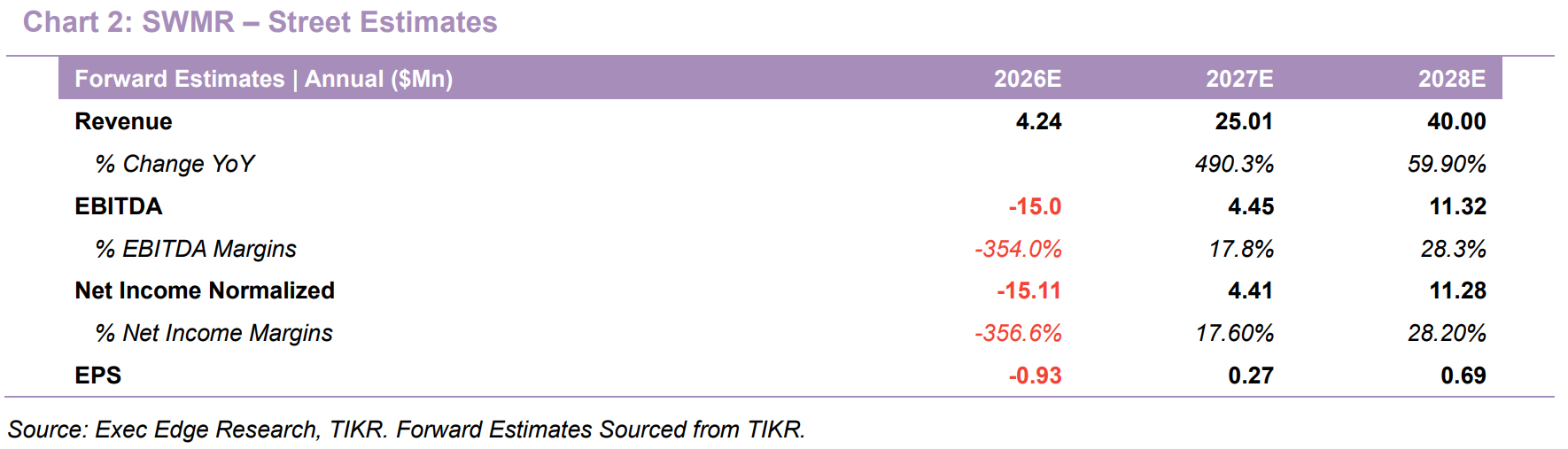
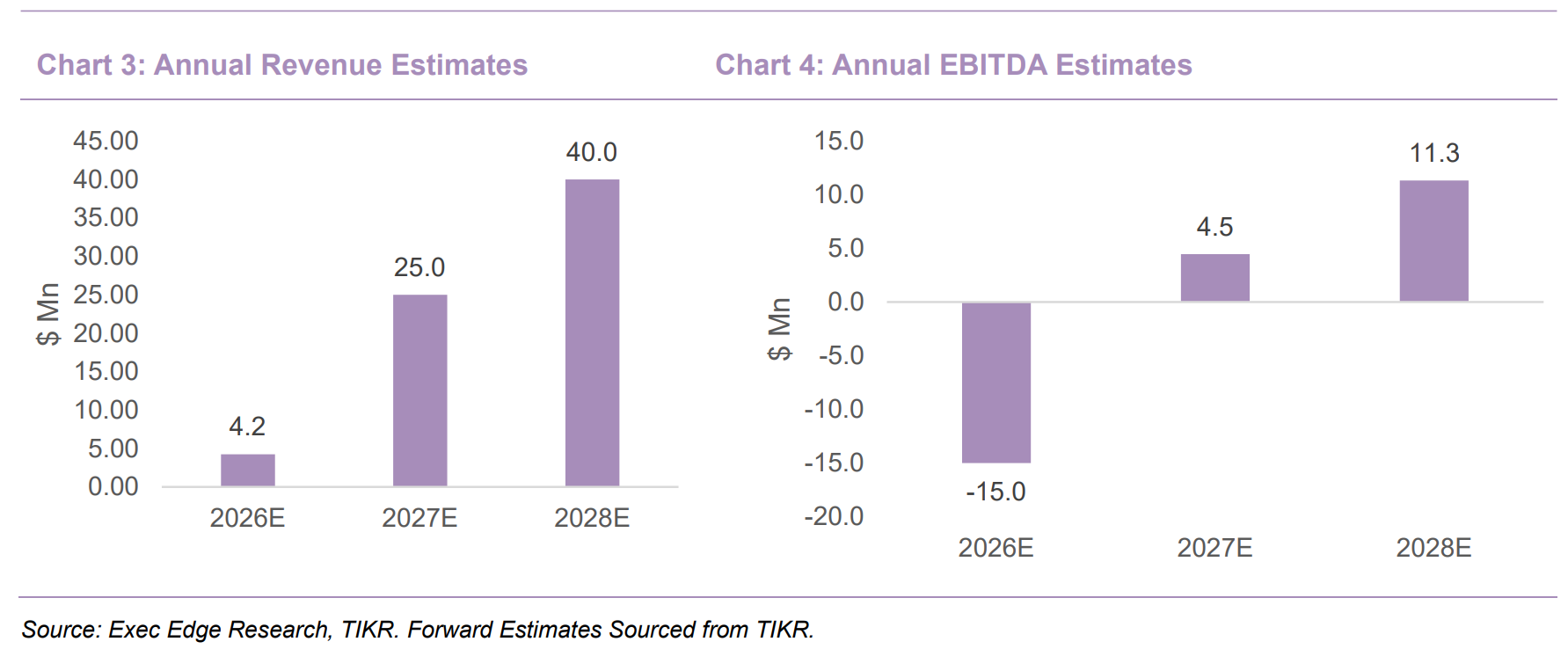
- Street estimates embed a hockey-stick revenue ramp as SWMR moves toward scaled license activation. Street estimates sourced from TIKR suggest revenue of $4.24 million in 2026E before rising to $25.0 million in 2027E and $40.0 million in 2028E, with EBITDA margin inflecting to 17.8% in 2027E and 28.3% by 2028E. With 2Q26 revenue of $0.2 million despite $1.4 million received from SkyKnight, the key focus now shifts to whether deferred/advance amounts and the broader partnership pipeline convert into recognized revenue in 2H26 and beyond, with SkyKnight recognition, OS-to-full-autonomy upgrades and additional OEM production providing the clearest paths to the expected 2027E step-up.
SkyKnight Expansion and Ecosystem Scale Support a Premium Valuation Framework
- Disclaimer: Exec Edge does not publish proprietary estimates, ratings, price targets, or investment recommendations. The valuation discussion below is illustrative only and is based on company filings, management commentary, and third-party data and estimates. It does not constitute a recommendation, price target, rating, or prediction of future pricing.
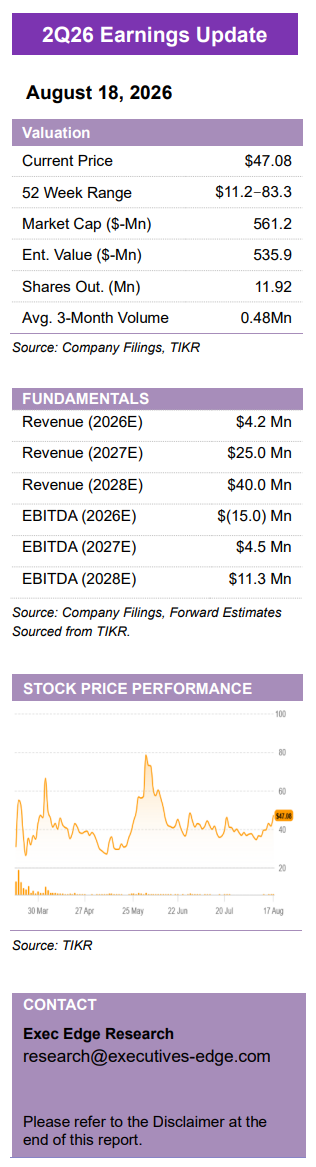
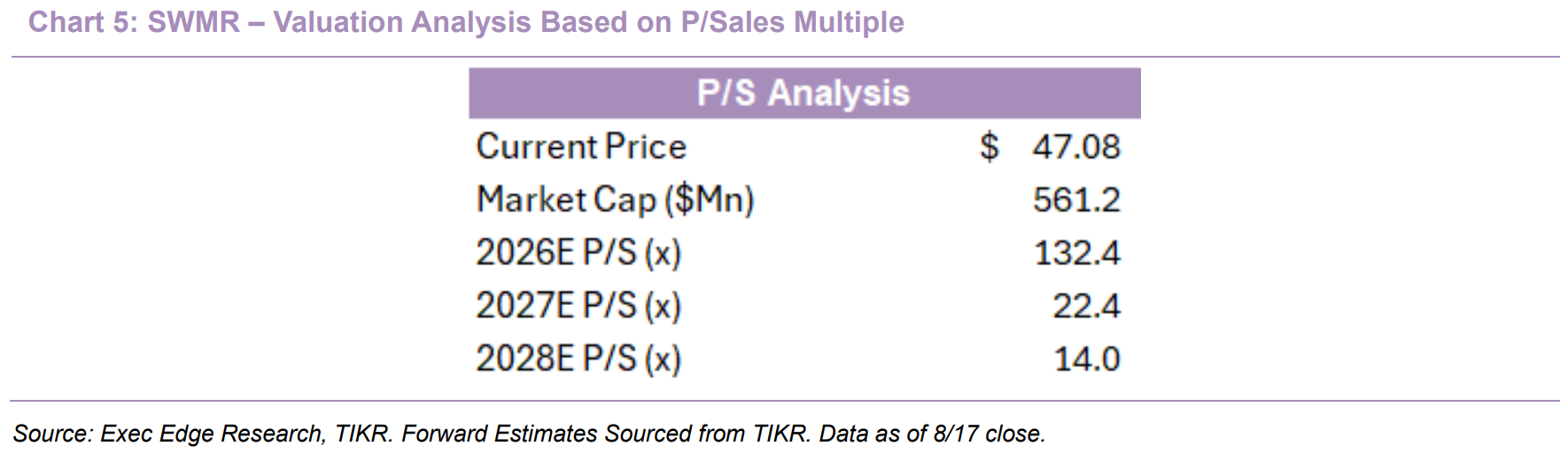
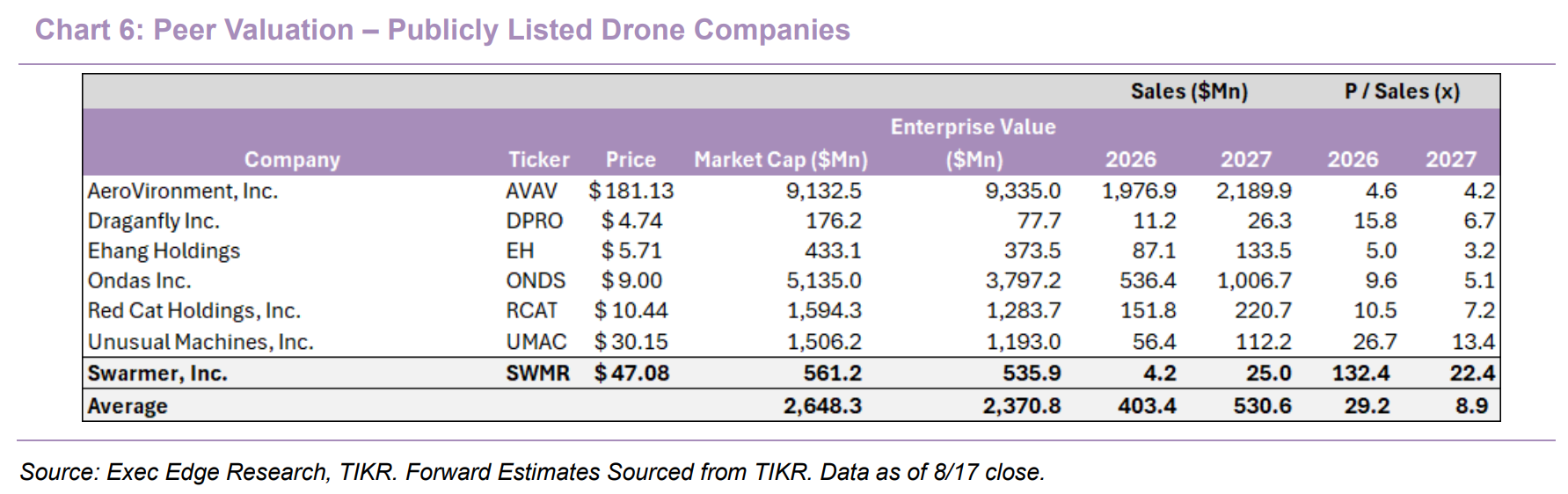
- SWMR trades at a clear premium to broader public-market peers, but we believe that premium is defensible given its combat-validated software model, hardware-agnostic architecture and higher-margin licensing potential. SWMR currently trades at approximately 22x 2027E sales, reflecting its early commercialization stage and significant operating investment. However, the valuation also reflects SWMR’s positioning as a combat-validated, platform-agnostic autonomy software provider rather than a traditional defense hardware or drone manufacturer, with the company increasingly expanding its ecosystem through OEM integrations, compute partnerships, operational data relationships and potential strategic acquisitions. The multiple declines to 14x based on 2028E sales (source: TIKR), highlighting the meaningful forward valuation compression as the expected software-license ramp scales. In our view, further support for the current premium will depend on converting SkyKnight, Powerus, Lantronix and other integrations into scaled deployments, recurring software revenue and improving profitability.
- Software-led autonomy positioning: SWMR’s hardware-agnostic autonomy platform remains positioned to capture value across multiple OEMs, unmanned platforms and mission types, with recent partnerships expanding its reach beyond individual drone manufacturers.
- Asset-light model: SWMR does not manufacture drones or heavy hardware, allowing capital to remain focused on software development, engineering, platform integration and autonomy capabilities while leveraging third-party platforms.
- Revenue scaling potential: Current revenue remains at an early commercialization stage, but Street estimates sourced from TIKR call for revenue to increase from $4.24 million in 2026E to $25.0 million in 2027E and $40.0 million in 2028E, as license deployments and platform adoption scale.
- Profitability glidepath: SWMR continues to invest heavily in personnel, engineering and product development ahead of revenue growth, while the software-led model offers potential operating leverage as license revenue scales. Street estimates sourced from TIKR indicate EBITDA and EPS turning positive in 2027E.
- Defense autonomy tailwinds: Rising defense spending, accelerating adoption of unmanned systems, growing demand for autonomous and collaborative platforms, and operational lessons from Ukraine continue to support the broader market opportunity for AI-enabled autonomy and drone coordination.
- SWMR’s premium to public drone peers is notable, but defensible given its hardware-agnostic software model, combat validation and stronger margin potential. Relative to the broader listed comp set, SWMR’s higher multiple reflects a business model with less hardware intensity, greater software attach potential and a path toward materially higher gross margins as licensing scales, while sustained relative outperformance will depend on converting integrations and license deployments into recurring revenue and positive EBITDA. Street positioning also remains constructive, with a consensus price reference of approximately $60 providing an additional external valuation benchmark.
- Private-market defense-autonomy valuations also support premium forward revenue multiples for differentiated platforms. A recent Financial Times report indicates Helsing was valued at approximately 32x forecast 2026 revenue, Shield AI at approximately 21x revenue, and Anduril at approximately 13x forward revenue. Against this range, SWMR’s approximately 22x 2027E sales multiple sits within the premium private-market autonomy range. While differences in scale, maturity, valuation period and hardware exposure limit direct comparability, SWMR’s hardware-agnostic architecture, 100,000+ combat missions and high-margin licensing model provide a defensible basis for premium positioning as commercial adoption scales.
Read Exec Edge’s Initiation on Swarmer Inc. Here
Subscribe to our Weekly Newsletter to Receive All Research
Contact:







[…] Swarmer’s SkyKnight & Platform Expansion Builds Commercial Momentum – Quarterly Update Repor… […]