Download the Complete Report Here
Beyond Oil Ltd. (BOIL/BEOLF)
Record Revenue and U.S. Direct-Sales Buildout Support Scaling Phase; Enterprise Rollouts and Margin Recovery Shape 2H Setup
- Key Takeaways:
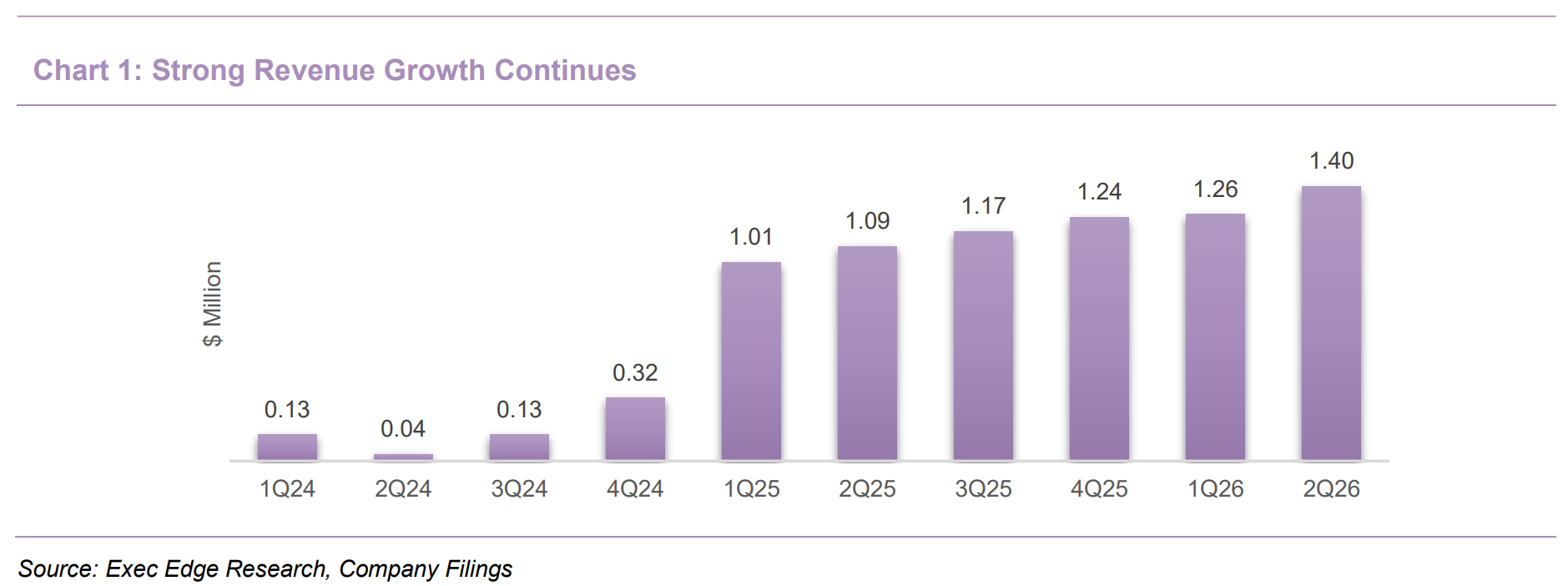
- 2Q26 revenue of $1.40 million increased 28% y/y and 11% sequentially, lifting first-half revenue 26% to $2.65 million.
- S. commercial infrastructure is increasingly established, with 100+ validated locations and enterprise opportunities collectively representing thousands of potential customer sites.
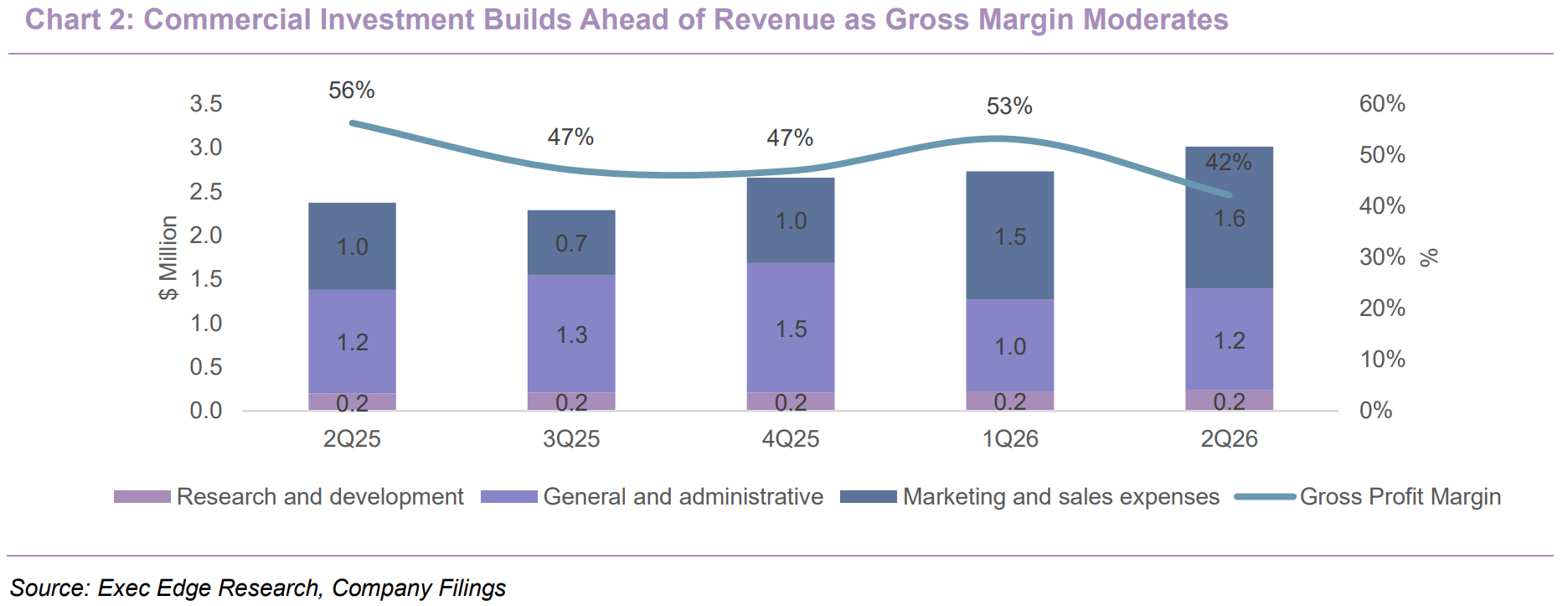
- Gross margin declined to 42.2% from 53.1% q/q, reflecting rollout, inventory and channel-transition costs with improvement expected as direct U.S. sales scale.
- Supermarket, fast-food, casual-dining and Sysco programs broaden the commercial funnel, while accumulated customer proof points should improve future conversion efficiency and rollout velocity.
- Valuation upside tied to enterprise conversion, recurring revenue growth and margin recovery.
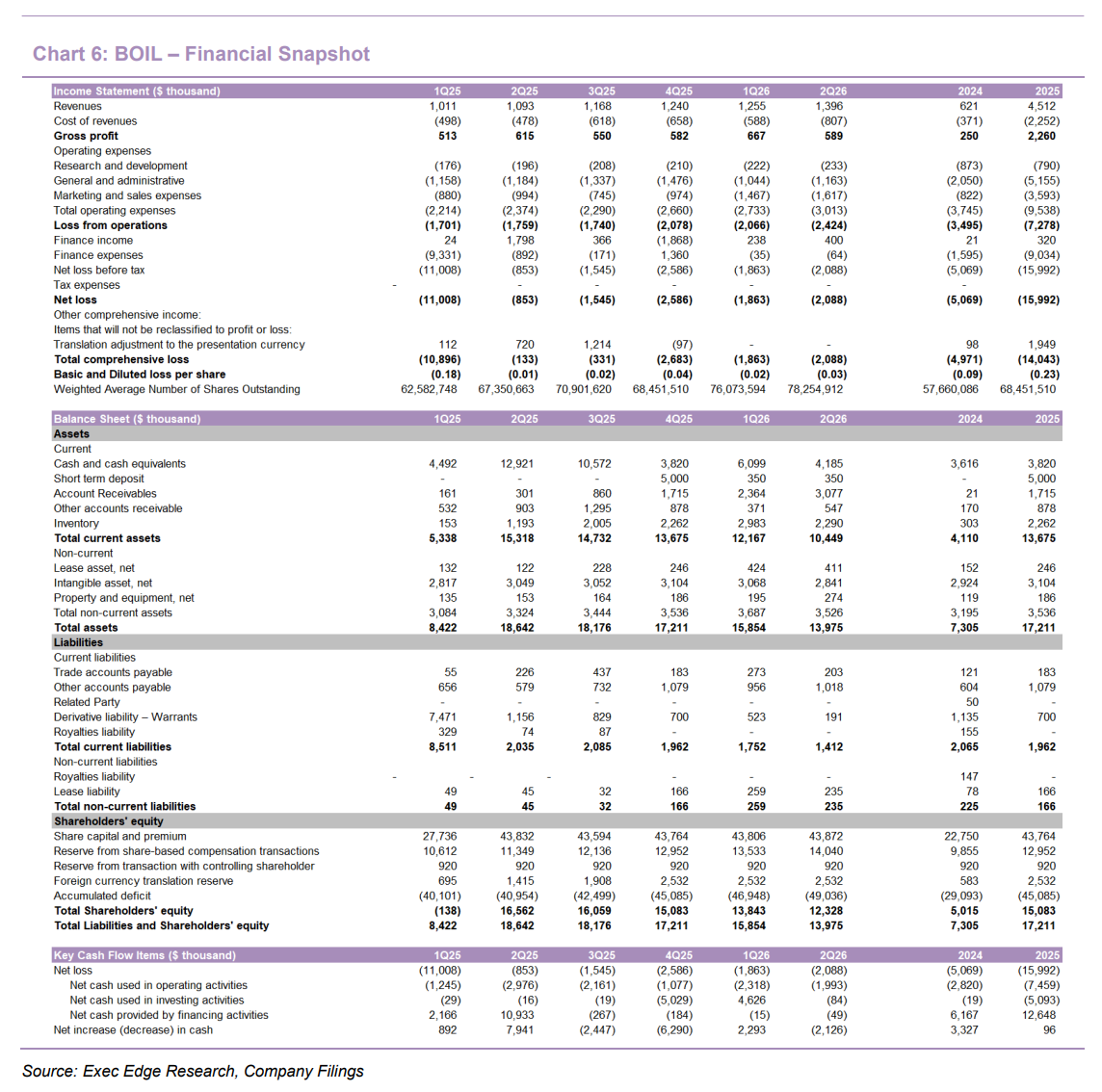
- Record revenue and improved sequential growth reinforce BOIL’s transition from commercial platform buildout toward scaled execution. BOIL reported record revenue of $1.4 million in 2Q26, up 28% y/y from $1.1 million and 11% sequentially from $1.3 million in 1Q26, a meaningful acceleration from the ~1% sequential increase reported last quarter. 1H26 revenue reached $2.7 million, up 26% from $2.1 million in 1H25 and equivalent to 59% of full-year 2025 revenue of $4.5 million. The quarter lifts BOIL’s annualized revenue run-rate to ~$5.6 million from roughly $5.0 million entering 2Q26, while BOIL continued to invest in the U.S. direct-sales infrastructure supporting larger strategic customers. We believe the combination of improved sequential revenue growth and broader enterprise activity supports the view that BOIL is moving further into the revenue-execution phase, with broader deployments and recurring consumption representing the next stage of scale.
- Gross margin moderated as BOIL absorbed early rollout and channel-transition costs, while commercial investment remained focused on supporting U.S. execution. Gross profit was $0.59 million in 2Q26 versus $0.62 million y/y, with gross margin declining to 42.2% from 56.3% in 2Q25 and 53.1% in 1Q26 as inventory and channel mix, early U.S. customer servicing costs, and new-market expansion weighed on profitability. Total operating expenses increased 27% y/y to $3.01 million from $2.37 million, driven primarily by a 63% increase in sales and marketing expense to $1.62 million from $0.99 million as BOIL expanded its U.S. direct-sales team, pilot activity, and customer training. G&A remained relatively stable at $1.16 million versus $1.18 million y/y, while R&D increased modestly to $0.23 million from $0.20 million. The expense mix remains concentrated on commercialization rather than product development, while management expects lower inventory costs and a larger contribution from direct U.S. sales to support gross-profit improvement as deployments scale.
- Commercial traction continues to broaden across food retail, fast food, and casual dining, providing multiple pathways for BOIL to scale recurring U.S. revenue. Recent progress across supermarket, fast-food and premium casual-dining customers, alongside distribution through Sysco Los Angeles, has expanded BOIL’s base of multi-site commercial activity. Product validation now spans 100+ U.S. locations, with several relationships moving beyond pilot activity into paid deployment and broader rollout. This broadening customer base strengthens the setup heading into 2H26, with location expansion, repeat orders and recurring consumption increasingly becoming the key indicators of execution.
- S. direct strategic accounts remain the primary growth focus, with customer validation now extending across more than 100 locations. BOIL indicated that direct U.S. work includes three large food operators collectively representing thousands of potential locations. The company has also streamlined parts of its distributor portfolio, discontinuing master-distribution agreements with Latitude in the U.S. and Ukraine and T&J Oil in Australia, while transitioning its Indian relationship with Deep Frying Solutions to a non-exclusive structure. Distribution remains an important part of the model, with 25 distributors covering more than 50 countries, but is increasingly positioned as a complement to direct selling rather than the primary commercial engine for large strategic accounts. This hybrid approach should give BOIL greater control over pricing, implementation and recurring customer economics for tier-one accounts, while continuing to use distributors for local logistics, smaller customers and geographies where direct infrastructure would be inefficient. Several strategic relationships are now moving beyond initial validation into paid deployment and broader multi-site rollout, providing early evidence of the direct-account model progressing toward recurring commercial usage.
- Supermarket expansion provides an early example of validation translating into broader deployment. A second ownership group of BOIL’s top-tier U.S. supermarket customer approved rollout across 14 additional high-volume locations after quarter-end, with four already operational. Expansion within the same banner suggests that successful validation with one ownership group can support adoption across additional operators within the brand, while high-volume prepared-food operations provide an attractive recurring-use profile.
- Fast-food and premium casual dining add further multi-site opportunities as pilots convert into commercial usage. BOIL commenced paid sales with a U.S.-based fast-food chain operating hundreds of locations, initially across three franchisees in three states, while its premium casual-dining rollout spans approximately 70 restaurants with potential expansion across the broader group. The key commercial KPIs increasingly shift from pilot activity toward location expansion, repeat orders and recurring consumption.
- Sysco provides a scalable fulfillment pathway alongside BOIL’s direct-account strategy. Distribution through Sysco Los Angeles began in 1Q26, while approved-vendor status and an assigned SUPC enable additional Sysco operating companies to onboard the product. This allows BOIL to maintain direct strategic customer relationships while leveraging established procurement and fulfillment infrastructure, with end-customer pull-through remaining the key measure of value.
- The expanded U.S. commercial organization should increasingly shift the focus from infrastructure buildout toward conversion efficiency. During its July management webinar, BOIL highlighted that the organization has grown from approximately 20 employees at year-end 2024 to ~45 currently, with most incremental hiring focused on sales, marketing and commercial execution, particularly in the U.S. Enterprise sales cycles can currently exceed six months across engagement, pilot, broader market testing and rollout, with the company targeting an average of approximately three months over time as reference customers and implementation experience accumulate. Against 2Q26 sales and marketing expense of $1.6 million, improving conversion speed and revenue productivity across the expanded organization should become increasingly important indicators of operating leverage.
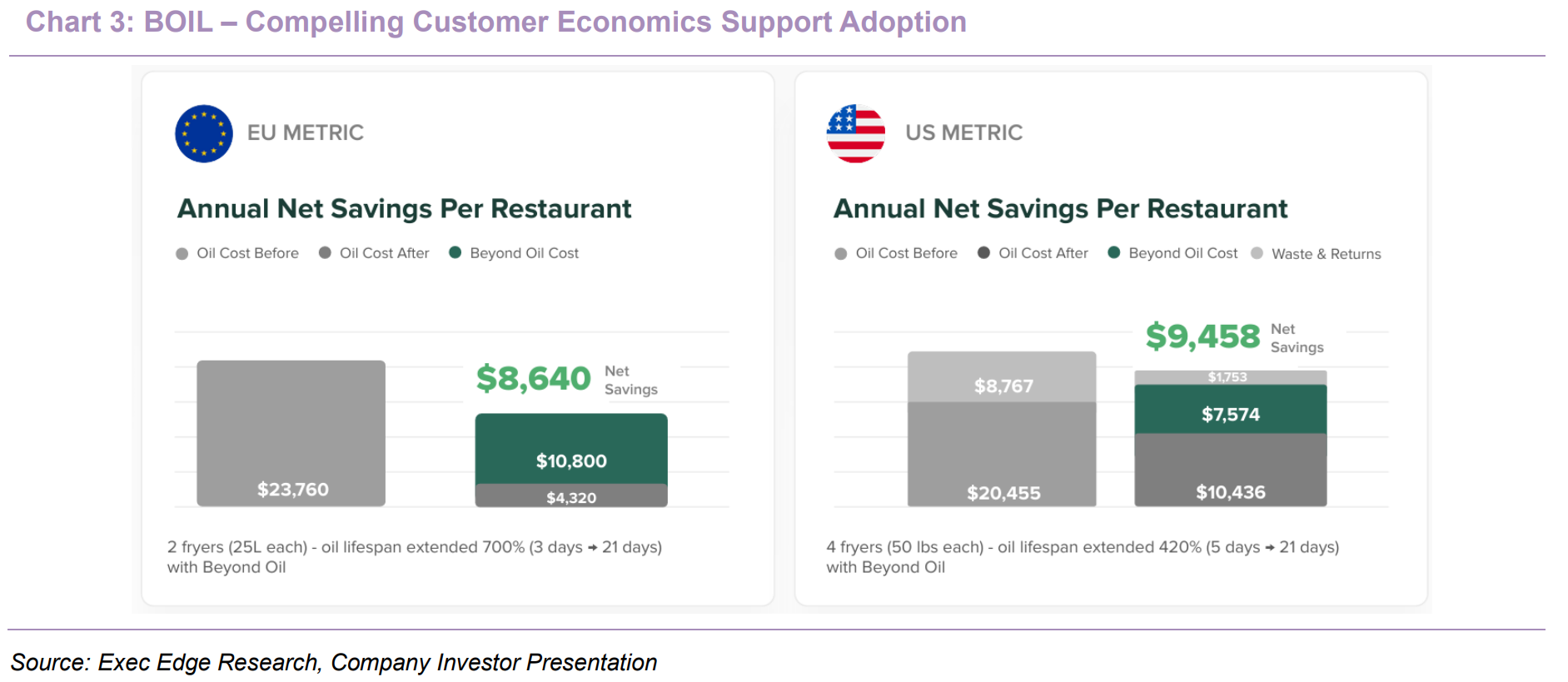
- Customer economics remain central to adoption, with ROI complemented by operational benefits at the kitchen level. Illustrative company examples show annual net savings of approximately $8,640 per European restaurant and $9,458 per U.S. restaurant, with oil life extending from approximately 3-5 days to 21 days in the illustrated cases, while implementation requires no new equipment or material capex. Improved food consistency, easier fryer cleaning and lower waste further support adoption, which is important because enterprise rollout ultimately depends on both procurement-level economics and restaurant-level acceptance.
- Manufacturing capacity remains substantially ahead of current revenue, providing meaningful headroom for enterprise rollout without near-term capacity constraints. During the July webinar, BOIL indicated that existing manufacturing capabilities can support ~$100 million of annual sales, roughly 18x the current ~$5.6 million annualized revenue run-rate and materially above the >$50 million capacity previously discussed. BOIL can also add North American or other regional manufacturing as demand develops. The existing headroom is strategically important because broader enterprise conversion could translate into materially higher revenue without requiring a proportional manufacturing build, supporting stronger fixed-cost absorption as volumes scale.
- Industrial frying provides a longer-term extension of that scalability, with development progressing alongside the core foodservice rollout. Management characterized industrial frying as BOIL’s “next stage” and potentially larger than foodservice, with R&D activity underway with prospective customers. Subsequent industrial-scale validation further strengthened the opportunity, with an independent pilot showing ~93% lower Free Fatty Acids and 52% lower Total Polar Compounds versus untreated control, while integrating with existing plant filtration infrastructure without custom capital equipment. Industrial applications involve substantially higher oil volumes per customer and could therefore increase recurring product consumption meaningfully if commercialized. While still earlier-stage than the U.S. foodservice business, successful industrial adoption would broaden BOIL from restaurant oil management into a larger frying-operations platform and add another scalable revenue vector.
- Operating investment remains ahead of the current revenue base, with improved gross-profit conversion becoming increasingly important to earnings leverage. BOIL reported a 2Q26 operating loss of $2.4 million versus $1.8 million y/y and a 1H26 operating loss of $4.5 million versus $3.5 million, reflecting continued commercial investment ahead of revenue scale. Net loss totaled $2.1 million, or $0.03 per share, versus $0.9 million, or $0.01 per share, although the y/y comparison was affected by approximately $1.7 million of non-cash warrant revaluation gains in 2Q25 versus roughly $0.3 million in 2Q26. As direct U.S. sales scale and gross margin improves, higher gross-profit dollars relative to the existing commercial cost base should become the key indicator of progress toward operating leverage.
- Working-capital dynamics reflect the timing of larger commercial activity, with receivable conversion providing an expected source of additional liquidity. Trade receivables increased to $3.1 million at June 30 from $1.7 million at year-end, due to a significant 2Q commercial shipment for which collection is expected in the ordinary course. Inventory remained comparatively stable at $2.3 million versus $2.3 million, despite the expanding commercial pipeline, suggesting the current commercial ramp has not required a disproportionate inventory build. As larger enterprise deployments scale, receivable timing and working-capital discipline should become increasingly important, while collection of the $3.1 million receivable balance should provide an additional source of near-term liquidity.
- The balance sheet continues to support near-term commercial execution; cash conversion is becoming more important as investment remains elevated. Cash and short-term deposits totaled $4.5 million at June 30 versus $8.8 million at December 31, while positive working capital remained $9 million and the current ratio was approximately 7.4x. Current assets totaled $10.5 million against $1.4 million of current liabilities, with shareholders’ equity of $12.3 million. 1H26 net cash used in operating activities increased modestly to approximately $4.3 million from $4.2 million y/y, reflecting continued investment in commercial scale. Importantly, spending remains concentrated on sales execution rather than manufacturing capex, while the elevated receivable balance provides an expected near-term source of cash as the underlying shipment is collected. The June 30 positive-EBITDA milestone was not triggered, leaving the $13 million cumulative-sales threshold as the principal remaining disclosed operating-linked contingent share milestone under the existing transaction structure.
- The 2H26 setup is increasingly centered on converting the commercial foundation into broader deployments, recurring revenue and improving unit economics. The company expects gross profit to improve as direct U.S. sales become a larger part of the mix, while key 2H26 execution indicators include expansion of the supermarket program beyond the additional 14 locations, progression of the existing ~70-restaurant casual-dining rollout, further penetration of the fast-food customer’s franchise network, additional Sysco-supported activity and repeat orders across existing deployments. With customer validation spanning 100+ U.S. locations, approximately 45 employees supporting the organization and manufacturing capabilities stated to support up to ~$100 million of annual sales, the focus increasingly shifts from building the platform toward increasing conversion, utilization and recurring revenue across the infrastructure already in place.
Valuation Reflects Revenue Conversion Potential, Not Current Scale Alone
- Disclaimer: Exec Edge does not publish proprietary estimates, ratings, price targets, or investment recommendations. The valuation discussion below is illustrative only and is based on company filings, management commentary, and third-party data and estimates. It does not constitute a recommendation, price target, rating, or prediction of future pricing.
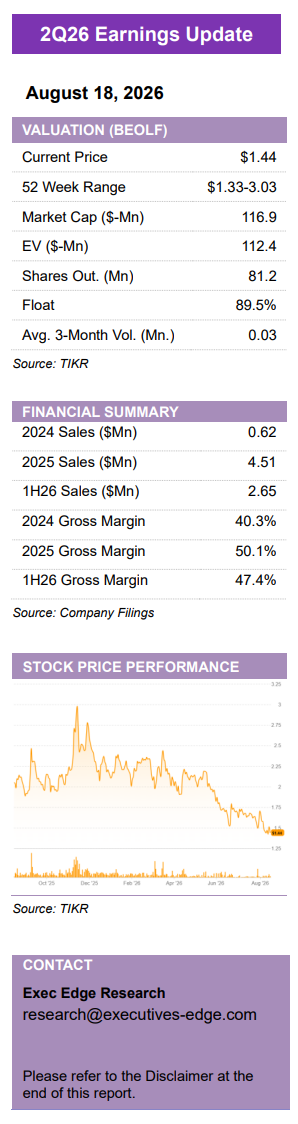
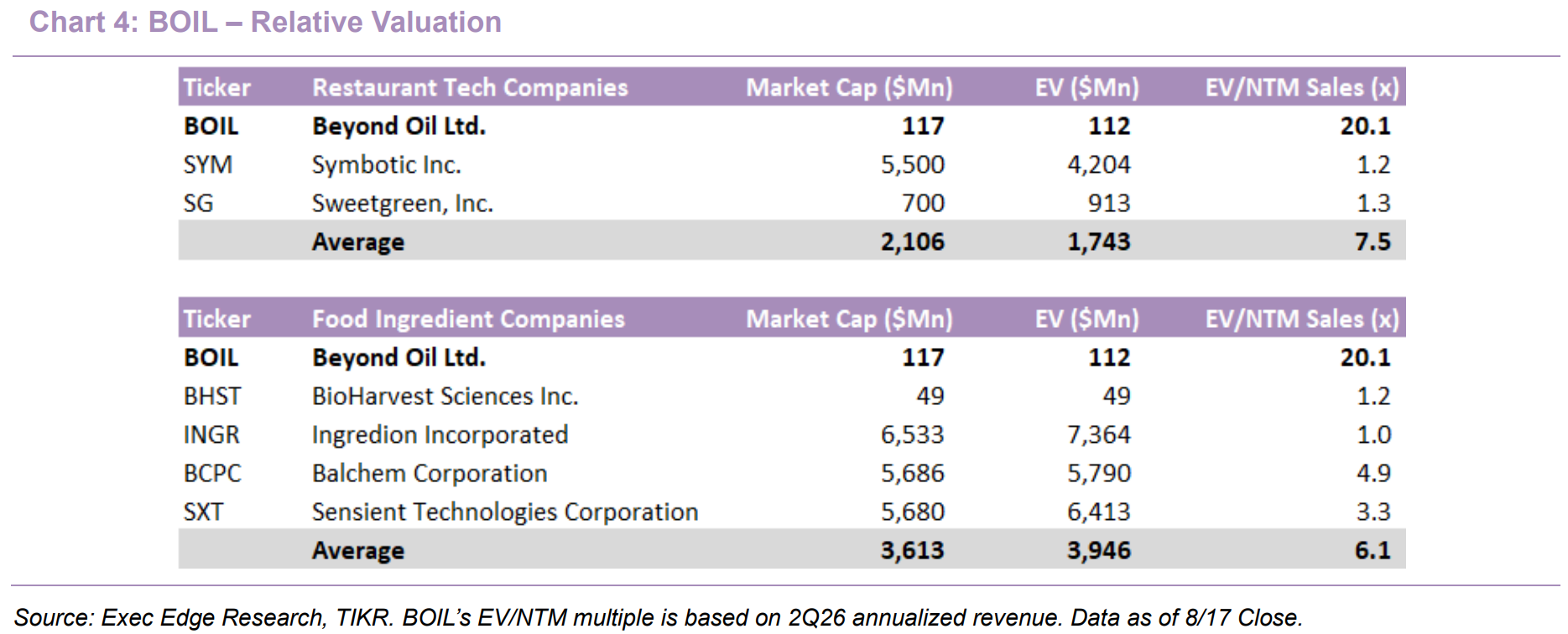
- BOIL continues to trade at a premium to more mature peers, reflecting its earlier commercialization stage and higher expected growth profile. Based on an enterprise value of $112 million and 2Q26 revenue of $1.4 million, or an annualized run-rate of roughly $5.6 million, BOIL trades at approximately 20x run-rate sales, down from ~33.6x at the time of our May update. This remains elevated relative to more mature restaurant-technology and food-ingredient peers, but BOIL is still an early-stage commercialization story where valuation is driven less by current revenue scale and more by the pace of multi-location rollout conversion, repeat ordering, gross-margin recovery and operating leverage as revenue expands, with valuation support increasingly dependent on revenue growth and operating leverage rather than further multiple expansion.
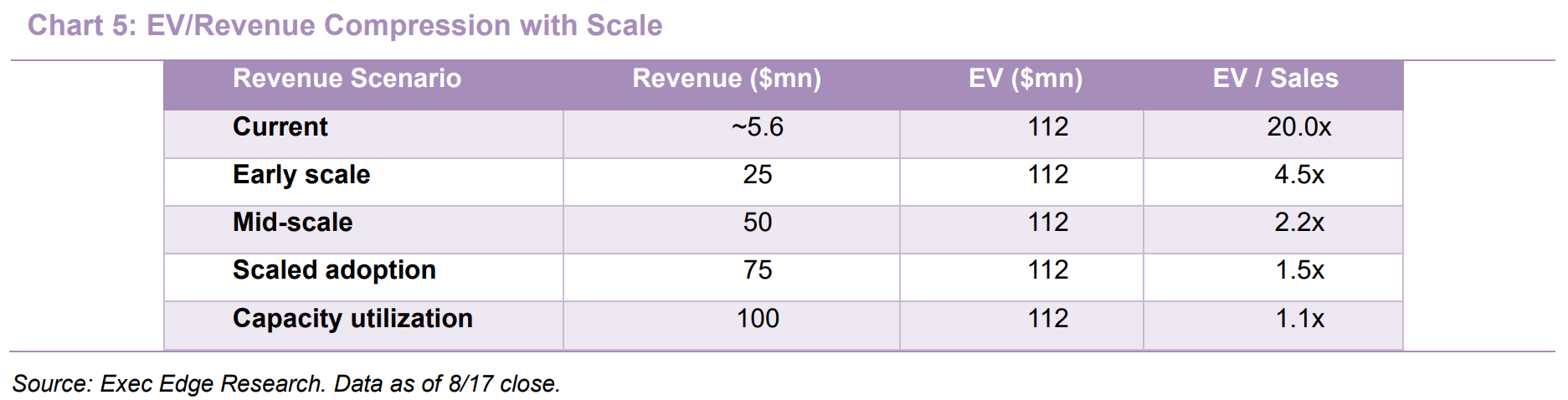
- The more relevant valuation framework is therefore revenue scaling into the infrastructure already in place. Holding the current $112 million enterprise value constant, $25 million of annual revenue would imply 4.5x EV/Sales, $50 million would imply 2.2x, $75 million would imply 1.5x and $100 million would imply 1.1x. These scenarios are illustrative rather than forecasts, but they highlight the potential for substantial multiple compression through revenue growth alone. Management indicated in July that existing manufacturing capabilities can support approximately $100 million of annual sales, materially above the current ~$5.6 million run-rate, providing capacity for enterprise conversion without requiring a proportional near-term manufacturing build.
- Overall, BOIL remains an execution-driven valuation story, with the recent reset lowering the hurdle for further rerating. Customer validation across 100+ U.S. locations, the ~70-restaurant casual-dining rollout, supermarket expansion and initial paid fast-food deployment provide a broader base for recurring revenue growth, while the direct-account model should improve control over rollout execution and customer economics. The key valuation drivers are now broader site penetration, repeat ordering, shorter sales cycles and recovery in gross margin from 42.2% toward the 50%+ levels achieved previously, which would improve absorption of the current $1.6 million quarterly sales and marketing base. Continued enterprise conversion, recurring reorder activity and improving operating leverage would provide increasing fundamental support for BOIL’s valuation as revenue scales into the commercial and manufacturing infrastructure already in place.
Read Exec Edge’s Initiation on Beyond Oil Ltd. Here
Subscribe to our Weekly Newsletter to Receive All Research
Contact: