Download the Complete Report Here
 Brazil Potash Corp. (GRO)
Full-Project FEED Coverage, Stronger Liquidity and New Policy Support Further De-Risk Autazes; Valuation Still Attractive.
- Key Takeaways:
- Underground FEED award to WSP/Redpath completes project-wide engineering coverage, advancing lender-ready documentation supporting approximately $1.8 billion of targeted DFI/ECA debt.
- Gera Center BOOT MOU could remove ~$33 million of upfront construction capex and deliver ~$10 million lifetime savings, supporting GRO’s infrastructure carve-out strategy.
- Profert could provide additional construction funding support, with GRO estimating up to ~$190 million of combined Profert and SUFRAMA federal tax benefits.
- 2Q26 operating loss fell 77% y/y to $3.4 million, while May equity financing lifted quarter-end cash to $75.7 million and working capital to $74.6 million.
- Valuation remains attractive and continues to reflect substantial financing and execution risk despite progress across FEED, liquidity, infrastructure funding, policy support, and legal de-risking.
- Completion of project-wide FEED awards moves Autazes further from permitting-led de-risking toward lender-facing engineering and construction readiness. During 2Q26, GRO awarded the mine shafts and underground development FEED to WSP UK, with Redpath Deilmann supporting the shaft scope, complementing the surface facilities and infrastructure FEED already being executed by Wood and Promon Engenharia. Engineering design coverage now spans both the surface and underground components of the ~$2.5 billion Autazes Project, strengthening the technical foundation for DFI and ECA construction-debt discussions. The two mine shafts sit on the project’s critical path, making their design and execution central to subsequent underground development, processing, tailings, and logistics. Redpath’s experience across more than 500 shafts globally, including major potash projects such as Jansen, Rocanville, K3, Woodsmith, and Nezhinsky, adds further credibility to the lender diligence package.
- The contractual structure also allows GRO to advance the highest-priority engineering work without immediately committing to the entire underground FEED program. The total potential contract value is approximately $26 million, but only the initial $4.3 million, 12-month Early Works phase has been authorized. This scope covers geotechnical investigation, freeze modelling, basis-of-design development, and other work required ahead of full FEED, allowing GRO to improve project bankability while subsequent phases remain subject to further authorization. Separately, physical early works construction has begun, alongside a modular construction strategy using off-site fabrication and river-barge transport to mitigate weather-related execution risk.
- The Gera Center power MOU provides initial evidence that GRO’s BOOT strategy could reduce upfront project capital requirements and, in turn, the equity burden associated with Autazes. In May, GRO signed a non-binding MOU with Gera Center for a 28-year Build, Own, Operate and Transfer arrangement covering a modular diesel generation system that would provide construction power before transitioning into emergency backup power during the mine’s 23-year operating life. The proposed 20 MW plant would initially deploy 10 MW and ramp to 20 MW during the first construction year, with first power available within 120 days after definitive contract execution and 98% minimum availability during the backup phase. More importantly from a financing perspective, if finalized, the structure is expected to shift approximately $33 million of upfront power-generation capex into operating costs over the contract term while generating approximately $10 million of net savings versus the Pre-Feasibility Study budget.
- New Profert legislation introduces another potential lever to lower Autazes’ construction funding requirement and expand access to domestic financing. Brazil’s Senate approved Profert on August 11, 2026, creating a new incentive framework for domestic fertilizer production that now awaits presidential signature into law. Management estimates that Profert, when combined with existing SUFRAMA incentives, could exempt up to ~$190 million of federal taxes on Autazes’ ~$2.5 billion initial capex, reducing required construction capital by approximately 7%. The legislation also authorizes BNDES to invest in the construction of new domestic fertilizer production capacity and introduces a domestic-content requirement for fertilizer sold in Brazil, beginning at 2% in 2027 and rising to 10% by 2037, with potential to increase to 30% depending on supply availability. Importantly, the benefits are not yet assured, as GRO’s eligibility will depend on a competitive selection process and implementing regulations from MAPA that have not yet been published. Separately, Profert provides for a production tax credit of up to 20% of eligible investment, subject to a R$2 billion annual program cap from 2027 through 2031, which management notes is distinct from the ~$190 million capex tax analysis.
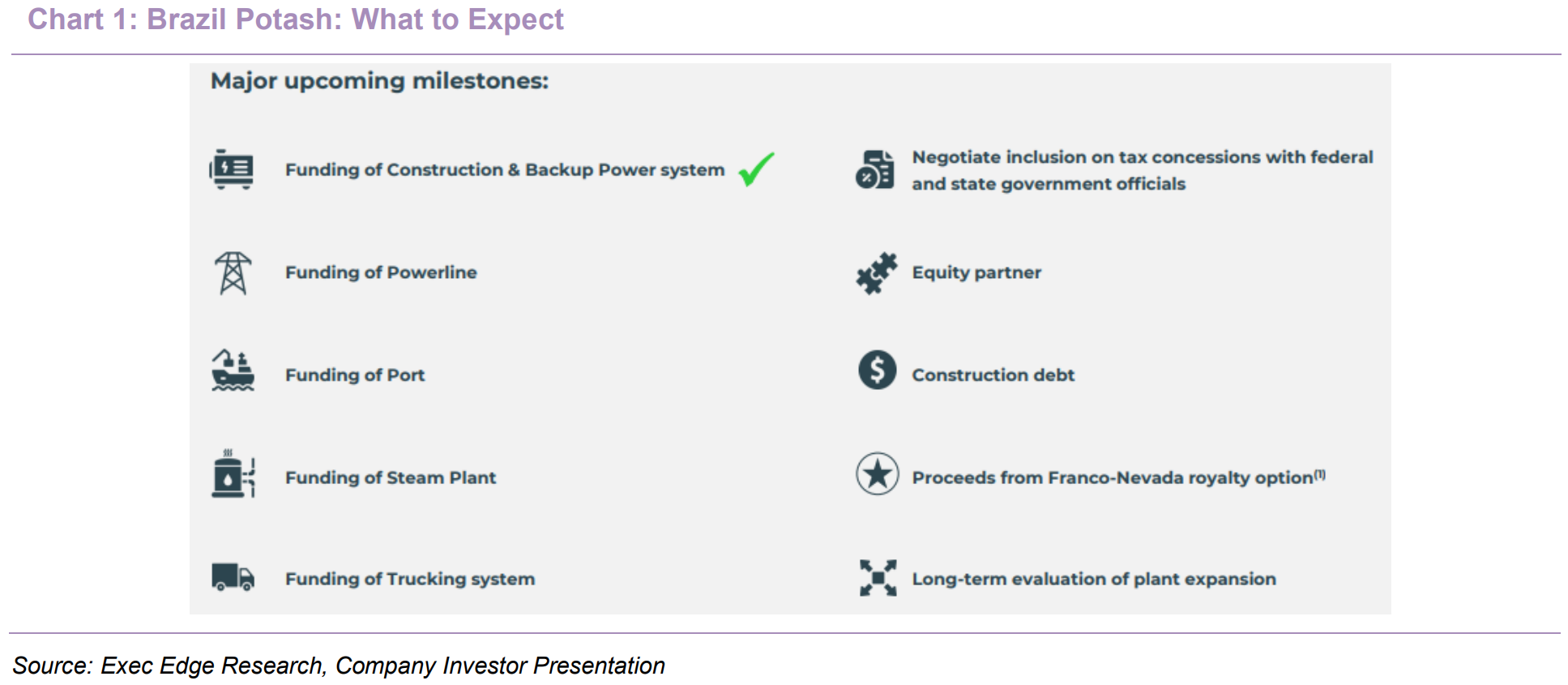
- Infrastructure carve-outs could become a meaningful component of the broader construction funding stack if additional proposals convert into definitive agreements. GRO continues to frame Autazes around approximately $2.5 billion of total capex, with ~$1.8 billion expected from DFIs and ECAs and up to ~$350 million of potential third-party infrastructure funding across the powerline, port, steam plant, construction/backup power, and trucking system. The project also has potential access to approximately $150 million from Franco-Nevada’s binding royalty option, subject to the applicable funding condition. On a purely illustrative basis, if all three funding sources were fully realized, they would represent roughly $2.3 billion of the $2.5 billion requirement, leaving approximately $200 million to be addressed through strategic project equity or other capital. The $350 million remains prospective and the Gera agreement remains non-binding, but the $33 million identified in the proposed Gera construction-power BOOT begins to demonstrate how the BOOT strategy could reduce the amount of equity capital ultimately required at the project level.
- Recent judicial developments have further reduced perceived legal risk around Autazes, with both the PGR’s position and separate favorable TRF-1 rulings supporting the project’s legal and permitting position. In July, the DPU filed an application with the Federal Supreme Court seeking to suspend installation activities, but the matter did not constitute a new lawsuit or introduce new allegations and instead challenged prior TRF-1 decisions favorable to GRO and the Mura Indigenous Council. The underlying consultation process spanned more than six years, covered over 35 Mura villages and concluded with approximately 90% support among participating communities. On July 9, the PGR, Brazil’s highest prosecutorial authority before the STF, recommended that the application not be heard on the merits, citing lack of standing and an inappropriate procedural mechanism. Separately, on August 11, TRF-1 found other special and extraordinary appeals inadmissible for referral to the Superior Court of Justice and Federal Supreme Court, thereby preserving prior rulings supporting the Mura consultation process, IPAAM’s licensing authority and the validity of Autazes’ environmental licenses. Together with the project’s 21 Installation Licenses covering the mine, processing plant and port, the cumulative judicial record further supports the project’s legal and permitting position, while residual procedural risk remains given that additional appeals may still be available.
2Q26 Financials Reflect Sharp Corporate Cost Normalization and Stronger Liquidity
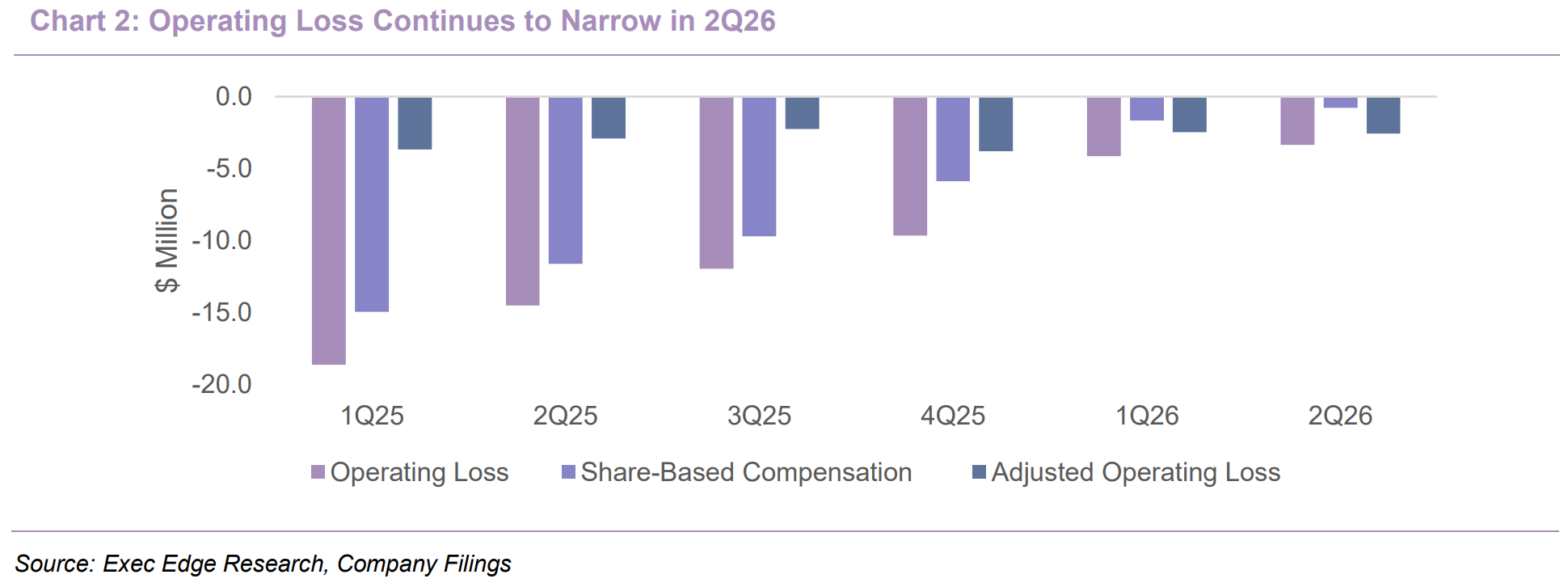
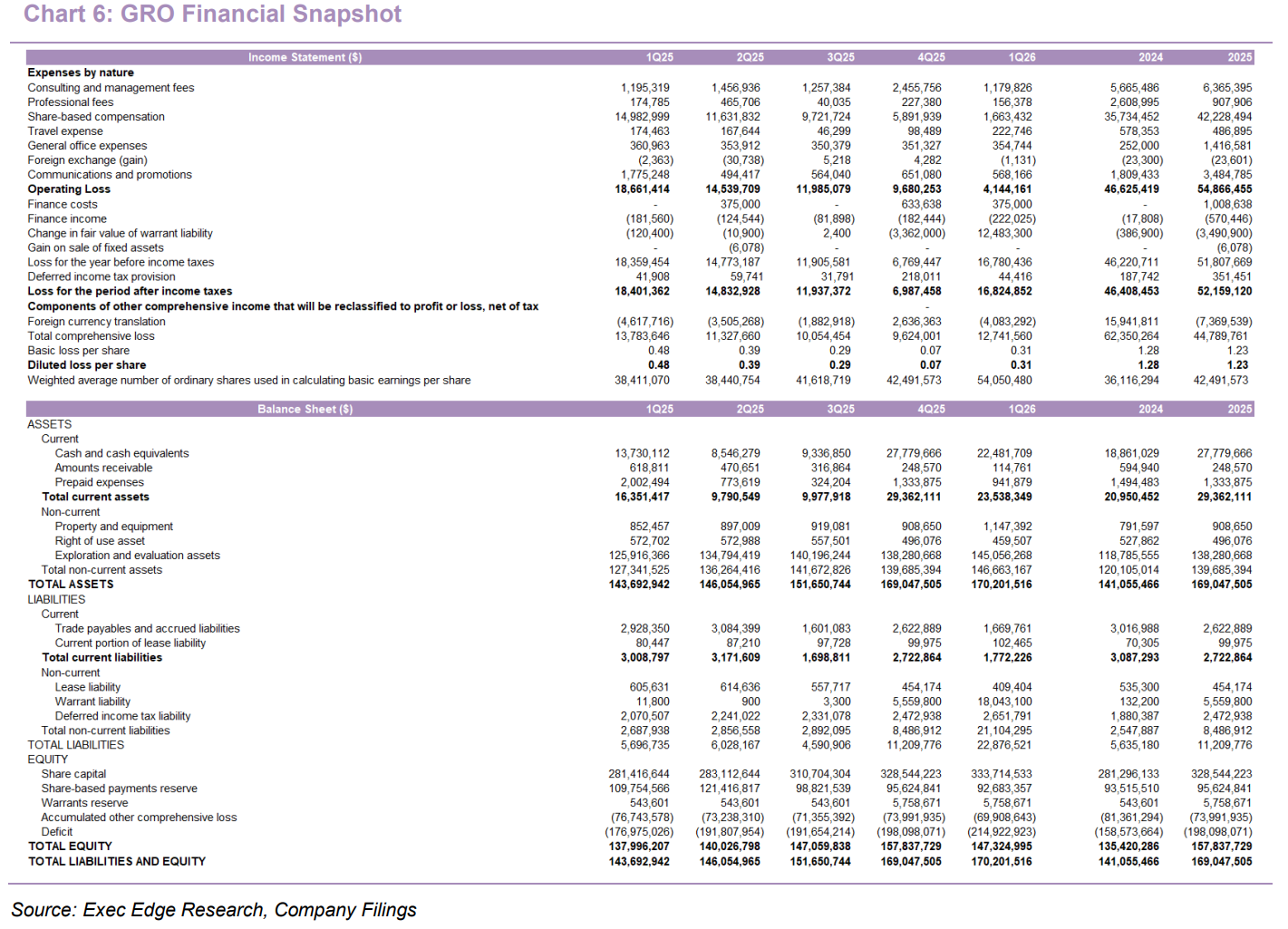
- Development-stage operating expenses fell materially y/y, while reported 2Q26 net income was driven by a non-cash warrant revaluation rather than an operating earnings inflection. GRO remains pre-revenue, but operating loss declined 77% y/y to $3.35 million from $14.54 million. The largest driver was share-based compensation, which fell 93% to $0.79 million from $11.63 million as prior-period share-based compensation expense normalized sharply; professional fees also declined to $0.17 million from $0.47 million, while consulting and management fees were broadly stable at $1.44 million. Reported net income of $7.60 million versus a $14.83 million loss in 2Q25 primarily reflected a $10.67 million gain from the change in fair value of warrant liabilities. We therefore view operating loss as the better measure of underlying corporate expense intensity.
- The cost normalization is evident on a year-to-date basis. For 1H26, operating loss fell to $7.50 million from $33.20 million in 1H25, led by a sharp decline in share-based compensation to $2.45 million from $26.61 million and lower communications and promotional spending of $1.07 million versus $2.27 million. The lower non-cash compensation burden and reduced communications spending helped narrow net loss to $9.22 million from $33.23 million.
- At the same time, a greater share of cash deployment is now being directed toward advancing the Autazes Project. Cash expenditures on exploration and evaluation assets increased 24% y/y to $6.13 million, from $4.95 million in 1H25, primarily for site operations, environmental work, construction-related services, technical consulting, and early FEED activity. Exploration and evaluation assets reached $149.7 million at June 30, reflecting continued development work as well as foreign-exchange translation effects. With 1H26 project investment exceeding the $5.12 million of operating cash burn, versus project investment below operating cash burn in 1H25, the mix of cash deployment has shifted more clearly toward project advancement.
- The May financing materially strengthened GRO’s ability to fund FEED and development activity while larger project-level financing is pursued. Cash increased to $75.7 million at June 30 from $27.8 million at December 31, 2025, while working capital rose to $74.6 million from $26.6 million. The increase primarily reflects the May 4 public offering, which generated $63.23 million of gross proceeds through 7.0 million common shares at $2.50 per share and 18.3 million pre-funded warrants at $2.499, with approximately $4.27 million of issuance costs. Common shares outstanding increased 15% from 53.69 million at year-end to 61.95 million at June 30, reflecting the public offering as well as RSU and DSU exercises and other share issuances during the period, while the 18.3 million new pre-funded warrants create additional economic dilution given their $0.001 exercise price. The financing nevertheless gives GRO substantially greater negotiating flexibility as it works through FEED, BOOT agreements, and project-level debt/equity discussions.
- Current liquidity materially extends GRO’s runway for corporate and engineering activities, but it should not be confused with construction funding capacity. GRO used $5.12 million of cash in operating activities during 1H26 and invested $6.13 million into exploration and evaluation assets, implying combined operating and project cash deployment of roughly $11.25 million before financing flows. Annualizing that 1H pace would imply approximately $22.5 million of cash deployment, against $75.7 million of quarter-end cash; however, that run-rate is unlikely to remain static as the $4.3 million underground FEED Early Works program progresses alongside surface FEED and other pre-construction activities. Accordingly, the balance sheet materially reduces near-term corporate financing risk, but the financial statements continue to note that GRO’s ability to continue development remains dependent on securing additional financing, and the principal investment question remains GRO’s ability to assemble the approximately $2.5 billion project funding package required to reach full production.
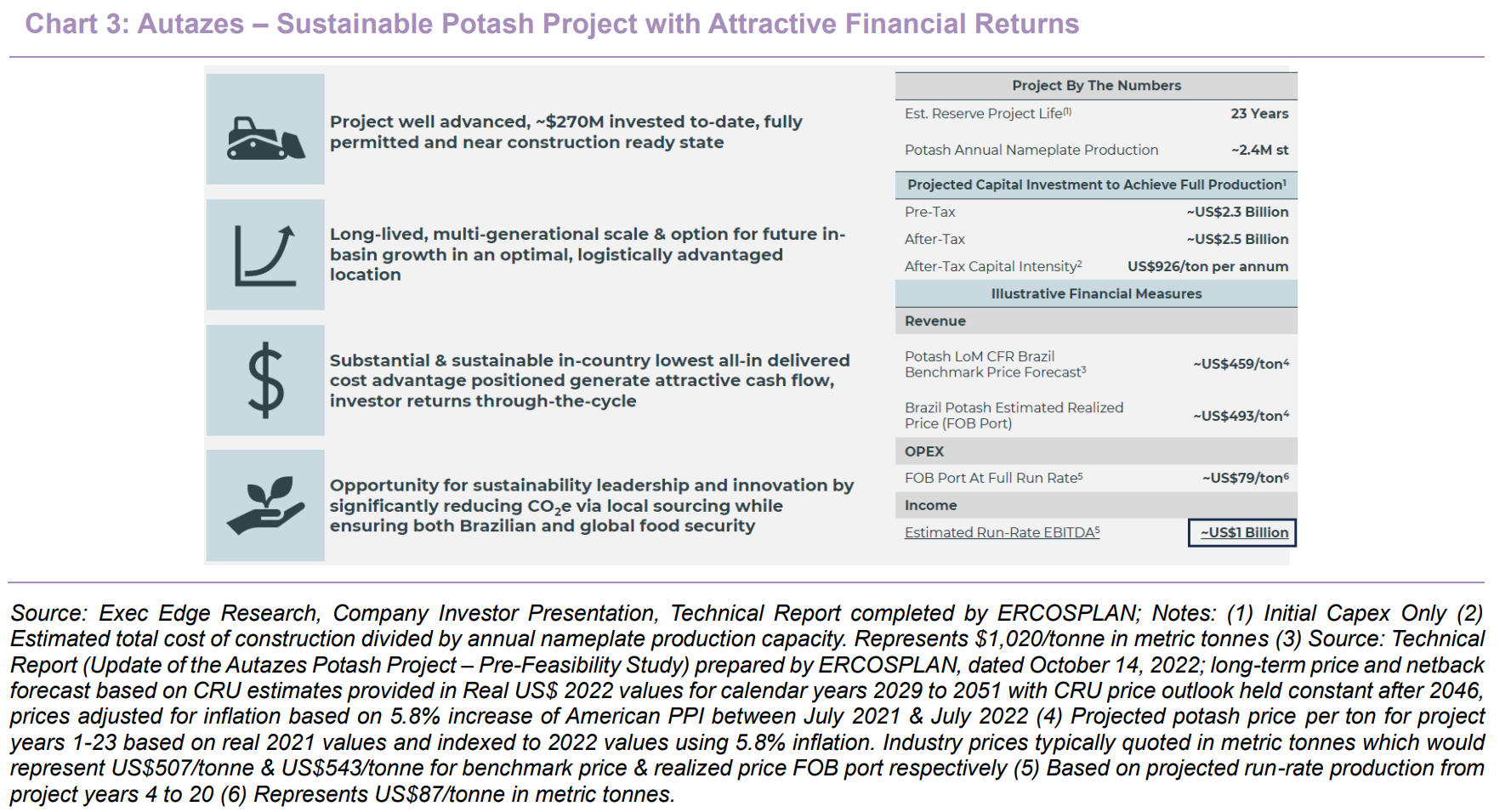
- Autazes’ long-term financial profile remains intact. Based on ERCOSPLAN technical report assumptions, management illustrates potential run-rate EBITDA of ~$1.0 billion at commercial scale, supported by an estimated realized price of ~$493/ton FOB Port and operating costs of ~$79/ton at full run-rate. This implies mine-gate gross margins above 80% and an EBITDA margin approaching ~75% after transportation and G&A, reflecting the project’s structural delivered-cost advantage in Brazil’s import-dependent potash market.
- The opportunity remains significant, though still execution dependent. Autazes is planned for ~2.4 million tons of annual production over a ~23-year reserve life, with projected capital investment of ~$2.5 billion, or ~$926 per ton of annual nameplate capacity. While the October 2022 pre-feasibility assumptions remain exposed to cost inflation, funding terms, potash pricing, and timing risk, they illustrate why FEED, construction financing, infrastructure funding, and stakeholder alignment are critical valuation catalysts.
- We continue to view GRO as pre-revenue through 2026 and 2027, with near-term value creation driven by milestone completion rather than quarterly earnings progression. Commercial production could begin approximately four years after construction commencement, while current project materials continue to show 2.4 million tons of annual nameplate production and approximately $1.0 billion of estimated run-rate EBITDA once steady-state operations are reached. Over the next several quarters, the more relevant indicators are therefore advancement of the 12-month, $4.3 million underground Early Works program; progression of the Wood/Promon surface FEED; conversion of the Gera Center and other BOOT proposals into definitive agreements; and progress toward the approximately $1.8 billion of targeted DFI/ECA debt and strategic project-level equity required to begin full-scale construction.
Attractive Valuation Relative to Long-Term EBITDA Potential
- Disclaimer: Exec Edge does not publish proprietary estimates, ratings, price targets, or investment recommendations. The valuation discussion below is illustrative only and is based on company filings, management commentary, and third-party data and estimates. It does not constitute a recommendation, price target, rating, or prediction of future pricing.
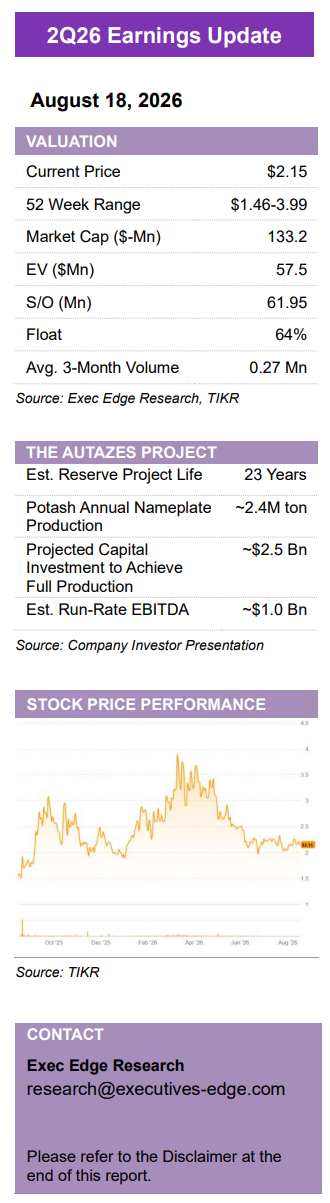
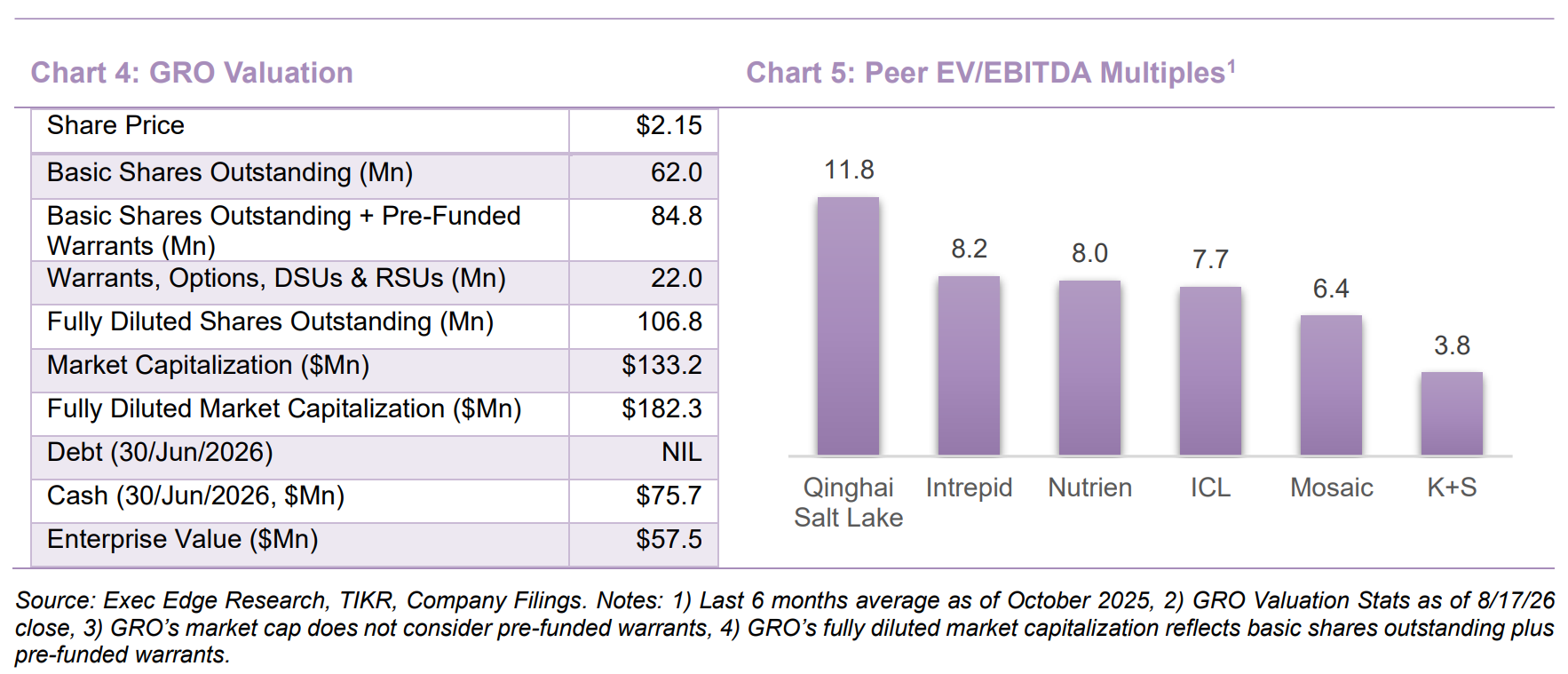
- GRO’s current valuation continues to reflect substantial financing and execution risk despite meaningful project de-risking and a materially stronger liquidity position. At $2.15 per share, GRO carries a basic market capitalization of approximately $133.2 million and enterprise value of $57.5 million, reflecting $75.7 million of cash and no debt as of June 30, 2026. Cash therefore represents roughly 57% of basic market capitalization, while the stock remains approximately 26% below the $2.92 price used in our May update despite subsequent progress across underground FEED, infrastructure funding optimization, liquidity, and the project’s legal position. GRO also has 84.8 million basic shares plus pre-funded warrants and approximately 106.8 million fully diluted shares, highlighting that dilution remains an important consideration as the company assembles the larger construction funding package.
- Peer valuation provides a useful reference for the potential value of Autazes once fully developed, although substantial discounts remain appropriate today for financing, construction, timing, and dilution risk. GRO’s Q2 presentation shows comparable potash producers trading across a broad 3.8x-11.8x EV/EBITDA range, with a 7.8x reference multiple across the peer group. Applying 7.8x to management’s approximately $1.0 billion steady-state EBITDA estimate implies an illustrative production-stage enterprise value of roughly $7.8 billion for Autazes. Against GRO’s current $57.5 million basic EV, the market is therefore assigning less than 1% of that theoretical production-stage value today. However, GRO remains several years from commercial production and still requires approximately $2.5 billion of construction capital, meaning current valuation appropriately incorporates substantial discounts for funding, timing, execution, commodity-price exposure, and dilution.
- We expect valuation to evolve with project milestones, with the largest rerating potential tied to financing de-risking and progression into full-scale construction. GRO is targeting approximately $1.8 billion of DFI/ECA debt against the ~$2.5 billion Autazes funding requirement, supplemented by potential third-party infrastructure funding of up to ~$350 million, the Franco-Nevada royalty option, and strategic project-level equity. As these funding sources move from indicative discussions toward binding commitments, we would expect the market to assign greater value to Autazes’ prospective operating economics and reduce the discount currently applied for financing, dilution and execution risk. Key catalysts include completion and lender acceptance of the Wood/Promon and WSP/Redpath FEED programs, binding DFI/ECA commitments, additional BOOT infrastructure agreements, strategic equity participation and ultimately the start of full-scale construction. With 91% of nameplate capacity already covered by long-term offtake agreements, full-project FEED coverage established, and the legal/permitting backdrop improving, valuation remains highly sensitive to further milestone delivery, while the scale of the remaining construction requirement keeps funding execution and dilution as the principal risks to the rerating path.
Read Exec Edge’s Initiation on Brazil Potash Corp. Here
Subscribe to our Weekly Newsletter to Receive All Research
Contact: