Download the Complete Report Here
 Einride AB (ENRD)
Signed Demand Starts Converting; 2H26 Growth Acceleration and Fleet Scale Advance Path to 2028 Cash Flow Breakeven
- Key Takeaways:
- H1 constant-currency revenue grew 26% to $27 million, with H2 growth guided to 60%-73% as signed capacity moves into deployment.
- Amazon’s 75-truck rollout and 500-truck Tesla Semi program expand fleet capacity, with the fleet approaching 400 vehicles by year end.
- Contribution margin held at 20.7%, while a 3x larger sales pipeline, rising network density and shorter deployment cycles support customer conversion.
- Autonomous operations reached 5,400+ driverless hours, while Flipturn adds 5,000+ charging ports and >250 MW of software-managed capacity.
- At ~9.0x December 2026 annualized revenue run-rate, re-rating depends on revenue conversion, margin improvement and progress toward 2028 cash flow breakeven.
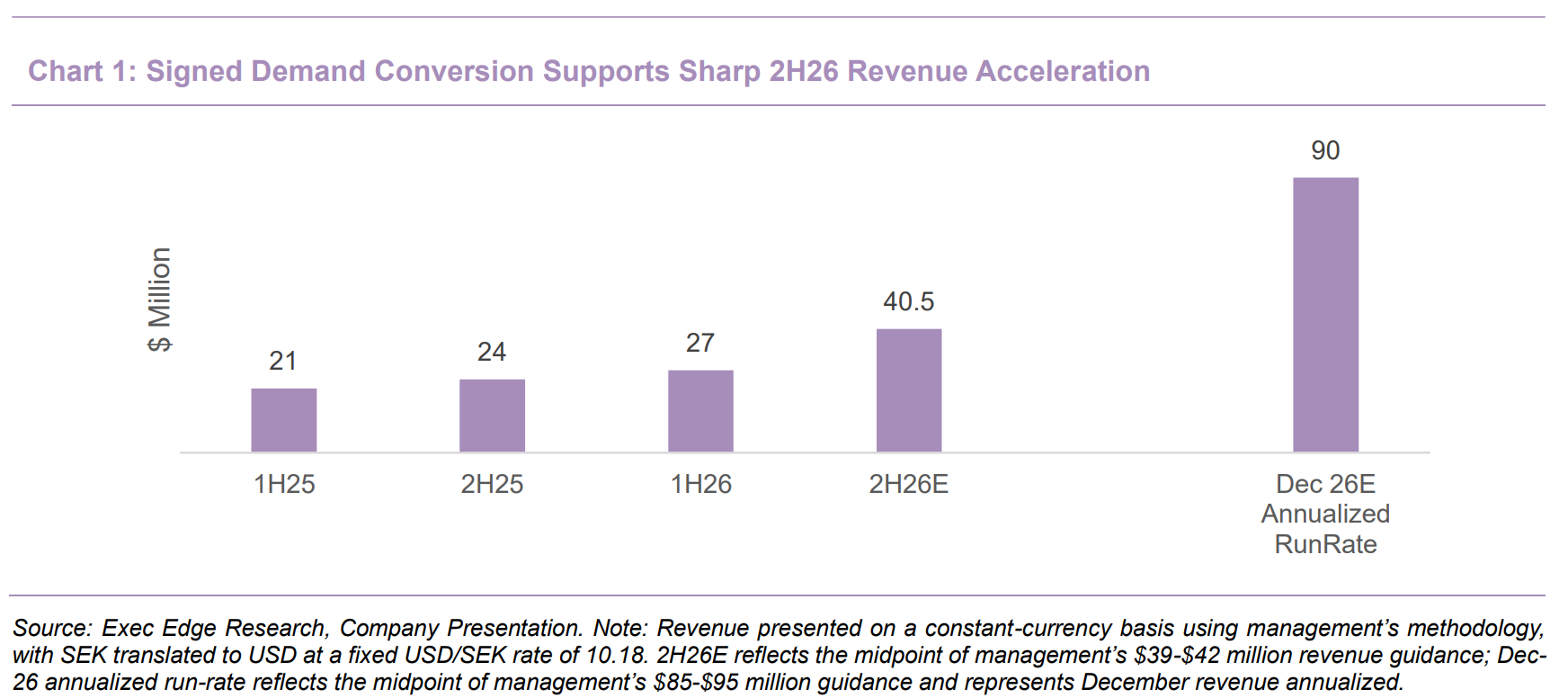
- 1H26 marks an important step in ENRD’s transition from contracted demand toward scaled deployment, with signed capacity beginning to convert into a materially faster revenue growth profile in 2H26. Revenue increased 26% y/y on a constant-currency basis to approximately $27 million from $21 million in 1H25, driven by additional capacity with existing customers and new deployments across the network. Reported revenue increased ~22% y/y to SEK263.5 million from SEK216.5 million, with transport services contributing SEK246.6 million versus SEK201.0 million and rental revenue increasing to SEK16.9 million from SEK15.5 million. The forward setup is considerably stronger than the 1H26 growth rate, with 2H26 constant-currency revenue guided to $39-$42 million, up 60%-73% y/y from $24 million in 2H25. The step-up is expected to be driven primarily by the Amazon ramp, additional U.S. and European deployments and the initial Tesla Semi rollout, suggesting the principal near-term growth constraint is shifting toward deployment capacity and execution as signed demand moves into operations.
- A meaningful portion of near-term growth has already moved from the JBP funnel into contracted business awaiting deployment. ENRD continues to disclose more than $800 million of potential ARR through Joint Business Plans, while the customer base has expanded to 32 customers across seven countries and cumulative operating activity now exceeds 560,000 shipments. The $800 million+ JBP figure remains non-binding, but management provided an important distinction around the December revenue ramp: the absolute majority of capacity supporting the targeted $85-$95 million December 2026 annualized revenue run-rate has already moved from JBP into signed contracts, leaving vehicle deployment and capacity activation as the primary remaining steps before revenue recognition. We believe this is an important progression because the near-term execution focus is now increasingly on converting contracted capacity into deployed revenue at higher utilization and improving margins, rather than proving underlying customer demand.
- Amazon is becoming both a meaningful deployment driver and a strong validation point for ENRD’s enterprise customer-acquisition model. Following an initial pilot, ENRD secured a deployment of 75 electric heavy-duty trucks across five U.S. locations in Amazon’s middle-mile network, with the fleet integrated into Amazon Relay and execution managed through Saga AI; initial deployments are already live and the majority of the first wave is expected to be operational before year end 2026. The commercial organization has also been scaled over the last 6 to 8 months, contributing to an approximately 3x increase in the sales pipeline, while deployment lead times have improved over the past 12-18 months as vehicle availability, charging infrastructure and ENRD’s operating footprint expanded. For a high-touch enterprise model with relatively long initial sales cycles, reference deployments such as Amazon should help shorten customer diligence and support expansion across additional lanes and geographies.
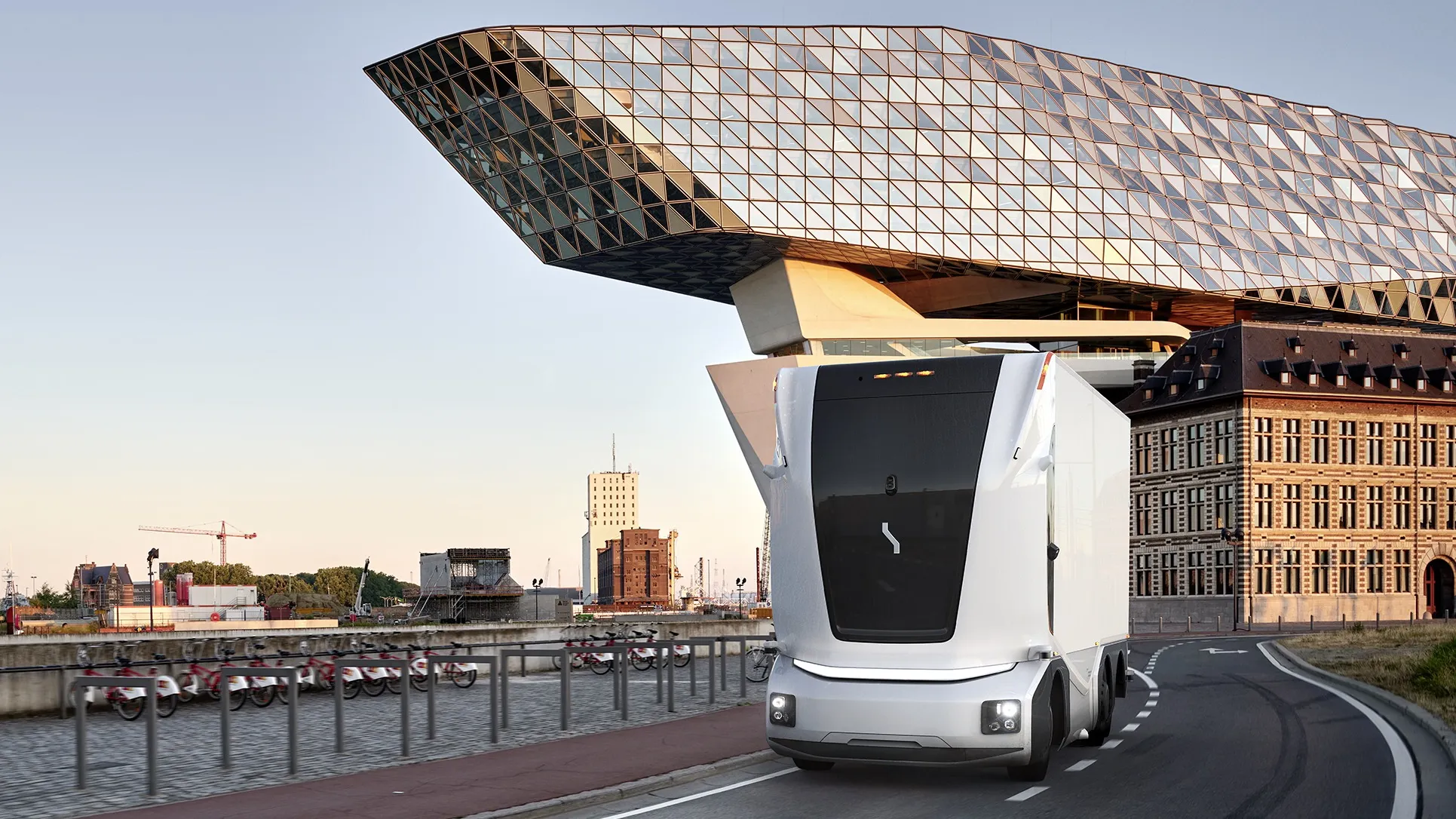
- The recently announced 500-truck Tesla Semi program materially changes ENRD’s fleet scaling equation by adding significant deployment capacity while separating a substantial portion of fleet growth from equity funding. ENRD currently operates approximately 250 vehicles and expects Amazon, other signed deployments and the initial Tesla rollout to take the fleet to just under 400 by year end 2026, implying roughly 60% growth from the current base. The 500 Tesla Semi program alone would triple the current fleet toward approximately 750 vehicles, with the majority targeted to be operational before year end 2027. The program should also support higher revenue per truck from the current roughly $300,000 annual level, with the Semi’s specifications opening additional lanes and distances and management expecting a positive contribution-margin impact as utilization increases. The vehicles will be financed through third-party solutions rather than equity, allowing ENRD to match asset-backed leverage directly against revenue-generating capacity and accelerate conversion of its $800 million+ JBP opportunity into operating revenue without incremental equity dilution.
- Growing network scale is building the conditions for improved FCaaS economics while creating the data and operating density required for autonomous commercialization. ENRD has now completed more than 18.5 million electric miles and 560,000 shipments across 32 customers in seven countries, providing Saga AI with a larger data set to optimize routing, charging and vehicle utilization. That same network has generated more than 5,400 driverless hours in contracted customer operations, up 64% over the preceding six months across six autonomous deployments, while management estimates that approximately 80% of customer freight demand already captured on the platform is suitable for automation over the medium term. This creates a differentiated commercialization pathway: ENRD can progressively introduce autonomous capacity into freight flows it already operates and understands rather than building a separate autonomous-demand base, while Saga and Einride Driver have begun generating SaaS revenue following the late-2025 launch of the vehicle-agnostic offering, providing an early proof point for a more capital-light technology revenue model.
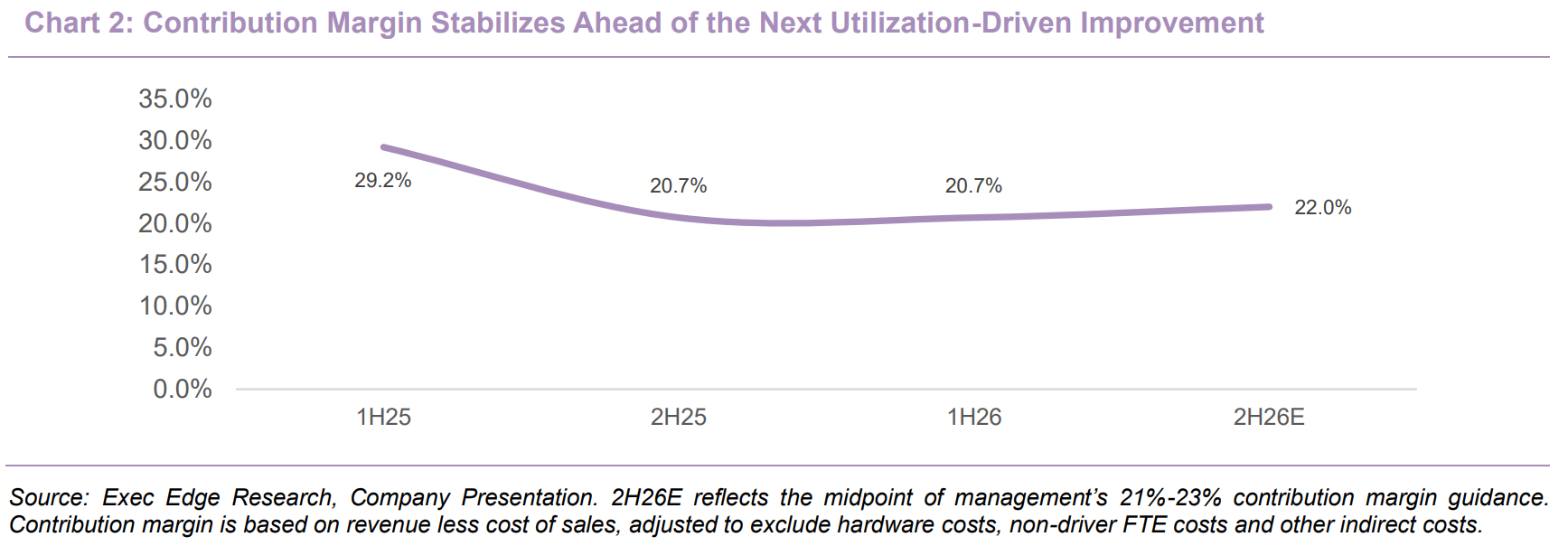
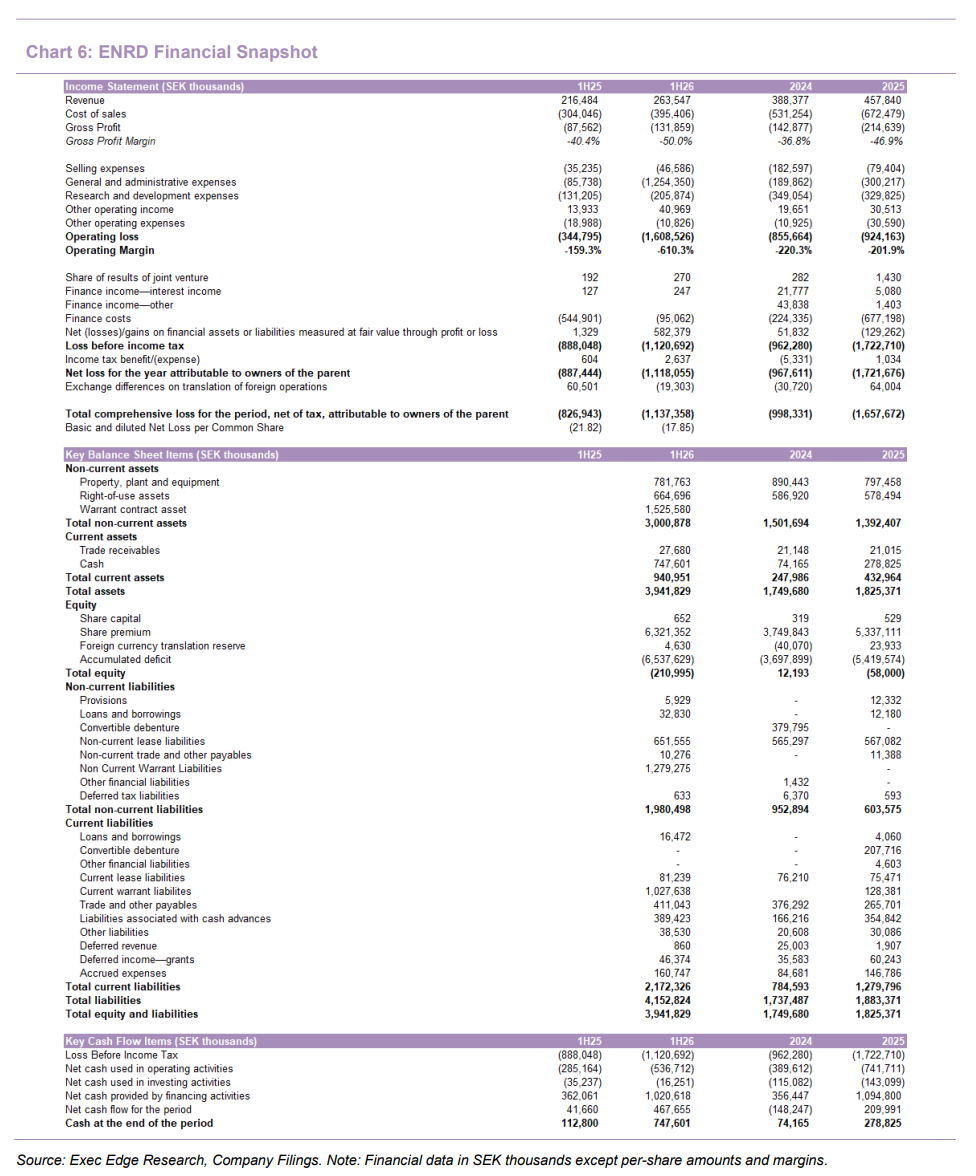
- Contribution economics have stabilized at the transport level, with the next margin inflection dependent on higher utilization and fixed-cost absorption as fleet scale increases. Contribution margin declined from 29.2% in 1H25 to 20.7% in 2H25, remained at 20.7% in 1H26 and is guided to improve to 21%-23% in 2H26 as utilization increases, with management targeting approximately 35% over the longer term. Reported cost of sales was SEK395.4 million against SEK263.5 million of revenue, producing a gross loss of approximately SEK131.9 million and gross margin near negative 50%, versus roughly negative 40% in 1H25, with approximately SEK95 million of depreciation and amortization embedded in cost of sales. The key margin lever is therefore scaling revenue and utilization faster than vehicle and infrastructure costs, with the approaching 400-vehicle year-end fleet expected to provide greater fixed-cost absorption and support operating leverage.
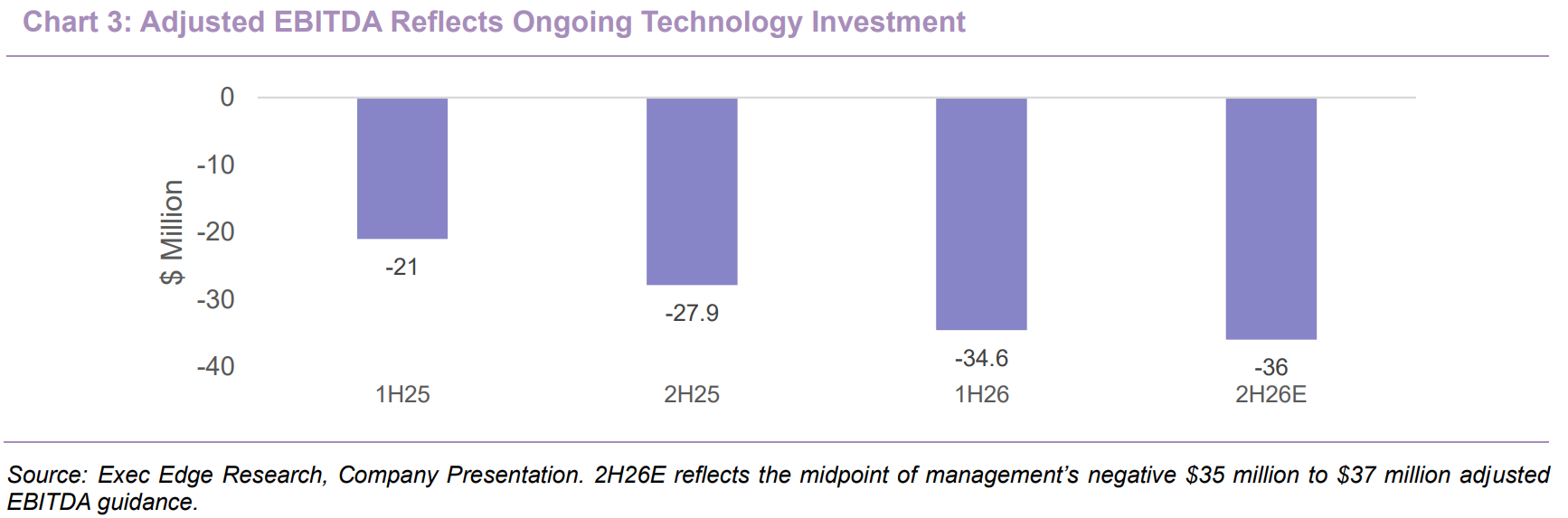
- Investment in autonomy, technology and commercial capacity is keeping adjusted EBITDA negative despite the stronger revenue trajectory. Adjusted EBITDA widened from negative $21.0 million in 1H25 to negative $27.9 million in 2H25 and negative $34.6 million in 1H26, with 2H26 guided to negative $35 million – $37 million as ENRD continues funding autonomous development, Saga capabilities and commercial infrastructure. Constant-currency R&D spend increased ~57% y/y to $20.4 million from $13.0 million, while reported R&D rose to SEK205.9 million from SEK131.2 million and selling expense increased to SEK46.6 million from SEK35.2 million. Net loss widened to SEK1.12 billion from SEK887.4 million, although comparability was affected by SEK636 million of non-cash recapitalization expense, SEK245 million of listing-related share compensation and SEK203 million of transaction advisory costs, partly offset by a SEK582 million warrant-remeasurement gain. The 2H26 setup therefore centers on whether 60%-73% revenue growth begins to improve fixed-cost absorption while ENRD sustains elevated investment in autonomy and platform development.
- DAF and defense expand the commercialization pathways for Einride Driver beyond ENRD-owned autonomous hardware, reinforcing the vehicle-agnostic licensing model. The DAF partnership will integrate Einride Driver onto an established PACCAR vehicle platform, with interface work during 2026 followed by integration and commissioning in 2027 before progressing toward more scaled deployments, reducing reliance on ENRD’s proprietary cab-less trucks as autonomy commercializes. In parallel, ENRD established a dedicated defense unit following pilot contracts with NATO-allied organizations and partnered with Centinus to combine autonomous logistics with real-time threat detection and counter-UAS monitoring. General (Ret.) Keith B. Alexander, who joined ENRD’s Board earlier this year, is expected to help guide expansion across Europe and the U.S., adding defense and cybersecurity expertise to the commercialization effort. Neither channel is yet a material financial contributor, but both broaden the potential market for a vehicle-agnostic Einride Driver while supporting a more capital-light technology revenue model that does not require ENRD to own the underlying fleet.
- Flipturn expands Saga into charging and energy management, adding a software-led layer that can improve deployment efficiency while addressing a practical bottleneck to electric-fleet scale. The acquisition adds more than 5,000 live charging ports and over 250 MW of charging capacity under management, alongside charge-port management, energy orchestration and connectivity to third-party charging networks. Aggregating charging demand should improve access to external infrastructure and charging economics while reducing site-readiness friction as ENRD expands across more customer locations. The transaction was primarily equity funded, with SEK373.5 million of base consideration including approximately 4.41 million ENRD ADSs and only ~SEK2.4 million of cash, while up to another 3.72 million ADSs are tied to contracted ARR and product milestones through 2028. The strategic payoff will depend on whether Flipturn converts its charging footprint into incremental software revenue, lower deployment friction and better charging economics, sufficient to justify the associated equity consideration.
- Operating cash requirements increased with the investment and deployment ramp, making working-capital efficiency increasingly important to funding the next phase of scale. Net cash used in operating activities increased ~88% y/y to SEK536.7 million from SEK285.2 million, reflecting the heavier investment burden ahead of planned fleet and technology deployments. Working capital provided a meaningful partial offset, with SEK143.1 million in inflows supported by higher trade payables and accrued expenses as supplier activity increased alongside deployment volumes. Trade receivables increased 32% from year end 2025 to SEK27.7 million and accrued income more than doubled to SEK61.3 million from SEK29.5 million, while trade and other payables increased ~55% to SEK411.0 million and accrued expenses rose to SEK160.7 million from SEK146.8 million. As ENRD moves into a faster deployment phase, the ability to convert revenue into cash efficiently and manage supplier and vehicle-payment timing should become increasingly important to limiting incremental external funding needs as the fleet scales.
- The public-market transaction materially strengthened near-term liquidity, providing a larger capital base to support the current deployment ramp and technology roadmap. Cash increased to approximately SEK747.6 million, or $77 million, at June 30 from SEK278.8 million at YE25 and SEK112.8 million a year earlier, supported primarily by approximately $113 million of PIPE proceeds, although only ~$3.3 million remained in the SPAC trust following redemptions and transaction fees and expenses totaled approximately $34 million. With 1H operating cash use of SEK536.7 million and investing cash use of SEK16.3 million, ENRD will still require access to external funding as the business scales, but management’s strategy of financing revenue-generating fleet assets separately should reduce the amount of corporate capital required for vehicle growth and preserve more balance-sheet capacity for Saga, autonomy and commercial expansion.
- Capital allocation is increasingly centered on capital-efficient fleet scaling, with corporate capital reserved for technology and commercial expansion while vehicle growth is funded through non-dilutive asset-backed structures. Loans and borrowings excluding leases totaled approximately SEK49.3 million at June 30, while lease liabilities were ~SEK732.8 million and the prior SEK207.7 million convertible debenture had been eliminated. ENRD entered approximately SEK33.9 million of installment-financing arrangements for electric-truck purchases during 1H26 and subsequently added a $25 million U.S. equipment facility in August, with individual drawdowns carrying 42-month terms and an effective interest rate of approximately 14%. Management expects this asset-backed approach to extend to larger fleet programs, including the Tesla Semis, with vehicles financed against the underlying revenue-generating assets rather than through new equity, implying zero incremental equity dilution from those vehicle deployments. The strategy allows corporate capital to remain directed toward Saga AI, Einride Driver, R&D and commercial expansion, while making vehicle utilization, contribution margin and returns relative to financing costs increasingly important to determining whether fleet growth remains value-accretive.
- The December 2026 exit rate provides the clearest near-term marker of ENRD’s scale-up, with annualized revenue targeted at $85 million to $95 million as contracted capacity moves into deployment. For 2H26, constant-currency revenue is guided to $39-$42 million, up 60% to 73% y/y, contribution margin to 21%-23% and adjusted EBITDA to negative $35 million to $37 million. Combined with the $27 million 1H actual, this implies approximately $66 million-$69 million of 2026 constant-currency revenue and negative $70 million to $72 million of adjusted EBITDA based on disclosed results and guidance. The December run-rate is expected to be supported by a fleet just below 400 vehicles versus approximately 250 today, with the majority of the capacity underpinning that revenue level already contracted. ENRD plans to issue a business update with selected figures in the fall before moving to quarterly reporting in 2027.
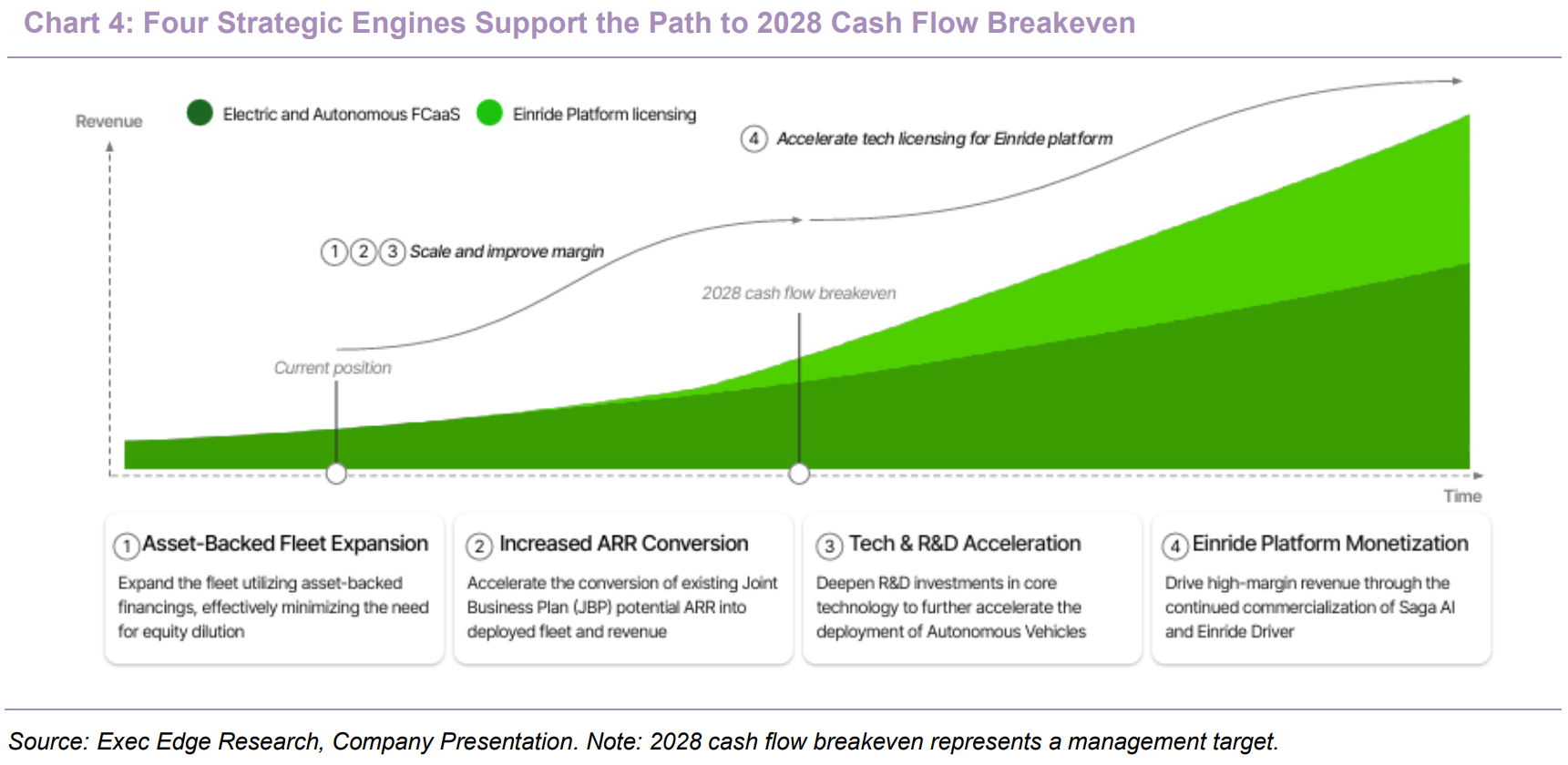
- Beyond 2026, the operating roadmap increasingly centers on scaling the four engines required to reach management’s 2028 cash flow breakeven target. Management estimates that approximately 1,500-2,000 deployed vehicles are required to reach breakeven, while existing JBPs represent roughly 1.4x-1.8x the freight volume necessary to support that fleet. With the majority of the 500 Tesla Semis targeted to be operational before year end 2027, the next execution steps center on converting additional JBPs into signed capacity, adding deployments through Tesla and other OEMs, and scaling technology licensing alongside FCaaS. The demand base therefore appears sufficient to support the targeted operating footprint, making deployment cadence, capital efficiency and margin conversion the principal milestones into 2027 and 2028. Together, capital-efficient fleet expansion, contracted-demand conversion, continued autonomy and R&D investment, and increasing Saga AI and Einride Driver monetization form the four strategic engines supporting the path to cash flow breakeven.
Revenue Conversion and Commercial Autonomy Execution Support Valuation
- Disclaimer: Exec Edge does not publish proprietary estimates, ratings, price targets, or investment recommendations. The valuation discussion below is illustrative only and is based on company filings, management commentary, and third-party data and estimates. It does not constitute a recommendation, price target, rating, or prediction of future pricing.
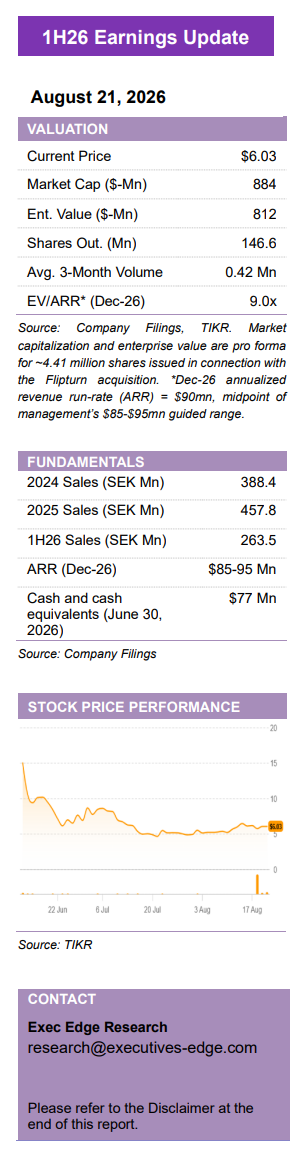
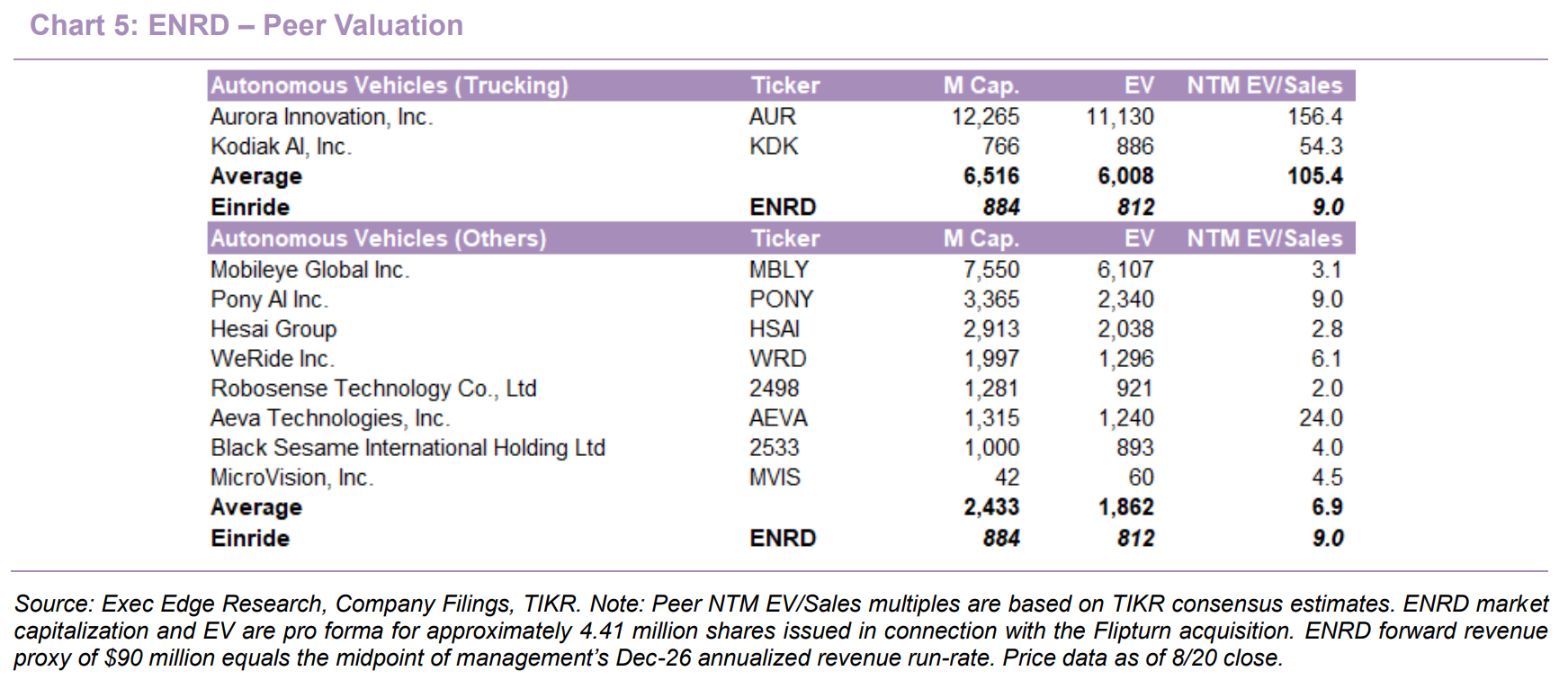
- Valuation has reset materially below the original transaction level despite improving commercial visibility, leaving execution against the current deployment ramp as the principal potential re-rating catalyst. As of the 8/20 close, ENRD carries a pro forma market capitalization of ~$884 million and an EV of ~$812 million, approximately 46% below the ~$1.51 billion EV implied by the SPAC transaction. This reset has occurred despite 1H26 constant-currency revenue growth of 26%, a 60%-73% 2H26 growth outlook, and substantially greater deployment visibility following the Amazon and Tesla Semi programs. Using the midpoint of management’s $85-$95 million December annualized revenue run-rate as a forward revenue proxy, ENRD trades at approximately 9.0x EV/Sales, providing a materially lower valuation entry point despite a substantially larger and more visible operating base.
- ENRD screens at a substantial discount to direct trucking-autonomy peers while trading at only a modest premium to the broader autonomous-vehicle group. Aurora Innovation and Kodiak AI trade at 156.4x and 54.3x NTM EV/Sales, respectively, producing a direct trucking-autonomy average of 105.4x compared with ENRD’s 9.0x forward revenue multiple based on management’s December annualized run-rate. The direct peer multiples remain unusually high because both businesses are still early in their commercial revenue ramps; however, the dispersion illustrates the substantial premium public markets assign to autonomous-trucking commercialization potential. The broader AV and sensing peer group trades at an average of approximately 6.9x NTM EV/Sales, placing ENRD at a more measured ~30% premium. That premium appears supportable given ENRD’s existing commercial footprint of 32 customers across seven countries, approximately 250 deployed vehicles, more than 18.5 million electric miles and 5,400+ driverless hours, combined with an integrated FCaaS, Saga AI and autonomous-software model that provides both current freight revenue and longer-term technology monetization.
- The valuation increasingly centers on ENRD conversion of contracted demand into revenue at improving margins and lower capital intensity. Delivery of the $39-$42 million 2H26 revenue outlook, a fleet approaching 400 vehicles by year end 2026 and contribution margin improving from 20.7% to the guided 21%-23% would provide tangible evidence that the current deployment ramp is translating into operating leverage. Beyond 2026, execution of the 500 Tesla Semi program, continued conversion of the $800 million+ JBP opportunity and increasing Saga AI and Einride Driver monetization could support a progressively higher-margin revenue mix, while third-party asset-backed financing provides a pathway to expand revenue-generating fleet capacity with zero incremental equity dilution from those vehicle deployments. Conversely, slower deployment conversion, limited gross-margin improvement or weaker capital efficiency would justify maintaining a discount despite the scale of contracted and prospective demand. At 9.0x EV/Sales on December run-rate revenue, the potential re-rating case is therefore increasingly tied to demonstrating that higher fleet scale can convert into faster revenue growth, improving margins and lower equity capital intensity, rather than further proof of underlying customer demand.
Read Exec Edge’s Initiation on ENRD Here
Subscribe to our Weekly Newsletter to Receive All Research
Contact: