Download the Complete Report Here
 Enhanced Group, Inc. (ENHA)
Enhanced Games Validate Audience & Sponsorship; Focus Shifts to Live Enhanced Conversion and Operating Leverage
- Key Takeaways:
- 2Q revenue reached $17.7 million and sponsorship contract value totaled $32 million, validating initial commercial demand for the Enhanced Games property.
- More than 4 million live views and 1 billion+ global reach established meaningful brand scale while athlete outcomes strengthened clinical credibility.
- Live Enhanced launched with 11 Rx products and 34-country supplement distribution, shifting the next proof point toward conversion, retention and customer economics.
- Reusable infrastructure, lower-cost Breakers and a ~$5.5 million underlying SG&A base establish a materially leaner operating model and clearer path to operating leverage beyond the inaugural Games.
- Valuation has contracted and remains deeply discounted, with rerating dependent on Live Enhanced monetization, cost normalization and greater financing visibility.
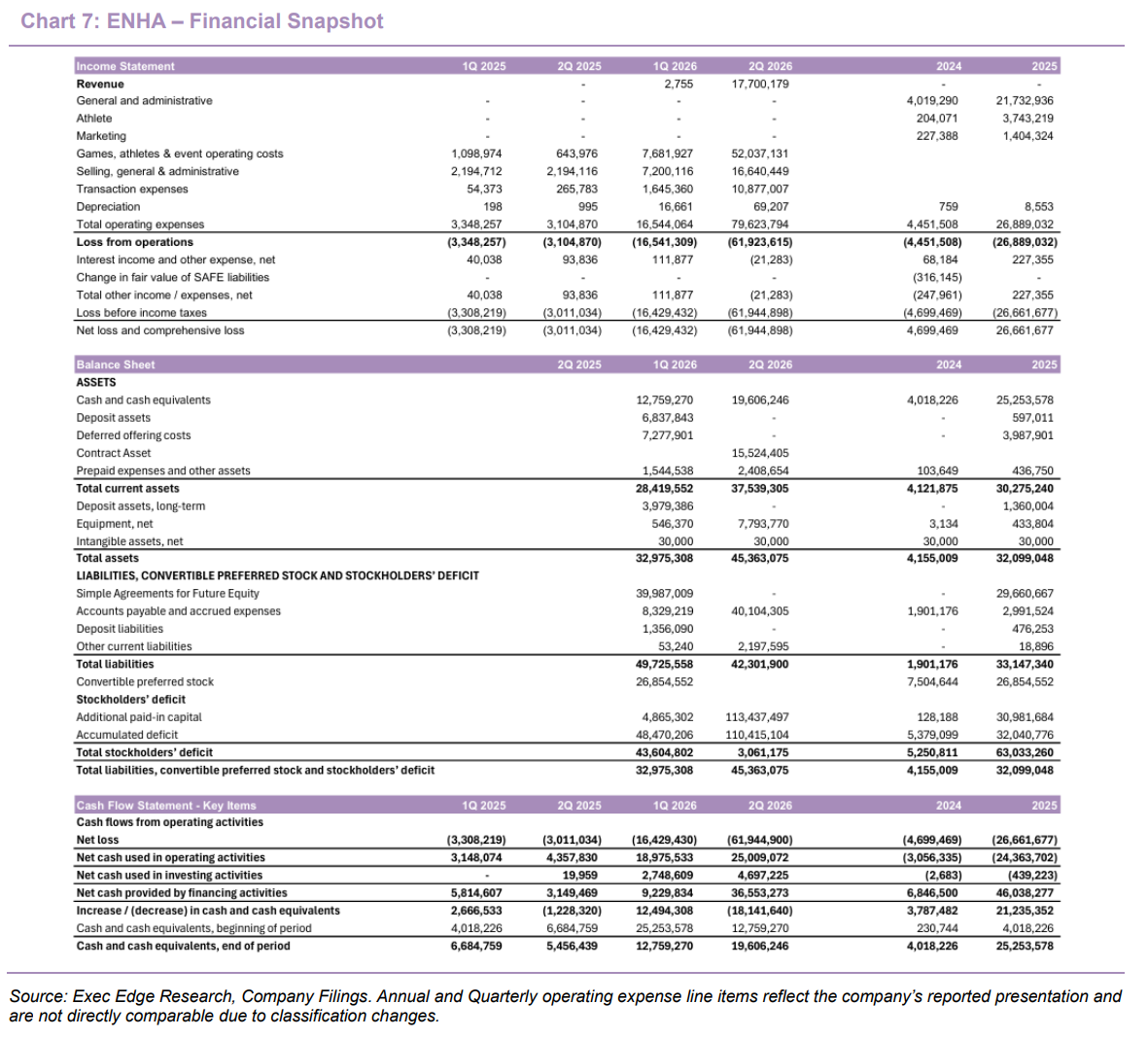
- 2Q26 revenue of $17.7 million, supported by ~$32 million of sponsorship contract value, provided the first commercial validation of ENHA’s integrated sports and performance-medicine model. Revenue reached $17.7 million versus none a year ago, supported by ~$32 million of sponsorship contract value across 10 sponsors. However, the initial revenue base was concentrated and largely non-cash, with roughly $17.5 million tied to two sponsorship arrangements that included Rezolve equity and Rumble advertising inventory. Against Street’s $43.7 million 2026E revenue estimate (source: TIKR), 1H26 revenue represents ~41% of the full-year estimate, leaving ~$26 million to be generated in 2H26. The focus now shifts to sponsor diversification, stronger cash conversion and meaningful scaling of Live Enhanced.
The inaugural Enhanced Games established immediate audience and brand scale, creating a commercial benchmark for future sponsorship and media-rights monetization. The Games generated more than 4 million live views excluding Roku, while Roku distribution made it available across ~100 million North American households. Total global reach exceeded 1 billion people, supported by ~4,000 media stories reaching a combined 16.7 billion unique monthly visitors. A one-hour ESPN E:60 documentary provided additional mainstream media validation. Owned audience increased 884%, social engagements rose 419%, and video views increased 227% during the event period. ENHA now enters future commercial discussions with demonstrated viewership rather than a conceptual property, after securing ~$32 million of sponsorship contract value. As of June 30, ~$4.5 million remained allocated to unsatisfied sponsorship performance obligations, providing modest forward revenue visibility as ENHA expands sponsorship, media-rights and other event monetization. The key next step is converting this reach into repeatable, higher-quality monetization across both the sports property and Live Enhanced.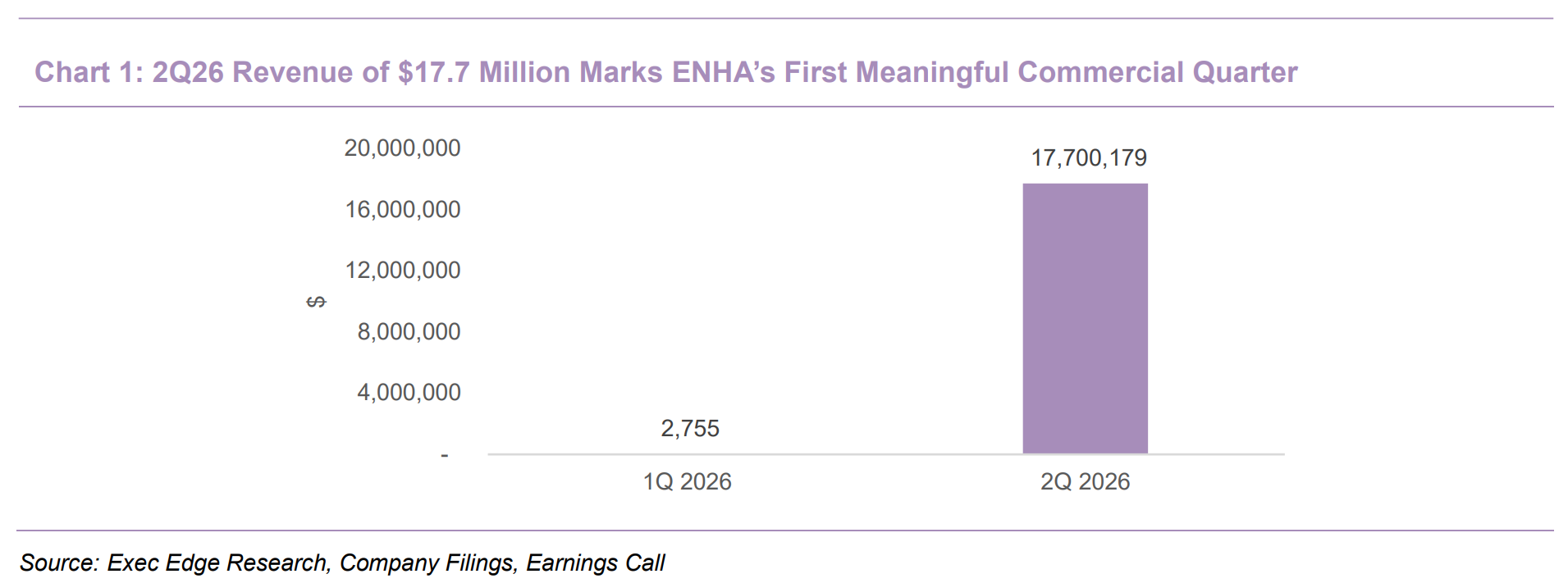
- Brand research indicates the inaugural Games established meaningful awareness and brand strength, supporting ENHA’s customer-acquisition strategy. A pre-Games Qualtrics survey found 61% awareness and a 67% positive perception among those familiar with the property, while post-event research positioned Enhanced alongside Hyrox and The CrossFit Games despite its limited operating history. Combined with the 884% increase in owned audience and 1 billion+ global reach, these results suggest the Games investment established meaningful brand equity that ENHA can potentially monetize through Live Enhanced rather than relying on each event as a standalone marketing spend.
- Athlete outcomes and clinical execution strengthen ENHA’s sports property while building the proprietary-data foundation for Live Enhanced. ENHA has produced three world records across its competitions since inception, including one at the inaugural Games, alongside 21 personal bests across 42 athletes. All athletes also completed the interventional phase of its IRB-approved clinical trial safely, with the medical team making 274 protocol adjustments in the two months before the Games and generating data across biomarkers, interventions and individual responses. The broader performance narrative now extends beyond headline records toward transparent protocols, health outcomes and individualized performance improvement, better aligning the sports property with Live Enhanced’s consumer opportunity across recovery, longevity and everyday performance. The successful Games have also strengthened athlete recruiting, with Olympic champions and world-record holders expressing interest in future events, supporting a reinforcing loop in which stronger rosters can deepen both audience engagement and the data feeding Live Enhanced.
- Live Enhanced is becoming the more important next-stage proof point as commercialization begins to scale. The platform became fully operational in mid-May, leaving only several weeks of contribution in 2Q, while sponsorship remained the dominant source of the $17.7 million of revenue. Live Enhanced now offers 11 Rx products in the U.S. and two proprietary supplement stacks, with supplements available across 34 countries. The largest customer cohort is currently aged approximately 25 to 45, although demand extends across both genders and into older age groups, supporting an addressable consumer base broader than an athlete-centric demographic. Management cited strong weekly and monthly cohort growth and expects momentum to continue through 2H26 as new categories launch.
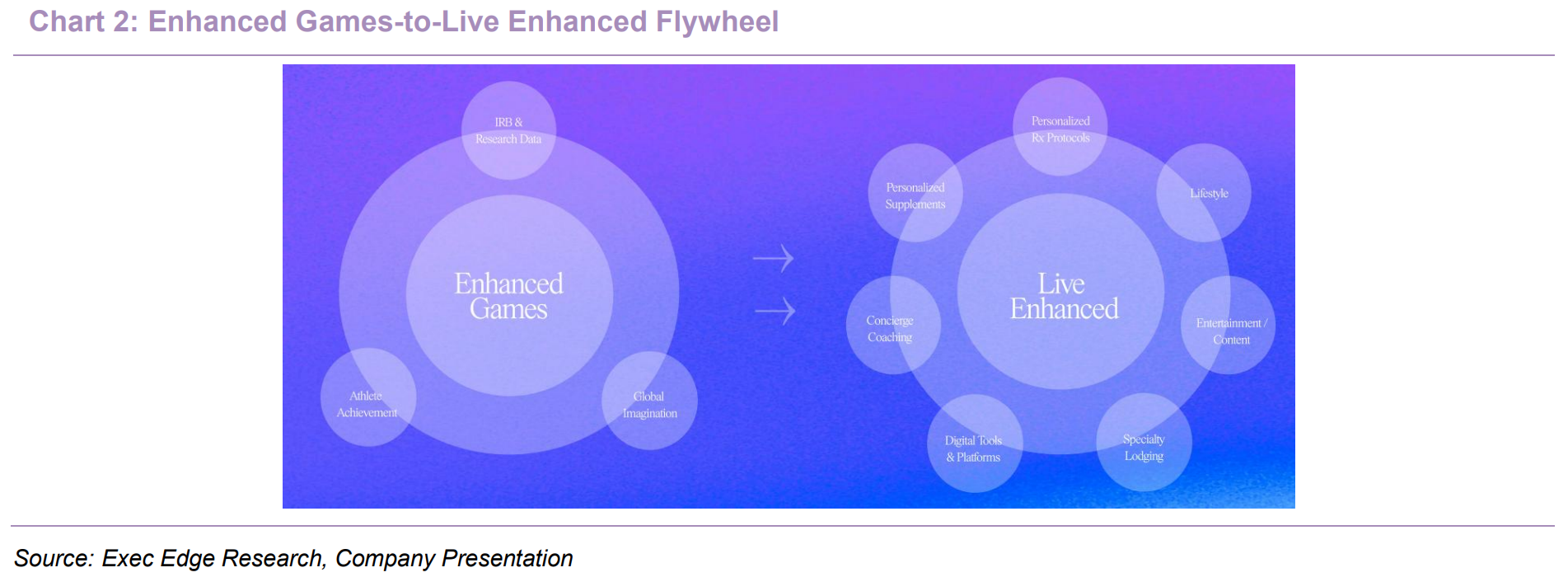
- Enhanced OS materially sharpens the consumer strategy by positioning ENHA around personalized performance medicine. Planned for launch later in 2026, Enhanced OS is designed to combine baseline health information, personal goals, therapies and supplements, wearables and ongoing response data to continuously adjust individual performance protocols. ENHA intends to apply the medical learnings generated through 274 athlete protocol adjustments to a broader consumer population, creating a data and intelligence layer around products that may otherwise become commoditized. Personalization could support multiple-product adoption, stronger retention and higher lifetime value while reducing reliance on price as the primary differentiator. It also completes the intended operating flywheel: sports creates attention and trust, athletes generate data and credibility, Enhanced OS converts those learnings into individual consumer protocols, and a growing consumer population creates additional data that can further improve personalization. The Rezolve relationship could also extend beyond sponsorship, with its AI-commerce capabilities potentially supporting Live Enhanced commerce and conversion as Enhanced OS develops.
- Peptides represent potentially meaningful regulatory upside for Live Enhanced. Following July FDA advisory activity, ENHA intends to launch six peptides receiving favorable advisory-panel support if the regulatory pathway permits, while strengthening U.S. pharmacy and supply-chain partnerships to support personalized compounding, nationwide fulfillment and improved product margins. Regulatory clarity could expand the addressable market beyond consumers already sourcing peptides through gray-market channels to a broader population unwilling to use untested or unregulated supply. ENHA’s differentiation is likely to depend less on access to individual peptides and more on personalization, protocol design and the data layer around them. As regulatory access broadens and the underlying molecules become more commoditized, Enhanced OS, biomarker and lifestyle data, and individualized protocols should become increasingly important sources of competitive differentiation. Management also expects to expand into cognitive enhancement and other lifestyle-oriented performance categories, broadening the product funnel and creating more opportunities to increase products per customer, wallet share and ultimately lifetime value.
- ENHA is evolving the sports side from a single annual tentpole toward a year-round engagement and customer-acquisition ecosystem. The first Enhanced Breakers event was held in Los Angeles in July and produced a new weightlifting world record while operating at a fraction of the scale and fixed cost of the inaugural Games. Breakers can expand into additional sports, keep athletes competing between flagship events, provide more frequent content, and give sponsors additional activation opportunities throughout the year. ENHA is also evaluating partnerships with participatory communities such as run clubs and local competitions, extending the concept beyond elite athletes toward a broader base of amateur athletes and health-conscious consumers. Together, these formats could create more frequent, lower-cost touchpoints that keep performance medicine visible year-round. If successfully executed, the model could reduce reliance on purchased digital traffic and strengthen sports as a recurring acquisition channel for Live Enhanced.
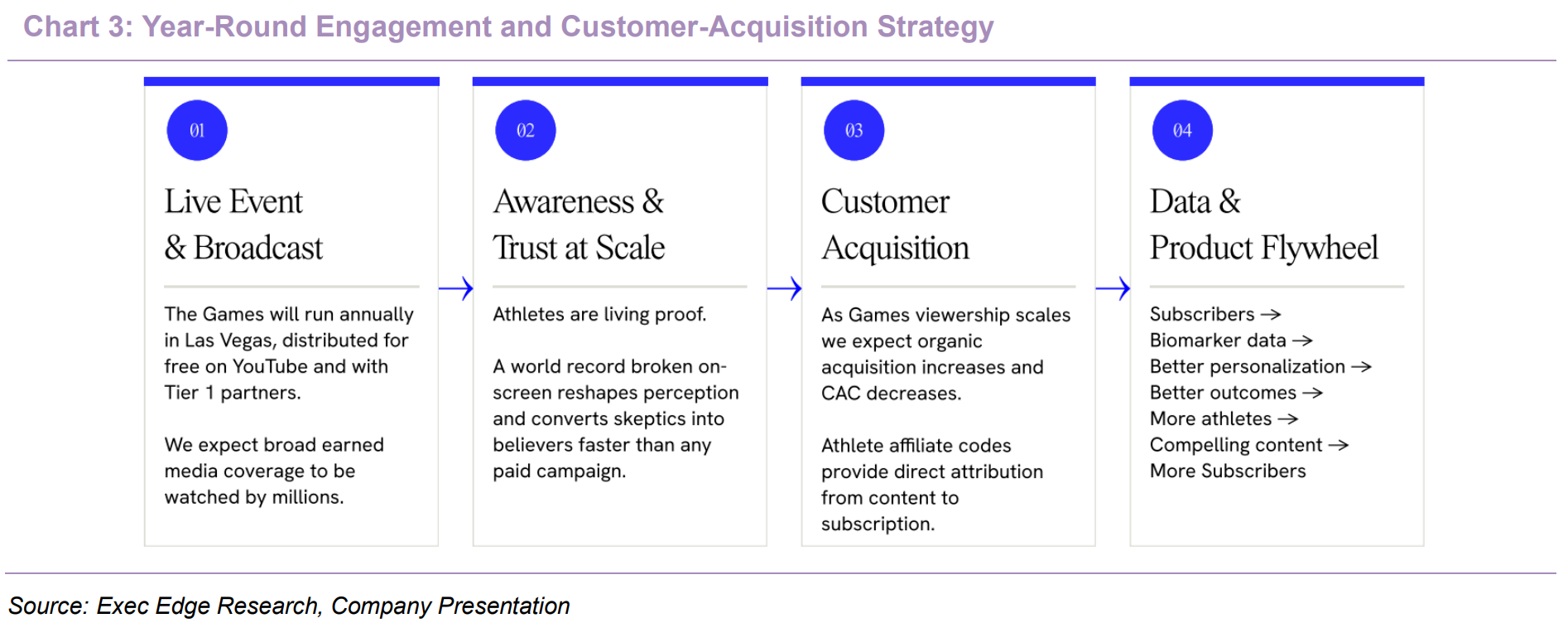
- Marketing is increasingly shifting from purchased acquisition toward owned media and community, but the economic advantage still needs to be demonstrated through conversion and retention. ENHA spent approximately $1.6 million on performance marketing in 2Q, while the larger customer-acquisition investment was embedded in the Games, which generated more than 4 million live views, 1 billion+ global reach and an 884% increase in owned audience. Breakers, athlete content and planned participatory events are intended to sustain that attention between flagship Games and reduce reliance on paid traffic over time. The model could support structurally lower CAC if Games- and community-acquired consumers convert at attractive rates and show stronger retention, but conversion, CAC and retention remain undisclosed. The next stage of the thesis therefore requires ENHA to demonstrate that owned attention can translate into superior customer economics.
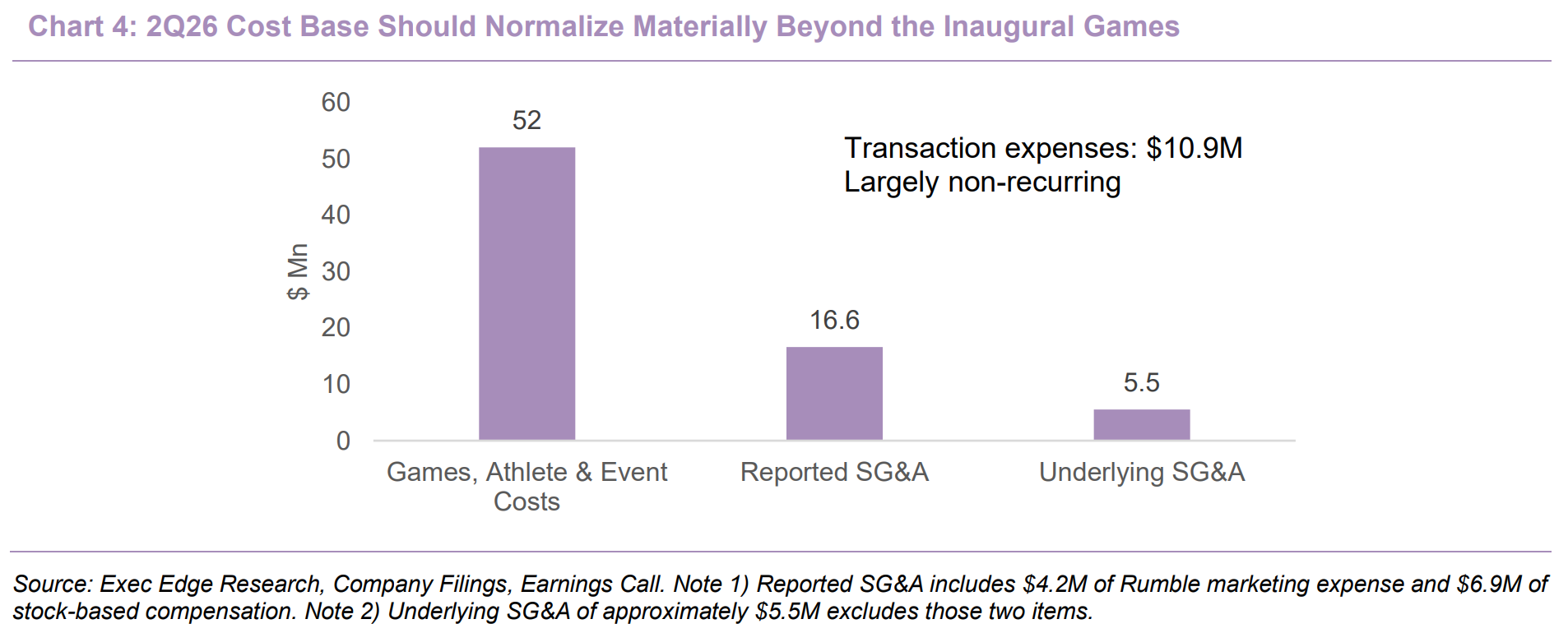
- With the inaugural build complete, future Games economics should improve as ENHA monetizes the infrastructure, audience and commercial relationships established through the first event. Games, athlete and event operating costs reached $52.0 million in 2Q26, contributing to total operating expenses of $79.6 million versus $3.1 million a year ago. Operating and net losses were both $61.9 million compared with approximately $3.0 million in 2Q25, while net loss per share widened to $0.53 from $0.03. Adjusted EBITDA was negative $42.7 million versus negative $2.7 million, bringing the 1H26 adjusted EBITDA loss to $56.2 million. These results reflect the deliberate front-loaded investment required to build the venue, broadcast infrastructure and supporting event platform largely from scratch. A meaningful portion of this cost base should not recur at the same level, with the pool and track available for reuse across future Games and Breakers, while the lower-cost Breakers format provides a way to maintain sports engagement without replicating the scale and fixed cost of the flagship event. ENHA is also evaluating future host cities partly on economic-development financing and other incentives, creating another opportunity to reduce net event costs and support operating leverage as the model scales.
- The revenue opportunity should also broaden as the Games evolve from a proof-of-concept event into a repeatable sports property. The inaugural event was invitation-only and monetized primarily through sponsorship, whereas future Games could add ticket sales alongside sponsorship and media-rights revenue while leveraging infrastructure and commercial relationships already established. ENHA now enters those discussions with a tangible benchmark of more than 4 million live views and ~$32 million of sponsorship contract value, giving the company greater leverage when pricing sponsorships, media rights and venue economics. The inaugural Games therefore established the upfront sports infrastructure and audience proof point; the next phase is converting those assets into a more scalable revenue-to-cost relationship as the property repeats and monetization expands.
- Underlying corporate costs were materially below reported 2Q levels, supporting a clearer path to operating leverage as revenue scales. SG&A was $16.6 million, including $4.2 million of Rumble advertising expense and $6.9 million of stock-based compensation, leaving approximately $5.5 million of underlying SG&A, including $1.8 million of salaries and wages and $1.6 million of performance marketing. Transaction expenses added another $10.9 million in 2Q and $12.5 million in 1H26 and should largely roll off. Combined with lower future event costs, this points to a materially leaner expense base entering 2H26 and strengthens the potential for operating leverage as revenue scales.
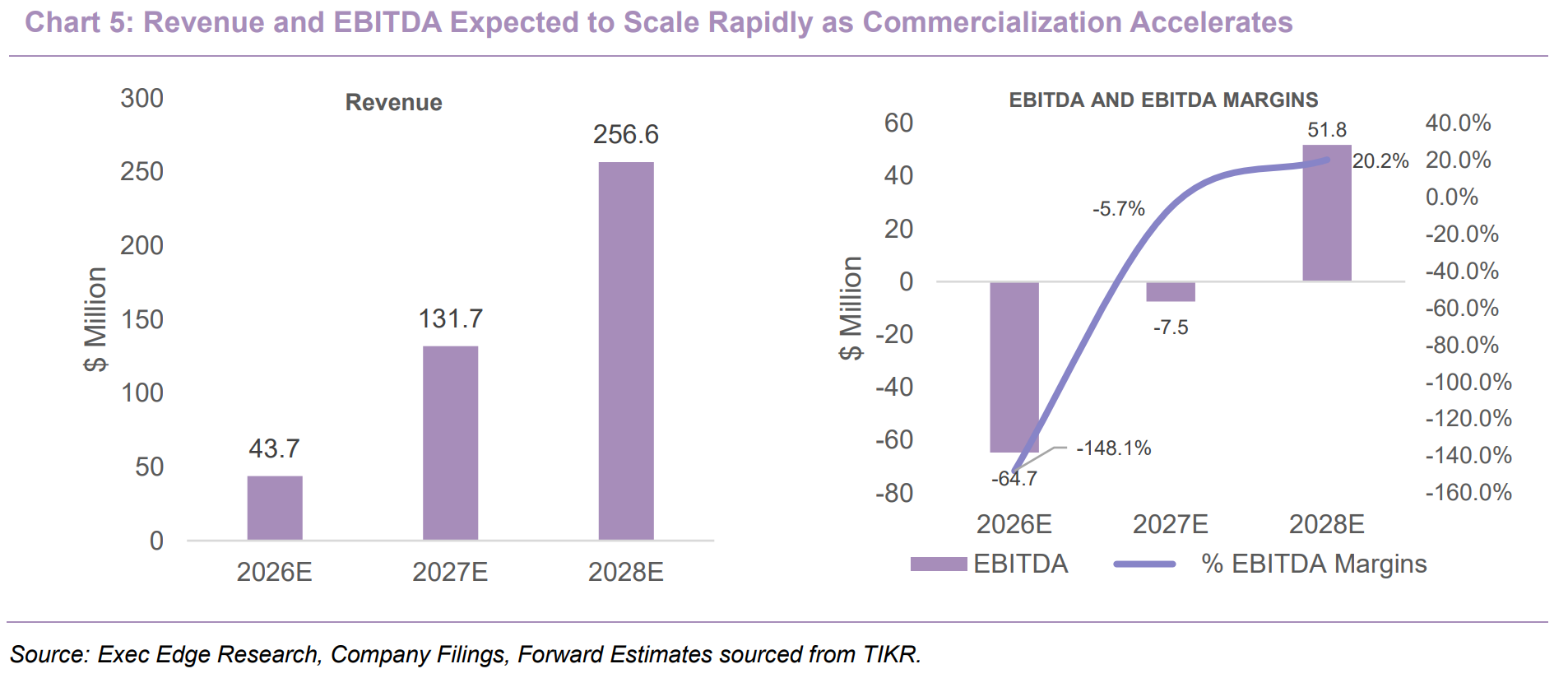
- Liquidity reflects the early-stage investment cycle following the inaugural Games, with post-quarter financing activity and liability management helping to support the near-term position. ENHA ended 2Q26 with $19.6 million of cash after using $44.0 million of operating cash and $7.4 million of investing cash during 1H26, while accounts payable and accrued expenses increased to $40.1 million. Following quarter-end, management repaid approximately $10 million of payables, reducing accounts payable to roughly $16 million while maintaining cash near $20 million as of the filing date. ENHA also holds approximately $10 million of Rezolve shares that remain locked through December, while the unrecognized $10 million Zoop title sponsorship provides additional potential value if collectability requirements are satisfied. Despite these sources, additional financing will be required to fund planned operations over the next twelve months. Street estimates sourced from TIKR show EBITDA improving from negative $64.7 million in 2026E to negative $7.5 million in 2027E before turning positive at $51.8 million in 2028E, making the pace of cash-burn normalization a key determinant of future financing needs and dilution.
- The $50 million PIPE supports near-term liquidity, while $25 million of insider participation signals management confidence in the long-term platform build. The financing included $20 million from Executive Chairman Christian Angermayer and $5 million from CEO Maximilian Martin, with subsequent tranche proceeds helping reduce near-term payables. Deployment priorities now include Enhanced OS, Live Enhanced customer acquisition, new product and peptide categories, pharmacy and supply-chain capabilities, Breakers and participatory events, and potentially strategic M&A. ENHA has engaged advisors to evaluate acquisitions and partnerships that could expand its sports, live entertainment and consumer capabilities, although $44 million of operating cash usage in 1H26 reinforces the importance of disciplined deployment. Transactions that add data, personalization, commerce, community or distribution capabilities while preserving the asset-light model would be particularly complementary to the existing platform.
- The forward setup now depends on a meaningful 2H operating improvement as ENHA transitions from front-loaded platform investment toward revenue scaling and a more normalized cost base. Current Street estimates sourced from TIKR indicate 2026E revenue of $43.7 million, followed by $131.7 million in 2027E and $256.6 million in 2028E. EBITDA is expected to improve from negative $64.7 million in 2026E to negative $7.5 million in 2027E before turning positive at $51.8 million in 2028E, with margins improving to +20.2% by 2028. With approximately $17.7 million of revenue and negative $56.2 million of adjusted EBITDA through 1H26, estimates imply approximately $26.0 million of 2H26 revenue and an ~$8.5 million EBITDA loss in 2H26, representing a substantial sequential improvement. The absence of another inaugural-scale Games build should materially reduce the expense base, while sponsorship recognition, Live Enhanced commercialization and broader product expansion provide the principal revenue levers into year-end. Delivery against current estimates would provide early evidence that the front-loaded investment made in 1H26 can translate into a significantly more scalable cost structure and eventual operating leverage.
Differentiated Platform and Superior Growth Support an Attractive Valuation
- Disclaimer: Exec Edge does not publish proprietary estimates, ratings, price targets, or investment recommendations. The valuation discussion below is illustrative only and is based on company filings, management commentary, and third-party data and estimates. It does not constitute a recommendation, price target, rating, or prediction of future pricing.
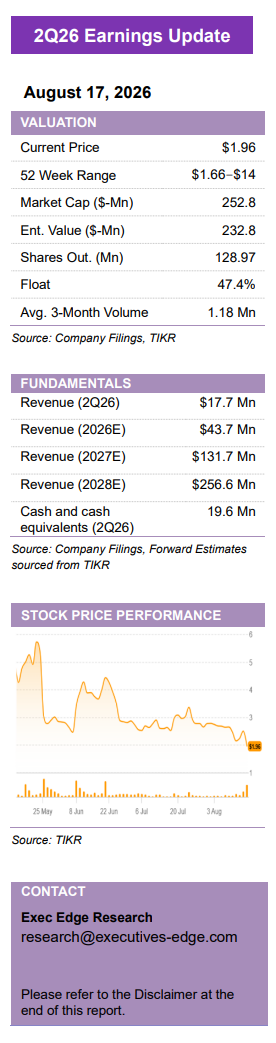
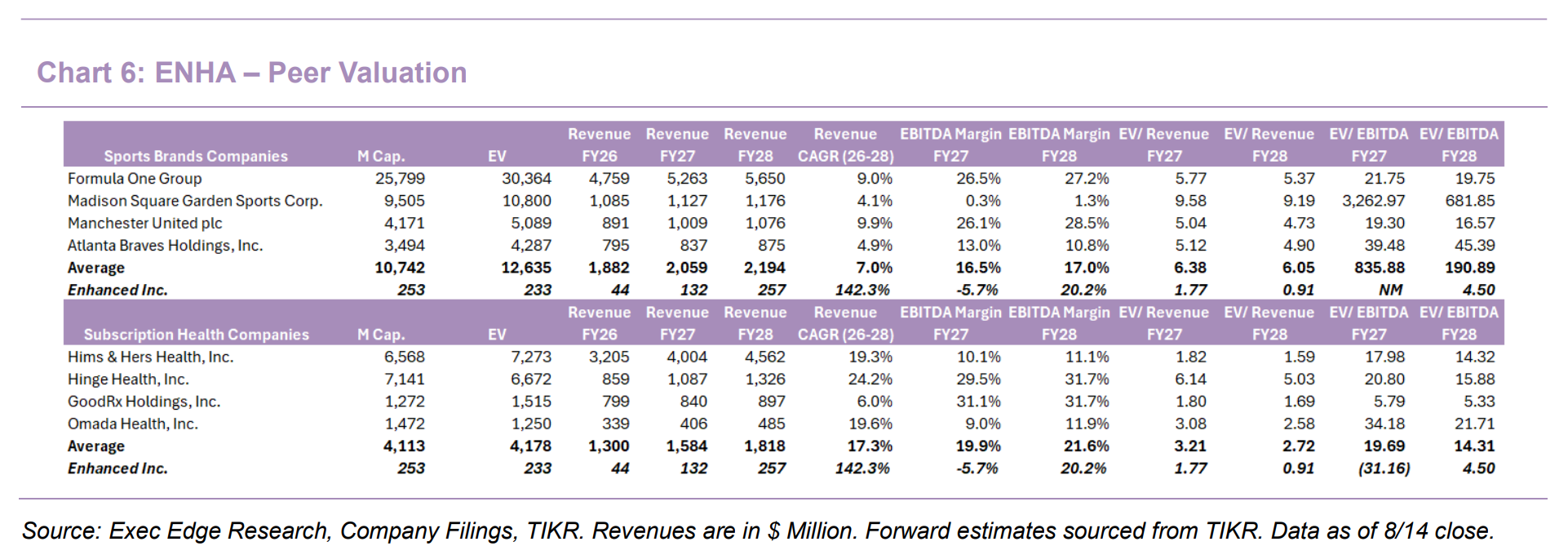
- Valuation has compressed materially from the SPAC transaction, creating a meaningful disconnect between current enterprise value and ENHA’s longer-term earnings potential. At a share price of $1.96 and approximately 129 million Class A shares outstanding, ENHA’s implied market capitalization is approximately $252.8 million. Using approximately $20 million of pro forma cash and no financial debt, we calculate enterprise value of approximately $232.8 million. Current enterprise value is therefore more than 80% below the ~$1.2 billion SPAC transaction valuation, reflecting substantial investor skepticism around execution, financing requirements and the timing of profitability.
- Forward valuation becomes increasingly compelling if ENHA delivers against current 2027-2028 scaling assumptions. Based on current estimates, ENHA trades at approximately 5.3x 2026E revenue, 1.8x 2027E revenue and 0.9x 2028E revenue. EBITDA is expected to remain negative through 2027E before inflecting to positive $51.8 million in 2028E, implying approximately 4.5x 2028E EV/EBITDA and a 20.2% margin. The current valuation therefore embeds a meaningful discount for execution risk, particularly given the substantial revenue growth and margin improvement required over the next two years.
- Relative valuation remains highly discounted if Live Enhanced develops into the primary earnings engine rather than ENHA being valued principally as an emerging sports property. ENHA trades at approximately 1.8x 2027E revenue and 0.9x 2028E revenue versus subscription-health peer averages of 3.2x and 2.7x, respectively. By 2028E, ENHA’s 4.5x EV/EBITDA also compares with a 14.3x subscription-health peer average. The discount is notable given estimates implying a 142.3% revenue CAGR for ENHA from 2026-2028 versus approximately 17.3% for the subscription-health group. Sports peers trade at substantially higher revenue multiples, averaging 6.4x 2027E and 6.1x 2028E revenue, although their slower growth and different economics make that comparison less directly relevant. The valuation gap remains understandable given ENHA’s limited operating history, near-term financing needs and delayed EBITDA breakeven, but measurable consumer conversion, improving retention and CAC, Enhanced OS adoption and lower recurring event costs could increasingly support a rerating toward the subscription-health framework.
- Rerating drivers are becoming increasingly measurable as the investment case shifts from proving ENHA can create attention and commercial demand toward demonstrating that those assets can compound through recurring consumer monetization. The inaugural Games generated 1 billion+ global reach, more than 4 million live views excluding Roku and approximately $32 million of sponsorship contract value, while 21 personal bests and 274 athlete protocol adjustments strengthened the data and credibility supporting Live Enhanced. The next phase is translating that foundation into recurring consumer revenue, stronger customer economics and a materially lower recurring event cost base. Delivery against estimates of $131.7 million of revenue in 2027E and $256.6 million in 2028E, alongside EBITDA improving from negative $7.5 million to positive $51.8 million, would materially de-risk the current valuation. The next several quarters should therefore be judged less by incremental media reach and more by Live Enhanced conversion, retention and acquisition efficiency, cash-burn normalization, and ENHA’s ability to sustain the sports flywheel through lower-cost formats such as Breakers and community participation.
Read Exec Edge’s Initiation on Enhanced Group, Inc. Here
Enhanced CEO Maximilian Martin & CFO Sid Banthiya, Live at NYSE
Enhanced CEO Maximilian Martin on Enhanced Games: ICR Conference 2026
Subscribe to our Weekly Newsletter to Receive All Research
Contact: